NYC-Mayor: Bloombo Leads Top Challengers, But Nums Aren’t Great

The New York City mayoral race stands a good chance of being the marquee municipal matchup of 2009. (I’m nerd enough to say that with a straight face.) Quinnipiac takes an early look at two potential matchups (11/18-23, registered voters):

Anthony Weiner (D): 34

Michael Bloomberg (I-inc): 50

Undecided: 13

(MoE: ±2.5%)

William Thompson (D): 34

Michael Bloomberg (I-inc): 49

Undecided: 14

Really, though, these questions essentially test Bloomberg against Generic D. Fifty-seven percent have no opinion of Weiner, who represents NY-09 in the House and came in second in the Democratic primary for mayor in 2005. For Thompson, the city’s two-term comptroller, that number is 70%. His Bloominess barely scrapes 50% against both guys.

Of course, there are so many potential wrinkles here. Either or both Thompson and Weiner could drop out. They could immolate each other in the primary (which is late, in September). Some Alan Gold-type Repuke could jump in and steal votes from Hizzoner.

More: Bloomstead could spend an insane sum – perhaps $200 million, though the sky’s the limit – which could drastically alter the landscape. Case in point: In the equivalent poll four years ago, Freddy Ferrer led Bloomington by 45-40 but got crushed on election day. Then again, Mayor Mike’s approvals were much lower then than now, thanks in part to his push for an unpopular football stadium on the West Side.

But that just shows you how much can change in a relatively short amount of time. Bloombo has staked his reptuation – and the raison d’etre for his obnoxious term-limits extension – on his ability to steer the city through the brewing financial crisis. If his leadership falters, his polling numbers are likely to follow. He might even pay a price straight-up for his nakedly self-interested gambit on term limits.

And finally, there still remains a chance that the term-limits move gets rejected in court, perhaps under the VRA. (Did you know that Brooklyn, Queens and Manhattan are all subject to pre-clearance rules?) While I give this scenario low odds, it would completely up-end things and put the Dems in the driver’s seat.

(Hat-tip: Political Wire)

OH-15: 6th Cir. Overturns Ruling on Provisionals; Stivers Up 594

Just a few days ago, Judge Algenon Marbley of the United States District Court for the Southern District of Ohio ruled that he, and not the Ohio Supreme Court, had jurisdiction to hear a suit brought by supporters of Steve Stivers as to whether a particular batch of 1,000 provisional votes cast in OH-15 should be counted. (And he also said they should in fact be counted.) Today, the United States Court of Appeals for the Sixth Circuit reversed that ruling, saying that the case should get sent back to the Ohio Supreme Court, where it was originally filed.

Note that the appeals court did not rule on whether those 1,000 votes can be counted – rather, they simply decided a jurisdictional dispute. The Ohio Supremes will rule on the merits of the issue; they are a 100% Republican-appointed bunch, so this unfortunately does not bode well.

Meanwhile, rural Madison County completed its vote count, putting Stivers’s lead at 594 votes. The only remaining votes now are therefore in Franklin, which has 27,306 provisional ballots outstanding, a number that I believe includes the 1,000 disputed ballots. The thing is, no one is quite sure how many of these 27K are in the 15th CD, though this district occupies about 40% of Franklin. Nonetheless, I’m going to try to estimate.

There are three CDs which occupy portions of Franklin County: OH-07, OH-12 and OH-15. Using unofficial returns (PDF), we can see that, counting over-votes and under-votes, about 50% of House race ballots were cast in the 15th, while 42% were in the 12th and 8% were in the 7th. So let’s say that half of the provisionals (13,500 or so) belong to the 15th. Now what?

Fortunately, we have a pretty good guide as to what we should do with those ballots. As we all know, this race was equally tight in 2006. That year, there were some 21,000 outstanding votes, and about 2,600 got rejected, or a little over 12%.

Pryce led by about 3,500 votes before the outstanding votes were counted. Her final margin was just 1,054. So if there were about 18,400 votes counted after rejections, that means Kilroy won those by about a 13% margin.

If similar numbers were to hold true this year, Kilroy would gain more than enough votes to beat Stivers – about 3,300 by the back of my envelope (or 1,400 if you double the rejection rate). But there are a few things to be aware of:

  • Last cycle, the NYT said that the outstanding ballots were split about evenly between absentees and provisionals. The former tend to have a much lower rejection rate than the latter. This time, news accounts have been referring to the outstanding 27K ballots as comprising only provisionals, which means the rejection rate will likely be higher (which is why I suggested doubling it in the hypothetical above).

  • News articles also are unclear about whether all of those 21K outstanding votes in 2006 were in OH-15  only or in Franklin County as a whole. If, as I’m speculating this year, only half were in the 15th, then Kilroy won them by something more like a 27% margin, rather than “just” 13%.

  • Could there really be fewer outstanding ballots in a presidential year than in a mid-term?   It’s possible, if absentees have already been counted (as I believe they have), but were not at this stage in 2006.

  • And one more note: Before the outstanding votes were tallied in 2006, Kilroy led in Franklin by three points (51-48), rather than the five she leads by now. So that’s good news.

In any event, take heart: If the 13,500 figure is correct, even if half of those ballots get thrown out, and even if Kilroy only takes the remainder by a 10% margin, she’d still win (albeit by fewer than 100 votes). I think those are pessimistic projections, so I think Kilroy has a good shot, assuming my math is right.

RandySF has more in the diaries.

OH-15: Appeals Court Thows Out District Ruling

Folks, we are nowhere near finishing counting the votes in the OH-15 race. According to the Columbus Dispatch, the always nasty 6th Circuit Court of Appeals has thrown out a lower court ruling that the 1,000 provisional ballots in Franklin County should be counted.

An appeals court ruled today that a federal judge erred in determining that Franklin County’s controversial provisional ballots can be counted.

The 6th U.S. Circuit Court of Appeals ruled that the issue involves state law — not federal — and sent the case back to the Ohio Supreme Court, where it started. The unanimous ruling was made by Judges Jeffrey S. Sutton, Cornelia G. Kennedy and David W. McKeague.

Secretary of State Jennifer Brunner said she would not appeal, but urged justices to “quickly affirm their previous clear guidance ‘to liberally construe election laws in favor of the right to vote,’ so as not to disenfranchise approximately 1,000 Ohio voters with a hypertechnical interpretation of Ohio law.”

The decision puts a continued hold on two races that are still too close to call: the 15th Congressional District, where Republican Steve Stivers leads Democrat Mary Jo Kilroy, and the 19th Ohio House District, where Democrat Marian Harris has a 40-vote lead over Republican Brad Lewis.

Stivers’ lead grew to 594 votes today after Madison County finalized its vote count.

The outcome of the congressional race, though, will remain in limbo until legal challenges decide if Franklin County’s 27,000 provisional votes can be counted. It is not known how many of those votes are in the 15th district; roughly 40 percent of the county lies within the district.

The State Supreme Court is giving interested parties until 4pm on Monday to file their arguments. I still think Kilroy is going to win, but I have the following questions.

1. How many of the remaining 27,000 Franklin County ballots are in the district?

2. How many ballots are absentee and how many are provisionals? I hear each term used in different articles.

3. If they are all provisionals, what percentage are likely to get counted?

4. Assuming for a moment that the 1,000 are not counted, what are the odds that Kilroy will overcome the nearly 600 vote lead that Stivers currently has?

It sure is getting messy down there. I hope we have a winner by January!

IA-SEN: Grassley to Get a Serious Challenger?

The progressive blog Down With Tyanny! is quoting a Congress Daily rundown of the 2010 senate races that suggests that Chuck Grassley’s free rides may be about to end.

The success of Iowa Democrats in the last two election cycles has fueled talk that the party can finally take a serious run at Sen. Charles Grassley, who will be running for a sixth term in 2010. Democrats took over both houses of the state Legislature and picked up two House seats in 2006, and President-elect Obama won the state with 54 percent of the vote this year after it narrowly went for President Bush in 2004. Democrats have held the governor’s mansion since 1999, and Gov. Chet Culver will be at the top of the ticket in 2010.

A source at the Iowa Democratic Party said she would be “very surprised if there’s not a high-profile challenger” to Grassley but acknowledged challenging the popular Grassley would be “daunting” to many candidates because of his high approval ratings. “Some folks do feel he’s unbeatable,” she said. Grassley has never faced a serious challenge for his seat, and in 2004 was re-elected with 70 percent, his highest total. Potential challengers include former two-term Gov. Tom Vilsack, Lt. Gov. Sally Pederson and Rep. Bruce Braley. The Democratic source said she expects the field to take shape next year, and said some might be waiting on Vilsack, who has been mentioned as a possible Agriculture secretary for Obama. [That rumor ended yesterday.]

I have to admit that I never really held anything against Grassley, who has always reminded me of the more sensible old-school Republicans that I grew up with. I never figured he was vulnerable either. But when is the last time he had a top-tier challenger? Wil he run again? Is he so tough? Has he been mostly getting a free ride based on his good name? Has Iowa changed that much? It will be interesting to find out.

GA-Sen: Johnny Who?

Yes, I know that the runoff election for Saxby Chambliss’s seat hasn’t even been decided yet, but that doesn’t mean we can’t also look ahead to 2010, as our friends at Public Policy Polling are doing today.

According to PPP’s latest poll, frosh GOP Senator Johnny Isakson seems pretty unknown, sporting only a 30-25 approval rating (with a whopping 44% saying “not sure”). PPP was also kind enough to give us a look at some numbers of Isakson against two strong Democrats on Georgia’s bench (11/22-23, likely voters):

Thurbert Baker (D): 39

Johnny Isakson (R-inc): 45

Jim Marshall (D): 38

Johnny Isakson (R-inc): 47

(MoE: ±3.3%)

I have my finger in this pie, as these match-ups were my suggestions. Not that I think either Marshall, who seems to be settling into his R+8 district, or Baker, Georgia’s African-American Attorney General, are likely to run, but it’s worth seeing how well Johnny would do against a pair of Democrats that at least some people have heard of in the state. And, sure enough, neither of these leads are particularly formidable, though Isakson still has two years to get his ass in gear (if he really needs to).

While Isakson isn’t one of the more obvious targets for Dems in 2010, perhaps there’s some potential here for a ambitious candidate to make a name for themselves in a race like this. After all, few thought that Jim Martin had much of a shot in his race this year, and he polled very poorly against Chambliss at the start of his campaign.

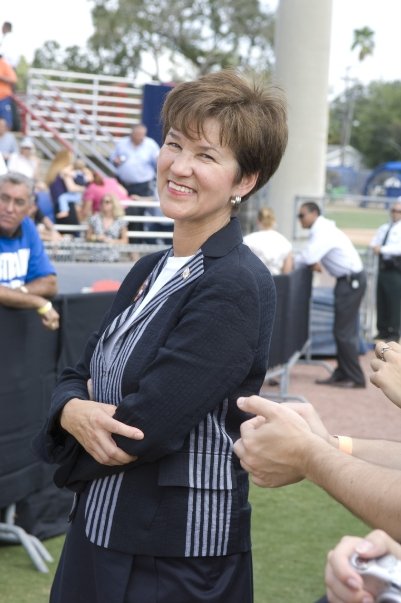
FL-Sen, FL-Gov: Sink to Announce Decision “Soon”

Florida Chief Financial Officer Alex Sink, who is perhaps the strongest candidate Democrats currently have on their statewide bench (and the only one aside from Bill Nelson currently elected statewide), says the she’ll be making a decision shortly on her political future. From the St. Petersburg Times:

On the subject of politics, Sink promised a decision soon on her political future which could include running for the U.S. Senate seat held by Republican Mel Martinez in 2010, running for governor, or staying put, and perhaps preparing for a run for governor in 2014 when the office will be open.

“I’m going to make up my mind very soon,” Sink said. “It’s all about what’s best for me, and what’s best for the state.”

As for Martinez himself, The Hill notes that he hasn’t announced his intentions for 2010 (he will do so in January). While it may be unlikely, it wouldn’t totally shock me if Martinez decided not to run for another term.

Menendez Takes Over DSCC

To no one’s surprise, Harry Reid has named Bob Menendez to take over stewardship of the DSCC in the wake of Chuck Schumer’s departure. Menendez certainly has a tough act to follow after Schumer’s 13 big wins over the past two cycles, but there are a lot of good opportunities on the table in 2010 that could make it a good year for Bob (and us). Let’s wish him luck.

The DSCC’s full press release is available below (and under the flip):

REID NAMES MENENDEZ DSCC CHAIRMAN FOR 2010 CYCLE

Senate Majority Leader Harry Reid today named U.S. Senator Robert Menendez of New Jersey the chairman of the Democratic Senatorial Campaign Committee for the 2010 election cycle.  Menendez will take over the DSCC from Senator Charles Schumer, who led the committee during the last two election cycles.

Senator Reid said: “As an aggressive, focused and committed Democrat and a widely respected Senator, Bob Menendez will be a superb leader of the Democratic Senatorial Campaign Committee.  Our Caucus will be well-served by Bob Menendez, whose mastery of policy is matched only by his mastery of politics.  He was a leader in the House, rising to become the third-ranking Democrat there; has already established himself as a leader in the Senate; and will continue to lead us in protecting our incumbents and electing new Democrats in the future. I thank Sen. Schumer for his four years of leadership.  Because of his efforts, Democrats have expanded our majority to its largest in 30 years.  I am confident that Sen. Menendez will build upon this success.”

Senator Menendez said: “I am humbled by this opportunity, and I fully recognize the responsibility that comes with it. In 2006 and again this year, under the masterful stewardship of Senator Schumer, we have made major gains toward bringing change to our country. We face historic challenges and must continue to move in that new direction. I intend to make sure that we build upon the majority in Senate that allows us to affect the change we need. I want to thank Majority Leader Reid for his terrific leadership and for entrusting me with this position.”

Senator Schumer said: “I want to thank Senator Reid and all of my Democratic colleagues for making the past four years such a success.  Bob Menendez is a great choice.  We worked closely together the past two years, and I am confident he will do a fabulous job.”

Menendez served as vice chairman of the DSCC for the past two years.  He was appointed to the Senate in January 2006 to fill the remainder of Governor Jon Corzine’s term and was elected to a full term in November of that year.  He was elected to the House of Representatives in 1992 and elected by his colleagues as chairman of the House Democratic Caucus in 2002, making him the highest ranking Hispanic in Congressional history.  With today’s appointment he becomes the first Hispanic in history to lead a Senate or House campaign committee.

Alex Sink Seeking the Senate in Florida?

Cross posted at draftalex.com.

It’s pretty obvious that people are hoping that Alex Sink tosses her hat in the ring or higher office. The question we hope she’s facing right now is which one: Senate or Guvna?

There are perhaps a few too many calls for Alex Sink to be our Senate nominee.  This morning, Blast Off! even called for her to run for Senate and forget about the governor’s mansion.

n689468099_962883_7922At Draft Alex Sink for Governor the bias is pretty obvious. But, think for a second about why running for Senate wouldn’t be as good as a move.

First, just in terms of personality and experience, Alex is perfectly suited to be governor. She’s been an executive- and that’s what a governor theoretically does (just don’t look to Charlie for an example). Dan Gelber, Bob Wexler, Allen Boyd- these men are legislators- damn good ones, if I may. Their skills and interests fit the profile of a Senator more than Alex’s do.

There is a crowded bench already. Alex would have to compete with the likes of Dan Gelber and Chris Korge, maybe Allen Boyd, or even Bob Wexler. Those are some serious players, who could all represent the state well and some will run if she gets in or not. Alex could win the primary and the general, but why go for Senate to when the bench is already so deep, so good.

Winning the senate seat back is going to be tougher than we imagine. Sure, it looks a lot easier than beating Charlie does, but we’re two years out from the election- things change. Charlie should start to look more like a do-nothing, and Mel Martinez might decide to gracefully bow out, leaving the Republicans to nominate someone who could give us more of a challenge. In short, get excited about another Democratic senator, but don’t bet money on it just yet.

While there’s a crowded bench for Senate, there is literally no bench for governor- outside Alex Sink. If Democrats want to stop losing the state, then we can’t cede races like the 2010 gubernatorial. We need to not only nominate a candidate, but we need to nominate a good one. Right now, no other Democrat is really dipping the proverbial toe in the water- no one, not even Rod Smith.

And, there’s my peace.

NH-02: North of Nashua: Paul Hodes by the Numbers

(From the diaries – promoted by James L.)

I confess it – this was more challenging for me to put together than my earlier piece on Carol Shea-Porter, because in comparing the Charlie Bass (R-inc) – Paul Hodes (D) race of 2006 to the Paul Hodes (D-inc) – Jennifer Horn (R) race of 2008, the numbers tell you over and over again that the two are not really comparable.  Very much apples and oranges.

There are a number of reasons for this.  For starters, Charlie Bass held on to a district for six terms that showed less and less opportunity for the GOP every year, especially given the radicalism of the Bush brand in the final six of them. So the absence of a Bass incumbency factor gave us he opportunity to see the district more as it may actually be. Secondly, freshman class president Paul Hodes has proven to be, unlike the BassMaster, something of a leader in Congress, and has paid excellent attention to the needs of his district.  Third, he’s a capable fundraiser.  And finally, in Jennifer S. Horn-Palin, the GOP chose a standard-bearer who could not be more out-of-touch with CD2.  But let’s listen to what the numbers are saying.


(More below the fold…)

First, the list of towns that flipped from Charlie Bass in ’06 to Paul Hodes in ’08 is – happily – so long it’s not useful even listing, imho.  But just for the record, the total number is forty-five.  And the most important ones, in voter-rich terms, are accounted for in the tables below.

Jennifer Horn, on the other hand, flipped one whole town:  Millsfield. Total votes cast? 15.

Due to the larger number of towns in CD2 v. CD1, and the convincing victory Hodes had (and leaving aside cities with wards for a moment), I thought it would be both more readable and more useful to focus first on those towns with greater than 2000 votes cast for the general election cycle. As in my earlier post on CSP, the following list represents those populous towns where Paul Hodes raised his vote percentage from ’06 to ’08 by three percentage points or more.  The table also lists total votes cast, and Hodes’ 2008 vote percentage, the color of which declares who won that town (blue for Hodes, red for Horn):

Town ’08 Hodes % ’06-’08 +/-% Diff. Total Votes Cast
Littleton* 57.7% +16.5% 2699
Newport 59.4% +9.8% 2845
Plymouth 67.8% +8.4% 3457
Northfield* 53.9% +8.0% 2204
Hillsborough 56.9% +7.5% 2743
Epsom* 51.3% +7.1% 2397
Pembroke 56.7% +7.0% 3580
Loudon* 51.8% +6.2% 2742
Weare* 48.7% +5.4% 4447
New Boston 45.04% +5.2% 2982
Jaffrey 56.8% +5.1% 2766
Charlestown 63.2% +4.9% 2475
New London* 54.2% +4.9% 2788
Bow* 53.4% +4.9% 4645
Allenstown 57.3% +4.8% 2064
Henniker 59.8% +4.7% 2405
Enfield 64.6% +4.6% 2333
Pelham 46.0% +4.3% 6310
Walpole 61.0% +4.3% 2143
Hopkinton 60.6% +4.1% 3744
Litchfield 45.0% +3.7% 4252
Hudson* 49.1% +3.3% 11,332

* Flipped to Hodes in 2008.

Now, the next step would be to do the same for those towns of over 2000 votes cast where Paul’s vote percentage decreased by three points or more.  The (happy) problem with that?  There’s only one town that fits the bill, Brookline. With 2,706 votes cast, Hodes won 41.8% of the vote, a decrease of 4.5% from 2006.  And I’ll be generous: neighboring Boston-commute southern tier town Hollis gets honorary mention with a Hodes decrease of 2.9% from the last cycle.

Finally, let’s have a look at how Paul fared from 2006 to 2008 in the major cities of the second district:

City ’08 Hodes % ’06-’08 +/-% Diff. Total Votes Cast
Berlin 73.0% +13.0% 4179
Claremont 64.2% +6.7% 5470
Concord 65.6% +5.2% 21,128
Franklin 58.2% +8.9% 3587
Keene 70.2% +3.4% 12,263
Lebanon 68.1% +3.4% 6455
Nashua 55.3% +0.2% 37,995


So. What observations, if any, come from these numbers, aside from the obvious points above about the lopsided nature of this race compared to 2006?

* Check out Littleton, Plymouth, and Berlin on those charts.  Huge increases for all three. North Country Yankee natives are Democrats now.

* The Upper Valley continues to be a dominant – and growing – sector for Democrats.  Not on the chart, and populous enough to have its own wards, Hanover gave Hodes 78.7% of its vote with 6,912 votes cast.

* From the long litany and diverse nature of flipped towns such as Grafton, New London, Milford, Colebrook, and Boscawen, you can feel the grip of the GOP’s too-long grip on CD2 slipping away, perhaps for a good long time. The six term backbencher BassMaster really did hold on to half of New Hampshire longer than was ultimately viable.

* Here’s the biggest surprise of all for me from these numbers.  Take a look at the percent increases for the larger towns, and for all the cities.  What stands out? Nashua.  It didn’t budge.

But guess what else?  With all due respect to the good Granite Staters of Nashua, it didn’t much matter, either.  Despite being by far the most populous city in the district, it simply isn’t enough to focus on Nashua and hope it spreads outwards.  In this sense, NHGOP Chair Fergus Cullen, imho, made a critical tactical mistake in throwing his heft behind Horn (if the rumors and spin are to be believed).  A far-right, socially conservative talk radio show host from the southern tier was not going to cut it with the rest of the district’s demographics. Far better it would have been to have had Bob Clegg as the nominee, if of course Clegg showed himself to be a better candidate (he didn’t), or perhaps the more moderate, Concord area primary spoiler Jim Steiner, if he could have shown a better fundraising presence.

The long and the short of it, though, is that if the GOP ever wants a chance at CD2 again, they’re going to have to stop going to the Massachusetts tax refugee well like flies to honey. They will need to field someone much more moderate.  And someone who understands rural and agricultural issues, alternative energy concerns, the importance of the North Country, and the newly dominant progressive voter in the Upper Valley.

Too bad Paul owns all those areas.  It’s a good day to be a Democrat.
Schumer Calls it a Day

The AP:

Sen. Charles Schumer said Monday he is giving up his job running the Senate Democrats’ national campaign efforts after two successful elections.

“We’ve had a great run,” said Schumer, chairman of the Democratic Senatorial Campaign Committee since the 2006 campaign, when he helped engineer a 6-seat gain that gave his party a slim 1-vote majority margin.

Chuck had one hell of a run, and it’s a shame to see him go. It looks like New Jersey’s Bob Menendez, a current DSCC vice-chair, will likely take over the reins. Let’s hope he can make some inspired recruiting moves like Chuck was able to do on more than one occasion.