(cross-posted at WMR, ML, BFM, and SSP-pb)
Following my earlier analysis of the 2009 Compliance Statements from the Michigan State House, the State Senate is also worth examining. It is important to remember how wide open the Senate is for turnover in 2010, as there are 30 of 38 State Senate seats open. In the past decade, only one state senate incumbent has lost to a challenger (Laura Toy to Glenn Anderson in 2006), underscoring how much easier open seats are to capture.
http://i303.photobucket.com/al…
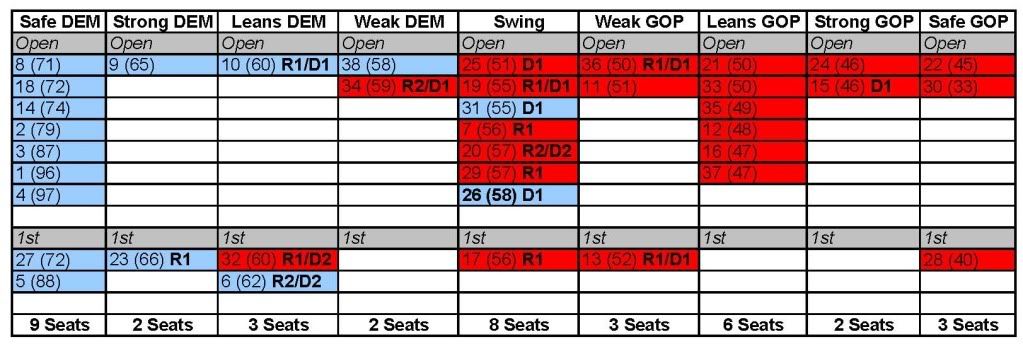
Figure 1: State Senate Partisan Status
Figure 1 is a chart displaying the expected competitiveness for Michigan State Senate races. Using the underlying baseline vote from the Michigan Board of Education races over the past four elections (2002-2008), I have also noted the number of times each party has challenged a seat. For example, in Senate District 34, the Democrats have invested party resources in the seat one time, while the GOP has invested in it twice. It quickly becomes apparent that rarely spends money defending or challenging seats in their Safe or Strong category or that of the opposing party.
For an upset occur in these races means that the challenger needs to be self-financing, as the party will pay for nothing. Given the sheer number of competitive races in 2010, I have also included districts that have a GOP lean in the safe category, bringing the number of safe Republican seats up to 11. For the Democrats, I have included one of the three leaning Democratic districts (District 10) in the safe column, bringing the number of safe Democratic seats to 12 (more on this later). Thus, this analysis consists of two parts. The first looks at the 23 safe Republican and Democratic seats that feature an array of interesting primaries. The second part will focus on the 15 districts that are considered tossup, weak Democratic/Republican. Candidates are listed with the amount of money raised in the past year, the amount on money spent over 2009, the total cash on hand, and the amount of personal funds each candidate given to his or her campaign.
http://i303.photobucket.com/al…
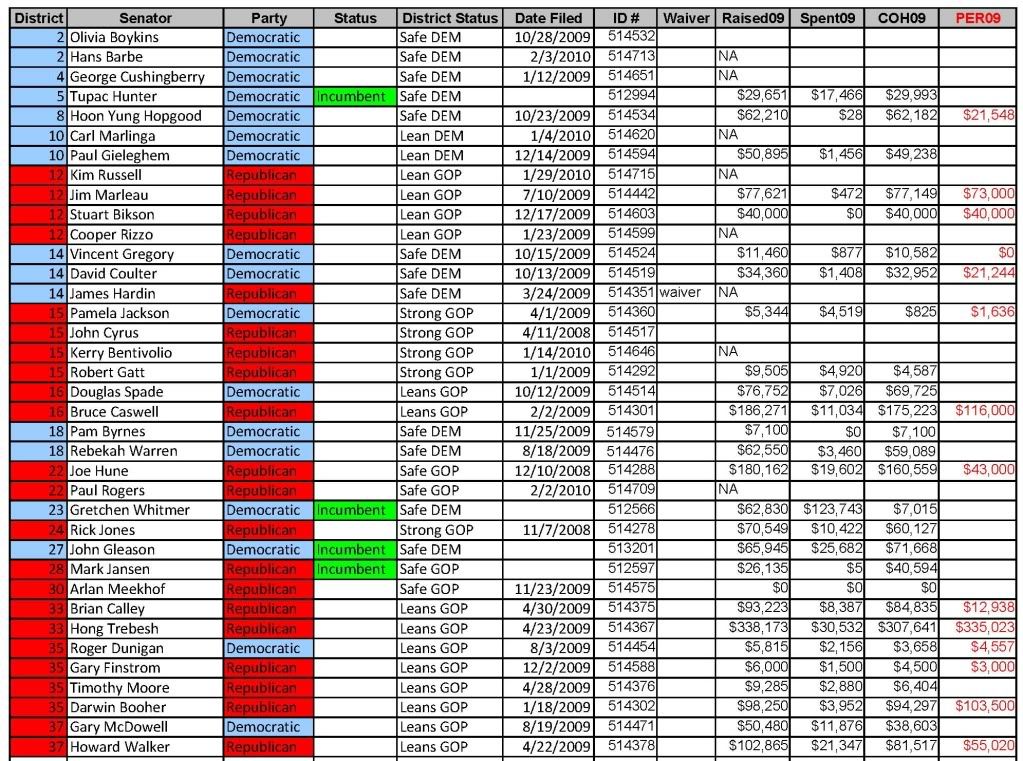
Figure 2: Safe DEM/GOP Seats
There are 12 safe Democratic seats that will return Democrats to Lansing next year. These are largely concentrated in Detroit (Districts 1, 2, 3, 4, and 5), Wayne County (District 8), southern Oakland and Macomb Counties (District 9, 10, and 14), Ann Arbor (District 18), Lansing (District 23), and Flint (District 27). Of these seats, Districts 5 (Tupac Hunter), 23 (Gretchen Whitmer), and 27 (John Gleason) have incumbents that are not are not expected to face a serious primary challenge. The other nine districts are open seats and are another story. District 2 has Olivia Boykins and Hans Barbe vying for the nomination, and neither have filed a CS yet. Representative George Cushingberry has filed for District 4 and presently does not have primary opposition. Former Representative Hoon Yung Hopgood ($62,182 cash on hand) is the only candidate in the 8th District (Dearborn and downriver municipalities in Wayne County). District 10 (Sterling Heights, Clinton Township, Utica, and Roseville) features a primary between former Macomb County Prosecutor Carl Marlinga and Macomb County Commissioner Paul Gieleghem ($49,238 cash on hand), and the former is expect to have a significant financial edge. Vincent Gregory ($10,582 cash on hand) and David Coulter ($32,952 cash on hand) are the two Democrats seeking the party’s nomination in the 14th District, while their potential Republican opponent James Hardin has filed a financial wavier, ensuring his defeat in November. Finally, in the 18th District, Representatives Pam Byrnes (7,100 cash on hand, although she has $104,133 in her State House account) and Rebekah Warren ($59,089 cash on hand with an additional $2,120 in her State House account) will slug it out Washtenaw County. This race should be extremely interesting to watch, and could be an excellent proxy test on the fate of Andy Dillon’s candidacy with the Democratic electorate (Byrnes is one of Dillon’s strongest supporters in the House, and Warren is an extremely harsh critic).
There are 11 safe Republican seats that will have Republicans Senators next year. These are largely located in the “out-state” region outside of metropolitan Detroit (Districts 16, 21, 22, 24, 28, 30, 33, 35, and 37) and in northern Oakland County (Districts 12 and 15). Only one of these seats (District 28-Mark Jansen) has a Republican incumbent. District 12 has four Republicans running to replace Mike Bishop, and thus far Representative Jim Marleau is the leading money raiser, with $77,149 cash on hand (although $73,000 is from his own pocket). In District 15 there are three Republicans running for the nomination, and Robert Gatt is the only candidate who has raised funds ($4,587 cash on hand), while Democratic candidate Pamela Jackson has $829 cash on hand. Republican Representative John Proos is running unopposed in the 21st District ($91,439 cash on hand), and in District 22 Joe Hune leads the money race ($160,559 cash on hand) against Paul Rogers. Representative Rick Jones ($60,127 cash on hand) is the only candidate in the 24th District, and Arlan Meekhof ($0 cash on hand, although has $29,600 in his State House account) is the only candidate in the 30th. District 33 features a primary between Representative Brian Calley ($84,835) and businessman Hong Trebesh ($307,641 cash on hand, with $335,023 from his own pockets) that will be costly to say the least, while District 35 has three Republicans slugging it out to face Democratic candidate Roger Dunigan ($3,658).
There are two traditional Republican seats that could cause the GOP some trouble in 2010. The first is in District 16 where Democratic Representative Douglas Spade ($69,725 cash on hand) is running against Republican Representative Bruce Caswell ($175,223 cash on hand-$116,000 from his own pocket). Spade has done well in a Republican leaning district while serving in the House (District 57), and is the strongest candidate the Democrats could nominate in a seat that has seen few challenges. Likewise, in District 37 Democratic Representative Gary McDowell ($38,603 cash on hand and an additional $95,219 in his State House account) has more money than his opponent Republican Representative Howard Walker ($81,517). While the 37th District has a long-standing GOP lean, McDowell has had similar success that Spade has had in the 57th, winning a traditionally GOP district (District 107) with room to spare. Both of these seats are examples of a smart Democratic strategy to expand the playing field.
http://i303.photobucket.com/al…
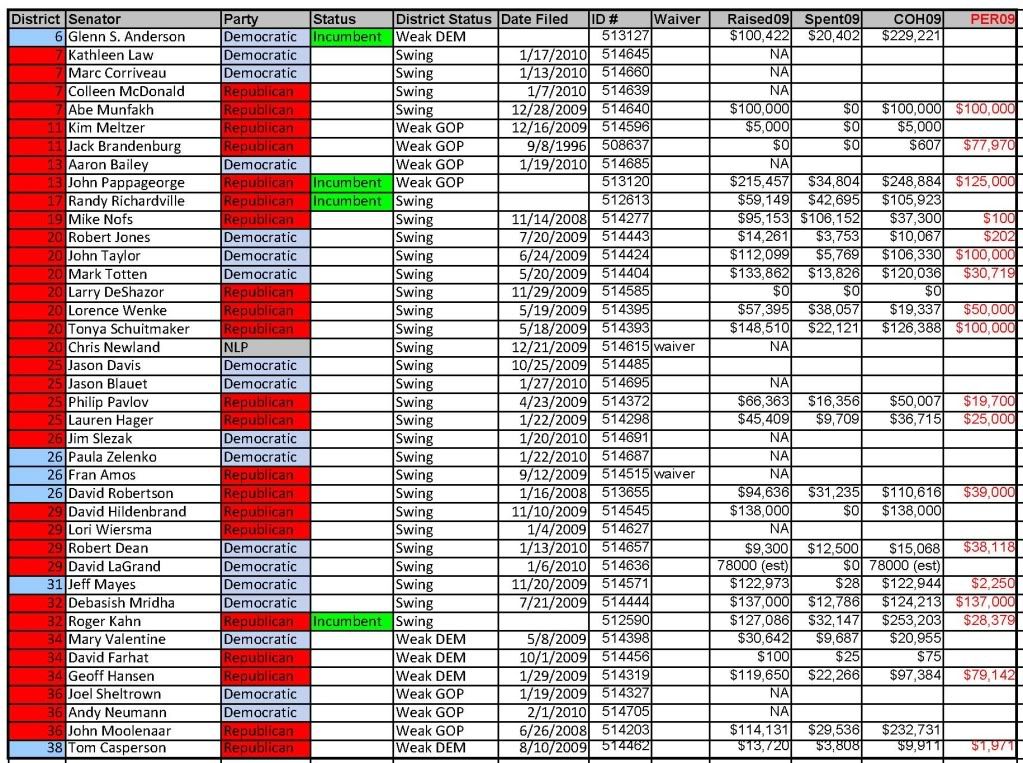
Figure 3: Weak & Swing Seats
Of the remaining 15 seats, 4 are weak Democratic seats, meaning that with the right candidate, the party will likely not need to step in with resources. Two of these are currently held by Democrats, with Districts 6 (Wayne County) represented by incumbent Glenn Anderson, who knocked off Republican Senator Laura Toy in a hard-fought matchup in 2006. Anderson spent 2009 accumulating funds, and currently has $229,221 cash on hand with no Republican challenger in sight. With such a well-funded incumbent and no viable GOP prospect, it is unlikely that the GOP will make a serious effort to challenge Anderson in 2010. A different situation prevails in District 38 (Upper Peninsula), which is being vacated by term-limited Democratic Senator Mike Prusi. The 38th has a long Democratic heritage and a deep farm-system with talent ready to move up, and expect the state party to make holding this seat a priority. The Republicans have perhaps their strongest Upper Peninsula challenger in years with former Representative Tom Casperson running for this seat. Yet Casperson is relatively weak at fundraising, with debt left over from his failed challenge to Bart Stupak in 2008 for the 1st Congressional District, and only has $9,911 cash on hand. To make this seat a possible pickup, the GOP will have to make a significant financial contribution, something unlikely given all the other seats the party needs to hold.
In a sign of Democratic failure in the 2006 election, two other weak Democratic seats are currently held by the GOP. District 34 (Muskegon County & Lakeshore) is an open seat, with the Republican Jerry VanWoerkom term-limited after two closely fought elections in 2002 and 2006 that were each one by fewer than 1,500 votes. While VanWoerkom had electoral success in this district, over the past decade this seat had strongly trended Democratic. The Democrats also have a candidate in Representative Mary Valentine ($20,955 cash on hand, with another $24,982 in her State House account) who has a reputation for running excellent campaigns in 2006 and 2008 in the swing 91st District. Valentine will face either former Representative David Farhat (whom was beaten by Valentine in 2006 and has $75 cash on hand) or Representative Geoff Hansen ($97,384 cash on hand including a personal loan of almost $80,000). Regardless of candidate, both parties will likely spend an ample amount of money for this seat, and in an even financial contest, I would pick Valentine any day.
The other weak Democratic seat held by the GOP is a tougher nut to crack. Incumbent Republican Roger Kahn won District 32 (Saginaw County) in 2006 by a narrow margin. Kahn currently has $253,203 cash on hand, and is a strong fundraiser who will likely be able to raise even more funds in 2009. The only declared Democratic candidate is Debasish Mridha, who is a doctor and a first-time candidate. Mridha has $124,213 cash on hand, all which was self-contributed. Given that District 32 is represented by a Republican incumbent, the state party might be reluctant to provide funding unless Mridha appears to be in the running after the August primary. Given this, I would say that District 34 is a much more likely Democratic pickup than the 32nd.
Three of the remaining eleven seats are weak Republican, meaning that with the right sort of candidate and a neutral political environment, the GOP candidate will win election. These include District 11 (northern Macomb County), District 13 (Oakland County-incumbent), and District 36 (northern Lower Peninsula). District 11 has attracted a number of GOP candidates, including State Representative Kim Meltzer ($5,000 cash on hand with another $4,625 in her State House account), former Representative Jack Brandenburg ($607), and Leon Drolet (who has not officially filed yet). Given the Republican lean of this district, and that no strong Democratic candidate has emerged, this seat is looking to be a Republican hold unless the divisive Drolet wins the primary. District 13, which was the site of a hard fought battle between Democrat Andy Levin and eventual winner John Pappageorge that was narrowly decided in the GOP’s favor. Pappageorge raised an enormous amount in 2009, and has $248,884 cash on hand (as well as a $125,000 loan he gave to himself in the 2006 campaign). Aaron Bailey is the only official Democratic candidate, and filed in late January 2010. Given his substantial financial edge in a Republican leaning district, Pappageorge should be considered an early favorite to win reelection.
District 36 is perhaps the most vulnerable to a Democratic challenge. An open seat being vacated by term-limited Republican Tony Stamas, the 36th has attracted three candidates. Two are Democrats, Representatives Andy Neumann and Joel Sheltrown. Sheltrown has a substantial financial edge against Neumann, although the latter previously ran and narrowly lost against Stamas in 2002. Republican Representative John Moolenaar has a substantial $232,731 cash on hand, but hails from the southernmost portion of the district, thus requiring a significant amount of campaigning and funds to familiarize himself with the 36th. If the Democratic candidate emerges from the primary in decent condition, one could easily see the state party spending funds to win this seat.
The remaining eight seats are swing districts, although two are likely to remain in the GOP column. District 17 (Monroe and portions of Washtenaw Counties) is currently held by Republican Randy Richardville ($105,923 cash on hand). Unless Democratic Representative Katie Elbi leaves her safe house seat to challenge Richardville, there are few other potential Democratic challengers. The MDP and Elbi might consider a redrawn 17th District might be easier to take in 2014 when Richardville is unable to run again. Another likely Republican hold is District 19, which was won by Mike Nofs in a 2009 special election against Democratic Representative Marty Griffin. Given Nofs’ thumping of Griffin, few potential Democratic challengers will be interested in facing Nofs ($37,300 cash on hand just months after his November election).
The six other seats are open districts, with two currently held by Democrats, and the remaining four by Republicans. Of the two seats currently held by Democrats, District 31 (Bay County and the Thumb Region) appears to be a more likely hold, with Democratic Representative Jeff Mayes ($122,944 cash on hand) having no Republican challengers as of yet. The situation in District 26 (Genesee and Oakland Counties) is more fluid. There are currently two candidates, Representative Jim Slezak and Paula Zelenko, facing off in the Democratic primary, while former representatives Fran Amos and David Robertson in the GOP primary. Of the four candidates only Robertson has a significant amount of cash on hand ($110,616), while Amos has filed a financial waiver, and both Slezak and Zelenko entered the race in early 2010 (although Slezak has $11,304 cash on hand in his State House account). Robertson has a history of winning tough races while in the state house, and will be a challenge for the Democrats to hold off. Expect the MDP to spend funds to hold this district.
Of the four Republican held seats, District 25 (St. Clair and Lapeer Counties) appears to be the safest hold for the GOP. Representatives Phillip Pavlov ($50,007 cash on hand) and Lauren Harger ($36,715 cash on hand) are vying for the GOP nomination, while Jason Davis and Jason Blauet are relatively unknowns battling for the Democratic nod. The 25th has always been a tempter of Democratic dollars, but funds spent in 2002 did very little.
The remaining three seats are truly tossup. District 7 (western Wayne County) is be vacated by Republican Bruce Patterson, and has drawn the attention of both parties. Democrats scored a coup when Representative Marc Corriveau entered the race in early January. Corriveau, much like Valentine, is a master campaigner and has one in districts long held by the GOP, and his strong fundraising abilities will surely be needed in both the general and primary elections. Corriveau ($76,314 cash on hand) is facing former Representative Kathleen Law in the Democratic primary. Facing Corriveau or Law in the general election will be either Republican Colleen McDonald or Abe Munfakh ($100,000 cash on hand and a personal contribution). If the GOP wants to hold this Democratic trending district, they’ll need to send plenty of additional funds to assist the winner of the GOP primary.
District 20 (Kalamazoo County and portions of Van Buren County) has contested primaries on both sides. The Republican primary features three candidates; Representatives Tonya Schuitmaker ($126,388 cash on hand) and Larry DeShazor ($2,341 in his state house account) represent the conservative and moderate factions of the GOP base, while former Representative Lorence Wenke ($19,337) is a liberal Republican who has deep personal pockets and is willing to spend freely in the primary. The clash between these three Republicans representing the spectrum of the Republican ideology will be fascinating to watch. That is to say, the Democratic field will be interesting to watch as well. Representative Robert Jones ($10,067 cash on hand with another $14,656 in his State House account) currently represents Kalamazoo City, and has a deep background in local and state politics. He’ll face Kalamazoo County Commissioner John Taylor ($106,330 cash on hand, although $100,000 is from his own funds) and Professor Mark Totten ($120,036 cash on hand, $30,719 of which is a personal loan) in the Democratic primary. While Jones was considered a front-runner earlier this year, Totten’s substantial haul (with a large number of donations coming from small donors across the state in addition to out of state support) has put many on notice. With 2010 shaping up to be an anti-incumbent year, it may be a candidate like Totten that will do better with the electorate than Jones. Regardless, both parties will be watching the 20th District in the next nine months.
District 29 (Grand Rapids and eastern suburbs) will be another closely watched seat. I’ve blogged about this race and the potential candidates previously, and I’m still convinced that the race to watch is the GOP primary. While Representative Dave Hildenbrand has $138,000 cash on hand, he is relatively unknown to voters in the Grand Rapids and Kentwood, as he represents Lowell and other rural portions of Kent County. Kent County GOP leaders appear to be aware of this liability as well, and a number of leading Republicans (including Senator Mark Jansen and Congressman Vern Ehlers) are considered to be behind the candidacy of Lori Wiersma. Wiersma is a political neophyte, but has deep ties to the Christian Reformed community that has long been the bedrock of the GOP base in west Michigan. If both candidates stay in the primary, it will be interesting to see if Hildenbrand’s financial edge can win victory against a city-based Republican candidate. On the Democratic side, businessman and City Commissioner David LaGrand (estimated $76,000 cash on hand) begun rolling in endorsements and funds only a few weeks after his entrance into the race. While Representative Robert Dean is also considering running, his weak fundraising totals ($9,033 cash on hand) is leading many to question whether he will instead file run for reelection to his state house seat.
With nine months away from Election Day, control of the Michigan State Senate as of January 2011 remains an open question. The Democrats need to pick up four seats to gain control of the chamber for the first time in 26 years, and there is a clear road to achieving this. At the same time, the GOP has a political climate that is much more favorable than the 2006 cycle. Whether this remains the case in November 2010 is still to be seen.
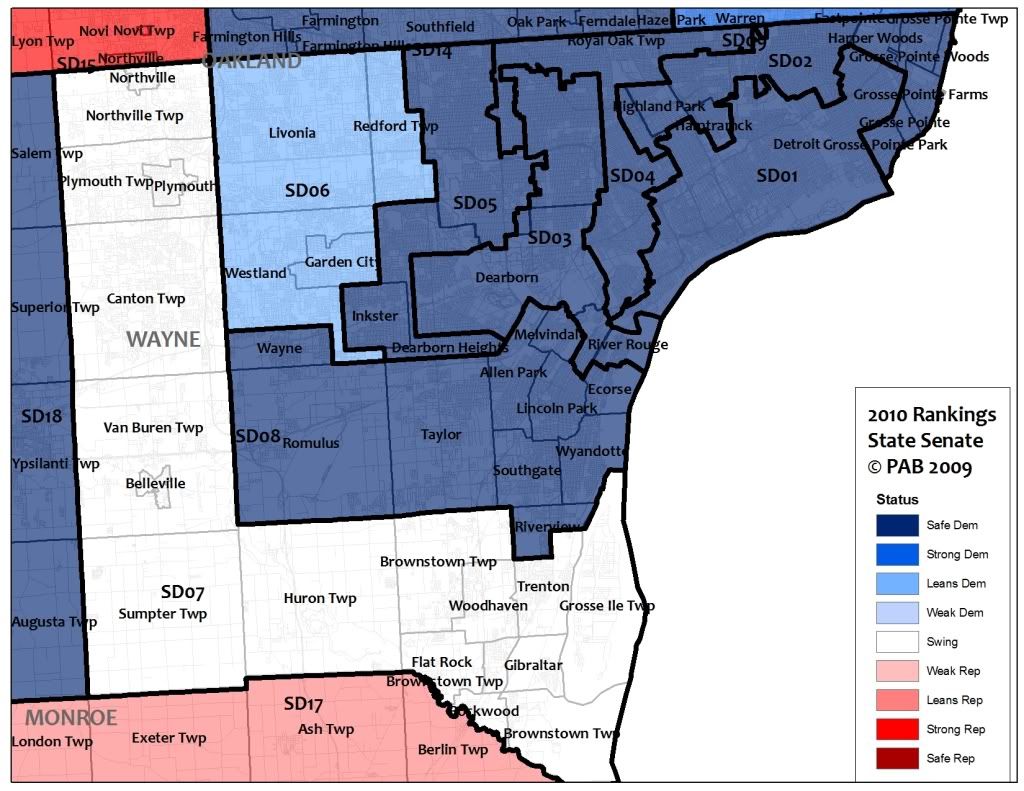
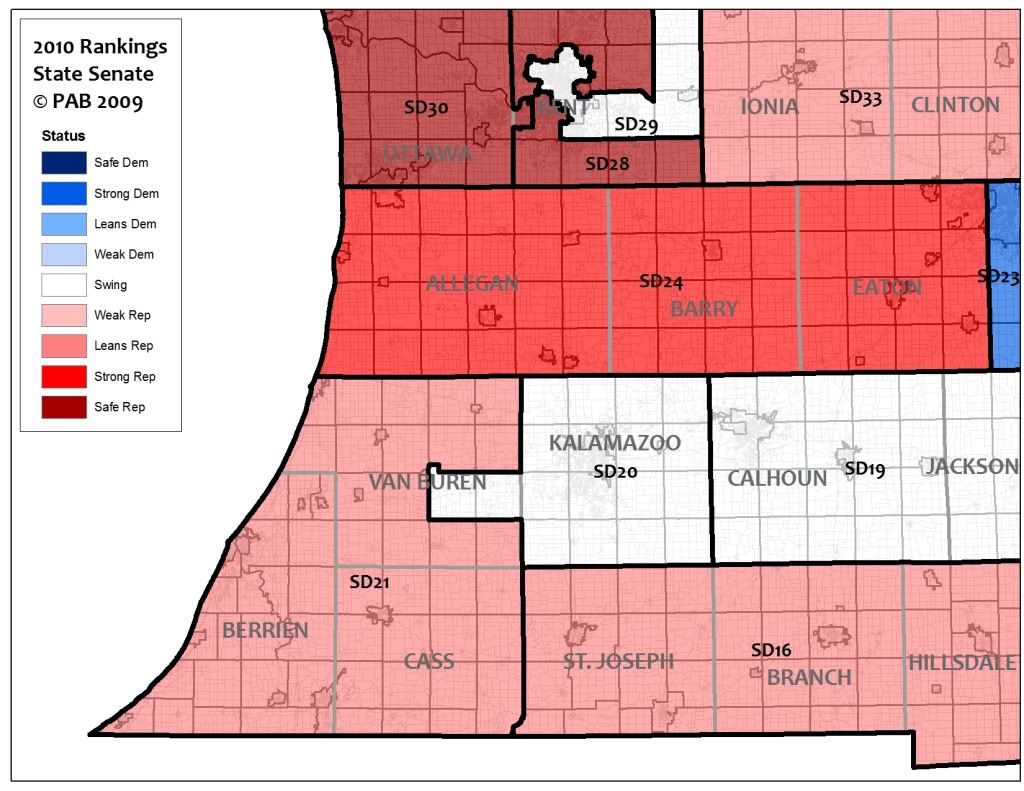
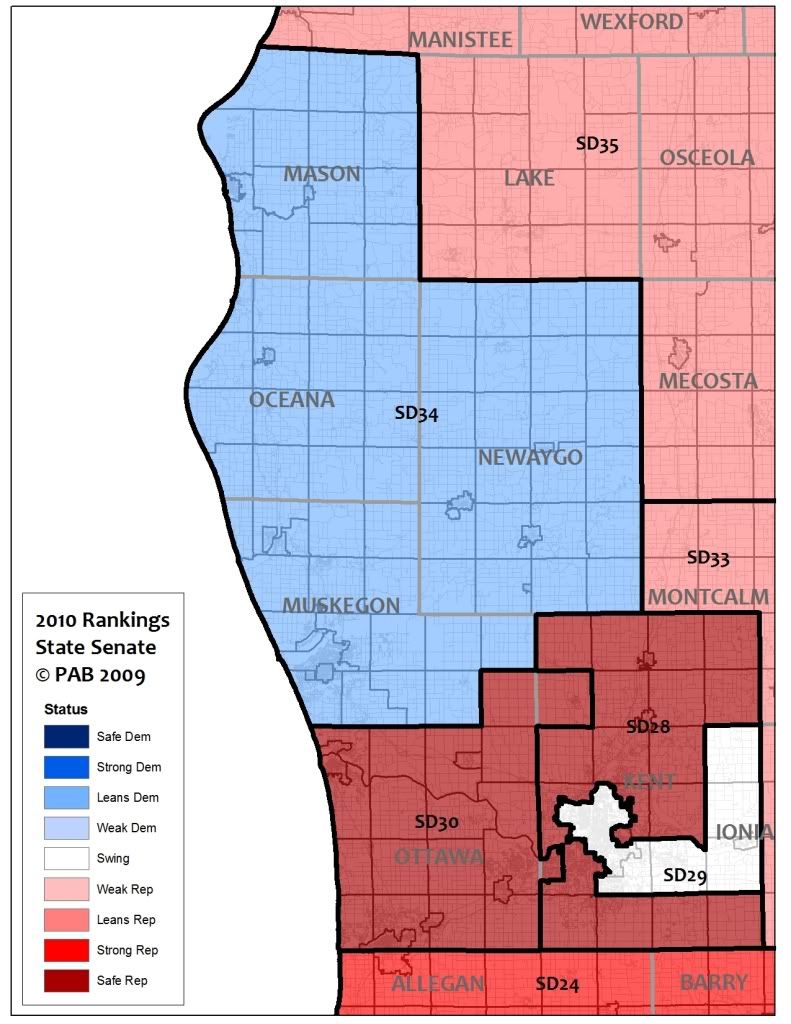
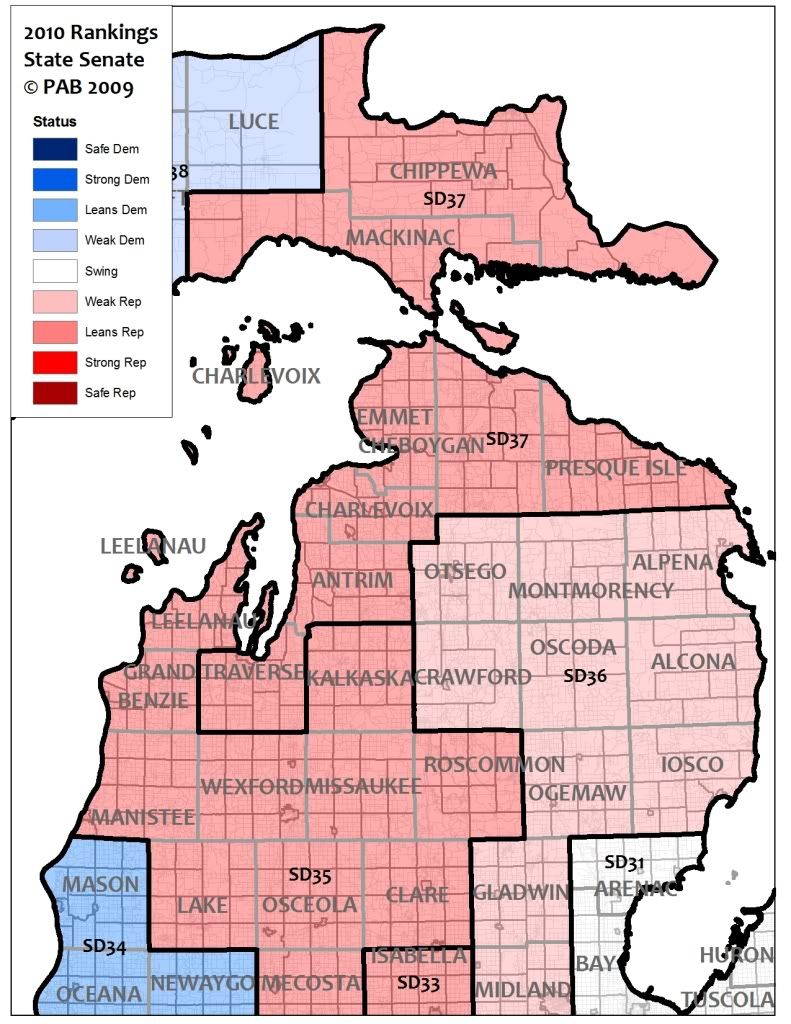
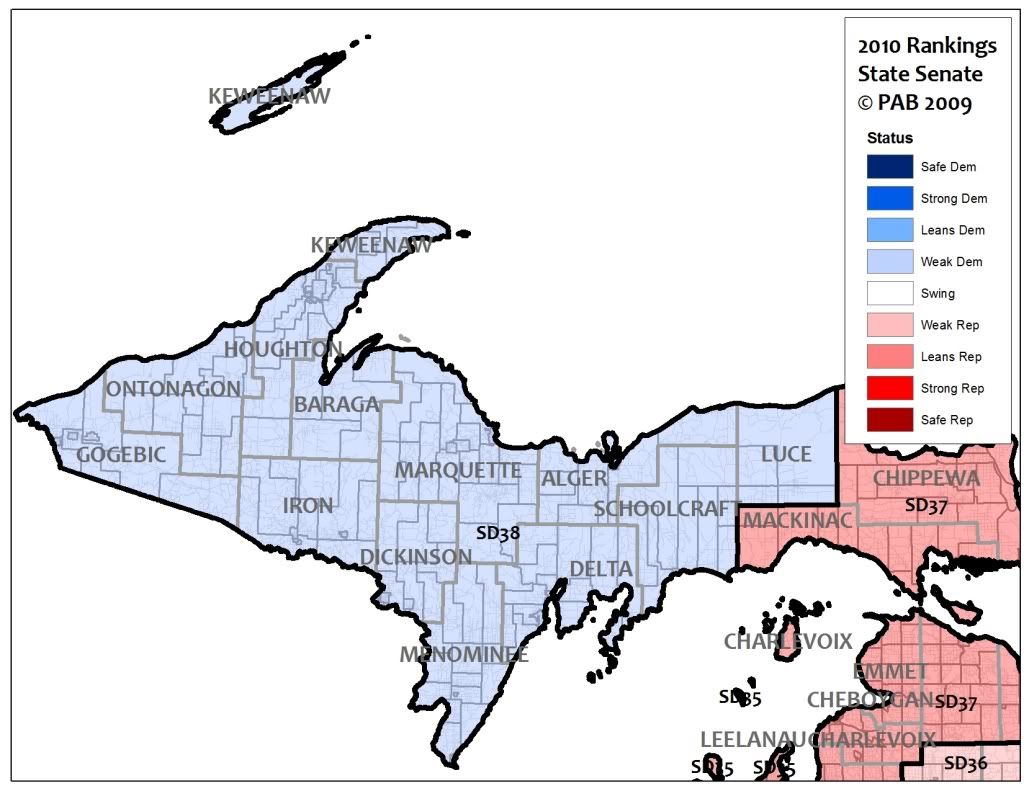
For reference, I have included some maps of the State Senate Districts discussed in this analysis.
http://i303.photobucket.com/al…
Wayne County
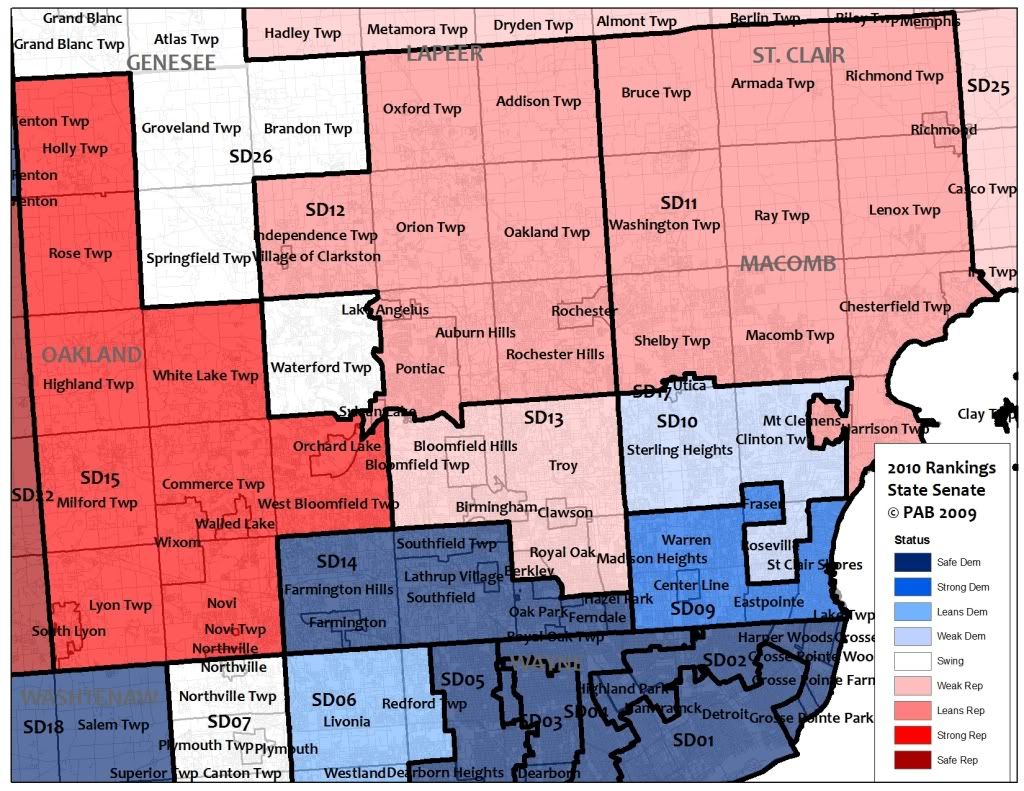
http://i303.photobucket.com/al…
Oakland & Macomb Counties
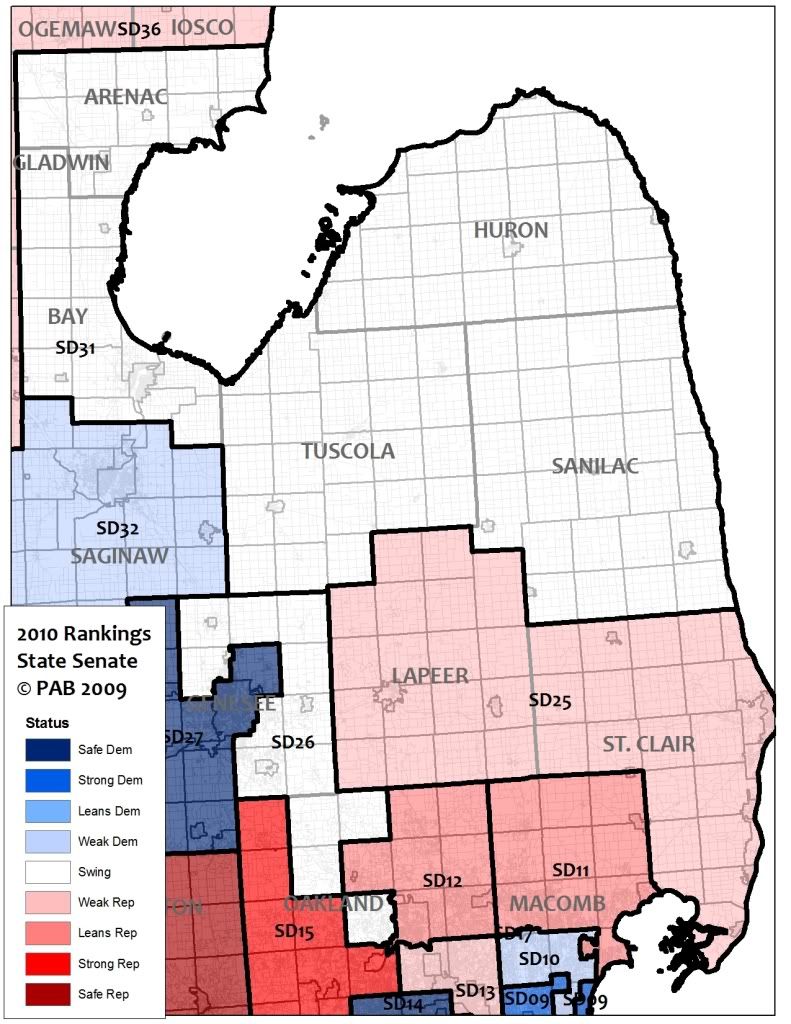
http://i303.photobucket.com/al…
The Thumb
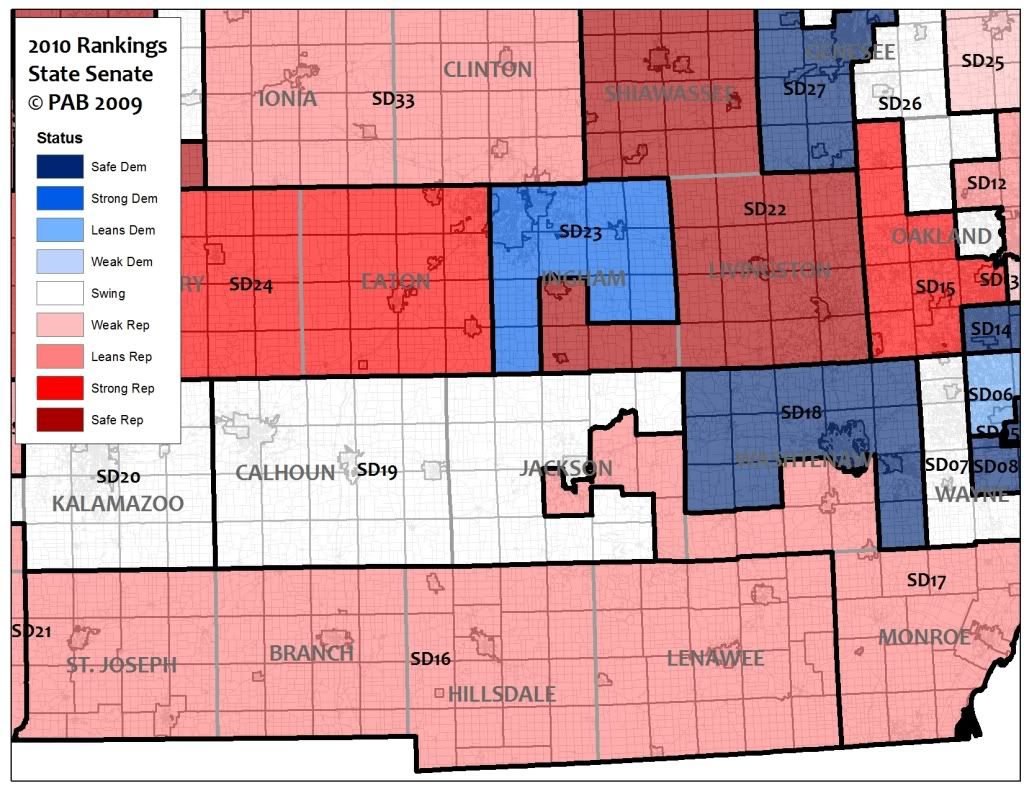
http://i303.photobucket.com/al…
South Central
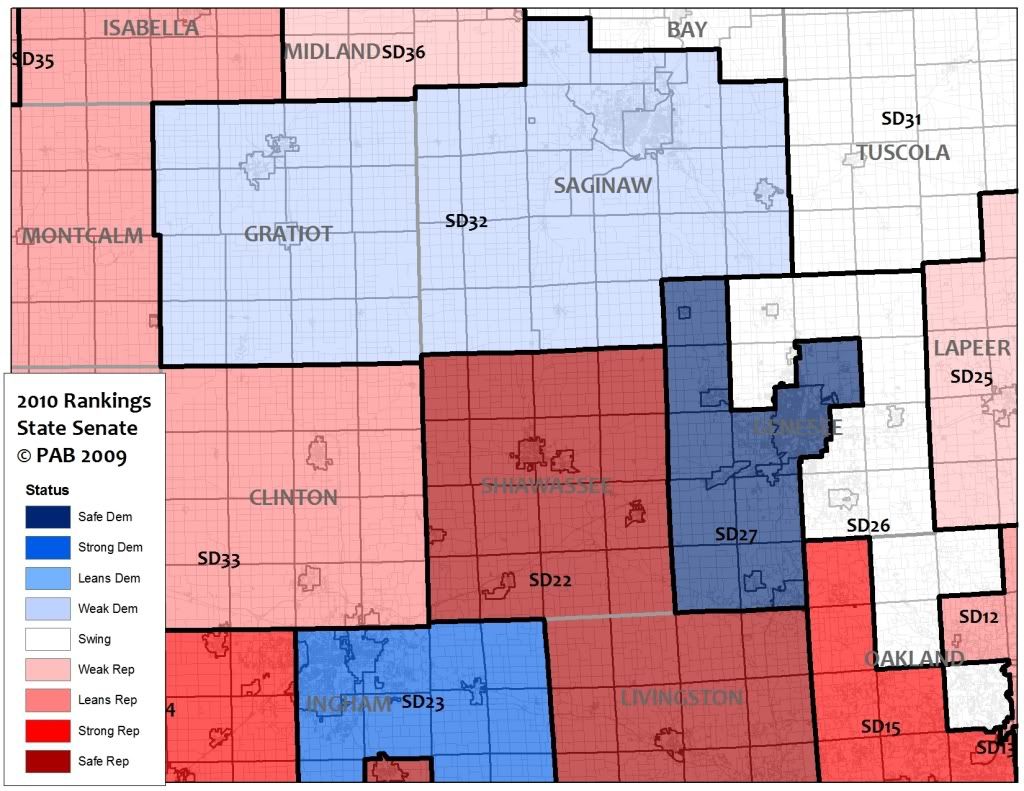
http://i303.photobucket.com/al…
North Central
http://i303.photobucket.com/al…
Southwest Michigan
http://i303.photobucket.com/al…
West Michigan
http://i303.photobucket.com/al…
Northern Lower Peninsula
http://i303.photobucket.com/al…
Upper Peninsula