Weekly Open Thread: What Races Are You Interested In?

UPDATE (David): Check it out – every time you use bit.ly to create a short URL for a link here at the Swing State Project, you’ll now get a link to our new “ssp.bz” (think “buzz”) micro-domain, such as: http://ssp.bz/7se2hb. This is especially great for Twitter users – whenever you see an ssp.bz link, now you’ll always know the source, regardless of who tweets it. This hotness is courtesy bitly.Pro, a free service which launched tonight.

P.S. You should follow @SwingState on Twitter.

UPDATE 2 (David): So I didn’t have my explanation of bitly.Pro quite right. It turns out that for now, only the editors of SSP can create ssp.bz links. The ability to make that universal hasn’t been rolled out yet. But even so, any time you see an ssp.bz link on Twitter or elsewhere, you’ll know it’s from us.

Also, since sapelcovits brought up the “What congressional district do you live in?” question, I thought I’d bring back this Frappr map we created when we first asked this question a couple of years ago. You can joint to show fellow SSPers where you’re from (no personal information is revealed):

Historical Perspective on Mid-Term Elections

(This diary is more of a rant on my part — a response, if you will, to some of the fatalistic analysis I see on a lot of progressive sites these past several weeks …)

By now we all should know how the tiniest of election margins can sometimes have gigantic political consequences.  After all, a 537-vote margin in Florida in 2000 ushered in eight long and painful years for this country and for the world.  When looking at the 2010 mid-terms it has become the norm for Democrats as of late to look at the upcoming elections only in terms of defense.  A lot of our focus seems to be just on minimizing losses – by trying to figure out how not to lose this or that particular seat.  There seems to be a lot of emphasis on looking at depressing poll numbers (a new one showing a Democrat losing in this or that particular state seems to pop up almost every day from Rasmussen) and on the seemingly incessant reminder from all quarters that “the party in power always loses seats in mid-term elections.”  What’s missing, in my opinion, is an equal focus on offense for the Democratic Party and realizing that nothing is inevitable and nine months is still an eternity in politics.  I will use House races in this diary to demonstrate what I’m talking about …

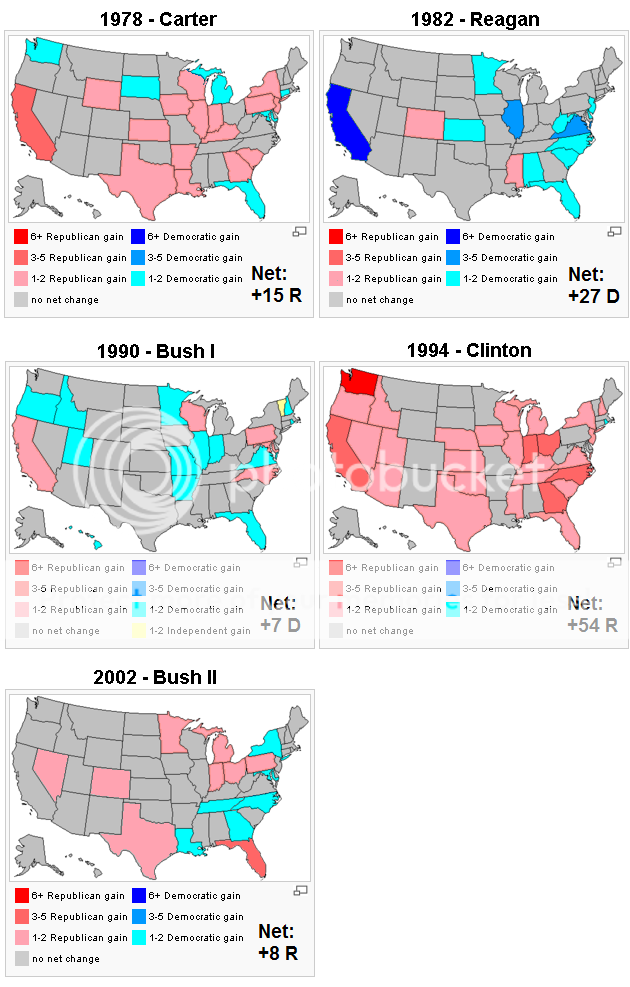
Historically, in most mid-terms, the losing party, has nevertheless almost always managed to score some victories that run against the prevailing political currents.  I got the maps below from Wikipedia, but I had to make a number of corrections as some of the information was not accurate.  I only include the “first-term mid-terms” here, as “second-term mid-terms” have a little different dynamic due to the “six-year itch” that often works more strongly against the party in power … but you can easily look up all this information yourself if you want more details about particular elections in the past (a note re. the maps: Truman wasn’t elected in 1944, but, for all practical purposes, 1946 was like the middle of his first term).

Photobucket

Photobucket

To complement the maps above, here are unemployment figures for November of each year (for 1934 and 1946, only yearly averages are provided):

1934: 21.7

1946: 3.9

1954: 5.3

1962: 5.7

1966: 3.6

1970: 5.9

1978: 5.9

1982: 10.8

1990: 6.2

1994: 5.6

2002: 5.9

My point here is that if we do go on offense (as well as defense) and a truly anti-Democratic wave materializes, our losses will more likely be significantly smaller than if we’re just playing defense alone.  Oftentimes, surprising and counter-intuitive victories can be the factor that separates a “loss” from a “wipeout”.  In fact, when looking at House elections in the middle of a President’s first term over the last 75 years or so, you can see that in most cases, losses in certain geographic areas have more often than not been offset by wins in other areas.  

For example, in 1970 Nixon’s GOP lost seats in 16 different states, but the losses were somewhat minimized by GOP wins in states as varied as California, Montana, Colorado, Oklahoma, Virginia and New York.  In 1978, Carter’s Democrats lost seats scattered across 15 different states, but those losses were offset by Democratic gains in states as diverse as Michigan, Washington, South Dakota, Connecticut, Maryland and Florida.  Going back to 1934, FDR’s losses in parts of the midwest were actually more than offset by some big wins in the northeast, particularly in Pennsylvania where 11 (sic) Democrats took over previously GOP-held seats (without Pennsylvania, the Democrats would have had a net loss of seats that year !  Incidentally, Pennsylvania also added Democrats in 1932 and 1936 House elections, going from having 33 Republicans and 3 Democrats prior to the 1932 election to 7 Republicans and 27 Democrats after the 1936 election).

In fact, in all of U.S. History there has only been one election of any kind (mid-term or not) where the “losing” party did not gain a single Senate, House or Governor’s seat from the “winning” party: 2006.  (In 2006, the GOP did not take over a single seat from the Democrats in Senate, House or Governor’s races; the next closest was 1938, which was a big GOP year, and the Democrats did not pick up a single Republican Senate or House seat, but they still managed to take the Governorships of California, Maryland and North Dakota away from the GOP.  Even during the 1994 GOP landslide, Democrats took over four previously Republican-held House seats and also picked up the Governorship of Alaska.)

Anyhow, I hope you get the picture re. how some elections can have more than just one political current going.  (1982 has to be looked at in a slightly different prism, in my view.  The 11% unemployment in November of that year was certainly the main factor.  But also, a new set of districts due to reapportionment and redistricting was a factor as well.  Phil Burton’s gerrymander in California was probably by itself instrumental in an additional six Democratic seats.)  This aspect of elections (dealing with political counter-currents) is just one point I want to make.  Perhaps more importantly, is how we handle elections which indeed seem like they will turn out to be wave elections.

Some first-term mid-terms are indeed wave elections.  1994 is perhaps the best example (I personally like 2006 better, but again, I’m trying to limit this diary to “first-term mid-terms”), and we often think of 1994 when comparing it to 2010.  But even in a worst-case scenario, like 1994, it is imperative that we study the history.  Because — even in that GOP landslide, a relatively small number of votes may have made the difference between a “loss” and a “wipeout”.   Now, this part is not shown on the map above — on which 1994 indeed looks like the wipeout that it was.  But if you look behind the picture, so to speak, you can see that even in the landslide, a little more effort on the part of Democrats may have made a huge difference:

First of all … the power of incumbency.  The following Democratic incumbents won contested elections in 1994 in districts that were quite conservative (ones which Bill Clinton lost by 1% or more in 1992); the incumbents’ winning margin is listed (please note that only districts that were contested by a Republican are shown):

AL-3: Glen Browder 63.6 – 36.4

AL-5: Robert Cramer 50.5 – 49.5

GA-9: Nathan Deal 57.9 – 42.1 (Deal changed parties after the election)

IN-3: Timothy Roemer 55.2 – 44.8

KY-6: Scotty Baesler 58.8 – 41.2

MI-10: David Bonior 62.2 – 37.7

MS-3: Sonny Montgomery 67.6 – 32.4

MS-4: Michael Parker 68.5 – 31.5 (Parker changed parties after the election)

MS-5: Gene Taylor 60.1 – 39.9

MO-4: Ike Skelton 67.8 – 32.3

NC-8: Bill Hefner 52.4 – 47.6

ND-AL: Earl Pomeroy 52.3 – 45.0

PA-6: Tim Holden 56.7 – 43.3

SC-5: John Spratt 52.1 – 47.8

SD-AL: Tim Johnson 59.8 – 36.6

TX-4: Ralph Hall 58.8 – 39.8

TX-11: Chet Edwards 59.2 – 40.8

TX-14: Greg Laughlin 55.6 – 44.4 (Laughlin changed parties after the election)

TX-17: Charles Stenholm 53.6 – 46.3

UT-3: Bill Orton 59.0 – 39.9

VA-2: Owen Pickett 59.0 – 40.9

VA-4: Norman Sisisky 61.6 – 38.4

VA-5: Lewis Payne 53.3 – 46.7

In most cases, the above incumbents won rather comfortably.  On the other hand, the following districts were open seats in 1994 and went GOP — despite being not as conservative as the first group above (all the districts below were won by Clinton in 1992, or Clinton came within 1% or less of winning in the case of KS-2 and NC-5):

IL-11: George Sangmeister, retired

KS-2: Jim Slattery, resigned to run for Governor

ME-1: Thomas Andrews, resigned to run for Senate

MI-8: Bob Carr, resigned to run for Senate

MN-1: Tim Penny, retired

NC-5: Stephen Neal, retired

NJ-2: William Hughes, retired

OH-18: Douglas Applegate, retired

OK-2: Mike Synar, defeated in primary

OR-5: Michael Kopetski, retired

TN-3: Marilyn Lloyd, retired

TN-4: Jim Cooper, resigned to run for Senate

WA-2: Al Swift, retired

It is quite likely that many of the seats above would have stayed Democratic if the incumbent had not retired.  If, theoretically, all 13 stayed in Democratic hands, then there would have been no “Republican Revolution” in 1994, as the Democrats would have maintained an effective majority (with a 217 D – 217 R split, and Bernie Sanders of Vermont).

Therefore, it is imperative that retirements be minimized.  This is perhaps already obvious.  

The second point … always be in fighting mode.  A lot of House districts were lost in 1994 by relatively small margins.  All the districts listed below were won by the GOP in 1994 by about 6 points or less (most, though not all, were Democratic incumbents who were defeated):

WI-1: Mark Neuman (R) 49.4 – Peter Barca (D) 48.8, margin 1120 votes

NC-4: Fred Heineman (R) 50.4 – David Price (D) 49.6, margin 1215

NV-1: John Ensign (R) 48.5 – James Bilbray (D) 47.5, margin 1436

CA-22: Andrea Seastrand (R) 49.3 – Walter Capps (D) 48.5, margin 1563

NE-2: Jon Christensen (R) 49.9 – Peter Hoagland (D) 49.0, margin 1766

NJ-8: William Martini (R) 49.9 – Herbert Klein (D) 48.6, margin 1833

KY-1: Ed Whitfield (R) 51.0 – Thomas Barlow (D) 49.0, margin 2462

OH-6: Frank Cremeans (R) 50.9 – Ted Strickland (D) 49.1, margin 3402

WA-5: George Nethercutt (R) 50.9 – Tom Foley (D) 49.1, margin 3983

PA-21: Phil English (R) 49.5 – Bill Leavens (D) 46.9, margin 4643

CA-49: Brian Bilbray (R) 48.5 – Lynn Schenk (D) 46.0, margin 4686

GA-7: Bob Barr (R) 51.9 – George “Buddy” Darden (D) 48.1, margin 5287

WA-9: Randy Tate (R) 51.8 – Mike Kreidler (D) 48.2, margin 5382

AR-4: Jay Dickey (R) 51.8 – Jay Bradford (D) 48.2, margin 6099

WA-1: Rick White (R) 51.7 – Maria Cantwell (D) 48.3, margin 6444

OK-2: Tom Coburn (R) 52.1 – Virgil Cooper (D) 47.9, margin 6536

OR-5: Jim Bunn (R) 49.8 – Catherine Webber (D) 46.8, margin 7354

NC-3: Walter Jones (R) 52.7 – Martin Lancaster (D) 47.3, margin 7451

MA-6: Peter Torkildsen (R) 50.5 – John Tierney (D) 47.4, margin 7471

PA-13: Jon Fox (R) 49.4 – Marjorie Margolies-Mezvinsky (D) 45.2, margin 8181

IN-8: John Hostettler (R) 52.4 – Frank McCloskey (D) 47.6, margin 8672

NH-2: Charlie Bass (R) 51.4 – Dick Swett (D) 46.0, margin 8878

TX-9: Steve Stockman (R) 51.9 – Jack Brooks (D) 45.7, margin 9710

ME-1: James Longley (R) 51.9 – Dennis Dutremble (D) 48.1, margin 9943

OH-19: Steve LaTourette (R) 48.5 – Eric Fingerhut (D) 43.5, margin 10296

NY-1: Michael Forbes (R) 52.5 – George Hochbrueckner (D) 46.5, margin 10345

KS-4: Todd Tiahrt (R) 52.9 – Dan Glickman (D) 47.1, margin 12287

IA-4: Greg Ganske (R) 52.5 – Neal Smith (D) 46.4, margin 13111

That’s 28 districts above, or more than 50% of the total GOP gain of 54 seats.  If those districts went Democratic instead of GOP (and I’m not using the word “switched”, because some of the above, like CA-22, PA-21, AR-4 and MA-6, were GOP-held prior to 1994), the Democrats would have remained in the majority with a 232 D- 202 R margin, instead of winding up with a losing margin of 230 R – 204 D.

If only the first 13 districts on the list hadn’t gone GOP, the Democrats would have maintained a majority (217 D – 217 R split, and Bernie Sanders of Vermont).  The first 13 districts on the list have an average Republican – Democratic margin of only 50.1% – 48.3%.  This is all a theoretical exercise, of course, because there were other factors like party-switchers, but the point remains that the results in even a dozen or so close-margin seats can have profound political consequences.  The combined GOP over Democratic margin in the first 13 districts above is only 38,778 voters.  So, in effect (and yes, theoretically) if about 19,400 voters (out of over 71 million votes cast in House elections in 1994) had voted differently, there would have been no “Republican Revolution” that year.

And yes, I realize that many Democrats won their races by the same slight margins that year, and so the GOP gains could have been even larger — but that is not the point.   My point is that if the political climate was overall just a little better for the Democrats that year (just a few points) the whole election could have gone differently (and the climate could have been a little better if Bill Clinton made some better choices) – and/or if the Democrats had made just a little more of an effort (better candidates, more funds, less retirements, better turnout, etc.), it may have gone differently … According to one analysis, http://archive.fairvote.org/re… , most eligible voters did not participate in the 1994 election.  “… only 17 of the 56 Republicans who won seats held by Democrats (in 1994) had higher vote totals than losing Republicans had won in those districts in 1992 suggest the impact of voter turnout.”

The bottom line — even if we’re looking at a bad year, we should not be afraid to go on the offense in states and districts across the country.  Chances are that minimizing retirements as well as having good Democratic candidates, campaigns and turnout will minimize any losses that our party may incur (and we may even be in store for a big, happy surprise like in 1934).  There’s nothing like a good campaign – just look at Scott Brown’s recent victory in Massachusetts, or something just as impressive to me – the near-defeat of Barry Goldwater in Arizona — by a Democrat ! — in 1980 of all years ! (Goldwater won a razor-sharp victory only after all the absentees had been counted).

If, on the other hand, we’re just playing defense and adopt a fatalistic outlook towards November 2010, our losses are likely to be greater.  The President also needs to make the right choices over the next nine months – in order to create as favorable a climate for the Democratic Party to succeed in November (and that includes not alienating his base and thus depressing turnout !) … so, good luck to the Democrats … but don’t forget go on offense and fight like hell over the next nine months and don’t be afraid of history; nothing is inevitable in elections.

CA-33 Rep. Diane Watson to retire

Just left a CA delegation meeting with Cong. Diane Watson was quietly telling Members that she will not be running for re-election.

Word is that Former CA Assembly Speaker Karen Bass will immediately enter the race following Watson’s announcement.  Further proof of this plan — Bass is scheduled to be in DC next week for a series of meet and greet events with potential financial supporters.

Anyone that knows anything about Watson and Bass can attest that this would be a TREMENDOUS upgrade for the district, CA Delegation, and US House in general. Bass is a real leader — while Watson has been less than impressive during his tenure to say the least…

SSP Daily Digest: 2/5

FL-Sen: Jeb Bush has studiously avoided explicitly taking sides in the Florida Senate primary, but various actions (like sending out his sons to endorse Marco Rubio) have tipped his hand. Another moment like that today, as he said on a radio interview that he’s “proud” of Rubio and the challenge he’s mounted. Meanwhile, Charlie Crist seems to be digging in rather than making plans to switch to an indie or Dem bid: he’s saying “he’s no RINO,” and perhaps more tellingly, now saying he opposes the repeal of “don’t ask don’t tell,” a wedge issue he could be using to propel himself out of the GOP if he so chose. (h/t sapelcovits)

OH-Sen: Geez, this is just bad to worse for Jennifer Brunner. She’s been holding off on reporting her fundraising again, and here’s why: she raised $93,000 in the fourth quarter, and managed to burn through more than that, leaving her sitting on a whopping total of $60,000 in the bank (1% of what Rob Portman has). Clearly she thinks someone is going to bail her out at some point – I’m just wondering who she thinks it’ll be.

FL-Gov (pdf): Republican internal pollster McLaughlin & Assocs. finds a sizable lead for Republican AG Bill McCollum over Democratic state CFO Alex Sink: 41-30. That’s right in line with both Rasmussen and Quinnipiac’s most recent looks at the race, so this one seems to be moving away from Sink for the time being.

IL-Gov: With all the new allegations popping up about pawnbroker-turned-LG nominee Scott Lee Cohen – on top of yesterday’s news about his rap sheet, today’s news features his steroid use and resulting ‘roid rage and sexual violence — I’m starting to wonder where the other Lt. Governor candidates were in terms of doing opposition research. For that matter, where was the media? That’s the kind of thing that sells papers, if nothing else. At any rate, Cohen is saying he isn’t stepping down (having invested more than $2 million of his own money in winning the race purely on name rec), while Pat Quinn is reduced to saying that “the situation will resolve itself.” Ex-Sen. Adlai Stevenson is advising Quinn to take the same route he did in 1986 when he was saddled with a LaRouchie running mate, which is to abandon ship and make a third-party run. Of course, that didn’t work too well for Stevenson, who lost anyway, although he was running an uphill fight against popular Gov. Jim Thompson.

The one bright spot for the Dems in all this is that the GOP may be months away from having a candidate. State Sen. Kirk Dillard, who came up 406 votes short, isn’t conceding, and is saying let’s wait until all the absentee and provisional ballots (possibly up to 10,000 of them) are counted. Even if he wants a recount, that won’t be able to start until the race’s certification in early March.

MN-Gov: The Democratic field in the Minnesota governor’s race got a little smaller, as state Sen. Steve Kelley dropped out. He was probably motivated by his poor showing on Tuesday’s informal straw poll, where he finished with 4%, behind at least half a dozen other candidates and “uncommitted” as well.

OR-Gov: With ex-SoS Bill Bradbury getting a Howard Dean endorsement, ex-Gov. John Kitzhaber just rolled out an endorsement of his own from another netroots favorite: Steve Novick, who barely lost the 2008 Senate primary. Kitzhaber, of course, was one of the few establishment figures to line up behind Novick, so Novick is returning the favor. (You’ve gotta love the photo of the two of them at the link.)

AL-05: Looks like the Democrats are moving closer to a candidate to take on Parker Griffith (or whoever defeats him in the GOP primary). Taze Shepard, a Huntsville attorney and elected member of the state Board of Education in the 90s, is considering the race. He has quite the pedigree, too: he’s the grandson of John Sparkman, who represented the 5th from 1936-1946 and then was Alabama’s senator from 1947 to 1979 (and was the Democratic VP nominee in 1952). Also, Griffith may have a little more company in the GOP primary, and it’s an old foe: businessman Wayne Parker, who narrowly lost to the Democratic version of Griffith in the open seat race in 2008.

MA-10: There are increasing retirement rumors about Rep. William Delahunt, since, of course, the dominant narrative is that Democrats start to cry and run home as soon as usually-ignored Reps face a halfway-credible challenge. Also feeding the rumors, perhaps, are Delahunt’s fundraising numbers from last quarter: $31K (although he is sitting on $568K). What may be most interesting is that the rumors all come with a likely replacement attached: Joe Kennedy III.

WA-08: Ex-Microsoft executive Suzan Del Bene brings her own money to the race (and lots of it – she already has $773K on hand, compared with Rep. Dave Reichert’s $477K), but now she’s poised to tap into a nationwide donor base, with an endorsement from EMILY’s List.

Mayors: So primary season is here for real: the primary election in the New Orleans mayoral race is tomorrow. With a highly cluttered field and one clear frontrunner looming over the field (Lt. Gov. Mitch Landrieu), the real question here seems to be who manages to get into a runoff with Landrieu (who was polling at 45% in the most recent poll of the race). Other major opponents include John Georges, Rob Couhig, Nadine Ramsey, James Perry, and Troy Henry.

NH-Sen: Ayotte May Face Trouble in GOP Primary

Research 2000 for Daily Kos (2/1-3, likely voters, 7/13-15 in parentheses)

Paul Hodes (D): 39 (38)

Kelly Ayotte (R): 46 (39)

Undecided: 11 (23)

Paul Hodes (D): 46

Ovide Lamontagne (R): 36

Undecided: 13

Paul Hodes (D): 45

William Binnie (R): 35

Undecided: 15

(MoE: ±4%)

Kelly Ayotte (R): 36

Ovide Lamontagne (R): 27

William Binnie (R): 4

Undecided: 33

(MoE: ±5%)

John Lynch (D): 59

Jack Kimball (R): 13

Undecided: 26

(MoE: ±4%)

The toplines in Research 2000’s new poll of the New Hampshire Senate race aren’t that noteworthy; they fall right in line with most other recent polls of the race, which have given Republican ex-AG Kelly Ayotte a 5 or 7 point lead over Democratic Rep. Paul Hodes. The trendlines aren’t very appealing, but they go back to July, and think about everything (mostly bad for the Dem brand) that’s happened in the last half a year; at any rate, Ayotte’s gain has only come out of the undecided column.

What’s very intersting about this poll is the GOP primary, about which we have precious little information so far. Ayotte has been running a startlingly substance-free campaign, leaving her to get squeezed both on the right by Ovide Lamontagne, favorite of national movement conservatives, and perhaps on the left (though it’s hard to tell, since Ayotte hasn’t given us any benchmarks) by businessman William Binnie, who seems to be operating in traditional New England moderate mode.

The only poll we’ve had about the primary prior to this one is a Kelly Ayotte internal from Tarrance from last month, where she led Lamontagne 43-11, with Binnie at 5 and Bender at 3. That poll seemed pretty optimistic to me from the outset, and now we have some confirmation from an independent pollster that Ayotte’s in a real fight here. With 33% still undecided, there’s still plenty of time for Lamontagne to torpedo Ayotte — especially if he can pick up national-level institutional backing, from the Club for Growth, the tea partiers, and their ilk. And considering that Lamontagne loses convincingly to Hodes in the general, I sure hope these groups are taking notice. (For what it’s worth, Ayotte is starting to go on the air, with her first radio spot, suggesting that she may be starting to notice that she can’t sleepwalk her way to the nomination.)

There are also numbers from the gubernatorial race, one of the few uncompetitive ones anywhere in the country. Centrist Democratic incumbent John Lynch has a 57% generic re-elect, and thumps GOP businessman Jack Kimball in a head-to-head. (Kimball may lose in the primary to social conservative activist Karen Testerman, but either way, this race doesn’t look like it’ll be on anyone’s radar come November.)

RaceTracker Wiki: NH-Gov

Rundown of the Michigan State House Campaign Filing Statements

(cross-posted at WMR, ML, BFM, and SSP-pb)

February 1 marks a big day for Michigan political junkies, a day when candidates and officeholders who have filed a candidacy committee to run for office on the state level must file an annual compliance statement (CS). Candidates who have filed for a financial waiver (meaning that they are not going to spend or raise more than $1,000 on their campaign, and will most assuredly lose in their bid for elected office) are not required to file a CS, nor are candidates who have filed after January 1 of the current year. Hence, any candidates who have filed to run for office after January 1, 2010 do not need to file a CS.


http://i303.photobucket.com/al…

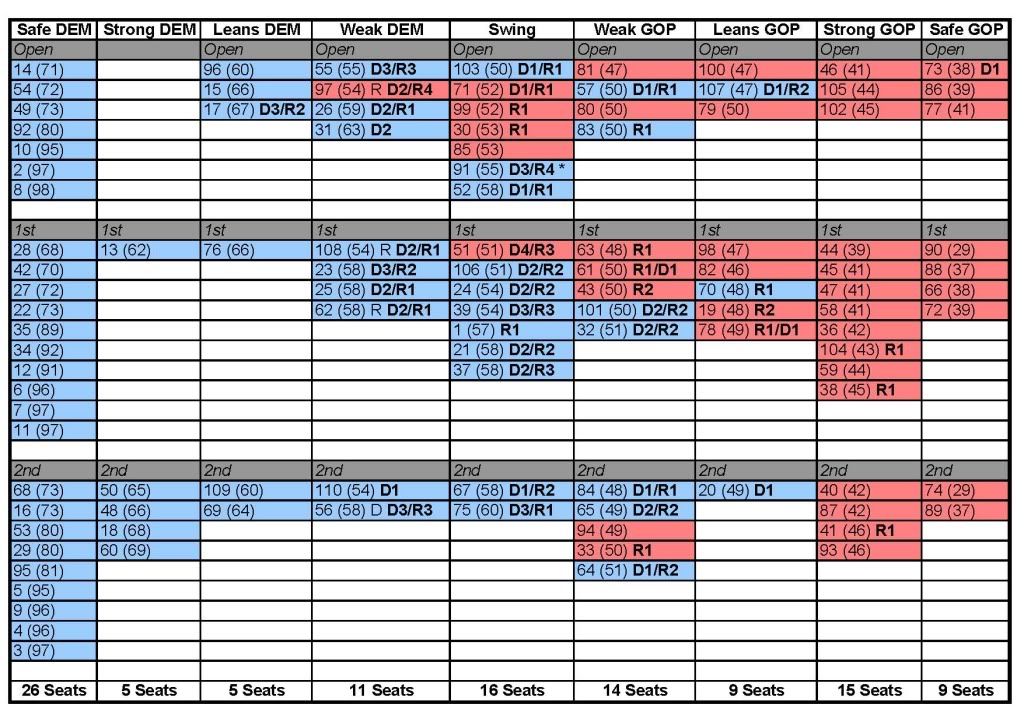
Figure 1: Competitiveness Matrix, Michigan State House

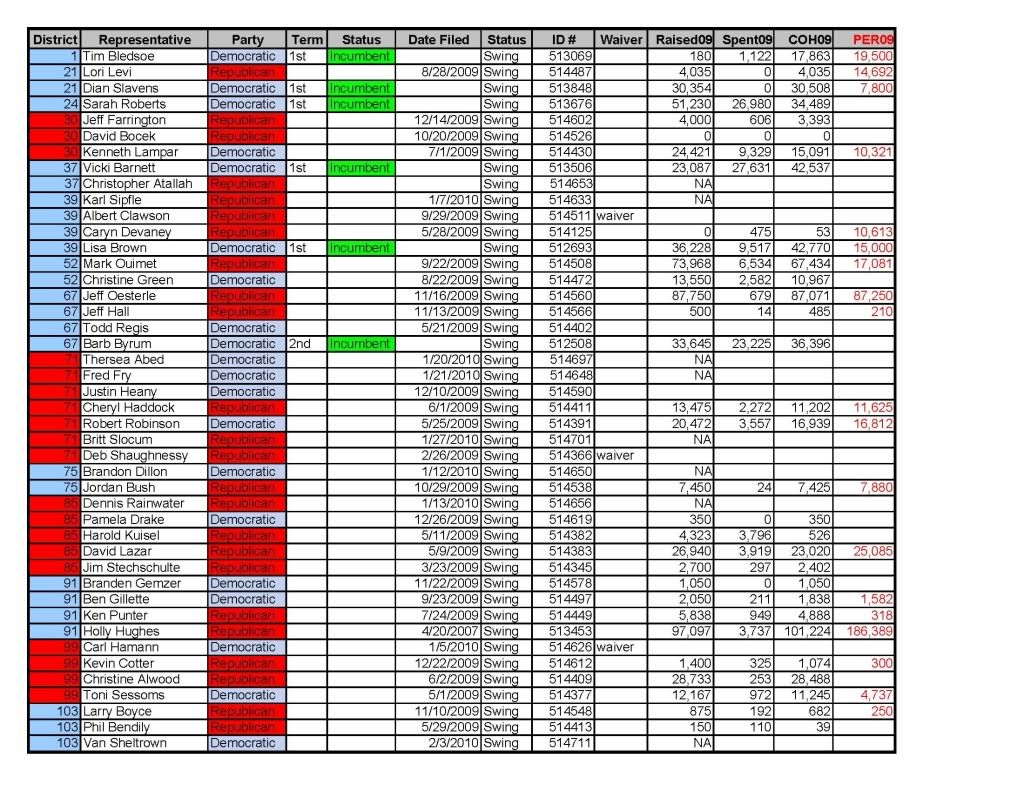
Figure 1 is a chart displaying the expected competitiveness for Michigan State House races further. Using the underlying baseline vote from the Michigan Board of Education races over the past four elections (2002-2008), I have also noted the number of times each party has challenged a seat. For example, in House District 51, the Democrats have invested party resources in the seat four times, while the GOP has invested in it three times. It quickly becomes apparent that rarely spends money defending or challenging seats in their Safe or Strong category or that of the opposing party. Hence, that gives the Democrats 31 worry free seats, and the Republicans 25. For an upset occur in these races means that the challenger needs to be self-financing, as the party will pay for nothing. This analysis will focus on CS from 54 districts that are considered tossup, weak or leaning Democratic/Republican. Candidates are listed with the amount of money raised in the past year, the amount on money spent over 2009, the total cash on hand, and the amount of personal funds each candidate given to his or her campaign.


http://i303.photobucket.com/al…

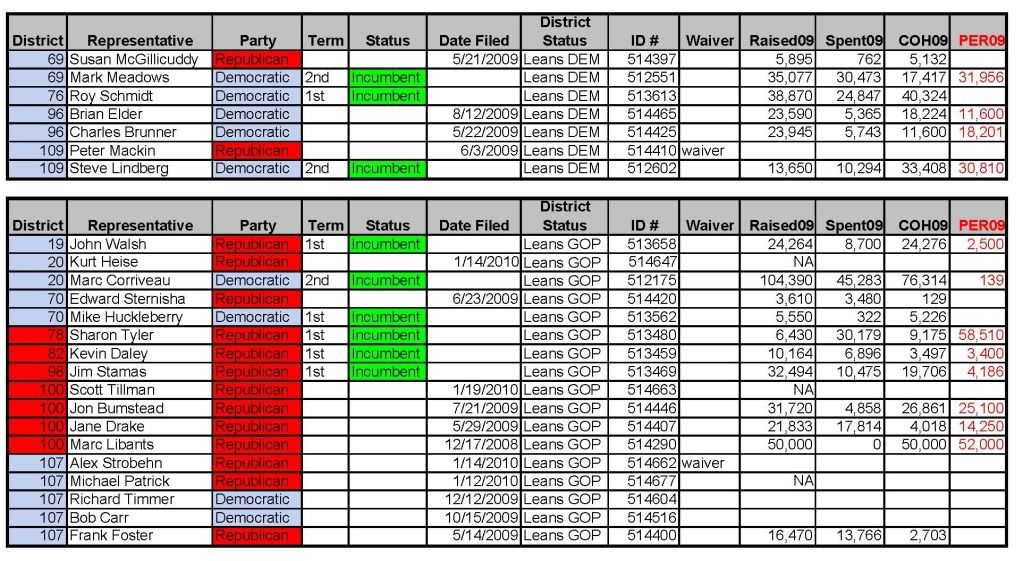
Figure 2: Leaning Democratic/Weak Republican Districts

Most districts in the leaning category tend to be competitive in when seats open up due to term-limits, or a “wave” year occurs for one party or the other. Judging from the 2009 CS filings, none of the leaning Democratic districts appear to be competitive, particularly for the Democratic incumbents. Roy Schmidt (76th) has an enormous cash on hand advantage, and fellow incumbents in the 69th and 109th appear to be in good shape. The open 96th seat has no GOP challenger yet but two well-funded Democratic candidates have emerged.

The Republican leaning districts are another story. While most districts currently held by GOP incumbents appear to be safe (Districts 19, 82, and 98), Sharon Tyler in Berrien County (District 78) has done little fundraising to help shore up a district that has become increasingly Democratic over the past eight years. However, the three districts held by Democrats (Districts 20, 70, and 107) are the most vulnerable seats for a potential Republican pickup. In District 20 Democratic Representative Marc Corriveau is leaving his seat to run for the 7th State Senate district, while the 107th is vacant thanks to term-limits. Thus far no clear financial picture has emerged in the 107th, although 2008 Republican candidate Alex Strobehn has filed a financial waiver, dooming himself to defeat in the GOP primary. In the 70th District, Democratic incumbent Mike Huckleberry has a small financial edge over Republican challenger Edward Sternisha, although expect the GOP to pour resources to retake this seat. However, given that open seats are much more likely to change their partisan status, I would put districts 20 and 107 higher up on the danger list.


http://i303.photobucket.com/al…

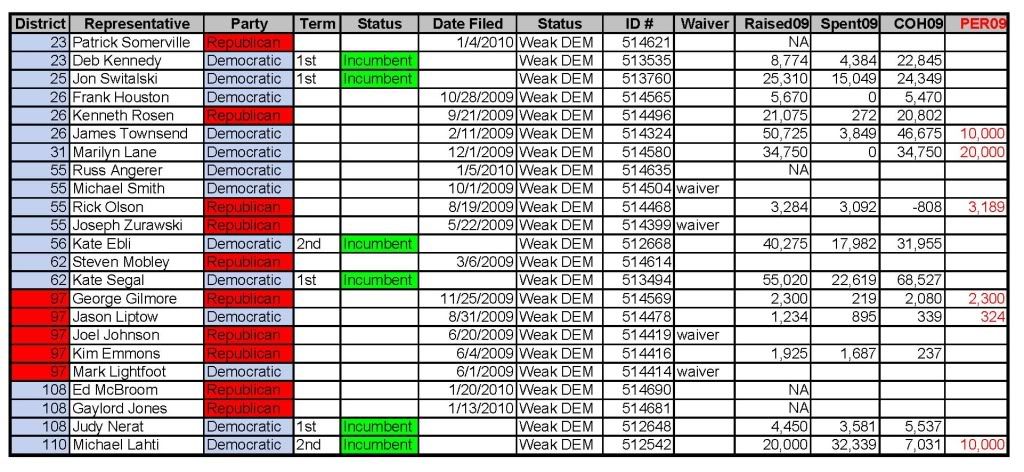
Figure 3: Weak Democratic Districts

The odds favoring incumbents is even more apparent in examining districts with a weak Democratic lean. Of the ten seats, six are held by Democratic incumbents, all whom have significantly outraised their Republican opponent.  Kate Segal (District 62) and Kate Ebli (District 56) lead the pack in fundraising, and it appears highly unlikely that the GOP is going to challenge for these seats. Judy Nerat (District 108) appears to be in weaker financial shape, but expect the MDP to spend funds to ensure her victory. In the four open seats, three are currently held by Democrats and thus far look to remain in their column. Democratic candidates in districts 26 and 31 have significantly outraised GOP opponents, and while Democratic candidate Russ Angerer (District 55) filed in early 2010, the fact that he is the current representative’s spouse provides a ready avenue of financial support against Republican Rick Olson, who has a negative cash-on-hand sum. The one Republican-held seat (District 97) feature two viable GOP candidates (Kim Emmons and George Gilmore) and Jason Liptow for the Democrats. I’d expect some other Democratic candidates to consider this seat, including former representative Jennifer Elkins and Mike Shea. This seat is one to watch.


http://i303.photobucket.com/al…

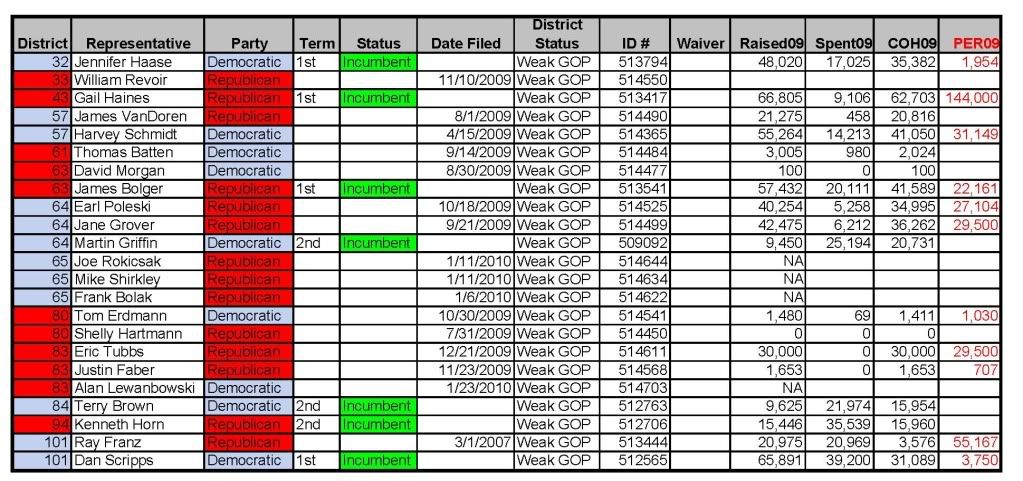
Figure 4: Weak Republican Districts

Given the number of weak Republican seats held by Democrats, one would expect that the GOP would find easy pickings among these districts. However, of the thirteen seats, four are held by incumbent Democratic representatives with enormous cash on hand advantages. Leading the way is Dan Scripps (District 101) who raised a whopping $65,891 this past year, while 2008 Republican challenger Ray Franz spent as much as he raised, and is deeply indebted to himself. Other Democratic incumbents in districts 32 and 84 appear to have a large financial edge. Democratic Representative Marty Griffin (District 64) is in somewhat greater danger, given his massive defeat in the 19th State Senate district special election, and has attracted two GOP challengers. Griffin has won serious races in 2006 and 2008, and one could expect the GOP to wait one more cycle to mount a more vigorous challenge in 2012.  Of the remaining nine seats, three are held by GOP incumbents (Districts 33, 43, and 94) that have no serious challenger yet. The remaining six seats are competitive to varying degrees. The death of Democratic Representative Mike Simpson puts District 65 potentially in play, although a crowded GOP primary field might be beneficial to the future Democratic candidate. Open Republican seats in Districts 33, 61, 80 and 83 are potential opportunities for Democratic pickups; however, challengers Tom Batten (District 61) and Tom Erdmann (District 80) have not yet demonstrated vigorous financial strength yet, although state party support could make each of these races interesting. District 57, is a potential Republican pickup opportunity, although Democratic candidate Harvey Schmidt ($41,050 cash on hand) has significantly performed Republican James VanDoren ($20,816) in the money race.


http://i303.photobucket.com/al…

Figure 5: Swing Districts

The remaining fourteen districts are swing seats that will be the focus of partisan attention through 2010. While there are really sixteen swing seats, I removed two seats from this category; one a likely Republican hold (District 51 Paul Scott-$52,765 cash on hand), and one that has no data yet (District 106 where Democratic incumbent Andy Neumann is term-limited and no candidate has emerged for either party). Of the fourteen districts, seven have Democratic incumbents. Of these seven, one (Robert Dean District 75) is considering running for the State Senate, although the Kent County Democrats have lined up a strong potential replacement in Kent County Commissioner Brandon Dillon, and there appears to be a likely GOP primary between attorney Jordan Bush and businessman Bing Goei. Of the remaining six Democratic incumbents, four have a large financial edge that puts them on strong footing heading into the 2010 cycle. In the 67th District, Democratic incumbent Barb Byrum is facing a challenge from Republican Jeff Oesterle, who is a self-funding his run. While Byrum’s district has long been competitive, she has repeated won against stronger GOP candidates. The only Democratic incumbent who appears in potential trouble is Tim Bledsoe (District 1) who has just over $17,000 in cash on hand. Given the expense of running in this district, the MDP will likely spend ample funds to hold this seat.

Of the remaining seven seats, four are open seats held by the GOP. In District 30, term-limited Republican Tory Rocca is leaving a historically GOP district that has been held by different family members for almost a generation. Macomb County Commission Ken Lampar has the field to himself in the Democratic primary, and has $15,000 cash on hand. Jeff Farrington is the only viable GOP candidate thus far, and he is significantly trailing Lampar ($3,393 cash on hand). District 71 features four Democratic and three Republicans candidates, although Democrat Robert Robinson ($16,939) and Republican Cheryl Haddock ($11,202) have emerged as the front runners in this race, although both have provided significant financial support of their own. District 85 has long been a Democratic target, although thus far the only candidate Pamela Drake disappointing financial numbers ($350 cash on hand) means another candidate will likely vie for the Democratic nomination. On the Republican side, David Lazar is the leading money raiser ($23,020 cash on hand), although much of his funds were from his own bank. Finally, expect District 99 to be ground zero for both parties, with Democratic candidate Toni Sessoms ($11,245 cash on hand) and Christine Alwood ($28,488) to received enormous support from each party.

Three of the open swing seats are currently held by Democrats. District 52 has been held by Democrat Pam Byrnes for the past six years, and Scio Township Mayor Christine Green ($10,967 cash on hand) is seeking the Democratic nod, while Washtenaw Commission Mark Ouimet is the Republican candidate ($67,434 cash on hand). Given the historic Republican nature of this district, and Ouimet’s strong fundraising thus far, this race is going to be on the top of the GOP’s pickup opportunities. District 91 is being vacated by Democratic Representative Mary Valentine, who is running for the State Senate. 2008 Republican candidate Holly Hughes is back, and has provided large amounts of money for her campaign (she’s given $186,389 thus far) and has $101,224 cash on hand. Hughes faces Ken Punter ($4,888 cash on hand) in the GOP primary, although it is likely that she will prevail with her enormous financial edge. Hughes’ amount dwarfs the figures raised by Democratic candidates Branden Gemzer ($1,050) and Ben Gillette ($1,838). Given that the 91st District is covered by the 34th State Senate district that is going to be strongly contested by each party, expect the MDP to provide ample support for the eventual Democratic nominee. Finally, District 103 is being vacated by Joel Sheltrown. Given that his brother Van Sheltrown has entered the race, this is a seat the Democrats can hold, especially given that the declared GOP candidates (Phil Bendily and Larry Boyce) have raised miniscule amounts of money.

While politics is not pre-ordained by money, having it helps, especially in a tough economic climate where donors are unlikely to be in a giving mood. While the GOP has a number of potential pickup opportunities, if I had to predict today I would expect the Democrats to lose five seats, reducing their majority to 62 seats. While smaller in number, this would still give the Democrats the chance to create a favorable redistricting plan for decade to come.  

SSP Daily Digest: 2/4

CA-Sen: Possibly the most bizarre political ad (well, web video) of all time has just gotten unveiled by the Carly Fiorina campaign, which makes their “Carlyfornia Dreaming” website look reasoned and well-thought-out. I mean, they’re going to be studying this in political rhetoric classes 50 years from now, as an example of what not to do. Not only is the imagery laughable (check out the glowing-eyed demon sheep at 2:24) but the metaphor completely falls apart (Tom Campbell is a “FCINO” (financial conservative in name only) and thus a crafty wolf, while good politicians are a herd of helpless mindless sheep?).

CT-Sen: Even Rasmussen can’t find a way to put a happy face on the tombstone piledriver the Connecticut GOP suffered with the Chris Dodd-for-Richard Blumenthal swap. They find Blumenthal leading ex-Rep. Rob Simmons 54-35 and Gorgeous Lady of Wrestling Linda McMahon 56-36. Simmons is actually very well-liked, at 60/26 favorables, but that’s no match for Blumenthal at 70/27.

IL-Sen: Republicans can content themselves with Rasmussen’s first post-primary poll of the Senate field; they find GOP Rep. Mark Kirk leading Dem state treasurer Alexi Giannoulias 46-40. This, of course, doesn’t jibe with not only last week’s PPP poll (with a 42-34 Alexi lead) but the last Rasmussen poll of the general, from December (with a 42-39 Alexi lead). Both those polls predate the strangely-timed consent decree between the FDIC and the Giannoulias-family-owned Broadway Bank, so it’s possible Giannoulias might have taken a hit from that. Also, Rasmussen’s numbers aren’t that far off from an internal (pdf) from Magellan that the Kirk campaign was quick to release yesterday: 47-35. One suggestion that might cast a little doubt on the samples, though, is Barack Obama’s approval ratings in his home state, oddly low at 54% and 51% respectively, only a few points ahead of his national average.

IN-Sen: Ex-Sen. Dan Coats is leaving himself a lot of elbow room with the way he’s carefully phrased what he’s doing: “as I test the waters for a potential challenge…” I realize that SSP is pretty much powerless to change the nature of the political discourse, but we’re getting very tired of the whole “I’m not running, but I’m running, wink wink” kabuki that seems to be standard practice these days (John Boozman, we’re talking to you too). We fully intend to change the rating on this race, but not until Coats truly and officially gets in. At any rate, Coats may be wise leaving himself an escape hatch, if the dribs and drabs like this one keep piling up: one of his lobbying clients has been Hugo Chavez-connected oil company Harvest Natural Resources (but, then, making nice with Chavez is IOKIYAR, I guess).  

WI-Sen: If you’re looking for a tea leaf on whether or not ex-Gov. Tommy Thompson is interested in taking on Russ Feingold this year, look no further: he just took a position as an advisor to a hedge fund. He’ll consult with Peak Ridge Capital Group on agribusiness matters. Not only will that keep him occupied in the near future, but it’s not really the kind of thing you want on your resume if trying to run at a time of anti-banker agitas. (Another hint: the talk of an ex-Rep. Mark Neumann switch from the Governor’s race, to a rematch with Feingold, suddenly bubbling up.)

IL-Gov: We have winners in the gubernatorial primaries, as all of Illinois’s precincts reported by the end of the day yesterday. Pat Quinn wound up with a more than 8,000 vote margin over Dan Hynes (good for 50.4%), and Hynes conceded this morning. On the Republican side, state Sen. Kirk Dillard didn’t make up as much ground in Cook County on fellow state Sen. Bill Brady as anticipated, and Brady wound up finishing with a 406-vote margin. There’s no automatic recount law in Illinois, so it’s up to Dillard to decide whether or not to proceed with a challenge.

Meanwhile, down the ballot, both parties seem somewhat aghast at the winners of their Lt. Governor primaries. News came out today that pawnbroker Scott Lee Cohen, winner of the Democratic nod, was arrested four years ago for misdemeanor assault after holding a knife to the throat of a girlfriend (who had also been convicted of prostitution). Needless to say, Quinn is already distancing himself from Cohen, calling on him to step aside. (Although Governor and Lt. Governor are elected separately in primaries, they’re then lashed together as a ticket for the general, which is how Rod Blagojevich and Quinn got put together despite their antipathy – I’m not sure if any other state does it that way.) Which isn’t to say that the Republicans fared much better on that front, nominating random teabagging businessman Jason Plummer (who, like Cohen, won by pouring his own money into the race) instead of state Sen. Matt Murphy.

NY-Gov: I can’t see this being of any interest unless something goes seriously wrong and we somehow wind up with a David Paterson/Rick Lazio matchup and we need to shunt off some right-wing votes to get Paterson over the hump. But now there’s a teabagger-linked rich guy, Buffalo real estate developer Carl Paladino, saying that he’s considering a gubernatorial run, and that he “would go in as a pure independent.”

PA-Gov: Allegheny Co. Exec Dan Onorato has the big financial edge in the Dem gubernatorial primary, and now he has some key labor backing as well. The Teamsters are the first major union to endorse in the primary, and they went for Onorato.

TX-Gov: Looks like there’s going to be a crazy Wang Dang Tango at Rick Perry’s Houston rally on Sunday: not only is Sarah Palin going to be there to endorse Perry, but so too is the Motor City Madman, the Ten Terrible Fingers of Doom, the Rock ‘n’ Roll Caveman: Ted Nugent (who plans to perform). In case you’re wondering where the normally reserved and understated Nugent stands on all things political, he recently said: “I think that Barack Hussein Obama should be put in jail. It is clear that Barack Hussein Obama is a communist. Mao Tse Tung lives and his name is Barack Hussein Obama. This country should be ashamed. I wanna throw up.”

AR-01: The first Democrat making moves to replace retiring Rep. Marion Berry is Berry’s very own Chief of Staff, Chad Causey, who has already scheduled a fundraiser. State Sen. Steve Bryles, state Rep. Keith Ingram, and former state party chair Jason Willett are other Dems publicly eyeing the race. For the GOP, broadcaster Rick Crawford probably won’t have the race to himself, with state Sen. Johnny Key interested. Princella Smith is also likely to get in – she’ll definitely need a new job starting in November, as she’s currently a staffer to Rep. Joe Cao.

FL-24: The 24th seems like an apt target for Republicans, with a Republican lean and freshman Rep. Suzanne Kosmas not quite finding her footing – but fundraising has gone poorly for the two GOPers in the race, state Rep. Sandy Adams and Winter Park city councilor Karen Diebel, neither of whom has broken into the six digits in the last few quarters. The NRCC is now touting the likely entry of Craig Miller, the former CEO of Ruth’s Chris Steakhouses. He’s never held office before, but at least he brings his own money with him.

NC-10: In the dark-red 10th, the only way odious chickenhawk Rep. Patrick McHenry is going to get dislodged is in a GOP primary – and it’s starting to look like that’s a possibility this year. Not one but two different opponents have outraised him (although mostly by dipping into their own wallets): dentist and Iredell Co. Commissioner Scott Keadle and businessman Vance Patterson. Keadle has some electoral experience, coming within 14 points of Mel Watt in NC-12 in 1998, during the brief period when the frequently-modified VRA district had a sizable white plurality. Keadle claims to be coming at McHenry from the right, which is hard to fathom as McHenry is already one of the most stridently conservative members of the House.

NH-01: Another one-time NRCC fave who’s fallen by the side of the road somewhat as he’s put up quarter after quarter of mediocre fundraising is former Manchester mayor Frank Guinta. Sensing an opening, several other contenders have gotten into the GOP field; one, Richard Ashooh, has been exploring the race but made it official today. He comes with his own set of insider credentials, though: he’s the VP of governmental relations for large locally-based defense contractor BAE Systems.

NY-23: Talk about not learning from the past. If Assemblyman Will Barclay wins the GOP nomination, he may find himself getting Scozzafavaed by the same guy. Doug Hoffman plans to run on both the Republican and Conservative lines, but Conservative party chair Mike Long says he’ll continue to back Hoffman on the Conservative line even if Hoffman loses the Republican primary.

Redistricting: There’s still a chance to get on the newly-created California legislative redistricting board. The deadline to submit an application is Feb. 12. The state is taking notice that 73% of applicants are non-Hispanic whites and 70% are males, neither of which is very representative of the state’s makeup, and is shelling out for a last-minute outreach campaign to bring in some more minority applicants. Part of the problem is that applicants can’t have run for office or worked for a politician, which filters out many of the most politically engaged in minority communities. At any rate, it’s an opportunity to get more progressives behind the wheel of shaping a more competitive legislative map for next year, so any SSPers in the Golden State are urged to apply.

Exploring the Most Republican Place in America: Part 1

This is the first part of two posts examining the Texas panhandle, a rock-hard Republican stronghold. The second part can be found here.

Exploring the Most Republican Place in America

In the Texas panhandle and the empty plains surrounding it, Democrats go to die. There is no place in the country more Republican than this rural region, where conservatism is ingrained bone-deep and from birth. Not even the most Mormon stretches of Utah, or whitest areas of the Deep South, exceed the Republicanism of this part of Texas.

Yet, in the vast emptiness of the Texas prairie there are a number of interesting patterns – some of which are quite strange to behold.

More below.

Yellow-dog Democrats

Believe it or not, much of the most Republican place in the nation used to be Democratic territory, voting for the blue candidate even when the rest of America did not. Now, of course, the same could be said for the entire American South, which routinely gave badly losing Democratic presidential candidates over 70% (and often 90%) of the vote. Texas was no exception to this rule; President Truman lost a grand total of eight counties during the 1948 election, for instance.

The difference with the Texas panhandle, however, was that parts of it continued to vote Democratic even as the Solid South collapsed. In 1956, for instance, President Dwight Eisenhower won re-election by a solid 15.40% and cracked the South. One such crack included Texas, which Mr. Eisenhower won by 11.28%. Mr. Eisenhower carried the state backed mainly by its Republican-leaning cities (an oxymoron nowadays), while much of rural Texas voted for Democrat Adlai Stevenson. This included almost the entire panhandle:

Exploring the Most Republican Place in America

This Democratic-leaning trend continued for some time, even after the 1964 realignment of the South. The panhandle cast a strong ballot for Senator Hubert Humphrey and President Jimmy Carter (both times), while a number of counties voted to Governor Dukakis and even hapless Senator Walter Mondale. As late as 1996, when President Bill Clinton lost Texas by 4.93%, there still remained a flicker of yellow-dog Democratic strength:

Exploring the Most Republican Place in America

It was one President George W. Bush who finally crushed this Democratic tradition; since his time, the panhandle has begun voting uniformly Republican. But for all its current love of Republicans, it must be noted that this phenomenon is relatively recent – although long in coming.

IA-03: GOP primary developments

Seven-term Representative Leonard Boswell is only the 64th most vulnerable Democrat in the House of Representatives, according to Crisitunity’s “vulnerability index,” but Iowa Republicans still like their chances against him. Five candidates have already entered the GOP primary, and two others I’ve never heard of were reportedly collecting signatures on nominating petitions at the off-year caucuses on January 23. The field may expand before the filing deadline in March.

A few recent developments in the Republican primary race are after the jump.

Former Iowa State University wrestling coach Jim Gibbons is way ahead in the money race, thanks to support from heavy-hitters like ethanol baron Bruce Rastetter as well as a number of political action committees. After announcing his candidacy in November, Gibbons raised $207,310, spent $2,240 and ended the year with $205,069 on hand and $2,686 in debts owed. In the fourth quarter, he raised more money than Boswell, who collected $169,377, spent $50,643 and had $462,193 cash on hand as of December 31. (Most of Boswell’s fourth-quarter fundraising came from political action committees.)

Craig Robinson of the Iowa Republican blog has been promoting Gibbons’ candidacy for a while now, and he is ready to declare victory for Gibbons in the primary already, based on the fundraising numbers. However, Bleeding Heartland user mirage (a supporter of State Senator Brad Zaun) noted in the same thread, “About $51,000 of Gibbons funds will be restricted (meaning they can’t be used against Zaun in a primary), and about $130,000 came from outside the 3rd district.”

Speaking of Zaun, he raised $30,600 during the fourth quarter, spent $93 and ended 2009 with $30,507 on hand. Presumably he has raised more money since January 1, because he made a television ad buy last week. It’s generic Republican fare with low production values:

Zaun was the first up on television, but as Robinson noted triumphantly, “Even if [Dave] Funk or Zaun raised $1000 everyday between now and the primary, they still wouldn’t match what Gibbons currently has in his campaign account.”

Funk, the IA-03 candidate favored by the Tea Party crowd, raised $22,685 in the fourth quarter, spent $19,553 and ended the year with $16,507 on hand. According to mirage, much of Funk’s remaining money is restricted for use after the primary. I don’t think he’ll be needing that.

Mark Rees, who is running as a more moderate Republican, raised $3,100 and loaned his own campaign $52,647. He spent $3,247 and ended the year with $52,500 and $52,647 in debts owed to himself. I don’t know how much of a moderate GOP base is left in the Des Moines suburbs, but if conservatives divide their support among three or four candidates, Rees could slip through.

Yesterday we learned about an internal poll of the GOP race, conducted by Victory Enterprises, campaign consultants for Zaun. I posted the whole polling memo from Victory Enterprises at Bleeding Heartland. The poll was conducted on January 27 and 28 and surveyed 400 Republicans in Iowa’s third Congressional district who are likely to vote in the June primary.

The poll shows 60 percent of respondents were undecided about whom to support in the primary. Zaun had 26 percent support, compared to 5 percent for Gibbons, 3.6 percent for Funk, 2.1 percent for Pat Bertroche and 1 percent for Rees. In Polk County, the population center of the district, 37.5 percent of respondents supported Zaun. His family has owned hardware stores in the Des Moines area, and he is a former mayor of Urbandale, a large suburb. His state senate district includes Urbandale and part of Des Moines.

About half the respondents hadn’t heard of Zaun. (This poll was in the field before his tv ad went up on January 29.) I was more surprised to see that 67.8 percent of respondents said they had never heard of Gibbons. His supporters have promoted him as almost a celebrity candidate, because he was the last person to lead Iowa State to a national championship in wrestling.

Several of the candidates will gain more name recognition in the coming months as they begin to advertise and hold campaign events around the districts. Gibbons clearly will have the resources for an extensive paid media campaign. National Republicans seem to have picked Gibbons already, which is one reason he’s pulled in so much out of state PAC money.

Robinson brings you the pro-Gibbons spin on Zaun’s internal poll at The Iowa Republican blog:

Zaun’s early activity is similar to that of another former Victory Enterprises client, 2008 2nd Congressional District candidate Peter Teahen. In May of 2008, Victory Enterprises polled the 2nd Congressional District. Teahen, the better known candidate from the largest county in the district, had a big lead in the poll.

In VE’s 2008 poll showed Peter Teahen with 36% of the vote, while Miller-Meeks had 14 percent, and Lee Harder netted 7.5 percent. Forty-one percent of likely GOP primary voters were undecided. Despite the Teahen’s early lead, Miller-Meeks won the primary by 218 votes.

The difference between the 2008 2nd District race and this year’s 3rd District primary is that Gibbons has created a huge fundraising advantage over his opponents. Thus far, Gibbons has not run any ads, sent mail, or paid for phone calls.

The money race between Teahen and Miller-Meeks in the primary was tight. While Miller-Meeks outraised her opponent, Teahen had the ability to loan his campaign a considerable amount of money. Gibbons has already raised more money in his first fundraising quarter than Miller-Meeks and Teahen spent combined in the 2nd District primary.

I agree with Robinson that this race is up for grabs with so many Republicans undecided and most of the candidates lacking name recognition. I also think Boswell will be re-elected, despite the Republican wave that may be coming. None of the GOP candidates seem impressive, and the eventual nominee will have little cash left after the primary.

House Vulnerability Index, Version 3

With January coming to a close, silly season on retirements is hopefully also winding down, giving us a pretty clear picture of the open seats on tap for November. With that in mind, let’s do one last version of the House Vulnerability Index, accounting for the wave (wavelet? small whitecap?) of Democratic retirements.

In case you missed the previous installments, I’ve been developing an index for predicting vulnerability for House members based on a mix of Charlie Cook’s PVI and previous House election performance. (It turned out to be pretty useful, in that 2006 numbers were pretty predictive of who actually got knocked off in 2008.) Here’s a quick recap of how it works. Check out the chart of vulnerable Democrats below, which indicates that Bobby Bright is in the worst shape. Bobby Bright had the 3rd narrowest margin of victory of any Democrat (0.6%, behind only Tom Perriello at 0.2% and Scott Murphy at 0.4% in the NY-20 special), and he’s in the district with the 4th worst PVI of any Democrat (R+16, behind only Chet Edwards, Gene Taylor, and Walt Minnick). Add them up for a raw vulnerability score of 7, the worst of any Democrat. Slightly below him you might notice that LA-03 gets a margin of 0 (despite that Charlie Melancon won unopposed in 2008); that’s the tweak that I perform for all open seats. With PVI alone (R+12, 13th worst of any Dem-held seat), the raw score is 13, good for 3rd place.

You might remember that in November’s installment, I expanded the Democratic list to 50, reflecting the GOP’s success at expanding the playing field. Well, I’ve expanded it again this time, up to 75, not just to accommodate the new red open seats that previously weren’t on the list because their entrenched inhabitants had won against little or no opposition in 2008, but also to acknowledge that the danger zone is starting to seep up above 50. Again, not to say that actual losses will be above 50, just that there may be some potential losses up that high on the list. (Eagle-eyed observers will also notice that many of the numbers have shifted down 1 since the previous installment. That’s because I’m no longer counting AL-05 among Dem seats, thanks to Parker Griffith’s switch.)

District Rep. Margin
rating
PVI
rating
Total
AL-02 Bright 3 4 7
ID-01 Minnick 6 3 9
TN-06 Open 0 10 10
LA-03 Open 0 12 12
MD-01 Kratovil 5 11 16
AR-01 Open 0 21 21
TX-17 Edwards, C. 20 1 21
TN-08 Open 0 30 30
MS-01 Childers 27.5 7 34.5
VA-05 Perriello 1 37 38
NY-29 Massa 7 35 42
AR-02 Open 0 41 41
KS-03 Open 0 48 48
NY-20 Murphy, S. 2 52 54
VA-02 Nye 16.5 39 55.5
GA-08 Marshall 41 15 56
PA-10 Carney 37 19 56
PA-03 Dahlkemper 9 49 58
PA-04 Altmire 33 28 61
MI-07 Schauer 8 55 63
AZ-05 Mitchell 24 42 66
FL-08 Grayson 13 53 66
NM-02 Teague 35 33 68
TN-04 Davis, L. 60 9 69
NY-24 Arcuri 13 56 69
CO-04 Markey, B. 36 34 70
WA-03 Open 0 73 73
OH-16 Boccieri 29.5 47 76.5
AZ-01 Giffords 34 43 77
OH-15 Kilroy 4 74 78
NY-23 Owens 13 65 78
AZ-01 Kirkpatrick 48 31 79
ND-AL Pomeroy 66 14 80
OH-18 Space 58 23 81
IN-09 Hill 56 26 82
WI-08 Kagen 21 61 82
NJ-03 Adler 15 69 84
TX-23 Rodriguez 39 46 85
NC-08 Kissell 29.5 58 87.5
UT-02 Matheson 84 5 89
NH-01 Shea-Porter 19 71 90
CA-11 McNerney 27.5 63 90.5
FL-24 Kosmas 47 44 91
SC-05 Spratt 67 24 91
OH-01 Driehaus 16.5 77 93.5
FL-02 Boyd 64 32 96
NH-02 Open 0 96 96
NC-11 Shuler 69.5 27 96.5
PA-07 Open 0 98 98
FL-22 Klein 22 76 98
MO-04 Skelton 94.5 6 100.5
NV-03 Titus 18 83 101
NY-19 Hall 51 50 101
CO-03 Salazar 63 40 103
PA-17 Holden 74 29 103
MI-09 Peters 23 82 105
KY-06 Chandler 87.5 18 105.5
IL-14 Foster 44 62 106
IN-08 Ellsworth 87.5 20 107.5
PA-11 Kanjorski 10 101 111
PA-12 Murtha 45 68 113
TX-27 Ortiz 57 60 117
VA-11 Connolly 32 85 117
IA-03 Boswell 40 78 118
NY-01 Bishop, T. 49.5 70 119.5
NY-13 McMahon 75 45 120
SD-AL Herseth Sandlin 107 17 124
OR-05 Schrader 46 79 125
CT-04 Himes 11 114 125
PA-08 Murphy, P. 43 84 127
WV-03 Rahall 102.5 25 127.5
IL-08 Bean 61 67 128
NY-25 Maffei 38 90 128
IL-11 Halvorson 65 66 131
NM-01 Heinrich 31 108 139

As always, some of these names that are high up the list may not be in much danger: Scott Murphy and Jim Marshall, for instance, are still lacking first (or second-)tier opposition. And some of the higher-up names are, as we’ve seen, already in grave danger: Steve Driehaus and Dina Titus, up in the 40s, have seen some alarming polls. This is just a rough guide, looking at the various Reps. relative to one another.

Now let’s turn to the vulnerable GOP seats. The only change here is that PA-06 has become less vulnerable for the GOP, seeing as how Rep. Jim Gerlach came back to it. It doesn’t change much, though; given his lame performance in 2008, he’s still the (UPDATE: second) most vulnerable incumbent (although that’s largely by virtue of the Republicans having almost no other vulnerable incumbents). None of the other newly-minted GOP-held open seats comes even close to being interesting (CA-19 is closest, with a vulnerability index of 70).

You might be wondering where Parker Griffith is these days. Even if you bumped his margin rating down to 0 (since he’s basically starting from scratch), his R+12 district is #102 among Republicans, so he’s nowhere near this vulnerability list. (His vulnerability in the primary, of course, is a whole ‘nother matter, but I don’t purport to measure that.) You might also notice that I’ve shortened the list down to 10 here. Frankly, with a few possible exceptions (PA-15, MN-06), there’s really not much to see here beyond the top 10.

District Rep. Margin
rating
PVI
rating
Total
DE-AL Open 0 2 2
IL-10 Open 0 3 3
LA-02 Cao 5 1 6
PA-06 Gerlach 9 4 13
WA-08 Reichert 16 5 21
MI-11 McCotter 17 11 28
CA-50 Bilbray 11 23 34
MN-03 Paulsen 22 12 34
FL-12 Open 0 41 41
OH-12 Tiberi 34 8 42