SSP Daily Digest: 1/5

CT-Sen: Looks like the question marks that were raised a few weeks ago about all of the Linda McMahon campaign’s hundreds of thousands of dollars in undisclosed in-kinds have trickled up to the FEC. They’re now requiring her to disclose the recipients of more than $567K worth of mysterious payments (for services including consulting and legal fees) made over the brief course of her campaign.

FL-Sen: After a lot of speculation yesterday that he was fighting for his political life, today Jim Greer announced that he’s out as Florida’s state GOP chair. Greer said it was his decision (in order to “reunite” the party — although he launched a whole salvo of parting shots at the party’s right wing on the way out the door) and that Charlie Crist didn’t push him out. Still, it’s pretty clear that this is a big victory for the Rubio camp and assorted right-wing allies, for whom Greer, a moderate and key Crist ally, was one of the biggest scalps they’d hoped to claim. Greer is being replaced by state Sen. John Thrasher, a Jeb Bush ally who, while not an explicit Rubio endorser, recently attended a Rubio fundraiser.

Anybody remember that there’s still a Democratic primary going on in this race too? It’s a sleepy affair, and may be getting sleepier, based on the sputtering coming out of the camp of former Miami mayor Maurice Ferre. Campaign manager Todd Wilder has departed, although he cites family health concerns.

SC-Sen: Lindsey Graham just keeps racking up the censure resolutions from county-level GOP organizations for being insufficiently crazy. He got dinged by the Lexington County GOP (one of the state’s largest counties, in Columbia’s suburbs), largely over his immigration and TARP positions.

UT-Sen: Rounding out the trifecta of GOP Senatorial cat fud, the insufficiently crazy Bob Bennett pulled in his highest-profile primary challenger since AG Mark Shurtleff departed the race. As expected, attorney Mike Lee officially got into the race today, and will be running to Bennett’s right. Lee is the former counsel to ex-Gov. Jon Huntsman, and is the scion of a locally prominent family (his father is former U.S. Solicitor General and BYU president Rex Lee).

WA-Sen: Add one more name to the list of never-before-elected retired jocks with a political itch to scratch. Former Washington Redskins end Clint Didier says that he’ll run against Patty Murray. Didier does at least have experience speaking at the local tea party rally in his native Tri-Cities (in eastern Washington), though. With her gigantic fundraising advantage, expect the five-foot-tall Murray to clothesline Didier.

MI-Gov: With the governor’s race suddenly scrambled, Domino’s Pizza CEO Dave Brandon — an oft-rumored candidate for both Governor and Senate — said that he isn’t running for anything any time soon. He just committed to a five-year stint as the Univ. of Michigan’s athletic director.

NY-Gov: It sounds like David Paterson will get a primary challenge even if Andrew Cuomo doesn’t step up: Suffolk County Executive Steve Levy is now publicly floating the idea of a challenge, and setting up an exploratory committee. The law-and-order, anti-immigrant Levy would be running to the right of Paterson (and probably to Cuomo’s right too, if he stuck around in a three-way scrum). Paterson still seems to be planning to stick around, and he’s getting some more verbal backing from Charlie Rangel, who’s saying that Cuomo “wouldn’t dare” run against Paterson, re-invoking the specter of Cuomo’s racially-fraught 2002 primary against Carl McCall. Meanwhile, the NYT explores the train wreck that is the campaign of GOP candidate Rick Lazio, finding him getting a lukewarm reception even from GOP audiences.

TX-Gov: Kay Bailey Hutchison seems to be pinning her dwindling hopes in the fast-approaching GOP gubernatorial primary on a big ad blitz. She’s splurging for an ad buy during the college football championship game (which should have a big audience with the Longhorns in the game — for whom she was a cheerleader decades ago).

AL-05, AL-Gov: In the wake of his botched public I-might-switch-races-no-I-won’t play, Democratic gubernatorial candidate Ron Sparks has parted way with campaign manager Justin Saia. Not exactly the sign of a well-oiled machine, there. Meanwhile, turncoat Rep. Parker Griffith, still smarting from the resignations of almost his entire stafff, played the “excessive partisanship” card while ostensibly wishing them well yesterday.

FL-08: Second-term state rep. Kurt Kelly made his campaign official, running against Rep. Alan Grayson in the 8th. That should come as no surprise given his previous announcements, but it’s interesting to note that now he comes at it with the endorsement of a number of the other state Reps. that the NRCC had been working on to get into the race, who seemed a little higher up their wish list: Stephen Precourt and Eric Eisnaugle. Also noteworthy: businessman Bruce O’Donoghue, who’d been sounding like the NRCC’s pick after they couldn’t find anyone else, still sounds like he hasn’t fully committed to the race; maybe he’s having cold feet with Kelly in.

FL-10: I don’t think this is worth much weight, but the St. Petersburg Times found it newsworthy enough to mention, suggesting that there may be some conventional wisdom developing here. A local poli sci professor is convinced that long-time GOP Rep. Bill Young will announce his retirement in the next few weeks.

FL-19: This seemed to elude almost everyone yesterday, but Rep. Robert Wexler’s resignation was official over this weekend; he heads to the helm of a Middle East peace-oriented non-profit. His resignation leaves Nancy Pelosi short one “yes” vote for the upcoming post-conference HCR vote, meaning one less seat in the lifeboat for whatever vulnerable Dem wants to take a pass.

HI-01: Also on the resignation front, Rep. Neil Abercrombie (who’s leaving to focus on his gubernatorial run) has set an official last day in office: Feb. 28. As for a replacement, it sounds like new interim state election officer Scott Nago is looking at a special election date in May, probably an all-mail vote set for May 1. Nago said he was confident he’d find the money to hold the election (which had earlier been in doubt), although it might mean appealing asking the U.S. Election Assistance Commission for federal dollars. (I guess this means Kevin Cronin’s time in charge of Hawaii elections is over. He’ll still Keep On Loving You, though.)

IA-03: One less retirement for the DCCC to worry about: aging Rep. Leonard Boswell confirmed that he’s sticking around and running for re-election.

IL-10: I didn’t think that anyone other than me was making any sport out of GOP House candidate Bob Dold’s name similarities to a certain presidential candidate, and I can’t imagine anyone was actually confused. But Bob Dold actually came out with a jingle, complete with video, reminding voters that Bob Dold is different from Bob Dole.

MN-06: Here’s a big boost for state Sen. Tarryl Clark, who’s been viewed as a strong contender against crazy Rep. Michele Bachmann but didn’t put up impressive numbers in a recent PPP poll of the 6th. She got the endorsement of EMILY’s List, giving her access to their nationwide pool of donors.

NY-01: This is the first I’d heard of a contested GOP primary in the 1st (where the victor will take on potentially vulnerable Democratic Rep. Tim Bishop), but it suggests that the deep-pocketed Randy Altschuler is going to have to watch over his back for another well-funded rival. George Demos, a former SEC attorney who made his mark on the Bernie Madoff case, reports that he’s raised more than $300K since launching his campaign in October, from more than 400 donors.

PA-17: After downplaying earlier reports of his interest, now it’s sounding like Republican state Sen. David Argall is going to go up against Democratic Rep. Tim Holden after all. Reportedly, he’ll be announcing his campaign next Monday. Argall (newly promoted to the Senate in a special election, after many years in the state House) gets a freebie as his seat isn’t up until 2012; he’s from Holden’s home turf of Schuylkill County in coal country, which may help limit Holden’s usually wide margins in that part of the district.

SC-01: As things sort themselves out following the retirement announcement of endangered Republican Rep. Henry Brown, 2008 Democratic candidate Linda Ketner is sounding a little more interested than she did before his retirement. She’d previously been unenthusiastic about another race (she’d relied a lot on self-financing in her previous close race, but her finances had taken a hit in the intervening year), but now she tells the Atlantic she’ll “take the time to consider it.” Also, frequent Mark Sanford critic state Sen. Larry Grooms is one other name to add to the speculation pile on the Republican side.

TX-18: A Democratic primary is the only way we’re ever going to see any turnover in the heavily Democratic, mostly African-American and Hispanic 18th — and we’ve actually got one on tap this year. Houston city councilor Jarvis Johnson sneaked under the finish line for Texas filings; he’ll take on long-time Rep. Sheila Jackson Lee (who got into office herself with a successful 1994 primary challenge to Rep. Craig Washington).

WA-03: State House minority leader Richard DeBolt had been on lots of watch lists as a possible GOP candidate in the open seat race in the 3rd, but today he declined to run. (He’s a rather nasty piece of work who, while having better name rec than the GOPers in the race so far, probably wouldn’t play too well outside his own dark-red slice of this swing district.) Here’s one other interesting detail: rather than endorse fellow state Rep. Jamie Herrera (whose lack of experience has left many people uneasy), he threw his endorsement behind David Castillo, a former low-level Bush administration official who’d been running long before Brian Baird’s retirement announcement.

WV-01: I’d assumed that when state Sen. Clark Barnes got into the race for the GOP to go against entrenched Democratic Rep. Alan Mollohan, the NRCC would be happy (although there’s little overlap between his turf and the 1st). But they kept looking, and now they’re loudly touting their newest recruit, businessman and former state Del. David McKinley. He can partly self-finance, which is probably what’s most attractive about him to them.

Texas: As mentioned above, Texas had its filing deadline pass. All House members are running for re-election. In one small indication of a change in prevailing political winds, the Republicans managed to fill all the state’s House races, while Dems left 7 openings (Louie Gohmert, Ted Poe, Kevin Brady, Mac Thornberry, John Carter, and unhappily, Kenny Marchant, in a rapidly bluening suburban Dallas district, and John Culberson, who faced a strong challenge in 2008). One other filing worth note: Dems fielded a strong last-minute Land Commissioner candidate, in the form of former state Sen. Hector Uribe (not only is it good to round out a competitive slate, but the Land Commissioner is one of the members of the Legislative Redistricting Board, which will be a big issue in coming years).

NY-St. Ass.: The blowback from the GOP civil war in NY-23 just keeps flying. A key Dede Scozzafava ally in the state Assembly, Janet Duprey, is facing a challenge from the right in this year’s GOP primary. She’s being challenged by Plattsburgh town party chair Dave Kimmel, who was a Doug Hoffman backer. Like Hoffman, if Kimmel doesn’t get the GOP nod, he’ll continue on with just the Conservative party line.

DGA/RGA: The DGA and RGA both reported huge year-end cash hauls, as the moneyed interests are well-aware that the gubernatorial races (with redistricting fast approaching) is where the real drama will be this year. The DGA reports $23.1 million raised over 2009 and currently is sitting on $17.5 million. The RGA did even better, reporting $30 million raised in 2008, with $25 million still on hand.  

MA-Sen: Rasmussen Sees Coakley Leading Brown by 9

Rasmussen (1/4, likely voters):

Martha Coakley (D): 50

Scott Brown (R): 41

Some other: 1

Not sure: 7

(MoE: ±4.5%)

Rasmussen Reports sees a nine-point race in the special election contest between Democratic AG Martha Coakley and Republican state Sen. Scott Brown to replace Ted Kennedy. At first glance, that may seem closer than expected, since people are generally used to Democrats winning federal races in Massachusetts with at least 65% of the vote. Frankly, I’m not especially surprised, though, given that a) it’s Rasmussen, whose likely voter model seems tailored to project the Dems’ worst case scenario, b) there were pervasive rumors yesterday of an unreleased private poll that had a Coakley lead of 50-39, and c) this is the first Senate race in, well, more than a decade where the Republicans have bothered fielding an appealing, somewhat-well-known candidate instead of the usual unknown sacrificial lamb. Recall that while Ted Kennedy and John Kerry won their last elections against nobodies 69-31 and 66-31, respectively, Kennedy beat Mitt Romney 58-41 in 1994 and Kerry beat William Weld 52-45 in 1996. If Rasmussen’s numbers project out to, say, a 54-45 Coakley win, then, well, that certainly fits within the scope of those latter races.

Needless to say, this poll has led to a fair amount of press hyperventilating today, wondering if Brown could somehow pull it off. Chris Cillizza remains highly skeptical, saying that Coakley’s name rec and fundraising advantages are “close to determinative.” Coakley was, as of Nov. 18, sitting on $1.9 million (after raising $4.2 million) compared to Brown’s $258K, which will certainly set the tempo for the last few weeks’ worth of TV advertising, especially since Brown seems unlikely to receive any NRSC financial help (which would have arrived long ago if they had the data to support the idea that there was a competitive race here). Cillizza also cites Democratic sources saying that their own polling hasn’t seen Brown emerge out of the mid-30s.

Nate Silver is also skeptical, if mostly of Rasmussen’s sample composition; it’s heavy on conservatives, compared with exit polls, and light on registered independents, who make up a big chunk of the Massachusetts electorate. In the end, he throws up his hands, though, saying that in a super-low-turnout election (as this one is poised to be), almost anything is possible, from a Coakley landslide to a nailbiter.

If you ask me, this race is shaping up to be a little reminiscent of the MA-05 special election a few years back, where Niki Tsongas beat Jim Ogonowski by a margin in the high single digits. Tsongas didn’t excite anyone and coasted into the general, Ogonowski had his area’s few Republicans revved up and lots of energy on the ground, there was a late tizzy as Dems realized late in the game that this could be close, the district’s Dem lean still pulled it out… and in the end, Dems seemed briefly chastened by the unnecessarily close margin in such a blue district but, having banked the win, didn’t seem to learn much from the experience. While Massachusetts is even bluer as a whole than the suburban 5th, 2010 is also a less Dem-friendly year than 2007.

RaceTracker Wiki: MA-Sen

Contest Entry: Redistricting New York – 26 Safe Democrats

I decided to do a partisan gerrymander for the contest which pretty much locks in 26 Democrats and 2 Republicans for the state.  All 26 Democratic seats were won by Obama with at least 58% of the vote, and McCain got at most 41%.  This is, in effect, making each Democratic district at least a “+10 D” seat since Obama beats McCain by at least a 17 point margin for each of the 26 seats, while Obama beat McCain nationally by about 7 points, and essentially assures that a Democrat will represent each of the 26 seats in Congress.

The remaining two seats are ceded to the GOP.  One is NY-26 in western New York, and the other is a reconfigured NY-24 in the eastern part of upstate.  It was sad to sacrifice Michael Arcuri in this manner, but it makes all the neighboring seats safe and then some, by spreading more Democrats outward to other seats.  It’s nothing personal against Arcuri; it was just easiest to do it this way for me geographically, and since Arcuri had a hard time at reelection in 2008, he may not be that safe in future elections anyhow.

Despite the highly gerrymandered lines, each district strives to maintain at least a decent portion of the territory currently in the district (including, ofcourse, each incumbent’s home).  The notable exceptions are Arcuri’s district (discussed under NY-24 below) and Peter King’s district on Long Island, which is obliterated.  About 26% of King’s district becomes part of NY-2; about 26% becomes part of NY-4; 8% goes to NY-5, and 5% to NY-18.  (The Democratic percentage in NY-2 and NY-4, nevertheless, goes UP to 60% Obama in each district, while remaining above the 60% level in both NY-5 and NY-18).

The largest part of the current NY-3, about 35% (including King’s home in Seaford/Oyster Bay) goes to NY-6, but King would have no chance there, as the district is 50%+ African-American and voted 71% for Obama.  Thus, King’s district is geographically torn into pieces and destroyed.

In the meantime, Eric Massa’s NY-29 in upstate is renamed NY-3 (thanks to MattTX2 for the inspiration from his contest entry !  as well as the inspiration for intertwining upstate districts  in the eastern part of the state with areas in metro NYC.  Btw, as far as I’m concerned, I’m OK if others take parts of my plan to use in their remaps.  I mean, I like the competition of the contest, but one goal for us all is to draw the best map possible for New York and show just what can be done.)

Several technical notes:  

BIG NOTE TO CONTEST JUDGE:  please note that in the drf.xml file I sent you (and reflected on the maps here) I have switched districts 5 and 6 because of the better color differentiation (yellow/green) from neighboring districts on the maps.  So, what’s tagged as “District 5” in the program is really District 6 … and vice versa.

I decided to have an even stricter population difference than the contest calls for; all my districts vary by no more than 2,000 persons from the ideal population; the contest rules accept up to around 7,000.  However, I have 1,760 persons unaccounted for in my plan.  Yes, I know to use the “next unassigned” button, but the program just can’t seem to find the missing geographical bits (I was successful at finding a bunch of missing precincts through “unassigned”, but with the last 1,760 persons, it just points to areas already designated for a specific district).  Anyhow, the missing area(s) voted 84% for Obama, so perhaps one of my districts could be even more Democratic than what’s in this plan ? oh well !)

Here’s my plan:

MAPS:

Photobucket

Photobucket

Photobucket

District 1:

Incumbent: Timothy Bishop

Current District:  Obama 52; McCain 48

Proposed District:  Obama 59; McCain 41

Population: 701,005

Demographics: white 70; black 11; native am. 0; asian 2;  hispanic 15; other 2

Encompasses the eastern half of Long Island.  Entire district is confined to Suffolk Co., mostly the eastern portion but with some very Democratic areas in western Suffolk added (parts of Islip and Babylon) to bring up the Democratic percentage.

District 2:  

Incumbent: Steve Israel

Current District:  Obama 56; McCain 43

Proposed District:  Obama 60; McCain 40

Population: 701,072

Demographics: white 67; black 15; native am. 0; asian 3; Hispanic 12; other 2

The new district is centered on western Suffolk Co. and eastern Nassau Co., including most of Huntington, and parts of Babylon, Islip, Oyster Bay and Hempstead.  The Democratic percentage goes up with the addition of very Democratic areas in Hempstead.

District 3 (Old 29):

Incumbent: Eric Massa

Current District:  Obama 48; McCain 51

Proposed District:  Obama 58; McCain 41

Population: 700,442

Demographics: white 87; black 8; native am. 0; asian 2; hispanic 2; other 1

The current NY-29 is renamed NY-3.  The new district encompasses parts of Buffalo and Erie Co., then stretches south and east along the Pennsylvania border to include Massa’s home in Corning, and then goes northeast to include the Ithaca area.  Adding Ithaca and parts of Buffalo makes the district a lot more Democratic, and I think including Ithaca is a nice complement for the progressive Massa.

District 4:  

Incumbent: Carolyn McCarthy

Current District:  Obama 58; McCain 41

Proposed District:  Obama 60; McCain 40

Population: 701,554

Demographics: white 58; black 11; native am. 0; asian 11; hispanic 15; other 6

The district retains much of the current territory in Nassau, including McCarthy’s home in the Mineola part of North Hempstead, but the borders are made more gerrymandered in order to maintain the current Democratic advantage.  In order to make the district overall even more Democratic than the current version, part of the district is extended into Queens.

District 5:  

Incumbent: Gary Ackerman

Current District:  Obama 63; McCain 36

Proposed District:  Obama 63; McCain 37

Population: 698,427

Demographics: white 43; black 6; native am. 0; asian 22; hispanic 27; other 2

The new district is quite similar to the current one, including parts of Queens and northern Nassau Co. (North Hempstead).  The district is extended eastward a bit, further into northern Nassau (northern part of Oyster Bay), but loses some southern areas in Queens and Nassau.  The partisan breakdown remains very much the same.

District 6:

Incumbent: Gregory Meeks

Current District:  Obama 89; McCain 11

Proposed District:  Obama 71; McCain 29

Population: 701,198

Demographics: white 38; black 50+; native am. 0; asian 1; hispanic 7; other 3

The new NY-6 contains much of the territory of the current NY-6 (Jamaica, St. Albans, etc.), but is reconfigured in a manner to maximize the obliteration of Peter King’s district.  Basically, the most Democratic parts of NY-6 are combined with the most Republican parts of NY-3 (including King’s home base).

Despite the new unorthodox appearance with the district hugging the water in many areas, a person can actually walk from one part of the district to any other part via land or bridges.  You start out in the Queens heart of the district; can walk west into the Brooklyn extension or take the Cross Bay Blvd. south over Jamaica Bay to the Rockaway area (Meeks home is in Far Rockaway); then go east along the Atlantic shore, hop over another bridge to Long Beach (the district is very narrow here, btw, only one precinct deep hugging the ocean); from there you can hop over several more bridges and islands to Jones Beach Island.  Then, you can go in either of two directions.  1.) Go further east towards Oak Beach, and can then go over the Robert Moses Causeway either south to Fire Island or north to the Long Island mainland around West Islip where part of the district continues along the shore back towards Amityville, or 2.) go north from Jones Beach Island across Wantagh State Parkway to the mainland and Seaford/Oyster Bay — what today is the heart of NY-3 and Peter King’s base in Nassau.

District 7:  

Incumbent: Joseph Crowley

Current District:  Obama 79; McCain 20

Proposed District:  Obama 73; McCain 27

Population: 699,421

Demographics: white 51; black 10; native am. 0; asian 9; hispanic 26; other 4

Contains parts of Queens (Astoria, part of Woodside), Brooklyn (Greenpoint, part of Williamsburg) and parts of the Bronx and Manhattan.  All areas are connected by land or bridges – specifically, the series of highways and bridges on Randalls Island connects the Bronx, Manhattan and Queens parts of the district which are across water from each other.  The Democratic percentage goes down somewhat, but the district remains very safely Democratic.

District 8:  

Incumbent: Jerrold Nadler

Current District:  Obama 74; McCain 26

Proposed District:  Obama 73; McCain 26

Population: 700,314

Demographics: white 59; black 6; native am. 0; asian 17; hispanic 14; other 4

The new district contains territory same as or similar to the current district – a combination of very progressive areas in Manhattan (Nadler’s home base on the Upper West Side, Chelsea, Tribeca) and relatively more conservative  parts of Brooklyn (areas like Bensonhurst and Bay Ridge).  The Brooklyn Bridge connects the Manhattan and Brooklyn parts of the district.  The partisan breakdown does not change much.

District 9:  

Incumbent: Anthony Weiner

Current District:  Obama 55; McCain 44

Proposed District:  Obama 60; McCain 40

Population: 698,687

Demographics: white 55; black 10; native am. 0; asian 15; hispanic 16; other 5

The new NY-9 contains parts of Queens (including Weiner’s home in Forest Hills), Brooklyn, and Nassau Co.  The Democratic percentage goes up, as the district no longer includes most of the Orthodox Jewish conservative parts of Brooklyn.

District 10:  

Incumbent: Edolphus Towns

Current District:  Obama 91; McCain 9

Proposed District:  Obama 80; McCain 19

Population: 700,702

Demographics: white 32; black 50+; native am. 0; asian 4; hispanic 11; other 3

The new Brooklyn-based district is largely similar to the current one, and includes areas like Bedford-Suyvesant, parts of Canarsie and East New York. The Democratic percentage goes down as the new district expands to include more conservative parts of Brooklyn (including Orthodox Jewish areas), and into more GOP-friendly territory on the Rockaway peninsula in Queens.

District 11:  

Incumbent: Yvette Clarke

Current District:  Obama 91; McCain 9

Proposed District:  Obama 76; McCain 24

Population: 701,845

Demographics: white 33; black 50+; native am. 0; asian 4; hispanic 9; other 3

Similar situation to NY-10 above; Brooklyn-based district; newly added Orthodox Jewish areas make the Democratic percentage go down, but at 76% Obama, it’s a very safe Democratic seat.  The new district includes African-American majority areas east of Prospect Park, the eastern part of Flatbush and Brownsville, then extends to the Orthodox areas around Ocean Parkway and Borough Park, and goes south all the way south to Brighton Beach.

District 12:  

Incumbent: Nydia Velázquez

Current District:  Obama 86; McCain 13

Proposed District:  Obama 85; McCain 15

Population: 698,381

Demographics: white 20; black 12; native am. 0; asian 14; hispanic 50+; other 4

The new district is concentrated along the Brooklyn-Queens border.  It expands north further into Queens, and also goes across Manhattan Bridge from Brooklyn to include part of the Lower East Side of Manhattan. The Hispanic percentage increases from the current 48% to 50%+.

District 13:

Incumbent: Michael McMahon

Current District:  Obama 49; McCain 51

Proposed District:  Obama 61; McCain 39

Population: 699,033

Demographics: white 63; black 9; native am. 0; asian 6; hispanic 20; other 2

The new NY-13 includes all of Staten Island.  It then goes over the Verrazano Bridge to include some of the most Democratic (though mostly non-minority) areas in Brooklyn including parts of Park Slope, Brooklyn Heights and Sunset Park.  No inclusion of any part of Manhattan was necessary to increase the Democratic percentage significantly (again, thanks to MattTX22 for the inspiration !).

District 14:  

Incumbent: Carolyn Maloney

Current District:  Obama 78; McCain 21

Proposed District:  Obama 81; McCain 18

Population: 701,165

Demographics: white 70; black 4; native am. 0; asian 15; hispanic 9; other 2

The new district is now confined entirely to Manhattan, as the Queens areas are taken out.  The district includes areas like the Upper East Side, Midtown and the East Village.  It becomes marginally even more Democratic than the current progressive stronghold.

District 15:  

Incumbent: Charles Rangel

Current District:  Obama 93; McCain 6

Proposed District:  Obama 79; McCain 20

Population: 699,529

Demographics: white 29; black 26; native am. 0; asian 3; hispanic 40; other 2

The new district includes Harlem and other areas in northern Manhattan.  It then follows Broadway out into the Bronx, and then Highway 87 up through Yonkers, and into Rockland Co.  The district remains minority-majority (71%) though, as with the current district, no racial/ethnic group has a clear majority by itself.

District 16:  

Incumbent: José Serrano

Current District:  Obama 95; McCain 5

Proposed District:  Obama 93; McCain 7

Population: 700,289

Demographics: white 5; black 30; native am. 0; asian 2; hispanic 60; other 2

Remains similar to the current district, including much of the South Bronx and central parts of the Bronx around the zoo.  The Hispanic percentage remains at the 60% level required by the contest rules.

District 17:

Incumbent: Eliot Engel

Current District:  Obama 72; McCain 28

Proposed District:  Obama 63; McCain 36

Population: 699,291

Demographics: white 65; black 10; native am. 0; asian 3; hispanic 20; other 2

The new district includes much of the same territory in the Bronx (including Engel’s home in Riverdale), and Westchester and Rockland Counties, but also expands north into more conservative areas upstate (parts of Orange, Sullivan, Delaware and Broome Counties) as well as south into more progressive areas on the west side of Manhattan.  In effect, the new district forms most of New York’s border with New Jersey.  The district becomes somewhat less Democratic, but is still very safe.

District 18:  

Incumbent: Nita Lowey

Current District:  Obama 62; McCain 38

Proposed District:  Obama 61; McCain 39

Population: 700,775

Demographics: white 62; black 20; native am. 0; asian 3; hispanic 13; other 2

NY-18 remains very similar in partisan preference to the current district, but the borders change rather dramatically.  Many parts of Westchester are still there (including Lowey’s home in Harrison, Rye and parts of New Rochelle), but the new district also includes a part of the northern Bronx and jumps across Long Island Sound to encompass northern parts of Long Island – most of Glen Cove, and areas east along the shore into Suffolk Co. (Smithtown and part of Brookhaven).  I figured that Lowey might be OK with such a district, since back in the 1990’s she represented a district that also combined rather disparate areas (parts of Westchester combined with parts of the Bronx and Queens).  Sorry, there’s no existing bridge to connect the two major parts of the new district (Westchester and Long Island) but there is a proposal to have a bridge or tunnel built (from Rye to Glen Cove and/or Oyster Bay) ! — http://en.wikipedia.org/wiki/L…

District 19:  

Incumbent: John Hall

Current District:  Obama 51; McCain 48

Proposed District:  Obama 60; McCain 40

Population: 701,088

Demographics: white 60; black 11; native am.0; asian 4; hispanic 23; other 2

The new NY-19 becomes more Democratic as it’s extended southward towards NYC.  The district runs from Hall’s home in Dover in the very northern part of the district, through Dutchess, Putnam and Westchester Counties (including parts of White Plains and New Rochelle) and then into a part of the northern Bronx.  Inevitably the Democratic percentage goes up to levels where just about any Democrat should be safe.

District 20:  

Incumbent: Scott Murphy

Current District:  Obama 51; McCain 48

Proposed District:  Obama 59; McCain 40

Population: 698,825

Demographics: white 75; black 13; native am. 0; asian 3; hispanic 7; other 2

In a fashion very similar to NY-19 described above, the NY-20 starts near Murphy’s home in Glens Falls, then follows the Hudson Valley south towards NYC, stopping just short of actually entering the city, but still including very Democratic Mount Vernon, just over the NYC line in Westchester.

District 21:  

Incumbent: Paul Tonko

Current District:  Obama 58; McCain 40

Proposed District:  Obama 58; McCain 41

Population: 701,643

Demographics: white 81; black 7; native am. 0; asian 2; hispanic 8; other 2

The new district continues to include a good part of the Albany area, including Tonko’s home in Amsterdam, as well as all of Schenectady and parts of Albany.  It then follows the Hudson Valley south to Peekskill, ending in Westchester and Rockland Counties.  The partisan breakdown remains pretty much the same as the current district.

District 22:  

Incumbent: Maurice Hinchey

Current District:  Obama 59; McCain 39

Proposed District:  Obama 58; McCain 41

Population: 700,768

Demographics: white 81; black 8; native am. 0; asian 2; hispanic 7; other 2

The new NY-22 is similar in many ways to the current district.  It includes areas from Binghamton and Broome Co. to Hinchey’s home area in Ulster Co. around Hurley and Kingston.  Also included are all of Chemung and Tioga Counties and parts of Chenago, Otsego, Delaware, Sullivan and Orange Counties, as well as Poughkeepsie and Beacon in Dutchess Co.  The Democratic percentage here remains very similar to the current district.

District 23:  

Incumbent: Bill Owens

Current District:  Obama 52; McCain 47

Proposed District:  Obama 58; McCain 41

Population: 700,802

Demographics: white 91; black 4; native am. 0; asian 1; hispanic 2; other 1

The new district combines the more Democratic parts of the current NY-23 (St. Lawrence, Franklin, Clinton and most of Essex Co.) with Democratic territory further south around Saratoga Springs and including most of Albany.  Now, either Doug Hoffman or Jim Tedisco could try to run against Owens, but either would have a hard time, as the Democratic percentage goes up significantly.

District 24:  

Incumbent: Michael Arcuri

Current District:  Obama 51; McCain 48

Proposed District:  Obama 44; McCain 54

Population: 700,042

Demographics: white 94; black 2; native am. 0; asian 1; hispanic 2; other 1

The new district includes a large swath of territory in the eastern part of upstate New York, including all or parts of 19 counties.  Arcuri had a close call during his 2008 re-election bid, so it’s likely he would lose here.  The new NY-24 actually includes much of Arcuri’s current territory (except, notably his home in Utica, which goes into the new NY-25 to make that district more Democratic), but the new partisan breakdown would be too much to handle.  However, not all hope is lost.  Perhaps Doug Hoffman, who lives just outside the borders of the new NY-24, can run here instead and we can have a repeat of NY-23 from this past November !  Most of DeDe Scozzafava’s legislative district is also included here, as is most of the district of State Senator Darrell Aubertine, who perhaps might be the only Democrat who could launch a possibly successful campaign here.

District 25:  

Incumbent: Daniel Maffei

Current District:  Obama 56; McCain 43

Proposed District:  Obama 58; McCain 41

Population: 700,401

Demographics: white 86; black 7; native am. 1; asian 2; hispanic 3; other 2

NY-25 continues to include all of Syracuse and Onondaga Co.  Also included under the new lines is most of Cayuga, Seneca, and Madison Counties, Geneva in Ontario Co., and

Utica in Oneida Co.  The Democratic percentage goes up a bit.  Even though Arcuri’s home in Utica is included here, as well as the counties west of Onondaga which are also currently in NY-24, most of the territory comes out of Maffei’s current NY-25, and the new district is designed with Maffei in mind.

District 26:  

Incumbents: Christopher Lee

Current District:  Obama 46; McCain 52

Proposed District:  Obama 41; McCain 57

Population: 698,894

Demographics: white 95; black 2; native am. 0; asian 1; hispanic 2; other 1

This new district combines much of Lee’s base in Erie Co. with other hyper-Republican areas in the western part of upstate New York – including all or parts of 16 different counties.  The Republican percentage goes up significantly, as the vast majority of GOP precincts in this part of the state are packed into the district

District 27:  

Incumbent: Brian Higgins

Current District:  Obama 54; McCain 44

Proposed District:  Obama 58; McCain 41

Population: 700,771

Demographics: white 82; black 11; native am. 1; asian 1; hispanic 4; other 1

This Buffalo-based district remains very similar to the current configuration.  The Democratic percentage is made higher with the addition of more of Buffalo.  Also included are Niagara Falls, Tonawanda and areas south of Buffalo in Erie and Chautauqua Counties.

District 28:

Incumbent: Louise Slaughter

Current District:  Obama 69; McCain 30

Proposed District:  Obama 60; McCain 39

Population: 701,210

Demographics: white 77; black 13; native am. 0; asian 3; hispanic 5; other 2

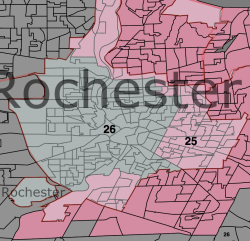
This is one of the few districts that is actually made more compact by this plan.  NY-28 is now almost completely confined to Rochester and Monroe Co. (including the most Democratic parts, ofcourse) with a sliver protruding south to Geneseo  (home of SUNY-Geneseo) in Livingston Co.  The Democratic percentage goes down, but the seat remains safe for a Democrat.

So that’s my plan for New York.  Thanks.

MI-Gov: Cherry Drops Out

Big news:

Lt. Gov. John Cherry ended his sputtering Democratic campaign for governor, saying he was unable to raise the money he needed.

“I was not successful in that endeavor to the degree that was needed. With that in mind, I have come to the conclusion that to wage a successful campaign will be difficult at best,” Cherry said in a prepared statement.

Cherry, who had not formally announced his candidacy, expressed disappointment for those who had worked on his campaign and contributed money.

Given that Cherry had some significant troubles in the polls, this move is probably a good thing for Democrats. Perhaps someone with fewer connections to the Granholm administration like Lansing Mayor Virg Bernero will seize upon this opportunity.

UPDATE (Crisituntiy): Politico has a few other tidbits, in a piece provocatively titled “Dems cheer Cherry’s exit from race:” for starters, it sounds like Cherry may have been shown the door (or at least pointed in that direction) by Beltway Democrats.

Cherry was in Washington last month to meet with Democratic officials, where they showed him bleak polling numbers and questioned whether he would be able to win the contest.

The article also states that multiple Democratic sources say state House speaker Andy Dillon will be entering the race. (Dillon has already made his interest in the race known and has shown up often in polls of the Democratic primary, but hasn’t taken official steps yet.) Dillon has had poor relations with organized labor, though, and would probably still draw a serious challenge. Politico also says that Lansing mayor Virg Bernero, as speculated above, is “also expected” to enter the race, although they don’t even rely on unidentified sources for that.

Also, a variety of minor Dems are already in the race and presumably now more motivated to stay in: state Rep. Alma Wheeler Smith, former state Rep. John Freeman, Flint mayor Don Williamson, and MSU trustee (and former football coach) George Perles. The removal of front-running Cherry mightily scrambles the field — but given Cherry’s weak numbers and weak fundraising, we may in fact be better off rolling the dice on someone else here.

RaceTracker Wiki: MI-Gov

Democratic Governors Association raised big money in 2009

Democratic incumbent governors are facing some tough races in 2010, but fortunately the Democratic Governors Association will be in a position to help in key states.

Link:

The Democratic Governors Association raised $23.1 million in 2009, more than ever before in the organization’s history, and will start the 2010 election cycle with nearly 12 times as much cash on hand as 2006, the last equivalent election cycle, Chairman Gov. Jack Markell announced today. […]

The DGA’s 2009 fundraising marks the second year in a row and the first off-year in which the DGA raised more than $20 million. Fourth quarter fundraising was by far the strongest, with more than $7 million in contributions received during the period. December contributions alone totaled nearly $4 million.

The record-breaking fundraising means that the DGA begins 2010, the most critical gubernatorial cycle in a generation, with $17.5 million on hand. In the equivalent election cycle in 2006, the DGA carried over $1.5 million and spent less than $14 million on races that year.

The Republican Governors Association has historically outraised the DGA by wide margins. In spite of the fundraising gap, since 2007, the DGA has won twice as many targeted governors races as the RGA. The DGA’s strong cash-on-hand position means that it will be able to spend at a competitive level with the RGA in this critical cycle.

Losing the governor’s races in New Jersey and Virginia was painful enough, and I am glad to know that those campaigns didn’t deplete the DGA’s cash reserves.

Here in Iowa, Governor Chet Culver may need the DGA’s help to keep pace with Republican expenditures. Culver held lots of fundraisers during the fall, but he also spent money running a couple of television commercials statewide. The leading Republican challenger, Terry Branstad, probably pulled in big numbers during the fourth quarter, although he will have to spend a lot of cash before the Republican primary in June. The other strong Republican candidate, Bob Vander Plaats, has a lot of support from conservative activists and should have the resources to run a solid campaign.

Most Recent Times Rasmussen has been wrong

Since there has been so much talk about Rasmussen polls andwhether or not they are accurate, I decided to post some of the most recent times Rasmussen was wrong.

NC-GOV: 2008

Rasmussen Final Poll

51% McCrory

47% Perdue

Actual Result

50% Perdue

47% McCrory

MN-SEN: 2008

Rasmussen Final Poll

43% Coleman

39% Franken

Actual Result

42% Franken

42% Coleman

Florida President-2008

Rasmussen Final Poll

50% McCain

49% Obama

Actual Result

51% Obama

48% McCain

North Carolina President-2008

Rasmussen Final Poll

50% McCain

49% Obama

Actual Result

50% Obama

49% McCain

Indiana President-2008

Rasmussen Final Poll

49% McCain

46% Obama

Actual Result

50% Obama

49% McCain

MO-SEN: 2006

Rasmussen Final Poll

49% Talent

48% McCaskill

Actual Result

50% McCaskill

47% Talent

SSP Daily Digest: 1/4

KY-Sen: I’ve never heard of Bill Johnson before, but bringing six figures to the table is bound to gain some attention. The western Kentucky businessman, who’s running in the Republican Senate primary, said he’s loaning himself $250,000 to try and garner some notice in the big-$ primary between Trey Grayson and Rand Paul.

LA-Sen: I never thought I’d see the day when urea formaldehyde would become a campaign issue, but Democrats are hoping to use it against David Vitter in the Bayou State. Vitter (who has the backs of Louisiana’s large chemical industry) has been placing a hold on a new EPA administrator’s nomination, partly over concerns that the EPA will more heavily regulate formaldehyde. Unfortunately for Vitter, more than 34,000 Louisiana residents have first-hand experience with urea formaldehyde, outgassing from the paneling of their FEMA-provided post-Katrina trailers.

MA-Sen: Republican State Sen. Scott Brown has an uphill fight in this month’s special election to overcome the state’s Dem lean and perhaps sentimental desires to keep Ted Kennedy’s seat in Democratic hands. Still, he got an endorsement from the state’s most popular conservative: Red Sox great Curt Schilling.

NH-Sen: Salt shaker at the ready? ARG has a new poll out of general election matchups in the New Hampshire Senate race, showing a single-digit edge for Republican AG Kelly Ayotte over Democratic Rep. Paul Hodes, 43-36 (their last poll, from September, also gave Ayotte a 7-pt edge). They also poll Hodes against conservative upstart Ovide Lamontagne for the first time, and, in a bit of a head-scratcher, find a similar margin for the less-known and, one would think, less electable Lamontagne, who leads Hodes 37-31.

MI-Gov: Here’s a Rasmussen poll that slipped our notice over the holidays; as one might expect, Santa Rasmussen had a big lump of coal for John Cherry’s stocking. All three Republicans lead the Democratic Lt. Governor, as other pollsters generally find, but Rasmussen still manages to depart from the other pollsters’ findings: AG Mike Cox, who has generally polled the best against Cherry, here has the smallest edge over him (only 39-34), while loudmouthed right-wing Rep. Pete Hoekstra has the biggest edge (46-32). (This poll was taken before Hoekstra’s grandstanding over the attempted plane bombing, which would serve to raise his name rec outside his western Michigan home turf.) Oakland Co. Sheriff Mike Bouchard leads Cherry 42-32. One hope for Cherry, though, is that, in terms of favorables, he still has higher unknowns than any of the Republicans, giving him room to grow.

RI-Gov: Jan. 4 has been penciled in as the official launch date for Lincoln Chafee’s independent campaign for Rhode Island for a while now. With it comes news that (against a backdrop of mediocre fundraising so far) he’ll be dipping into the family fortune to propel his race; he just lent his campaign another $200K after starting it off with a previous $110K. Compared with Dem state Treasurer Frank Caprio’s $1.5 million, Chafee has a lot of ground to make up. Meanwhile, Republicans would still like a candidate… any candidate.

AL-05: Looks like recent turncoat Parker Griffith is having a busy day today, answering his own phones and making his own coffee. Almost his entire staff resigned en masse today, unwilling to join him on his foray into the Republican fold.

CA-19: Another sort-of-well-known Republican is scoping out the new open seat in the 19th: former SoS, former Assembly minority leader, and 2004 Senatorial loser Bill Jones is considering the race. Fresno city councilor Larry Westerlund is also looking at the race, which already has state Sen. Jeff Denham and former Fresno mayor Jim Patterson in the GOP field… and, as of this afternoon, former CA-11 Rep. Dick Pombo. (I wonder if Tom McClintock is interested in running here? He’s gotta be feeling restless again, having represented CA-04 for a full year now.)

MN-01, MN-02, MN-03: We might actually wind up with a Democratic former elected official running in John Kline’s 2nd but not in the theoretically more-vulnerable 3rd next door. Former state Rep. Shelly Madore of Apple Valley (who was defeated by a Republican in 2008) has decided to get into the race in Minneapolis’s southern suburbs. (H/t Andrew.) Speaking of the 3rd, Democratic challenger Maureen Hackett is the first to hit the airwaves with a new radio spot; she faces a primary fight with state PTA president Jim Meffert, and the winner takes on freshman Republican Rep. Erik Paulsen. Finally, as expected, it only took Republican ex-state Rep. Allen Quist a few weeks to start bringing the crazy over in the 1st, as seen in recent comments that beating “radical” Democrats in Washington is a bigger battle than beating terrorism.

NY-20, NY-Comptroller: Republican John Faso (the former Assembly minority leader and 2006 gubernatorial loser) was getting touted for a number of different races: for a run for Comptroller, against Rep. Scott Murphy in the 20th, or maybe even for NY-Sen-B if no other Kirsten Gillibrand challenger stepped up. It looks like he won’t be doing any of those things, saying it’s “doubtful” he’ll run for anything this year. State party chair Ed Cox is pushing Emil Henry Jr. for the GOP’s Comptroller slot now (Henry, a former Lehman Bros. exec, had earlier been trying to generate some interest for a gubernatorial run, apparently to little avail).

PA-04: Insiders are leaking that former W.D. Pa. US Attorney (and loyal Bushie) Mary Beth Buchanan is increasingly likely to run against Rep. Jason Altmire this year, although the word is she’ll make her decision “soon.” On the flipside, this may mean the likelihood of state House minority whip Mike Turzai running for the GOP is going down.

TN-08: Jackson-area physician Ron Kirkland will be joining the GOP field, now that this seat is a more tempting target with the retirement of long-time Democratic Rep. John Tanner. Kirkland joins “farmer” (or agribusiness kingpin, if you prefer)/gospel singer Stephen Fincher, who’s already off to a big fundraising start.

TX-10: With a nasty hole in the lineup looming with the departure of promising candidate Jack McDonald, here’s a big-time save by veteran Ted Ankrum, who’ll file to take McDonald’s place in the 10th. Ankrum, you might recall, was our 2006 nominee in the 10th, and his strong performance with almost no funding is what drew a lot of Dem attention to the potential winnability of this rapidly-bluening seat. (Speaking of filing, the filing deadline in Texas is today. Primaries are soon, too – March 2nd, with potential run-offs on April 13th. Check out SSP’s full sortable primary calendar, if you haven’t before.)

GA-SoS: With current Secretary of State Karen Handel resigning midterm in order to pursue her gubernatorial bid, Republican Gov. Sonny Perdue got the chance to hand-pick a successor. 38-year-old state Rep. Jim Cole, a member of the House’s leadership, will serve out the remaining year of her term and then run for a full term in 2010. (UPDATE: Or not. Cole has already turned down Perdue’s offer; former state Sen. Brian Kemp now sounds likely to be offered the job. H/t RuralDem.)

Mayors: Lt. Gov Mitch Landrieu’s path to be the next mayor of New Orleans looks even easier now. His main opposition, state Sen. Ed Murray, opted to drop out, acknowledging that he didn’t want to suffer through an expensive and racially-divisive (Murray is African-American) campaign.

NRCC: Looks like we’re not the only ones taking notice of the NRCC’s cash-on-hand problems, as the legacy media start to take notice: Politico observes that right now the NRCC has enough money to fund about one big-name House race, not the dozens they’re trying to put into play with various recruiting successes.

RNC: Reid Wilson has an interesting catch: the RNC is sending money ($20K) to the local party in the Northern Mariana Islands (popu. 86,000), which, of course, don’t have a voting member of the House or any electoral votes. It looks like it may be a little payback from Michael Steele, who owes his chairmanship to votes from the NMI and other insular territories.

Polltopia: Politico also belatedly picks up on another favorite theme in the liberal blogosphere: what the hell is up with Rasmussen’s numbers? Nate Silver judiciously examined the issue too, over the weekend, pointing out that Rasmussen’s well-documented “house effects” aren’t necessarily indicative of bias per se. Rasmussen’s defenders, of course, will point to Nate’s ratings of Rasmussen’s accuracy, which are high; fitting, as their numbers do tend to converge with reality in a race’s final weeks (as we saw last November in NJ and VA). Still, one question wasn’t raised in either of these pieces over the weekend: how to hold Rasmussen to account for showing out-of-whack numbers long before the election, before they start to fall in line with everyone else (and when they, by virtue of Rasmussen’s frequent polling, can play a large role in shaping the conventional wisdom about who’s up and who’s down)?

Maps: A denizen of the forums at Dave Leip’s site has put together an even better set of maps of presidential election results by county, dating back to 1840. (H/t metstotop333.)(D)

Redistricting: A reminder – if you post an entry in the redistricting contest, please e-mail your .DRF.XML file to jeffmd [at] swingstateproject [dot] com. (Instructions for finding your file are here.) This will make it a lot easier for Jeff to judge entries. And the deadline to submit your entry is fast approaching – Sunday, January 10th at midnight Eastern time. (D)

Also, on the redistricting front, Politics Magazine has a lengthy piece on Democrats’ efforts to avoid getting out-hustled by the GOP in both congressional and state-level redistricting. Hint to Bill Burke’s Foundation for the Future and Brian Smoot’s Democratic Redistricting Trust: Reach out to the redistricting geeks here at the Swing State Project. We’re a great untapped resource. One interesting note: This is the first time since the passage of the Voting Rights Act that the White House (and thus the Department of Justice) will be in Democratic hands during the start-to-finish redistricting process. (D)

Census: The Census Bureau is rolling out a $340 million ad blitz over the next few months to make sure that everyone knows about the Census and that they need to participate. The rollout includes two ads (directed by Christopher Guest and starring Ed Begley Jr., which ought to get the right-wingers a-foamin’ at the mouth) during the Super Bowl, but also $80 million in ad outreach to non-English-speaking populations. Talking Points Memo also has a neat observation about Rep. Michele Bachmann, once the Census’s greatest foe but who’s been surprisingly quiet in her criticisms of it lately: she may need to rely on huge Census turnout by Minnesotans to keep Minnesota at 8 seats, and thus, keep her own seat (the likeliest target for elimination if the state needs to drop to 7 and Dems exclusively control the process).  

SC-01: Henry Brown Calls It Quits

It looks like House Democrats aren’t the only ones heading to the exits this year — electorally-vulnerable Republicans can get in on the act, too! Cue up a retirement from an oh-so-unsurprising source: GOP Rep. Henry “Smokey” Brown. From the Politico:

Rep. Henry Brown, a five-term South Carolina Republican from a conservative-leaning district, has told associates he will his announce his retirement Monday, POLITICO has learned.

He will be making his announcement at a press conference tomorrow afternoon back in his coastal Carolina district

Brown survived a closer-than-expected re-election in 2008 and was already facing a primary challenge from Carroll Campbell III, the son of the former GOP governor and congressman.

Brown, who was nearly decapitated by Democrat Linda Ketner in 2008, was facing a potentially crowded primary from “Tumpy” Campbell, Mt. Pleasant Town Councilman Mark Fava, Isle of Palms councilman Ryan Buckhannon, and “frequent candidate” Katherine Jenerette. Attorney Paul Thurmond (Son of Strom) has also been in the mix as a potential GOP candidate.

Democrats have been making noises about seriously contesting this coastal R+10 district again this year, but it’s unclear who will be the nominee. One of the leading contenders for the nomination, state Rep. Leon Stavrinakis, said that he would make a decision last July, but has since remained silent on the subject. Georgetown restauranteur Robert Dobbs, a political newcomer, is in. Robert Burton, a former South Carolina Housing, Finance, and Development Authority Commissioner and U.S. Air Force Colonel, is also in. Burton has a bit more political seasoning — he lost a statewide race for SC Adjutant General in 1998. Retired navy officer and accountant Dick Withington rounds out the current primary field. Attorney Ashley Cooper, a former Fritz Hollings aide, has also been reportedly mulling the race. We’ll see how this one shakes out.

UPDATE (Cristunity): Politico is rolling out lots of names of potential other Republicans in addition to the ones we’ve already mentioned. Most notable may be former Rep. Tommy Hartnett, who held the forerunner to this seat in the 80s. (Hartnett is 68, not much younger than the retiring Brown.) Other potential names listed by former state chair (and almost RNC chair) Katon Dawson include state Sen. Luke Rankin, state Rep. Chip Limehouse, and state Sen. Chip Campsen. The rumor mill also points to state Sen. Raymond Cleary, state Rep. Alan Clemmons, and… this seems like an out-of-the-box pick, but she may have emerged from last years’ events with her personal popularity increased… first lady Jenny Sanford. Finally, on the Dem side, it’s worth noting that restaurant owner Robert “Bob” Dobbs does have a political track record, as a former county commissioner — unfortunately, that was in Manitowoc County, Wisconsin.

RaceTracker Wiki: SC-01

Contest Entry: New York 28-0

Overall Plan

This entry in the redistricting contest creates 28 Democratic seats and 0 Republican seats. I expect Peter King to lose against Carolyn McCarthy, Chris Lee to lose against Brian Higgins, two Democrats to win in new districts, and one of Scott Murphy or Bill Owens to lose in a primary.

I aimed for compact districts, by and large. Some districts stretch this a little (e.g., 16 and 18), but most are more compact than they used to be. There are no earmuffs like NY-26. There are no water connections over uninhabited islands like NY-08. There’s no connecting through a Con Ed plant to pick up population from Rikers Island like NY-15. Perhaps the only cheap trick was connecting the new Velázquez district through Prospect Park. I even refrained from drawing a thin tendril from Meeks’s district to King’s house.

I was very careful to ensure that a representative actually lives in a district if I assert that I’m drawing a district for him or her. This was rather constraining in several cases. However, I avoided relying on incumbency to keep districts safe, since most of the NY delegation will retire before the next round of maps goes into effect in January 2023.

Along a similar line, I tried to keep Democratic incumbents with at least some of their base of support. For example, since Massa’s current district runs to the Rochester suburbs, I kept it that way rather than giving him some kind of Buffalo-based or Binghamton-based creation. (But when an incumbent, such as Slaughter, has two very distinct bases of support, I only aimed to keep one of them – in Slaughter’s case, it was Rochester rather than Buffalo.) Our incumbents have worked hard to build relationships with local leaders and activists in their current districts, and I’d rather not take that away from them.

All districts are within 100 votes of the target population, except for the three westernmost districts, which are within 200.

Photobucket

Photobucket

Photobucket

Districts by Geography

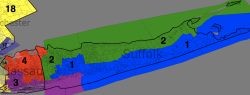
On Long Island, I’ve reconfigured the two Suffolk districts into an east-west alignment to even out the Democratic advantage between them. In Nassau, I’ve carved King’s district up between Ackerman (whose district is now almost entirely outside the City) and McCarthy, and placed some Republican areas along the NYC border into Meeks’s and Weiner’s districts.
Photobucket

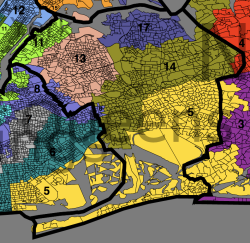
In Queens, Meeks’s district is roughly the same as before, although it now encompasses some Black and Republican areas in Nassau and Brooklyn. Weiner’s district is still based in Forest Hills, but now spills eastward towards Nassau rather than westward into Brooklyn. Lowey’s new district reaches down into Whitestone. Crowley’s district has been consolidated into a compact area of western Queens, and Maloney still has about the same area.
Photobucket

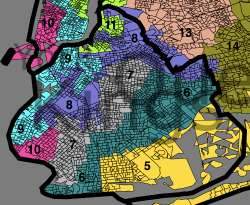
Most of Brooklyn is in VRA districts. Velázquez’s district is heavily Democratic, since I found that I had to use almost entirely Democratic precincts in order to build a 48% Hispanic district. However, I found that it was easy to build solidly Democratic 50% Black districts that had spare capacity to take on Republicans from southern Brooklyn. Therefore, most of southern Brooklyn is divided among the 50% Black VRA districts of Meeks, Towns, and Clarke. Most of the remainder (White Democratic areas like Brooklyn Heights and Park Slope) goes to Nadler, while McMahon and Maloney each represent small areas near the cores of their districts.
Photobucket

Staten Island is in McMahon’s district. If McMahon were to lose in 2010, I would want to split the island across two safely Democratic districts.

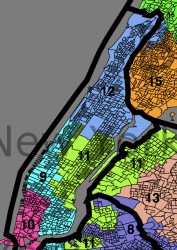
Lower Manhattan is split between McMahon (who needs the Democratic votes) and Nadler. Midtown and Uptown up to about 96th are split between Nadler and Maloney, as is roughly the case today. Harlem is still in Rangel’s district.
Photobucket

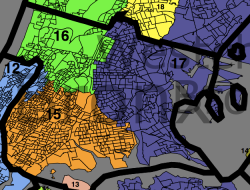
In the Bronx, Serrano’s district is substantially similar to its current form, although Rangel and Engel both get some of his current Democratic Hispanic votes. The rest is split among two of the districts districts that extend up into Westchester and beyond.
Photobucket

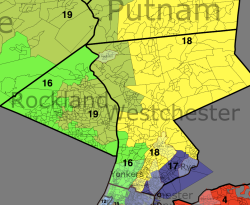
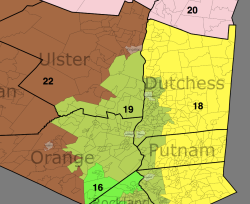
I have divided the northern Metro Area into four districts. Two (Engel and Lowey) have significant Democratic populations from New York City, which allows Engel to take Republican precincts from further Upstate. Hall also extends through Democratic areas nearly to NYC, which allows him to take Republican precincts from further Upstate as well. In particular, Rockland County is carefully divided between Republican precincts (which go to Engel) and Democratic precincts that can be used elsewhere. This allows me to create a fourth new district in the Hudson Valley, which goes from Poughkeepsie down to New City.
Photobucket

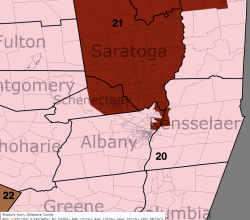
I split the Capital Region into two districts, one for Tonko and one for either Murphy or Owens. I judged Owens’s current district too tenuous to maintain in its existing form, so I split the North Country into three parts to attach to Maffei’s, Arcuri’s, and Murphy or Owens’s districts.
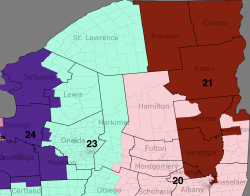
PhotobucketPhotobucket

In Central New York, Utica and Syracuse each have one district. Binghamton also has a district, which extends eastward to Kingston and Middletown, as it does today. However, I transferred Ithaca from Hinchey to Arcuri in order to solidify Arcuri.
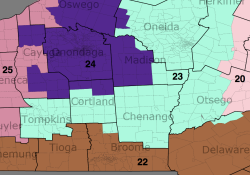
Photobucket

After the 2000 Census, the redistricters drew four districts for Western New York, intending to have them split 3-1 Republican. Their map connected parts of Rochester and Buffalo along a narrow strip to create a packed Democratic district, and then splintered the remaining Democrats among three other districts that they intended for Republicans. However, the four-district region as a whole leans Democratic, so one can create four Democratic districts just by giving each of the four districts an equal number of Democrats. In order to prevent Lee from stealing a district, I’ve put his residence into Higgins’s district and have drawn the incumbent-less district so that it has more Democrats than the other three.
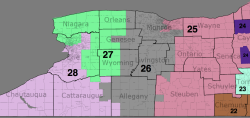
Photobucket


District Summaries

NY-01

Incumbent: Tim Bishop (D) lives in precinct Southampton 6.

Population: 700259

Population % by Race
Wh Bl Hisp Asn Nat Oth
75 6 15 2 0 2
Presidential Voting
New Old 1
Obama % 53.91 51
McCain % 45.56 48

Description: District 1 covers the southern half of Suffolk County, from Brentwood and Central Islip out to the Hamptons. It omits a strip of Republican land along the beach opposite Jones Beach and Fire Islands.

The current NY-01 was drawn to favor a former Republican incumbent, Felix Grucci, and contains all of Republican-leaning eastern Suffolk. In order to equalize the Democratic performance of Districts 1 and 2, I’ve reconfigured them so that each one gets a share of Republican-leaning eastern Suffolk. Thus, a large number of people from the North Fork are moving from NY-01 to NY-02, and a large number of people from the neighborhood of Brentwood and Central Islip are moving from NY-02 to NY-01.
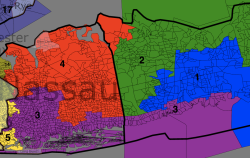

Photobucket
Photobucket


NY-02

Incumbent: Steve Israel (D) lives in precinct Huntington 100 in Dix Hills.

Population: 700383

Population % by Race
Wh Bl Hisp Asn Nat Oth
81 8 7 3 0 1
Presidential Voting
New Old 2
Obama % 53.36 56
McCain % 46.49 43

Description: District 2 covers the northern half of Suffolk County, from Huntington and Commack, out through Coram to the North Fork.


Photobucket
Photobucket


NY-03

Incumbents: Carolyn McCarthy (D) lives in precinct North Hempstead 111 in Mineola; Peter King (R) lives in precinct Hempstead 36 in Seaford.

Population: 700386

Population % by Race
Wh Bl Hisp Asn Nat Oth
73 11 11 3 0 2
Presidential Voting
New Old 3 Old 4
Obama % 53.23 47 58
McCain % 46.04 52 41

Description: District 3 covers Democratic southwestern Nassau County (Hempstead, Garden City, Valley Stream, Freeport) along with a strip of Republican territory on the shore well into Suffolk County.

In 2008, King outperformed McCain significantly in his district, while McCarthy outperformed Obama modestly in her district. In an incumbent-incumbent race, I expect McCarthy to be able to win in a D-leaning district with 22% Black+Hispanic, particularly since about 2/3 of the district’s population comes from her old NY-04.


Photobucket


NY-04

Incumbent: Gary Ackerman (D) lives in precinct North Hempstead 99 in Roslyn Heights.

Population: 700388

Population % by Race
Wh Bl Hisp Asn Nat Oth
79 6 8 6 0 1

63

36

Presidential Voting
New Old 3 Old 5
Obama % 52.88 47
McCain % 46.35 52

Description: District 4 covers most of northern and eastern Nassau County, including Levittown, Hicksville, Oyster Bay, and Port Washington.

This coincides in large part with Peter King’s old NY-03. However, it also includes Democratic territory around Plainview and Port Washington, and it excludes the Republican shore. If King moved into this new district, he could conceivably pull an upset if Ackerman has forgotten how to run a competitive race. (This would be similar to how Tim Holden upset George Gekas in central Pennsylvania after they were thrown together in a Republican-leaning district.)


Photobucket
Photobucket


NY-05

Incumbent: Gregory Meeks (D) lives in precinct Queens 33-28 in St. Albans.

Population: 700255

Population % by Race
Wh Bl Hisp Asn Nat Oth
28 50 11 5 0 5
Presidential Voting
New Old
Obama % 78.94 89
McCain % 20.73 11

Description: As a VRA district, District 5 covers the Black areas of eastern Queens, St. Albans and Far Rockaway. It also covers several nearby Republican areas: the Five Towns, Rockaway Peninsula, and (through a connection across the Flatbush Ave. Bridge) Sheepshead Bay and Manhattan Beach.

This district achieves its required 50% Black population in southeastern Queens, and then uses its spare capacity to help achieve two goals: 1) It takes Republican votes from the Five Towns that might otherwise help King. 2) It helps break up the large White Republican sections of southern Brooklyn into irrelevant pieces. Currently, Weiner’s district achieves this second goal, but I prefer to use Weiner to inoculate Republican votes in Queens.

One more thing: For historical reasons, Section 5 of the VRA does not apply to Queens, only to the other three major boroughs. I think it would be a good thing to investigate whether Meeks’s district could be broken up to help out McCarthy and Ackerman against King. Meeks could still win a ~40% Black district handily. But maybe there’s a Section 2 thing that I’m not understanding?


Photobucket
Photobucket
Photobucket


NY-06

Incumbent: Ed Towns (D) lives in precinct 54-56 in East New York.

Population: 700355

Population % by Race
Wh Bl Hisp Asn Nat Oth
30 50 13 4 0 3
Presidential Voting
New Old 10
Obama % 79.82 91
McCain % 19.9 9

Description: As a VRA district, District 6 covers certain Black areas of Brooklyn (East New York, Brownsville, Canarsie, Flatlands). It also covers some nearby Republican areas around Gravesend and Brighton Beach.

This is another “Blacks and Republicans” district that achieves its required 50% Black population in one area, and then stretches out to White southern Brooklyn to split up the McCain votes there.


Photobucket


NY-07

Incumbent: Yvette Clarke (D) lives in precinct Brooklyn 43-78 in Prospect Gardens.

Population: 700389

Population % by Race
Wh Bl Hisp Asn Nat Oth
31 50 9 7 0 3
Presidential Voting
New Old 11
Obama % 79.31 90
McCain % 20.33 9

Description: As a VRA district, District 7 covers certain Black areas of Brooklyn (Bed-Stuy and Crown Heights). It also covers some nearby Republican areas, such as Mapleton and Bensonhurst.

This is another “Blacks and Republicans” district that achieves its required 50% Black population in one area, and then stretches out to White southern Brooklyn to split up the Republican votes there. Currently, Nadler’s district does this, but I prefer to make Nadler’s district less spectacularly gerrymandered than it is today.


Photobucket


NY-08

Incumbent: Nydia Veláquez (D) lives in precinct Brooklyn 72-100 in Carroll Gardens.

Population: 700328

Population % by Race
Wh Bl Hisp Asn Nat Oth
19 20 48 9 0 4
Presidential Voting
New Old 12
Obama % 88.22 86
McCain % 11.14 13

Description: As a VRA district, District 8 covers Hispanic areas of Brooklyn (Bushwick, some of Williamsburg, Boerum Hill, Sunset Park, and Kensington). It connects the two large Hispanic populations with a narrow strip through Prospect Heights and Prospect Park.

The Hispanic population of Brooklyn is barely large and concentrated enough to sustain a high-percentage district. Because of this, I avoided putting any nearby non-Hispanic areas in the district, such as Park Slope, Greenpoint, or the Republican sections of southern Brooklyn.


Photobucket
Photobucket


NY-09

Incumbent: Jerrold Nadler (D) lives in precinct Manhattan 35-67 on the Upper West Side.

Population: 700352

Population % by Race
Wh Bl Hisp Asn Nat Oth
52 11 18 16 0 3
Presidential Voting
New Old 8
Obama % 85.33 74
McCain % 13.85 25

Description: District 9 runs from the UWS, through Chelsea, and over to the LES. Then it crosses the Brooklyn and Manhattan Bridges, and covers several neighborhoods in Brooklyn: Brooklyn Heights, Park Slope, Red Hook, and Bay Ridge.

The Brooklyn portion of the district consists (by and large) of White Democratic neighborhoods. These are the neighborhoods that are not covered by the VRA districts.

I would ideally like to extend this district far enough down into Bay Ridge so that McMahon’s district would contain none of Brooklyn. However, it is difficult to do this and still have the district reach Nadler’s apartment on 70th St. In the end, I’m satisfied that McMahon’s district is sufficiently Democratic.


Photobucket
Photobucket


NY-10

Incumbent: Mike McMahon (D) lives in precinct Staten Island 61-35 on the northern part of the island (I don’t know neighborhood names).

Population: 700426

Population % by Race
Wh Bl Hisp Asn Nat Oth
72 7 11 8 0 2
Presidential Voting
New Old 13
Obama % 57.29 49
McCain % 41.95 51

Description: District 10 covers all of Staten Island, part of Bay Ridge in Brooklyn (connected by the Verrazano-Narrows Bridge), and the western half of Lower Manhattan (connected by the Staten Island Ferry).

The existing NY-13 was drawn to favor former Republican congressman Vito Fossella. A major goal of any Democratic redistricting should be to make this into a safe Democratic district. I accomplish this by adding a large portion of heavily Democratic Lower Manhattan. If there were a Republican incumbent, I would have split Staten Island into two pieces in order to guarantee the Republican’s defeat. However, that seems like overkill to shore up the seat for a sitting Democrat.


Photobucket
Photobucket


NY-11

Incumbent: Carolyn Maloney (D) lives in an unknown precinct on the Upper East Side (I’m assuming between 59th and 96th).

Population: 700270

Population % by Race
Wh Bl Hisp Asn Nat Oth
70 4 13 4 0 3
Presidential Voting
New Old 14
Obama % 77.09 78
McCain % 22.06 21

Description: District 11 covers the Upper East Side and Midtown East in Manhattan, Astoria and Long Island City in Queens, and Greenpoint and Williamsburg (the non-Hispanic parts) in Brooklyn. Although not visible on the Brooklyn map, the two sections of Brooklyn are connected by a couple precincts near the waterfront.

This district is very similar to Maloney’s current district.


Photobucket
Photobucket
Photobucket


NY-12

Incumbent: Charlie Rangel (D) lives in precinct Manhattan 70-31 in Harlem.

Population: 700336

Population % by Race
Wh Bl Hisp Asn Nat Oth
13 31 51 3 0 2
Presidential Voting
New Old 15
Obama % 93.62 93
McCain % 5.79 6

Description: District 12 covers Harlem (including Spanish Harlem) and Washington Heights, as well as a bit of the South Bronx. It has majority-minority (in fact, majority Hispanic) population.

Although this district has traditionally been considered a Black district, it is now majority Hispanic. There is a strong possibility of a Hispanic representative once Rangel retires or is driven out of office because of corruption.

I live in this district.

Photobucket
Photobucket


NY-13

Incumbent: Joe Crowley (D) lives in precinct Queens 30-45 in Woodside.

Population: 700405

Population % by Race
Wh Bl Hisp Asn Nat Oth
33 6 38 19 0 3
Presidential Voting
New Old 7
Obama % 71.26 79
McCain % 27.99 20

Description: District 13 covers several neighborhoods in Queens, including Jackson Heights, Corona, and Middle Village.

This district is quite different from the old NY-07, which reaches into the Bronx. I’m not sure why NY-07 has such a strange shape, and I see no good reason for it.

District 13 is a rare diverse district in the age of VRA-based segregation – no racial group exceeds 40% of the population. If Crowley retires in the coming decade, one could imagine a White, Hispanic, or Asian representative from this district. The Black voting population is actually slightly lower than 6%, since the district includes 8000 Black inmates at Rikers Island.


Photobucket


NY-14

Incumbent: Anthony Weiner (D) lives in precinct Queens 28-36 in Forest Hills.

Population: 700334

Population % by Race
Wh Bl Hisp Asn Nat Oth
41 8 19 24 0 8
Presidential Voting
New Old 9
Obama % 66.67 55
McCain % 32.64 44

Description: District 14 covers several neighborhoods in Queens. Starting at Howard Beach, it comes up through Ozone Park to Forest Hills, and then goes eastbound along the LIE to Little Neck. It also contains Great Neck in Nassau County, in order to isolate the Republican voters there from Peter King.

This district is more Democratic than the existing NY-09. That’s because the existing map uses NY-09 to fracture the Republican vote in southern Brooklyn. Instead, I use Meeks’s more heavily Democratic district to fracture Republicans in Brooklyn.


Photobucket
Photobucket


NY-15

Incumbent: José E. Serrano (D) lives in precinct Bronx 77-74 in the South Bronx.

Population:700362

Population % by Race
Wh Bl Hisp Asn Nat Oth
2 32 62 2 0 2
Presidential Voting
New Old 16
Obama % 94.60 95
McCain % 5.20 5

Description: District 15 covers the South Bronx, including the area just west of the Whitestone Bridge (Soundview?). It has a 60% Hispanic supermajority.

This district is substantially similar to the existing NY-16. However, it allows Engel to take some more Democratic votes from around Fordham campus.


Photobucket


NY-16

Incumbent: Eliot Engel (D) lives in precinct Bronx 81-67 in Riverdale.

Population: 700249

Population % by Race
Wh Bl Hisp Asn Nat Oth
53 14 26 5 0 3
Presidential Voting
New Old 17
Obama % 63.08 62
McCain % 36.26 38

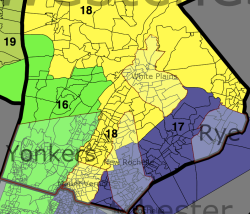
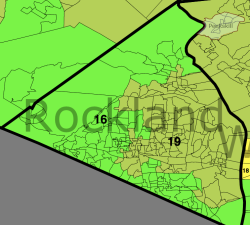
Description: District 16 covers the northwestern Bronx (Riverdale, Kingsbridge, Bedford Park) and Yonkers. It then crosses the Hudson and picks up Republican areas along the New Jersey border in Rockland and Orange Counties.

Because this district gets so many Democratic votes from the Bronx and Yonkers, it can very selectively include only Republican voting districts in Rockland County. Many voting districts in Rockland County are either very Republican or very Democratic (possibly because of the separation of the Orthodox Jewish communities from other towns up there). As a result, the remainder of Rockland County can provide a core of Democratic votes for a district in the Hudson Valley. Obama lost District 16’s portion of Rockland County (134k population) by 16%, but won the remainder (167k population) by 23%.
Photobucket
Photobucket
Photobucket
Photobucket
Photobucket


NY-17

Incumbent: Nita Lowey (D) lives in precinct Harrison 10 near Rye.

Population: 700372

Population % by Race
Wh Bl Hisp Asn Nat Oth
43 23 21 10 0 3
Presidential Voting
New Old 18
Obama % 71.91 62
McCain % 27.53 38

Description: Within New York City, District 17 covers Whitestone in Queens and most of the eastern Bronx. It then continues along the shore (New Rochelle and Rye).

Nita Lowey used to represent parts of Bronx and Queens, and she can again. In compensation for taking away most of her current district’s population, I’ve given her a heavily Democratic district majority-minority district.


Photobucket
Photobucket
Photobucket


NY-18

Incumbent: John Hall (D) lives in precinct Dover 1 in Dover Plains.

Population:700344

Population % by Race
Wh Bl Hisp Asn Nat Oth
74 11 10 3 0 2
Presidential Voting
New Old 19
Obama % 58.07 51
McCain % 41.05 48

Description: District 18 starts in Democratic Mt. Vernon next to the Bronx, and snakes its way up through Democratic White Plains to rural Putnam and Dutchess Counties.

This district is heavily Democratic, without cutting into the Hudson Valley precincts that I need for the new Democratic-leaning District 19.


Photobucket
Photobucket
Photobucket


NY-19

Incumbent: None.

Population: 700376

Population % by Race
Wh Bl Hisp Asn Nat Oth
71 11 12 3 0 3
Presidential Voting
New
Obama % 58.20
McCain % 40.79

Description: District 19 lies in the Hudson Valley, including Poughkeepsie, Newburgh, Peekskill, and the Democratic portions of Rockland County. (See description of District 16 above.)

Although this district strongly favors Democrats at the federal level, there is no Democratic incumbent. Furthermore, the state legislators are all Republican, as are the mayors of Poughkeepsie and Newburgh. I believe that a Democratic non-politician along the lines of Hall, Murphy, or Owens would claim this seat. However, if the DCCC failed to recruit effectively, this district could fall to a local Republican.

Neither Sue Kelly (lost to Hall in 2006), John Sweeney (lost to Gillibrand in 2006), nor Jim Tedisco (lost to Murphy in 2009) lives in this district.


Photobucket
Photobucket
Photobucket


NY-20

Incumbent: Paul Tonko (D) lives in precinct Amsterdam city 1.

Population: 700342

Population % by Race
Wh Bl Hisp Asn Nat Oth
89 6 3 1 0 1
Presidential Voting
New Old 21
Obama % 54.49 58
McCain % 43.68 40

Description: District 20 contains part of the Capital Region, including Albany.

This district is slightly less Democratic than its predecessor. Most notably, it gives up Democratic Schenectady and Troy in order to make the new District 21 safer.
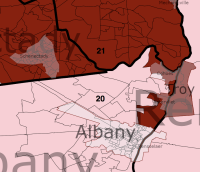

Photobucket
Photobucket
Photobucket
Photobucket
Photobucket


NY-21

Incumbent: Scott Murphy (D) lives in precinct Glens Falls 5; Bill Owens (D) lives in precinct Plattsburgh 3.

Population: 700425

Population % by Race
Wh Bl Hisp Asn Nat Oth
92 3 2 1 0 1
Presidential Voting
New Old 20 Old 23
Obama % 54.90 51 52
McCain % 43.41 48 47

Description: District 21 runs along the Vermont border, containing Schenectady, Troy, Saratoga Springs, and Plattsburgh.

The existing NY-20 and NY-23 were both created for Republican incumbents, and neither is particularly attractive to Democrats. Rather than contort district boundaries to preserve seats for both of these Blue Dogs, I prefer to carve up the moderate/Republican North Country to give safer seats to one of them and to Arcuri.

In a head-to-head primary, both candidates would have a reasonable chance of winning, since many of the Democratic votes would come from around Schenectady and Troy, which are presently in Tonko’s district.

Of course, there’s a real chance that one of these incumbents will lose in 2010. If that happens, then this district should favor the Democratic incumbent. Jim Tedisco (lost to Murphy) and Doug Hoffman (lost to Owens) both live in this district, but Dede Scozzafava (withdrew against Owens) does not.


Photobucket
Photobucket
Photobucket


NY-22

Incumbent: Maurice Hinchey (D) lives in precinct Hurley 3.

Population: 700380

Population % by Race
Wh Bl Hisp Asn Nat Oth
87 5 5 2 0 1
Presidential Voting
New Old
Obama % 53.24 59
McCain % 45.30 39

Description: District 22 contains Kingston, Middletown, Binghamton, and Elmira.

Giving Democratic Ithaca to Hinchey only makes sense if one is trying to pack Upstate Democratic votes in order to create Republican seats. This new district has enough Democrats from Binghamton and the Hudson Valley to be easily winnable.

Hinchey (born 1938) will probably retire during the next decade, and Republicans could make a play for this district in an open-seat election. However, the eastern part of the district is quickly becoming more Democratic (see Sue Kelly and John Sweeney), and I would expect Democrats to hold the seat.

Since the average district size increased by 4%, this new District 22 can span about the same amount of longitude without looking quite as goofy as the old NY-22.


Photobucket
Photobucket
Photobucket


NY-23

Incumbent: Michael Arcuri (D) lives in precinct Utica 4.

Population: 700382

Population % by Race
Wh Bl Hisp Asn Nat Oth
92 3 2 2 0 1
Presidential Voting
New Old 24
Obama % 52.62 50
McCain % 45.66 48

Description: District 23 contains Potsdam, Utica, and Ithaca.

Arcuri looked surprisingly weak in the 2008 election. However, with the advantage of incumbency and a district that’s a few percent safer, he should be able to hold his seat. He is one of the few Democratic incumbents who may stay in Congress until 2030.


Photobucket
Photobucket


NY-24

Incumbent: Dan Maffei (D) lives in precinct DeWitt 3 near Syracuse.

Population: 700338

Population % by Race
Wh Bl Hisp Asn Nat Oth
87 7 2 2 1 2
Presidential Voting
New Old 25
Obama % 55.45 56
McCain % 42.76 43

Description: District 24 contains Syracuse and Watertown.

This is the safest of the seats in the central part of the state. Its Democratic performance is similar to Maffei’s old district, but it crucially takes its non-Syracuse Democratic votes from the North rather than from the Rochester area. This allows the Rochester area to be split into Democratic-leaning districts.


Photobucket
Photobucket


NY-25

Incumbent: Eric Massa (D) lives in Corning city.

Population: 700395

Population % by Race
Wh Bl Hisp Asn Nat Oth
91 4 2 1 0 1
Presidential Voting
New Old 29
Obama % 52.64 48
McCain % 45.92 50

Description: District 25 is based in the Rochester area, containing the eastern part of the city, and most of the northeastern suburbs. It goes along the Lake Ontario coast as far East as Oswego, and also extends to the Finger Lakes Region (Auburn, Geneva, Canandaigua) and down through rural areas to the Pennsylvania border.

This district is much safer for Massa than the old NY-29.
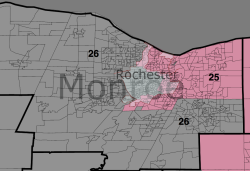

Photobucket
Photobucket
Photobucket
Photobucket


NY-26

Incumbent: Louise Slaughter (D) lives in precinct Perinton 14 in Fairport.

Population: 700170

Population % by Race
Wh Bl Hisp Asn Nat Oth
80 12 5 2 0 1
Presidential Voting
New Old 28
Obama % 53.00 68
McCain % 45.73 30

Description: District 26 is also based in the Rochester area, containing the western part of the city and most of the suburbs. It contains rural areas (including Livingston and Allegany Counties) going South to the Pennsylvania border.

To create more safe Democratic seats in western New York, I give Slaughter’s Buffalo Democrats to the new NY-27 and give some of her Rochester Democrats to Massa in the new NY-25.


Photobucket
Photobucket
Photobucket


NY-27

Incumbent: None.

Population: 700157

Population % by Race
Wh Bl Hisp Asn Nat Oth
84 11 2 2 1 1
Presidential Voting
New Old 26
Obama % 54.55 46
McCain % 43.90 52

Description: District 27 is based in the Buffalo area, containing the northern part of the city, Niagara Falls, and rural areas to the North and East.

On a map, it may appear as though this district should “belong” to Lee, if he decided to move into it. However, only about 300k of the residents are part of Lee’s current district. Nearly as many (270k) are part of Slaughter’s current district, and the remainder are largely Democrats from Higgins’s district.

Because there is no Democratic incumbent here, I’ve made it the safest Democratic seat of western New York. If Lee did decide to run here, he would face a very tough district full of Democrats who don’t know him. Furthermore, Lee is not a strong candidate. Despite a bitter three-way Democratic primary in 2008 that produced a weak candidate, Lee barely managed to outpoll McCain in his current district.

Byron Brown (mayor of Buffalo) and Alice Kryzan (lost to Lee in 2008) live in this district. Jon Powers (lost in the primary to Kryzan in 2008) and Tom Reynolds (retired in 2008) do not. I don’t know about Jack Davis (lost several times).
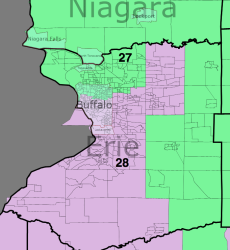
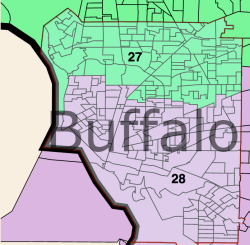
Photobucket
Photobucket
Photobucket


NY-28

Incumbents: Brian Higgins (D) lives in precinct South 19 in Buffalo; Chris Lee (R) lives in an unknown precinct in Clarence.

Population: 700176

Population % by Race
Wh Bl Hisp Asn Nat Oth
85 8 4 1 1 1
Presidential Voting
New Old 27
Obama % 54.23 54
McCain % 44.11 44

Description: District 28 is based in the Buffalo area, containing the southern part of the city, the eastern and southern suburbs, and rural Chautauqua and Cattaraugus Counties.

Higgins would certainly beat Lee in an incumbent-incumbent matchup. A considerable majority of the population comes from Higgins’s old district, and the district leans safely to Democrats.


Photobucket
Photobucket
Photobucket

By what margin will Bob Shamansky win?

View Results

Loading ... Loading ...