CT-Sen: Chris Dodd Will Retire

Whoa — now this just caps off the craziest day of horserace politics we’ve seen in a long time:

Senator Christopher J. Dodd, the embattled Connecticut Democrat who was facing an increasingly tough bid for a sixth term in the Senate, has decided to step aside and not seek re-election, Democrats familiar with his plans said Wednesday.

Mr. Dodd, 65, will announce his decision at a news conference later in the day in Connecticut.

Unlike Byron Dorgan’s tragic retirement decision in North Dakota, Dodd is actually taking one for the team here. Dodd’s well-documented baggage proved to be a tremendous burden for him in every poll we’ve seen of his re-election bid this year. PPP will also come out with a poll soon suggesting that Democrats would breathe a lot easier with longtime state AG Richard Blumenthal in Dodd’s place in November. Blumenthal has been notoriously reluctant to leave his AG perch, but he has made noises in the past year about taking a crack at the Senate (in 2012, against Lieberman), but this would be a much clearer shot for him. If he decides to pass, Democrats would have other perfectly suitable choices to turn to, including 5th CD Rep. Chris Murphy, who has proven himself to be a strong campaigner.

(Discussion already underway here and here.)

RaceTracker Wiki: CT-Sen

Contest Entry: Redistricting New York – 28 D, Zero R

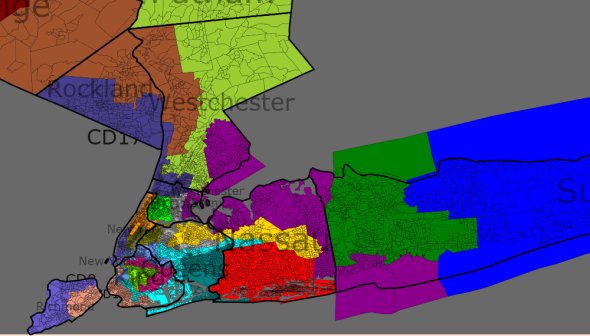
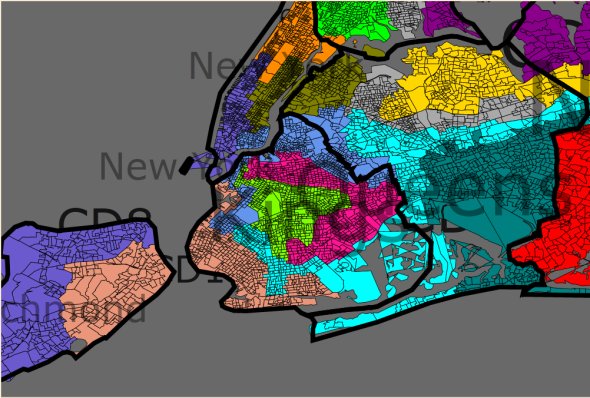
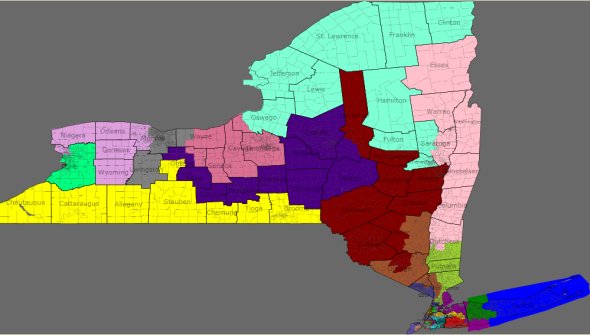
My entry in the redistricting contest. I manage to create one new Democratic district and eliminate both Republicans, while making most of the vulnerable Democrats safer.  Enjoy.


1. (Bishop) East Suffolk same as the current district.

Pop. 706,721. 84%W, 4% Bl,  2% Hisp   Obama 52%, McCain 48%

Current District:  Obama 52; McCain 48 (same breakdown)

Virtually identical to the existing district; in fact, the only one where I had to remove blocs due to expanded population.

2. (Israel) West Suffolk.

Pop 706,650  72%W, 10%Bl, 14% Hisp   Obama 55%, McCain 45%

Current District:  Obama 56; McCain 43 (down 1 point)

Adds some South Suffolk blocs; removes the Nassau blocs. More compact and contiguous than the old 2nd, and safe for Israel.  I had wanted to push this and the 1st deeper into the current 3rd, but it could not be comfortably done.

3. ( Lowey, King. Advantage Lowey). East edge of Nassau;  Oyster Bay and North Shore; Great Neck; Throgs Neck; Long Island Sound; Pelham; New Rochelle; Larchmont; Rye; Harrison; White Plains.

Pop 702,996 79% W, 4%Bl, 11% Hisp Obama 54%, McCain 45%

Current District: None

Here’s where I start to get creative. If  we must lose one district, I want it to be the one held by “King Peter”in the current 3rd.  However, way out on Long Island like that, contiguous to only a few districts, none of which can afford more Republicans, that’s hard to do.  Plus, the upstate districts lost more population than Long Island, and if we started on the other end of the state and worked east, the districts would start to look really unfamiliar by the time we got to Westchester (see what I had to do with Hinchey’s district, for example. That one made it all the way to Westchester!)  

The solution is to bring in Nita Lowey from Westchester across the Sound.  Lowey is a suburban representative who ought to be a good fit for the Long Island suburbs.  The new 3rd is about 1/3 Lowey’s old district, 1/3 of the old 3rd (the north shore is the most liberal part of King’s existing district), and 1/3 other parts of the North Shore, the Westchester shore, and the Bronx shore taken from the Ackerman and Crowley districts, all of which should be more friendly to Lowey than to King.  Back in the 1980s, when Long Island was considered a conservative Republican stronghold, a solid North Shore district was comfortably occupied by Democrat Robert Mrazek. Also, this model of the 3rd does go as far west as the Throgs Neck Bridge–though only the north side of it.

4. (McCarthy) South Nassau, including Mineola, Freeport, Levittown, most of the south shore.

Pop 699,475  67% W, 15%Bl, 12% Hisp Obama 56%, McCain 43%

Current District:  Obama 58; McCain 41  (down 2 points, still safe)

This one is measured to be about 2/3 within the existing 4th and 1/3 in the 3rd. It’s not in “King Peter”s residential zone, but it does have most of his base. It lops off part of the top of the old 4th to give the Weiner and Ackerman districts room to snake in.   Slightly less Democratic, but still safe for McCarthy.

5. (Ackerman) North Queens: Elmhurst, Murray Hill, Littleneck and east into Nassau, then Southward into the current 3rd to Hicksville.

Pop 702,921 49% W, 5%Bl, 22% Asian, 22% Hisp Obama 59%, McCain 40%

Current District:  Obama 63; McCain 36 (down 4 points. As it should be; 63 is overkill)

A little more snakelike and gerrymandered than the current 5th, but still recognizably and safely Ackerman’s.

6.  (Meeks) Jamaica.

Pop 701,408  15% W, 51%Bl, 17% Hisp Obama 88%, McCain 12%

Current District:  Obama 89; McCain 11 (down 1 point)

It would have been much easier to screw “King Peter” and protect McCarthy and Weiner if I had been allowed to tinker with this district. But it was VRA-protected and surrounded by lily-white communities, and so I left it pretty much as is. You’ll notice I did the same with all the other majority-minority districts, all of which look pretty much the same as the old versions. You’ll also notice these districts are the ones most likely to skirt the lower edge of the minimum population requirements. I didn’t want to have to stuff more Democrats into districts that regularly give 70%+ Democratic victories.  Good thing disproportionate population increases reduced the need to expand them.

7. (Crowley) East Bronx, LaGuardia airport, Woodside, and east into Queens, short of Nassau

Pop 694,523  28% W, 16%Bl, 37% Hisp Obama 78%, McCain 21%

Current District:  Obama 79; McCain 20 (down 1 point)

Messy, but safely Democratic.

8. (Nadler) West side of Manhattan  (Upper West, Chelsea, Greenwich, Financial District) plus west Staten Island, made contiguous by the unbroken Jersey shore and by the Staten Island Ferry route.

Pop 694,080  72% W,  7 %Bl, 12% Hisp Obama 72%, McCain 27%

Current District:  Obama 74; McCain 26 (down 2 points that are needed elsewhere)

I’ve wanted for a long time to dilute GOP influence in Staten Island by dividing it. Nadler’s west side district is blue enough to absorb it easily, and it’s no more awkward than the existing district that goes into Brooklyn.

9. (Weiner) Centered in Weiner’s native Forest Hills; snakes southwest to Lindenwood, Georgetown, Gravesend, Breezy Point; and east to Utopia, Oakland Gardens, Glen Oaks and Central Nassau.

Pop 702,016  67% W,  3%Bl, 14% Hisp Obama 51%, McCain 49%

Current District:  Obama 55; McCain 44 (down 4 points)

Of all districts in this entry, this one satisfies me the least. It takes the biggest and most dangerous hit. Surrounded by the VRA-protected 6th, 10th, and 12th  , that gave Obama 70% or better, I had to struggle to get Weiner to a 51% district. There were some South Brooklyn districts that went for McCAIN  90%, and most of them went into the new 9th, the cost of keeping four majority-minority districts in the area and making the 13th safer.  It’s a bummer.  The possible saving grace is that the conservatives here are divided between orthodox Jews and racist Archie Bunker prototypes, and it’s hard to imagine both groups voting for a single candidate locally.  Also, Weiner is popular enough to survive and thrive here; still,  there are few excuses for forcing a district this marginal into New York City. If other entries make both this and the 13th  more blue-leaning, I’ll be impressed.

10.  (Towns) East NY; Bedford-Stuyvesant. Mostly unchanged from the existing Towns district.

Pop 693,765  18% W, 58%Bl, 17% Hisp Obama 90%, McCain 10%

Current District:  Obama 91; McCain 9 (down 1 point)

11. (Clarke) Crown Heights, Flatbush. Mostly unchanged from the existing Clarke district.

Pop 694,130  21% W, 60%Bl, 12% Hisp Obama 91%, McCain 9%

Current District:  Obama 91; McCain 9  (unchanged)

12. (Velasquez) Lower east side; Williamsburg; Bushwick, Park Slope; West coast of Brooklyn. Virtually no different from the old 12th. In fact, I had a hard time moving even one bloc without going beneath the 46% Hispanic threshold.

Pop 705,533  24% W, 9%Bl, 17% Asian, 47% Hisp Obama 86%, McCain 14%

Current District:  Obama 86; McCain 13 (almost unchanged)

13.  (McMahon) East Staten Island; Bensonhurst; Coney Island;  Sunset Park; Sheepshead Bay.

Pop 706,767  65% W, 6%Bl,  14% Asian, 12% Hisp Obama 52%, McCain 47%

Current District:  Obama 49; McCain 51 (UP three badly needed points, converting a McCain district to Obama)

I thought I was going to easily make the 13th more Democratic by dividing Staten Island with the 8th. I learned that a lot of the GOP leanings of the 13th came from the Brooklyn part of the district and that a lot of the neighboring parts of the old 8th and 9th had been put there to safely disperse Republicans in safe Dem districts. I needed to reach as far as I did from South Brooklyn and fill the population to the limit to get there, but the proposed 13th now has a Democratic lean.

I was almost sorry to have a Staten Island Democrat to protect. I had started out watning to bisect SI into the 8th and 14th.

14. (Maloney) East Manhattan from Stuyvesant Town to Yorkville; Roosevelt Island; Astoria.  Not much different from the existing 14th.

Pop 698,199 65% W, 6%Bl, 11% Asian, 15% Hisp Obama 78%, McCain 21%

Current District:  Obama 78; McCain 21 (unchanged)

15. (Rangel). Upper Manhattan. Harlen, Spanish Harlem, Wash. Hts, Southern edge of the Bronx at Port Morris.  Virtually no different from the old 15th.

Pop 694,620  16% W, 30%Bl, 49% Hisp Obama 93%, McCain 6%

Current District:  Obama 93; McCain 6 (unchanged)

16. (Serrano)  South Bronx. Almost unchanged from the old 16th, and very compact.

Pop 695,862  3% W, 31%Bl, 63% Hisp Obama 95%, McCain 5%

Current District:  Obama 95; McCain 5 (unchanged. I wonder who here voted for McCain?)

17. (Engel) North Bronx; Yonkers; Mt. Vernon; west edge of Westchester to Tarrytown; south Rockland County.

Pop 695,193  42% W, 29%Bl, 21% Hisp Obama 71%, McCain 28%

Current District:  Obama 72; McCain 28 (almost unchanged)

A little bluer due to packing in more Democrats from southern Westchester. North border follows the existing 17th exactly.

18. (Massa)  Chautauqua, Cattaraugus, Allagheny, Steuben, Chemung, Tioga, Broome, Schuyler, southwest part of Ontario.

Pop 706,906  93% W, 2%Bl, 2% Hisp Obama 48%, McCain 51%

Current District:  Obama 48; McCain 51 (unchanged)

I called the Southern Tier district the 18th for continuity’s sake. It might as well be called the 28th and go at the end; however, as the 18th, the only incumbent Democrats whose district numbers are changed are Lowey, Massa and Slaughter.

This is the only district in this redistricting plan that went for McCain (48-51); with the addition of Jamestown on the west and Binghamton on the east, it ought to be a little less red than before.  Without the Monroe County suburbs, though, it’s a wash. Well, at least I did not make it WORSE, even while I completely eliminated the GOP-heavy district next door.

19. (Hall) Southeast  Dutchess, Putnam, East Westchester (North Salem, Chappaqua, Brewster).  

Pop 700,295  76% W, 8%Bl, 11% Hisp Obama 55%, McCain 44%

Current District:  Obama 51; McCain 48 (UP 4 needed points)

More compact and Democratic than the old 22nd, this one should make the potentially vulnerable Hall safe. I was tempted to make the district more Westchester-centric, but Hall resides in the part of Dutchess that had to be included.

20. (Murphy) Upper Dutchess, Columbia Rensselaer, Warren, Washington, Saratoga, Essex

Pop 695,099  91% W, 4%Bl, 2% Hisp Obama 54%, McCain 45%

Current District:  Obama 51; McCain 48  (UP 3 needed points)

This was the easiest to make Dem friendly of all the marginal newly Dem districts upstate.  Poughkeepsie and the Albany suburbs of Rensselaer had been artificially removed to make the district Republican. Put them back, and the natural things to lop off are the Catskill tail at the bottom of the old 20th. The district is more compact and contiguous, and more Democratic. What could be better?

21. (Tonko)  Montgomery, Albany, Schoharie,Greene, Delaware, Sullivan, parts of Ulster, Orange and Herkimer.  

Pop 701,290  84% W, 7%Bl, 6% Hisp Obama 56%, McCain 42%

Current District:  Obama 58; McCain 40 (down 2 unneeded points)

The price of shoring up the 20th and 23rd was to make the Tonko district slightly   less safe by adding in a lot of conservative rural territory. But it’s still handily blue.

22.    (Hinchey)  Scarsdale, Peekskill, parts of Rockland, Orange and Ulster.

Pop 702,909  77% W, 7%Bl, 11% Hisp Obama 57%, McCain 42%

Current District:  Obama 59; McCain 39 (down 2 unneeded points)

This one changed a lot. This Borscht Belt district traditionally had Binghamton and Ithaca on the west and stretched to Poughkeepsie with as little in between as they could get away with. I put Binghamton and Ithaca in other districts that needed more Democrats, and compensated by extending a tail of the 22nd deep into Westchester, between the 17th and the 19th. The extent to north Ulster is due to Hinchey’s home base, near Woodstock.

23.    (Owens) Clinton, Franklin, Essex, Schenectady, Fulton, Hamilton, St Lawrence, Lewis, Jefferson, most of Oswego, West part of Saratoga.

Pop 707,028 92% W, 3%Bl,  2% Hisp Obama 52%, McCain 46%

Current District:  Obama 52; McCain 47 (up 1/2)

Made just a little more Dem friendly. The primary change was the addition of Schenectady and the removal of some conservative western land.

24. (Arcuri) Central New York State: Oneida, Cortland, Madison, Otsego, Chenango, Tompkins, Schuyler, Yates, North-central part of Ontario, southwest part of Herkimer

Pop 699,841  92% W, 3%Bl,  2% Hisp Obama 51%, McCain 47%

Current District:  Obama 51; McCain 48 (up 1 point, just like the 23rd.)

This district is made marginally safer for Arcuri, mainly due to the addition of Ithaca.

25. (Maffei)  Onondanga (Syracuse),  Cayuga, Seneca, Eastern part of Wayne and Ontario

Pop 701,716  87% W, 7%Bl,  2% Hisp Obama 57%, McCain 41%

Current District:  Obama 56; McCain 43 (up 2 points)

Slightly more safe for Maffei. The main change was taking the district away from Monroe County and adding some rural blocs. you’d think that would make it more Republican, but no.

26. (Slaughter) Rochester and suburbs, plus Livingston County and West edge of Wayne.

Pop 703,921 78% W, 13%Bl,  5% Hisp Obama 58%, McCain 40%

Current District:  Obama 69; McCain 30 (looks like a big dip, until you consider that we’re eliminating the pro-GOP 26th and making two good Dem districts)

Slaughter represented an area like this in the 1990s, and shouldn’t have any trouble keeping this one.  The current 28th was one of the big mistakes of the 2001 redistricting, protecting a Republican incumbent at the expense of a safe blue district. See District 28, below, for more. With Lee an insignificant minority party Freshman and the redistricting controlled by Democrats, hopefully they won’t make that mistake again.  Slaughter still has a 58% Dem district to work in here.

27. (Higgins, Lee. Strong advantage to Higgins) Entirely within Erie County; includes all of Erie except for the Northwestern part, most of which is in the current 28th.  Eliminates Chautauqua County.

Pop 695,556  83% W, 11%Bl,  3% Hisp Obama 56%, McCain 43%

Current District:  Obama 54; McCain 44  (up 2 points)

Lee could challenge Higgins here or try to move to the new 28th. Either way, he’d have a hard time holding on. This district is more partisanly Dem than the one Higgins now wins in.

28. (no incumbent) Northwest Erie/Tonawanda; all of Niagra, Genesee, Wyoming counties; NW Monroe.

Pop 694,502  87% W, 8%Bl,  2% Hisp Obama 52%, McCain 47%

Current District:  Obama 69; McCain 30  (I’m counting the current 28th as “current” in both this district and Slaughter’s proposed 26th, for lack of an alternative. This district has most of the territory; the proposed 26th has the incumbent; and the goal was the total breakup of the existing 26th, which has no counterpart in this proposal).

This district attempts to eliminate the other GOP-held district in NY and replace it with one approximating the district held by John LaFalce through the 1990s. The new 26th, 27th and 28th try to recreate what the three districts would look like if in 2001 they had eliminated the district now held by Lee instead of the LaFalce district.

OVERALL RESULT: All 28 districts are swing or better, all definitely winnable by Democrats, and all start out with an incumbent Democrat. Big winners include McMahon, Murphy, Maffei, and the Democrat who runs in the new 28th.  Owens and Arcuri are marginally better, and Massa is no worse off. Weiner is the only Democrat who is worse off enough to notice, and even he is still slightly blue leaning, in the middle of the city, where he’ll have a LOT of support. Both incumbent Republicans, meanwhile,  are…yes, I think “toast” is the operative word.

What do you think?

CT Sen- Dodd will retire

Chris Dodd will retire according to Chris Cillizza;

Embattled Connecticut Sen. Chris Dodd (D) has scheduled a press conference at his home in Connecticut Wednesday at which he is expected to announce he will not seek re-election, according to sources familiar with his plans.

[…]

State Attorney General Richard Blumenthal is widely expected to step into the void filled by Dodd and, at least at first blush, should drastically increase Democrats’ chances of holding the seat.

Blumenthal, who has served as state Attorney General since 1990, is the most popular politician in the state and has long coveted a Senate seat; he had already signaled that he would run for the Democratic nomination against Sen. Joe Lieberman (I) in 2012. (A sidenote: Assuming Blumenthal gets in to the race, Rep. Chris Murphy could be the long-term beneficiary as he is widely regarded as a rising star and would be at the top of the list of Democratic hopefuls to challenge Lieberman in 2012.)

PPP tweeted earlier that the seat would be safe if Blumenthal runs. No numbers yet, but we’ll see them soon.  

An Election, not an Auction

I wanted to share with you my latest column, cross-posted on other blogs.

Thanks,

John Marty

DFL Candidate for Governor in Minnesota

http://www.johnmarty.org  

An Election, not an Auction

by Senator John Marty

November 2, 2010 is supposed to be an election. Unfortunately, it is beginning to look like an auction, with government for sale to the highest bidders. Powerful interest groups buy favors with big campaign contributions.

Special interest money is a dominant force in determining who wins elections and even who runs for office. And it doesn’t simply affect who gets into office. Once elections are over, special interest money influences who chairs legislative committees, who has the ear of powerful lawmakers, which bills receive a hearing, and ultimately what laws are passed. One congressional staffer, after observing the clout of interest groups, said, “If this were NASCAR, members of Congress would have the corporate logos of their sponsors sewn to their jackets.”

It’s an insidious process, in which wealthy interests buy elections and gain access and goodwill through campaign contributions. Most public officials are honorable people who would never “sell their vote.” But this system has a very real, albeit subconscious, impact even on well-meaning public officials.

We can change this and we must change it. In the Minnesota Senate, I have been a leader, authoring campaign finance reform legislation to drive special interest money out. Politicians understandably want the money, because campaigns are expensive, and without the special interest money, they feel they cannot win. That’s why reforms that put in public financing and limit spending are essential. With reform, politicians can win elections without taking the special interest money.

Let me give three examples of the problem: special interest money is destroying our environment, crushing health care reform, and buying big taxpayer subsidies.

Special interest money is destroying our environment. It is the reason we cannot pass basic environmental protection legislation in Minnesota, even though DFLers have a two-to-one margin in the Senate, and almost that in the House. The powerful interests fighting environmental legislation make generous contributions to both Republican and DFL legislative caucuses. Consequently, it is no surprise that legislative leaders appoint committee chairs and structure committees in a manner that won’t upset those donors too much.

Likewise for health care reform. Even with all the talk about “universal” health care in Washington, there is not a single proposal to provide universal care under consideration. Even before the legislative compromising began, the Obama proposal with the public option was estimated to cover only 94% of the public, leaving 6% with no care, and many more whose insurance doesn’t cover the care they need. That’s not exactly universal.

So why isn’t universal health care on the table? Senator Max Baucus, the chair of the committee that wrote the Senate legislation, refused to consider it. Is it any surprise that Baucus wants to require people to buy insurance, instead of providing universal health care, when he has received hundreds of thousands of dollars from the health insurance lobby? Not surprisingly, the insurance lobby’s money goes to all the key lawmakers involved in the health reform debate.

Special interests are brazenly buying taxpayer subsidies. Four years ago, Zygi Wilf and his family, the owners of the Minnesota Vikings, gave $20,000 to both the Minnesota Republican Party and the DFL Party. They gave $10,000 to the DFL legislative caucuses and $12,000 to the Republican ones. In fact, they gave $5000 to both Republican Governor Tim Pawlenty and to his DFL challenger.

Why would they give massive amounts to both parties? Because they want as much as $700 million in public money to subsidize a new stadium. They haven’t won yet, but their proposal is getting a lot of attention at the capitol this year despite the worst budget crisis in memory.

Political insiders are so accustomed to lobbyists and interest groups bearing contributions that many have been desensitized to this influence peddling. Picture what would happen if the Wilf family made similar contributions to NFL officials before the next Vikings game.

A referee taking the money wouldn’t be saluted as a successful participant by either the NFL or its fans. He would be thrown out of his job. The conflict of interest is obvious.

But in politics, unlike football, the special interests who give the most aren’t thrown out in disgrace. They are actually admired for their clout. Candidates accepting their contributions are seen as major players because of the amounts they can raise.

This isn’t acceptable. Isn’t fair treatment from our government as important as fair officiating in our football games?

Do we value our democracy so little that we are willing to turn it over to special interests?

It doesn’t have to be this way. Replacing special interest money with publicly funded campaigns would cost a fraction of what taxpayers pay in subsidies, tax loopholes and other give-aways that special interests buy. And the benefits of a clean environment and a health care system that works for everyone? That’s priceless.

___________


Want to join our database for updates on our campaign? Please e-mail campaign@johnmarty.org

NYC-Mayor: Thompson to Run Again in 2013; NY-Sen-B: Harold Ford, Srsly?

Still more big news today:

Former Comptroller William C. Thompson Jr., who lost to Mayor Michael R. Bloomberg in an unexpectedly close race in November, said on Tuesday that he had decided to run for mayor again in four years.

“I am not running for office this year; it is my intention to run for mayor in 2013,” he said in an interview. “While I have been flattered by the large number of people who have reached out to me to suggest that I run statewide this year, the issues I raised in New York City – the need for good-paying jobs and closing the affordability gap – those are issues I still feel strongly about.”

“While it’s a great state, I grew up in the city and love the city, and feel like I am uniquely qualified to be the mayor,” he said.

This is certainly one of the earliest imaginable announcements for any race, well, ever – but it’s probably the strongest move Thompson can make. All of the other races he was reportedly considering – against Kirsten Gillibrand for Senate, against Tom DiNapoli for state Comptroller, or against Charlie Rangel for the 15th CD House seat – would have involved primarying an incumbent, and a loss in any of those would likely have been a career-ender. Thompson may yet have to deal with a contested Dem primary for the mayoral race in four years’ time, but with this announcement, he’s the instant front-runner, and probably gives pause to other would-be contenders.

The person probably happiest about this right now is Gillibrand, who has managed to avoid primary challenges from a whole hell of a lot of people. The unhappiest? I’m guessing Rep. Anthony Weiner. While I’d expect him to try running again in 2013, Thompson now has a lot of cred as the guy who dared to take on Bloombo (and almost won) when no one else was willing. I’m not generally one to care about “waiting one’s turn,” but I think a lot of people who matter will feel that Thompson has earned a second shot, while Weiner bailed when the chips were down.

But about that Gillibrand streak of luck

Encouraged by a group of influential New York Democrats, Harold Ford Jr., the former congressman from Tennessee, is weighing a bid to unseat Senator Kirsten E. Gillibrand in this fall’s Democratic primary, according to three people who have spoken with him.

Mr. Ford, 39, who moved to New York three years ago, has told friends that he will decide whether to run in the next 45 days. The discussions between Mr. Ford and top Democratic donors reflect the dissatisfaction of some prominent party members with Ms. Gillibrand, who has yet to win over key constituencies, especially in New York City.

About a dozen high-profile Democrats have expressed interest in backing a candidacy by Mr. Ford, including the financier Steven Rattner, who, along with his wife, Maureen White, has been among the country’s most prolific Democratic fund-raisers.

When this story first “broke,” I thought it had to be some kind of joke – sort of like Bob Kerrey’s absurd (and mercifully brief) flirtation with the idea for running for NYC mayor in 2005. But somehow, it looks like this crazy Ford idea is quite a bit more real than that. I simply can’t imagine how Ford, an extremely conservative Southerner who ran for office in Tenneesse just three years ago, could have much appeal to New York Democrats. While the comparisons to Hillary Clinton are inevitable, I think there are a hell of a lot more differences than similarities.

In any event, if Ford does run, nothing could make me want to support Gillibrand (about whom I’ve been quite lukewarm) more. I suspect a whole lot of other people and organizations will be similarly motivated. Ultimately, it sounds like Ford is being propelled by wealthy interests similar to those which backed Tom Suozzi in his suicidal run against Eliot Spitzer in the 2006 gubernatorial primary. While Gillibrand’s lock on the nomination isn’t quite as secure as Spitzer’s was, I think these moneybags will see their dollars run into a stiff wall of grassroots and establishment resistance. Democratic primary politics in New York state ain’t beanbag.

Where Al Gore Did Better than Barack Obama: What Conventional Wisdom Doesn’t Tell You

By: Inoljt, http://mypolitikal.com/

Several days after the 2008 presidential election, the New York Times produced a famous map of voting shifts since 2004.  Most politics buffs have seen this map; according to it, Appalachia “voted more Republican, while the rest of the nation shifted more Democratic.”

Photobucket

There is something else occurring here, however, which the map hides – and which almost nobody has perceived. This trend goes strongly, strongly against conventional wisdom.

To unearth this trend, let’s move back one election – to former Vice President Al Gore’s 2000 tie with former President George W. Bush. Before going below the fold, I invite you to guess – which states did Mr. Gore do better than President Barack Obama?

Here are the states he performed best relative to President Barack Obama. In all these, Mr. Gore did at least five percent better than Mr. Obama.

Photobucket

By and large, these states are what one would expect. All are located in the midst of Appalachia or the Deep South, regions rapidly trending Republican. All were fairly unenthused by Obama’s themes sounding change and hope.

Here are the remaining states in which Gore improved upon Obama:

Photobucket

This result is something quite different. Arizona – Senator John McCain’s home state – is not surprising, nor is Appalachian Kentucky.

Massachusetts, Rhode Island, and New Jersey, on the other hand – these constitute core Democratic strongholds. The vast majority of pundits would characterize them as becoming more Democratic, if anything at all. Indeed, there has been much ballyhoo about the Northeast’s Democratic shift – how Republicanism is dead in the region, how every single New England congressman is a Democrat, how Obama lost only a single county in New England.

That Al Gore performed more strongly than Barack Obama in Massachusetts, Rhode Island, and New Jersey runs strongly against this hypothesis. Remember, too, that Obama won the popular vote by 7.3% while Gore did so by only 0.5%. If the two had ran evenly, this trend would have been far more pronounced. The state in which Obama improved least upon Gore, for instance, was not Alaska or Mississippi – but New York, where Gore did only 1.88% worse than Obama. The map below indicates this:

Photobucket

Much of the movement derives from the Republican candidates in 2000 and 2008. George Bush was a terrible fit for northeastern voters, with his lack of intellectual depth and cowboy persona. John McCain, on the other hand, was a man many northeasterners admired – he had a strong brand of independence and moderation, which the campaign tarnished but did not destroy. McCain was a person New England Republicans could feel comfortable voting for – and they did. (Fortunately for Democrats, there are not too many Republicans left in the Northeast.)

All in all, the Northeast’s relative movement right constitutes a very surprising trend. Few people would anticipate that Al Gore did better than Barack Obama in Massachusetts, Rhode Island, and New Jersey. It defies conventional wisdom and the common red-blue state dynamic, which holds that the northeast is permanently Democratic. Finally, given increasing political polarization, this relative trend the other way probably is a good thing for the country.

CO-Gov: Source Tells Political Wire That Ritter Will Drop Out (Update: It’s Happening)

Taegan:

A source tells Political Wire that Colorado Gov. Bill Ritter (D) is ending his re-election campaign. A fundraiser scheduled for tonight was canceled and all campaign staff was sent home in the middle of the day.

If this does indeed turn out to be the case, this news is much more on the “John Cherry” end of the drop-out scale than it is on the Byron Dorgan side. While Ritter is the incumbent, his poll numbers have been flaccid all year, and he hasn’t done himself any favors with the Democratic rank-and-file over the past four years with his borderline-hostile relationship with organized labor in the state. This could give Democrats the opportunity to start fresh and tap Denver Mayor John Hickenlooper for the race. If nothing else, a Hickenlooper candidacy would likely do more to excite the base than a Bill Ritter/Michael Bennet top-of-the-ticket pairing would accomplish.

UPDATE: Just a thought: the longer the Ritter campaign lets this story go unanswered, the greater the likelihood that it’s true. Taegan updates that the Ritter campaign is not responding to emails, which is a pretty telling sign. And just now, Ambinder is apparently hearing the same news.

LATER UPDATE: A campaign source is telling the same thing to Hotline On Call.

LATE LOCAL UPDATE: A local ABC affiliate also confirms the news.

EVEN LATER UPDATE (David): Jennifer Duffy of the Cook Political Report tweets that her sources are saying that Andrew Romanoff, presently challenging Sen. Michael Bennet in a primary, is weighing a switch. Personally, I’d much rather have Hickenlooper.

RaceTracker Wiki: CO-Gov

Dorgan Retiring UPDATE Hoeven WILL Run

http://politicalwire.com/archi…

Very unexpected news coming from North Dakota. I’m shocked.

We need to find a candidate for this race immediately. Is anyone familiar with ND politics? Are there any other statewide officeholders besides Earl Pomeroy who may run?

And does anyone know what the chances of Hoeven jumping in are? There are a lot of questions to be answered regarding ND-Sen

UPDATE

http://politicalwire.com/archi…

Looks like Hoeven will run. I’d say our chances of holding this are less than 1% 🙁 even if Pomeroy runs.

Despite North Dakota’s Republican lean, ND is represented by two Democratic Senators, and a Democratic Rep. Dorgan has been a reliable Democratic vote (much more so than his counterpart, Conrad) on most major Democratic initiatives over his many years in the Senate.

While we would all love for him to stay, we need to find a candidate ASAP!

Earl Pomeroy sounds good on paper, but does anyone know what his chances would be if he switched to a Senate Race? Or any possible competition besides sitting Governor Hoeven?

ND-Sen: Dorgan To Retire; SSP Moves to Lean R

I don’t think anybody saw this coming — North Dakota’s long-time Democratic Senator Byron Dorgan is planning to retire. His statement today reads in part:

Although I still have a passion for public service and enjoy my work in the Senate, I have other interests and I have other things I would like to pursue outside of public life.  I have written two books and have an invitation from a publisher to write two more books.  I would like to do some teaching and would also like to work on energy policy in the private sector.

A recent Rasmussen poll had shown Dorgan losing by double-digits to Republican Governor John Hoeven. Hoeven, however, hadn’t taken any steps to get into the race; it’s unclear whether Dorgan had advance notice of Hoeven starting to move toward entering the race and decided to get out of the way, or the 67-year-old Dorgan, as implied in his statement, legitimately had had enough and was ready to try something other than a fourth term. At any rate, it seems much likelier now that Hoeven gets into the race.

On the Dem side, long-time at large Rep. Earl Pomeroy seems like a possible candidate to try for a promotion. (At 58, he’s still within Senate range.) However, the Democratic bench here seems to pretty much begin and end with Pomeroy, and he’d still start at a deep disadvantage against Hoeven, and maybe a lesser disadvantage against another statewide Republican official. (Pomeroy running would also expose us to the likely loss of ND-AL.) With the lack of possibilities beyond Pomeroy, we’re moving this race to Lean Republican, with a likelihood that it may move further in the Republicans’ favor as things unfold.

RaceTracker: ND-Sen