Fiat lux!
Reminder: Polls close in Louisiana for the LA-06 primary run-off at 9PM Eastern tonight. (James)
Fiat lux!
Reminder: Polls close in Louisiana for the LA-06 primary run-off at 9PM Eastern tonight. (James)
(Phenomenal work. The graphs and analysis below the fold are a must-read. – promoted by James L.)
Crisitunity compiled a whole lot of data, and wrote a diary about the PVI-Voting Pattern Index. It’s a great piece. But I thought some graphics would be nice. And some more statistics. First, go read that diary. When you get back, I’ll be below the fold.
First, let’s look at all 435 representatives. I’ve plotted each rep’s Progressive Punch score against their district’s Cook PVI.
Repubs in red, Dems in blue
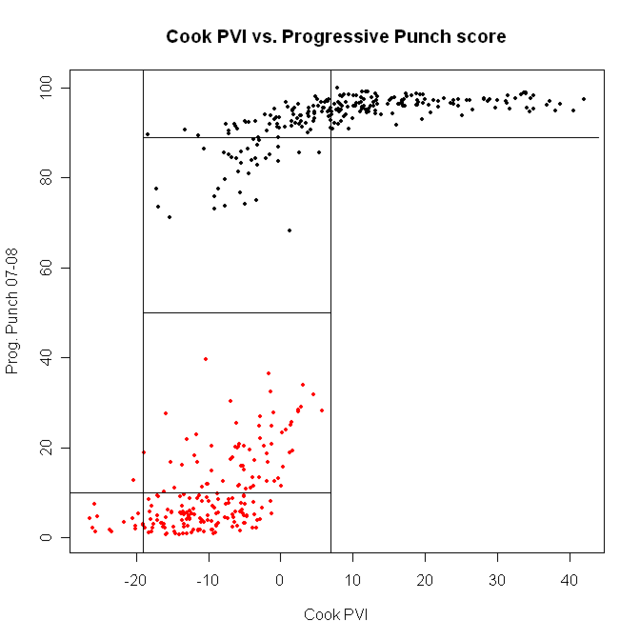
the first point is clear: ALL Democrats are more progressive than ALL Republicans. We are ALWAYS better. All the talk about how bad the blue dogs are is….well, wrong. Democrats are better than Republicans. Period.
Next, look at the lines that divide the plot into boxes. Here, the point is that, above about Cook PVI of D + 8, every Democrat gets a good PP score. Every Democrat who got a PP score under 89 came from a district with a Cook score of under D+8. If we want better Democrats, we need better voters. Move the population, the reps will follow.
A somewhat different picture comes from using National Journal’s ratings.
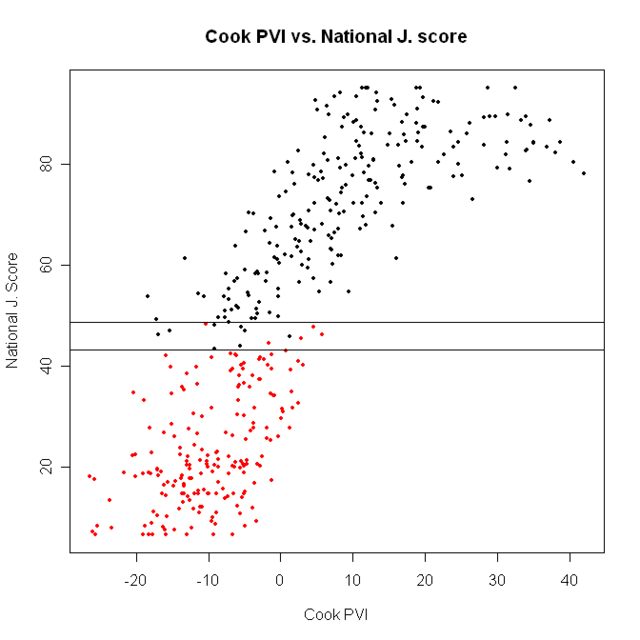
There are actually some Democrats who are less liberal than the most liberal Republicans, and vice versa. They’re between the two vertical lines in the plot; there are 12 such districts:
CT-04 R Shays
DE-AL R Castle
GA-12 D Barrow
IL-10 R Kirk
IN-02 D Donnelly
IN-08 D Ellsworth
LA-03 D Melancon
MD-01 R Gilchrest
MS-04 D Taylor
NJ-04 R Smith
OK-02 D Boren
TX-22 D Lampson
7 Democrats out of 234 are less liberal than the most liberal Republican.
So, which should we use? If we went just by better statistical properties, we’d pick the National Journal rankings. But substance should always trump method. If we look at the graph below, we can see the difference in the two ratings: There are no PP scores between about 40 and 60. Is this reasonable? Well, for our purposes, I don’t think it is. If our aim is particularly to identify the most conservative Democrats and the least conservative Republicans, we want a measure that is sensitive exactly in that middle region. So, from here, we’ll use NJ ratings
Now, let’s just look at the Democrats
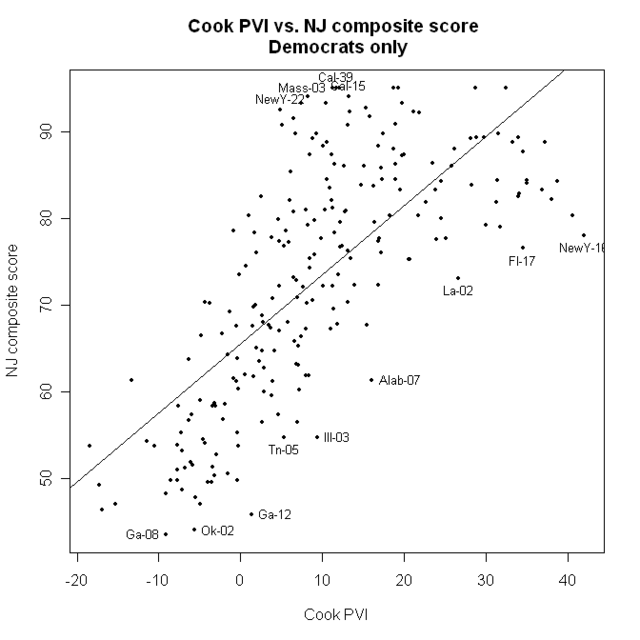
Here, the straight line is not a bad fit.
I’ve identified some of the best and worst, compared to their district’s PVI numbers
What else can we do? Well, region is always regarded as important. The census bureau divides the nation into 9 regions. I’m not saying it’s the greatest division (I may do a diary sometime on other ways to make regions) but it’s not horrible, and it’s standard, if only because the Census says so. here is one map of the regions.
If we attempt to fit a linear model for all 435 districts to NJ numbers from region, we get this:
Coefficients:
Estimate Std. Error t value Pr(>|t|)
(Intercept) 48.9848 3.1517 15.543 < 2e-16 ***
regionE. Sou Cent - 11.8008 6.0130 - 1.963 0.05037 .
regionMid Atl 12.9774 4.5475 2.854 0.00454 **
regionMountain - 11.4815 5.6379 - 2.037 0.04234 *
regionNew Eng 31.0437 6.4149 4.839 1.84e-06 ***
regionPacific 10.1898 4.4405 2.295 0.02225 *
regionSouth Atl - 4.5797 4.2823 - 1.069 0.28549
regionW. North Cen - 0.5241 5.7746 - 0.091 0.92772
regionW. Sou Cen - 13.3131 4.9178 - 2.707 0.00707 **
---
Signif. codes: 0 '***' 0.001 '**' 0.01 '*' 0.05 '.' 0.1 ' ' 1
One thing this tells us is the average NJ score from each region. Across all regions, it’s 48.98 (that’s the intercept). For East South Central it’s 48.98 – 11.80 = 37.18; for the mid Atlantic, it’s 48.98 + 12.98 = 61.96; and so on. The most liberal region (no surprise) is New England, where the average representative gets a 48.98 + 31.04 = 80.02; it would be even higher, except for Shays (CT-04), who is the only Republican in the region, and who got a 47.7.
I’m a little surprised that Mountain is just as conservative as East South Central.
Another interesting thing is that region, by itself, only accounts for about 17% of the variance in NJ score.
But what if we combine region and Cook PVI? Do we do better at predicting NJ scores? We sure do. That model accounts for 70% of the variance in NJ scores. And, if we add party to the model? That model accounts for 89% of the variation in PP scores…. which is pretty amazing.
Here is a summary of that model
Coefficients:
Estimate Std. Error t value Pr(>|t|)
(Intercept) 65.21028 1.33998 48.665 < 2e-16 ***
regionE. Sou Cent - 3.79987 2.20085 - 1.727 0.085000 .
regionMid Atl 1.40556 1.65805 0.848 0.397087
regionMountain - 1.35274 2.05635 - 0.658 0.511012
regionNew Eng 8.95746 2.35363 3.806 0.000163 ***
regionPacific 2.52476 1.60749 1.571 0.117041
regionSouth Atl - 0.68440 1.55044 - 0.441 0.659138
regionW. North Cen - 0.29151 2.10166 - 0.139 0.889753
regionW. Sou Cen - 3.68887 1.81898 - 2.028 0.043206 *
repdata$Actual.PVI 0.74017 0.04772 15.512 < 2e-16 ***
partyR - 34.16677 1.25862 - 27.146 < 2e-16 ***
what’s interesting here is that, after accounting for party and Cook PVI, region doesn’t make much difference. The region that’s the most different is New England, and that is 8.96 points more liberal on average, than would be predicted from just party and Cook PVI. But, other than New England, all the regions are just about where the model would predict.
Next is a graph of the predicted values from that model, and the actual NJ ratings
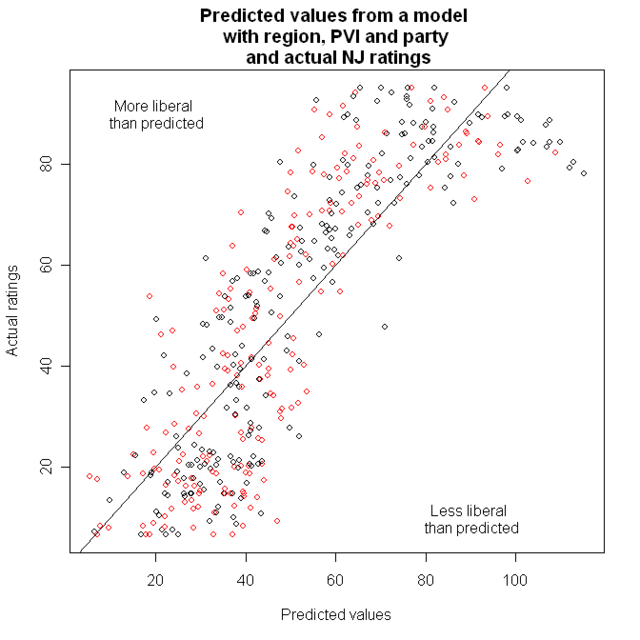
Now, we want to look at points that are far from that line; but it’s easier for people to judge distance from a horizontal line than a diagonal one. That leads to the Tukey Mean Difference plot. On the X-axis, we have the average of what was on the X and Y axes before: That is, the predicted value and the actual value. On the y axis, we now have the difference between them.
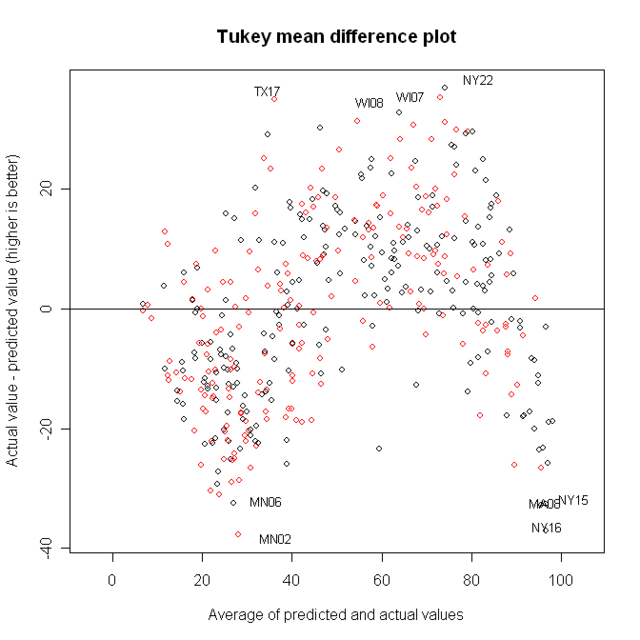
I’ve identified four of the best and worst districts.
But if we want to identify good and bad Democrats, we should go back to looking at just Democrats.
A model with region and CookPVI looks like this
Estimate Std. Error t value Pr(>|t|)
(Intercept) 63.3242 1.6443 38.512 < 2e-16 ***
democrats$Actual.PVI 0.7410 0.0502 14.762 < 2e-16 ***
region[party == "D"]E. Sou Cent - 5.2676 3.1070 - 1.695 0.091432 .
region[party == "D"]Mid Atl 1.8968 2.0786 0.913 0.362482
region[party == "D"]Mountain 1.8168 3.0926 0.587 0.557487
region[party == "D"]New Eng 10.6171 2.5004 4.246 3.22e-05 ***
region[party == "D"]Pacific 7.5039 2.0499 3.661 0.000316 ***
region[party == "D"]South Atl 1.5945 2.1492 0.742 0.458941
region[party == "D"]W. North Cen 3.8981 2.7225 1.432 0.153630
region[party == "D"]W. Sou Cen - 3.9359 2.5680 - 1.533 0.126810
---
Signif. codes: 0 '***' 0.001 '**' 0.01 '*' 0.05 '.' 0.1 ' ' 1
Residual standard error: 8.772 on 218 degrees of freedom
(6 observations deleted due to missingness)
Multiple R-Squared: 0.6116, Adjusted R-squared: 0.5956
A couple interesting things here. The average Democrat has a NJ score of 63. Cook PVI score is clearly important: For each point increase in Cook PVI, the predicted NJ score goes up by .74 points. And New England and the Pacific region are more liberal than the model predicts.
Now, here’s the TMD plot for this model
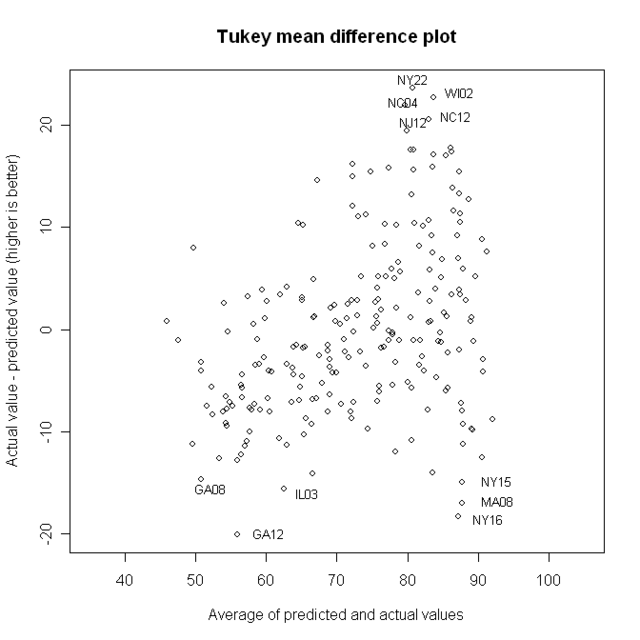
I’ve identified the best and worst. Here are their names and districts:
Best:
NY22 Maurice Hinchey – A strong liberal from a district that is D + 6
WI02 Tammy Baldwin – This district is D + 13, but her NJ score is 95
NC04 David Price – NJ score of 91, district is D+6
NC12 Melvin Watt – The district is D +11, NJ score is 93
NJ12 Rush Holt – D + 8, NJ score of 90
notice that the most liberal Democrats, from the most liberal districts, can’t appear here, because the scale simply doesn’t go that high
Worst
GA12 John Barrow. D +2, NJ = 46
NY16 Jose Serrano D +43, NJ = 78…this is the most Democratic district in the USA
MA08 Michael Capuano D +33, NJ = 83.5
IL03 Daniel Lipinski D +10, NJ = 55
NY15 Charles Rangel D +43, NJ = 80, the second most Democratic district
Kentucky is a state that could make a huge difference in our Congress this year. Despite the circus that has become the Presidential Primary, Democrats simply must remember that no matter who wins, a Progressive direction is highly unlikely without expanded Congressional majorities. That is why this long, grueling primary may prove to be a disaster for our country. Not only are the last two candidates standing and their supporters hurting each other, they are stealing valuable oxygen and funding from our candidates who can truly change this country from the ground up, our Congressional and Senate candidates.
One case in point is the Democratic race in Kentucky to find a candidate who will run to Ditch Mitch McConnell. We have already lost one fine candidate in this race, Andrew Horne because the netroots ignored him and didn’t give him the funding he needed. Now, Chuck Schumer and our party leadership have recruited a millionaire businessman, Bruce Lunsford to run so they don’t have to invest in Kentucky Democrats yet again.
Forget the fact that Lunsford has donated to many Republicans, including donating AGAINST John Yarmuth, our only pickup in 06. Add to that the fact that when he lost the Democratic Primary in 03 against Ben Chandler, he ENDORSED Ernie Fletcher, the corrupt Governor we just ousted, and actually managed his transition team.
Luckily, after the loss of Greg Stumbo and Andrew Horne to this race, we still have a good Progressive Democrat. His name is Greg Fischer and his campaign is gaining steam. Here is an email sent to me from his campaign today:
It is with great pride and gratitude that I announce today we have exceeded our first quarter fundraising goal and will report an impressive amount to the FEC next week.
Dollar by dollar, support is coming in from across the state. Our backing has been strong and encouraging. We’re confident that our campaign will have the resources necessary to defeat Bruce Lunsford on May 20 and we have set our sights on ditching Mitch in November.Thirty percent of the contributions were received from folks like you who received an e-mail from a friend or the campaign and then went online to www.gregfischer.com to contribute. And, 44 percent of all contributions were for amounts of $200 or less. Every dollar counts.
Our support is multiplying each day. When people from Paducah to Covington learn about my candidacy, they realize I’m the contrast candidate with a clean record that has the best chance of defeating Mitch McConnell in the fall.
I am grateful for your encouragement and continued support.
Thank you,
Greg
If you don’t know Greg, here is some video of him:
Now, believe me, Bruce Lunsford in the Senate is not going to forward a Progressive agenda. With him replacing McConnell, we may have a Senator that votes with us half the time. Why should we settle for that? We need a Senator from Kentucky that will fight for our values, not back into them!!!
Please help the Greg Fischer campaign to defeat Lunsford and McConnell, two millionaires that will fight against us here:
http://actblue.com/entity/fund…
Now, on to the fight for my home. We have an awesome grassroots lady running here in Kentucky’s First Congressional District to unseat another millionaire and Mitch McConnell protege’ Ed Whitfield. We call Whitfield Exxon Eddie, because while Kentuckians and Americans are feeling much pain at the pump, Ed Whitfield is profiting handsomely with his Exxon and Chevron stock.
At Ryan for Kentucky, we believe we can do better. We believe we can find homegrown solutions for our dependence on foreign oil, and that we can have a Representative that votes for the betterment of our district, not the betterment of their own stock options.
Heather is a newcomer but is educated, passionate, and smart. We desperately need the resources to get our message out to the 63% of registered Democrats in this district who want to be invested in again. Many of them don’t know Heather, but look at the response she got recently when 3000+ of the people she is seeking to represent got their first look at her:
This was an event she was scheduled to speak at for a long time, and then Hillary decided to come too. From what I heard Heather and Hillary were the only two out of many that recieved standing ovations at this event.
Here her hear answering a Kossack about what it means to be a Democrat:
Yes, I know the feeling. George Bush makes me spit up too!!!
Now, we need your help in this race. Our district has long been ignored by the state and national party, despite being 63% registered Democrat. The Republicans have invested here, and all the Democrats here want is to be important to our party once more. If we get the resources we win, bottom line.
Please consider an investment in the expansion of our Congressional majorities here:
http://www.actblue.com/page/am…
With the help of grassroots Democrats, Kentucky can be what it always was for generations, BLUE!!!
Please consider helping out these two great Kentucky Democrats who want to make a difference for US in the next Congress. Our eventual nominee will thank you for it when they win the White House and have two awesome Democrats to work with!!
Best wishes fellow Democrats!!
Girls, rock your boys:
AZ-01:
Ann Kirkpatrick (D): $260K raised (revised from $240K), $450K-$500K CoH
PA-08:
Patrick Murphy (D-inc.): ~$600K raised
Tom Manion (R): >$400K raised
SC-02:
Joe Wilson (R-inc.): $75K raised “in the past two weeks,” >$300K CoH
Got more numbers? Post ’em in the comments.
UPDATE:
AZ-03:
Bob Lord (D): >$211K raised
Previous diaries:
1Q Fundraising Results Thread | Son of…
While Democrats are licking their chops over the chance to snag another special election victory in the special election to replace Rep. Richard Baker (R), Republicans are reportedly fretting over the chance that the GOP front-runner could end up losing the seat to Democratic state Rep. Don Cazayoux. From Roll Call:
Portions of a GOP poll conducted March 17-18 and obtained by Roll Call showed Jenkins down three points in a head-to-head matchup with Cazayoux. That’s not great math to begin with in a district that gave President Bush a 19-point margin of victory in the 2004 presidential campaign and repeatedly sent former Rep. Richard Baker (R) to Congress by large margins.
But the numbers get worse when looking at specific important voting blocs in the Baton Rouge-based 6th district. Men 55 and older preferred Cazayoux 51 percent to 38 percent, voters who turned out in the special March primary would vote for Cazayoux 53 percent to 39 percent and those voters who said they are definitely going to vote in the special preferred Cazayoux by nine points.
Cazayoux will face off with state Rep. Michael Jackson in the Democratic runoff election this Saturday, while Woody Jenkins will square off with lobbyist Laurinda Calongne for the GOP nod. The winners of the runoff will advance to the special general election on May 3rd.
Great news from NJ-03 (GOP Rep. Saxton’s open seat): John Adler, the Democratic candidate for Congress announced that he raised almost $1.2 million dollars this cycle, including a whopping $530,000 this quarter alone. (75% of the donations came from local NJ donors.) In fact, Adler did so well, one of his GOP opponents campaigns called it “impressive.”
Besides the great fundraising success – Adler has picked up major endorsements from other prominent groups and has been knocking on hundreds of doors.
In the meantime, Adler has been knocking on doors in neighborhoods as far southeast as Little Egg Harbor Township and the age-restricted communities that pepper the area three to five days each week.
And he recently introduced legislation that would protect senior insurance citizens from predatory brokers. The move was prompted by constituent concerns, not scoring points with the electorate.
More after the jump…
And today, even PolitickerNJ’s Wally Edge, was impressed with Adler:
John Adler’s fundraising numbers are impressive: he’s brought in nearly $1.2 million so far as the Democratic candidate for an open congressional seat that has been held by the Republicans since 1882. This kind of early fundraising success will help Adler grow his warchest exponentially as he competes in one of the nation’s premier House races – the fight for Jim Saxton’s seat. Adler is expected to be unopposed in the Democratic primary.
There are a lot of seats in play, but NJ-03 is ready for a “take-over”. Let’s end the failed Bush Republican policies and elect a real Democrat who will bring change to Washington!
The NJ GOP’s recruitment saga for the race against Sen. Frank Lautenberg is a well-known farce by now. But could Republicans actually pull one out of the fire here and recruit a respectable challenger? PolitickerNJ says that they just might:
Biotech millionaire John Crowley is now close to entering the race for the Republican U.S. Senate nomination, after receiving calls from several GOP Senators, including presidential candidate John McCain, urging him to run, according to Republican sources.
Other sources said that Crowley spoke with one Republican Senate candidate, Andy Unanue, tonight and told him that he is now likely to run. Unanue has told some GOP leaders that he would withdraw from the race if Crowley gets in.
Crowley spoke at length today with Sen. John Ensign (R-NV), the Chairman of the National Republican Senatorial Committee, who urged him to run and committed resources if he does. At least five other Republican Senators also reportedly lobbied Crowley, whose efforts to find a cure for a rare genetic disease that affects two of his three children has caused Republican leaders to view the political newcomer as a potentially strong Senate candidate.
Perhaps Crowley and the NRSC are heartened by Dem Rep. Rob Andrews’ primary challenge of Lautenberg, and hope that Crowley could capitalize on the weaknesses of Lautenberg that Andrews will highlight in his primary bid.
Ever since Republican Congressman Jim Walsh announced his retirement, the GOP has had a difficult time finding a candidate to run for this district, leaving Democrat Dan Maffei unopposed. Well, Maffei is still the clear favorite to win in November, but he is not officially unopposed anymore; David Gay, a former organizer for Ron Paul's presidential campaign, has stepped up to the plate. I have a feeling that the GOP will have trouble getting behind him, though, since he doesn't exactly toe the party line when it comes to intervening in other people's– or other nations'– matters:
As a true Conservative Republican voter, I will answer this call to action. I will defeat my opponent using no other guide for my campaign than the Declaration of Independence and the United States Constitution. In Congress I will work relentlessly in defense of our rights to life, liberty, and the pursuit of happiness. I believe we should eliminate the income tax, stop taxing Social Security pensions, respect private property, secure our national borders, stop government spending with credit we can never afford to repay, and bring our troops home from all over the world immediately. In Washington, I will fight to keep the government out of our wallets, our bedrooms, our telephone calls, and our daily lives.
Somehow, I have a feeling that the only Republicans left in the northeast will be those with libertarian views such as those of David Gay. And even then, the Democrats will handily win. Here’s to the prospect of a completely blue northeast!
PolitickerNJ has the confirmation: Rep. Rob Andrews (NJ-01) will challenge Sen. Frank Lautenberg in the Democratic primary for NJ-Sen. The primary is June 3rd. A new poll shows Lautenberg with a hefty lead, but undoubtedly name rec is playing a big role here. Meanwhile, NJ pols are rushing to pick sides. This is going to be a serious battle, and I wouldn’t be surprised if other members of Congress jump in as well.
This also opens up Andrews’ House seat, a safe D+14 district. Undoubtedly there will be a ton of scrambling to succeed Andrews.
cross-posted from Election Inspection.
The latest Pennsylvania primary polls show a lot of movement towards Obama:
| Pollster | Date | Obama | Clinton |
|---|---|---|---|
| PPP | 3/31-4/1 | 45 | 43 |
| Quinnipiac | 3/24-3/31 | 41 | 50 |
| SUSA | 3/29-3/31 | 41 | 53 |
| Rasmussen | 3/31 | 42 | 47 |
| ARG | 3/26-3/27 | 39 | 51 |
Analysis below the flip.
Compared with the previous result from each pollster, all except ARG show a net gain for Obama:
PPP: Obama net gains 28 from two weeks prior
Quinnipiac: Obama net gains 3 from two weeks prior
SUSA: Obama net gains 7 from three weeks prior
Rasmussen: Obama net gains 5 from one week prior, 8 from 3/12, and 10 from 3/5.
ARG: Obama net loses 1 from 19 days prior.
PPP published an article immediately before they released their PA poll today touting their accuracy in prior contests like Texas and Ohio. Looks to me like they’re trying to protect their reputation in the face of the fact that today’s poll and the prior one in the state are major outliers in opposite directions. In other words, let’s discount PPP for now; and ARG while we’re at it, since ARG polls tend to be way off until the final day of the contest. That leaves a spead of 5, 9, and 12, which is right in line with my analysis from Monday suggesting that as things stand today, Clinton would win Pennsylvania by 5-15 points. However, the trending suggests that the race continues to tighten, and if this continues, Clinton will win Pennsylvania by single digits, if at all.
And as I’ve said previously, a single digit win in Pennsylvania will make any suggestion that she could win this nomination sound mathematically ridiculous instead of merely far-fetched. Clinton’s campaign should be in full panic mode by this point, because this is their last chance and it is slipping away.
Election Inspection’s current delegate breakdown: Clinton 55, Obama 48
 Loading ...