Maryland Redistricting, 8-0 Democrats

Recently, I saw quite a few redistricting maps, especially on Maryland. Here is my perspective. Instead of playing it safe, I went all out for an 8-0 map. The Democrats are in control and may try for a map like this. I know what you are thinking; it will be too difficult for Democrats to hold. I feel that I definitely made each Democrat’s district safe enough for them without throwing the VRA down the drain. The Democrats have large majorities in the State Legislature and if they retain the Governorship, this map is realistic. Enough chatter, here are the maps.
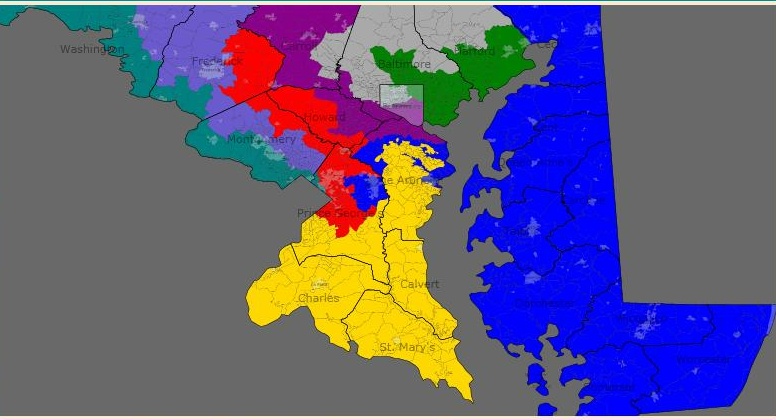
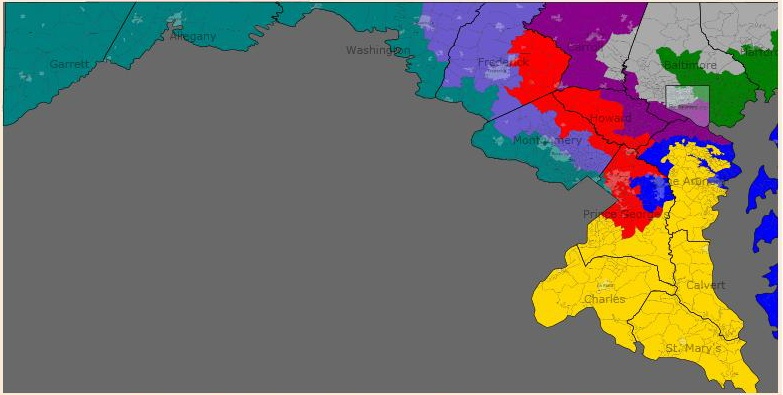
Central/eastern Maryland

West Maryland

Balitmore Area

District 1 Frank Kratovli (D) Blue

This district did go to the western shore to pick up population. Yet it picked up heavily Republican areas to keep out of the 2nd and 3rd districts. Now that Maryland is trending Democratic, adding Republican areas to other districts will be offset by Democratic margins. This left me free to slip in Democratic Annapolis into Kratovli’s district as well as a hunk of Prince George’s County. These changes raised the Black percentage from 11% to 24%. If a Republican could not win in a district that is 11% Black, watch him or her try to win in a district with Prince George’s County. Obama probably won 54% of the vote here. Demographics are 24% Black and 67% White. Status is Likely Democrat.

District 2 Dutch Ruppersburger (D) Green

His district is less gerrymandered but should be safe. I added some Republican areas of Baltimore and Harford Counties but I slipped in more of Baltimore City. These changes should make the district a little more Republican. Ruppersburger is a popular representative and should handle himself. Obama probably won 53%-54% of the vote here. Demographics are 22% Black and 69% White. Status is Safe/Likely Democrat.

District 3 John Sarbanes (D) Reddish Purple

Okay, I see the flaws. Yes, I know I took Sarbanes’s home out of the district. I had to because the district would be too convoluted if I kept it. I also know that Carroll County is heavily Republican. I included Democratic territory in Howard County which should offset Republican margins in Carroll County and more. For any more Republican areas, Baltimore City should offset their margins. Bartlett is Sarbanes is the son of longtime former Senator Paul Sarbanes (D). I do not see Sarbanes losing here anytime soon. Obama probably won 56% of the vote here. Demographics are 23% Black, 5% Asian and 65% White. Status is Safe/Likely Democrat.

District 4 Donna Edwards (D) Red

Her district extends into Republican Frederick County but Edwards should be content. The 4th district is VRA protected. Obama probably won 73% of the vote here. Demographics are 50% Black, 5% Asian, 9% Hispanic and 33% White. Status is Safe Democrat.

District 5 Steny Hoyer (D) Yellow

I took out northeastern Prince George’s County and pushed the district into Republican parts of Anne Arundel County. I only reduced the Black percentage by 1% and should probably get higher in the mid 2010’s because of Blacks moving into Prince George and Charles counties. Hoyer and is successor are safe. Obama probably won 60% of the vote here. Demographics are 29% Black and 62% White. Status is Safe Democrat.

District 6 Vacant Teal

No current representative lives here. Even though I put in some heavily Republican counties in western Maryland, I more than erased that margin by 60% of this district in heavily Democratic Montgomery County. I slipped in about 84,000 people in Prince George’s County just to ensure Democratic votes. That area gave Chris Van Hollen (D) his winning margin against Connie Morella (R) so it had to be in this district to ensure it will vote Democratic. Mark Shriver (D) might want to run in this district. It would be nice to have another Kennedy in Congress. Obama probably won 62% of the vote here. Demographics are 13% Black, 8% Asian, 14% Hispanic and 61% White. Status is Safe Democrat.

District 7 Elijah Cummings (D)

This district is BARELY protected the VRA. I tried to squeeze in as many Republican precincts as I could while keeping the Black percentage at 50% or above. This district used to go into Howard County but now takes in Republican suburbs in Baltimore, Carroll and Harford Counties. Since almost all the Baltimore precincts in the 7th voted around 90% for Obama, Cummings should be very safe. Obama probably won 67% of the vote here. Demographics are 50% Black and 43% White. Status is Safe Democrat.

District 8 Chris Van Hollen (D) vs. Roscoe Bartlett (R) Purple

Bartlett is 83 years old and about 63% of the 8th district is in Montgomery County, Van Hollen’s home base. Bartlett can campaign as a moderate but I see Montgomery County voters sticking with Van Hollen. With Bartlett out of the picture, Van Hollen should have an easy ride to reelection. Obama probably won 63% of the vote here. Demographics are 16% Black, 10% Asian, 13% Hispanic and 58% White. Status is Safe/Likely Democrat if Bartlett decides to run, Safe Democrat without Bartlett.

By what margin will Bob Shamansky win?

View Results

Loading ... Loading ...

OH-Gov: Strickland In Better Shape

Quinnipiac (9/8-10, likely voters, 6/26-7/1 in parentheses):

Ted Strickland (D-inc): 46 (43)

John Kasich (R): 36 (38)

(MoE: ±3%)

There’s some definite improvement in the Ohio Governor’s race, where a number of summertime polls showed incumbent Dem Ted Strickland leading John Kasich within the margin error. Strickland’s putting a little more distance between himself and the ex-Rep., now holding a 10-point edge.

Strickland’s hardly out of the woods, polling below 50%. And although his overall job approval is positive at 48/42, he’s in deep negative territory on his handling of the state budget and the economy (not that anyone could do much with that, given the demolished manufacturing sector at his state’s core). Ohioans are a little happier with their Senators: George Voinovich is at 52/33 and Sherrod Brown is at 48/33.

RaceTracker Wiki: OH-Gov

NYC Primary Predictions & Results Thread

10:52PM: Take this however you like: I count at least five NYC City Council incumbents who’ve lost tonight: Alan Gerson (District 1), Maria Baez (14), Helen Sears (25), Kendall Stewart (45), and Kenneth Mitchell (49). Another, Thomas White (28), is currently losing by three votes with a few precincts outstanding. Four more incumbents won with less than 50%, and the City Council Speaker, Christine Quinn, won with about 53%.

10:38PM (David): Results here. Cyrus Vance wins the DA’s race, and Bill Thompson wins the mayoral primary. With most of the vote counted, it looks like the Comptroller’s race will go to a run-off between John Liu and David Yassky. The big surprise is probably Bill DeBlasio leading the Public Advocate’s race over Mark Green – this one also looks destined for a runoff.


For those of you who live in New York City, or have moved here in anticipation of DavidNYC’s eventual primary challenge to someone or other, today is the long-awaited 2009 primary.

Because of the city’s geographic complexity, we’re voting on everything from district leader to district attorney, from city council to a special assembly race. Because of the city’s recent political complexity (largely due to the controversial term limits extension), there are also many more races than usual with a pack of challengers.

Counting just the city races (not county races like D.A. or state races like Assembly), we have 152 candidates today. How many can you vote for?

The major contested races are:

  • Mayor
  • Public Advocate
  • Comptroller
  • Manhattan District Attorney
  • Queens Borough President
  • Special election for NY AD 38
  • A cornucopia of City Council matchups
  • Your favorite race that I forgot

This is New York. Nobody knows what’s going on. But let’s hear your predictions. Be sure to show your work.

Polls close at 9pm. Don’t forget to vote in the actual booths as well as in the comments area below.

CT-Sen: Dodd Trails Simmons In Two Polls

Research 2000 for Daily Kos (9/8-10, likely voters, 3/23-25 in parentheses):

Chris Dodd (D-inc): 42 (45)

Rob Simmons (R): 46 (40)

Undecided: 12 (15)

Chris Dodd (D-inc): 46 (51)

Sam Caligiuri (R): 37 (30)

Undecided: 17 (19)

Chris Dodd (D-inc): 44 (NA)

Tom Foley (R): 40 (NA)

Undecided: 16 (NA)

Chris Dodd (D-inc): 47 (NA)

Peter Schiff (R): 35 (NA)

Undecided: 18 (NA)

(MoE: ±4%)

Rob Simmons (R): 38

Sam Caligiuri (R): 7

Thomas Foley (R): 6

Peter Schiff (R): 1

Undecided: 48

(MoE: ±5%)

Research 2000 takes a look at the Connecticut Senate race, and while of course it’s never good to be an incumbent who’s trailing a challenger, things are looking merely bad for Chris Dodd instead of dire. Note that the R2K trendlines have actually gone down for Dodd, but this still feels like a marked improvement because it’s been six months since R2K polled, during which time two Quinnipiac polls have seen a precipitous decline for Dodd (most recently, giving ex-Rep. Rob Simmons a 48-39 edge over Dodd). Maybe it’s an apples and oranges problem, or maybe we’ve seen Dodd bottom out and start back up as the economy improves and his woes associated with the Wall Street Bailout recede in the rear-view.

R2K also looks ahead to the 2012 Senate race, but their poll is conditioned on the assumption that Jodi Rell runs for the GOP (and it’s not even clear yet that she’s running for re-election as Governor)… and it’s also conditioned on Joe Lieberman not finding a way to win back the Democratic primary. Rell wins a Rell/Ned Lamont/Joe Lieberman match-up 46-26-26, and a Rell/Richard Blumenthal/Lieberman match-up 40-32-23. It also finds 68-21 support for the public option, and 87-6 rejection of birtherism.

Rasmussen (9/10, likely voters):

Chris Dodd (D-inc): 39

Rob Simmons (R): 49

Some other: 5

Not sure: 6

Chris Dodd (D-inc): 40

Tom Foley (R): 43

Some other: 7

Not sure: 10

Chris Dodd (D-inc): 43

Sam Caligiuri (R): 40

Some other: 7

Not sure: 10

Chris Dodd (D-inc): 42

Peter Schiff (R): 40

Some other: 7

Not sure: 10

(MoE: ±4.5%)

Rasmussen (from numbers released last Friday) paints a grimmer picture for Dodd in their first look at this race, showing him down 9 against Simmons and also down 3 against Tom Foley, the former Ambassador to Ireland. Dodd beats the more conservative options, state Sen. Caligiuri and Paulist economist Peter Schiff.

Rasmussen doesn’t poll the Republican primary, although R2K finds Rob Simmons in commanding position there. The already-cluttered field sounds like it’s going to get even bigger (and weirder) with the addition of World Wrestling Entertainment CEO Linda McMahon to the mix, with the threat of her bringing $30 million of her own money with her. This creates the specter of a riotous primary where the contestants are not just metaphorically but literally hitting each other over the heads with folding chairs — but Connecticut uses a party endorsement process where the real vote that counts is the May convention vote among 1,600 town committee members. The winner goes onto the primary ballot with the party’s endorsement, although candidates who receive at least 15% of the vote at the convention may still petition to appear on the ballot in the August primary — but you’ve gotta wonder whether the Schiffs and McMahons of the field, with no political party connections whatsoever, will even make it over that threshold. (UPDATE: McMahon was a heavy contributor to Jodi Rell and was appointed in early 2009 to the Connecticut State Board of Education, so she’s not totally out of the political loop.)

RaceTracker Wiki: CT-Sen

Sensible Democratic Gerrymander of Illinois

The primary goals of any partisan redistricting should be to, first, protect endangered incumbents; and, secondly, maximize your seats without spreading your votes too thin to risk losing seats in a wave election.  Of the Republican gerrymanders after 2000, the Michigan map (where the GOP legislature aimed for a 9-6 split) held up much better than Pennsylvania.

My map aims for a 13-5 split in normal years, and possibly a 14-4 split.  It shores up Bean, Foster, and Halverson.  It throws Mark Kirk and Jan Schakowsky together in the new CD-1, which Schakowsky would easily prevail; and Peter Roskam and Judy Biggert together in the new CD-11, which is designed to elect a Republican.  It creates a new district centered in northern Chicago and the northwest Cook suburbs that are heavily trending Democratic.  Lastly, Downstate it puts Aaron Schock’s congressional career in jeopardy by combining Peoria with Decatur, Champlain, and Bloomington while trading Republican farm territory with Shimkus and Johnson.

Oh, and one more thing, I renumbered all the districts in logical order – it doesn’t make much sense to me that Jerry Costello’s current district is the #12 while #1-11 and the 13th are all in Chicago or Suburban Chicago.  

CD-1 (Schakowsky vs. Kirk) – Dem favored (57% white, 13% black, 7% asian, 19% hispanic)

Schakowksy’s currently configured #9, along with Quigley’s #5 are both too packed with Democrats.  Instead of having a PVI of D+20 and D+19 respectively, it is possible I believe to create four Chicago-North districts with only slightly lesser Dem PVIs.  This district extends along Lake Chicago from the lakefront wards of Chicago, north through Evanston, and New Trier Township, and then Lake County up to the Wisconsin border including Waukegan and Lake Zion.  

CD-2 (Bean) (69% white, 3% black, 12% asian, 13% hispanic)

By moving Schakowsky’s district north, I was able to draw Bean much closer into Chicago and into Chicago-trending suburbs.  Includes about 100k of Chicago itself, plus all of Niles, Northfield, and Palatine townships in Cook, plus more rural parts of Lake County.  Should be significantly more Democratic now.

CD-3 (Vacant) (69% white, 1% black, 11% asian, 16% hispanic

The third and fourth districts break up Quigley’s district into two parts and marry those parts with suburban townships in Cook and northern DuPage which are trending Democratic.  This district includes Elk Grove, Wheeling, and Maine townships, plus a fair amount of northern Chicago.  It should elect a Democrat.

CD-4 (Quigley) (65% white, 4% black, 9% asian, 19% hispanic)

Combines Democratic leaning northern DuPage townships (Bloomington and Addison, which both voted for John Kerry) and a small part of Milton with the rest of Quigley’s current district left over from drawing the third.

CD-5 (Davis) (52% black)

I decide to reorient how the Hispanic-majority district is hooked up to the Chicago lakefront instead of the Cook County border in order to dilute some suburban Republican votes.  Parts of Milton and all of York township in DuPage is added to the current district.

CD-6 (Gutierrez) (71% hispanic)

Little changes except how the two parts of the district are hooked up.  They now make a backwards C.  Still hideously gerrymandered.  By the time the next census comes around, it should become possible to create two separate Hispanic-majority districts in Chicago.

CD-7 (Lipinski) (63% white, 5% black, 1% asian, 28% hispanic)

Firmly anchored in Cook County and adds several left-over Hispanic precincts in the current #4 to bolster the Democratic nature of the district.  Possibly, Lipinski can be primaried if he still votes the way he does?

CD-8 (Rush) (52% black)

Extends out to Will County now to pick up Republican precincts in Lockport and Homer townships, same thing in Cook County (all of Lemont and Orland, most of Palos, and parts of Bremen and Worth, plus the south side of Chicago = a very good way to get rid of Republican precincts.

CD-9 (Jackson, Jr.) (52% black)

Adds parts of Will County (New Lenox, Manhattan, Frankfort and Green Garden townships) to currently existing district.  Exchanges parts of Monee Township with Halvorson to increase her district’s Democratic performance.

CD-10 (Halvorson) (58% white, 12% black, 3% asian, 23% hispanic)

Includes left-over parts of Will County not in CD-8 or 9 (which are significantly more Democratic) with Democratic-leaning Aurora and a tiny part of Kendall County to connect the two.  Should be safely Democratic now.

CD-11 (Roskam vs. Biggert) (71% white, 4% black, 9% asian, 13% hispanic)

Although it probably is possible to create several thin strands and eliminate every one of the remaining Chicago-area Republicans, it is safer I believe to leave one Republican-leaning district left.  The CD-11 is designed to be such a district.  It includes the left-over parts of DuPage not in the 4th or the 5th (Downers Grove, Lisle, Naperville, Winfield, Wayne, and parts of Milton (Wheaton) to include Roskam’s home), St. Charles and Dundee in Kane County, and Hanover and Barrington townships in Cook.

CD-12 (Foster) (74% white, 6% black, 2% asian, 14% hispanic)

All of LaSalle and DeKalb counties, most of Kane and Kendall, plus Rockford.  Should be safer for a Democrat now.

CD-13 (Manzullo)

One of three districts that pack Republican voters to ensure the election or reelection of Democrats in neighboring districts.  Rockford has been removed from the current district in exchange for all of McHenry and the far western rural townships of Lake.  District also now drops down to include Republican Lee and most of Bureau counties.

CD-14 (Hare)

Cleaned up the lines significantly by removing snake that went all the way to to Decatur.  District now includes all of Springfield and a few small rural counties to its north, along with some rural townships near Peoria.  Should still be safe for Hare or any generic Democrat with the dominance of Springfield and Rock Island.

CD-15 (Schock) (80% white, 10% black, 3% asian, 2% hispanic)

By straightening out the lines of Hare’s district, and with some clever trading of territory with Johnson, it opens the possibility to end Schock’s career before the Republicans groom him to take a leadership role.  Combines Peoria with Bloomington-Normal, Urbana-Champlain, and Decatur.  Furthermore, it does it in a way that doesn’t lead to serpentine appendages going everywhere.

CD-16 (Johnson)

The consequence of going after Schock means that Johnson gets quite possibly the most Republican district in Illinois.  Swaps Democratic-leaning Champlain and Urbana for Republican farm counties.

CD-17 (Shimkus)

The third and final district that packs Republicans.  It would have been nice to go after Shimkus too, and indeed, it would probably not be too difficult to draw Shimkus into a Madison-Springfield, Macoupin centered district that would be very tough for him to win re-election in.  But, many southern Illinois counties outside of Carbondale, Cairo, and Metro-East are trending very Republican and need to be placed somewhere.

CD-18 (Costello)

Adds Democratic-leaning Jersey, Calhoun, Macoupin, and most of Montgomery counties, Edwardsville of Madison country, to the currently Democratic areas of the district; swaps Republican-leaning Williamson, Franklin, and most of Union counties over to Shimkus’s district.

SSP Daily Digest: 9/15

CO-Sen: Former Lt. Gov. Jane Norton is set to launch her bid for the GOP nomination for the Senate today; however, not every prominent Colorado Republican is on board. Ex-Rep. Tom Tancredo lit into her, saying she’s “not ready for prime time” and that he would have less of a problem with her if she’d worked the regular behind-the-scene channels in preparing for the race instead of parachuting in at the last minute, apparently at the urging of family friend John McCain. Those on the left, however, are casting a dark eye toward her lobbying past: she used be the head of government relations for a for-profit health care lobbying shop.

KS-Sen: The GOP primary in Kansas is commonly understood to be an establishment/movement duel between Reps. Jerry Moran and Todd Tiahrt. However, the endorsements in the race are scrambling that a bit, as South Carolina’s Jim DeMint, maybe the nuttiest guy in the Senate, has endorsed Moran (the ‘moderate’ in the race, who surprisingly also got Tom Coburn‘s endorsement this spring). The somewhat more mainstream figures of John McCain and Richard Burr will also headline Moran fundraisers in DC.

NH-Sen: Instead of linking to that Populus poll (with a bizarre sample that’s way off state party composition) that shows Rep. Paul Hodes losing 54-39 to a generic Republican, I’ll just direct you to Dean Barker’s authoritative takedown of the poll and of Populus in general.

NY-Sen-B: As suspected, that Rudy Giuliani-for-Senate thing that happened yesterday was just cloud talk. Via right-hand-man Tony Carbonetti, the word is that Giuliani doesn’t see himself as a Senator, and only belongs in chief executive positions instead.

CA-Gov: Here’s about as big an endorsement as SF mayor Gavin Newsom could have hoped for in his bid for California Governor, where he has been sinking into underdog status in the Dem primary against AG Jerry Brown. Bill Clinton will appear at an Oct. 5 event for Newsom. (Payback for Brown staying around in the 1992 presidential primary after it had been sorted out?) The popularity of the Clinton brand, especially among Latinos, may give Newsom a boost among the state’s Latinos, who haven’t shown much interest in Newsom yet.

NJ-Gov: PPP, like most pollsters, shows a narrowing edge for Chris Christie in New Jersey but Jon Corzine still standing at the bottom of a hole. Christie leads Corzine 44-35 (improved from 50-36 last month), with independent Chris Daggett pulling in his strongest performance in any poll yet, at 13%. Corzine just isn’t gaining, but Christie seems to be leaking votes to Daggett, suggesting there are a lot of Dems and Dem-leaning indies who hate Corzine but can’t bring themselves to vote for a Republican (Corzine is polling at only 64% among Democrats). Also similar to other pollsters, there seems to be a big enthusiasm gap at work on the Dem side: among those who fit into PPP’s likely voter screen, Barack Obama won only 48-46 in 2008 (despite his actual 15-pt edge last year).

VA-Gov: This bodes ill for Creigh Deeds: one of his electability assets was that he was the most gun-friendly of the Democratic candidates. However, the National Rifle Association — who, in the 2005 Attorney General’s race endorsed Deeds over Bob McDonnell — turned around and endorsed McDonnell over Deeds in the Governor’s race.

IL-10: State Rep. Julie Hamos got a key endorsement in her primary fight against 06/08 nominee Dan Seals, from EMILY’s List. That gives her a national fundraising profile that may help counteract Seals’ netroots backing.

NH-02: It seems like there has been an endless supply of “Charlie Bass is weighing his options” stories out of New Hampshire, but the ex-Rep. now says he’s “leaning toward” a run to get back his old seat. However, the moderate Bass would first have to survive a primary against conservative radio blabber Jennifer Horn, who was the 2008 candidate against Rep. Paul Hodes and has said she’s back for another try.

PA-03: John Onorato made it official: he’ll be running against freshman Rep. Kathy Dahlkemper. He’s currently general counsel for the Manufacturer and Business Association, but he used to be Erie County Solicitor, an elected office with a constituency that makes up almost half of the district.

SC-04: I might as well just start the “Bob Inglis Deathwatch” series today. The South Carolina Republican, who used to be one of the most conservative House members but has been sounding increasingly moderate (and sick of Republican hypocrisy) lately, Twittered a suggestion for neighbor Joe Wilson to apologize on the House floor for his outburst. This is the same Inglis who voted for TARP and against the Iraq Surge, and who told town hall screamers to turn off the Glenn Beck; he faces several serious primary challengers in this mega-evangelical R+15 district.

VA-05: Cordel Faulk, the former spokesperson for Larry Sabato’s Univ. of Virginia Center for Politics, said that he won’t run for the GOP nod to oppose Tom Perriello after all. Still no top-tier (or even second or third-tier) GOP candidate in this district that presents, on paper, one of their best pickup opportunities.

VA-07: A local real estate developer, Charles Diradour, has announced that he’ll run as a Democrat against Republican whip Eric Cantor in Richmond’s suburbs. He’ll need to bring a lot of developer money to the table if he’s going to have a chance at Cantor, the House Republicans’ biggest fundraiser, in this R+9 district.

CfG: The Club for Growth is havnig a busy day. They just announced endorsements in the area where they can do the least harm, in open-seat GOP primaries in super-red districts. They endorsed state Sen. Tim Huelskamp in KS-01, and state Rep. Tom Graves in GA-09. Interestingly, they’re also interviewing both Rand Paul and Trey Grayson to see if they want to get involved in the Kentucky primary.

NYC: It’s primary election day for New York City’s elective offices, and the final SurveyUSA poll (sampled the 11th through the 13th) is out today. In the mayor’s race, Comptroller William Thompson, at 46%, seems clear of the 40% mark that necessitates a runoff. We’re seeing momentum in two different directions below that, though. Former PA Mark Green is losing steam in the Public Advocate’s race, down to 33%, making a runoff likely against city councilor Bill DeBlasio (who’s at 23%). Meanwhile, city councilor John Liu is making a break for the 40% line; he’s at 37%, while David Yassky and Melinda Katz are fighting for 2nd (at 22% and 21% respectively).

MA-Sen: Lynch Publicly Opts Out

Now this is a surprise:

After lagging support from unions – one of his vital voter bases – U.S. Rep. Stephen Lynch (D-South Boston) said today he wouldn’t run for the late U.S. Sen. Edward M. Kennedy’s seat….

“The challenge of putting together the resources and organization necessary to wage a competitive statewide campaign in less than 90 days is insurmountable,” said Lynch in a statement.

Here’s the take-home lesson that a lot of Democrats, not just Lynch, need to take to heart (starting with a certain majority leader whose name rhymes with Barry Bead who will need on-the-ground labor support to make it over the hump in 2010). If labor support is a key component to your coalition, don’t dither around on the public option.

So, that leaves AG Martha Coakley and Rep. Michael Capuano as the only elected officials in the race. What had once looked like it would be a 5-way frenzy of House members where the more moderate Lynch had a shot at sneaking through, instead has turned into a fairly easy shot for Coakley, the only statewide official in the running. Capuano’s best bet is to try to consolidate Boston and Cambridge-area votes and outflank Coakley on the left (although Coakley is outwardly progressive, unlike Capuano she doesn’t have a voting record to point to, so we have no idea how deep her progressive bona fides are). The only wild cards left are the entry of random rich guys who can fund their own way: City Year founder Alan Khazei confirmed that he’s getting into the race, and Boston Celtic co-owner Stephen Pagliuca is also sounding like a candidate.

On the GOP side, state Sen. Scott Brown seems to be the Republicans’ best bet… although he’s attracting the kind of attention you don’t necessarily want when you’re running for Senate. Although, c’mon, we’ve all posed nude to pay our way through law school, haven’t we? Uh… we haven’t?

CT-SEN: Rob Simmons gets a VERY wealthy primary opponent

Pull out all your bad wrestling puns because it looks like WWE’s Linda McMahon will be running for Senate.

http://rds.yahoo.com/_ylt=A0ge…

McMahon has contributed primarily to Repubs but has contributed to Dems, which will be used against her.

I don’t think anyone thinks she’s actually going to win the primary or the general. But what she has is an essentially endless supply of money. Vince McMahon has called himself a billionaire in the past, and he’s probably overstating that by a fairly significant amount. Either way 5-10 mill. is probably chump change for these guys.

Florida, Part 3

This is part three of a series on the political structure of the swing state Florida.

The I-4 Corridor

If there is a holy grail of Florida politics, it is winning the I-4 corridor. This refers to the Interstate 4 highway, which begins in Tampa Bay, travels though Orlando, and ends in Daytona Beach.

Quite a lot of people live in the I-4 corridor. It’s far more populated than northern Florida (and northern Florida itself is relatively dense compared to other parts of the South). While parts of south Florida are far more people-heavy, as an aggregate central Florida has a slightly greater population. The I-4 corridor can be compared to a gigantic suburb, with an unusually high number of retirees. Granted, there are cities, but they are more alike to Phoenix (which is really just a big suburb with skyscrapers) than New York.Photobucket

The picture above indicates counties in which more than 100,000 votes were cast in 2008; it is a rough indication of voting density. There are a scattering of counties with more than a hundred thousand voters in northern Florida; actually Obama does quite well in the highlighted counties. Most of south Florida is also yellow. Then there is an empty region – the Everglades. And above that is the I-4 corridor, which is nearly entirely highlighted. The center yellow counties are actually a rough definition of the I-4 corridor.

The I-4 corridor is often considered to be the “swing” region of Florida. The metropolitan areas that lie inside it are the heart of central Florida, and they have enormous importance. The percentage by which a politician wins the I-4 corridor often mirrors his overall performance in the state.

Continued below the flip.

For a so-called “swing” area, though, central Florida is quite conservative. It can be characterized, like Florida itself, as a Republican-dominated region with a few Democratic strongholds. The “average” county in central Florida leans Republican, with a few exceptions. And remember, the “average” county is quite populated.

What are the “exceptions,” the parts of I-4 that lean Democratic? They’re generally more populated than the mean. They have high levels of minorities. They’re places like Tampa Bay and Orlando. Osceola County has a large Puerto Rican community; it leans Democratic. Democrats sometimes do well in the communities north of Tampa. To be clear, “doing well” means winning these counties by ten percent or so; Democrats generally don’t pull off 60% or more of the vote anywhere in the I-4 corridor unless it’s a landslide.

Here is the performance of a relatively weak Democrat, John Kerry, in the I-4 corridor:

Photobucket

John Kerry gets absolutely pummeled. There is a sea of red counties. This is the reason why John Kerry lost Florida.

Here is the performance of a stronger Democrat, Barack Obama:

Photobucket

He does better. Obama’s probably winning the I-4 corridor, largely due to his landslide victory in Orlando – where he took 59% of the vote, the highest Democratic performance since 1944. Still, it’s a very very close thing (actually, Obama’s only leading by several thousand votes if one adds up all the counties pictured). Compared with how the Democrats did nationally, winning by 7.2%, that’s a very unimpressive result.

McCain and Obama essentially ran even in central Florida, or Florida’s “swing” region. They also ran even in Missouri, Indiana, and North Carolina. To say that the I-4 corridor is as conservative as North Carolina is an eye-opening statement. But the data backs it up.

There is hope for Democrats, nevertheless. The type of conservatism typified by central Florida seems like a softer, more suburban type of conservatism. Central Florida voters are probably more accepting of Democrats and willing to vote for them. Republicans won most counties in the I-4 corridor – but they did by 10 points, not by 40. Using an analogy earlier from this post, Central Florida Republicans are more akin to Phoenix Republicans than their northern Florida counterparts. While the I-4 corridor didn’t vote for Clinton in ’92, it did so in ’96. In contrast, the conservatism typified by northern Florida and the Deep South is deeply ingrained and rock-hard. Only a tidal wave can change voting patterns there.

Moreover, demographic change may shift central Florida leftward. This is especially evident in Orange County (Orlando) and Osceola County. In 1992, Orange County gave George H.W. Bush one of his largest margins in central Florida; he won it by double-digits. In 2008, it was Obama’s best-performing county in the region. The U.S. Census estimates that around 40% of the population is black or Latino, highly Democratic voting blocs. Rapid Puerto Rican immigration into Osceola County, too, has led to a nearly 30% voting shift since 1992, according to the Times.

For the moment, nevertheless, the I-4 corridor is roughly as conservative as North Carolina in terms of votes. To summarize so far: northern Florida, commonly considered the Republican base, is as red as the Deep South. Not parts of the Deep South; the Deep South as a whole. The I-4 corrider, which is called Florida’s “swing” region, swings blue just as much as Indiana, Missouri, and North Carolina did in 2008. Historically, it’s probably been closer to Missouri; to call central Florida as red as Indiana or North Carolina is probably an overstatement.

Miami, as we shall see, is about as liberal as Dallas and Sacamento.

–Inoljt, http://thepolitikalblog.wordpr…

TN-09: Just What We Needed

It looks like former Memphis Mayor Willie Herenton is playing with an entire deck full of race cards:

“To know Steve Cohen is to know that he really does not think very much of African-Americans,” Mr. Herenton said in a recent radio interview on KWAM. “He’s played the black community well.”

Lovely – just what we need. But wait, there’s more:

“This seat was set aside for people who look like me,” said Mr. Herenton’s campaign manager, Sidney Chism, a black county commissioner. “It wasn’t set aside for a Jew or a Christian. It was set aside so that blacks could have representation.”

Have these guys even listened to themselves? I’m just glad no one seriously tried to make the mirror-image of this argument with regard to Obama last year.

Anyhow, the Times glosses over this, but Nikki Tinker tried the same bullshit last time and got utterly pasted. Sure, Herenton is much better-known, but Tinker had the endorsement of EMILY’s List (to their everlasting shame) and spent half a million bucks. With any luck, Herenton will meet the same fate.