AK-Sen: Gap Closes to 971 Votes

Great news:

It’s just getting started, but early results from this afternoon’s ballot counting in the contest for U.S. Senate show Mark Begich gaining ground against incumbent Sen. Ted Stevens.

The elections division still has tens of thousands of ballots left to count today and even more next week, but the latest numbers show Stevens’ lead is down to 971 votes.

The new numbers, reflecting nearly 28,000 newly counted absentee ballots, are from all over the state. Election night, Stevens led the Democratic Begich by about 3,000 votes.

Before this latest batch of counted ballots, Stevens has leading by 3257 votes, so this is some excellent movement.

Altogether, the state is counting 60,000 absentee or questioned ballots today — so there’s a lot of room left for Begich to grow his vote count. On top of that, there are an additional 35,000 votes that the Alaska Department of Elections will be counting over the next week. More updates as we get ’em…

Update: For up-to-the-minute results, check here.

Update II: Friend of SSP Nate Silver says that the outstanding districts that won’t post finalized counts today are Begich-friendly rural areas. (Indeed, if you take a look at the map, Begich did quite well in most of the state’s rural areas.)

Update III: Begich takes the lead — by a margin of three votes!

Mondale/McCain and Dole/Obama Counties

There’s already been a lot of analysis of the evolving political trends from 2004 to 2008 (including from me, although still nothing beats that widely-circulated New York Times county-change map) based on preliminary election returns. But with the exception of dreaminonempty‘s remarkable and must-see map diary over at Open Left, no one has really focused much on what longer-term trends look like, especially at the county-by-county level.

One question I was left with after this election was what areas have changed so much that they used to stick with the Democrats (or Republicans) even in their absolute darkest hour, but now favor Republicans (or Democrats). The darkest hour for Democrats was a pretty easy choice (Walter Mondale); for Republicans, I was initially thinking of Barry Goldwater, but his pre-Civil Rights Act map is just too different from today’s map to be useful, so I settled for the GOP’s second biggest recent failure, Bob Dole.

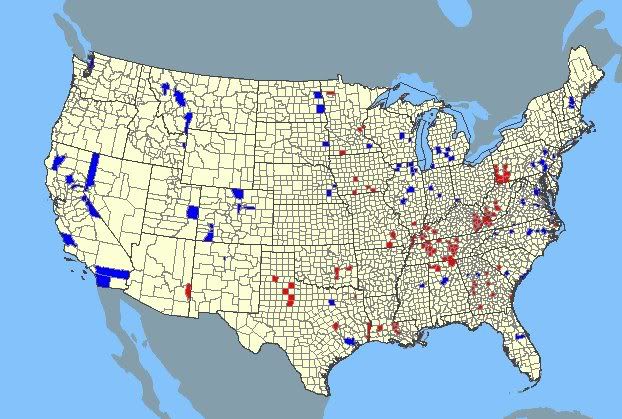
As I suspected, Mondale/McCain counties were clustered mostly in the same Appalachian swath where Obama underperformed the most at the statewide level; much of this transition is very recent, as a number of these counties (especially eastern Kentucky and western Pennsylvania) even went for Kerry. There were also some southern counties that are around 50/50 white/black, where enough white voters used to be yellow-dog Dixiecrats to put even Mondale barely over the edge, but collapses in white rural southern voting for Dems at the presidential level has allowed Republicans to take those counties more recently.

To my surprise, there were actually more Mondale/McCain counties than there were Dole/Obama counties. (In case any righties are trolling this article looking for some scraps of solace, there’s your takeaway: OBAMA UNDERPERFORMS MONDALE!!!) There are 97 Mondale/McCain counties, and only 85 Dole/Obama counties (or independent cities).

However, there’s a key difference. While the Mondale/McCain counties are rural and very small (and generally stagnating or getting smaller), the Dole/Obama counties include many of the nation’s largest population centers. The Mondale/McCain counties have a median 2000 population of 16,000, while the Dole/Obama counties have a median population of 103,000. The sum population of all Mondale/McCain counties? 3,197,000. For all Dole/Obama counties: 25,846,000. There’s pretty much the story of the 2008 election right there.

More specifically, there are only five Mondale/McCain counties with a 2000 census population over 100,000. Four are collar counties around Pittsburgh (Beaver, Fayette, Washington, and Westmoreland). These are counties that used to be manufacturing and coal-based union strongholds, hence the willingness to vote Dem even in the face of all that was Mondale. Unfortunately, these counties all share one common thread: little in-migration, and an elderly population aging in place (all of these counties are 17-18% 65+, a rate unseen pretty much anywhere else other than Florida)… and these counties become both smaller and more conservative each year as former unionists die off. (Bear in mind John Murtha’s comments too, as most of these counties are the core of his district.)

The fifth county is Anoka County in the Minneapolis suburbs, where there may have been something of a favorite son effect in 1984, but this is also an area where exurbanification and the mega-church religious right seems to be edging out traditional rural Lutheran Minnesota values (as seen by this county’s choice of congresscritter: Michelle Bachmann).

By contrast, the four largest Dole/Obama counties all have a population over one million: Harris (Houston) and Dallas in Texas, and San Diego and Riverside in California. These are all counties that are young, fast-growing, and most ominously for the GOP, are on the verge of tipping to Hispanic pluralities in the next decade.

Now maybe that can be shrugged off because California and Texas weren’t in play this year, but in the 800,000-1,000,000 population range are a number of swing counties in swing states that basically swung the election: Orange County, Florida (Orlando), Marion County, Indiana (Indianapolis), Hamilton County, Ohio (Cincinnati), and Fairfax County, Virginia (DC suburbs). And below that, fully 43 of the 85 Dole/Obama counties have populations over 100,000. Even the loss of the Pittsburgh-area collar counties can be more than compensated, population-wise, with the four eastern Pennsylvania counties that went Dole/Obama: Berks, Chester, Dauphin, and Monroe.

Here’s a map of the Mondale/McCain counties (in red) and the Dole/Obama counties (in blue):

Continue over the flip for full lists of the counties…

Mondale/McCain counties

AL: Colbert, Jackson, Lawrence

AZ: Greenlee

GA: Crawford, Greene, Marion, McIntosh, Mitchell, Taylor, Telfair, Webster, Williamson

IL: Franklin

IA: Dallas, Davis, Monroe, Ringgold

KY: Ballard, Breathitt, Floyd, Harlan, Knott, Letcher, Livingston, Lyon, Magoffin, Marshall, Morgan, Muhlenberg, Perry, Pike, Union, Webster

LA: Allen, Pointe Coupee, West Baton Rouge, West Feliciana

MI: Keweenaw

MN: Anoka, Chisago, Jackson, Pennington

MO: Mississippi, Oregon, Reynolds

NC: Tyrrell

OK: Coal, Haskell, Hughes

PA: Armstrong, Beaver, Fayette, Greene, Lawrence, Washington, Westmoreland

SC: Edgefield

TN: Benton, Cannon, DeKalb, Franklin, Grundy, Henry, Hickman, Humphreys, Lake, Lincoln, Overton, Perry, Robertson, Smith, Stewart, Trousdale, Van Buren, Warren, White

TX: Cottle, Dickens, Fisher, Morris, Newton, Orange, Robertson, Stonewall, Swisher

VA: Buchanan, Dickenson, Russell

WV: Brooke, Clay, Fayette, Hancock, Lincoln, Logan, Mingo, Wyoming

Dole/Obama counties

AL: Jefferson

CA: Alpine, Butte, Mono, Nevada, Riverside, San Diego, San Luis Obispo, Trinity

CO: Arapahoe, Jefferson, La Plata, Larimer, Ouray, San Juan

FL: Orange

GA: Douglas, Newton, Rockdale

ID: Teton

IL: Boone, Carroll, DuPage, Kane, Kendall, McHenry, McLean, Sangamon, Stephenson

IN: Marion, Tippecanoe

MD: Charles

MI: Berrien, Clinton, Eaton, Jackson, Kent, Leelanau

MN: Olmsted

MS: Oktibbeha

MT: Lake, Lewis & Clark, Gallatin

NE: Douglas, Lancaster

NV: Carson City, Washoe

NH: Belknap, Carroll

NJ: Somerset

NM: Los Alamos

NC: Forsyth, Pitt, Wake, Watauga, Wilson

ND: Cass, Grand Forks

OH: Hamilton

PA: Berks, Chester, Dauphin, Monroe

SC: Barnwell, Charleston

SD: Brookings

TX: Dallas, Harris

UT: Grand

VA: Albemarle, Chesapeake, Danville, Fairfax, Fairfax city, Harrisonburg, Henrico, Loudoun, Manassas, Manassas Park, Prince William, Staunton, Winchester

WA: Island

WI: Calumet, Waupaca
AL-Sen: Shelby Says He’ll Run Again

Laura Henderson, the press secretary for the office of Alabama Sen. Richard Shelby, sends us the following note after picking up on our discussion from yesterday:

I saw your posting from yesterday.  I can assure the readers of your blog that Senator Shelby has announced that he is running for reelection in 2010 and has every intention of remaining Alabama’s senior senator.

Of course, plans and intentions can change — for a while, it looked like Sens. Domenici and Hagel were going to run for another term this year. But at the age of 76 when he’ll be up for re-election in 2010, Shelby does have at least one term’s worth of gas left his tank, if he wants to use it. However, unlike Markos, I doubt that Shelby will face any Democrats of note if he indeed runs for another term.

Of Time and the Tarheels: GOP delegation is incredibly old

This year, NC voters were confronted witha Republican ticket headed up by a 72 year old white man running for President and a 72 year old white woman running for the US Senate.  I guess they call that diversity but it was pretty indicative of the seven incumbents (plus McCain)

Republicans running for Federal office in North Carolina (I’m excluding Sarah Pallin as she was essentially a tag a long).

The Congressional loser for the Republicans was 63 year old Robin Hayes.  Hayes was bested by 57 year old Democrat Larry Kissell.  That’s part of the story as 47 year old Barack Obama and 55 year old Kay Hagan whipped the aging Dole and McCain, each 72.

The Congressional winners for NC Republicans included 77 year old Howard Coble, 67 year old Sue Myrick, and two 65 year olds in Walter Jones and Virginia Foxx.  Foxx looks a good deal older than her age having the traditional old grandma look.  Only Patrick McHenry, 33, is younger than the traditional retirement age and even he got an age “Schock.”  McHenry is no longer the youngest House member being badly overtaken by 26 year old wunderkid/brat Aaron Schock of Illinois.

By contrast, two North Carolina Democrats are also clearly agingin 68 year old David Price and 67 year old Bob Etheridge.  GK Butterfield is getting there at 61.  and so is Mel Watt at 63.  Larry Kissell (57), Brad Miller, Mike McIntyre (52) and Kay Hagan (55) are in what would seem prime age for a legislator.  Heath Shuler at 36 is still young and hardly has the ambitious brat reputation of McHenry.

Makes one think of the two curmudgeons from Alaska (Don Young (73?) and Ted Stevens (84).

LA-04: Fleming Releases Garbage Poll

Multi-Quest International for John Fleming (10/6-8, likely voters):

Paul Carmouche (D): 43

John Fleming (R): 48

(MoE: ±8.3%)

Check out that margin of error — it’s a monstrous 8.3 points. Now, the pollster claims that the MoE is lower (6%, according to Roll Call), but the poll’s sample size is a minuscule 140, making a 6% MoE mathematically impossible. (Update: In the comments, MichiganLiberal notes that it would be possible to have an MoE that low for this poll, but doing so would require using a significantly lower confidence interval than what is normally used by reputable pollsters. Either way, it’s a junky poll.)

Republicans are hyping this poll in response to a Kitchens Group survey for Carmouche that showed Dems in the lead by 10 points. If this is their best evidence of Fleming’s strength, they have a lot to feel embarrassed about.

Meanwhile, Roll Call gives us a taste of the air war in the 4th:

While the Democratic Congressional Campaign Committee has released an ad attacking Fleming’s Social Security plan and his support for a national sales tax, the National Republican Congressional Committee is going after Carmouche’s record as a district attorney.

The NRCC’s attacks are focused on the case of John Pilinski Jr., who Republicans say was allowed to go free after numerous arrests and convictions because Carmouche failed to prosecute him under Louisiana’s habitual offender law.

“Paul Carmouche, soft on crime, wrong for us,” the NRCC ad states.

The Pilinski stuff reeks of typical of out of context Republican BS, but it remains to be seen whether or not it’ll stick. The Carmouche campaign is pretty livid over this one.

AZ-Sen, AZ-Gov: Statewide Recruitment Thread

Continuing our totally excellent series of threads on recruitment possibilities for senatorial and gubernatorial contests in 2010, we now turn our attention to Arizona, where things could get very interesting.

Popular incumbent Democratic Gov. Janet Napolitano is term-limited, and she seems to be everyone’s first choice to run for the Senate seat of John McCain, which will also be up in 2010. It remains to be seen whether McCain will run for another term (I bet not, but you never know), but Napolitano’s name has already been floated as a potential Attorney General pick in the Obama Administration, which would take the most obvious choice off the table.

Supposing that Napolitano can’t or won’t make a Senate run in 2010, who might the Democrats run in her place? Who would step up for the Republicans if McCain calls it quits? And, for that matter, who should run for the Governor’s office in the Copper State?

Who Replaces Biden?

Say it ain’t so, Joe! You’re leaving us after only… uh… 36 years? Biden’s departure from the Senate leaves some pretty big shoes to fill, and while filling Obama’s Senate seat has been a hot topic of discussion here at SSP for the last week (and even Rahm Emanuel’s seat, for that matter), we haven’t talked about the situation in Delaware much.

There may, at this point, be more uncertainty about who gets to pick the replacement than who gets picked… which is odd, because it’s quite certain that Jack Markell will take over from Ruth Ann Minner as governor. Here’s the problem, according to ABC’s Political Radar:

Just prior to Tuesday’s election, Biden told a local television station that he does not want to resign his Senate seat until the moment he were to become vice president.

Delaware has not determined the time of its Jan. 20, 2009 gubernatorial nomination. But Gov. Minner’s office tells ABC News that the decision is traditionally made by the incoming governor.

So, who gets to replace Biden depends on when Jack Markell decides he wants to have his own inauguration ceremony on the 20th. If it’s before the presidential inauguration (and if Biden gets his wish of remaining in office until the moment of becoming Veep), Markell will get to appoint the replacement. (The tea leaves seem to indicate this will happen, as the ABC story cites Markell’s spokesperson as citing Gov. Pierre DuPont IV’s 12:01 am swearing-in in 1989 as precedent for doing it early in the day.)

Who, then, does Markell (or Minner) appoint? One obvious possibility is Minner herself, but Minner is 73 and has indicated that she is not interested in the job.

The most talked-about option seems to be Beau Biden, the Delaware Attorney General who also just happens to also be Joe Biden’s son. There’s one problem: Beau Biden is a member of the military, and is currently training prior to a one-year deployment to Iraq (as a lawyer, not as a front-line soldier). Military law (as well as his inability to be present for votes) would prevent him from serving in the Senate during his deployment, which makes his appointment right now impossible or at least ineffective. In addition, Biden Jr. has seemed leery of appointment in the past, perhaps unwilling to get tarred with the brush of nepotism; in 2005, Minner offered him the Attorney General post when it was vacant, but he chose to wait until 2006 to run for it and win it.

As a result, the possibility of a placeholder occupying the seat for two years, with the understanding that Biden Jr. would run for it in the 2010 special election, seems somewhat likely. Supreme Court Justice Myron Steele, who is close to Minner, is often mentioned in that context (although it’s possible Minner herself could keep the seat warm for two years). Secretary of State Harriet Windsor Smith’s name also crops up, at least in the placeholder context.

The other likeliest outcome is the appointment of Lt. Gov. Jack Carney, who lost the Democratic gubernatorial primary to Markell. The possibility of appointing the gubernatorial loser to the Senate seat was occasionally broached during the campaign; Carney, however, made it clear that if appointed to the Senate seat, he would want it to be on a permanent basis, not as a seat-filler for Biden Jr.

Finally, as an out-of-the-box choice, Chris Cillizza says that some Beltway chatter is talking up Obama campaign manager David Plouffe for the job, who grew up and went to college in Delaware.

Regardless of whether the 2010 candidate is Biden or Carney, the 2010 race could turn into a very competitive race if Delaware’s popular at-large GOP representative Mike Castle ran for the Senate. At age 69 and in the wake of some health problems, though, that challenge doesn’t seem likely.

UPDATE (David): We also discussed Biden’s successor in this August post when he was first named to the ticket.

The Changing Electorate (and the implications for down-ballot races)

Cross-posted at Election Inspection 

(Note: due to formating issues, I didn't post the charts here, to see how Obama did compared to Kerry, visit the Election Inspection link) 

I've actually been quite interested in doing a comparison of how Obama did compared to the last Democratic nominee (Kerry). Here's the difference between Obama and Kerry's margins in each state (for reference, I subtracted Kerry's margin from Obama's margin to get the final number, for example, if Obama's margin in California was 24 and Kerry's margin was 9, the equation would be 24-9=15).

Obviously, since Obama won the popular vote by 7, while Kerry lost it by 3, Obama is going to outperform Kerry almost everywhere, and speaking of, the only states where Obama did not outperform Kerry were in Alaska (-1), Arkansas (-11), Louisiana (-4), Tennessee, (-1), Oklahoma (0), and West Virginia. This, however, only tells us what we already know, Obama outperformed Kerry almost everywhere. A more important question to ask would be, where did Obama do better than Kerry relative to how the entire country did (to put it another way, we know that Kerry won California by 9 points, but he lost the national popular vote by 3 points, so Kerry actually ran 12 points higher in California than in the country, and Obama, who won California by 24 points but won the popular vote nationwide by 7 points, performed 17 points better than the country at large. Subtracting Kerry's performance in California compared to the country at large from Obama's same performance means California voted 5 points more Democratic relative to to the rest of the country than it did 4 years ago).

So how did Obama do in these other states compared to the national vote relative to Kerry?

(Follow link at the top for a look at the relative performance of Obama to Kerry in each state)

This gives us a much better picture of which states, in any given year, are moving more Democratic, and which ones are stalling out. Of course, it would be smart to keep in mind that some of these numbers have to be taken in context of home state effects of presidential and vice presidential candidates (Arizona, Alaska, Illinois, Hawaii, and Delaware are the home-states of McCain, Palin, Obama, and Biden respectively; while Texas, Wyoming, Massachusetts, and North Carolina are the home-states of Bush, Cheney, Kerry, and Edwards, if some people over/underperform in certain states and regions, it has to be taken in this context). The glaring exception to the home-state advantage here is North Carolina, where Obama performed three points better relatively to his popular vote standing than Kerry did (and could easily be attributed to the growth of the Raleigh/Durham/Chapel Hill area). The states where Obama had the highest outperformance of Kerry's standing were in Hawaii (+26), Indiana (+12), North Dakota (+9), and a three-way tie between Utah, Montana, and Nebraska (+7 each). Obama's top under-performances, by comparison, were in Arkansas (-21), Louisiana (-14), Alaska (-11), Tennessee (-11), with a tie between West Virginia and Oklahoma (-10 each). There are, of course, a bunch of others, but generally speaking, we can say that by comparison, Obama generally underperformed Kerry in the south and the northeast (the exceptions being Vermont, Virginia, Georgia, Delaware, Connecticut, and North Carolina), while he generally outperformed Kerry in the midwest and the west, particularly where there was a large Hispanic population (New Mexico, Nevada, Colorado, and California). Obama seemed to stick pretty close to Kerry's relative performance in Washington State, Oregon, and Iowa (in fact, it seems that compared to the country, Iowa seems to have a consistant Democratic lean, as it changed exactly zero relative to the country)

This has extremely important ramifications for both presidential and down-ticket races in the future, for example, three states which Obama won which Kerry did not (Ohio, Florida, and Iowa) might seem to be massive improvements for the Democrats compared to how Kerry did, but in actuality, Obama underperformed Kerry relative to the rest of the country in Florida and Ohio, while Iowa stayed the same relative to the rest of the country (that is to say, in both 2004 and 2008, Iowa was roughly three points more Democratic than the country at large) (of course, for Ohio, Kerry actually did relatively better than most Democrats normally do in Ohio, but it usually tends to vote slightly more Republican than the rest of the country, whereas Ohio voted slightly LESS Republican than the national vote in 2008). Now, relatively speaking, Obama tended to GREATLY outperform Kerry in the midwest (Obama's relative performance in Wisconsin was 2 points better, in South Dakota was 3 points better, in Nebraska it was 7 points better, and a full 9 points better(!)). Of course, Obama did, relatively speaking, underperform Kerry in Minnesota, but that might be more a function of McCain spending a dispropotionate amount of time and resources in Minnesota (one of the only places where McCain was significantly outspending Obama on both field organization and advertising). The places where Obama really outperformed Kerry though were in the southwest and the mountain west (Obama outperformed Kerry by 3 points in Colorado, 4 points in Idaho, 5 points in Nevada, 5 points in California, , 6 points in New Mexico, 7 points in Montana, and 7 points in Utah. Like I said above, Obama did tend to underperform in the south, but the three places where Obama outperformed Kerry are states which have strong implications for state-wide Democrats are in Georgia (+2), North Carolina (+3), and Virginia (+4). The other two big deals are California (which has become almost as Democratic as New York) and Indiana (which went from being 18 points more Republican than the country to being only 6 points more Republican).

Democrats are probably going to have a harder time getting elected in Southern states like Alabama, Mississippi, Louisiana, Tennessee, Kentucky, and Oklahoma, but strong Democrats are going to have a much easier time running in states like Montana, Colorado, New Mexico, Indiana, North Carolina, Virginia, North Dakota, and South Dakota. Furthermore, with California's gubenatorial race in 2010, if the Democrats don't rip each other apart like they did in 2006, they should have an extremely good chance at winning the governor's mansion, and controlling redistricting for the census.

AL-Sen, AL-Gov: Statewide Recruitment Thread

During each weekday this month, we’ll be looking at a new state featuring senatorial or gubernatorial races in 2010, and asking for your thoughts on who Democrats should recruit to take on these races.

Yesterday was Alaska, and today we turn our eyes to Alabama. Incumbent Republican Gov. Bob Riley is term-limited, and several Democrats of note are giving this race a look (notably, Agriculture Commissioner and SSP hero Ron Sparks, Lt. Gov. Jim Folsom, Jr., and Rep. Artur Davis).

On the Senate side, GOP Sen. Richard Shelby has yet to announce his re-election plans, but with $13 million in his campaign’s coffers, I highly doubt any Democrats of note will want to receive a pummeling by that kind of money. Still, Shelby will turn 76 in 2010, and a retirement is not out of the question. If that seat opened up, we could see a serious game of musical chairs up and down the ballot on both sides of the aisle.

So, whom should the Democrats recruit for these races? And whom might step forward from GOP bench for either of these races (assuming that Shelby retires)?