Disincumbenting Illinois: A Democratic Redistricting Plan

This diary presents an 18-seat map for Illinois. Illinois is a particularly difficult state for me to get my head around politically, so in this diary I am  going to highlight a particular strategic approach to redistricting. I’m calling it “disincumbenting” — I don’t think I’ve encountered an existing term of  art anywhere that covers quite the same ground.

The basic idea of disincumbenting is to make the new districts as unlike the current districts as possible. Doing so reduces the value of incumbency (hence  the name) by reducing the number of constituents who are familiar with the incumbent representative.

Illinois strikes me as a particularly fertile environment for the technique, because the party out of power on the state level has a large number of  contiguous seats. The Democrats have unified control over the line-drawing. In the most recent election, they lost four outstate districts, resulting in the Republicans controlling every non-Cook-County-based district except for Jerry Costello’s 12th district in the far southwest. (The Republicans also control  the Cook-County-based 9th.) With so much adjacent territory under the control of the opposition party, it is fairly easy to draw new lines that wreak havoc  on the political bases of each incumbent.

As I said above, I find it difficult to get my head around Illinois’ politics. This is because recent elections have been so very unrepresentative. 2010 was a Republican wave year. 2008 was a Democratic one, compounded by Obama’s favored son status. Blagojevich’s election numbers are impacted by the presence of a  significant Green candidacy. And so on. I tried to design the new districts so as to maximize the number of “Democratic opportunity” districts outside of  Cook County as best I could, but these districts aren’t as numbers-based as I would like. I welcome any feedback from those who know Illinois better.

Aside from the goals of disincumbenting Republican incumbents and maximizing Democratic chances outstate, I had two other, inter-related goals: create a second Hispanic majority seat in cook County, thereby eliminating Lipinski’s district. In a previous diary, I had created a second Hispanic seat by (inadvertantly) messing with Quigley. Geoneb suggested that Lipinski should be the target instead, so here’s a plan that does that. These two goals have an unintended spillover effect of somewhat disincumbenting the Chicago Democratic representatives. If resistance from the Democratic incumbents proves too great, these two goals could be abandoned.

To demonstrate the disincumbenting strategy, in my district descriptions I’m making use of silverspring’s Territory Transfer Percentage (TTP), introduced here. TTP is the percentage of the new district’s population that was part of the old district. My impression is that Silverspring introduced it with the general intent of keeping TTPs relatively high. Because of the set of goals I applied to the creation of this map, I’m actually trying to keep TTPs low (at least in the Republican districts.)

Pictures and descriptions of the plan start after the jump.

Overview Map
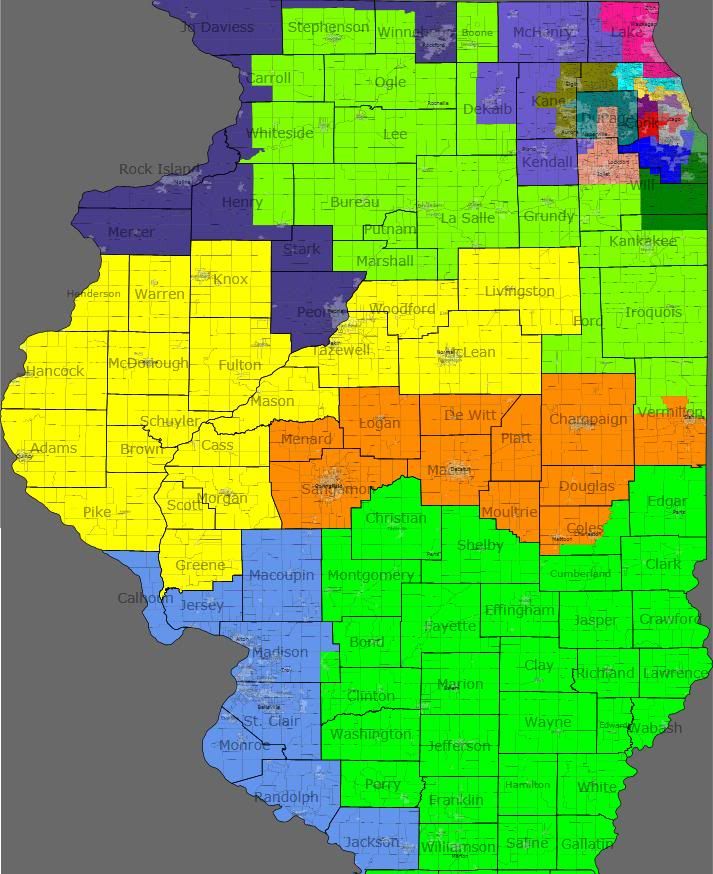
Note that the 16th is (roughly speaking) the seat lost through reapportionment. I relocated it south to cover for the missing number 19.

Chicagoland Map
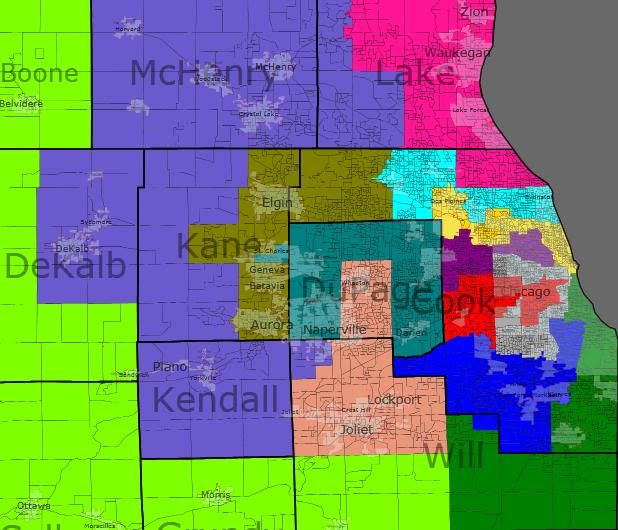
District-By-District

Given the strategy I’m following here, I’m presenting the old/new maps for each district. The pink outline is the old district. The green squiggles represent the new district.

Democratic Held Seats

My intention was that all of these seats would remain solidly Democratic. In the absence of sound numbers though, I’m slightly worried about the 9th. (And, I guess, the 12th — but I think I actually improved the 12th’s Democratic performance.)

District 1 — Bobby Rush (D)

VRA: B 53% W 35%

TTP: 49%
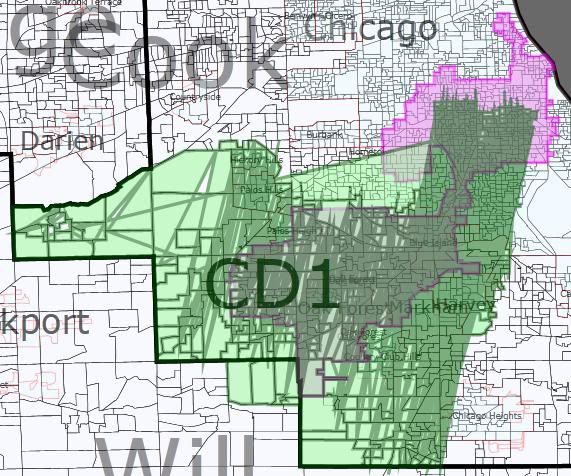
Rush’s district slides south somewhat, expanding into parts of what is currently the 2nd and 13th. I’m not sure if Rush still lives in this version of the district. Wikipedia says he used to represent the 2nd Ward. If he still lives there, it’s a relatively easy fix to swap some territory with the 2nd while keeping both majority African American.

District 2 — Jesse Jackson, Jr (D)

VRA: B 54% W 32% H 11%

TTP: 56%
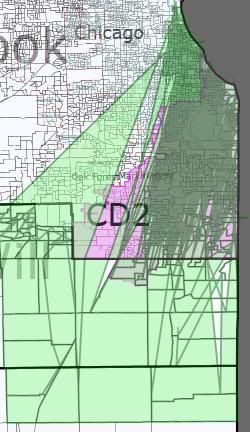
Jackson’s district narrows slightly to expand significantly to the north and south. Again, I’m not sure if Jackson lives here, but his wife represents the 7th Ward, so I think he probably does.

District 3 — Open Seat (D)

VRA: H 52%, W 34%

TTP: 2%
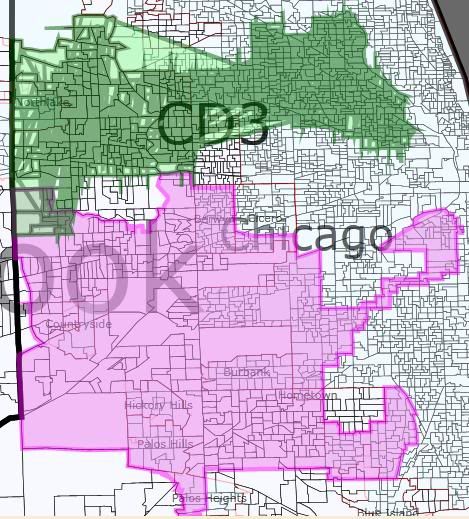
[Update: Per sapelcovits in the comments, my description of the ethnic background for the 3rd and 4th are flipped. This is Guiterrez’s district. It’s the 4th that’s open.]

This was Lipinski’s district, now almost entirely relocated to become a second Hispanic majority district. (The old district is split roughly evenly between the new 4th and 7th, both of which are still majority-minority.) My understanding is that the Hispanic population here is largely Mexican, so voting participation rates might not be enough to elect a Hispanic representative.

District 4 — Luis Guiterrez (D)

VRA: H 58%, W 35%

TTP: 51%
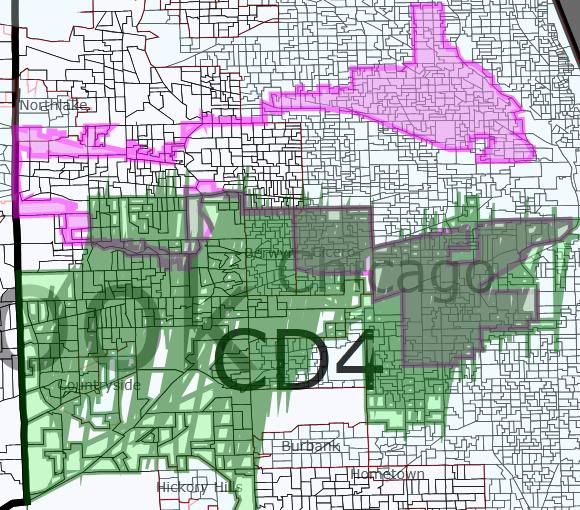
Guiterrez’s seat now takes in only the southern half of his old district (along with a good part of the old 3rd). My understanding is that the Hispanic population here is largely Puerto Rican (and therefore US citizens), so this district should pass VRA muster.

District 5 — Mike Quigley (D)

VRA: W 68%, H 15%

TTP: 53%
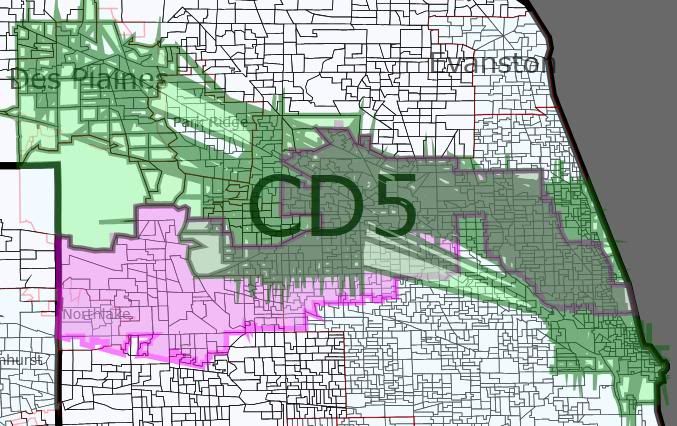
Quigley’s seat shifts northwest on its western end, now taking in Des Plaines instead of Northlake. I believe he should still live in the district; if not, the territory swap needed to make it happen shouldn’t be too difficult.

District 7 — Danny Davis (D)

VRA: B 50% W 34% H 11%

TTP: 50%
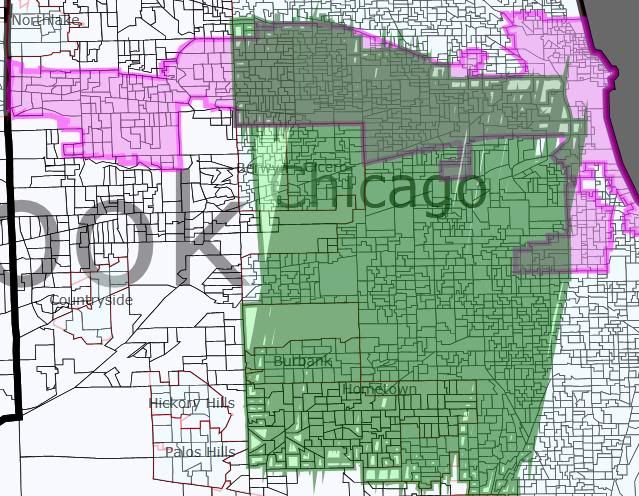
Sadly one of the less informative old/new maps. You might need to refer back to Chicagoland overview. Davis’s seat lurches south radically as part of the dismemberment of the old 3rd. The 29th Ward that he used to represent is still in the district, so I assume he is too. If 50% is too low an African-American percentage, some territory swaps with the 1st and/or 2nd could probably be arranged.

District 9 — Jan Schakowsky (D)

VRA: W 62% H 15% A 14%

TTP: 60%
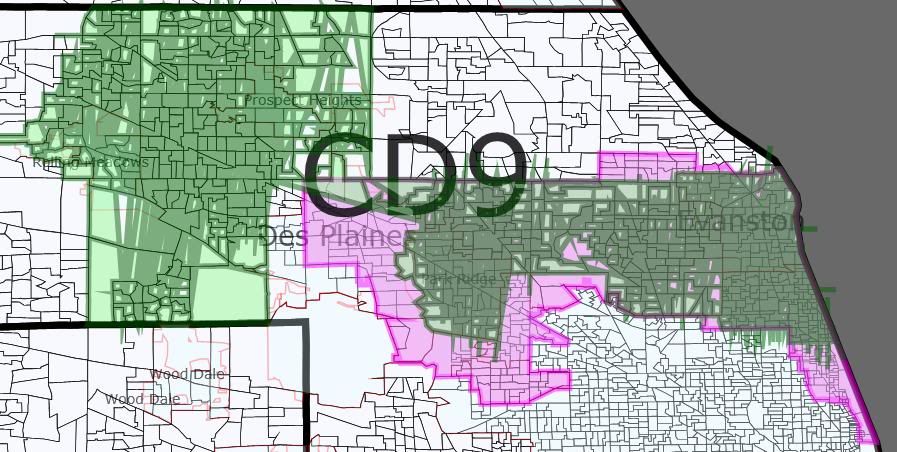
Schakowsky’s district stretchs significantly further west now. This is the only Democratic-held district I’m concerned about whether I weakened it significantly. Perhaps she and Quigley could swap Elk Grove for Des Plaines? (Is that even an improvement for her?)

District 12 — Jerry Costello (D)

VRA: W 80%, B 15%

TTP: 71%
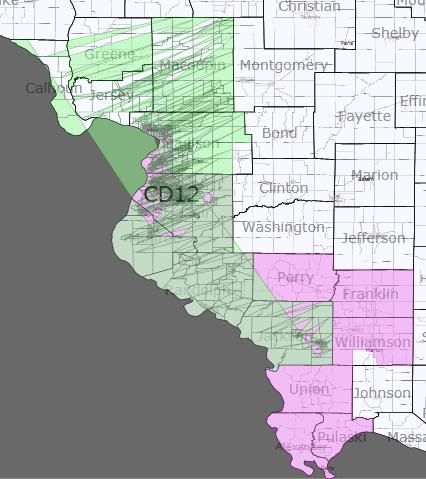
Costello’s district shifts north, and in doing so becomes more Democratic (I think.) One danger: I’ve technically drawn Shimkus into this district, but I’m assuming he’d run in what is now the neighboring 16th. I don’t think Shimkus is a problem (71% TTP for Costello!), but if he is, he could be drawn into the 16th properly. But I’m guessing that would require decreasing the 12th’s Democratic performance.

Republican Held Seats

Now the fun begins! Republicans, please met your new districts.

I have no firm idea what the Democrat’s chances in any of these districts are. I’m hoping that disincumbenting the Chicago suburban Republicans will make them vulnerable. Outstate from Chicagoland, I think I created two new districts that are at least competitive for the Democrats.

District 6 — Judy Biggert (R) vs Randy Hultgren (R)

VRA: W 71% H 14% A 10%

TTP: 55%
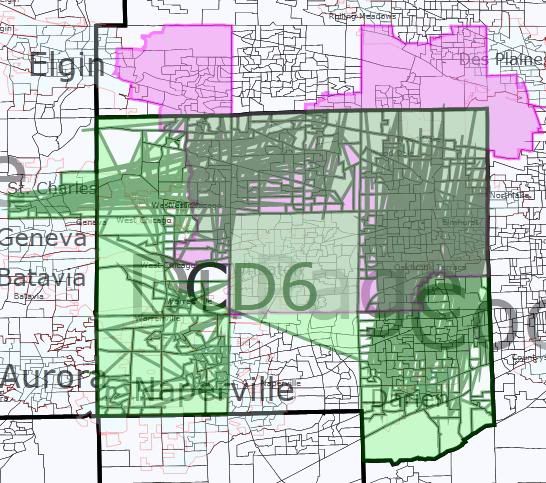
While remaining DuPage-based, the 6th now pairs the residences of two incumbent Republicans — neither of whom are the incumbent in the 6th! Its upside-down U-shape is to keep incumbent Peter Roskam’s hometown of Wheaton out of the district. The listed TTP is if Roskam ran here anyway. If Biggert ran here, her TTP would be 34%; for Hultgren, 11%.

District 8 — Joe Walsh (R)

VRA: W 82%, H 11%

TTP: 35%
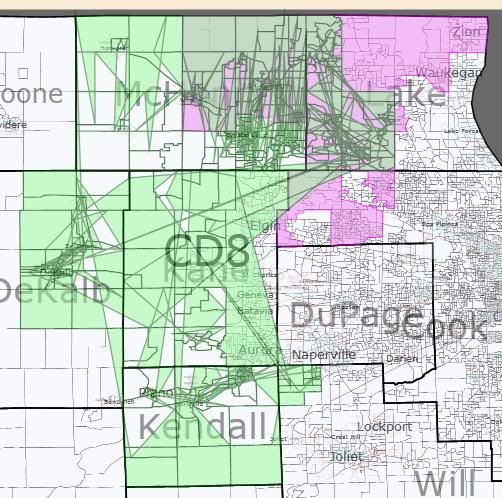
No longer stretching to Lake Michigan, Walsh’s seat now heads south into eastern Dekalb, western Kane, and Kendall Counties. Sadly, I suspect that this territory as at least as favorable to Walsh as his current one. Walsh would have nearly the same TTP if he ran in the new 10th at 30%. Representatives Manzullo and Hultgren would be at 28% and 29%, respectively, if they ran here — despite, you know, not living here.

As a side note, I believe Bean lives in my new 14th.

District 10 — Bob Dold (R)

VRA: W 67%, H 19%

TTP: 68%
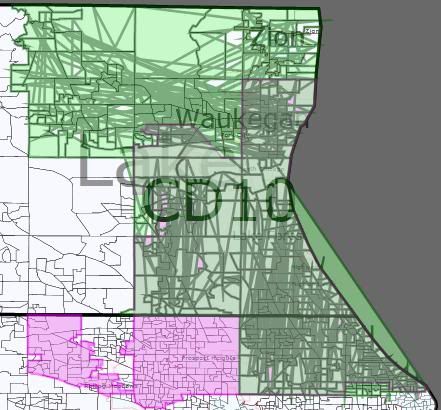
The GOP district I most failed to disrupt. Any suggestions on what I can do with this?

District 11 — Don Manzullo (R) vs Adam Kinzinger (R)

VRA: W 86%

TTP: 46%
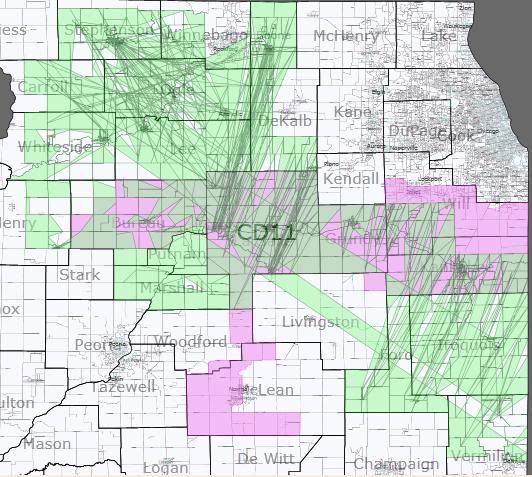
Contains parts of no fewer than 6 current districts. The TTP listed is for Kinzinger, the incumbent by district number and by largest TTP. Manzullo’s TTP is 28%. I’m pretty sure that this is a Republican vote sink. I do feel like I’m wasting LaSalle County, though, which I understand to be a reliable source of Democrats votes. Maybe there’s a better way to draw this vis-a-vis the 8th?

District 13 — Peter Roskam (R)

VRA: W 68%, H 15%, B 10%

TTP: 50%
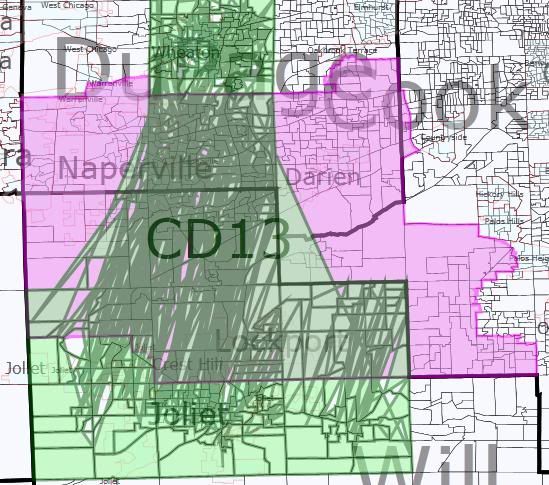
Biggert’s old district now stretches from Wheaton to Joliet. She no longer lives here (Roskam does), but the TTP listed is hers. If Roskam run here, his TTP would only be 17%; Kinzinger would have a TTP of 34%.

District 14 — Open Seat (R?)

VRA: W 62%, H 25%

TTP: 61%
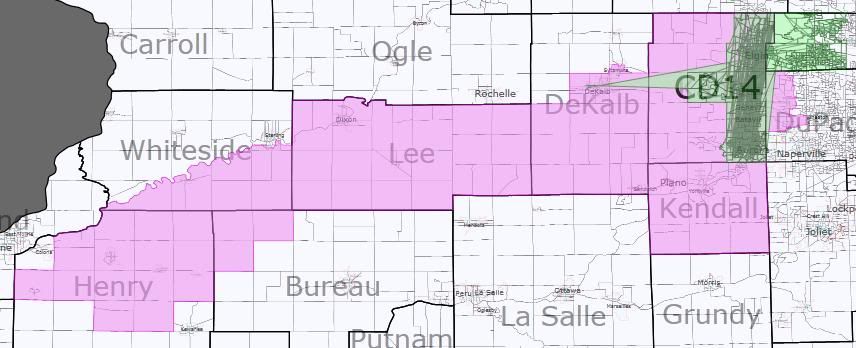
Compacts immensely — no longer stretching out towards the Quad Cities, it is now limited to eastern Kane and far northwestern Cook. This is technically an open seat, since Hultgren lives in the neighboring 6th, although the TTP is his. I believe that both Foster and Bean live in this district. Walsh would have a TTP of 23%. It’s not as disincumbented as I was hoping for — any suggestions?

District 15 — Tim Johnson (R)

VRA: W 83%, B 10%

TTP: 54%
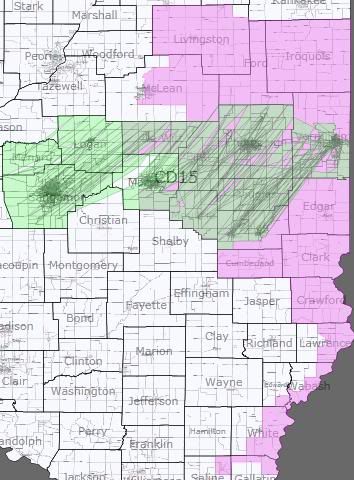
Switches orientations from north-south to east-west, dropping rural areas to pick up Decatur and Springfield. The Springfield area seems to be unusually Republican-friendly for a state capital, so I don’t think this hurts him as much as might be hoped. Nonetheless, this is one of the three districts outstate that I consider a potential D pick-up. Schock’s TTP is 22%, Schilling’s is 17%.

District 16 — Open Seat (R)

VRA: W 93%

TTP:  60%

Entirely relocated from the northwest to the southeast, where it takes over for the reapportioned-away 19th. (This also results in no old/new picture, since the number changes — you’ll have to scroll up to the overview.) Although technically an open seat, I assume that Shimkus would run here; the TTP is his. Johnson’s TTP is 21%; Costello’s is 14%. The second of the downstate Republican vote sinks.

District 17 — Aaron Schock (R) vs Bobby Schilling (R)

VRA: W 78%, B 11%

TTP: 45%
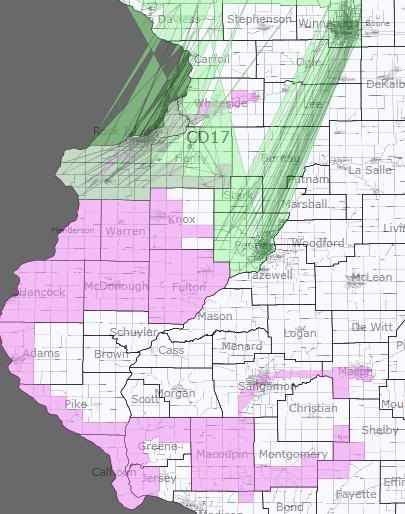
Of the Republican-held seats, this is the one I most strongly suspect would flip Democratic under my plan. A succesor in spirit, if not in form, to the current 17th. It strings together Rockford, the Quad Cities, and Peoria. The TTP listed is actually Manzullo’s, who doesn’t live in the district. Schock’s TTP is 26%; Schilling’s is 25%.

District 18 — Open Seat (R)

VRA: W 91%

TTP: 38%
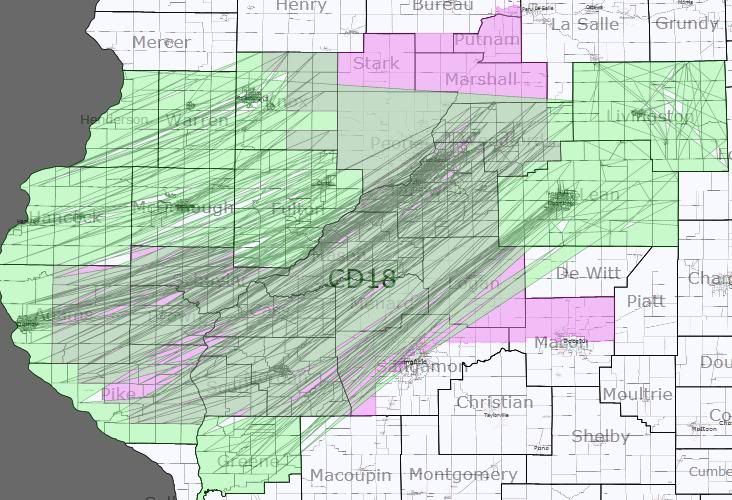
Drops Peoria County and the northern suburbs of Springfield to pick up Bloomington-Normal. This is my third and last Republican vote sink. The listed TTP is Schock, the closest this district (which covers parts of five current ones) comes to an incumbent. Schilling’s TTP is 32%; Johnson’s is 15%; Kinzinger’s is 14%.

Summary

With the caveat again that Illinois is a hard state for me to judge, I think that this map averages around a 12-6 Democratic advantage. Best case scenario: 15-3. Worse case scenario: 8-10 (ie, the status quo, minus one Republican from reapportionment.)

Again, the goals for this map were to demonstrate two things: a possible way to disincumbent the Republicans by making their districts as different as possible from the current set-up and a possible way to swap out Lipinski for a new Hispanic representative. I remain curious about what people who actually understand Illinois think about my plan.

MI-Sen: Stabenow Leads, But Looks Shaky

Public Policy Polling (12/3-6, Michigan voters, no trendlines)

Debbie Stabenow (D-inc): 49

John Engler (R): 42

Undecided: 9

Debbie Stabenow (D-inc): 45

Pete Hoekstra (R): 44

Undecided: 11

Debbie Stabenow (D-inc): 45

Terri Lynn Land (R): 41

Undecided: 14

Debbie Stabenow (D-inc): 47

Tim Leuliette (R): 30

Undecided: 24

Debbie Stabenow (D-inc): 43

Candice Miller (R): 41

Undecided: 15

MoE: ±2.8%

PPP’s first look at 2012’s Michigan Senate race may surprise some people, as this race isn’t one that gets mentioned in the same context as the main trio of troublesome races for the Dems this cycle (Montana, Missouri, and Virginia), yet the numbers here look more similar to those races than the ones that are shaping up to be pretty safe, like Minnesota. I’m not entirely surprised, though, as PPP’s previous approval scorings have placed Debbie Stabenow near the bottom of the Senators up for re-election in 2012, and that seems to show up here again, with middling 41/40 approvals and not breaking 50% against any of her opponents.

Interestingly, the person I’d thought would be the strongest opposition for her, three-term ex-Gov. John Engler (about whom there had been vague rumblings last year about a run), fares worse than most other GOPers. It’s not as if people have forgotten him; he’s still only 9% unknown, it’s just that people remember him and don’t like him (33/45)! It may be a Tommy Thompson-style problem, where a fresh face is more compelling than the old hand that everyone initially feared. The closest race is with Rep. Peter Hoekstra, who’s probably top of mind right now because he ran statewide, narrowly losing the GOP gubernatorial primary… but the polarizing Hoekstra is much less liked (28/31) than some of the other options that may have more upside for the GOP (Rep. Candice Miller and SoS Terri Lynn Land, both at 36/21, although I haven’t heard any mention of Miller or Land’s names being floated for this race).

(I don’t think there will be a digest today, partly because of time concerns, partly because of sheer lack of compelling news, so feel free to use the comments here for off-topic discussion today.)

Rank of Obama challengers

This diary will be not as long as others, but can be interesting too.

I see the polls about the republican primary (without include results for all the voters or independents) and I make this rank.

I think this way for separe the candidates give so logical results.

Leading some poll:

01 M Romney 20

02 M Huckabee 11

03 S Palin 9

04 N Gingrich 1

05 C Christie 1

2nd in some poll:

3rd in some poll:

06 D Cheney 1

07 J McCain 1

08 B Jindal 1

4th in some poll:

09 S Brown 1

10 J Bush 1

11 T Pawlenty 1

12 R Paul 1

13 R Giuliani 1

5th in some poll:

14 L Alexander 1

15 C Crist 1

16 H Barbour 1

6th in some poll:

17 M Daniels 5

18 J Thune 2

19 R Santorum 1

20 R Perry 1

21 M Sanford 1

22 M Pence 1

Worse results:

23 G Bush

24 J Bolton

25 M Rubio

26 F Thompson

27 J Ensign

28 J Cornyn

29 J DeMint

30 B Corker

31 G Pataki

32 G Johnson

33 J Huntsman

34 B McDonnell

35 J Brewer

36 P Ryan

37 E Cantor

38 L Fortuño

39 D Petraeus

40 M Bloomberg

41 J Arpaio

41 B Gates

42 W Buffett

43 D Trump

44 A Mulally

45 C Norris

46 C Eastwood

47 T Selleck

48 B Marceaux

49 J Greenspon

50 F Krager

51 H Cain

52 G Sinise

The first number would be the post in the rank the second number mean the number of polls when the potential candidate get his best place. As example M Ronmey is the leader in 20 polls, M Daniels is 6th (his best place) in 5 polls.

I a emphasize the people unelectable in a republican primary cause of different reasons.

Between all these potential candidates (and some other options included in polls face to face against Obama, only M Romney, M Huckabee and N Gingrich appear leading Obama in some poll, very few, except for a rare poll of Newsmax/SurveyUSA the last election day what gives to Bill Gates, Warren Buffett and David Petraeus strong leads over Obama as republicans.

SSP Daily Digest: 12/9

AK-Sen: Tomorrow is now the expected date for the ruling from a state superior court judge on Joe Miller’s suit contesting 8,000 ballots (over spelling) and also alleging various instances of voter fraud. There’s an injunction in place that keeps the race from being certified until this case (which started in federal court and got moved) has been decided, although the judge is conceding that whatever he decides, it’s likely to get immediately appealed to the Alaska Supreme Court.

News also comes today that Joe Miller wound up finishing the Alaska Senate race with over $900K still in hand, an outrageous sum given how cheap the Alaska media market is. Much of that was intended to go toward post-game legal expenses, and some of that may have been the same problem that plagued other teabagger fundraising dynamos (like Christine O’Donnell and Sharron Angle), of not being able to find any ad slots to spend the money. Also worth a read: a wrapup over at Daily Kos from the Scott McAdams campaign’s media guy, especially his recounting of the adventure he went through to find the Incredible Hulk tie that appeared in McAdams’ TV spot. Finally, we’ll let Kagro X get the last word in on the state of the Alaska race:

Joe Miller keeps fighting on, like a 90 year old Japanese commando on a forgotten island…

FL-Sen: The Florida GOP primary is looking like it’s going to be a very crowded affair after all: Adam Hasner, the former state House majority leader, has suddenly bubbled up over the last few days as a possible if not likely candidate. If the name sounds familiar, he considered and decided against a run in FL-22 this year; he’s one of the few Republicans from the Gold Coast and, in addition to being a key Marco Rubio ally, could tap quickly into Jewish Republican fundraising circles.

PA-Sen: It’s looking more and more like Bob Casey Jr.’s challenger is going to come not from the U.S. House but the ranks of the state Senate; the question, though, is which one? The newest name to surface is Kim Ward, who says she’s starting to test the waters. She’s from Westmoreland County, maybe the most conservative of the once-blue, now-swingy collar counties around Pittsburgh, giving the GOP hopes they might eat into Casey’s strong backing in SW PA.

RI-Sen: Don’t rule out soon-to-be-ex-Gov. Don Carcieri (who’d probably be the only Republican who could make this an interesting race here) from Senate race consideration. The 68-year-old two-termer says he isn’t ruling it out, but wants to take some time off before thinking about it.

VA-Sen: George Allen is definitely acting candidate-ish now; having laid down markers against possible primary challenger Corey Stewart, now he’s moving on to direct attacks on Jim Webb (who, of course, may or may not be running for re-election), over voting against the earmark ban and the horrible sin of supporting collective bargaining rights for public safety officers.

LA-Gov: Still no word on whether a strong Dem will get into the Louisiana governor’s race, but The Daily Kingfish takes a very interesting look at the field of possible challengers to Bobby Jindal, whose numbers indicate he’s popular but not bulletproof. They handicap the odds on a collection of possible challengers; interestingly, the guy they give the greatest odds to is ex-Dem John Kennedy (who presumably would take on Jindal while still wearing the “R” badge, although I guess anything’s possible in Louisiana, where party labels seem to get taken on and off like so much laundry). They also float the possibility of a Mary Landrieu run, in that she may be eager to bail out of Washington before her next re-election in 2014.

WV-Gov: With a pileup of half a dozen Dems interested in the 2012 (or 2011?) gubernatorial race, who’s running for the GOP? The Beltway rumor mill seems, this week, to have Shelly Moore Capito more interested in going for the Gov race than the Senate or staying in the House. While she’d be the undisputed heavyweight, a few other second-tier GOPers are making their interest known (although it’s unclear whether they’d bother if Capito got in). Most prominent is ex-SoS Betty Ireland, one of the few GOPers around who’s held statewide office, and who had briefly considered running for Senate this year. State Sen. Clark Barnes is the only Republican who has committed to the race so far.

CO-03, VA-11: Republican Keith Fimian, who came within a thousand votes of Gerry Connolly, is publicly saying he’s interested in another run. He wants to wait and see what the district looks like after redistricting before committing one way or the other, though. One other rematch that may or may not be on the table is Dem John Salazar in Colorado’s 3rd, who narrowly lost the reddish district to Scott Tipton and “is open” to a rematch.

House: Politico takes a quick look at the Republicans that Democrats in the House are most likely to target in 2012. I don’t think any of the names (mostly surprise victors in Dem-leaning swing districts) will surprise any devoted SSP readers: in order, they discuss Chip Cravaack, Ann Marie Buerkle, the Illinois Five (especially Bobby Schilling), Blake Farenthold, Renee Ellmers, and Allen West.

Votes: The DREAM Act passed the House today (although it looks like, so many other pieces of legislation, its next stop is a slow Senate death by neglect). It’s an interesting vote breakdown, with 38 Dems voting no (mostly Blue Dogs, and mostly ones on their way out the door) and 8 Republicans voting yes (almost all the non-white GOPers, along with the newly-liberated Bob Inglis). Most puzzling “no” vote may be Dan Lipinski, whose safe blue IL-03 is significantly Latino, and getting more so every day.

Census: This is a strange video to go viral, but I’ve been seeing lots of links to this new video from the Census Bureau today, a catchy little explanation of what reapportionment is and how it works. Also a helpful Census Bureau release today: a release schedule of all the various parts and pieces that will be necessary for the redistricting process. The big enchilada, of course, is the reapportionment breakdown, which will be released at some point before the end of the year, although they’re still not specifying which date. According to today’s release, state numbers on race (down to the block level) will be out in February, so I’m sure there’ll be flurry of activity with Dave’s Redistricting App at that point.

Let’s Redistrict Utah!

 All I know about Utah is that its Mormon and overwhelmingly Republican.  The largest city, Salt Lake, is Democratic but everything else is so Republican that the city does not have enough Democratic votes to overcome the rest of the state.  I think that there is a growing Latino population in Utah and also a growing non-Mormon population.  I also heard a while back that SLC had a surprisingly large gay population.

Utah should have actually got a 4th seat back in 2002 so a 4th seat is guaranteed for 2012.  Right now there are three districts, two are ultra-conservative Republicans and one is a conservative Democrat (Jim Matheson).  The Republicans will control everything in 2012.

There is no partisan information for redistricting on the app so all I could do was create as friendly of a district for Democrats as I could.  I knew that Summit County, to the right of Salt Lake County, for whatever reason votes Democratic.  The President won a third county, Grand County, which is in southeastern Utah.  I guess that both Summit and Grand are skiing counties?  Or perhaps they have Native American reservations.  San Juan County, in the very southeastern corner, was 51-47 McCain.  So what's up here?

Every other county was extremely Republican, often by more than 70%.

What I did was basically just make four districts – three that I knew would be very Republican and one that I made to be Democratic-friendly.  (In my map, this is the blue district.)  I have no idea if it would actually be good for the Democrats but it does put Summit County into this Salt Lake City-based district so I'm thinking this can only help.  Of course, the Republicans know about Summit County and they'll most likely put it into a Republican district.

It looks like that Republicans will succeed in making four districts that went for McCain in 2008 and this will likely help them when the President is up for reelection in 2012.  My prediction is a 3-1 Republican delegation in 2012, with a new Republican 4th district, but Jim Matheson may very well lose in 2012 if he is given a very different district.

It's a rather depressing map for Democrats, but it is one of the states that will gain a seat so I thought it was important to do.

My Map

2008 CNN Statewide County Results for Utah

(Links will open in new window.)

SSP Daily Digest: 12/8

CT-Sen: Following his loss in the CT-Gov primary after leading the polls almost all the way, I hadn’t heard much discussion about Ned Lamont making a repeat run against Joe Lieberman for the 2012 Senate race. Lamont confirms that, saying he’s “strongly disinclined” to try again.

FL-Sen: Here’s a dilemma for temp Sen. George LeMieux, as he gave his farewell speech from the Senate floor. Acknowledge the man without whom he’d be utterly unknown and thus not in a position to run again for Senate in 2012… or invoke said man, whose name is utterly mud in Florida GOP circles, thus reminding everyone of those connections that can only hurt in a 2012 primary? In the end, basic human decency prevailed, and LeMieux thanked Charlie Crist for appointing him.

ME-Sen: This is pretty big news, as everyone has been treating newly-elected Gov. Paul LePage’s imprimatur as a make or break for Olympia Snowe’s hopes in a GOP primary in 2012. LePage, of course, was the tea party choice in the primary, and his say-so would go a long way toward either encouraging or discouraging a teabagger challenge to Snowe. LePage just came out with a statement of support for Snowe in the primary, saying he’d back her in the face of a possible primary challenge.

MO-Sen: Sarah Steelman continues to rack up support from the GOP’s far-right, as she girds for a possible GOP primary showdown against ex-Sen. Jim Talent. Steelman met with Jim DeMint, the Senate’s de facto kingmaker of the tea party set, and those involved expect DeMint’s Senate Conservative Fund to back Steelman shortly (which would be his first endorsement of the 2012 cycle).

PA-Sen: Moran gets brain? Perhaps sensing the steep uphill climb of a challenge against the Casey name brand in Pennsylvania in a presidential year, random rich guy John Moran has done an about-face on a threatened possible Senate run that first emerged last week. Another central Pennsylvanian, though, state Sen. Jake Corman, seems to be interested in taking on Bob Casey Jr.

UT-Sen: In case there was any doubt about Orrin Hatch running again — in his 70s and facing a likely difficult primary/convention — well, he is. He released a statement this morning saying “I intend to run, and I intend to win.” That comes in the face of the formation of a new leadership PAC by Rep. Jason Chaffetz, which would likely point to stepped-up fundraising efforts in the face of a intra-party challenge. (Hatch is sitting on $2.32 million CoH, while Chaffetz has $179K. If the targeted audience isn’t all Utahns but a few thousand nuts at the state convention, though, money is less of an issue.)

IN-Gov: Soon-to-be-ex-Sen. Evan Bayh is issuing something of a timeline regarding whether or not he runs for his old job as Governor again in 2012. Bayh says he’ll make a decision by the end of the year, and is saying it’s a “possibility but [not] a probability.” (Rep. Baron Hill and Evansville mayor Jonathan Weinzapfel are other fallback options.)There’s no timeline, though, from Rep. Mike Pence, who probably would be the strongest candidate the GOP could put forth, but seems more interested in going straight for the Presidency. One GOPer who isn’t waiting for Pence’s decision is Lt. Gov. Becky Skillman, who has moved forward on fundraising although she hasn’t officially declared anything. Soon-to-be-Rep. Todd Rokita warns not to underestimate Skillman.

MN-Gov: This is kind of a moot point in view of his concession this morning, but in case you’re wondering what suddenly motivated Tom Emmer to drop his challenge to Mark Dayton and move on, this was probably the last straw: yesterday the Minnesota Supreme Court denied his petition asking for all counties to perform a reconciliation of number of voters with number of ballots cast. With the recount already done, the reconciliation would have been the only practical way of even stringing this thing out for a while longer, let alone finding an extra 9,000 votes.

MO-Gov: In marked contrast to the recent PPP poll giving Jay Nixon a clear edge, Republican Lt. Gov. Peter Kinder (now looking more like a candidate than ever) is pointing to an internal poll by American Viewpoint taken way back in late September that gives him a 47-38 lead over Nixon. The poll finds Nixon still popular, though, with 51% approval.

ND-Gov: Today was the first day on the job for North Dakota’s new Governor, ex-Lt. Gov. Jack Dalrymple, who took over as John Hoeven resigned in order to join the Senate soon. Hoeven is the first-ever North Dakota Governor to resign voluntarily. Taking over as Lt. Gov. is ex-US Attorney Drew Wrigley. Dalrymple will be watched carefully as to what happens in 2012: he could either run for election to a full term, or move over to a Senate run against Kent Conrad.

MN-08: Newly-elected Rep. Chip Cravaack will have one of the tougher re-elects of any of the new House Republicans (he’s in a D+3 district that includes the Dem stronghold of Duluth), but one of the bigger-name Dems in the district is saying he won’t be the challenger. State Sen. Tom Bakk (one of the 5,589,358,587,568,120 people who ran for the DFL gubernatorial nomination this year) is staying where he is, especially since he’s about to become minority leader.

GA-St. House: One more D-to-R party switcher to report, and it’s a fairly big name within the confines of the Georgia legislature: Doug McKillip, who was previously #2 among Democrats. Interestingly, he’s not from a dark-red rural district but represents the college town of Athens, and he says he’ll be better able to agitate for the University’s needs from within the majority… although, that, of course, would depend on getting re-elected again from that (presumably blue) district.

MA-Sen: Who Will Take On Scotty?

Public Policy Polling (11/29-12/1, registered Democrats)

Vicki Kennedy (D): 22

Barney Frank (D): 17

Mike Capuano (D): 15

Deval Patrick (D): 13

Stephen Lynch (D): 7

Ed Markey (D): 7

Tom Menino (D): 3

Tim Murray (D): 1

Undecided: 15

MoE: ±6.2%

Perhaps the better question to ask here is who didn’t PPP poll in asking Dems who they want to take on Republican incumbent Scott Brown. Ted Kennedy’s widow Vicki leads at 22, followed by the one and only Congressman Barney Frank at 17 and Boston/Cambridge Congressman (and special election primary second-place finisher) Mike Capuano at 15. Recently re-elected Governor Deval Patrick is fourth at 13, followed by two more Congressmen, Stephen Lynch and Ed Markey at 7 apiece. Boston mayor Tom Menino gets 3, while recently re-elected Lieutenant Governor Tim Murray gets 1.

The general election half of this poll has Scotty leading all the Dems, but many of our challengers remain relatively unknown quantities, with even 44% of Dems having no opinion of Capuano, 45% having no opinion of Lynch, and 36% having no opinion of Markey.

This field is still wide open…let’s just be happy Martha Coakley isn’t seeking redemption.

NY-01: Altschuler Concedes

Finally, our Long Island nightmare (and our national nightmare, given that this was the last contested House race of the cycle) is over:

New York Republican Randy Altschuler has conceded to Democratic Rep. Tim Bishop, bringing the final undecided House race of the 2010 election cycle to a close.

Altschuler, a wealthy, self-funding businessman, trailed Bishop by 263 votes late Tuesday, after a Suffolk County judge sorted through 1,000 challenged ballots.

The two campaigns were scheduled to meet in court Wednesday morning to continue sorting through ballots, but with fewer than 1,000 challenged votes left to be counted, Altschuler’s campaign determined that it could not close the gap.

“After consulting with my family and campaign staff, I am ending my campaign and offering congratulations to Congressman Tim Bishop on his victory,” Altschuler said in a statement, adding that he had decided to forego a district-wide hand recount.

MN-Gov: Emmer Will Concede

It’s Dayton time:

It’s over.

Republican Tom Emmer will concede the 2010 Minnesota governor’s race this morning to Democrat Mark Dayton, a Republican source with direct knowledge confirmed to the Pioneer Press.

Emmer’s 10:30 a.m. concession means he will not contest the election in court – thus averting a scenario that could have kept Republican Gov. Tim Pawlenty in office past the scheduled Jan. 3 swearing-in of the next governor, the source said.

I guess he figured that his chances at the World Court in the Hague weren’t that great.