10-3 Republican Non-Dummymander of North Carolina

Photobucket

This was intended to test the extent to which the GOP could wreak havoc with North Carolina redistricting, while remaining VRA-compliant.  The key to the map is taking Mel Watt’s 12th district, and sending it eastward instead of northward (which is what the Bush Administration was trying to force NC to do in the early 1990s.  This allows massive packing of Democrats in the RTP/Greensboro/Winston-Salem area into a heavily Democratic district, that is a borderline third VRA district.  As an additional bonus, it places McIntyre, Watt and Kissell in the same district.

This would obviously engender a Shaw v. Reno-type challenge, but again, this is simply meant to test boundaries.  You can smooth the lines out in the 12th and 1st to make them not all that much worse than they presently are, especially if you don’t try to pack the three Congressmen together into the 12th.

I assumed that any district that gave McCain at least 54% of the vote would be pretty safe for Republicans, especially considering that high African American turnout probably skews these districts a touch toward the Democrats right now.

Without further adieu . . .

First District (Butterfield) — 70% Obama, 30% McCain, 42% White, 50% Black, 5% Hispanic (old district 63% Obama, 37% McCain, 50% black, 43% white, 4% H.).  This district needs to gain population, and the only way to do that is to extend it into Raleigh or Durham.  I chose the latter.  In reality, it is difficult to keep this black-majority, but you probably don’t need to do that to remain VRA compliant, which allows some smoothing of the lines (at the expense of making the 3rd/13th more Democratic).

Second District (Ellmers) — 45% Obama, 54% McCain, 67% White, 23% Black, 6% Hispanic (old district 53/47 Obama, 58/29/10 W/B/H).  This district no longer resembles a dragon viewed from above.  Ellmers loses Democratic portions of Fayetteville and Wake County, and trades them for Republican areas there.

Third District (Jones) — 42% Obama, 57% McCain, 72% White, 21% Black, 4% Hispanic (old district 62/38 McCain, 75/16/5 W/B/H).  Jones’ district loses some heavily Republican precincts on the western edge of the 1st, and gains Democratic areas in Duplin and Pender. If the 1st has to be smoothed out some, I’d extend this one down to downtown Wilmington to shore up the 7th.

Photobucket

Fourth District (Price/new minority Rep) 79% Obama, 20% McCain, 45% White, 42% Black, 8%Hispanic (old district 62/37 Obama, 66/19/8 W/B/H) — This basically packs as many Democratic precincts in the area as possible into one district.  I think this is probably a third VRA district, since African Americans would probably control the Democratic primary, and the district would almost certainly elect whomever comes out of that primary.

Fifth District (McHenry) — 59% McCain, 40% Obama, 78% White, 16% Black, 4% Hispanic (old district 63/36M, 83/9/5 W/B/H).  I flipped the district numbers here just to make the maps more readable.  McHenry gets a lot of new territory, but most of it is reliably Republican and he should have little difficulty winning here.

Sixth District (Coble) — 43% Obama, 56% McCain, 83% White, 11% Black, 5% Hispanic (old district 63%/36% McCain, 82%W, 10%B,6%H).  Coble actually gets to keep a lot of his old territory.  You could smooth out the lines with the 13th and make it look a lot more “normal” without affecting its performance that much.

Seventh District (Open) — 44%Obama, 56% McCain, 69% White, 23% Black, 5% Hisp, 2% NA (old district 52%M/47%O, 64/21/6 W/B/H, 8% NA) — The black/hispanic percentages don’t change much; the key is moving Lumbee Native Americans from Robeson County into the minority-majority 12th.  McIntyre goes with them,and this new district should easily elect a Republican.

Eighth District (Open) — 44% Obama, 55% McCain, 81% White, 10% Black, 5% Hispanic (old district 52/47 Obama, 58/28/9 W/B/H) — Kissell gets moved into the 12th.  It would be pretty simple for him to move into this district, but it is much less hospitable for him.  The new GOP voters in Randolph County and thereabouts are true GOPers, not the remnants of Southern Democrats that inhabit the current 8th.

Photobucket

Ninth District (Myrick) — 44% Obama, 55% McCain, 83% White, 10% Black, 4% Hispanic (old district 55/45 McCain, 77/13/6) — The topline numbers don’t change on Myrick’s district, but the racial composition changes a hair.  It’s whiter now, meaning that in years where the GOP doesn’t completely alienate everyone, it will swing further to the right than its current makeup.

Tenth District (Foxx) — 43% Obama, 56% McCain, 88% White, 6% Black, 4% Hispanic (old district 61/38 McCain, 85/7/6).  She gets a chunk of Asheville, in order to shore up the GOP #s in the 11th, but this is still Republican enough that she should win handily.

Eleventh District (Shuler) — 57% McCain, 42% Obama, 89% White, 5% Black, 3% Hispanic (old district 52/47 McCain, 88/5/4 W/B/H) — Shuler loses most of Asheville, and I think he’d have a very, very difficult time winning this.  He’d have lost by about 6 points to a no-name in 2010.

Twelfth District (Watt, Kissell, McIntyre) — 72% Obama, 27% McCain, 38% White, 43% Black, 8% Native American, 7% Hispanic (old district 71/29 Obama, 41/44/11 W/B/H) — Not too much to say here, except that this is the lynchpin of the entire plan.  It’s what makes the 8th and 7th very, very difficult to win for Democrats.

Thirteenth District (Miller) — 45% Obama, 54% McCain, 77% White, 18% Black, 3% Hispanic (old district 60/40 Obama, 60/28/9 W/B/H).  I don’t know what precinct Miller is in; he may well be drawn into the First (or could easily be drawn there).  Regardless, I have a hard time seeing him winning here, except if 2012 is a very good Democratic year.

Thoughts?

Daves Redistricting 2.0.2

Last night I uploaded Version 2.0.2. This fixes a couple of bugs with 2.0.1 and introduces a new feature that I hope you like… Change Colors!

You can now change CD colors and change the opaqueness of the CDs essentially making them lighter or darker)! I also made the Old CD lines a little thicker and changed the county line color.

Launch Page

Please let me know what you think. Also, check out the Help page for lots of good information.

This will be all the changes for a little while, unless a bad bug is found. I’m working on a plan for next year and will let you all know about that when it’s ready.

Thanks!

The Keys to President Barack Obama’s Re-election Chances

By: Inoljt, http://mypolitikal.com/

The recent mid-terms were, by all accounts, very bad for Democrats. They lost 63 seats in the House of Representatives and 6 seats in the Senate. In many ways things were worse than in 1994, when Republicans won landslide victory.

There is another analogy to 1994, however, which will probably make Democrats happier. President Bill Clinton, after devastating mid-term losses, went on to win a comfortable re-election campaign. Can Mr. Obama do the same?

The book “The Keys to the White House,” by Professor Allan J. Lichtman provides a fascinating answer. Mr. Lichtman argues that the results of a presidential election can be predicted months or years beforehand by a series of thirteen “keys.” According to this theory, if the incumbent party or current president captures a certain number of “keys”, it will win the election. Otherwise it will lose.

More below.

This can readily be applied to the 2012 presidential election. Here are Mr. Lichtman’s exact words:

The Keys to the White House are stated as conditions that favor reelection of the incumbent party. When five or fewer statements are false, the incumbent party wins. When six or more are false, the incumbent party loses.

Key 1: Incumbent-party mandate – After the midterms the incumbent party holds more seats in the U.S. House of Representatives than it did after the previous midterm elections.

Key 2: Nomination-contest – There is no serious contest for the incumbent-party nomination.

Key 3: Incumbency – The incumbent-party candidate is the sitting president.

Key 4: Third party – There is no significant third-party or independent campaign.

Key 5:  Short-term economy – The economy is not in recession during the election campaign

Key 6: Long-term economy – Real annual per-capita economic growth during the term equals or exceeds mean growth during the previous two terms.

Key 7: Policy change – The incumbent administration effects major changes in national policy.

Key 8: Social unrest – There is no sustained social unrest during the term.

Key 9: Scandal – The incumbent administration is untainted by major scandal.

Key 10: Foreign or military failure – The incumbent administration suffers no major failure in foreign or military affairs.

Key 11: Foreign or military success – The incumbent administration achieves a major success in foreign or military affairs.

Key 12: Incumbent charisma – The incumbent-party candidate is charismatic or a national hero.

Key 13: Challenger charisma – The challenging-party candidate is not charismatic or a national hero.

A year before the 2008 presidential election, Mr. Lichtman used these keys to confidently predict that Democrats would win the coming election. Seven of the keys – the incumbent-party mandate, the nomination contest, incumbency, policy change, foreign/military failure, foreign/military success, and incumbent charisma – were going against the Republican Party at that point. As the election went on, three other keys turned against them: short-term economy, long-term economy, and challenger charisma. The Republican Party thus went into the 2008 presidential election with ten of the thirteen keys turned against them. In this context, it is not surprising that Senator John McCain lost.

Let’s take a look at how the keys are stacking up in 2012:

Key 1: Incumbent-party mandate – After the midterms the incumbent party holds more seats in the U.S.  House of Representatives than it did after the previous midterm  elections.

Democrats would have had to lose twenty-three or less seats for this statement to be true. That definitely did not happen. This statement is FALSE.

___________________

Key 2: Nomination-contest – There is no serious contest for the incumbent-party nomination.

Nobody has the stature to contest Mr. Obama in the Democratic primary, even with recent liberal unrest over his tax cut deal. This statement is TRUE.

___________________

Key 3: Incumbency – The incumbent-party candidate is the sitting president.

The Democratic candidate is indeed the sitting president. This statement is TRUE.

___________________

Key 4: Third party – There is no significant third-party or independent campaign.

Ralph Nadar and 2000 effectively killed-off third-party candidacies for a generation. At the moment, 2012 isn’t looking any different. This statement is TRUE.

___________________

Key 5:  Short-term economy – The economy is not in recession during the election campaign.

This is a tough one – the economy probably won’t be in recession in 2012, but it certainly could feel like a recession. Given that so much of Democratic troubles stem from the short-term economy, for the moment this statement will be FALSE.

___________________

Key 6: Long-term economy – Real annual per-capita economic growth during the term equals or exceeds mean growth during the previous two terms.

This particular statistic is also tough to find, but we can certainly infer some things from just looking at real GDP. According to my calculations, Mr. Bush averaged 2.0% real GDP growth (the relevant websites are here and here). That’s pretty low, but real GDP growth was – 2.6% in 2009 because of the recession. The first quarter of 2010 was 3.7%. The second quarter was 1.6%. The third is estimated to be 1.5%. So real GDP growth under Mr. Obama has been something like an average – 0.5%. Over the eight quarters left until November 2012, real GDP would have to grow by something like an average 4.2% for Democrats to win this key. That’s just within the conceivable bounds of possibility, although it’s quite unlikely. This statement is UNKNOWN – LEANING FALSE.

___________________

Key 7: Policy change – The incumbent administration effects major changes in national policy.

Health care definitely was a major change in national policy. This statement is TRUE.

___________________

Key 8: Social unrest – There is no sustained social unrest during the term.

Tea Party shenanigans don’t count as “sustained social unrest.” This statement is TRUE.

___________________

Key 9: Scandal – The incumbent administration is untainted by major scandal.

The Obama administration has not yet had a major scandal. This statement is TRUE.

___________________

Key 10: Foreign or military failure – The incumbent administration suffers no major failure in foreign or military affairs.

Likewise, Mr. Obama hasn’t suffered a major failure overseas yet. (Although Afghanistan is not looking too good these days.) This statement is TRUE.

___________________

Key 11: Foreign or military success – The incumbent administration achieves a major success in foreign or military affairs.

But neither has Mr. Obama achieved a major success overseas. This statement is FALSE.

___________________

Key 12: Incumbent charisma – The incumbent-party candidate is charismatic or a national hero.

Mr. Obama certainly fits the definition of “charisma” to the word. This statement is TRUE.

___________________

Key 13: Challenger charisma – The challenging-party candidate is not charismatic or a national hero.

Although this could change, the current crop of Republican candidates doesn’t look very charismatic. This statement is TRUE.

___________________

All in all, the Democrats end up holding nine keys out of thirteen (they need seven to win). Four statements are false or unknown; nine are true. Under Mr. Lichtman’s system, then, Mr. Obama looks set to win re-election in 2012.

Of course things might change and get worse for Democrats. The Republicans might nominate somebody like Senator Scott Brown, who is readily equipped with charisma – winning the “challenger charisma” key. Afghanistan might turn into Mr. Obama’s military failure, making him lose that key. The Obama administration might become engulfed in scandal and lose another key.

On the other hand, things might also get better. The economy might be growing steadily come 2012, for instance winning Democrats that key. Mr. Obama might miraculously create peace between Israel and Palestine, winning another key.

But whatever changes happen, Mr. Lichtman’s system gives Democrats surprisingly bright prospects in the 2012 presidential election. Democrats are quite gloomy nowadays, but come November 2012 their spirits may be a bit brighter.

My Democratic Gerrymander of Illinois (14-3-1)

The Land of Lincoln is one of the few bright spots in an otherwise gloomy redistricting cycle.  Through Governor Quinn’s come-from-behind narrow reeelection victory, we have the trifecta in this state.  At the same time, the GOP elected five freshmen congressmen from Illinois, some in districts like the 17th, that have historically elected Democrats.  Before these congressmen can get situated, they will be put through the ringer of a partisan reapportionment.

Here are my basic assumptions in drawing this map:

1) As one of the few states where Democrats can make a big difference, Illinois Democrats will squeeze out as much seats as possible.  Realistically, Maryland will only net us one more seat (7-1 seems more realistic than 8-0) and in the other states we control like MA we actually will lose a seat.  Illinois House Speaker Michael Madigan is an old-school Democratic pol; he knows a thing or two about screwing the Republicans and he will.  Unlike 10 years ago when Denny Hastert could deliver goodies to Chicago and thus needed to be placated, there is no reason to accommodate any Republicans, and there will be no accommodation.

2) A second Hispanic seat is almost inevitable, given the VRA and the explosive growth of the Latino population in Chicago.  But see #3.

3) As Madigan’s boy, Lipinski will be given another seat that he can win.  He will not be drawn out, which is more geographically logical, because he is Madigan’s boy.  Don’t know about Madigan and Quigley, but a Democrat is not going to sacrifice a seat here.  Instead, I drew Peter Roskam out of a seat; the 6th now joins the 4th as Chicago’s 2nd Hispanic seat.

4) Of the incumbent Democrats who got defeated in 2010, Debbie Halvorson will get the sweetest deal?  Why?  She’s a former majority leader (the #2 position in the caucus under Emil Jones) in the State Senate and thus in my view still has clout in Springfield.  Phil Hare will get a better seat.  And I drew a better seat for Foster to return to.  That leaves out Melissa Bean.  Oh well – not much of a Democrat is she?  

5) Partisan numbers: when the time comes for these to be uploaded, could you please put in the Kerry 2004 numbers if you are also going to do Obama numbers?  Obama got about what an average national Democrat would get below Springfield (home state advantage cancels out with the latent racism that I see every day living now in Southern Illinois among want-to-be southerners down here) but north of Springfield, particularly north of I-80, he got vote totals in Republican counties that no other national Democrat would have gotten.  No Democratic presidential candidate wins 55% of the vote in DuPage… I can see 47-50% nowadays as that county is becoming more moderate, but Obama PVI gives Democrats false assurance about redistricting.  Perhaps my map is one of those, I don’t know.  I did try to retain as much as possible of each Democratic congress person’s base in Chicago so that they would still be more than okay.

So it is hard to say for sure that all my districts will elect what I think they will elect.  But I think I’ve drawn a map that yields 14 reasonably safe Democratic seats (all the seats that string in and out of Chicago plus Jerry Costello’s 12th downstate and the newly configured 15th downstate cities seat), 1 swing seat (for Melissa Bean – the 8th), and 3 uber-Republican seats (the 16th, the 18th, and the 13th).  Following Illinois custom, the Biggert seat (the current 13th) got axed and its number migrated downstate to become Shimkus’s new seat number.

Chicagoland

Photobucket

District 1 (blue) Rush-D

50% Black, 41% white

Even though Rush has got a past with the Black Panthers, he should be all-right here.  One of the goals that any Democratic gerrymander of Illinois must achieve is the unpacking of enough Democratic voters from Chicago so that Debby Halvorson can win again (and I created a tailor-made new 11th district right below Jesse Jackson Jr.’s 2nd to make that happen.  Goes now into southern DuPage County and includes the home of soon-to-be ex-congresswoman Judy Biggert.

District 2 (dark green) Jackson, Jr.-D

50% Black, 40% white

Same story here as with the newly configured First Congressional District.  Removes Hispanic and white areas of South Chicago and its suburbs, which now go in the 11th to help Halvorson make a comeback to Congress, and snakes into Will County a bit and then up like a U to parts of DuPage.  If Jackson still nurses his statewide aspirations, this would be the perfect district for that.

District 3 (purple) Lipinski-D

White 65%, Hispanic 20%, Black 9%


Extends a bit further into suburban Cook County into areas once in the former 13th (so probably slightly lean Republican) but balances that off of black voters in south Chicago not needed by any of the 3 VRA protected districts.  Lipinski should be fine in any case.

District 4 (red) Randy Hultgren (R) but not for much longer!!

61% Hispanic, 28% White, 7% Black


I believe Gutierrez lives in my new 6th district and that this district contains more Mexicans rather than Puerto Ricans (but can a Chicagoan please correct me on this if I am wrong).  Don’t know whether this would pass VRA muster or not, but I see no reason why a Hispanic could not get elected from here even if his/her voters are not 61% Hispanic.  

To accommodate Lipinski for all the reasons spelled out above, and to help crack Peter Roskam and Randy Hultgren, this district now snakes all the way to Hispanic-Aurora.  Still no crazier than the current configurations of the 4th district.

District 5 (yellow) Quigley-D

69% White, 14% Hispanic

I believe the Du Page areas I added to this district, along with Elk Grove, are at worst 50-50.  With both Quigley and Schakowsky I tried to maintain as much as possible their Chicago bases of support while rejiggering a bit the suburban parts.

District 6 (teal) Gutierrez-D

56% Hispanic, 33% White, 4% Black

Also snakes a bit now into DuPage County.  I believe this is all-right with the VRA given that the district contains a lot of Puerto Ricans who are already citizens?  Please, a Chicago resident, correct me if I am grossly in error here.

District 7 (grey) Davis-D

50% Black, 37% White

Finishes the job of cracking Peter Roskam with throwing his key base, Wheaton, in a black-majority district.  Some of the 37% who are white, though, are white liberals out of Oak Park, so Davis will not face a problem here.

District 8 (purple) 50-50 rematch between Bean and Walsh, thinking that I’ve given Bean somewhat of a slight advantage here but am not sure

Grabs Waukegan and subtracts a bit in heavily-Republican McHenry.  I think I’ve given Bean a ticket back to Congress – especially when one considers that we are dealing with Governor Quinn, and thus a Democratic trifecta with redistricting, because State Senator Jim Brady- Tea Party got about 50k fewer votes than did Mark Kirk in the collar counties.  Joe Walsh is a one-term fluke; these Republicans are moderate and will probably cross over to vote for Obama and Bean in two years just as they did to reelect my governor when everyone said he was toast.  Could have gone the extra mile and grabbed Elgin but I wanted to make sure that the 14th was amenable to voting for a Democrat as well, so I did not.

District 9 (light blue) Schakowsky-D

Extends a bit further north into Republican-leaning Wheeling Township, but I made sure to keep enough of Evanston and the Lake Front of Chicago – her bases of support.  Look a Democratic gerrymander is going to have to unpack the black VRA seats and Schakowsky’s liberal bastion if it Schakowsky is going to be able to have a chance of voting for Speaker Pelosi again.  And I think Schakowsky knows that and will play along.

District 10 (pink) possibly now a Democrat wins?

Added about 100,000 new Chicago coast residents that make it practically impossible for Dolt to win reelection here.  One of the two really wonderful benefits of unpacking Democrats in Chicago a bit.

District 11 (light green) VACANT (tailor-designed for Halvorson-D)

Condenses to just Will County (minus 3 Republican townships in the 2nd) so Kinzinger is drawn out of the seat but… wait… this is Halvorson’s base.  Adds a finger of about 150,000 Cook County residents to the seat and… voila… I think I’ve just created a district that voted for Obama probably in the 60% range now.  I’d dare Kinzinger to try to win from here.

The rest of northern Illinois

Photobucket

District 14 (brown-green) VACANT

Built a district that connects slightly Republican-leaning Kane County (which it is, minus Aurora), slightly-Democratic DeKalb next door (because of NIU), and added what I imagine is heavily Democratic Rockford to the mix.  Looks compact and probably is enough Democratic to elect Bill Foster should he wish to run again.  This is the district that I want to test the most with Kerry 04 numbers, though.

District 16 (green) Kinzinger (R) vs. Manzullo (R) vs. Schilling (R)

Northern Illinois GOP vote sink.  Did the petty thing and drew all three Republican congressmen from this region into the same district, leaving the 17th and the 14th next door both vacant.

District 17 (purple) VACANT (Phil Hare-D?  or is there another Quad Cities Democrat who is more good at not losing his seat)

Quad Cities, Peoria (but not the part of Peoria that our glam-congressman lives in), snakes through mildly Democratic Bureau and LaSalle Counties to grab Kankakee.  Still looks a bit fugly, but in some ways is an improvement over the current district’s configurations.  Besides, no more ultra-Republican Quincy to muck up the works.

District 18 (yellow) Schock-R

Figure if you can’t get rid of this glamour-boy, straight out of central casting, and you really cannot, you might as well give him then a GOP vote sink so you can elect Democrat congressmen to the north and south.  This district now contains no major cities at all.

Southern Illinois

Photobucket

District 15 (orange) Johnson-R probably a Democrat wins now or after Johnson retires

The other district that I would like to have tested with Kerry numbers.  Connects Dansville, Urbana-Champaign, Normal-Bloomington, Decatur, and Springfield together in a reasonably-looking district.  Adds historically Democratic Montgomery County to the mix.  I think this district probably voted for Kerry, but I don’t know and Obama by a bit more.  Kerry didn’t do well in Southern Illinois.

District 12 (light blue) Costello-D

Changes very little, goes north into Macoupin and surrounding Democratic-leaning counties to make up for population loss.  This is my local congressman and about the only way to draw Southern Illinois nowadays to guarantee a Democrat in congress from that region.

District 13 (pink) Shimkus-R

Again, largely the same.  Goes a bit northward into where the old 15th was to enable the reconfiguration of that district into a district that will probably elect a Democrat now.  Shimkus is a scumbag, but realistically you need a Republican vote sink down here.

So, there you have it.  Is this something reasonably safe enough for a Democratic gerrymander?  Or did I just draw a dummymander?  Let me know.

SSP Daily Digest: 12/13

AK-Sen: Everyone’s watching Joe Miller’s next move, as tomorrow is the day he has to decide whether or not to appeal a trial court decision in order to keep fighting his largely-hopeless fight with Lisa Murkowski. On Friday afternoon, a state superior court judge ruled against Miller’s lawsuit, and in pretty withering fashion, saying he presented no evidence of fraud or malfeasance, only “hearsay, speculation, and… sarcasm.” This comes on top of other comments on Friday by state elections director Gail Fenumiai strongly disputing one of Miller’s cornerstone issues, that there was a strange sudden influx of felons voting in the state.

CT-Sen, CT-04: Rep. Jim Himes confirms that he isn’t going to run for Senate in 2012 against Joe Lieberman (if Lieberman even decides to stick around). It’s also pretty clear confirmation that Rep. Chris Murphy is ready to run on the Dem line, as Himes said he’s deferring to his slightly-more-senior colleague and might consider running if Murphy changed his mind. (The article also mentions that Rep. Joe Courtney is “considering” the race. Ex-SoS Susan Bysiewicz’s interest is well-known as well, although I doubt she’ll be able to manage to file her candidacy papers successfully.)

HI-Sen: Sometimes the Beltway media’s parsing of every innocent word from a potential candidate gets a little maddening, but this throw-away line from Linda Lingle’s website flagged by David Catanese is actually pretty suggestive of a future run (probably against Dan Akaka in 2012): the site is titled “Looking Back, and Forward,” and her first blog post is “Continuing the Journey.”

MD-Sen: Contrast that with Bob Ehrlich, who seems ripe to fall into the Dino Rossi trap but has just made it pretty clear that he won’t be running for anything else again. He says a Senate run would be “very highly unlikely.”

ME-Sen: The only story that seems to be here is that the viable Tea Party candidate that has been promised to emerge to take on Olympia Snowe is starting to look like more of a mirage. A must-read (for sheer hubris and wtf?ness) interview with the state’s self-appointed head teabagger, Andrew Ian Dodge, makes it sound like the candidate that Dodge is allegedly talking to is either imaginary, or else is Dodge himself (seeing as how he’s from southern Maine and has his own money).

MI-Sen: PPP includes a GOP primary portion in their Michigan Senate poll, and like a lot of other polls this far out, name rec seems to rule the day. Ex-Gov. John Engler, despite eight years out of the picture, has the lead (in fact, that may be good news, as the general electorate doesn’t remember him fondly; he underperforms Debbie Stabenow, losing by 7, compared with Peter Hoekstra, who loses by 1). It’s Engler 31, Hoekstra 24, with 12 for ex-AG Mike Cox, Terri Lynn Land (who may be interested in this race after all) at 7, Candice Miller at 5, Mike Rogers at 4, Thad McCotter at 3, and Tim Leuliette (the most-interested candidate so far) at 0.

NJ-Sen: The Hill has an article that’s mostly about how no GOPers are stepping up to express their interest in an uphill fight against Bob Menendez, but it does include the obligatory list of possible contenders. Top of the list is a rematch from state Sen. (and gubernatorial progeny) Tom Kean Jr., but also mentioned are Lt. Gov. Kim Guadagno, state Sen. Joe Kyrillos, Anna Little (a small-town mayor who was competitive against Rep. Frank Pallone this year), state Sen. Jennifer Beck, former state Sen. Bill Baroni, and state GOP chair Jay Webber if all else fails.

NY-Sen: Rep. Peter King does some coulda-woulda-shoulda in a recent interview, saying he definitely would have run in 2010 had Caroline Kennedy been the appointee. As for a run in 2012 against Kirsten Gillibrand (when she’s up for election for her first full term), he’s only “keeping his options open,” apparently leery of her fundraising prowess.

PA-Sen: Rep. Charlie Dent is usually at the top of the list for Senate race speculation, but a recent interview has him sounding rather un-candidate-ish: he’s about to land a plum spot on Appropriations, and speaks of it in terms of “one never rules anything out,” which to my ear sounds a few steps down the Beltway-ese totem pole from “considering” it. One other interesting rumor bubbling up is that ex-Gov. Mark Schweiker is being courted to run. The question is whether anybody even remembers Schweiker; he spent less than two years on the job in the early 00s after getting promoted after Tom Ridge moved to the Bush administration, and declined to run for his own full term.

VT-Sen: Could Bernie Sanders see a real opponent? While he isn’t specifically threatening to run yet, State Auditor Tom Salmon is taking to Facebook to attack Sanders over his anti-tax deal agitating (including attacking Sanders for being a socialist, which doesn’t quite have the same effective power with Sanders as with most Dems since he’s likely just to say “guilty as charged”). At any rate, going after the entrenched Sanders seems like an odd move if it comes to pass, as Peter Shumlin, who narrowly won the open gubernatorial race, seems like a much easier target in a blue state that’s willing to elect Republican governors but has sworn them off at the national level.

CA-Gov: Steve Poizner sounds likely to make another run at the governor’s mansion in 2014, publicly telling various people that he would have made a much better candidate than Meg Whitman. Poizner will have to step it up on the financial situation next time, though; self-funding only to the tune of eight digits, instead of nine, was pretty weak sauce.

IN-Gov: With Evan Bayh apparently out of the gubernatorial sweepstakes, Brad Ellsworth seems to be jockeying to the front of the line today, although with some of the requisite hedging. The other main contender, of course, is Evansville mayor Jonathan Weinzapfel, although the impact of redistricting changes (at the hand of the now-GOP-held legislature) could drive Reps. Joe Donnelly or Baron Hill into the race. Two lesser Dem names who’ve been bandied about, Hammond mayor Thomas McDermott and former state House speaker John Gregg, are already taking their names off the table, lining up behind others for now: McDermott backing Ellsworth and Gregg backing Weinzapfel. One final new Dem name to keep an eye on: Lake County Sheriff Roy Dominguez.

MS-Gov: For now, the Democratic side on the Mississippi governor’s race seems to be between two men: Hattiesburg mayor Johnny DuPree (that city’s first African-American mayor) and businessman Bill Luckett, who has his own money (and the backing of Morgan Freeman… apparently for real, unlike with NC-04’s B.J. Lawson).

WA-Gov: Here’s a good take from Joel Connolly (dean of the local press corps) on the 2012 gubernatorial election in Washington state, which the Beltway press seems to treat like an open book but everyone local knows is going to be between Rep. Jay Inslee and AG Rob McKenna, who’s probably the best shot the GOP has had in decades of winning the governor’s race. (Chris Gregoire can, by law, run for a third term, but, in practice, that would be unheard of even if she weren’t already too unpopular to do so feasibly.)

NY-15: Is the Charles Rangel era actually coming to a close? He’s not ruling out another run in 2012 but saying he’ll have to think about retirement. And in public comments he is actively pointing to a generation of successors, citing state Sens. Adriano Espaillat and Robert Rodriguez, and state Assemblyman Keith Wright. (Although Harlem is the core of the district, it now has more Hispanics than it does African-Americans… and the wild card is that the fastest growing group in this district is white regentrifiers.)

LA-St. Leg.: The hemorrhaging of Dem state legislators to the GOP in Louisiana continues apace, with one of its most prominent state Reps., the mellifluously-named Noble Ellington, sounding about ready to pull the trigger on a switch. He’d follow two state Sens., John Alario and John Smith, who also recently crossed the aisle.

Philly mayor: You’d think that at age 80, you’d want to think about retirement, but not if you’re Arlen Specter, apparently. There’s word of a poll making the rounds (from Apex Research, with no mention of who paid for it or why) that not only links the outgoing Senator to a mayoral run (in the city where he got his start generations ago as the DA) but actually has him in the lead. The poll has Specter at 28, with incumbent Michael Nutter at 19, Sam Katz at 9, Anthony Hardy Williams at 8, Tom Knox at 7, Bob Brady at 6, and Alan Butkovitz (anybody care to let me know who he is?) at 6.

WATN?: Try as he may, Artur Davis just can’t get the douchiness out of his system. On his way to the private sector, he’s still taking the pox-on-both-your-houses approach on his way out the door, writing an op-ed calling for an independent party as the solution to all of Alabama’s woes. Meanwhile, Mariannette Miller-Meeks has landed on her feet, after losing a second run in IA-02 in a rare setback for the Ophthalmologists (who elected at least two more of their own to Congress this year): Terry Branstad just named her head of Iowa’s Dept. of Public Health.

Census: Finally, this may be the most exciting news of the day: we have a reporting date for the first real batch of 2010 Census data. Dec. 21 will be the day the Census Bureau releases its state population counts, which also includes reapportionment data (i.e. how many House seats each state will get… at least prior to the inevitable litigation process among the most closely-bunched states).

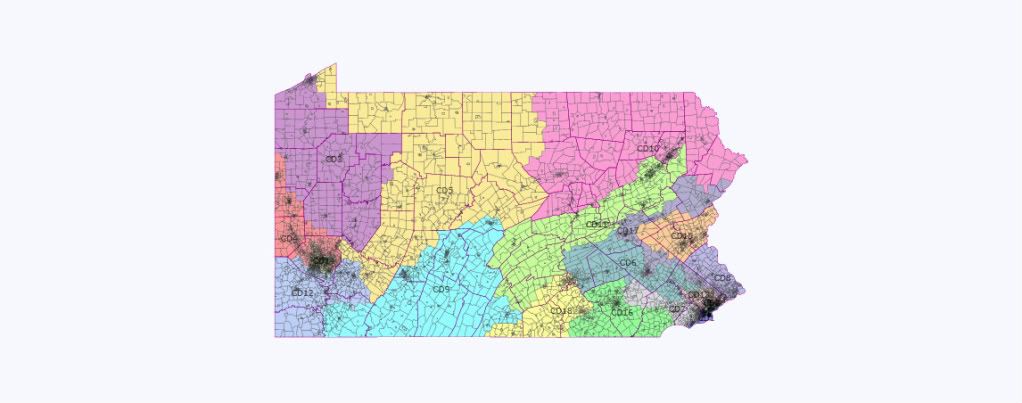
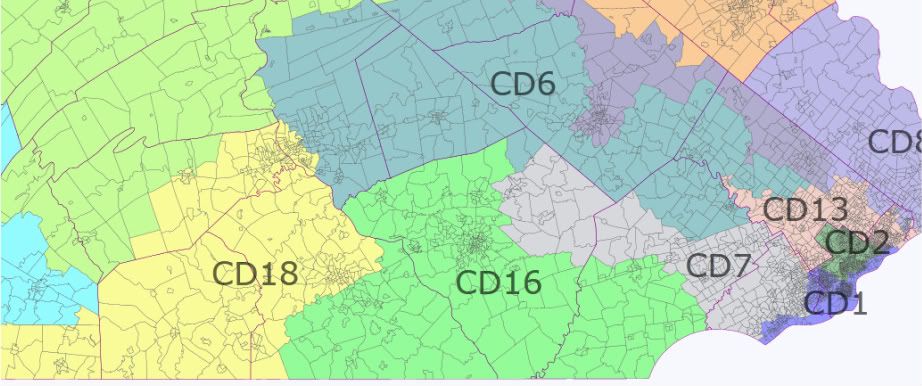
PA Redistricting: GOPmander

The GOP again has control of the redistricting trifecta in Pennsylvania.  Last time, it didn’t go as well as planned, as its intended 13 R & 6 D delegation (12 R + ousting Tim Holden) ended up a dummymander by 2008 (12 D & 7 R representatives).

This time around, the Republicans have the challenge of shoring up regained seats around the state, in addition to the probable elimination of one of the Democratic delegation.  My goal here was to accomplish that, in addition to a couple of other curve balls:

All of the districts are within +/- 650 people, based on 2008 population estimates.  And without further wait, let’s start!

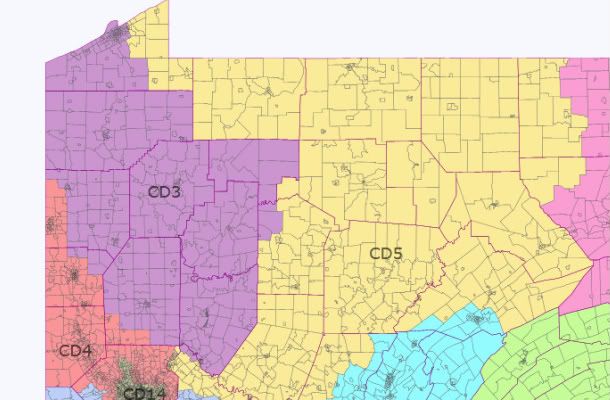
Northwest PA:

PA-3: Rep. Mike Kelly (R-Butler)

         93% White, 4% Black, 3% Other

         52% McCain, 47% Obama, (49% McCain, 49% Obama)

PA-3 shifts a few points to the right, as PA-5 takes eastern Erie county in exchange for more rural precincts.  With the old PVI R+5.2 in addition to the rightward shift in the district, Kelly should be safe in most years.

PA-4 : OPEN; potentially Rep. Jason Altmire (D-McCandless)

         93% White, 4% Black, 3% Other

         53% McCain, 46% Obama, (no shift)

Surprisingly, it is fairly easy to remove Rep. Jason Altmire out of PA-4 by combining McCandless (his residency) with Mike Doyle in PA-14 in exchange for more Republican parts of Allegheny County.  If he doesn’t decide to move within the district, this would probably be an GOP gain as the area is trending Republican with most of the state reps & senators being GOP members.  On the other hand, if Altmire sees the primary with Doyle as unfeasible (likely) and doesn’t decide to retire, PA-4 could be the successor to the current PA-17 (Dem incumbent too personally popular to be unseated).

PA-5: Rep. Glenn Thompson (R-Howard)

         96% White, 4% Other

         54% McCain, 44% Obama, (55% McCain, 44% Obama)

Thompson’s district moves westward and southward, taking parts of Allegheny and Erie county in order to shore up other less safe districts.  Nothing too exciting here.

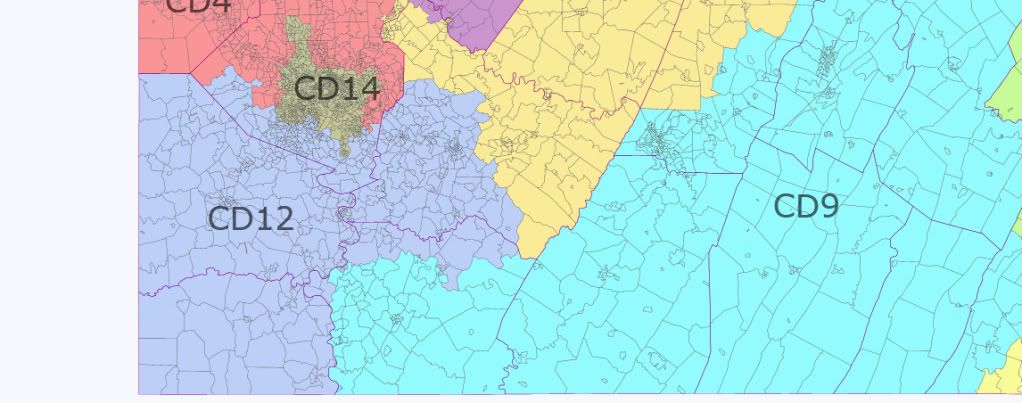
Southwest PA:

PA-9: Rep. Bill Shuster (R-Hollidaysburg) vs. Rep Mark Critz (D-Johnstown)

         93% White, 3% Black, 3% Other

         55% McCain, 43% Obama, (63% McCain, 36% Obama)

Sorry, Mark Critz, but you’re most likely going to be out of office come 2012.  The new PA-9 takes part of the former Murthamander of PA-12, including Critz’ home base of Johnstown.  At a 55% McCain district with a non-Tim Burns opponent, he’ll need the stars to align in order to beat Shuster.  Other than that, PA-9 shifts westward.

PA-12: Rep. Tim Murphy (R-Upper St. Clair), formerly PA-18

         95% White, 3% Black, 2% Other

         55% McCain, 44% Obama

Murphy snatches most of the rest of PA-12 along with the former PA-18, as southwest PA is where population growth is the lowest.  The McCain-Obama margin stays about the same as it was in the old PA-18.

PA-14: Rep. Mike Doyle (D-Forest Hills)

         72% White, 21% Black, 3% Asian, 4% Other

         67% Obama, 32% McCain ,(70% Obama, 29% McCain)

Mike Doyle’s district, still centered around Pittsburgh) becomes slightly less Democratic with the addition of Altmire’s base of McCandless.  Doyle probably doesn’t have to worry about a primary from his right, so he should be in the clear.

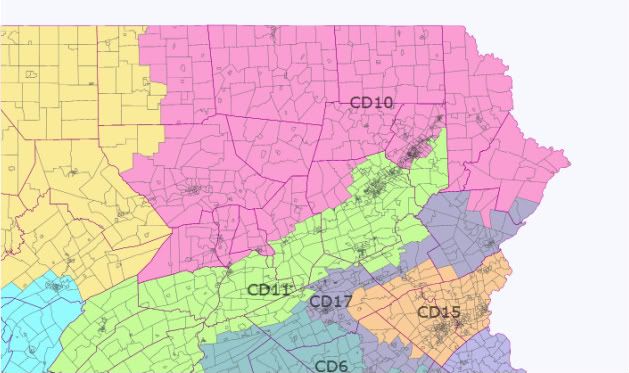
Northeast PA:

PA-10: Rep. Tom Marino (R-Lycoming)

         93% White, 3% Black, 4% Other

         51% McCain, 48% Obama, (54% McCain, 45% Obama)

It is really difficult to make all the Republicans in Eastern PA safe, as Tim Holden’s district can only hold so much population.  Neither Lou Barletta nor Tom Marino are strong candidates, so I had to choose one of them to shore up more.  As you can see, Marino took the hit (aka Scranton).  Carney would probably be good for a comeback here in a good Dem year, as Marino probably won’t be the most ethical congressman.  However, Lackawanna County isn’t trending Democratic at the federal level (Obama vs McCain margins were about the same as Gore vs Bush, a substantially more Republican year), so even if Marino were to lose, a better candidate could probably have at least an even chance of regaining the seat.

PA-11: Rep. Lou Barletta (R-Hazletown)

         94% White, 3% Hispanic, 3% Other

         53% McCain, 46% Obama, (57% Obama, 42% McCain)

Lou Barletta is the beneficiary of the Scranton switch, going from a 57% to 46% Obama district.  His district drastically shifts southwest, taking in the majority of the old PA-17, minus Schuylkill county, and eastern parts of PA-9.  He should be in pretty good condition here.

PA-15: Rep. Charlie Dent (R-Allentown)

         81% White, 12% Hispanic, 4% Black, 3% Other

         55% Obama, 43% McCain, (56% Obama, 43% McCain)

It is possible to make Charlie Dent theoretically safer by taking parts of Allentown or Bethlehem into PA-17 while grabbing more McCain-friendly precincts.  However, it would probably backfire on the Republicans, as it would remain an Obama district (52 or 53%).  Additionally, it would break up the Lehigh Valley, which historically has voted for a Republican for all but 6 years since the 1970s and has been in only one district for even longer.  Cracking Allentown would probably harm Dent more than help, as the “communities of interest” would potentially be an issue.  As a result, it only becomes slightly more Republican, taking in more conservative parts of the Valley.

PA-17: Rep. Tim Holden (D-St. Clair)

         78% White, 12% Hispanic, 6% Black, 3% Asian, 1% Other

         56% Obama, 43% McCain, (51% McCain, 49% Obama)

This district took quite a bit of effort and I’m not sure if it would hold up or not.  Basically, it makes Tim Holden safe, along with shoring up other suburban GOP reps.  With the most conservative part being his base, Holden takes in Reading, most of Monroe County, and chunks of Carbon & Montgomery Counties (PA-13 alone can’t shore up all of the southeastern Republican seats).  Basically, it becomes a Democratic vote sink.  There could possibly be a chance that Holden moves westward in Schuylkill and takes on Gerlach or Barletta if he fears a primary challenge in a more Dem-friendly district.  However, their districts are more conservative than the previous PA-17 so he’d probably have a better shot in this district.

Southeast PA (Philly Suburbs):

PA-6: Rep. Jim Gerlach (R-West Pikeland)

         90% White, 4% Black, 3% Hispanic, 3% Other

         52% McCain, 47% Obama, (58% Obama, 41% McCain)

From D+5 to R+6, how things change for Jim Gerlach.  PA-6 becomes a lot more rural, stretching westward out from the suburbs in addition to giving Reading over to Tim Holden in exchange for much of the old PA-17.  Gerlach has repeatedly shown a knack for survival, hanging on in great Dem years like 2006 & 2008, so he should be safe in this district.  Even if he tries again for higher office, a moderate-conservative Republican should be able to hold on to the new PA-6 fairly easily.

PA-7: Rep. Pat Meehan (R-Drexel Hill)

         89% White, 4% Black, 4% Asian, 3% Other

         51% Obama, 48% McCain, (56% Obama, 43% McCain)

With Allyson Schwartz’s district becoming a more Democratic vote-sink, PA-7 reddens a good deal.  Meehan’s new district picks up parts of Pitts’ and Gerlach’s old districts while dropping more Dem-heavy precincts to the Philly districts.  Overall, this should help Meehan to entrench himself in the district more than before.

PA-8: Rep. Mike Fitzpatrick (R-Levittown)

         88% White, 4% Black, 4% Asian, 3% Hispanic, 1% Other

         53% Obama, 46% McCain, (54% Obama, 45% McCain)

There isn’t a whole lot that can be done for Mike Fitzpatrick either, other than shifting the margin to what Obama won by nationally.  In 2006, a good Democratic year, Patrick Murphy only beat him by 1500-some votes, a margin that the switch of precincts with Allyson Schwartz would probably have eliminated.  PA-8, basically, remains a swing district, but leaves Fitzpatrick in a slightly stronger position.

PA-16:  Rep. Joe Pitts (R-Kennett Square)

         85% White, 8% Hispanic, 5% Black, 2% Other

         53% McCain, 46% Obama, (51% McCain, 48% Obama)

Joe Pitts’ Lancaster-based district moves somewhat westward out of the suburbs, thus becoming slightly safer for him.  Still, if current trends hold, all of the Philadelphia suburban districts are going to end up places where the GOP will have to sweat, regardless of this round of redistricting.  Pitts will probably need to tone down his anti-choice rhetoric or even moderate somewhat in order to keep the district in the mid-long term.

PA-18:  Rep. Todd Platts (R-York)

         82% White, 9% Black, 6% Hispanic, 3% Other

         52% McCain, 47% Obama, (56% McCain, 43% Obama)

I had to put Harrisburg somewhere, and unfortunately for Todd Platts, it gets thrown into his district.  Putting Harrisburg in any other district presents a higher risk to the GOP, as Joe Pitts and Jim Gerlach both have to worry about further Democratization of the Philly suburbs.  The district is still fairly Republican, so Platts should be pretty safe.

Philadelphia:

PA-1: Rep. Robert Brady (D-Philadelphia)

         46% Black, 41% White, 7% Asian, 4% Hispanic, 2% Other  

         83% Obama, 16% McCain, (88% Obama, 12% McCain)

Majority-minority district for Brady.  It just stretches out more along the Delaware River than before, nothing too drastic.

PA-2: Rep. Chaka Fattah (D-Philadelphia)

         53% Black, 23% White, 18% Hispanic, 4% Asian, 1% Other

         91% Obama, 8% McCain, (90% Obama, 10% McCain)

It is possible: Chaka Fattah’s district can become even more Democratic, albeit slightly.  It also becomes a lot more compact while remaining VRA at 53% black & only 23% white.  It also sheds some precincts to PA-13.

PA-13: Rep. Allyson Schwartz (D-Jenkintown)

         79% White, 9% Black, 6% Asian, 5% Hispanic, 1% Other

         64% Obama, 36% McCain, (59% Obama, 41% McCain)

PA-13 gains a lot more Dem voters and in the process makes the rest of the Republican suburbs safer.  It basically switches parts of Montgomery county with other districts in order to grab all of the 60%+ Obama precincts.  Allyson Schwartz, winning by a 13% margin in 2010, is there for as long as she wants to be in Congress.

—–

Overall, I think the Republicans will go for a map somewhat like this.  They might go with a Dem-vote sink in NW PA with Altmire by combining PA-4 with Erie, but I don’t think they’re going to cede to Altmire that easily.  Another option would be for Holden to take Scranton and drop some of SE Pennsylvania, but a similar district failed to pass last round I believe.  GOP wins in PA-10 & 11 this year complicated things for them, as the legislature is foremost going to try for R-incumbent protection.

So any thoughts?  I’m not from PA (no Florida precinct information on Dave’s app yet 🙁 ), so I’d be curious to see if anyone from there would think this would hold up.

PA GOPmander

The GOP again has control of the redistricting trifecta in Pennsylvania.  Last time, it didn’t go as well as planned, as its intended 13 R & 6 D delegation (12 R + ousting Tim Holden) ended up a dummymander by 2008 (12 D & 7 R representatives).

This time around, the Republicans have the challenge of shoring up regained seats around the state, in addition to the probable elimination of one of the Democratic delegation.  My goal here was to accomplish that, in addition to a couple of other curve balls:

Northwest PA:

PA-3: Rep. Mike Kelly (R-Butler)

         93% White, 4% Black, 3% Other

         52% McCain, 47% Obama, (49% McCain, 49% Obama)

PA-3 shifts a few points to the right, as PA-5 takes eastern Erie county in exchange for more rural precincts.  With the old PVI R+5.2 in addition to the rightward shift in the district, Kelly should be safe in most years.

PA-4 : OPEN; potentially Rep. Jason Altmire (D-McCandless)

         93% White, 4% Black, 3% Other

         53% McCain, 46% Obama, (no shift)

Surprisingly, it is fairly easy to remove Rep. Jason Altmire out of PA-4 by combining McCandless (his residency) with Mike Doyle in PA-14 in exchange for more Republican parts of Allegheny County.  If he doesn’t decide to move within the district, this would probably be an GOP gain as the area is trending Republican with most of the state reps & senators being GOP members.  On the other hand, if Altmire sees the primary with Doyle as unfeasible (likely) and doesn’t decide to retire, PA-4 could be the successor to the current PA-17 (Dem incumbent too personally popular to be unseated).

PA-5: Rep. Glenn Thompson (R-Howard)

         96% White, 4% Other

         54% McCain, 44% Obama (55% McCain, 44% Obama)

Thompson’s district moves westward and southward, taking parts of Allegheny and Erie county in order to shore up other less safe districts.  Nothing too exciting here.

Southwest PA:

PA-9: Rep. Bill Shuster (R-Hollidaysburg) vs. Rep Mark Critz (D-Johnstown)

         93% White, 3% Black, 3% Other

         55% McCain, 43% Obama, (63% McCain, 36% Obama)

Sorry, Mark Critz, but you’re most likely going to be out of office come 2012.  The new PA-9 takes part of the former Murthamander of PA-12, including Critz’ home base of Johnstown.  At a 55% McCain district with a non-Tim Burns opponent, he’ll need the stars to align in order to beat Shuster.  Other than that, PA-9 shifts westward.

PA-12: Rep. Tim Murphy (R-Upper St. Clair), formerly PA-18

         95% White, 3% Black, 2% Other

         55% McCain, 44% Obama

Murphy snatches most of the rest of PA-12 along with his own PA-18, as southwest PA is where population growth is the lowest.

PA-14: Rep. Mike Doyle (R-Forest Hills)

         72% White, 21% Black, 3% Asian, 4% Other

         67% Obama, 32% McCain ,(70% Obama, 29% McCain)

Mike Doyle’s district, still centered around Pittsburgh) becomes slightly less Democratic with the addition of Altmire’s base of McCandless.  Doyle probably doesn’t have to worry about a primary from his right, so he should be in the clear.

NE

It’s time for Iowa!

I’m having problems inserting images into this box so here is the link:

http://i1215.photobucket.com/a…

Old 1st= http://upload.wikimedia.org/wi…

New Iowa 1 (purple) Bruce Braley’s district stays the same for the most part.

Old 2nd=

http://upload.wikimedia.org/wi…

New Iowa 2 (red)

Dave Loebsack vs. Steve King.  This district could be better I’ll admit.  I checked the counties and its 56-44 Democratic which is okay for Loebsack and not good at all for King.

Old 3rd=

http://upload.wikimedia.org/wi…

New 3rd (blue)

This would be Leonard Boswell’s district.  There’s a bunch of blue counties in the current 4th and they’re being wasted to Tom Latham.  Story County (home of Ames and Iowa State) is here.  Since Latham lives in Ames, he would be running in this unfriendly district.

Old 4th=

http://upload.wikimedia.org/wi…

New 4th (green)

The new 4th is now a district that a new Democrat can get elected in or a new Republican, but no incumbent Republican can run in the 4th because none lives there.  This will make a Democratic-leaning swing seat.

Old 5th=

http://upload.wikimedia.org/wi…

New 5th= haha, there is no one.  Iowa’s losing it in 2012.

IN-Gov: Bayh Won’t Run

Via the Fix:

Indiana Democratic Sen. Evan Bayh has decided against a run for governor in 2012, robbing Democrats of their top recruit in the Hoosier State.

“After careful consideration, I have concluded that the appropriate decision is not to be a candidate for governor of Indiana in 2012,” Bayh said in a statement released to the Fix. “”The principle reason for my decision is the welfare of my twin sons.”

Bayh’s decision leaves the Democratic field wide open. Reps. Brad Ellsworth and Baron Hill, both of whom lost races this fall, are likely to consider the Bayh-less contest. Others mentioned include Rep. Joe Donnelly, Evansville Mayor Jonathan Weinzapfel and former state House Speaker John Gregg.

Maryland Redistricting: 7-1 Democratic

Cross posted on Daily kos  http://www.dailykos.com/story/…

and my blog http://frogandturtle.blogspot…. which you should visit for more redistrcting maps and election analysis.

Like in 2001, Democrats hold the trifecta in Maryland again. This means that not only do they control the Governorship, they also control both houses of the state legislature. In 2001, the congressional delegation was 4-4 but Democrats redrew the maps to make a favorable Democratic map that accomplished its goal of removing 2 of the 4 Republican representatives. After 2002, there were no party changes until 2008 when Frank Kratovli (D) ran in the 1st district which contains conservative Baltimore suburbs and the Eastern Shore. He barely won against an extremist candidate. Unfortunately for the Democrats, he lost in 2010 by 13 points. Therefore, the delegation has returned to its original 6-2 Democrats. Maryland has turned more blue though since 2002 due to more African Americans moving into Prince Georges and Charles Counties. Also, Hispanics, Asians and white liberals are moving into Montgomery County and even Frederick County. The Baltimore suburbs are actually trending Republican but that’s a different post for a different day.  

Still, with Maryland trending Democratic overall, it is now possible to construct a 7-1 Democratic map. I have even seen some 8-0 Democratic maps but some districts are too shaky and can result in a dummymander when Republicans are able to pick up 1,2 or even 3 of those seats. I chose to draw a 7-1 map because I think it is close to what the state legislature will draw. While drawing the map, I made sure the 4th and 7th districts remained majority African American because of the VRA requiring 2 African American majority districts. While drawing the map, I made sure no district except for the Republican 6th fell below 54% Obama. Also, I made sure 6 of the districts were at least 58% for Obama. This map should protect all the Democratic incumbents, one Republican incumbent and create a new district that leans Democratic. Now here is Maryland’s current map:

Maryland’s current map: http://www.nationalatlas.gov/p…

Maryland

             Statewide map of Maryland

Maryland’s 1st Congressional District: Andy Harris (R) (blue)

Partisan Data: Obama 137,680 54%, McCain 113,225 44%

Demographics: 23% African American, 5% Hispanic, 68% White

Old District’s Partisan Data: McCain 58%, Obama 40%

Major Cities: Annapolis, Salisbury

Status: Likely Democratic

This district makes some major changes when I moved conservative suburbs in Harford and Anne Arundel out into other districts such as the 6th and 7th while adding in Democratic Annapolis and some neighborhoods in heavily Democratic Prince Georges County and places in Anne Arundel County such as Odenton which will become more Democratic due to in migration by African Americans. Harris’s base is in conservative Harford County which I removed. Frank Kratovli (D), the representative before 2010 of the 1st now has a great shot at retaking this district because of the new Democratic areas in the district. The district’s Democratic lean may be overstated due to high Obama turnout in Prince Georges County but as the areas in Anne Arundel keep getting more Democratic, they should offset any drop in turnout. Also, Kratovli tends to over perform in the Eastern Shore so with big margins in Prince Georges and Anne Arundel Counties, he should win here.

Baltimore Area

                                       Baltimore Area

Maryland’s 2nd Congressional District: Dutch Ruppersberger (D) (Green)

Partisan Data: Obama 155,376 58%, McCain 107,691 40%

Demographics: 24% African American, 68% White

Old District’s Partisan Data: Obama 60%, McCain 38%

Major Cities: Baltimore, Towson, Dundalk

Status: Safe Democratic

Ruppersberger’s district gets less convoluted by losing all of its Anne Arundel County portions and picking up swingy Towson which was originally in the 3rd district. Although the 2nd district retains some Republican suburbs around Edgemere, it still remains Democratic by picking up more Baltimore City neighborhoods. They also help balance out the loss of some heavily Democratic precincts in Randallstown. Ruppersberger should be fine here.

Maryland’s 3rd Congressional District: John Sarbanes (D) (Purple)

Partisan Data: Obama 164,297 62%, McCain 96,626 36%

Demographics: 26% African American, 8% Asian, 60% White

Old district’s partisan data: Obama 59%, McCain 39%

Major Cities: Randallstown, Columbia, Catonsville

Status: Safe Democratic

I am aware of the fact John Sarbanes does not live in this district but it still contains Democratic Columbia. The district undergoes some major changes though. It retains parts of Baltimore County but loses nearly all of Baltimore City and all of Anne Arundel County. It even picks up some Republican areas in southern Carroll County. Sarbanes is still safe though because his district picks up some heavily African American areas in west Baltimore County, bringing the African American population in the district from 16% to 26%. I am not sure the state legislature will support this district though because in their mind, it may need more of Sarbanes’s old district and they may not want to extend this into Montgomery County. Still, this is a safe district for Sarbanes.

Washington Suburbs

                                       Washington Suburbs

Maryland’s 4th Congressional District: Donna Edwards (D) (Red)

Partisan Data: Obama 212,819 88%, McCain 27,795 11%

Demographics: 54% African American, 17% Hispanic, 6% Asian, 21% White

Old District’s Partisan Data: Obama 85%, McCain 14%

Major Cities: Fort Washington, Chillum, Silver Spring

Status: Safe Democratic

The district remains VRA protected and gets even more Democratic although Edwards was more than safe here already. The district becomes smaller and loses more moderate areas in northern Montgomery County while picking up part of Wheaton in Montgomery County. I would have extended this district out into more swingy areas in Montgomery County but the 3rd district took them for population reasons. I am not sure if the legislature will send Edwards’s district to pick up some Republican areas to help protect other incumbents or make a district similar to mine.

Maryland 5th Congressional District: Steny Hoyer (D) (yellow)

Partisan Data: Obama 176,048 66%, McCain 89,006 33%

Demographics: 36% African American, 5% Hispanic, 53% White

Old District’s Partisan Data: Obama 66% McCain 33%

Major Cities: St. Charles, Bowie

Status: Safe Democratic

Hoyer’s district remains strongly Democratic although retaining Republican St. Mary’s, Calvert and Anne Arundel Counties. The Democratic votes in Charles (which is getting even more Democratic due to migration from Prince Georges County,) and Prince Georges County more than counterbalance the Republican areas. The only changes in this district are the addition of Fairland in Montgomery County which leans Democratic and the switching around of some Prince Georges County precincts. Hoyer should be happy with his new district.

West Maryland

                                        West Maryland

Maryland’s 6th Congressional District: Roscoe Bartlett (D) Teal

Partisan Data: Obama 105,718 36%, McCain 183,765 62%

Demographics: 5% African American, 90% White

Old District’s Partisan Data: Obama 40% McCain 58%

Major Cities: Hagerstown, Bel Air, Cumberland

Status: Safe Republican

This district contains the fast growing red Baltimore suburbs, the D.C suburbs that lean Republican and the older communities in the Appalachian Mountains. At a first glance, it appears that the lines do not change much. Actually, they do change a bit and these changes make the district more Republican by removing most of Frederick which leans Democratic. The district loses a bit of Carroll County to the 3rd district but picks up some conservative Harford County suburbs from the old 1st district. The location affects Bartlett who lives in Frederick (which is mostly in the 8th on this map) but since the new 6th district is so similar to the old one, he will probably run there and win easily (unless Republicans try to teabag him which is possible.)

Maryland’s 7th Congressional District: Elijah Cummings (D) Gray

Partisan Data: Obama 193,995 70%, McCain 77,987 28%

Demographics: African American 50%, White 43%

Old District’s Partisan Data: Obama 79% McCain 20%

Major Cities: Baltimore, Glen Burnie, South Gate

Status: Safe Democratic

Although the 7th district still is anchored in Baltimore, it swings off in a different direction now. Instead of heading through west Balitmore County to west Howard County, the 7th district heads south into the conservative Anne Arundel County suburbs. It picks up Republican areas such as Glen Burnie which were formerly in the 1st district when it was very Republican. Although there are some precincts there that voted as high as 70% for McCain, precincts in Baltimore City that voted as high as 99% for Obama make this district heavily Democratic. The 50% African American population is a bit low for a VRA district but it should work because almost all of the Democratic primary voters are Democratic. Also, a 70% Obama district is way too high for any Republican to win, even in a good year.

Maryland’s 8th Congressional District: Chris Van Hollen (D) light purple

Partisan Data: Obama 173,125 69%, McCain 74,721 30%

Demographics: 12% African American, 14% Hispanic, 13% Asian, 59% White

Old District’s Partisan Data: Obama 74% McCain 25%

Major Cities: Bethesda, Frederick, Gaithersburg, Rockville

Status: Safe Democratic

This district gets a bit more Republican. I removed Wheaton from the district as well as the heavily Democratic small part of Prince Georges County which helped Van Hollen beat Connie Morella (R) in 2002. Also, Van Hollen’s district heads out into Republican leaning Frederick County but takes up the parts that lean Democratic such as the City of Frederick. These changes bring down the Obama percentage from 74% to 69%. Van Hollen will probably want a safer district but Montgomery County has grown much more Democratic since the 90’s when it elected Morella. Frederick County is getting more Democratic too so Van Hollen should have no problems.  

By what margin will Bob Shamansky win?

View Results

Loading ... Loading ...