Minnesota Redistricting Part 1

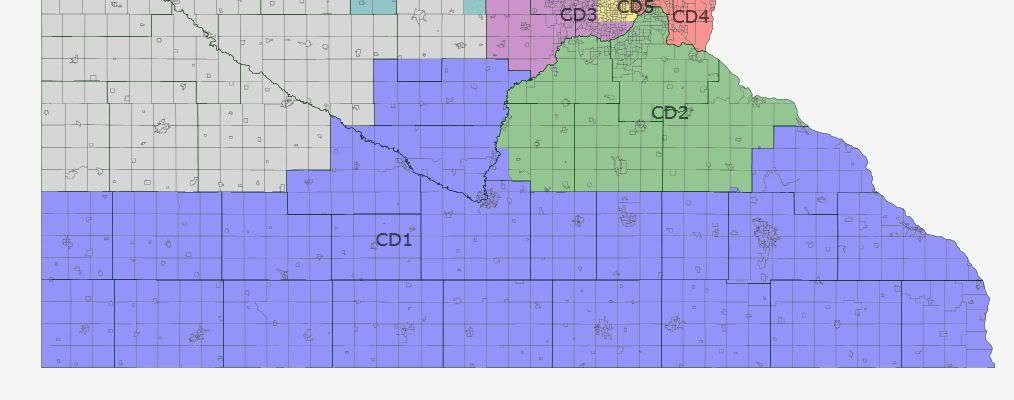
Well, seeing as how I just finished a short research paper on Minnesota congressional districts for one of my classes, I thought it would be a good idea to give the diary thing a try before I get too busy with finals. This is the first in a series of Minnesota maps, some possible and others, unfortunately not. The first map is below:

My goal with this map was to predict the outcome of the redistricting process given the current situation – Republican legislature and Democratic governor. I assumed that Minnesota will keep its eigth seat becasue new estimates suggest that will happen and Minnesota had a very high census response rate. I may have been too optimistic by drawing Craavack out of the 8th (God I hope that happens) but if that were to happen to anyone, it would be him since he has the least seniority and influence. Close ups of the districts are below. In some of the close ups, green represents new additions to the district and purple/pink represents areas that were lost.

First District – Blue – Walz (DFL)

Likely DFL

The 1st remains largely unchanged, picking up Sibley county (53-30 Emmer, 58-39 McCain) and small pieces of Le Sueur, McLeod, Goodhue for population balance. This new district voted 40-46-13 Dayton/Emmer/Horner but reelected Tim Walz. Obama would likely have one this district in 2008 as well since very little has changed.
Second District – Green – Kline (R)

Safe R

Not much happens to Rep. Kline’s southern suburbs district either. It pulls out of Washington and Carver counties to make way for the urban districts to expand. It takes West St. Paul back from the fourth to preserve county lines and gives up a few precints on the southern edge for population balance. Emmer won this district 38-49-19 as well as McCain. The new Chariman of the Education and Labor Committee won’t have a problem holding this.

Third District – Purple – Paulsen (R)

Likely R

Hennepin County has lost some population and so Paulsen’s district has to expand outward. It picks of Carver County and a small part of Anoka County that used to be in the fifth district. This district currently has a PVI of D+0 but the expansion into Carver County (57-42 McCain, 28-58-13 Emmer) it becomes more Republican. This may be winnable for a moderate Democrat in a good year but otherwise, Paulsen should be safe.

Fourth District – Red – McCullom (DFL)

Safe DFL

This district gives its part of Dakota County back to the second district and picks up the southern half of Washington County. I wanted to add all of Washington so that Bachmann’s home would be here but that isn’t realistic to expect the Republican legislature to agree to that. It may happen if the courts draw the lines and only pay attention to population but that is unlikely. This district is currently D+13. It may have dropped slightly in this map with the addition of part of Washington County but not significantly.

Fifth District (College) – Yellow – Ellison (DFL)

Safe DFL

There isn’t much to see here. The fifth district gives up the little piece of Anoka County (Fridley and Columbia Heigths) and picks up a slightly bigger piece (population wise atleast) in the southwest inner suburbs (Edina). This district is currently D+23 and probably would stay that way.

Sixth District – Teal – Bachmann (R)

Likely R with Bachmann, Safe R with anyone else

Bachmann’s district undergoes the biggest changes. The sixth district trades Sherburne and part of Stearns (St. Cloud, home of Tarryl Clark)for Isanti and Chisago (Chip Cravaack’s home). It also picks up Meeker County and small parts of Anoka, Washington, and McLeod while giving up part of Washington to McCullom. With the loss of St. Cloud and the addition of Meeker, this district becomes more Republican. Since Bachmann is so crazy, this may be likely R with a great DFL candidate and a good year. This would definitely be safe with any other Republican. Cravaack also lives in this district but would Bachmann would easily defeat him at the district convention or primary.

Seventh District – Grey – Peterson (DFL)

Safe DFL with Peterson, Lean R when open

This district is mostly the same with just few changes in central Minnesota. It picks up the rest of Beltrami as well as all of Hubbard, Cass, and Wadena from the eigth district. It loses Meeker, Sibley, and part of McLeod to balance out the population. This mostly rural district voted for McCain 47-50 and likely voted for Emmer over Dayton. This is Safe DFL with Peterson running but would probably be lean R at best when he decides to retire.

Eigth District (Home) – Slate Blue – Cravaack (R)

Lean DFL

A few weeks before the election, I confidently declared that Jim Oberstar would not lose. Unfortunately, I was wrong but now Rep.-elect Chip Cravaack is high on the target list for 2012. His new district trades Chisago and Isanti for part of Stearns (St. Cloud) and Sherburne. Cravaack no longer lives in this district but could easily move 20 miles up I-35 if he wanted to. Drawing Cravaack may not be possible with the Republican legislature but, since he has no seniority and very little influence, pretty much everyone has little incentive to listen to him. With Cravaack as the incumbent, this district is Lean DFL and woud be Likely DFL if the incumbency effect was not in place.

Overall, this map produces a 5DFL-3R split that would hold up in all but the worst years (like 2010). Once Peterson retires, it would become 4DFL-4R unless the DFL could find a moderate/populist to run.

Any suggestions and comments are welcome. this is my first complete map and diary so any insight would be greatly appreciated especially since I’m young don’t know a lot about the history of politics in Minnesota and how that might affect the results using this map or any historic district boundaries. Any information on that would be helpful too. Thanks!

OH-Sen: First Poll Shows Tough Race for Brown

Public Policy Polling (PDF) (12/10-12, Ohio voters, no trendlines):

Sherrod Brown (D-inc): 43

Mike DeWine (R): 43

Undecided: 14

Sherrod Brown (D-inc): 43

Jon Husted (R): 38

Undecided: 18

Sherrod Brown (D-inc): 43

Jim Jordan (R): 35

Undecided: 22

Sherrod Brown (D-inc): 40

Mary Taylor (R): 38

Undecided: 22

(MoE: ±4.3%)

Says Tom Jensen:

Ohio voters are pretty evenly divided on whether Brown’s done a good job in office so far – 40% approve of his performance while 37% disapprove. Democrats overwhelmingly like him, by a 66/9 spread. Republicans for the most part dislike him with only 16% approving to 62% who disapprove. The biggest problem for Brown though is independents – with them only 28% approve to 48% disapproving. To put those numbers into some perspective Ted Strickland, who was just defeated for reelection, is at a 38/42 spread with independents.

This race is likely to be priority #1 for progressives this cycle – and it won’t be an easy one.

Examining Turn-Out by Race in California

California constitutes one of the most diverse states in the United States. Here is how the Census estimates its population composition:

California’s   Ethnic Composition
Asian 12.7%
Black 6.6%
Hispanic 37.0%
Mixed 2.6%
Native   American 1.2%
Pacific   Islander 0.4%
White 41.7%

(Note that the numbers do not add up to 100, due to the way the Census tracks ethnicity.)

The people who actually vote in California, however, do not reflect this composition.

More below.

California’s electorate in the 2008 presidential election is quite different from its actual ethnic composition:

2008   Electorate: Exit Polls
Asian 6%
Black 10%
Hispanic 18%
Other 3%
White 63%

These numbers were taken from exit polls – and one should be warned that exit polls are very, very inaccurate. The numbers above should not be taken for the truth, but rather as a rough approximation of it.

Nevertheless, one can take something out of the exit polls: blacks and whites punched far above their demographic weight, while Asians and Hispanics punched far below theirs. This pattern isn’t so much a racial one as much as an immigrant versus non-immigrant one.

Since blacks and whites are mainly non-immigrant communities, they vote more often than immigrant communities. Blacks and whites thus are overrepresented in the electorate. There was little racial divide between black and white turn-out, which is quite remarkable, given the lower socioeconomic status of blacks. All in all the percentage of California’s 2008 electorate was about 50% more black and white than California’s overall population.

Hispanics are the ones hurt most by this. The difference between the Hispanic portion of the electorate and the Hispanic portion of the overall population is quite striking: the electorate is just half as Hispanic as the population. Most of this is attributable to the legal status of many Hispanic immigrants, the relative youth of the Hispanic population, the lower socioeconomic status of Hispanics, and the immigrant-heavy nature Hispanic community (this is different from the first factor in that immigrants are inherently less likely to vote even if they are citizens).

It is not Hispanics, however, who are least likely to vote: it is Asians. There are several similarities and differences between the two groups. Unlike Hispanics, the Asian population is not skewed downwards, and Asians generally have a high socioeconomic status. On the other hand, Asians are much more of an immigrant community than Hispanics: a remarkable four out of five adult Asians in California constituted immigrants, according to a 2002 study. Only 59% of adult Asians were citizens (who can vote), according to the study.

The low voting rates of Hispanics and Asians naturally reduce their political power. Hispanics, at around one-fifth of the California electorate, are influential – but imagine how much more influential the Hispanic vote would be if they voted their numbers. As for Asians, their low turn-out makes their community almost a non-factor in California politics.

This will probably change, of course. A century ago one could have written the exact same words about another immigrant-heavy group that did not vote: Irish-Americans.

–Inoljt, http://mypolitikal.com/

SSP Daily Digest: 12/15

MO-Sen: Ed Martin, who lost narrowly in MO-03, has kept spamming me (and presumably everybody else who writes about politics) with press releases vaguely hinting at voter fraud. It’s seeming like maybe there’s something more there to it than just garden-variety sore-loserism; there’s growing buzz that he’s trying to stay top-of-mind for a possible run for the GOP Senate nomination. Now, you might be saying, that’s a whole lot of hubris for a guy who couldn’t even win a House seat to go up against Sarah Steelman and possibly Jim Talent, but Martin might be able to grab the tea party mantle considering that the local ‘baggers are quite adamant that they aren’t as enamored with her as the national-level ones are. Martin is apparently also considering another run for the House; part of his decision will be what happens with redistricting, as MO-03 may be on the chopping block, between St. Louis-area depopulation and Republican legislative control.

MT-Sen: Trying to decipher Rep. Denny Rehberg’s intentions, about a possible run against freshman Dem Jon Tester? David Catanese is actually picking through his Christmas card to read the tea leaves. Rehberg tells his supporters (and extended family members) that he’s “not taking anything off the table” in terms of his next step, which is interesting, as it may mean he’s thinking about the open seat gubernatorial race too.

NE-Sen: Now here’s a blast from the past: ex-Gov. Kay Orr is so old-school that she was actually defeated for Governor by Ben Nelson, way back in 1990. Despite 20 years out of the political scene, her name is being floated as a possibility for the GOP Senate primary for the right to take on Nelson in 2012. Orr herself says she’s undecided, but sounds leaning against it. The Fix also seems to think that state Treasurer (and another long-ago loser to Nelson, although at least this time in a Senate race) Don Stenberg is likely to run, which would force a primary against AG Jon Bruning.

PA-Sen: There are two different overviews of the Pennsylvania situation today; one is from Alex Roarty at National Journal (and unfortunately is behind a paywall, so I’ll give you the gist). The one new name that surfaces in it is GOP Rep. Tim Murphy (from PA-18 in the Pittsburgh-suburbs); while he isn’t pushing forward on it, he’s shown more behind-the-scenes interest in it than Charlie Dent or Jim Gerlach, both of whom have gotten more touting but seem content with their cushy new committee posts. He also mentions that state Sen. Kim Ward is now leaning against, and confirms that ex-Gov. Mark Schweiker is at the top of the GOP’s wish list but probably a pipe dream. A Philadelphia Magazine article tries to handicap the GOP field, with absolutely nobody on the first tier, Gerlach alone on the second tier, and state Sen. Jake Corman (and Ward) comprising the third tier.

VA-Sen: Newsmax has an interview with new right-wing hero Ken Cuccinelli, who despite his new HCR-related celebrity is taking the opportunity to make clear that he isn’t running for Senate in 2012 (which would remove George Allen’s main impediment for the GOP nomination). He wouldn’t rule out running for Governor in 2013, though. (I wouldn’t link to Newsmax if you paid me to, so you’ll have to take my word for it.)

IN-Gov: Rep. Joe Donnelly is another option for Dems for Indiana Governor, although a run by Donnelly would require him giving up his seat. What if the GOP decides to get really aggressive in gerrymandering and build a nightmare seat for him (for instance, creating a dumbbell-shaped district linking Gary and his town of South Bend, forcing him to run against Lake County-based Pete Visclosky or else to move to a mostly rural red district)? South Bend’s Dem party chair is now saying that Donnelly would look at a statewide race in the event that the House map is too unfavorable.

FL-22: I think I’m going to greatly enjoy Allen West’s two years in the House, if only because he has the skill of digging his own hole deeper every time he opens his mouth. Fresh off the outrageous suggestion that the government should “censor” mainstream media outlets that publish information obtained via WikiLeaks (and apparently having had someone explain First Amendment jurisprudence carefully to him), now he’s claiming that he was misinterpreted, and that he actually said “censure” instead.

IL-17: Now here’s a fool’s errand: declaring your intention to run for a district that’s about to vaporize. Soon-to-be-ex-Rep. Phil Hare has already expressed his interest in a rematch with Bobby Schilling, but he may have some company. Both former Rock Island mayor Mark Schweibert and state Rep. Mike Boland said they’re interested in running in the Dem primary, too. (Hare, former aide to Lane Evans, was picked over Schweibert by local party heads to be the 2006 nominee after Evans dropped out of the race post-primary.) The 17th seems like the likeliest district on the Illinois chopping block, though, seeing as how most of the state’s population loss has been Downstate and there’s not much point for the Dem-held legislature to preserve a Democratic vote sink if it’s not even going to elect a Democrat.

KS-??: Despite his various Sherman-esque statements when he first announced he wouldn’t run for a full term as Governor, outgoing Dem Gov. Mark Parkinson is saying in an exit interview that he won’t rule out running for something in the future. (In the meantime, he’s heading to DC to rule the nursing home trade association.) It’s unclear what he’d run for, though… KS-03 is certainly a possibility, as it’s the most Dem-friendly part of the state and Parkinson is an Olathe resident.

NY-10: This may be taking tea leaf reading a step too far here, but the subtext to Ed Towns’ surprising decision not to seek the ranking member position on the Oversight committee (and back Carolyn Maloney for it) may be that he’s about to wind down his entirely unremarkable decades-long House tenure. Towns will be 78 in 2012.

KY-AG: It looks like Jack Conway is getting some GOP opposition after all, although not from as serious a threat as outgoing SoS Trey Grayson. Todd P’Pool, the state attorney for planet Vulcan Hopkins County (population 46K) has announced that he will challenge Conway in a battle to the death for the right to mate with T’Pring the 2011 election. Cue the epic fight music!

OR-St. Sen.: Who woulda thunk that the Oregon state Senate would be one of the last question marks to get resolved this year? The GOP-funded recount in SD-3, where Dem Alan Bates narrowly won, and the retaliatory Dem-funded recount in the race where Martha Schrader narrowly lost (she had been appointed to fill the seat vacated by her husband, now-Rep. Kurt Schrader), are over, with the numbers barely budging at all. The Dems retain a 16-14 majority.

TX-St. House: Two more party switchers to report, this time in the Texas state House, where Dems had actually entertained the notion of flipping the body a while ago and instead are now facing the wrong end of a supermajority. Aaron Pena and Allan Ritter have both announced that they’re joining the GOP, despite their blue districts (in fact, Pena’s Hidalgo County district went over 70% for Obama), apparently for the same rationale that the Georgia party-switchers are giving: deep in the minority, it’s the only way for them to have any effectiveness in the capitol.

Mayors: There’s a new Chicago mayoral poll out, where again the main question seems to be whether Rahm Emanuel can win outright without a runoff. That’s not looking likely, given the crowded field, although he still has a substantial lead in the new Tribune/WGN poll, at 32%. Gery Chico and Danny Davis are at 9, James Meeks is at 7, Carol Mosely Braun is at 6, Miguel del Valle is at 3, and Roland Burris is at 2, leaving 30 undecided. Emanuel leads among both blacks (with 19%) and Hispanics (27%).

One other mayoral race (or “situation,” really) that’s heating up is in San Francisco, where there’s a regularly scheduled 2011 election but also a looming vacancy with Gavin Newsom about to become Lt. Governor. The Board of Supervisors will have to choose an interim mayor to serve out those 11 months, and they’ll have to choose between one of their own who may be considering a November run, or an elder-statesman placekeeper. However, the Board is split any number of ways, and if there’s nobody who gets 6 of its 11 votes, the Board’s President, David Chiu, becomes acting mayor. The only person who seems in position to pick up at least six votes would be state Assemblyman Tom Ammiano.

Census: All manner of data analysis is pouring forth, in the wake of yesterday’s massive data dump of the Census Bureau’s five-year ACS estimates (which is where you’re going to find a lot of the information that used to be on the “long form”). Perhaps most amazingly of all is a new mapping tool from the New York Times, which lets you zoom in or out from the state level to the block level anywhere in the country to look at race and foreign-born status. (Set aside a few hours to explore this one.) Also worth reading are new articles on changes in racial segregation (in major decline in certain metro areas, especially Atlanta and Miami, which can have major VRA implications in terms of it being harder to cobble together districts that have a majority of any particular group) and in rural populations (declining rapidly, as you might imagine).

A Slightly More Cautious Gerrymander of Illinois 2.0

Heeding some of the comments I received on yesterday’s map (thank you by the way!), I drew a slightly more VRA-observant, slightly more cautious, but still robust Democratic gerrymander of Illinois.  This map assumes that the DOJ is going to insist on 60%+ for Chicago’s already-protected VRA Latino district and therefore only drew a second one that is 52% Hispanic for Lipinski.  Probably by the end of this decade it will become enough Hispanic to elect a Hispanic congressman.  I was convinced in the commentary that my 56% Latino district of yesterday’s map is of questionable legality.

I also drew each of the 3 VRA Black districts 53% Black.  Why 53% you might ask?  That is how much each of the districts contain now when you add in additional population to account for relative population loss.  That is the maximum you can realistically place in a VRA protected Black district from Chicago after 2010, assuming that the census estimates are accurate.  We’ll know for sure in a few months.  I was under the impression that the courts have started interpreting the VRA to require 50%+1 when possible of the population but perhaps it’s a bit more in areas where it is feasible to create such districts?

The other two highlighted changes from yesterday is that I firmed up the 14th and made it an almost certain Democratic pickup like the district I designed for Debbie Halvorson.  I do not agree with the comment made by a person or two that my finger down the lake for the 10th isn’t robust enough.  I double checked the numbers today: it is nearly 150,000 new residents of precincts that on average gave 85-90% of their votes to Obama and probably 80-85% to Kerry four years earlier. This more than makes up for the loss of Waukegan.  Waukegan in turn helps Melissa Bean in her rematch with Joe Walsh.  I respectfully disagree with the comment suggesting it did not help elect a Democrat congressman finally to the 10th, although not three-time loser Dan Seals (please!).  Whether we want to quibble over whether I should label it safe Democratic or probably Democratic, Dolt is a one-term wonder.

The second significant change is that I created a second Republican vote sink in northern Illinois and placed Biggert, Roskam, and Hultgren in the same seat that swoops from the more Republican areas of DuPage out a narrow tendril to further exurbia.  Should be fun watching that primary.

I then grouped Manzullo and Schiller together in a district that favors Manzullo.  The third pair-up includes Schock vs. Kinzinger out of personal spite.  One of these glamour boys has got to go!  And it will be 2014 until they can think on taking on Dick Durbin or Governor Quinn; good luck again either!

Photobucket

Photobucket

Photobucket

Photobucket

Chicagoland:

District 1 (dark blue): Rush-D 53%B, 39%W.  Stays in Cook County now but takes very white areas away from Lipinski so the district can comply with the VRA.

District 2 (dark green): Jackson Jr.-D 53%B, 39%W.  Gives up a bit of Hispanic and racially mixed south Chicago and suburbs to Halvorson in exchange for a bit of lean-Republican suburbia formerly in Biggert’s district.  Still Jackson will have no worries here and it may introduce him to some new voters he’ll need if he ever wants to follow through on his statewide aspirations.

District 3 (purple): Lipinski-D 51% Hispanic, 41% White

Probably white-majority electorate but as the children become voters, this district will eventually probably elect a second Hispanic congressman.  I expect a lot of hollering about this district and possibly some lawsuits, but the comments on yesterday’s map convinced me of its dubious legality regarding these two seats.  Besides, I offer you two options here.

District 4 (red): Gutierrez-D 63% Hispanic, 26% White, 5% Black.  It’s certainly possible to cram more Hispanics in here but I think it will no longer be legal to do this.  The VRA – as has been pointed out – is not designed to ensure the election of a member of the ethnic group but rather to give that ethnic or racial group the maximum opportunity of electing candidates of their choice.  Again, I’ve shown yesterday that it is feasible to create two districts that, on paper, are majority Hispanic – the question is whether the DOJ and/or the courts will require it be done.  We’ll find out next year.

Also I see no reason to draw the earmuffs except to preserve a Republican gerrymander, which is why they were drawn in the first place after 1990.  By reconnecting the two parts of the seat a bit differently, you can have Davis go out into DuPage County and free up enough non-Black areas of Chicago currently in his district to vote in the 10th.

District 7 (grey) Davis-D 53%B, 33%W, 8%H

Almost goes up to Roskam’s doorstep.  Helps out the gerrymander perhaps the most as it probably ensures the election of a new Democratic congressman from the 10th and, indirectly, helps out Melissa Bean in her comeback bid as it free up enough territory that the 10th doesn’t need Waukegan.

District 5 (yellow) Quigley-D 70%W, 16%H, 4%B

In the absence of partisan numbers, I’ll guestimate based on the racial numbers and from eye-balling this that I’ve left enough of Quigley’s Chicago base to not cause him much worries.  The areas of northern DuPage County were 50-50 in Kerry-Bush and are probably slightly Dem-leaning by now.  Elk Grove also I believe is slightly Dem-leaning by now.

District 9 (light blue) Schakowsky-D 63%W, 14%H, 13%A, 8%B

Again, I believe the addition of Wheeling Twp with Mt. Pleasant is probably not endangering Schakowsky terribly, especially when I left intact her Jewish and liberal Chicago and northern suburban base.

District 10 (pink-red) Dolt-R but probably I’m guessing Hamos-D 74%W, 11%H, 9%A, 5%B

A competent suburban Democrat can win this district.  As pointed out in the comments to my other map, the thin narrow tendril down to Navy Pier is deceiving; it is packed with high-rises which vote ~85% Democratic.  I tried not to rob too much of them from Schakowsky.  Probably turns an already D+6 district (the most frigging Democratic PVI seat at the moment represented by a Republican in Congress!) probably into a district that voted for Obama in the mid 60s% and for Kerry around 60%.  Although actual numbers here will rest my case.

District 8 (purple) Bean-D vs. Walsh-R 64%W, 20%H, 9%A, 6%B

Tilts toward Bean now with the addition of Waukegan and a few Hispanic precincts in northern DuPage.  Adds the Republican part of Palatine back into the district, though.  And Bean lives in frigging Barrington.  At least the district contains no more of McHenry, though.  Without McHenry in the district in 2010, Bean would have won re-election.  I think the fact that Walsh is a wack-job, Obama is at the top of the ballot, and this is a better district for Bean will all result in this district flipping in 2012.


District 11 (indigo) VACANT designed for Halvorson-D 60%W, 20%H, 15%B

Kinzinger drawn into the 18th to duke it out with Aaron Schock, modeled after Halvorson’s old state senate seat which straddled the Will-southern Cook County area if I recall.  Modeled after the district of the 1990s actually but a bit more Democratic now than then so Halvorson should like this district quite nicely.

Northern Illinois more generally

District 6 (teal) Hulgren-R vs. Roskam-R vs. Biggert-R 80%W, 8%H, 7%A, 4%B

I bet you Biggert retires and Roskam and Hulgren try to out tea party the other.  Might leave an opening for a Melissa Bean kind of Democrat as this district – although drawn to be a Republican vote sink – still probably narrowly voted for Obama in 2008.  So it isn’t super-Republican.  Should be fun to watch.

District 14 (brown-green) VACANT but designed for a Foster comeback 61%W, 26%H, 9%B, 3%A

More firmly Democratic than yesterday’s version.  What a big difference adding Aurora makes.  In case you are wondering what the deal is about the tiny dip into DuPage is – two reasons.  First of all partisan redistricting tends to be a bit petty – for example the tiny finger going into Montgomery County, PA to come near Hoeffel’s house – I think I might have come very close to drawing Hultgren into here.  But more the point, it grabs a few carefully chosen Hispanic precincts.


District 16 (green) Manzullo-R vs. Schilling-R

Swoops around the 14th and takes all the rural Republican areas of northern Illinois out of that district and the 17th to the south.

District 17 (dark purple) VACANT possibly the Democratic Moline-based State Representative that was mentioned in the comments?

Very little different from yesterday’s version.

District 18 (yellow) Kinzinger-R vs. Schock-R

Who can out-glamour and out tea party the other?  Realistically if you are a cynical political operator out of Springfield (and who isn’t in this state of consummate political machine politicians – and I thought New York State was bad!), you will get rid of the one of the two greatest long-term threats to Dick Durbin in 2014 by pairing them together.  Either one of them would make formidable candidates in a toxic midterm in the 6th year of Obama’s possible two-term presidency.  Not that I think Durbin’s in any danger or doesn’t know how to get his hands dirty and win an election.  Just thinking about the long-term view.

Anyway, this is a rural heartland GOP vote sink now missing its juicy Democratic cities.

Downstate

District 15 (orange) Johnson-R but maybe not for long

Very similar to how I drew the seat yesterday.  I’d like to see Kerry numbers on this one, but I think the cities probably outvoted the Republican rural areas connecting them.  And even if not, it is better to try to capture one seat rather than than divide these cities into two districts and continue electing two Republican congressmen.

District 12 (medium blue) Costello-D

Very similar to yesterday’s version except I thought that Edwardsville, with its students, might be added to add a few more Democrats to the seat, and subtracted much of racist Union County.  The reason you need a tiny tendril down to Cairo is that the very tip of the state is about 30-35% black and reliably Democratic.  I live in this district, in uber-liberal Carbondale, where I teach in the history department at SIU.  Costello is so frigging safe that I figured he did not need my vote this year and voted Green to protest against his antics on the health care reform law earlier this year when he was one of the Stupak gang threatening to withhold votes needed to pass it.

District 13 (pink-red) Shimkus-R

As I said before, it pains me that I have to draw a vote-sink for Shimkus but there it is.  A devious possible alteration would be to throw Shimkus into the southern-central Illinois cities seat and draw more moderate Johnson into the vote-sink.  I guess it doesn’t really matter.

What if Oregon Gets That Sixth District?

Oregon is one of the closest states, at last projection, to adding a House seat (and an electoral vote). I believe the Democrats should be cheering for this outcome, and here is why.

I think this map should shake out to a 5D-1R split in a neutral year, although Republicans may be able to swing the new OR-06 in an especially good year.

OR-01 (salmon, safe Democratic)

Democratic Rep. David Wu’s district consolidates to the western Portland suburbs, Portland’s West Hills, Columbia County, and the Oregon side of the Columbia River Delta. Wu is safe now in a district that includes a lot more reddish territory. He’s safe here.

OR-02 (red, safe Republican)

Eastern Oregon will never, ever vote for a Democrat. As incumbent Republican Rep. Greg Walden, who lives in Hood River, has been drawn out of this district, I think the electorate here would be happy to elect a more conservative Republican. State Senate Minority Leader Ted Ferrioli of John Day would be a top recruit, but really, Some Dude could win here as long as he touted his conservatism and ran on the Republican ticket.

OR-03 (green, safe Democratic

This district is basically just most of Multnomah County. Democratic Rep. Earl Blumenauer could get reelected here until the day he dies. After that, I’m sure this district would be happy to elect any other Democrat.

OR-04 (purple, safe Democratic)

Yes, it still includes Linn County. Yes, it retains most of Douglas County. It also includes all of Lane County, including the People’s Republic of Eugene. It also includes the most liberal parts of the Oregon Coast. Democratic Rep. Peter DeFazio is safe here. If and when he retires, I like Albany Mayor Sharon Konopa to succeed him, although I have no idea if she’s interested; running on a platform of environmental conservation and responsible urban growth management in a city renowned for being a conservative island in the middle of the sapphire Willamette Valley, she stomped the chairwoman of the Linn County Republican Central Committee in a nonpartisan election last month.

OR-05 (yellow, likely Democratic)

Yamhill and Polk counties are Republican, but Benton County is Democratic, and Marion County is bluer than not, especially with the influx of Latinos along the I-5 corridor from Salem to Aurora. The district also includes southern precincts of Washington and Clackamas counties. Democratic Rep. Kurt Schrader has been drawn out of this district, but Brian Clem, a Salem-area state representative who briefly was a candidate for governor this cycle, is probably in line to succeed him in any district centered on Salem. Fellow Salem-area representatives Kevin Cameron and Vicki Berger are probably the likeliest Republican entries, although I think Berger is too moderate to win in a primary. Matt Wingard, a representative from Wilsonville, could pick up support from the conservative wing of the party if he ran, but any competent Democrat would clean his clock in a district like this.

OR-06 (blue, lean Democratic)

This is the new district, and it could swing. But it includes the Democratic stronghold of Hood River County, most of blueing Clackamas County, and all of blueing Deschutes County. Not sure if it would have gone Republican this year; I believe Gov.-elect Kitzhaber narrowly lost the portions of the state included in this hypothetical district, but Sen. Wyden won it pretty handily. Democratic Rep. Kurt Schrader and Republican Rep. Greg Walden have both been drawn into this district. The terrain is more familiar for Walden, but Schrader has a base in populous Clackamas County and probably an overall advantage in terms of what politics are likely to play here. If Walden wants to move next door, Chris Telfer, a Bend-area state senator, would be the Republicans’ top recruit here; if Schrader would prefer to run in OR-05, his current district, the Democrats would probably like to turn to Rick Metsger, a Mount Hood-area state senator.

This whole exercise may be entirely academic. We’ll know for sure on 21 December…

Advantageous Retirements

Who would it be advantageous for us if they decided to retire in this cycle?  We know that in cycles that favor us, it is better for the old-timers to retire so that we aren’t burned by their leaving in cycles such as 2010.  So, I’m rating on a scale from 1-5 how advantageous it would be for our incumbents to retire in 2012.  1 is extremely bad for us, 5 is extremely good for us.

CA-Sen:  4.  Feinstein is old, and CA should get a rising star to get in.  However, it probably doesn’t matter, as the CA-GOP has little future statewide anyway.

CT-Sen: 5.  Avoiding an unpredictable 3-way race would be greatly helpful.

DE-Sen: 4.  Getting someone less moderate than Carper would be a plus, but it probably doesn’t matter.

FL-Sen: 1:  Nelson is probably the only Dem who wouldn’t get crushed.  The FL Dems need to get their shit together.  It is simply unacceptable that Nelson is the only statewide Dem in the state

HI-Sen: 5:  We need Akaka to go while Lingle is still unpopular

MD-Sen: 3:  Meh.  Doesn’t matter either way.

MI-Sen: 2:  Stabenow isn’t very popular, but the MI Dems need a few cycles to rebuild after their terrible collapse this last cycle.

MN-Sen: 2:  Klobuchar is the most popular politician in the state.  Though I don’t really see any GOP-ers as viable here.

MO-Sen: 2:  McCaskill is going to have it hard enough.  Though if she were to go, Robin Carnahan might be viable in a less unfavorable envirnoment.

MT-Sen: 3:  Tester is good, but if he were to retire, then Schweitzer could get in and pound anyone.

NE-Sen: 1:  Nelson’s probably a goner, but no one else can do it.

NJ-Sen: 4:  Menendez is a pretty lousy incumbent.

NM-Sen: 4:  Bingaman should probably get out before Martinez is termed out and can run here.

NY-Sen: 3:  I like Gillibrand, but pretty much any non-toxic Dem can win here.

ND-Sen: 1:  Conrad needs to stay as long as possible.

OH-Sen: 2:  I don’t know if Brown would do better than any other generic Dem, but the Ohio bench is not that great and I would not want to risk it.

PA-Sen:  1:  Casey is a great candidate, and the PA Dems don’t have that many other options with such a great profile.

RI-Sen: 3:  Pretty much any Dem could hold this.

VT-Sen: 3:  I love Sanders, but any Dem could win in VT.

VA-Sen: 3:  Kaine might actually do better than Webb.

WA-Sen: 2:  I don’t really want this opening up and tempting McKenna or Reichert.

WV-Sen: 1:  I don’t know if WV Dems can continue their senate monopoly in the state if either Manchin or Rockerfeller retired.

WI-Sen: 3:  Kohl makes this a sure thing, but it might be time to get Kind in before Ryan gets bored in the house.

To sum up:

We don’t want to see retirements in WV, WA, PA, OH, ND, NE, MI, MN, MO, or FL.

We DO want to see retirements in NM, NJ, HI, DE, CT, and CA.

SSP Daily Digest: 12/14

AK-Sen: To quote Troy McClure, “here’s an appealing fellow… in fact, they’re a-peeling him off the sidewalk.” Yes, Joe Miller didn’t even wait until today to make his decision about whether or not to appeal to Alaska’s Supreme Court; he already pulled the trigger on his appeal (despite the fact that everyone but him knows that he’s, at this point, roadkill). Arguments are set for Friday, so (since he can’t introduce new evidence, which the trial judge found sorely lacking, at the appellate level) this should get resolved pretty quickly.

CT-Sen: Linda McMahon is sounding very much like she’s ready to run again in 2012 against Joe Lieberman and a Dem to be named (maybe she found another $40 million under the couch cushions). She has a meeting planned with the NRSC’s John Cornyn, presumably to discuss her next move. Meanwhile, Joe Lieberman (who lost control of his own vanity party, the CfL) is seeming likelier to run again, thanks to encouragement from both sides of the aisle, and he may even have a useful vehicle to do it with: the new “No Labels” party-type thing courtesy of Michael Bloomberg. Meanwhile, there’s more follow-up from yesterday that, yes, Rep. Joe Courtney is considering a run for the Dem nomination (which could set up a primary against fellow Rep. Chris Murphy); he says he’s “looking at it” and, if he runs, will announce soon. That pretty much leaves Rosa DeLauro as the lone Dem House member in the state who hasn’t said yes or no, and today, as you’d expect, she said a loud “no.”

ME-Sen: Roll Call seems to have read the same article as everybody else yesterday that had that baffling interview with Andrew Ian Dodge — the tea party impresario who claims to be in contact with a killer-app candidate who will unite the teabaggers and defeat Olympia Snowe — and just flat-out concluded that Dodge is the mystery candidate himself (meaning that he’s spent the last few months talking to himself?). As added evidence, Dodge doesn’t dispute a local blog’s reports that he plans to run.

MI-Sen: Despite his strong name-rec-fueled showing in a PPP poll last week of the GOP Senate primary (or perhaps because of it), ex-Gov. John Engler is now saying that he has no plans to run for Senate, and will be staying in his role as head of the National Manufacturers Association. Strangely, the biggest-name candidate beyond Engler associated with the race, soon-to-be-ex-Rep. and gubernatorial primary loser Peter Hoekstra, sounded pretty indifferent about it when asked by a reporter yesterday, saying “We’ll see. I’m not sitting around yearning to get back into office.”

MN-Sen: PPP is out with GOP Senate primary numbers, and it’s a familiar story: the GOP base is irretrievably enamored with a female politician who’s poison in the general election. Rep. Michele Bachmann (who loses the general 56-39 to Klobuchar) leads the field at 36, far ahead of more establishment figures like outgoing Gov. Tim Pawlenty (20) and ex-Sen. Norm Coleman (14). They’re followed by new Rep. Chip Cravaack at 7, Tom Emmer at 6, John Kline at 5, Laura Brod at 4, and Erik Paulsen at 2. There’s not much indication that Bachmann is interested in a Senate run — in fact, she’s currently sending out fundraising appeals based on the threat of a rematch with Tarryl Clark — but there’s also word that Amy Klobuchar’s camp is most worried about facing Bachmann of any of the possible opponents, probably because of her national fundraising capacity (although it may also be a bit of public don’t-throw-me-in-that-briar-patch posturing).

NV-Sen: Need some evidence that Rep. Shelly Berkley is planning a Senate run? National Journal looks at her repositioning, as one of the key members of the party’s liberal wing in the House to break away and support the tax compromise, suggesting that she’s trying to tack toward the center to play better in the 2nd and 3rd districts. (Of course, it’s worth noting that she wasn’t that liberal to begin with, as a member of the New Dems, not the Progressives, and with a National Journal score usually putting her around the 60th percentile in the House.)

IN-Gov: Evansville mayor Jonathan Weinzapfel isn’t in a hurry to declare whether or not he’s going to run for Governor, although with Evan Bayh’s recent demurral, the iron would be hot. The key indicator, though, will be whether Weinzapfel runs for another term as mayor; the election is in 2011, and it’s assumed that if he does run for re-election a gubernatorial run is unlikely. He’ll need to make a mayoral decision by Feb. 18.

MT-Gov: The Dems have lined up a real candidate for the governor’s race, maybe the best they can do if AG Steve Bullock doesn’t make the race. Dave Wanzenreid, if nothing else, has a long resume: currently a state Senator, he served previously as a state Rep., as both minority and majority leader in that body. He was also chief of staff to ex-Gov. Ted Schwinden and then state labor commissioner in the 80s.

Crossroads: American Crossroads, after its avalanche of late-cycle ads a few months ago, is already getting back in the TV game. The Karl Rove-linked dark money vehicle is spending $400K on radio advertising in the districts of 12 Dems who won by narrow margins, urging them to vote in favor of the tax compromise package. Tim Bishop, Jim Costa, Gabrielle Giffords, Gerry Connolly, Ben Chandler, Jason Altmire, Bill Owens, Maurice Hinchey, Heath Shuler, Gary Peters, Joe Donnelly, and Sanford Bishop are all on the target list.

Votes: There’s a strange array of “no” votes on the tax compromise that passed the Senate 83-15. The Dems have a few votes from the left (Bernie Sanders, Sherrod Brown, Pat Leahy, Russ Feingold (although it’s gotten kind of hard to tell if he’s doing anything from the left or not anymore)), but also some votes from some pretty avowed centrists (Jeff Bingaman, Kay Hagan, Mark Udall) too, of which Bingaman is the only one up in 2012. John Ensign was one of the few GOP “no” votes, although you’ve gotta wonder whether it’s because he’s trying to save himself in a primary by appealing to the far-right or if he’s just given up and voting his conscience.

Census: While you wait for the main course on Dec. 21 (the day for reapportionment hard numbers), the Census Bureau is out with a gigantic appetizer. They’re rolling out their first-ever 5-year estimates from the American Community Survey (their one-year samples aren’t that reliable, but over five, they are). The ACS covers a lot of the deeper demographic information that used to covered by the Census “long form,” covering stuff like poverty, housing values, commute times, and education. Information is available all the way down to the block level, but here’s an array of county-level maps to start with.  

VA-Sen: Highway to the Danger Zone for Webb

Clarus (pdf) (12/7-9, Virginia voters, no trendlines)

Jim Webb (D-inc): 41

George Allen (R): 40

Undecided: 19

Jim Webb (D-inc): 39

Bob McDonnell (R): 42

Undecided: 19

Jim Webb (D-inc): 44

Ken Cuccinelli (R): 33

Undecided: 23

MoE: ±4%

Yes, yes, I know Jim Webb was a Marine, not a Navy aviator, so the Top Gun/Kenny Loggins reference is a bit misplaced, but the point still stands. Despite leading likely opponent George Allen in their rematch, Jim Webb is in a fairly dangerous position, well below the 50% mark that supposedly represents safety, even below 50 against the simultaneously little-known and polarizing AG Ken Cuccinelli. (Although think about the Senators who squeaked by in November despite routinely polling nowhere near 50%…)

Webb’s approvals are actually quite good, at 47/24; given the dropoff, it seems like there are a fair share of Republican and indie voters who approve of the man but still don’t want a Democrat in office. The 29% who “don’t know” is also surprisingly high. (Mark Warner fares even better, at 57/23, as does new GOP governor Bob McDonnell, at 53/27.) There’s one other very interesting data point in the crosstabs that’s worth sharing, that says a lot about the parties in Virginia, who’s in what party, and the very bright line somewhere around Fredericksburg that demarcates the Northeast from the South: Webb’s approvals are much higher among people making over $100,000 per year (54%) than those making under (45%).

One other bit of Virginia news: ex-Rep. Tom Davis, last seen getting cock-blocked out of the 2008 Senate nomination by the decision to hold an nominating convention rather than a primary, has decided that the GOP has gone even further away from his direction and isn’t even going to bother with this cycle. Davis used to represent Dem-leaning VA-11 and is from the sorta-moderate-or-at-least-sane camp of Republicans that would make him an imposing general election competitor if there were a way anymore for him to emerge with a primary victory.