MN-Sen: Klobuchar In Good Shape

Public Policy Polling (12/4-5, “Minnesota voters”)

Amy Klobuchar (DFL-inc): 56

Michele Bachmann (R): 39

Undecided: 4

Amy Klobuchar (DFL-inc): 54

Norm Coleman (R): 40

Undecided: 6

Amy Klobuchar (DFL-inc): 56

Tom Emmer (R): 38

Undecided: 6

Amy Klobuchar (DFL-inc): 53

Tim Pawlenty (R): 43

Undecided: 4

Amy Klobuchar (DFL-inc):: 52

Erik Paulsen (R): 34

Undecided: 14

MoE: ±3.2%

PPP’s latest has DFL incumbent Amy Klobuchar doing extraordinarily well a little less than two years out, besting all five GOP challengers by spreads of 10 to 18 points.

Klobuchar remains extremely popular, with approval ratings in almost unseen territory of +30, at 59/29! Her Class II counterpart, Al Franken, is barely above water at 45/42.

Also of note, Tom Emmer’s gubernatorial campaign (and potential post-election monkey business) have not reflected on him well, he records favorables at 37/49…almost as bad as tea party queen Bachmann’s 37/51.

36-0 Texas

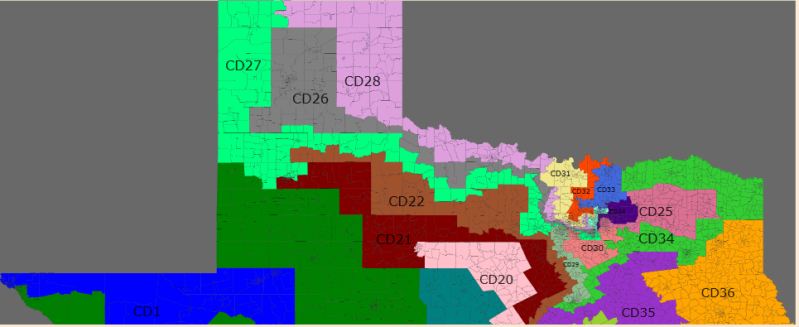
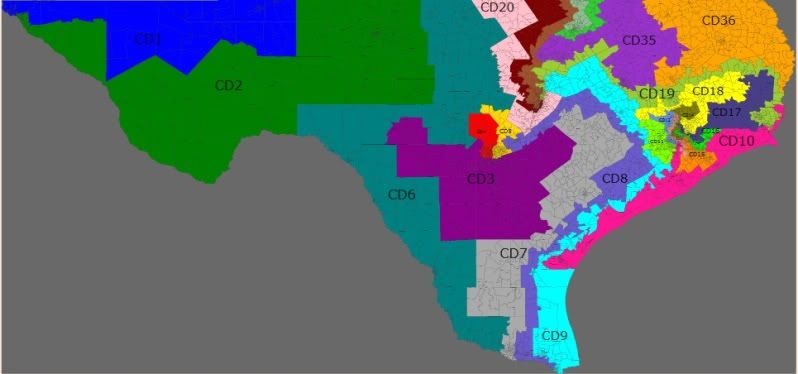
The hardest thing for me to remember when making GOP friendly gerrymanders is that a 50% John MctCain district isn’t a toss-up but a likely R district, similar in theory to a 60% Obama District. 5 points more friendly to the gop then the nation as an average implies that, but it is somewhat tricky for me, at least, to wrap my mind around it. However, that was my goal when I started North Carolina: create as many districts that went GOP in 08 as possible. After getting an 11-2 in a state that went for Obama, i figured a 36-0 in Texas was possible. and it was. One district voted for Obama by less than 1000 votes, so I’m going to count it. A 59% Obama district would be okay for most of us here… Without further ado, MAPS!

As always, ask me and i will provide a zoomed in map of whatever area you wish if it isn’t clear from the big one.

http://img.photobucket.com/alb…

http://img.photobucket.com/alb…

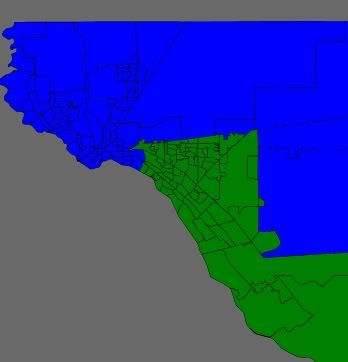
El Paso: http://img.photobucket.com/alb…

District 1 (Blue):  Mccain 56%, 56% Hispanic

El Paso and Odessa

District 2 (Green): M 53%, 63% H

Rest of El Paso and some nearby counties

San Antonio and Austin: http://img.photobucket.com/alb…

District 3 (Purple): M 50%, 60% H

South San Antonio

District 4 (Red): M 51%, 50% H

North and West Antonio

District 5 (Yellow):  M 51%, 40% H, 10% Black, 3% Asian

East and North San Antonio

District 6 (Teal): M 50%, 72% H

Laredo and some Border counties, then up to West Texas

District 7 (Gray): M 50%, 66% H

McAllen and Border areas all the way up to Bastrop and Fayette Counties

District 8(Violet) M 51%, 62% H

Brownsville, Mcallen and then up.

District 9(Sky Blue): M 51%, 59%  H

Brownsville, Harlingen, up to Williamson and Milam counties.

District 10 (Pink):  M 50%, 35% H, 16% B, 3% A

Corpus Christi and up

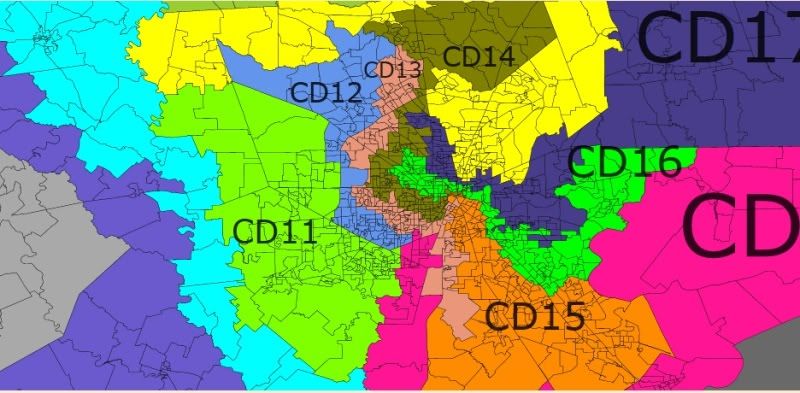
Houston:  http://img.photobucket.com/alb…

District 11 (Lemon-Lime Green): M 55%,  55% White

South of  Houston

District 12 (Blue-Line Green) :  M 56%, 22% H, 20% H, 11% A

Some of the south-west of Houston and then surroundin areas.

District 13(Light Brown): M 53%, W 52%

Houston and some areas north

District 14(Gold):  M 57%,  W 61%

Houston and some areas north

District 15 (Orange): M 52%, 32% H, 19% B, 4% A

South of Houston, with a bit of the city

District 16(Lime Green):  M 52%, 39% H, 12% B, 4% A

Houston and Areas East

District 17(Navy blue): M 52%, 41% H,  16% B

Houston and Areas North East

District 18 (Golden Yellow):  M 56%, 56% W

North of Houston

District 19 (Puke Green): M 56%, 65% W

Wraps around 11-17

District 20 (Light Pink): M 52%, 59% W

Wraps around Austin and takes part of the city then to Abilene

District 21 (Blood Red): M 54%, 66% W

Parts  of Austin then  going to sparsely populated Northern Texas

District 22 (Poo Brown):  M 51%, 79% W

Austin and North Texas

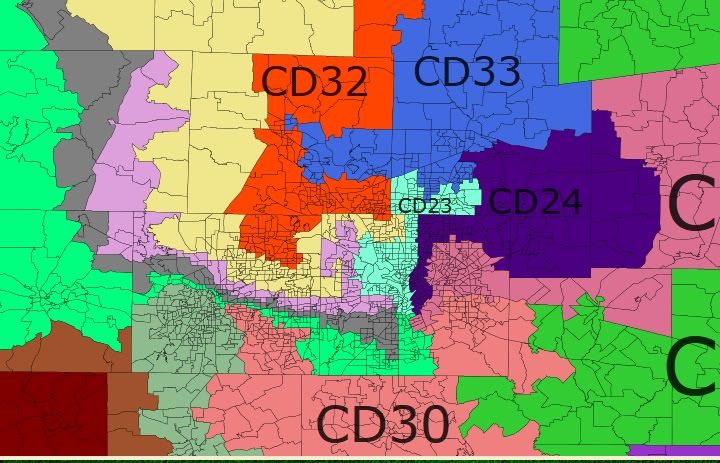
Dallas-FW: http://img.photobucket.com/alb…

District 23 (Robin’s Egg Blue): M 54%, 57% W

Dallas and some northern suburbs

District 24 (Dark Purple):  M 56%, 59% W

Dallas and Some Eastern areas

District 25 (Rose): M 54%,  59% W

Dallas then to some less populated eastern areas

District 26 (Silver) M 58%,   54% W

Dallas, FW, then to North Texas

District 27 (Sea Green) M 49%, 54% W

Dallas, FW, then to North Texas

District 28 (Pinkish Purple) M 60%, 57% W

Irving, then up to North Texas

District 29 (Gray Green): M 53%, 60% W

Waco and Forth Worth

District 30 (slightly lighter shade of rose then

the one touching it): M 55%, 60% W

Parts of Arlington, Dallas and Fort Worth

District 31 (Tan): M 61%, 71% W

North Fort Worth and Dallas then North

District 32 (Red Orange): M 64%, 79% W

North FW and then northern areas surrounding it

District 33 (I can’t name that many different shades of blue): M 63%, 80% W

North of Dallas

District 34 (Somewhat dark-green): M 69%, 75% W

Wraps around a lot of other districts, filling in a lot of gaps

District 35 (Royal Purple): M 62%, 64% W

Everything Else Part 1

District 36 (Not Flyers Orange, but I’m using it anyways): M 68%, 69% W

Everything Else, Part 2

This is not a perfect 36-0 Map. The last 5-6 districts could bleed some republican voters to some of the more borderline districts. However, in an ok to good year, the republicans win all 36 seats barring an exceptional democratic candidate.

Dave’s seems to have deleted my other maps. I’ll redo them later and either edit this diary or do a new one, depending on what you guys thing.

SSP Daily Digest: 12/7

DE-Sen: Here’s an amusing look back at the Delaware race, where it turns out that Christine O’Donnell raised $7.3 million over the course of the campaign (a somewhat large improvement on her $63K from her previous Senate bid) and then proceeded to lose by 16 points. O’Donnell apparently had the same problem that I suspected that Sharron Angle did (though we don’t have any confirmation on Angle yet)… there weren’t any media outlets with available slots to pour all that late-breaking money into.

MO-Sen: Jim Talent has offered his timeline on publicly deciding whether or not to run for Senate (which has seemed to get less likely over the last few days, if you believe the scuttlebutt). He won’t decide until the New Year, and possibly won’t announce anything until the state GOP’s Lincoln Day festivities in mid-February.

MT-Sen: PPP offered some GOP Senate primary numbers, although I’m not sure how useful they are given that Marc Racicot, the former Governor and RNC chair, eats up a lion’s share despite not having really ever been associated with the race. (Although, who knows… maybe this will suddenly prompt him to get interested.) At any rate, the two guys with name rec, Racicot and Rep. Denny Rehberg, are at 40 and 37, respectively. The two little-known guys who are actually the ones running (so far), Steve Daines and Neil Livingstone, are at 5 and 4.

RI-Sen: Although John Robitaille seems to be getting all the attention in terms of the GOP’s pick to challenge Sheldon Whitehouse, Warwick mayor Scott Avedisian is still stoking the fires of vague interest. Avedisian is a moderate and an ally of newly-elected Gov. Lincoln Chafee.

WA-Sen: The race against Maria Cantwell seems to already be a casualty write-off for the GOP, seeing as how the state’s entire viable GOP bench (aka Rob McKenna) will most likely be running for Governor. The state GOP’s usual M.O. in such situations is to turn to some random rich guy as a place-holder (see Mike McGavick, Cantwell’s 2006 opponent, or oft-threatened but never-happened candidate John Stanton), but it may turn out that Clint Didier, the tea partier whose GOP primary bid against Dino Rossi didn’t go anywhere and who’s now interested in trying again, gets left holding the bag this time. Didier, who refused to endorse Rossi and castigated him at every turn, isn’t likely to be able to count on much NRSC or even state GOP goodwill this time, though.

MN-Gov: Nothing like a little post-electoral cat fud, even if it means exiling pretty much your entire pantheon of elder statesmen. The state GOP just excommunicated more than a dozen key moderate Republicans who had jumped ship to support Independence Party candidate Tom Horner in view of Tom Emmer’s extremism. These aren’t just run-of-the-mill PCO-types, either: the list includes an ex-Senator (David Durenberger) and two ex-Govs (Arne Carlson and Al Quie). And if you’re wondering how Emmer is faring in the court of public opinion amidst the recount non-drama, PPP’s out with a snap poll: by a 68-22 margin, voters think it’s time for Emmer to give up (which matches the 68-21 margin of people who think that Mark Dayton was the election’s rightful winner).

OH-17: Wondering who the third-party candidate who fared the best was, in this year’s House races? It was none other than ex-con ex-Rep. Jim Traficant, who picked up 16.1% of the vote against Tim Ryan, the best showing of any indie with both Dem and GOP opponents (and he did it without spending a penny). He fared better than Randy Wilkinson in FL-12, who ran a more credible campaign and was widely viewed as a potential spoiler. In fact, Wilkinson finished 3rd at 10.7%; some random conservative, Dan Hill, got 12% in NE-03 by running to Adrian Smith’s right, although that was a race that Dems barely contested. What about MI-01’s Glenn Wilson, who made waves for approximately one day with his pledge to spend $2 million of his own money (although it’s dubious if he spent more than a fraction of that)? He barely registered, at 7%.

WV-01: Here’s an unexpected comeback, and probably one that’s not a good idea. Alan Mollohan, who couldn’t survive a Dem primary and most likely wouldn’t have won the general even if he’d gotten over the first hurdle, is publicly expressing his interest in running in 2012 for his old seat. He’s opened an FEC account for ’12 and has been reaching out behind the scenes.

NY-St. Sen.: This is basically a Hail Mary at this point, but when it’s the chance to tie the state Senate, it’s a chance you take. Craig Johnson officially filed an appeal yesterday of the judge’s ruling certifying Jack Martins as winner in SD-7 (giving the GOP a 32-30 edge there). He’s asking for a hand count, to see if any votes were missed in the state’s switch this year to electronic voting machines. Given the recent abject fail in finding all the votes cast in Queens, it’s not out of the realm of possibility.

Redistricting: The Fix has another installment in its ongoing redistricting previews, this time focusing on Georgia. The GOP-controlled state legislature should have little trouble adding a GOP-friendly 14th seat in Atlanta’s northern tier of exurbs, where most of the state’s growth has occurred. The real question will be whether they can do anything to turf out either of the two remaining Dems in slightly lean-Dem districts in south Georgia, Sanford Bishop or John Barrow? Although neither of their seats are truly minority-majority, the VRA might be implicated if their seats get messed with too much. Bishop’s GA-02 is likely to be shored up in order to make freshman Austin Scott safer in the 8th. Barrow seems like an easier target, but to do so would not only risk VRA litigation but also make Jack Kingston’s 1st less safe, meaning incumbent protection might be the result.

Demographics: There was a massive dump of U.S. Census data yesterday, although none of it is the actual hard count from 2010 (which is due by the end of the month, including state populations for reapportionment purposes). Instead, this is the Demographic Analysis (used to estimate undercounts in the actual count, although there won’t be any adjustments made to the counts for redistricting purposes in this cycle). The big number was the total population estimate, ranging from 306 million to 313 million, with a midrange estimate of 308.5 million (which would put the average House district, for redistricting, at 709K). Also worth noting: Hispanics accounted for essentially the nation’s growth in youth population in the last decade, and Hispanics have grown from 17% of the nation’s under-20 population in 2000 to 22% now; without Hispanics, the number of young people would have actually gone down since 2000.

California Redistricting Patterns by Region

The coming redistricting in California will see two significant forces working to give the new lines.  The first is population, how it has grown and shifted since the last maps were drawn.  The second is the commission process that will follow set rules around keeping cities and counties together, compactness, communities of interest, and drawing lines without considering where candidates live.

To survey the political landscape I put together this chart showing population growth in each congressional district.  While the commission does not need to start from the existing lines, this does show the disparity in population growth among current districts.

Swing State readers should quickly realize that districts with the greatest overages are Republican.  This is seen statewide where Republican congressional seats are on average 42,000 over target population, and Democrat-held seats are 28,000 under.

Tightly packed Democratic seats like those in Los Angeles will have to geographically expand, stealing population from other neighboring Democrats to gain the requisite number of residents.  Conversely, Republican districts will be contracting as they give up voters, and could provide more opportunity to other Republicans.

Current Congressional Districts and Variation from 2010 Projected Targets

Member Residence Variation

1 Mike Thompson D St Helena Under By 19,552

2 Wally Herger R Chico Over By 23,927

3 Dan Lungren R Gold River Over By 52,873

4 Tom McClintock R Elk Grove Over By 78,971

5 Doris Matsui D Sacramento Over By 21,151

6 Lynn Woolsey D Petaluma Under By 82,302

7 George Miller D Martinez Under By 47,071

8 Nancy Pelosi D San Francisco Under By 28,457

9 Barbara Lee D Oakland Under By 47,004

10 John Garamendi D Walnut Grove Under By 4,079

11 Jerry McNerney D Pleasanton Over By 68,602

12 Jackie Speier D Hillsborough Under By 73,416

13 Pete Stark D Fremont Under By 59,603

14 Anna Eshoo D Atherton Under By 47,104

15 Mike Honda D San Jose Under By 17,541

16 Zoe Lofgren D San Jose Under By 7,756

17 Sam Farr D Carmel Under By 63,360

18 Dennis Cardoza D Merced Over By 27,745

19 George Radanovich R Mariposa Over By 49,586

20 Jim Costa D Fresno Over By 18,060

21 Devin Nunes R Tulare Over By 75,114

22 Kevin McCarthy R Bakersfield Over By 71,524

23 Lois Capps D Santa Barbara Under By 54,321

24 Elton Gallegly R Simi Valley Under By 29,472

25 Howard McKeon R Santa Clarita Over By 4,084

26 David Dreier R San Dimas Over By 10,372

27 Brad Sherman D Sherman Oaks Under By 41,458

28 Howard Berman D Los Angeles Under By 37,913

29 Adam Schiff D Burbank Under By 39,041

30 Henry Waxman D Los Angeles Under By 31,871

31 Xavier Becerra D Los Angeles Under By 55,157

32 Judy Chu D Monterey Park Under By 54,149

33 Diane Watson D Los Angeles Under By 36,444

34 Lucille Roybal-Allard D Los Angeles Under By 47,705

35 Maxine Waters D Los Angeles Under By 39,585

36 Jane Harman D Los Angeles Under By 34,005

37 Laura Richardson D Long Beach Under By 36,943

38 Grace Napolitano D Norwalk Under By 51,103

39 Linda Sanchez D Lakewood Under By 44,407

40 Ed Royce R Fullerton Under By 37,637

41 Jerry Lewis R Redlands Over By 100,829

42 Gary Miller R Diamond Bar Under By 10,593

43 Joe Baca D Rialto Over By 57,355

44 Ken Calvert R Corona Over By 191,982

45 Mary Bono Mack R Palm Springs Over By 200,712

46 Dana Rohrabacher R Huntington Beach Under By 40,074

47 Loretta Sanchez D Anaheim Under By 43,323

48 John Campbell R Irvine Over By 437

49 Darrell Issa R Vista Over By 65,129

50 Brian Bilbray R Carlsbad Over By 13,076

51 Bob Filner D San Diego Over By 7,693

52 Duncan Hunter R Lakeside Under By 25,845

53 Susan Davis D San Diego Under By 25,626

The following shows variations for congressional districts by region, however they do not match county growth perfectly as several Congressional districts overlap counties and skew the numbers.

Variation from Ideal 2010 Population, by Congressional Districts in Regions

.: Northern California +4.5% 4 districts over by 175,000, 1 under

.: San Francisco Bay -5.8% 11 districts are under by 415.000

.: Central Valley +6.9% 5 districts over by 240,000

.: Los Angeles -5.5% 13 districts under by 550,000

.: Orange County +1.4% 1 district is over, 4 are under

.: San Diego +1% 2 districts are under, 3 over

.: Inland Empire +11.4% 8 districts are over by 640,000

Regional Differences…

San Francisco Bay Area

Bay Area congressional districts have largely not kept up with statewide growth, putting them under the required population by about 4.5%.  The only exception is the Jerry McNerney district, but the growth in this district is primarily within the San Joaquin portion.  Excluding McNerney, the remaining ten districts need to expand to capture another 415,000 residents.  

Excluding the McNerney district the remaining Bay Area seats have to grow 6% on average.  This does not seem significant when looked at for an individual district where it is like adding the city of Pacifica.  However, as each district takes from the next, the impact is added up.  In the end the last district is going to shift by the equivalent of gaining or losing a city the size of Oakland.

Central Valley and Norcal

Tightly packed urban Democratic seats like those in the Bay Area will have to geographically expand, stealing population from other neighboring Democrats to gain the requisite number of residents.  Conversely, Republican districts like these in the Central Valley and Northern California will be contracting as they give up voters, and could provide more opportunity to other Republicans as these regions add a district.

Aside from population, the requirements for geographic compactness and keeping cities and counties together will wreak havoc on the current districts.

Los Angeles

As can be seen above, the cumulative impact of shrinking population is that LA districts have to go searching for an additional 540,000 residents.   In a redraw that follows the new commission rules this should cause the loss of one congressional seat for the region.

The greatest volatility could come in the San Gabriel Valley where population growth has been slowest. The districts of Grace Napolitano (CD 38), Judy Chu (CD 32) and Xavier Becerra (CD 31) have only had growth of 2-2.5% – putting them under the state average by approximately 8%.  Furthermore, South and West facing beaches limit the ability for districts in the City of LA to move in either of those directions, meaning that expanding districts must shift North and East – likely toward the Inland Empire that has seen the highest growth rate in the state.

The only district in Los Angles with an overage is also the only district held by a Republican.

Orange County

Orange County congressional districts have largely not kept up with statewide growth putting them under the required population by about 5%.  The only exception is the Ken Calvert district, but the growth in this seat is primarily within the Riverside portion of the district.  Excluding Calvert, the remaining five districts need to expand to capture another 130,000 residents.

While Orange County currently has six congressional members, it only has four who live within the county.  The districts held by Miller and Calvert extend from Orange County into Riverside and San Bernardino where those members live.  Given Orange County population estimates, the county should have 4.25 members of congress.  

San Diego

Overall growth in San Diego is just 1% above the state average.  Yet that shifts to about 1% under the state average after accounting for the Issa District that overlaps with Riverside and the Filner district that takes in the Inland Empire.  As can be expected, it is the southern, more densely populated portion of San Diego that has had the least growth.

Inland Empire

Past redistricting efforts have not done a good job of keeping the Inland Empire intact or creating lines that benefit this growing portion of the State.  The area has eight congressional seats with only three districts entirely within its boundaries and five that overlap from Los Angeles, San Diego and Orange Counties.   Half of the Inland Empire’s congressional representatives live outside of the three-county area.

In a redraw that respects city and county lines and pays no regard to where current members live, it can be expected that the three Congressional districts entirely within the Inland Empire would increase to five, and the districts that only dip into the Inland Empire would be stopped at the county lines.  This would be an increase in the region’s true representation, but a decrease in the number of representatives that have any part of the Inland Empire.

Solving a Mystery in Philadelphia Voting Patterns

A long time ago, I posted a series of posts analyzing the swing state Pennsylvania. One section of this series focused specifically on the city of Philadelphia. This section analyzed Philadelphia’s vote by precinct results and mapped out the results of several previous elections.

Of particular interest was the difference between the results of the 2008 presidential election and the 2008 Democratic primary, which illustrated a political divide not seen in presidential elections: between Democratic-leaning white Catholics in the northeast and Democratic-voting blacks in the west.

Here is Philadelphia in the 2008 Democratic primary. Take a note at the region the question mark points to, which this post will discuss:

Photobucket

More below.

(Note: Both images are taken from a website which maps historical Philadelphia election results.)

Here is Philadelphia in the 2008 presidential election:

Photobucket

Most of the different voting patterns between these two elections is fairly easy to explain: blacks in west Philadelphia voted for  Barack Obama both times, while white Catholics in the northeast voted strongly for Hillary Clinton in the primary and then lukewarmly Barack Obama in the general election. There is generally a scaling relationship between the two groups: as an area gets more white and less black, its support for Mr. Obama decreases in both elections.

There was, however, a group of precincts in Philadelphia which did not follow this model. These precincts are marked by the question mark in both maps. This group behaved quite strangely. It gave incredibly strong support to Ms. Clinton in the primary and then even stronger support to Mr. Obama in the general election. In the map of the 2008 primary, a number of these precincts cast more than 70% of their ballot to Ms. Clinton. All of them then vote more than 90% Democratic in the general election.

This behavior was quite puzzling, and something that the model did not explain. Initially this author hypothesized that these voters were white liberals in gentrifying areas of Philadelphia and then eventually forgot about the mystery.

The answer, as it turns out, was not white liberals. Here it is:

Photobucket

The mysterious precincts were Hispanic!

The above image was created using Daves Redistricting Application. Due to the tremendous efforts of David  Bradlee, one can map the ethnic composition of every state in incredibly detail.

This provides some interesting insight into the behavior of Hispanics in inner-cities. If what holds for Philadelphia also holds for other cities (which is not a 100% certainty), inner-city Hispanics strongly supported both Hillary Clinton and then Barack Obama.

It is an insight provided by Daves Application which can be extended to many other areas and groups.

–Inoljt

MO-Sen, MO-Gov: Talent Leads GOP Senate Primary

Public Policy Polling (PDF) (11/29-12/1, Missouri voters, no trendlines):

Jim Talent (R): 53

Peter Kinder (R): 26

Sarah Steelman (R): 17

Undecided: 4

(MoE: ±4.9%)

PPP’s first look at the GOP Senate primary in Missouri shows, for now, the power of name rec over the reputed power of the tea party. Ex-Sen. Jim Talent is out to a big lead over ex-Treasurer Sarah Steelman, the only announced candidate so far. That’s despite a lot of hoopla that surrounded Steelman’s announcement last week that focused on her grass-roots popularity and some touting from those on the far-right, like the Club for Growth. Talent, despite the CfG’s attacks on him as pork-hungry, doesn’t seem to have much trouble with the very-conservative-leaning Missouri GOP electorate, with 55/13 favorables. Steelman, by comparison, is at 25/13 (with 62% unknown).

The big question here, though is what happens to the Peter Kinder vote (as the Lt. Governor is widely expected to run for Governor, not Senator)? Is his 26% part of an anti-Talent bloc, which is likely to gravitate toward Steelman, or is it Kinder-specific, and likely to break evenly between the two if it’s a Talent/Steelman matchup?

A Talent/Steelman matchup still isn’t a done deal, by the way; Jeremy Jacobs talked to a variety of GOP insiders in Missouri, and some think he’s hesitant to run, saying he hasn’t been aggressively reaching out to donors. The same article has some interesting wrinkles for Steelman, though; despite the wet kiss that she got from the inside-the-Beltway teabaggers (i.e. the CfG), the locals seem a lot more skeptical. The St. Louis Tea Party Coalition, in fact, has sent around e-mails to supporters questioning her credentials, and saying there is no Tea Party candidate in the race yet. The main problem seems to be her husband, who’s a leader among the state’s trial lawyers, giving rise to accusations that she was pro-trial lawyer while in the state Senate.

Public Policy Polling (PDF) (11/29-12/1, Missouri voters, no trendlines):

Jay Nixon (D-inc): 47

Peter Kinder (R): 39

Undecided: 14

Jay Nixon (D-inc): 46

Sarah Steelman (R):  35

Undecided: 19

(MoE: ±4.3%)

There’s also the matter of Missouri’s gubernatorial race in 2012, which is where we’re much more likely to see Kinder running. Despite Missouri’s seeming turn to the right in the last few years, Nixon seems on track to gut this one out, thanks to a mix of centrism and personal appeal (good for getting the vote of 14% of Republicans). He has 44/30 approvals (compared with 23/22 favorables for Kinder, good for a 54% unknown), making him the 6th-most popular governor according to PPP’s tally — despite a sample that breaks down 39% GOP and 36% Dem. This could get closer as the GOP opposition gets better known, but for now it’s one of the Dems’ lesser worries for 2012.

SSP Daily Digest: 12/6

AK-Sen: This shouldn’t come as a surprise and I highly doubt that Joe Miller would listen to anything Mark Begich would say even if it weren’t a surprise, but Begich is now encouraging Miller to drop his pointless challenge to Lisa Murkowski so Murkowski can get sworn in on schedule and the pork can continue to flow to the Last Frontier. Meanwhile, Miller is now actually saying that he would have gotten away with it, if it weren’t for those meddling Inuits. In a Washington Times column, Miller blames the Native Alaskan corporations for backing Murkowski (via the Alaskans Standing Together PAC), and even (gasp! call the Fox voter fraud hotline!) putting boots on the ground to teach people how to spell “Murkowski” and bus people to the polls!!1!

FL-Sen: If you were wondering if there was still a flicker of possibility that Jeb Bush was going to run against Bill Nelson, that’s pretty much extinguished: Bush himself acknowledged that over the weekend, admitting there’s a major problem given his support for immigration reform (and opposition to Arizona’s new law) that puts him at odds with the ascendant teabaggery. Mike Haridopolos is also letting everyone know that he wouldn’t be running if Bush were going to run, but that he’s gotten Bush’s green light. (The latter article also includes a few additional GOP names that we haven’t seen yet in connection with this race, like sophomore Rep. Tom Rooney and Adam Hasner, the former state House majority leader.)

IN-Sen: State Sen. Mike Delph is waving his arms around madly trying to get the tea partiers’ attention for a possible primary against GOP apostate Richard Lugar, with a widely-circulated post to his own blog saying that he’s “increasingly concerned” with Lugar’s actions, especially support for the DREAM Act. The real question is whether state Treasurer Richard Mourdock gets in; Lugar’s best shot at getting through, like Dan Coats in the 2010 Senate primary, is to have the multiple teabaggers cannibalizing each others’ votes.

NV-Sen: Democratic Rep. Shelly Berkley is mentioning some sort of timeline for deciding on whether to run for the Senate against John Ensign (or whoever decapitates him in the GOP primary): she’s saying early 2011, probably before mid-February. Worth noting: she’s sitting on $1.1 million CoH, more than your average Rep. and a good head start for a Senate bid.

WV-Sen: John Raese, who has run and lost four times statewide, is pretty much ruling out another run for office, aware that it’s probably not a good investment of his family fortune. Also, he says he’s “worn out” (and probably wants to spend more time with his new glass conservatory). As for who will actually run, Shelly Moore Capito is naturally at the top of the GOP’s wish list, but it sounds like she’s more interested in running for Governor in 2012, making a run from some other self-funding B-lister against Manchin seem likely.

MN-Gov: Tom Emmer’s legal team, over the weekend, pulled a large number of frivolous challenges: 2,600 of them, all from Hennepin County (Minneapolis). Between this token act of perceptions-management, and signals from Emmer attorney (and ex-state supreme court chief justice) Eric Magnuson that Emmer isn’t likely to prevail, it looks like we may actually get some resolution on this sooner rather than later.

CA-11: I’m not sure if anyone was still wondering if David Harmer had conceded this race, as Jerry McNerney declared victory nearly a month ago and the AP also called it a few weeks ago, but he finally pulled the plug over the weekend. Harmer says he has no plans to run again.

VA-09: Um, oooops. Here’s one veteran Dem who seems to have gotten caught with his pants down, when a late move in the polls in what had previously seemed an OK race (recall the spike in the last SurveyUSA poll of this race) seemed to come too late for him to do a last-minute ad blitz. Rick Boucher had by far the most money left over of any House Dem who lost: $699K. (Chris Carney came in second with $262K.)

House: Here’s a long pointless list of races where the loser is operating in the usual “not ruling another run in or out” post-election mode: Glenn Nye in VA-02, Tom Perriello in VA-05, Chet Edwards in TX-17, Patrick Murphy in PA-08, and Republican Ilario Pantano in NC-07.

DCCC: Another changing of the guard at the DCCC: Robby Mook is taking over as executive director, from Jon Vogel. He’s following the same path as Vogel, having led the DCCC’s independent expenditure arm during the 2010 cycle.

NY-St. Sen.: The last two races in the New York state Senate are more or less resolved. Suzi Oppenheimer, as expected, has been declared the victor, and GOP opponent Bob Cohen has conceded. Craig Johnson, on the other hand, has lost, or at least was on the wrong end of the recount, although he plans to appeal. Assuming nothing changes in SD-7, the GOP will control the Senate 32-30 for this session.

Redistricting: In Massachusetts, Democratic Secretary of State Bill Galvin is floating the idea of switching to an independent redistricting commission (albeit one that would apparently be non-binding). That’s odd, since if there’s one state where the Dems have firm control of the trifecta, it’s the Bay State. As you might expect, Dem legislative leaders are expressing little interest in the idea. They’re moving full speed ahead on the 2012 process, with state Senate president pro tem Stan Rosenberg in charge just as he was in 2002. As far as tea leaves for who might get protected in the elimination of that tenth House seat: I’m not sure if Rosenberg would be considered a John Olver ally, but it’s worth noting that Rosenberg is, like Olver, from Amherst, and succeeded Olver in the state Senate, taking over Olver’s old seat in 1991 upon Olver’s special election to the House.

Trying to Predict Redistricting in New York

As an ex-New Yorker, I keep my eyes perennially glued to New York politics.  It did not shock me terribly that Republicans took back a fair number of upstate New York house seats.  There were a lot of 27-1 or 28-0 nonsense maps put on this website last winter that failed to take into account that Republicans in New York often vote Democratic for president when they think the national candidate is too extreme but have no problem voting Republican downballot the rest of the way.  This may eventually change, like the voting habits of Dixicrats in the South apparently have, but it will take a while.

What shocked me the most was that it appears that the State Senate, and with it the Democratic trifecta that everyone was counting on last winter, has switched back into narrow GOP control pending the recounts in a few still undeclared State Senate seats.  With the lost of the North Buffalo seat to a Republican candidate, it appears our best hopes lay on working to a 31-31 tie.  Still, even were the lieutenant governor to cast a tie-breaking vote to organize the chamber for the Democrats, we have to keep in mind that there are quite a few scumbags in the delegation (Carl Krueger always tops the list in my view now that Espada and Montserrate are gone) who are more than willing to cut a deal with Dean Skelos (the GOP leader in the State Senate).  I therefore assume the following:

1) The GOP will have a seat at the table with redistricting.  Even with the very best scenario of the state senate breakdown of 31-31, it would be very hard to pass a Democratic gerrymander through the state legislature.  That’s just the reality.  

2) It will be an incumbent protection map that discomfits only those chosen to be drawn out.  

3) Despite Cuomo’s enthusiasm for a commission drawing the maps, it will not be passed in time to affect this round of redistricting and probably won’t be passed ever.  I can hardly ever see Shelly Silver giving up on drawing the State Assembly lines and that’s what it would take for Cuomo’s idea to prevail.  The Democratic leadership of the State Assembly perennially sold their party brothers and sisters over in the State Senate down the river for decades in going along with all the pro-GOP gerrymandering of the State Senate.  I hardly see anything different now.  

So this will be an agreement brokered between 3 men in a room, like the state budget or anything in New York State politics.  (For those of you not from New York or familiar with this phrase, it refers to the governor, the Assembly Speaker (always Democrat) and the State Senate President (usually historically Republican).

4) In addition to protecting the 4 black VRA districts and the 2 Hispanic VRA districts, a 3rd Hispanic district out of Joe Crowley’s currently minority-majority district that is Queens/Bronx will likely have to be passed to pass VRA preclearance.  This complicates greatly the map for downstate in a way that 2000 did not.  I would imagine that one of the three Queens white Democrats (Ackerman, Weiner, Crowley) gets the axe but expect there to be bitter racial tension over this.  Even if the GOP is closed out from redistricting through some act of miracle like the Buffalo state senator deciding to caucus with Democrats and/or Craig Johnson and Suzi Oppenheimer both winning their recounts, all it takes is one or two disgruntled Latino politicians that their constituency isn’t getting their “fair share” of congressional districts for them to bolt tactically to the Republicans.  If you don’t think this is a serious concern, I consult you to the 2001 mayoral election as a textbook example.  Fernando Ferrer sat on his hands – the Bronx Democratic machine did nothing on election day – and Bloomberg won.

So the crux of the matter is that a third Hispanic district will be created, very likely in the Queens/southern and eastern Bronx area.  Despite the fact that Crowley has close ties to Shelly Silver, he seems likeliest to be discomfited the most by the stark demographic realities of New York City.

5) In the past, New York State politicians in Albany have tended to privilege clout above all else.  Anyone who sits on Appropriations (Israel, Hinchey, Lowey, Serrano), Ways and Means (Rangel for now, Crowley, Higgins), or Financial Services because of the state’s ties to Wall Street and the large donations these members can draw (Maloney, Velazquez, Ackerman, Meeks, McCarthy) are generally immune from losing their districts.  I would add to this list Peter King (the incoming chair of Homeland Security – very important in swinging money to NYC and the State which overrides national partisan political objectives) and Slaughter (on Rules, which if the national Democrats get their act together and win back the House, she will again chair).

6) Western New York, which took the brunt the last time will not this time around, even though that is the part of the state that is losing the most population.  Either a prettier version of the dumbells will be created again for Slaughter, or there will be a Buffalo-Niagara Falls and a Rochester-Monroe County district.

7) The Hudson Valley (which gave up the other lost seat in 2002) will also not lose a seat.  Nita Lowey is too powerful to consent to a Westchester brawl between her and Nan Haysworth.  Hinchey’s on the powerful appropriations committee so a Hudson Valley conglomerated district between him and Haysworth also isn’t going to happen, either.  Given the state GOP’s desire to want to protect their most imperiled pickup, Buerkle’s surprise defeat of Dan Maffei in the Syracuse-based district, Hinchey’s elongated Southern Tier-Hudson Valley district will be needed to suck up ultra liberal votes out of Tompkins County.

Therefore, who might get targeted for elimination?

If New York only loses one seat, it seems easy to me to predict the outcome.  Bill Owens and Chris Gibson will be merged together in an Eastern Upstate New York congressional district that combines the northern most counties with the upper Hudson Valley, swooping around Albany.  It would be, depending on how you draw the lines, anywhere between a 52-54% Obama district and truly a “fair fight.”

What I’ve been struggling with is who gets the axe in addition if it’s a two-seat casualty loss and New York only has 27 seats after 2010.  In this scenario, the bipartisan redistricting scenario would require one Democratic and one Republican seat to vanish.  Upstate New York is where they would almost definitely take the Republican seat from.  Bill Owens would be left alone and Hanna and Gibson or Gibson and Haysworth would be merged.

Okay, so far so good.  Which Democrat gets the axe?  Remember, NYC is an universe all to itself and city politicians have a tendency to privilege the maintenance of clout and seniority over all else.  Also, it seems to me that even when I run the numbers on Dave’s redistricting app, a 3rd Hispanic district will still have to likely be created; therefore Crowley is still in a lot of peril one way or the other.

My guess is Eliot Engel of the north Bronx will eventually get the axe.  He is not well-liked in the delegation, nor by the Bronx party machine.  The demographic realities of a two-district loss mean that upstate will push a bit south even with losing one seat (because all of the population growth has been Hudson Valley-South for the past 2 decades at least) and there isn’t enough room in the Bronx to maintain a white district for him.  He sits on Foreign Affairs, which is a plum committee, but for pork barrel and “I scratch your back, you scratch mine” New York parochial politics, that aint good enough when push comes to shove.

The only thing that gives me pause is that when I play with it on Dave’s application, it does make the map a bit messy.  Haysworth swings south a tiny bit, like in the current map, to grab up more Republican-leaning or mixed areas of northern Westchester and northern Rockland.  Lowey takes the rest of Rockland and Westchester easily enough.  Then you would have Nadler swing north into Riverdale and left-over parts of Yonkers not needed in Lowey’s district.  Rangel could then have retain a black-plurality for his district by going into the north Bronx, Mt Vernon and parts of New Rochelle.  And then you would have room enough to create the 3rd Hispanic district in the southeast Bronx/northern Queens areas.  Down in Brooklyn, Grimm gets the heavily McCain precincts, the two black districts expand a bit more in that direction to gain new population, and Anthony Weiner gets the rest of the area that Nadler gives up.  Weiner is exactly the kind of Democrat that these voters would vote for so that’s not a big problem.

My only other guess is what to do out in Long Island.  Is it possible to really help Bishop at the expense of Israel or (ripple effects) McCarthy?  Bear in mind that Peter King has a safe pass given a) his position as the chair of Homeland Security and b) Dean Skelos being a fellow Nassau County Republican.  Realistically also, and this was the major flaw in many of the maps I saw it last year, no New York City politician wants to have to represent Long Island – there is just this hostility between the two regions as well as this narrow parochialism that is a New York City disease (and I can say that being a former New Yawker myself – I absolute refuse to give up rooting for my often lousy Mets).

So Peter King gets a safe GOP district, but unless you go into the City and have some of the City districts come out into the Island a bit, there are only enough Democrats for 2 districts (the current 2nd and 4th, both at 59% Obama performance).

So that’s what I foresee happening; Bishop not being helped all that much (except maybe the removal of Smithtown and the home of Altschuler) with some minority areas of Islip Town being added in its place.  This brings his district up from 52-53% Obama to 55% Obama, not that much of a help frankly.  It would have to be done in such a way not to imperil Israel most of all (as an appropriator he has a tremendous amount of clout) and McCarthy indirectly (because if you have Israel grab black areas in Nassau to compensate for losing minority voters in Islip, you risk imperiling McCarthy).

So the likeliest Democratic casualty if it is a 2-district loss seems to me to be Eliot Engel.  The only other possible scenario that I keep playing in my head is that perhaps Weiner gets the axe with everyone expecting (including himself all these years) that he will run for mayor in 2013.  I also note that he does not sit on any important clout committee – Education and Labor is not important enough in steering resources or in protecting tax provisions for Wall Street for Albany politicians to care much to want to protect him.  Engel still might not out of the woods with this scenario, though.  Might Shelly Silver protect his protege Crowley by drawing Eliot Engel into a Hispanic-majority district, axeing Weiner and drawing Crowley a dream Queens district where he can marshal the Queens Democratic machine behind him?  Intriguing possibilities….

I welcome your thoughts on this.  As someone who, because of my job, now resides in southern Illinois and only comes back to the City 2-3 times a year or to the Hudson Valley (where I’m originally from), my political radar antenna isn’t as perceptive as it might be were I still resident in New York.  

Senate/Governor Candidate Projection 2012

Here are my guesses for who runs in each state.  I’m not projecting wins and losses this far out.  However, I will say if I think the challenger is being smart.

Arizona: Sen. Jon Kyl vs Rep. Gabby Giffords

   I’m not actually sure if this is smart, she could wait six years and run then, when Arizona is bluer and more Hispanic.  However, I guess she expects Obama turnout to help, but immigration reform isn’t happening and would be helpful to that turnout.  It should be fun to watch regardless, and Arizona could have its first Jewish senator (Goldwater doesn’t count).

California: Sen. Dianne Feinstein vs. Some Rich CEO Person

   California doesn’t have any representatives moderate enough, unless former LG Abel Maldonado takes the plunge, but why would he? Newsom was weaker in a weaker year and beat him.  So it’ll be some rich person in my home state.  I honestly expected DiFi to retire and Jackie Speier and a couple others to run in a primary, but it’s fine.  I like DiFi, unlike some liberals.  I’ll get to vote for her in my first election!

Connecticut: Sen. Joe Lieberman vs. Peter Schiff vs. Rep. Chris Murphy

   This one should be extremely fun to watch!  Lieberman will run as an Indie, and three relatively strong candidates (no Schlesinger) means I have no clue who will win.  But it won’t be Schiff.  

Delaware: Sen. Tom Carper vs. Some Dude

   Carper, a mainstream, somewhat moderate, Democrat will not be considered vulnerable, and there’s absolutely no GOP bench anyway.  So he’ll be up against someone (Christine I hope).

Florida: Sen. Bill Nelson vs. Rep. Connie Mack

   Nelson replaced Mack’s father in the Senate and might retire this year, but I think he’s gonna try for one more term.  Mack is a strong conservative but not crazy candidate, and Florida’s rightward turn will probably convince him to take the plunge.  

Hawaii: Rep. Mazie Hirono vs. Fmr Rep. Ed Case

   The real action’s in the primary.  No Republican is winning in Hawaii when Obama’s up for re-election.  Classic Progressive vs. Blue Dog primary.

Indiana: Treas. Richard Mourdock vs. Sen. Dick Lugar

   Again, no Democrat is gonna win this Senate seat, both Republicans are strong.  Also, I don’t think anyone strong will run for the D’s.  This will be an interesting primary, and I really hope Lugar wins.

Maine: Tea Partier vs. Rep. Mike Michaud

  Michaud knows he’s got a good shot, being a moderate Dem in a year where Snowe could go down.  However, I think he’s cautious, but Snowe’s retirement (she has arthritis and doesn’t want the primary) will cause him to take the plunge.  

Maryland: Sen. Ben Cardin vs. Some Dude

  Cardin is distantly related to me.  That’s legitimately the most interesting thing about this race.

Massachusetts: Rep. Mike Capuano vs. Sen. Scott Brown

  Capuano’s unabashed liberal-ness vs. Brown’s semi-moderation.  Capuano’s primary will probably be cleared; nobody in the MA dem establishment wants Brown to be re-elected.

Michigan: Sen. Debbie Stabenow vs. Rich Guy/Rep. Candice Miller

  I’m not sure if Miller would win a primary; I know nothing about her campaign skills, but I think she’s in.  She also has one of the safest GOP seats, so it won’t be too much at risk.  

Minnesota: Sen. Amy Klobuchar vs. Some Dude

  Minnesota may be a swing state, but Klobuchar’s immensely popular.  Paulsen probably isn’t dumb enough to try and take her on, but if he’s redistricted out, he will have to do it.

Mississippi: Sen. Roger Wicker vs. Some Dude

  I forgot this seat was up again already.  But it’s not going to have a strong Democratic candidate.

Missouri: Sen. Claire McCaskill vs. Treasurer Sarah Steelman

  Steelman sounds Jewish, but I guess she isn’t.  McCaskill is one of my three favorite Senators (along with Wyden and Merkley) and I really hope she wins.  It’ll be interesting, and Former Sen. Jim Talent could still run, but I’m guessing he won’t.

Montana: Sen. Jon Tester vs. Rep. Denny Rehberg

  They both represent the whole state, and Rehberg is right-wing enough to win a primary easily (unlike Mike Castle).  

Nebraska: Sen. Ben Nelson vs. AG Jon Bruning

  Bruning’s already in, and personally, I don’t think the DSCC should spend a dime on this unless Obama looks to be up double digits (a.k.a. Democratic wave)

Nevada: Sen. John Ensign loses in primary, Rep. Dean Heller vs. Rep. Shelley Berkley

  The two non-freshman Reps go against each other after the corrupt sleazebag goes down.  Fields should be pretty well cleared.

New Jersey: Sen. Bob Menendez vs. Rich Dude

  I’m not really sure who the NJ GOP could put up against him otherwise, but he’s certainly vulnerable if Obama’s going down, so they’ll find someone.

New Mexico: Sen. Jeff Bingaman vs. Jon Barela/Fmr. Rep. Heather Wilson

  If Wilson wants to re-enter politics, she could try against the aging Bingaman.  Or else Barela could try.  Or it could be someone we’ve never heard of.

New York: Sen. Kirsten Gillibrand vs. Dan Senor

 After Gillibrand’s rout this year, nobody else wants to go up against her.  Although Paladino would be fun.  Taking a bat to DC? Campaign video of him smashing White House windows?

North Dakota: Sen. Kent Conrad vs. Some Dude

 Conrad’s an institution, and institutions don’t usually lose in a general election.  Although Tom Dachle may be enough of an example to show why Conrad should still watch out.  He also may retire.

Ohio: Sen. Sherrod Brown vs. Rep. Jim Jordan

 Jordan’s a Tea Partier, so he should win the primary.  Huge ideological differences between candidates in this swing state.

Pennsylvania: Sen. Bob Casey vs. Rich Guy

 Casey appears safe, so no representative will challenge him.  If it were 2016, Corbett might, but he’s a new governor and can’t leave yet.  That leaves a rich guy.

Rhode Island: Sen. Sheldon Whitehouse vs. John Robataille

 He’s the best the Rhode Island GOP has, so he’ll get the nomination.

Tennessee: Sen. Bob Corker vs. Some Dude

 The Tennessee Dems have nobody but Jim Cooper, and he’s already been a catastrophe running statewide.  Dems might want insurance in case a wacko wins the primary against Corker, though.

Texas: Railroad Comm. Michael Williams vs. John Sharp

 The candidates are pretty settled here.  Hutchison either retires (my guess) or goes down in the primary.  And we’ll probably have our first Black southern senator since Reconstruction.

Utah: Rep. Jason Chaffetz vs. Sen. Orrin Hatch

 Again, the competition is in the primary.  No Democrat has a chance, and Utah’s convention system should make Hatch relatively easy prey to Bay Area native (?!) Chaffetz.

Vermont: Sen. Bernie Sanders vs. Some Dude

 It’s Vermont.  The GOP has Dubie, who couldn’t win in 2010 in an open seat, and that’s about it.

Virginia: Sen. Jim Webb vs. Fmr Sen. George Allen

 I don’t think Webb will retire; if he does, I’d say Rep. Gerry Connolly jumps in.  Allen’s almost in for sure, and I think he’ll survive a primary, since he’s relatively Tea Party himself, with his Confederate sympathies.

Washington: Sen. Maria Cantwell vs. Some Dude

 The action here is in the governor’s race.  The only GOPer left would be Dino Rossi, and he’s lost three times.

West Virginia: Sen. Joe Manchin vs. Some Dude

 Capito’s all they got, and she’s in for Governor, I will predict.

Wisconsin: Rep. Ron Kind vs. AG JB Van Hollen

 Kohl’s impending retirement sets up a fun battle here, with two establishmenty candidates, both in tune with their party’s bases, but not so far out there to be unacceptable to indies.  They’re the best each party has.

Wyoming: Sen. John Barrasso vs. Some Dude

 We have no bench.

Governors:

Montana: Some State Senator vs. Some other State Senator

 I don’t know enough about this race at all.

Missouri: Gov. Jay Nixon vs. LG Peter Kinder

 Kinder’s already in against the popular Nixon.  I don’t think he’ll have primary problems.

West Virginia: SoS Natalie Tennant/Acting Gov. Earl Ray Tomblin vs. Rep. Shelley Capito

 A highly competitive governor’s election in a state that never really has competitive elections (except 2010).  Capito is the heir to the mansion, and there could be a brutal Democratic primary between two big WV pols.

Indiana: Fmr Sen./douchebag Evan Bayh vs. Rep. Mike Pence

 I think Pence knows he can’t win the presidential nomination unless he holds a bigger office.  This should have extreme spending, and liberals will flock to Bayh so the religious right Pence doesn’t get the office.  Primaries here should be no problem; they’d be too far outspent.

New Hampshire: 2 Statewide Officials

 Again, I know nothing about this race, but I think Lynch is retiring.

Vermont: Gov. Peter Shumlin vs. Some Dude

 Still no bench in Vermont.  

Washington: Rep. Jay Inslee vs. AG Rob McKenna

 McKenna shouldn’t have problems in the primary; he’s conservative for Washington.  Inslee has been around for a while and shouldn’t have problems either, and he’s been indicating he’s in.

Let me know if you disagree or agree, but comment either way!


New Mexico Redistricting

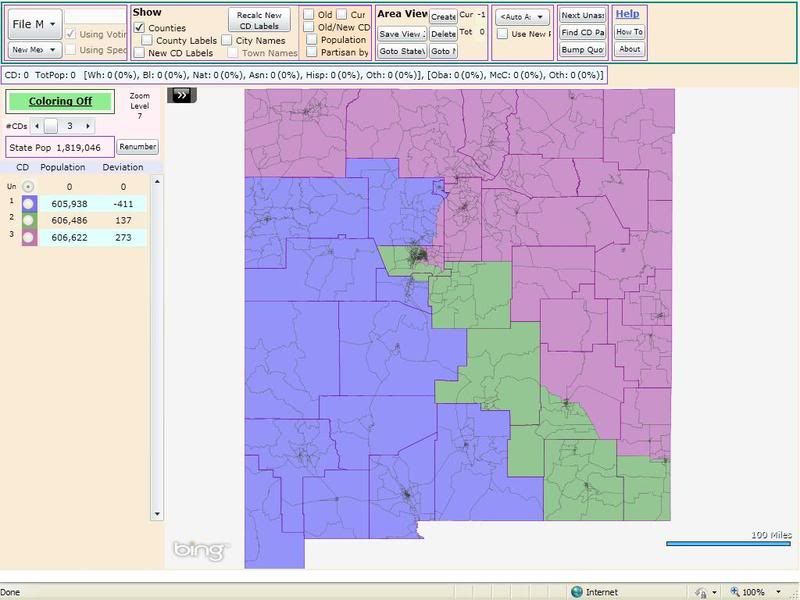
This was the first redistricting I did and I chose NM because its only three CDs.   I tried to the best of my ability to make clean districts, keep counties intact, and keep the population of the districts as close to being equal as possible.  Of course, this being a Democratic redistricting I wanted to make sure that President Obama won a substantial majority of votes in each new district.

1st (Blue) : Obama 56-43.  Las Cruces and the southwest, most of the west.  pop: 605,938.  There would be a new congressperson elected from this district.  None of the current reps live here.

2nd (Green): Obama 58-40.  Part of Albuquerque, all of Torrance and Lincoln, and Eddy counties, Roswell, central to southeast. pop: 606,486.  This would be Steve Pearce's new district (right now he represents a district that went 50-49 for McCain but this one would be much 9% more Democratic).  This would create a 2012 matchup between Steve Pearce and Martin Heinrich for this district, which Heinrich would be favored to win.

3rd (Purple): Obama 57-42.  Most of the east, all of the Northeast, the northwest, Santa Fe, part of Albuquerque, and north central.  pop: 606,622.  Ben Lujan would run in this CD.

http://i1215.photobucket.com/albums/cc513/sysm29/nm.jpg?t=1291594479