A possible Gerrymander of Massachusetts

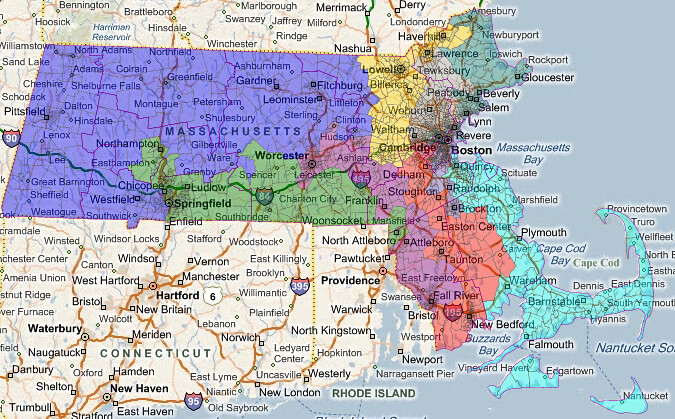
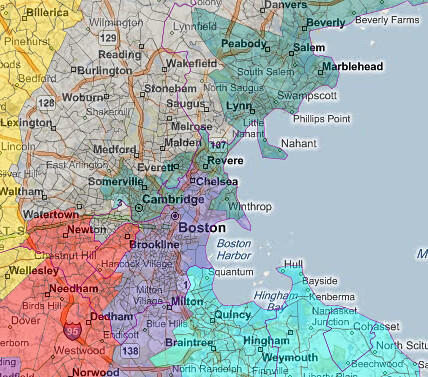
The assumption behind this map is that Capuano runs for Senate and all other incumbents are protected.  All cities and towns are kept intact, excepting Boston.

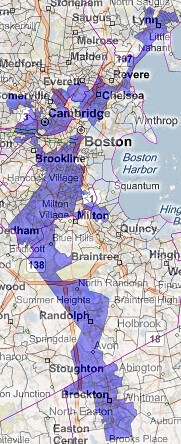
Boston Detail:

1st district – Oliver (Blue)

Gains some Worcester suburbs and some 495 belt towns, which makes it slightly more conservative, but at D+14 it has some room to spare.

2nd District – Neal (Green)

Adds a couple Republican towns in the East and Democratic ones in the West, overall not much changed.

3rd District – McGovern (Purple)

Keeps its Worcester and Fall River anchors, in fact gaining the portion of Fall River that Frank used to have.  The district shifts slightly, losing the Northern suburbs of Worcester and gaining other towns in Norfolk and Bristol counties.  Overall, not much change in partisan composition.

4th District – Frank (Red)

Like the 3rd, this district retains it’s anchors, but shifts slightly East.

5th District – Tsongas (Gold)

This district is made safer, swapping its 495 belt towns for more liberal towns in the Metrowest area.  (Fun fact: Framingham, at 67,000 inhabitants, is the largest town in New England)

6th District – Tierney (Teal)

Embattled rep Tierney needs some shoring up, so he gets the biggest prize from Capuano’s district: Cambridge and Somerville.  While this should make him safe in the general, if Tierney’s ethics troubles get any worse, he could be vulnerable in the primary, especially since much of the territory in this district is new to him.

7th District – Markey (Gray)

This district, while picking up the Alston-Brighton neighborhood of Boston, gets slightly more conservative overall, as it trades the metrowest towns that Tsongas picked up for some more conservative ones that Tierney lost. At D+15 it still has a strong liberal inner suburb base and should be fine.

8th District – Lynch (Periwinkle)

Lynch’s district changes radically in order to preserve the majority-minority district required (maybe?) by the VRA.  Lynch may not be too happy about this, since he has the most conservative voting record of any of the delegation and will now have a very Liberal district.  He could be vulnerable to a primary challenge, perhaps from State Senator Sonia Chang-Diaz.

9th District – Keating (Cyan)

This district doesn’t change much, unfortunately.  There are only so many ways to draw a district that stretches from Quincy to Cape Cod.  If O’Leary had won the primary we would have had more options.

The new 8th district is 48% non-hispanic white, which is comparable to the current 8th.  Just for fun, I tried to draw a district that would bring this number as low as possible:


40% White, 27% Black, 10% Asian, 21% Hispanic, 2% other.

Texas: Predicting Redistricting [Update II]

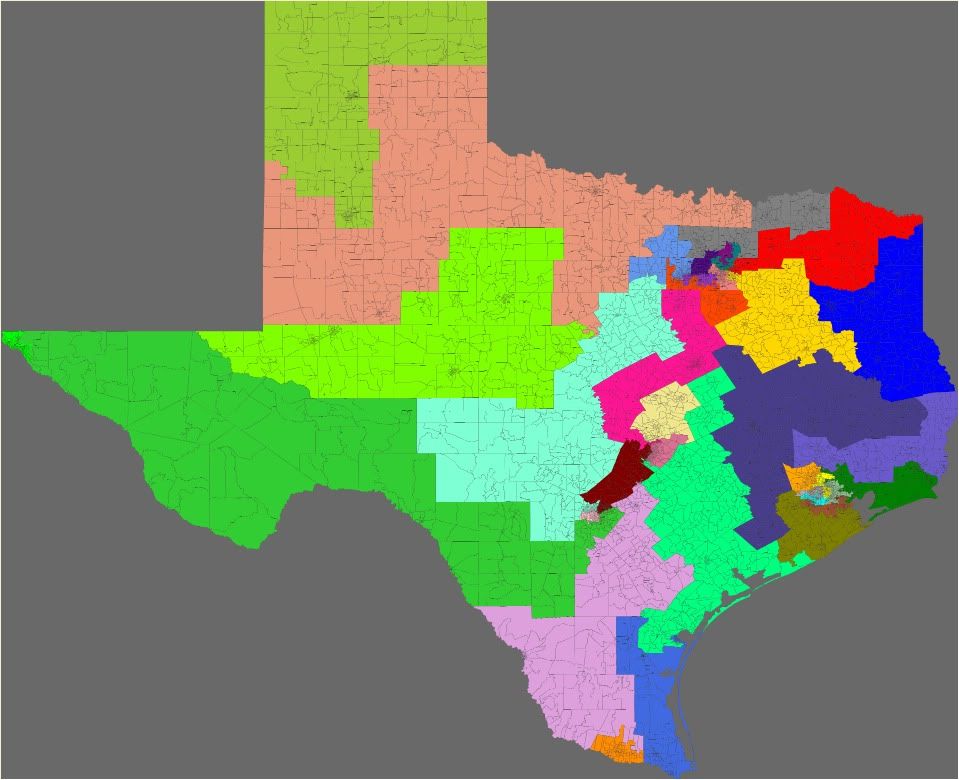
Now that we know that the Texas House and Governor’s mansion will be safely in the hands of the Republican Party during redistricting, I decided to draw a map using Dave Bradlee’s application that predicts what the Republicans might do.  (I used 1.0 instead of 2.0 because I had a previously drawn map that I could easily modify in 1.0.  If there is an easy way to convert a 1.0 map to a 2.0 map, then please let me know in the comments.) Again to be clear, this is a prediction of what I think the new map might look like, not what I hope happens.  I really wish I was sharing a more liberally friendly map than this one.  

It’s also a pretty boring map with the following objectives:

1) Keep all incumbents with their base voters, except McCaul.

2) Draw a Republican safe district for McCaul.

3) Draw a non-VRA Republican safe district using the suburban-exurban part of Nueces for Farenthold.

4) Draw a non-VRA Republican safe district using the Northern part of Bexar for Canseco.

5) Draw a new Republican safe district in Harris.

6) Draw a new VRA Democratic safe district in DFW.

7) Draw two new VRA Democratic safe districts from the current 23 and 27.

I suspect objectives (1)-(5) are real Republican goals, and objectives (6)-(7) will likely be required by the Obama DOJ.  Here are the maps with the pretty colors.

The state.
Photobucket

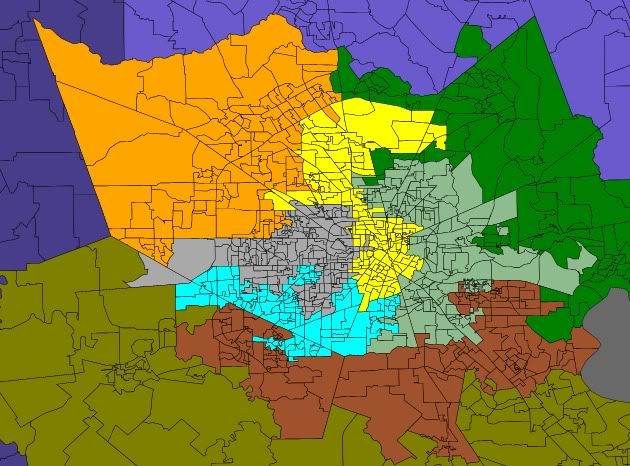
Greater Houston.

Photobucket

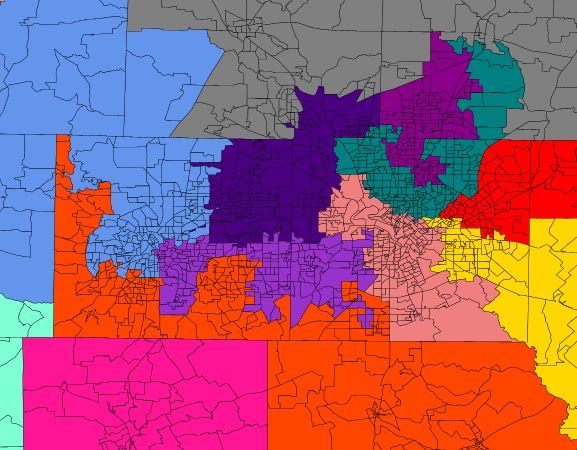
DFW.

Photobucket

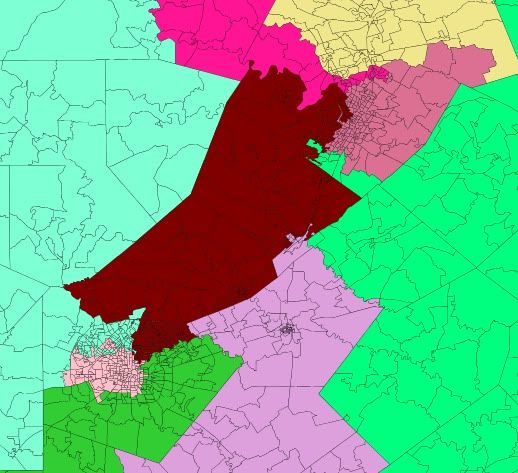
Central Texas.

Photobucket

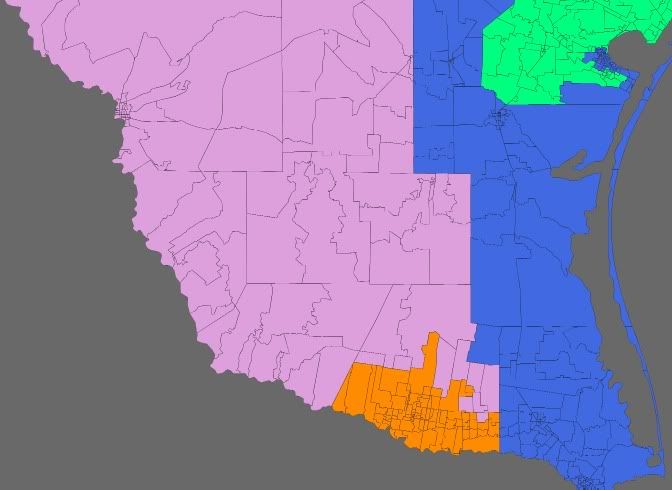
The Valley.

Photobucket

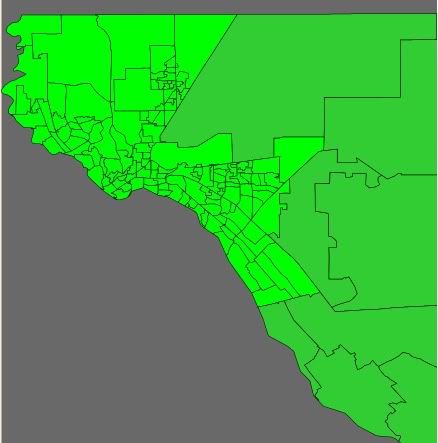
El Paso.

Photobucket

CD 1: (Blue) [31% Obama – 68% McCain, Wh 66%, Bl 19%, Nat 0%, Asn 1% Hisp 12%] Tyler based district for Gohmert.

CD 2: (Dark Green) [41% Obama – 58% McCain, Wh 54%, Bl 19%, Nat 0%, Asn 2% Hisp 24%] Northeast Harris based district for Poe.

CD 3: (Purple) [43% Obama – 56% McCain, Wh 59%, Bl 10%, Nat 0%, Asn 12% Hisp 17%] Plano based district for Sam Johnson.

CD 4: (Red) [35% Obama – 65% McCain, Wh 65%, Bl 12%, Nat 1%, Asn 2% Hisp 19%] Rockwall based district for Hall.

CD 5: (Yellow) [42% Obama – 57% McCain, Wh 55%, Bl 17%, Nat 0%, Asn 1% Hisp 25%] Dallas based district for Hensarling.

CD 6: (Teal) [43% Obama – 56% McCain, Wh 54%, Bl 9%, Nat 0%, Asn 7% Hisp 28%] Dallas based district for Sessions.  Sessions district now goes up into Collin County making him significantly safer. (I switched the numbers on 6 and 32, because the color contrast was poor with 4.  It’s strictly a visual effect, and I don’t expect the numbers to switch.)

CD 7: (Silver) [42% Obama – 57% McCain, Wh 50%, Bl 7%, Nat 0%, Asn 8% Hisp 34%] Houston based district for Culberson.  This district is a little safer than his current district.  

CD 8: (Violet) [25% Obama – 74% McCain, Wh 76%, Bl 7%, Nat 0%, Asn 1% Hisp 14%] Montgomery County based district from Brady.

CD 9: (Sky Blue) [76% Obama – 24% McCain, Wh 15%, Bl 39%, Nat 0%, Asn 10% Hisp 35%] Houston based district for Al Green.

CD 10: (Hot Pink). [39% Obama – 60% McCain, Wh 68%, Bl 9%, Nat 0%, Asn 3% Hisp 18%] Austin/Waco/Johnson Country district for McCaul. Really, the only challenge in this map was McCaul. He lives in liberal Austin, which is a few hundred miles away from his base voters in one of the conservative parts of Harris County.  Furthermore, because of population growth in both Harris County and Austin, there is no way to keep this district together for him.  In fact, I used that part of Harris to draw the new Republican district mentioned in objective (5). A congressperson does not have to live in his/her district, so McCaul could hypothetically run for the Harris district.  However, there are several state legislators in that district, who are looking up, and he could get hit with a primary.  So, I really don’t think living that far away from a district is practical.  Hence, I drew him in with Johnson County, which is very Republican and is not home to a congressperson.  With Waco in this district, there is a chance Chet Edwards could run against him, but I doubt it.

CD 11: (Lawn Green) [25% Obama – 75% McCain, Wh 59%, Bl 5%, Nat 0%, Asn 1% Hisp 34%] Midland based district for Conaway.

CD 12: (Steel Blue) [36% Obama – 63% McCain, Wh 59%, Bl 5%, Nat 1%, Asn 3% Hisp 32%] Fort Worth based district for Granger.

CD 13: (Dark Salmon) [25% Obama – 74% McCain, Wh 70%, Bl 5%, Nat 1%, Asn 1% Hisp 22%] West Texas based district for Thornberry.  This one though now spreads east and has a new conservative base in Wichita Falls.  

CD 14: (Olive) [39% Obama – 60% McCain, Wh 56%, Bl 13%, Nat 0%, Asn 3% Hisp 27%] Galveston based district for Paul.

CD 15: (Orange) [68% Obama – 31% McCain, Wh 9%, Bl 0%, Nat 0%, Asn 1% Hisp 89%] Hidalgo County based district for Hinojosa.  This district is much more compact.  [UPDATE: Several comments have noted that this district may be too Hispanic.  The 15 was after all one of the districts that the courts redrew in 2006.  That could very well be true.  This issue could easily be resolved by redrawing 15 and 28 (and possibly the new 33) similar to how they are drawn now to reduce the Hispanic influence in 15.  I considered doing this myself, but I decided against it.  One reason for my decision was that I ran out of time to work on this.  Two, I actually decided that the GOP could argue that (a) this district is compact and within a single community, (b) all of the neighboring districts are safely VRAs too, and (c) breaking up this district would break up a community, which is against the spirit of the VRA.  That’s not a great argument, but Justice Kennedy might buy it.  Since it gives the GOP a chance to weaken the Democrats in 28 almost down to a swing district, I wouldn’t be surprised if they made this argument. (See description of 28 below.)  Nonetheless, even if it doesn’t go as predicted, I suspect they will go with a fix by redrawing 15 and 28.]

CD 16: (Lime) [65% Obama – 34% McCain, Wh 14%, Bl 3%, Nat 0%, Asn 1% Hisp 81%] El Paso based district for Reyes.

CD 17: (Midnight Blue) [33% Obama – 66% McCain, Wh 64%, Bl 15%, Nat 0%, Asn 2% Hisp 18%] College Station based district for Flores. This district was moved out of Johnson County and McClennan County to make 10 friendlier for McCaul.

CD 18: (Yellow) [75% Obama – 24% McCain, Wh 17%, Bl 32%, Nat 0%, Asn 4% Hisp 46%] Houston based district for Jackson.

CD 19: (Yellow Green) [26% Obama – 74% McCain, Wh 59%, Bl 6%, Nat 1%, Asn 1% Hisp 32%] Lubbock based district for Neugebauer.

CD 20: (Pink) [65% Obama – 34% McCain, Wh 15%, Bl 4%, Nat 0%, Asn 1% Hisp 78%] San Antonio based district for Gonzalez.

CD 21: (Maroon) [42% Obama – 57% McCain, Wh 68%, Bl 4%, Nat 0%, Asn 3% Hisp 24%] San Antonio/Austin based district for Smith.

CD 22: (Chocolate) [39% Obama – 60% McCain, Wh 52%, Bl 8%, Nat 0%, Asn 12% Hisp 27%] Sugar Land based district for Olson.

CD 23: (Cyan) [33% Obama – 66% McCain, Wh 65%, Bl 3%, Nat 0%, Asn 2% Hisp 29%] North Bexar based district for Canseco.  As noted previously, this district is much more Anglo and Republican than the current VRA 23.

CD 24: (Indigo) [41% Obama – 58% McCain, Wh 63%, Bl 8%, Nat 1%, Asn 8% Hisp 18%] Southlake/Coppell based district for Marchant.

CD 25: (Violet Red) [69% Obama – 30% McCain, Wh 41%, Bl 10%, Nat 0%, Asn 5% Hisp 41%] Austin based district for Doggett.

CD 26: (Grey) [34% Obama – 65% McCain, Wh 72%, Bl 7%, Nat 1%, Asn 3% Hisp 16%] Flower Mound/Denton based district for Burgess.

CD 27: (Spring Green) [39% Obama – 60% McCain, Wh 53%, Bl 6%, Nat 0%, Asn 1% Hisp 38%] Greater Corpus Christi based district for Farenthold.  It is no longer a VRA district since it extends north.

CD 28: (Plum) [53% Obama – 46% McCain, Wh 24%, Bl 3%, Nat 0%, Asn 1% Hisp 72%] Laredo based district for Cuellar.  This district however is not nearly as safe as it is today even though is still safely a VRA.  It could be a Republican target, but Cuellar is a staple in Laredo, so I doubt he is going anywhere.

CD 29: (Dark Sea Green) [70% Obama – 30% McCain, Wh 13%, Bl 22%, Nat 0%, Asn 2% Hisp 63%] Houston based district for Gene Green.

CD 30: (Light Salmon) [76% Obama – 23% McCain, Wh 15%, Bl 29%, Nat 0%, Asn 2% Hisp 54%] Dallas based district for Eddie Bernice Johnson.

CD 31: (Khaki) [43% Obama – 55% McCain, Wh 61%, Bl 12%, Nat 1%, Asn 4% Hisp 21%] Williamson County based district for Carter.

CD 32: (Orange Red) [39% Obama – 60% McCain, Wh 64%, Bl 14%, Nat 0%, Asn 3% Hisp 18%] Ellis County based district for Barton.  (See comment about switching 6 and 32 above.)

CD 33: (Slate Blue) [58% Obama – 41% McCain, Wh 19%, Bl 2%, Nat 0%, Asn 1% Hisp 78%] Corpus Christi/South Padre Island based district for Ortiz, possibly Ortiz Junior if Ortiz Senior is ready to retire after losing.

CD 34: (Lime Green) [61% Obama – 38% McCain, Wh 21%, Bl 8%, Nat 0%, Asn 1% Hisp 69%] South Bexar/Border based VRA district for Rodriguez.

CD 35: (Orchid) [66% Obama – 33% McCain, Wh 29%, Bl 29%, Nat 0%, Asn 5% Hisp 36%] New Dallas-Fort Worth based VRA district for some Democrat like Royce West or Rafael Anchia. [UPDATE: curiousgeorge noted that this may not be a VRA district.  That is probably true.  After all, it looks a lot like Martin Frost’s old 24th district that the courts allowed DeLay to butcher in his mid-decade redistricting. Nonetheless, I still believe that there will be a new Democratic district in DFW.  Otherwise, at least one Republican would be seriously weakened.]

CD 36: (Dark Orange) [35% Obama – 65% McCain, Wh 61%, Bl 7%, Nat 0%, Asn 7% Hisp 24%] New Harris County based district for some Republican like Dan Patrick or Debbie Riddle.

Overall 24 R – 12 D.

[UPDATE: I corrected some minor typos, added racial percentages, and addressed the issue of 15 being too Hispanic.  There are some other minor issues with the map, but I think that the overview is about right.  Specifically, we’ll see a 24 R-12 D map with the Democrats representing the following: 3 from Greater Houston, 2 from DFW, 2 from the Valley, 1 from El Paso, 1 from Austin, 1 from San Antonio, 1 from Laredo, and 1 from South San Antonio to the border.]
MN-Gov: Dayton Wins Recount

No surprise:

Democrat Mark Dayton has won his bid to become Minnesota’s next governor, defeating Republican state legislator Tom Emmer after a recount, according to updated vote results released Friday by the Minnesota Secretary of State.

Dayton, a former U.S. Senator, lead Emmer by more than 8,715 votes with 99.99 percent of all ballots recounted.

An additional 765 ballots remain challenged by the Emmer campaign, too few to affect the final outcome.

But from what I understand, Emmer has vowed to take this one all the way to the World Court in the Hague, so it might be a few decades or so before we can put this one to bed.

(Hat-tip: LookingOver)

Maryland: Effective 8-0 Plan

I have yet once again redone my Maryland map.  I’m using the “original” version of Dave’s Application here as I did the map a while back but just haven’t had the chance to do the write-up.

Bottom line: there’s no reason not to do an 8-0 map, knowing that the GOP will do something similar in a number of states.  Democrats still have the trifecta in Maryland (we actually picked up a few seats in the state Senate here in November, btw !)

I had several goals in mind for this map:

– VRA: Both African-American-majority districts must have black population that is at least 1.5 times the size of the white population in those districts (to ensure representation).  The map does really well in this respect.  The black population in both MD-4 and MD-7 goes down from 57% and 59%, respectively, under the existing 2002 map — to 51% and 57%, respectively, under the proposed map here.  HOWEVER, because of the way the districts are reconfigured (expanding to include a lot more GOP-leaning territory in the northern part of the state) the proportion of African-Americans as a percentage of the Democratic primary vote in both districts goes up from approximately 70% now to approximately 80% under the proposed plan.

– Incumbency: Keep at least 50% of each Democratic incumbent’s current territory (population-wise) in the new district.  The percentages that each district gets to keep are below:

MD-1 – 66%

MD-2 – 70%

MD-3 – 62%

MD-4 – 53%

MD-5 – 74%

MD-6 – 49%

MD-7 – 55%

MD-8 – 78%

As you can see, it looks pretty good.  Other than the two minority-majority districts, each Democratic incumbent would get to keep at least 62% of their constituents.  This is important in any realistic redistricting plan for Maryland.  Although their districts get to keep only 53% and 55% of their existing constituents, Donna Edwards and Elijah Cummings should still be quite happy with their new districts for the reason discussed under “VRA” above.  In the case of MD-7 it should be noted that many areas in the eastern part of Baltimore City which were previously part of the district (prior to 2002) are now “returned” back to the district. So, while Cummings does not currently represent those constituents, the areas would likely be quite receptive to having him as a representative.  (I should also note that Steny Hoyer’s new district also contains territory which he has represented prior to 2002 — accounting for another 6% of the population —  so, in effect, the proposed MD-5 here includes 80% of territory Hoyer is currently representing or has represented in the past).

– Keep different parts/regions of the state “intact”.  This includes keeping the Eastern Shore whole in one district (same goes for Southern Maryland), keeping MD-2, MD-3 and MD-7 in the Baltimore orbit, while keeping MD-4, MD-5 and MD-8 in the Washington, DC orbit.  Likewise, I wanted to keep more communities intact.  Under the map here, the only incorporated cities that are split are Baltimore City (for obvious reasons), Mount Airy (because it is already split between two counties), and Hyattsville (although now it would only be split between two districts and not three like under the existing map).

Also, wanted to minimize county fragments and ensure that each district “corresponds” to a region or county.  Listed below is the largest jurisdiction (percentage of  district’s population) that each district is comprised of (you can look up the whole break-down under each district further down):

MD-1 – 62% Eastern Shore

MD-2 – 62% Baltimore County

MD-3 – 64% Anne Arundel and Howard Counties

MD-4 – 68% Prince George’s County

MD-5 – 76% Southern Maryland and Prince George’s Co.

MD-6 – 55% Montgomery County

MD-7 – 59% Baltimore City

MD-8 – 78% Montgomery County

As you can see, Montgomery Co. (the state’s largest) would form the majority of two Congressional districts under this plan.

– Partisanship (last, but not least !): Each new district must ensure that a Democrat is elected.  The percentages are discussed below the maps:

Photobucket

Photobucket

Photobucket

Photobucket

Photobucket

District 1:

Current District:  Obama 40; McCain 58

Proposed District:  Obama 56; McCain 43

Proposed District Demographics: 68% white; 25% black

Population: Eastern Shore 62%, Prince George’s Co. 20%, Anne Arundel Co. 18%

The 56% Obama percentage here would more than ensure that Frank Kratovil could make a comeback in 2012.

District 2:  

Current District:  Obama 60; McCain 38

Proposed District:  Obama 59; McCain 39

Proposed District Demographics: 66% white; 25% black

Population: Baltimore Co. 62%, Baltimore City 22%, Harford Co. 17%

District 3:  

Current District:  Obama 59; McCain 39

Proposed District:  Obama 59; McCain 39

Proposed District Demographics: 68% white; 19% black

Population: Howard Co. 33%, Anne Arundel Co. 31%, Baltimore Co. 26%, Baltimore City 10%

District 4:

Current District:  Obama 85; McCain 14

Proposed District:  Obama 72; McCain 27

Proposed District Demographics: 51% black; 33% white; 12% Hispanic

Population: Prince George’s Co. 68%, Carroll Co. 24%, Howard Co. 6%, Montgomery Co. 2%

District 5:

Current District:  Obama 65; McCain 33

Proposed District:  Obama 60; McCain 39

Proposed District Demographics: 59% white; 29% black

Population: Southern Maryland 47%, Prince George’s Co. 29%, Anne Arundel Co. 24%

District 6:

Current District:  Obama 40; McCain 58

Proposed District:  Obama 59; McCain 40

Proposed District Demographics: 66% white, 14% black, 10% Hispanic

Population: Montgomery Co. 55%, Frederick Co. 29%, Washington Co. 16%

District 7:  

Current District:  Obama 79; McCain 20

Proposed District:  Obama 69; McCain 30

Proposed District Demographics: 57% black; 38% white

Population: Baltimore City 59%, Baltimore Co. 24%, Harford Co. 17%

District 8:  

Current District:  Obama 74; McCain 25

Proposed District:  Obama 65; McCain 34

Proposed District Demographics: 63% white; 13% hispanic; 11% black; 11% asian

Population: Montgomery Co. 78%, Western Maryland 19%, Frederick Co. 3%

Iowa: 2-1-1

Not always I want leave in 0 to the republicans. Iowa is not a state for want it. My map for Iowa find 2D-1Swing-1R.

Habitually I bid not for the states without political data, because still I have enough with California or Pennsylvania (maybe later) for think in other states, but I have a idea what make so easy the calculus and I think the result of the bid help for it.

This is the map:

Photobucket

CD-01: B Braley (D)

57.98% Obama => D+5 (Currently D+5)

Based in Davenport (3rd city in Iowa)

Includes all of: Scott, Clinton, Jackson, Dubuque, Delaware, Clayton, Allamakee, Buchanan, Fayette, Winneshiek, Black Howk, Bremer, Chickasaw, Howard, Grundy, Butler, Floyd, Mitchell, Worth, Cerro Gordo and Franklin counties.

CD-02: D Loebsack (D)

57.97% Obama => D+5 (Currently D+7)

Based in Cedar Rapids (2nd city in Iowa)

Includes all of: Jones, Cedar, Muscatine, Louisa, Des Moines, Linn, Johnson, Washington, Henry, Lee, Benton, Iowa, Keokuk, Jefferson, Van Buren, Tama, Poweshiek, Mahaska, Wapello, Davis, Monroe, Appanoose, Lucas and Wayne counties.

CD-03: L Boswell (D) and T Latham (R)

53.75% Obama => D+1 (Currently D+1 and EVEN)

Based in Des Moines (1st city in Iowa)

Includes all of: Hardin, Marshall, Jasper, Marion, Hamilton, Story, Polk, Warren, Clarke, Boone, Dallas and Madison.

CD-04: S King (R)

46.05% Obama => R+7 (Currently R+9)

Based in Sioux City (4th city in Iowa)

Includes all of: The rest of the counties.

They are compact districts what respect the boundaries of the counties and respect the unity of the metropolitan areas in the state.

The new CD-01 and CD-02 districts are in risk of lose some point in the Cook PVI rating because both districts must asume new areas from districts with less democratic rating. Still I think this model for redistricting Iowa keep booth enough safe. The same reason make the future CD-04 down from R+9 until R+6.

The new CD-03 can give a decent chance to L Boswell because every bid for make a new district here what keep all the Polk county inside the district will give a strong position to L Boswell against T Latham.

Maryland and Utah: Plausible Redistricting Maps

This writeup will be brief and will lack detail pictures. Dave’s app ate one of my save files for the Maryland map, and the Utah map I drew up on a public computer when I was bored.

Utah will gain one seat. Rep. Matheson, the only Democrat in the Beehive State’s congressional district, has resisted every effort to defeat him. With the Wasatch Front gobbling up so much of Utah’s voting population and Salt Lake County trending blue, I think Utah Republicans will be relieved to confine Matheson to the state’s most populous county and parcel out his redder rural and suburban territory to help create a new district. Rep. Chaffetz will probably run against Sen. Hatch in 2012, but if he doesn’t, he could run in the new UT-04, as he’s been drawn out of UT-03. It really doesn’t matter, as UT-01, UT-03, and UT-04 would probably vote for Attila the Hun as long as he could prove he was a naturalized U.S. citizen.

All of these districts but MD-06 (teal) are safe Democratic seats. I posted this map in the comments section of a now-buried diary, but I figured I’d repost it in a new diary. Rep. Kratovil can run for MD-01 (blue) from his Stevensville home in coastal Queen Anne’s County. Rep. Bartlett has been drawn out of MD-06, with the blueing city of Frederick (as well as its little cousin of Hagerstown, in Washington County) drawn into Rep. Van Hollen’s MD-08 (slate blue). Rep.-elect Harris would probably do just fine in MD-06. Just to give you an idea of exactly how Democratic this state is, MD-06 voted for Sen. McCain over Sen. Obama in 2008 by within a point of the same margin by which MD-05 (yellow) and MD-08 broke for Sen. Obama. MD-04 (red) and MD-07 (grey) are black-majority VRA districts (54% black, 22% white; and 53% black, 33% white respectively). I may have drawn Rep. Sarbanes out of MD-03 (purple), but moving across Baltimore is really not a big deal for a congressman.

Don’t Overestimate Rahm Emanuel

By: Inoljt, http://mypolitikal.com/

In little more than a year several months, the great city of Chicago will select its next mayor. Following the retirement of Mayor Richard Daley, the field is wide open.

Enter Rahm Emanuel. A powerful Democrat and President Barack Obama’s former chief-of-staff, Mr. Emanuel currently looks like the front-runner for the office. With many strong candidates declining to run and his potential opposition divided, things look good for Mr. Emanuel.

And yet one shouldn’t overestimate Mr. Emanuel’s chances as media-anointed front-runner. Mr. Emanuel has a number of hidden weaknesses that may combine to badly damage his campaign.

More below.

A strong attack, for instance, could be levied against Mr. Emanuel as a Washington insider who doesn’t care for the little man. This attack is all the more damaging because its first portion is completely true: it is hard to find a politician more immersed in Washington than Mr. Emanuel.

There are other variations on this theme. There is the geography version: Mr. Emanuel is a carpet-bagger who hasn’t lived in Chicago and doesn’t care about it. There is the populist version: the Washington elite may have already declared Mr. Emanuel the winner, but Chicago doesn’t have to listen to what the elite say. There is the class version: Mr. Emanuel is one of the rich elite who don’t understand the concerns of the working-class. There is the race version: Mr. Emanuel is one of the white elite who don’t understand the concerns of Chicago’s minorities.

None of this possibilities has yet been tried out, or turned into a coherent critique of Mr. Emanuel. It is too early in the game for that. But already there are signs that Mr. Emanuel has limited appeal amongst Chicago’s poor and its minorities (who compose a majority of the city’s population).

Mr. Emanuel does have a lot of things going for him, more than for any other single candidate. He has the support of most of Chicago’s machine, the business community, the politically influential North Side, and probably President Barack Obama (although most pundits probably overrate the importance of an Obama endorsement). Other candidates would probably love to be in his position.

On the other hand, Harold Washington had all this interests aligned against him when he campaigned for mayor. Yet Mr. Washington – the first and to date only black mayor of Chicago – still won consecutive elections on the back of minority support.

Chicago has a run-off system, in which if nobody gets more than 50% of the vote, then the first two winners go on to a second-round.  Most experts expect Mr. Emanuel to get in the somewhere in the 40s, if not an outright majority of the vote.

But it’s also quite conceivable that Mr. Emanuel polls in the low 30s come election day, if he fails to attract the working-class and minority votes that he needs to win in a place like Chicago.

SSP Daily Digest: 12/3

FL-Sen: This probably isn’t the way that GOP state Senate President Mike Haridopolos, acting very candidate-ish this week, wanted to kick off a Senate bid. He just had to settle with the state’s Commission on Ethics, admitting to a litany of campaign finance violations for failing to properly fill out financial disclosure statements. As far as a penalty goes, though, expect a slap on the wrist; the state Senate’s Rules Committee, rather than the Commission, actually assigns the penalty, and Rules is now led by Haridopolos’s GOP Senate President predecessor, John Thrasher.

PA-Sen: There’s word of a rather Ron Johnson-style random rich guy interested in taking on Bob Casey Jr. in 2012: John Moran, who owns a logistics and warehousing company in central Pennsylvania and is willing to spend some of his own money to get elected. In other words, another federal-government-hater whose riches are largely dependent on an infrastructure put in place by the federal government (in this case, ex-Rep. Bud Shuster, who’s pretty single-handedly responsible for the creation of central Pennsylvania’s luxurious web of highways and the rise of trucking as the backbone of that area’s economy). Also, if you want to look back at a comparison of the 2010 Senate race vs. the 2006 Senate race (where Casey was elected), Greg Giroux has a very interesting spreadsheet showing which counties had the biggest drops in vote percentages and raw vote numbers.

RI-Sen: We mentioned a few weeks ago that John Robitaille, last seen coming close in the gubernatorial contest won by indie Lincoln Chafee, was on the wish list for a GOP Senate bid against Sheldon Whitehouse, and now he’s saying out loud that he’s “seriously considering” it. (Of course, Robitaille’s closeness mostly had to do with a split in the left-of-center vote between Chafee and Dem candidate Frank Caprio, but let’s just let the NRSC think they can win this one in hopes they spend some money here.)

UT-Sen: It looks like Orrin Hatch is not only running for re-election in 2012 (where retirement had been considered a possibility for the septuagenarian, no doubt facing a serious teabagging this cycle), but ramping up for a fierce fight at the state nominating convention (which is where Bob Bennett lost, not even making it to the primary). One of his key allies, state GOP party chair Dave Hansen, is reportedly about to resign from that position and start working directly for Hatch’s campaign.

MN-Gov: Tom Emmer held a press conference today in the face of a winding-down recount where the numbers didn’t budge, and instead of throwing in the towel, he said he’s going to fight on to the end, and threatened to keep on fighting even after the end, alluding to the possibility of legal action over the ballot reconciliation issue (saying the recount was merely “a step in the process”). Meanwhile, seeking to be the ones wearing the white hats here, Mark Dayton’s team said they’ll withdraw all their remaining frivolous challenges. That’s a total of only 42 challenges, though, as more than 98% of the frivolous challenges came from Emmer’s team.

NY-01: After another day of looking at challenged ballots, Tim Bishop continued to add to his lead. He netted another 12 votes, bringing his overall lead to 271 over Randy Altschuler. Challenges to a total of 174 ballots were dropped by both campaigns, leaving about 1,500.

NY-15: Usually there isn’t much speculation that a Governor is about to run for a U.S. House seat, unless it’s an at-large state or the Governor has fallen way down the food chain. If you’re talking about David Paterson, he may have fallen even further down the food chain than that, though (into dogcatcher realm). At any rate, Paterson quashed any speculation that he would run for Charles Rangel’s seat (despite his dynastic links to the seat, as his dad, Basil Paterson, is a key ally to Rangel as two of the so-called “Gang of Four”). It’s not entirely clear that Rangel won’t still be running in 2012, considering how he seems to utterly lack the ‘shame’ gene, although Paterson suggested state Assemblyman Keith Wright and city councilor Inez Dickens as possible replacments.

Committees: Both the NRSC and DSCC are starting the 2012 cycle from a place of parity: deep, deep in debt. The DSCC has $713K on hand and $6.7 million in debt, while the NRSC has $519K on hand and $6 million in debt. Even worse numbers are in the House: the DCCC has $19.4 million in debt and the NRCC has $12 million in debt.

Idawyoming: Idaho with three districts

I wanted to get in on the Wyoming fun, so I decided the state I’d do would be Idaho.

Photobucket

ID-1: More Republican without Ada County, which has trended less Republican over the past few cycles. The counties in the panhandle lean Dem in strong Democratic years.

ID-2: Covers Southern Idaho.

ID-3: Covers all of Ada County and portions of Canyon. Looking at the district, I would estimate it to be about R+8.

Bonus: Delaware with two districts

Photobucket

DE-1: Covers most of New Castle County and would be D+16. To make it, I looked at a map of New Castle County Council districts and figured out where to divide the county properly.

DE-2: Covers part of New Castle County and all of Kent and Sussex Counties. The PVI would be around D+1 based on 2008, but it probably would be more like R+2 in regular years. It might elect Christine O’Donnell, as both Kent and Sussex voted for her in the Senate race.

Second Bonus: Montana with two districts.

Photobucket

MT-1: This district would be about R+3 and would certainly be open to electing a Democrat, as it includes most of the places where Democrats perform well.

MT-2: Didn’t do much math on this one, but it would have a Republican PVI.