FL-Sen: Crist Cruising; Meek Over Brown

Mason Dixon (PDF) for Ron Sachs Communications (6/24-26, registered voters for general, likely voters for primaries, 5/14-18 in parens):

Charlie Crist (R): 51 (53_

Marco Rubio (R): 23 (18)

Undecided: 26 (29)

Kendrick Meek (D): 27

Corrine Brown (D): 12

Undecided: 61

(MoE: ±6%)

Charlie Crist (R): 48 (55)

Kendrick Meek (D): 26 (24)

Undecided: 26 (21)

Charlie Crist (R): 55

Corrine Brown (D): 24

Undecided: 21

(MoE: ±4%)

Not really sure what to say about these numbers, given how similar they are to those from other pollsters. Taegan Goddard notes: “Among Republican voters who recognize both candidates, Crist barely edges Rubio, 33% to 31%.” That’s good news for Rubio, though the margin of error among this tiny sub-sample (which can’t number more than about 150, given the internals) would be at least 8%. Still, Florida’s late primary is over a year away, giving Rubio plenty of time.

Here’s some food for thought: Would Charlie Crist have a better chance at winning this Senate seat if he ran as an independent – or switched to the Democrats?

VA-Gov: Bob McDonnell Embraces Bush Nostalgia

Hard to believe we’re seeing any Republican anywhere pining for the good ol’ Bush days, but Bob McDonnell went there:

Many of you probably remember after 9/11 we did something to stimulate the economy then, too. You know what we did? We cut taxes. President Bush put in a ten-year tax-cut on everything from the death tax to capital gains tax, and it was followed by an unprecedented period of economic recovery and economic growth. In fact, it almost overheated the economy through about 2006. So, I think that’s the way you stimulate business. And that’s the kind of governor that I’m going to be – to reduce those impediments to entrepreneurship, to let small businesses grow and thrive and create some opportunity.

Maybe tax cuts have tested well in McDonnell’s internal polling. But I refuse to believe that Bush nostalgia sells well to anyone but the most hardcore bitter-enders.

AR-Gov race 2014: Looking down the road.

In politics, you’re never going to get too good of results looking way down the road.  But hey, that never stops us from trying, and my home state, Arkansas, is one of those fun little rural states where everyone knows everyone else and what folks are up to, which makes prognosticating easier.  Already there are signs of what’s to come in the governor’s race for 2014, once Beebe is done and moving on.  And since I’ve been doing some writing on one of the potential candidates on my own blog as of late I thought I’d do a quick write up.

The three candidates constantly mentioned for the 2014 race are Attorney General Dustin McDaniel, Lt. Governor Bill Halter, and Congressman Mike Ross.

McDaniel is a former state representative from Jonesboro, where I now live. He’s a lawyer and a former cop, and he has a huge base here in northeast Arkansas.  He’s generally considered fairly liberal by Arkansas standards, and he touted his prochoice position in order to win the AG primary in ’06.  But he has some faults-his ethics bill he proposed has a huge flaw in it in that it doubled the amount of money legislators could draw as a salary from campaign funds, and he’s gotten some criticism over using the state police helicopter improperly.

Halter worked in Bill Clinton’s administration before running for Governor in ’06, then dropping down to the Lt. Gov race.  He pissed a lot of people off in that campaign, coming in with a lot of out of state money, making no effort to woo the state machine, and there was some significant opposition to his signature issue, the state lottery.  However, while he certainly doesn’t carry himself with the humility and down home mannerisms that Arkansans expect of their politicians, there is something to be said for Halter being a different kind of politician.  He doesn’t think like the rest of the establishment, he’s definately more liberal for one, and his move on the lottery was largely opposed by the entire state establishment who were all quick to take credit for its passage.

Then there’s Mike Ross, the Congressman from southern Arkansas.  Ross is probably the most conservative of the three, and his votes on hate crimes and cap-and-trade the lately have made that much clear.  He thought about running in ’06 but yeilded to his old mentor Beebe, stating he couldn’t take the pay cut.  He could make the electability argument I guess, though the other two guys won statewide elections fairly easily and look to do so again next year, so I’m not sure it works.

So those are our three potential candidates.  I’m hoping someone else jumps in personally as none of these three appeal to me.  But we’ve got a long way to go until then, so we’ll see what happens.

Helping the CfG help us

for a good laugh, I set myself up on the Club for Growth e-mail list.  I love to see what Democrats they target and I especially love to see them promote primary challenges to Republicans….especially when they are Republicans that we are targetting…like Mark Kirk.  

Recently, the CfG sent out an e-mail complaining about 8 RINO’s who voted in favor the “dangerous cap and trade bill” last Friday.  They are looking for viable candidates to run primary challenges against these 7 (McHugh is the 8th vote but he’s retiring)

Bono Mack, Mary (CA-45)

Castle, Mike (DE-AL)

Kirk, Mark (IL-10)

Lance, Leonard (NJ-07)

LoBiondo, Frank (NJ-02)  

Reichert, Dave (WA-08)

Smith, Chris (NJ-04)

I can’t help but notice that Democrats ran strong challenges in several of these districts and are primed to do so again.  It would certaintly work to our benefit if we gave the CfG a little boost in helping to find some viable primary challengers to these Republican candidates.  

Does anybody have any knowledge of potential Republican candidates in these races that we could give some encouragement to get into these races or give the CfG some encouragement to try and get them in themselves??

CA-Gov: Brown Beating Newsom; Foy May Get In

J. Moore Methods (D) (6/20-23, registered voters):

Jerry Brown (D): 46

Gavin Newsom (D): 26

(MoE: ±4.7%)

Here’s the first poll of the California governor’s primary on the Democratic side since LA Mayor Antonio Villaraigosa dropped out (although it’s a Democratic pollster, it’s not an internal). There aren’t any trendlines so we can’t see if AG Jerry Brown got a bump out of Villaraigosa’s disappearing act (Brown, the former governor, is better known in southern California than his rival, SF Mayor Gavin Newsom), but Brown now has a convincing lead. Brown leads even more among voters 60+ (i.e. those old enough to remember Brown’s first turn as Governor): 54-20. Newsom leads among the 18-to-39 set, 37-26.

There’s one other interesting new tidbit in the Governor’s race: Ventura County Supervisor Peter Foy says he’s now “strongly” looking into the race and will decide within the next couple months. Your first response is probably: who? Well, Foy is coming from a small regional base (affluent suburbia west of Los Angeles), and is decidely money-impaired compared with mega-self-funders Meg Whitman and Steve Poizner. Here’s the rub, though: Foy is a pro-lifer, and a doctrinaire fiscal conservative who helped lead the fight against Proposition 1A. Currently, the conservative movement has absolutely no horse in the race, with the primary field containing three pro-choice business/establishment conservatives (Whitman, Poizner, and ex-Rep. Tom Campbell). If movement conservatives unite behind Foy while the moderate vote gets split three ways, Foy could suddenly be a force to be reckoned with.

RaceTracker: CA-Gov

SSP Daily Digest: 6/29

FL-Sen: Oh please, oh please: The Club for Growth’s president, David Keating, says that he’s very impressed with Marco Rubio, and may run ads against Rubio’s primary opponent, Charlie Crist (although he said there’s no set timeline for “endorsement”). Politico also points to a strongly anti-Crist new editorial from the Wall Street Journal that, believe it or not, compares Crist to Barney Frank (get your mind out of the gutter… apparently it has something to do with an analogy between hurricane insurance and Fannie Mae).

MN-Sen: Despite the fact that Tim Pawlenty (not running for re-election, but probably running for the Big Show in 2012) is now answerable to the nationwide GOP base rather than to all Minnesotans, he’s not going to obstruct the all-but-inevitable seating of Al Franken. He confirmed on CNN that he’ll certify Franken if Norm Coleman loses his Minnesota Supreme Court case.

NC-Sen: While former state Sen. Cal Cunningham is making some senatorial noises, he says that he won’t commit to a timeline on getting into the race, saying only that he’ll make a “timely decision.”

AL-Gov: We’re up to six Republican gubernatorial candidates now; Bill Johnson, the state director of Economic and Community Affairs, resigned his post on Friday and declared his candidacy. Despite his statewide position, Johnson seems like kind of an odd duck; he was the Libertarian candidate for U.S. Senate in Missouri in 1994.

SC-Gov: The behind-the-scenes battle is heating up between Mark Sanford and his Lt. Governor and possible successor (either via resignation or the 2010 election), Andre Bauer. Bauer’s would-be opponents (who would be at a disadvantage if Bauer comes into the election as an incumbent) are already dusting off old lines of attack from his LG primary campaign in 2006, that Bauer is too much of a fast-driving, plane-crashing party boy and not sufficiently conservative. (Bauer’s spokesperson does some very strange pushback in this article, seemingly protesting too much that Bauer is merely a “red-blooded American male” and “straight.”) The New York Times details efforts by Bauer’s camp to exert pressure on legislators to pressure Sanford to resign (which came to public light when Bauer’s camp inadvertently contacted an ally of potential 2010 rival AG Henry McMaster).

Meanwhile, State Rep. Nikki Haley has been encouraging Sanford not to resign (which he says he won’t do) — on the surface because she was one of Sanford’s few legislative allies even before the scandal, but at this point, more importantly because she’s also running in 2010 and would be at a disadvantage if Bauer comes in as a one-year incumbent. She has also issued a statement “fear[ing] for the conservative reform movement” if Bauer takes office. Similarly, McMaster seems reluctant to launch criminal investigations into Sanford — again, the subtext being that would make Sanford’s immediate replacement by Bauer likelier.

WI-Gov: Here’s an interesting rumor: Gov. Jim Doyle may be in line to take over as the next head of the Peace Corps. Not only would this spare us a 2nd re-election run by Doyle, who’s been posting mediocre poll numbers, but, assuming he resigns to take the new post, it would give Lt. Gov. Barbara Lawton the chance to run in 2010 with a year of incumbency under her belt.

AL-05: Despite earlier reports that the GOP was happy with their recruit to run in AL-05, businessman and local GOP “minority outreach” coordinator Lester Philip, they’ve recruited a higher-profile figure to run against freshman Rep. Parker Griffith. Madison Co. (location of Huntsville) Commissioner Mo Brooks said he’ll formally enter the race this week.

CA-11: After first flirting with the CA-10 special election and then flirting with the idea of running against Rep. Jerry McNerney in CA-11 in 2010, Contra Costa Co. Sheriff Warren Rupf declared that he isn’t running for Congress, period. Rupf, in fact, basically gave Congress the middle finger, saying his values “don’t line up with the fringes of either party and compromising my values or my priorities is a price I am not willing to pay.”

CA-24: The DCCC has been cajoling Peter Jim Dantona, a local political consultant, to get into the race against longtime Rep. Elton Gallegly in the 24th. Dantona proved his bona fides by almost winning a seat on the Ventura Co. Board of Supervisors in a heavily Republican district. (Another consideration is the possibility that Gallegly, who’s tried to retire before, may turn this district, which Obama won 51-48, into an open seat if faced with a stiff challenge.)

CA-50: A Francine Busby fundraiser in a supporter’s backyard turned into a bit of a melee when the police were called over a noise complaint, ending with the party’s 60-year-old host getting pepper-sprayed and arrested when she wouldn’t give the police her name and date of birth.

FL-24: GOP State Rep. (and former mayor of Port Orange) Dorothy Hukill announced her interest in taking on Rep. Suzanne Kosmas. The NRCC was already highly touting Winter Park City Commissioner Karen Diebel in this race, so it’ll be interesting to see if Hukill is doing this on her own, or if the NRCC kept looking after pre-emptive Dem attacks on Diebel’s stability may have damaged Diebel.

MI-03: Rep. Vernon Ehlers, who’s 75, sounded a little ambivalent about running for another term in 2010. Roll Call does some interesting dot-connecting: Ehlers and SoS Terri Lynn Land are friendly, and her sudden jump out of the governor’s race, where she looked competitive, may have something to do with her getting some insider information on MI-03 being available instead.

NC-08: The GOP is still wondering what to do about a challenge to freshman Rep. Larry Kissell. Oddly, their first choice is a rerun by former Rep. Robin Hayes, who looked clueless en route to losing in 2008 by over 10 points. (Hayes is still considering it, but also helping to recruit other candidates.) Another possible (and more ominous) contender, who hasn’t ruled it out, is Charlotte mayor Pat McCrory, who lost the 2008 gubernatorial race and will be looking for something else to do after his seventh mayoral term ends this year. Union Co. District Attorney John Snyder was also cited as a possible GOPer.

NE-02: Rep. Lee Terry seems to be under a lot of stress lately, as seen by his recent F-bomb-laced freak-out when trying to cross the street in Washington.

Fundraising: Just a friendly reminder: the fundraising quarter ends tomorrow. If there’s a candidate out there who you want to give some early momentum to, now’s the time to contribute.

Louisiana Redistricting Maps

Well, I checked the poll results from my New Jersey map and the most popular result was Louisiana. I next plan to do Minnesota or Georgia so you can help me decide by voting in the poll below. Mainly because of Katrina, Louisiana will lose one electoral vote. Unfortunately, most of the population loss comes from New Orleans, a Democratic stronghold. This means that I had to extend the 2nd district all the way out to Baton Rogue through some marginal territory. My main objectives were to keep the 2nd district at Black majority status, keep the 3rd district safe enough for a Democrat. Charlie Melancon, its current Representative is running for Senate so the district needs to be safe enough for him if he loses the Senate race and decides to return to the 3rd. It also needs to be safe for another Democrat who would replace him if Melancon beats Vitter. I was able to create the majority Black 4th district which is very convoluted. You will see it before I even tell you what color it is. I think the map will create a 3-3 delegation. Trust me, a Republican controlled Legislature and Governorship will never let this plan pass. Feel free to share your thoughts. The link to my maps is http://frogandturtle.blogspot….

District 1 Steve Scalise (R) Blue

This district contains St. Tammany and Livingston Parishes. It contains parts of Jefferson, Ascension, Tangipahoa, and Washington Parishes. I tried to make this district as Republican as possible and I think I got it to be somewhere in the low 70’s. I slightly increased the Black population to 14% and the white population is 77%. Since Bill Cassidy is losing his Baton Rogue based district, he might want to take a run at this one. He probably will lose to Scalise, the current 1st district congressman. This is definitely a safe Republican hold. Status is Solid Republican.

District 2 Joseph Cao (R) Green

Since New Orleans lost a lot of people through Katrina, I had to snake the district up into Baton Rouge. This was detrimental to my plan and may have inadvertently weakened a few Democrats. The district contains all of Orleans Parish, parts of Jefferson, St. Bernard, St. Charles, St. John the Baptist, St. James, Ascension, Iberville, West Baton Rouge and East Baton Rouge Parish. This district barely has an African American majority and I hope that a Democrat holds it instead of Cao by the time they redistrict. It looks to me like a safe hold for a Democrat so we should not worry. Well, the stats are 52% Black and 39% White. Obama’s numbers here were probably between 58% and 64%. Status is Solid Democrat if Cao loses in 2010 which will probably happen.

District 3 Charlie Melancon (D) Purple

Before I tell you more about this district, I just want to say to Charles Melancon that I wish I gave you more Democratic precincts. I removed a lot of the river ones when I gave them to Districts 2 and 4. Anyway, the district has been Conservative while Melancon had it and he has been able to win not by nail biters. Since its original form has not been altered much, he could probably find a way to hold on unless a strong Republican ran against Melancon. Unfortunately, I put in some Republican precincts in East Baton Rogue but I think they should not alter the district too much. They might encourage Bill Cassidy to run in this district. Since he is unfamiliar to the voters outside of the Baton Rogue area, he does not have a strong chance of winning. The stats for the district are 24% Black and 69% White. They are the same as the current demographics for the district so I think Melancon will hold it unless Boustany decides to bail out and not run in the 6th. This district should vote Democratic in statewide elections. Status: Likely Democrat if Melancon runs without the 6th district congressman, Lean Republican if he does not.

District 4 No Incumbent Red

Boy, did I try here to pull off one. I created it to connect precincts with African Americans from Baton Rouge to Shreveport! It meanders along the river then extending across the northern border into Shreveport. It snakes into Monroe to take in a few Black precincts. Still, the northern parishes are Conservative and they drastically reduced the Black percentage of the population. Also, I had to extend the district to the east a bit because the 1st had too many people. I did it reluctantly but the eastern areas should not offset the Democratic areas enough. I do not know who would run here but I think Dan Cazayoux might want to give it a go. Or the guy who almost won the Shreveport seat might try too and since the bases are equal, this could trigger a large primary on the Democratic side. The Black population is 51% and the White population is 44%. This means that the district is now protected under the Voting Rights Act. It resembles the Cleo Fields district from the 90’s but this district is now much more Democratic. I estimate Obama won in this district somewhere in the range of 53% to 57%. Unless the Republicans can find a credible challenger, this district appears to be headed for the Democratic column. Status is Likely Democratic.

District 5 Rodney Alexander vs. John Fleming Yellow

Stats are 26% African American, 70% white. You could say that this district is the leftovers from the 4th district. The 5th district is meant to be safe for whichever Republican wins it. It should be safe for him and McCain probably won it within the 65% range. It contains the northern part of the state except for most of Shreveport, the border with Arkansas and the Mississippi River. Alexander could have a competitive primary with John Fleming but Alexander should probably win because the new 5th contains more of his district. Status is safe Republican.

District 6 Charles Boustany (R) Teal

This district closely resembles the old one. It has a 24% Black population and a 70% white one. I estimate McCain won this in the neighborhood of 66% of the vote. It takes in part of Lafayette and goes up the Texas border almost to Shreveport. John Fleming might take a go at this district but would probably lose to Boustany. This district might be competitive in statewide elections but in national races, the Republican hold it. Status is Safe Republican.  

By what margin will Bob Shamansky win?

View Results

Loading ... Loading ...

Redistricting Michigan in 2010

(Cross-posted at West Michigan Rising, Daily Kos, and Michigan Liberal-PB)

Introduction

In recent months astute political analysts have noted that the real prize in the 2010 election is control of the redistricting process that will follow in the year to come.  While redistricting occurs on every level of government throughout the 50 states, many observers note the importance of redistricting United States House Districts.  In the 2001-2002 redistricting cycle following the 2000 Census, many states, including Texas and Pennsylvania, underwent an aggressive Republican gerrymandering developed to maximize GOP gains in 2002 and 2004.  This strategy largely succeeded, allowing the Republicans to further their control of many state delegations.  

Perhaps the most aggressive GOP redistricting (with the exception of Tom Delay’s Texas redraw) came in Michigan.  Since the adoption of the 1964 Constitution, the state legislature has controlled the redistricting process, with the governor having veto power over the plan.  The redistricting plans offered in 1965, 1971, 1981, and 1991 by the state legislature were rejected by the federal courts, which decried the partisan nature of both the Democratic and Republican plans.  Given that the Republicans controlled the State Senate during each of four cycles (and the Democrats controlling the State House), the plans that were eventually approved by the federal courts strived to adhere to the 1964 State Constitution’s demand that districts be “compact, contiguous, and avoid breaking up political subdivisions (such as municipalities).”

This situation did not repeat itself in 2001. The Michigan Republican Party, which controlled the executive branch starting in 1990 and the State House in 1995, while maintaining its hold on the State Senate, drafted new legislation to guide the redistricting of federal and state legislative districts.  MCL 3.61 (PA 221 1996) often known as the Congressional Redistricting Act, guided redistricting of congressional seats, while State Legislative Redistricting Standards Act (MCL 4.261) charted redistricting of the State House and Senate. Both laws largely adopted the standards established by the Michigan Supreme Court during the previous redistricting battles.  

In regards to congressional redistricting, MCL 3.61 establishes the following requirements. First, the principle of “least cost” holds throughout, and states that municipalities should be incorporated within districts if the population of a municipality is smaller than the size of an average Congressional District. Secondly, populations for Congressional districts must equal (MCL 3.63d). Finally, the preservation of municipal and county identity is encouraged, and district lines should be drawn on municipal or county boundaries (3.61g).

Since the GOP controlled all three branches of the state government in 2001, the Republican drawn redistricting plan upheld by the Michigan Supreme Court in the same year had profound effects on Michigan Congressional Representation.  The state lost a seat, and two Democratic incumbents were thrown into one district (John Dingell and Lynn Rivers), while a number of marginal seats were stacked with Republicans. While the Michigan Delegation had 9 Democrats and 7 Republicans prior to the 2002 elections, afterwards the GOP held 9 of 15 seats.   Despite two Democratic tidal wave in the 2006 and 2008 elections, the Democrats only gained two seats, and currently hold a 9 to 7 edge in the Congressional delegation.  

As 2010 approaches, it appears that the Democrats will likely control at least one leg of the redistricting chair.  The 67 to 43 Democratic edge in the State House is likely to ensure that the Democrats will remain the majority party in the lower chamber.  While the gubernatorial race remains an open contest, the Michigan Democratic Party has made a serious effort to recapture the State Senate, something which has not happened since the tax-revolt elections in 1984.  Should the Democrats gain four seats (The current margin is 21 Republicans to 16 Democrats with one open seat), the Democrats will be in solid control of the redistricting process.  Given that the Michigan State Supreme Court also has a Democratic majority it is likely that a reasonably drawn plan by a Democratic legislature adhering to MCL 3.61 would receive judicial sanction.  

Two previous redistricting efforts have been made on the blosphere redraw Michigan’s congressional districts.  Both (rightly so) assume that Michigan will lose one congressional district after the 2010 Census.  The first, drawn by Menhen and was first posted on the Swing State Project creates 11 safe Democratic seats and three Republican districts.  The second, drawn by ArkDem, and also posted on the Swing State Project, that provides 10 Democratic seats with four Republican districts.  With both redistricting plans are ingenious, and do an excellent job at screwing the GOP, both have some flaws that limit their usefulness.  First, the vote analysis relies on the Presidential vote percentages from the 2008, which represents the strongest Democratic vote percentage in Michigan since Johnson’s landslide in 1964.  Obama’s excellent performance should be viewed as a high watermark of the Democratic vote in 2008, as his opponent has effectively conceded the state in early October.  Thus, Obama’s decisive win in Michigan makes the state appears far more Democratic than it really is.  Likewise, there is no examination of the Democratic performance in previous election cycles, which hinders a long-term analysis of how stable Democratic majorities are in the proposed Congressional Districts.  Finally, voters tend to vote for the candidate for races on the top of the ballot (such as in the Presidential, Senate, and Gubernatorial races) that limits the effectiveness of using this data for determining the underlying partisan affiliation of a proposed district.

Methodology

I created a redistricting plan that tries to avoid some of the pitfalls mentioned earlier.  First, rather than using the Obama vote percentage in 2008, I used another indication to determine the underlying Democratic partisan edge.  While Michigan does not have partisan registration, it does have a wonderful obscure State Board of Education (BOE) that has eight members, of which two are elected every two years.  Each party is allowed to nominate two candidates, and the top two vote getters join the BOE.  BOE races often have candidates largely unknown by voters, who generally vote according to their partisan preference. I calculated the Republican and Democratic baseline by finding the average Democratic share of the vote cast for the two major parties. I calculated the Democratic Baseline on the municipal and county level for the 2000, 2002, 2004, 2006, and 2008 elections.  Mark Gerbner, the famous guru of Michigan Democratic politics helpfully provided the raw data for all but the 2008 election cycle, which I tabulated myself from the Michigan Secretary of State website.  The Democratic Baseline generally runs slight behind successful top of the ticket candidates (such as Obama, Granholm and Levin), but provides an elected approach to examining long-term voting trends within communities across the state.

I used Census Data from the 2007 American Community Survey (ACS) to determine the current population of municipalities in Michigan.  With Michigan’s current population at 10,287,460, I calculated that each congressional district needs to have 734,818 residents.  Under MCL 3.63, each district is allowed to have a 5% variation (ranging from 95% to 105% of the average), giving each district a population range of 698,077 to 771,558.  In Google Docs I provide the county level voting data for each district, and when I need to divide further, I provide the municipal data.  The link can be found below:

http://spreadsheets.google.com…

All the maps were created in ArcGIS 9.3, which I use for my career and for fun.  

Analysis
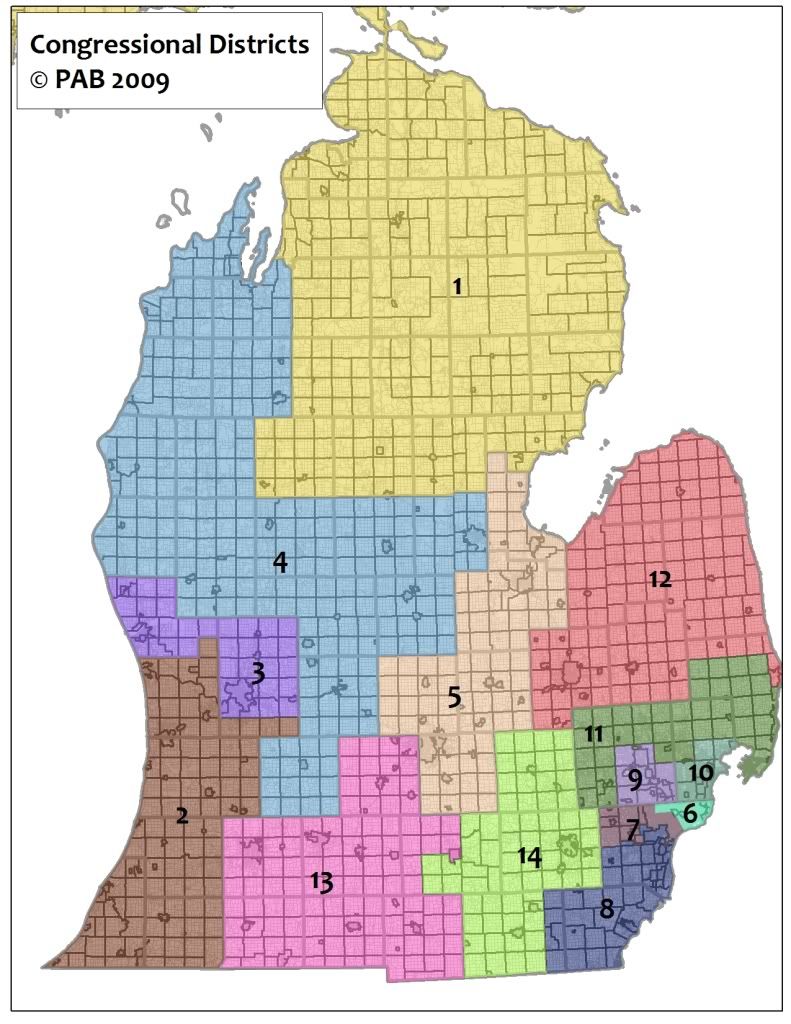
http://i303.photobucket.com/al…

The overall state map is shown above without the Upper Peninsula, which is part of the 1st Congressional District.  
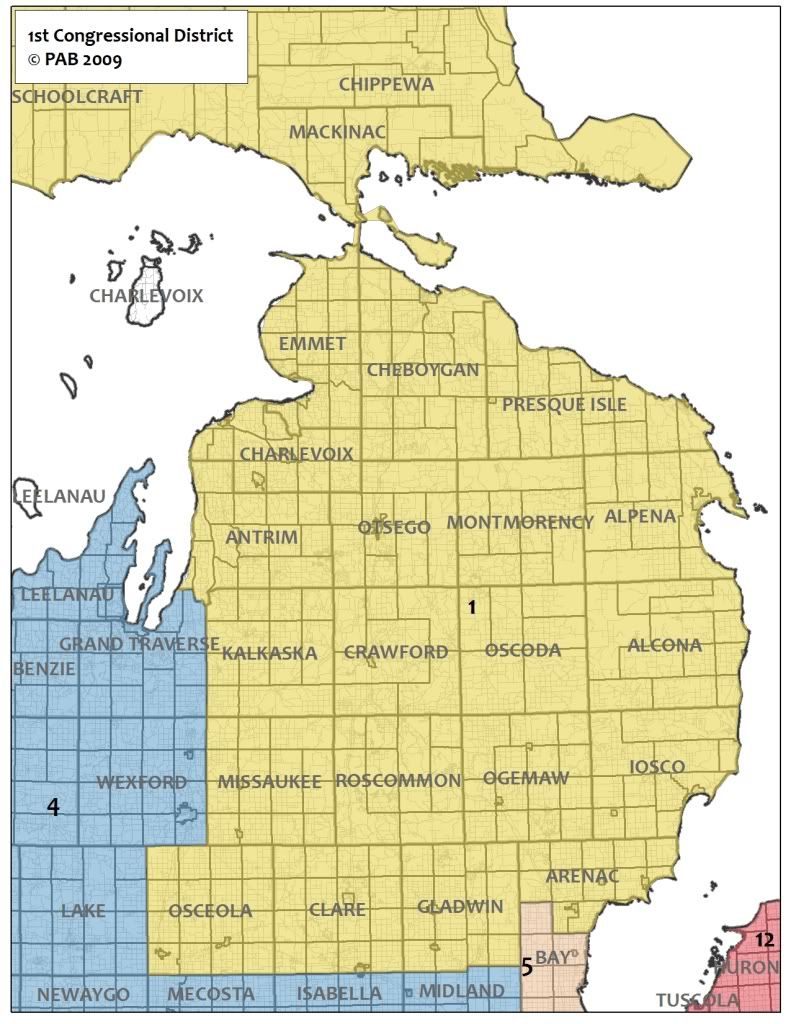
http://i303.photobucket.com/al…

1st Congressional District (2008 Democratic Baseline of 53%).  The First Congressional District is relatively similar to its 2001 incarnation, with a few moderate changes.  The district loses Bay County, and gains some smaller rural counties on the western edge of the district from David Camp’s district.  Stupak has always done very well in the 1st District, and ran 3% ahead of the Democratic Baseline in his current district.  He will likely continue to do well in the new district, although the Democratic Baseline dropped slightly below 50% in 2004 and 2002, two very Republican years.  Until Stupak retires, it will be hard for a Republican to win this district.
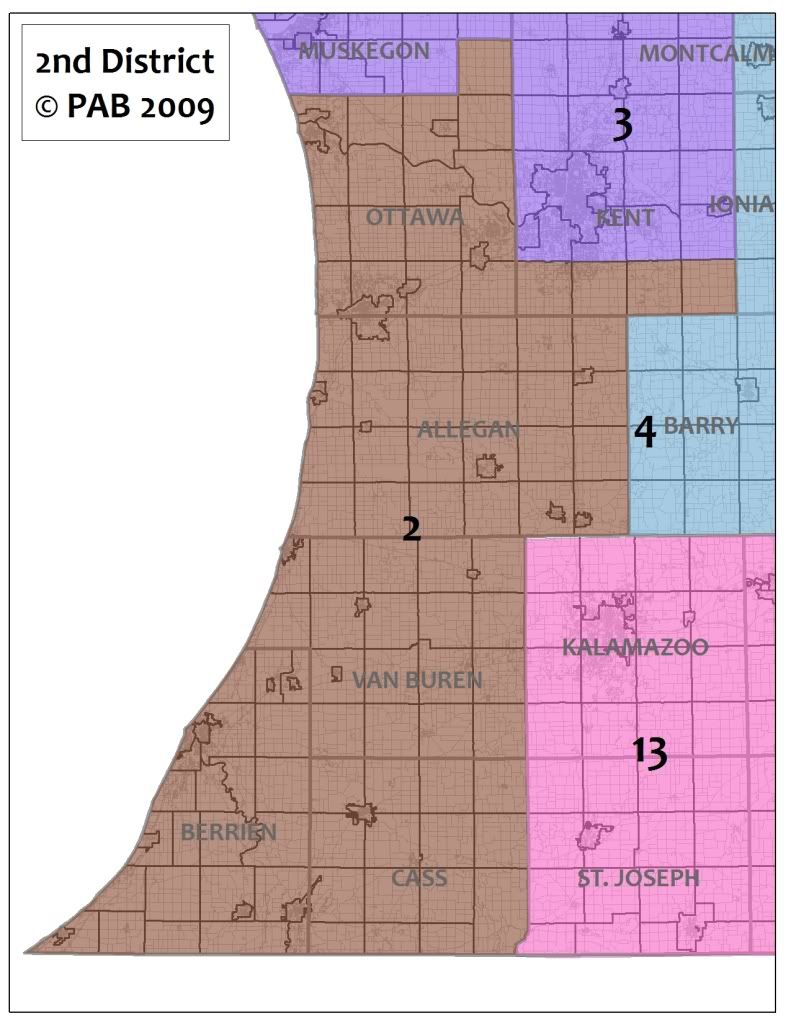
http://i303.photobucket.com/al…

2nd Congressional District (2008 Democratic Baseline of 40.2%).  This is one of the three safe Republicans seats in Michigan.  Essentially this new seat flips Republican Pete Hoekstra’s current 2nd District, running from GOP bastion Ottawa County south along the Lake Michigan shoreline.  The district would take a majority of the 6th District (represented by Republican Fred Upton), moving Cass, Berrien, Van Buren, and Allegan Counties to Ottawa County and the four southern townships in Kent County (Byron, Gains, Caledonia, and Bowne Townships).  The new 2nd District would likely force the current 2nd District Representative (whoever replaces Pete Hoekstra in 2010) into a nice runoff against Fred Upton, who lives in Berrien County (St. Joseph). I would suspect that Upton would be able to win a primary, and given that he is a relative moderate in the GOP caucus, it would be beneficial long-term for moderates in the GOP.  
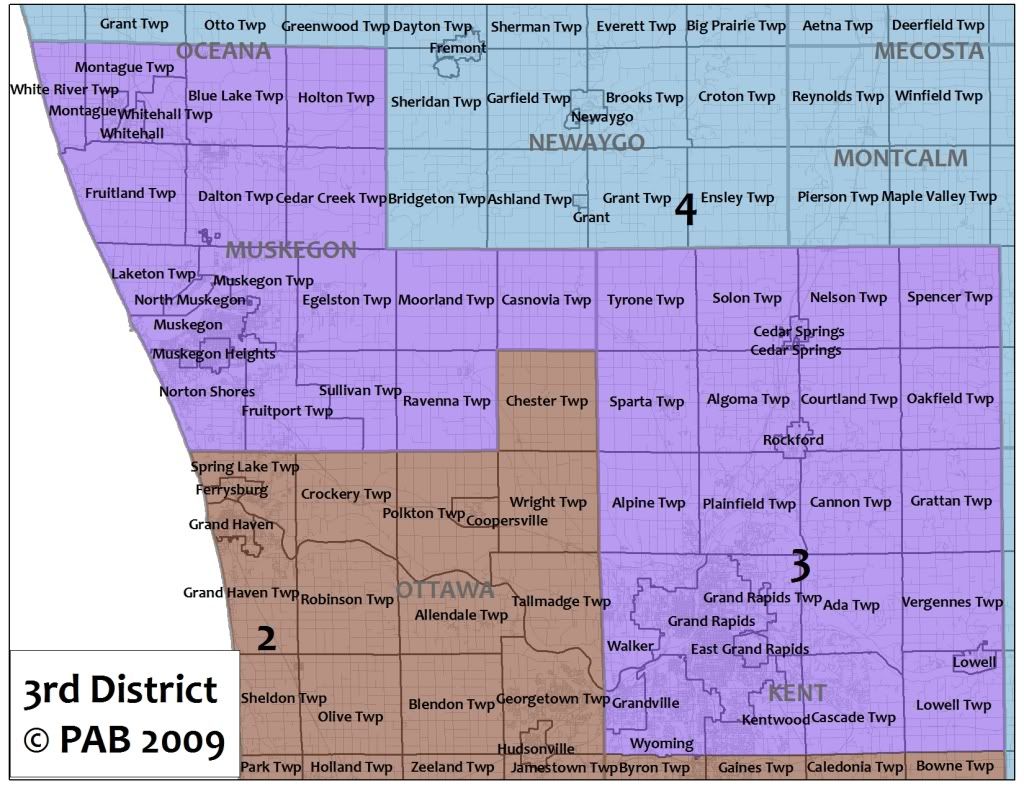
http://i303.photobucket.com/al…

3rd Congressional District (2008 Democratic Baseline of 52.7%).  This district is a likely swing seat since Muskegon and Kent Counties (minus the southern four townships) have trended Democratic over the past decade, and Obama carried 54.5% of the total vote in the two counties. An important case can be made for congressional districts that follow regions land use patterns, and this district certainly encompasses the heart and soul of western Michigan.  This proposed 3rd district allows for issues addressing the urban core (Grand Rapids and Muskegon), and provide two centers of Democratic voters that gave baselines of 64% and 72% respectively.  The district loses the largely rural counties of Ionia and Barry, allowing for strong economic development efforts for metropolitan Grand Rapids. On an off-Democratic year this seat may be difficult for the Democratic Party to hold, but it also provides an excellent excuse for further party building.  Some strong Democratic candidates would be former State Representative Steve Pestka or Scott Bowen. Should current Republican Representative Vern Ehlers retire, the GOP primary battle would be between Secretary of State Terri Lynn Land and State Senator Bill Hardiman. However, to run competitively in this district the GOP will need to find candidates that can speak on urban and metropolitan issues, something which the party of no has a difficult time even thinking about.  
http://i303.photobucket.com/al…

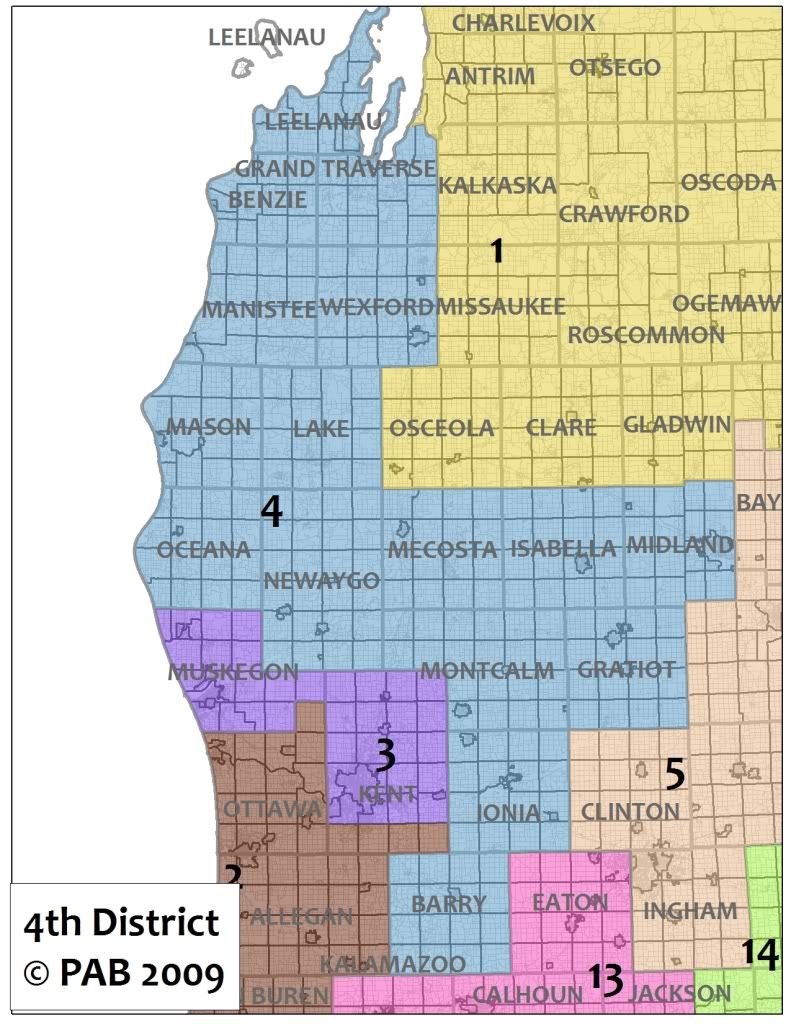
4th Congressional District (2008 Democratic Baseline of 47.5%)  While this district is slightly less Republican than the 2nd, it is the third most Republican district in the state.  Moving westward from the current 4th District, it collects the portions of the 2nd District north of Muskegon County, follows the current district boundaries to Midland County, and gains Ionia and Barry Counties.  Like the current 4th, the district mostly consists of rural areas, along with a few mid-side cities, including Midland, Big Rapids, and Traverse City.  This district will likely reelect Republican David Camp.
http://i303.photobucket.com/al…

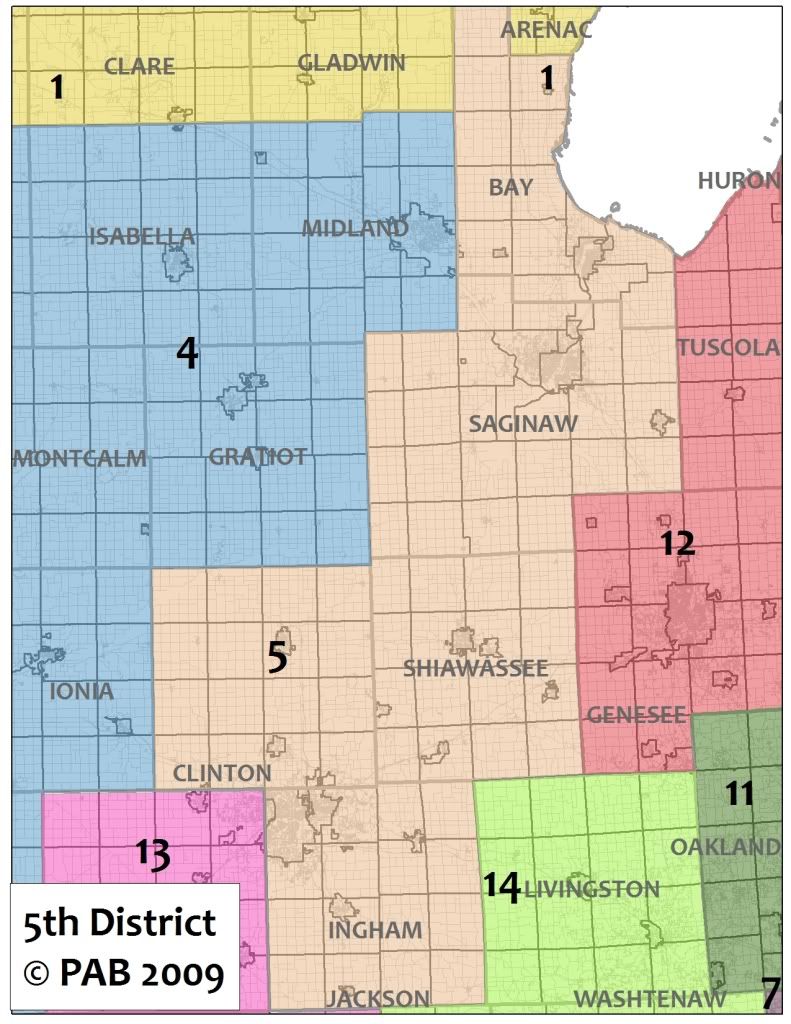
5th Congressional District (2008 Democratic Baseline of 60.8%).  This is among the most reconfigured districts from its 2001 incarnation.  While the current 5th  district covers Genesee, Tuscola, and portions of Bay and Saginaw Counties, the new 5th includes Bay, Saginaw, Clinton, Shiawassee, and Ingham Counties.  Much like the existing 5th District, it is a Democratic stronghold, but unlike the current 5th it steals the western half of Republican Mike Rodgers gerrymandered seat and restores its Democratic edge.  This district combines the urban centers of Lansing, Saginaw, Bay City, and will be easily held by a Democratic candidate like Lasing Mayor Virgil Bernero or former Democratic Representative Jim Barcia.  Good luck to any Republican running in this safe Democratic seat.  
http://i303.photobucket.com/al…

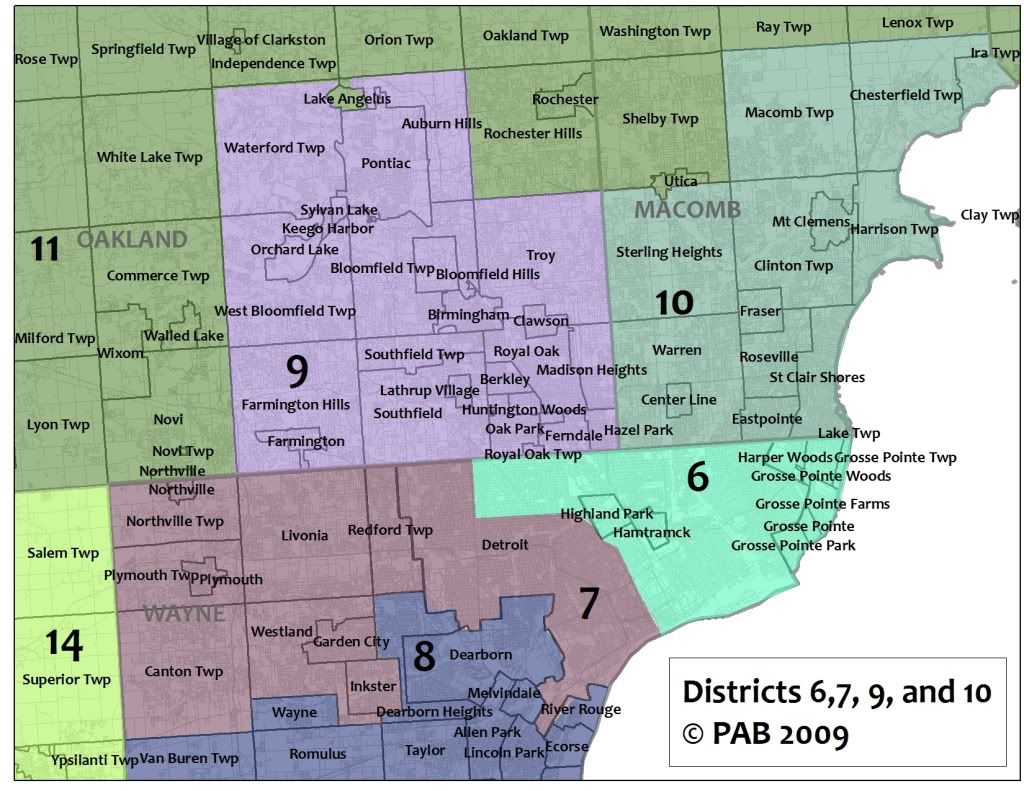
6th Congressional District (2008 Democratic Baseline of 90.3%).  Similar to the current 13th Congressional District, this district reflects the painful reality that Detroit continues to lose population.  According to the 2007 ACS, Detroit’s population is 916,000, and I suspect it might fall below 900,000 by 2010.  The 6th District contains the eastern Wayne County suburbs, Highland Park, Hamtramck, and two-thirds of the city of Detroit.  This seat is a safe Democratic stronghold, and complies with the Voting Rights Act by being a minority-majority district.  Let’s hope that State Senator Martha Scott once again primaries Carolyn Kirkpatrick.  

7th Congressional District (2008 Democratic Baseline of 72.5%).  The 7th District is a greatly modified version of the 14th District currently represented by Democratic Congressman John Conyers.  The new district includes the western third of Detroit, and the western Wayne County suburbs of Redford Township, Livonia, Canton Township, Westland, Garden City, Inkster, Northville City and Township, and Plymouth City and Township.  While this district is much less Democratic than the 6th District, it is still a strong Democratic seat that accomplishes the beautiful task of eliminating Republican Thad McCotter’s seat. McCotter could try to run against Conyers (or State Senator Buzz Thomas should Conyers retire), but he’d lose.  Too bad.
http://i303.photobucket.com/al…

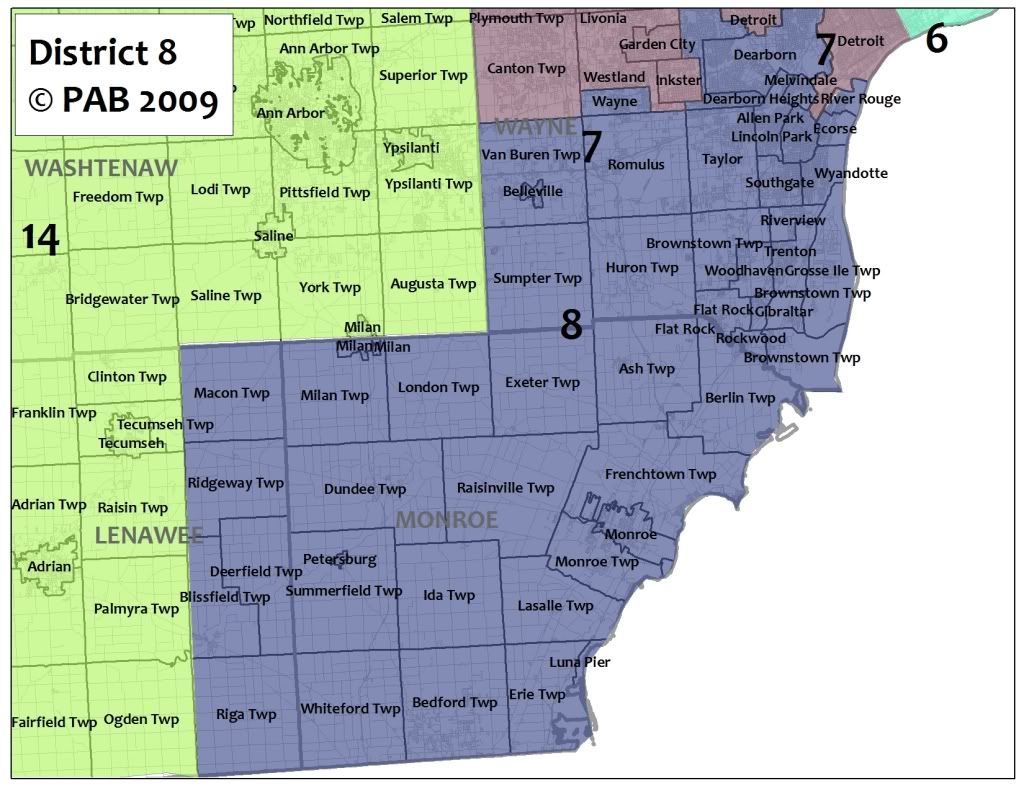
8th Congressional District (2008 Democratic Baseline of 65.3%).  Much like John Dingell’s 15th District, this seat is a strong suburban working-class district that covers southern Wayne County, Monroe County, and a portion of eastern Lenawee County.  While the new 8th Congressional District loses Ann Arbor and its surroundings, the new district remains a strong Democratic seat, anchored by Democratic communities in Dearborn, Monroe, and Romulus.  While it remains unlikely that Dingell will stay in US House much longer, I would not be surprised to see Debbie Dingell run for this seat when John retires.  It would be hard to see a Dingell lose this safe Democratic seat to a Republican.  

9th Congressional District (2008 Democratic Baseline of 63.6%).  The new 9th District is all about providing incumbency protection for Democratic Representative Gary Peters.  Peters currently represents much of Oakland County, and this redraw would add the southern portions of the county that are currently represented by Democratic Representative Sander Levin.  This district would shed the conservative northern suburbs of Rochester and Rochester Hills and would become increasingly Democratic.  Even in the Republican year of 2002, this safe Democratic seat still had a Democratic Baseline of 54.4%.  

10th Congressional District (2008 Democratic Baseline of 60.2%).  This district covers the southern portion of Macomb County.  Much like former Democratic Representative David Bonior’s old Macomb County seat, this district would be a working class Democratic stronghold, providing two districts (the 8th and the 10th) that would be platforms for labor voices to be heard from Michigan.  Sander Levin will have no problem holding this safe Democratic seat.
http://i303.photobucket.com/al…

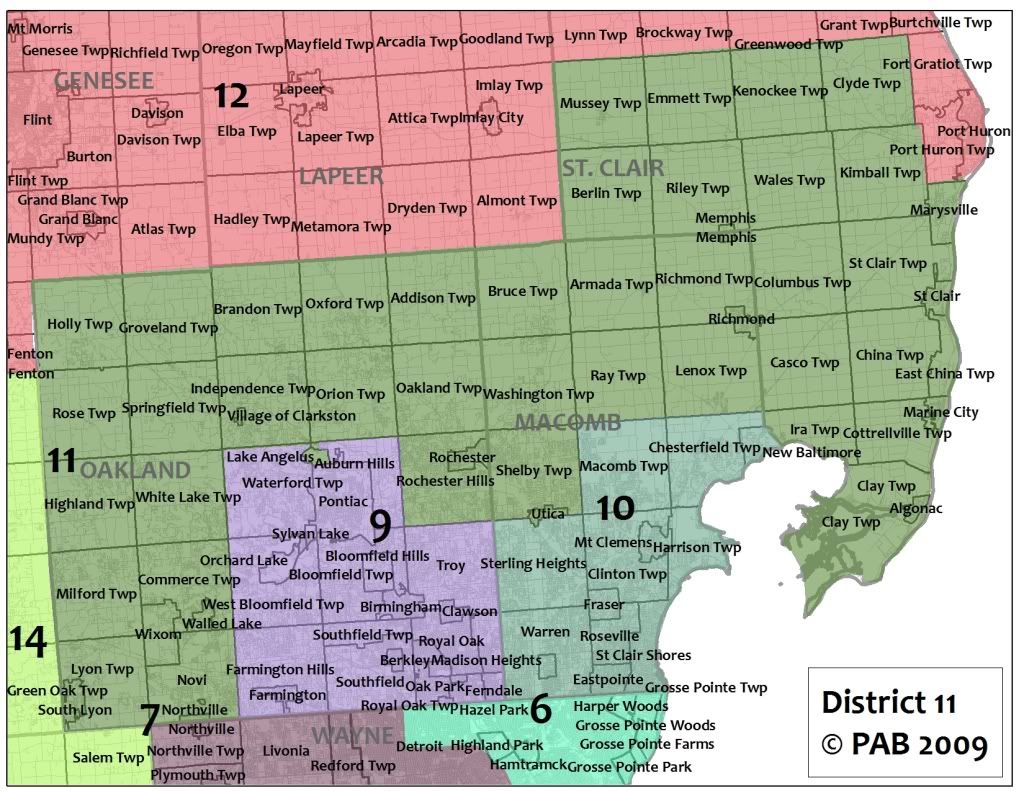
11th Congressional District (2008 Democratic Baseline of 46.0%).  This safe Republican seat would give Representative Candice Miller a vastly new district to represent, which is good for her.  Covering the northern and western portions of Oakland County, northern Macomb County, and much of St. Clair County, this district has some suburban communities along with a strong rural character.  This district is the third safe Republican seat in the state.
http://i303.photobucket.com/al…

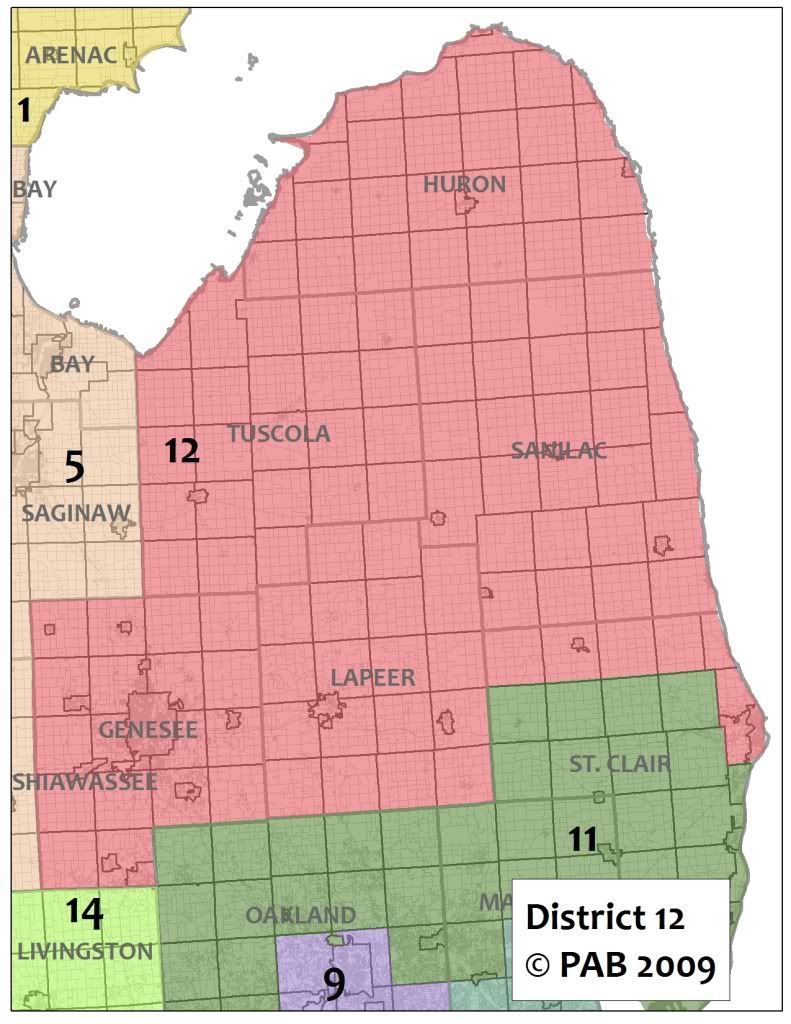
12th Congressional District (2008 Democratic Baseline of 61.7%).  This is a modified version of Dale Kildee’s current 5th Congressional District, and is centered in Genesee County.  Many people don’t know that the “thumb” of Michigan is a pretty swing district, and adding Huron, Tuscola, Lapeer, Sanilac Counties, and a portion of St. Clair County (largely metropolitan Port Huron) would not significantly dent the Democratic base around greater Flint.  This district has a a couple major urban centers, but is largely rural as well, which might call for some vigorous constituency work to ensure the Democrats holding this seat.  
http://i303.photobucket.com/al…

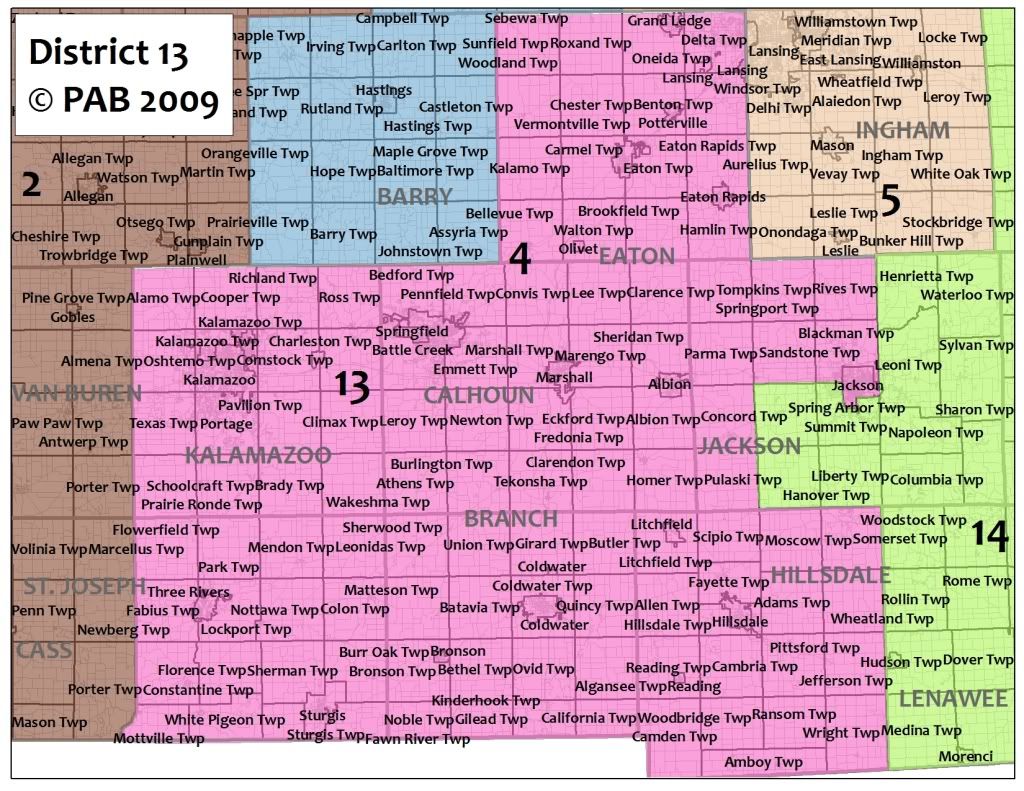
13th Congressional District (2008 Democratic Baseline of 54.3%).  Much like Gary Peter’s 9th District, Democratic Representative Mark Schauer won election to a traditionally Republican district.  Should Schauer win reelection in 2010, his district should shed some GOP votes and pick up some Democratic voters.  The new 13th District does just that, losing a portion of Jackson County and Washtenaw County that are largely Republican.  In return, the district adds Kalamazoo and St. Joseph Counties, the latter, along with Calhoun County, provides a strong Democratic base for the 7th District.  This district, while increasingly Democratic, was a swing seat from 2000 to 2006, giving it swing district status on an off year.  Given that Schauer has done a great job in the State Senate and in 2008 in running effective constituency service and electoral campaigns, a GOP would need a determined candidate to knock him off.  Someone more likable than Taxing Tim Walberg would be needed.
http://i303.photobucket.com/al…

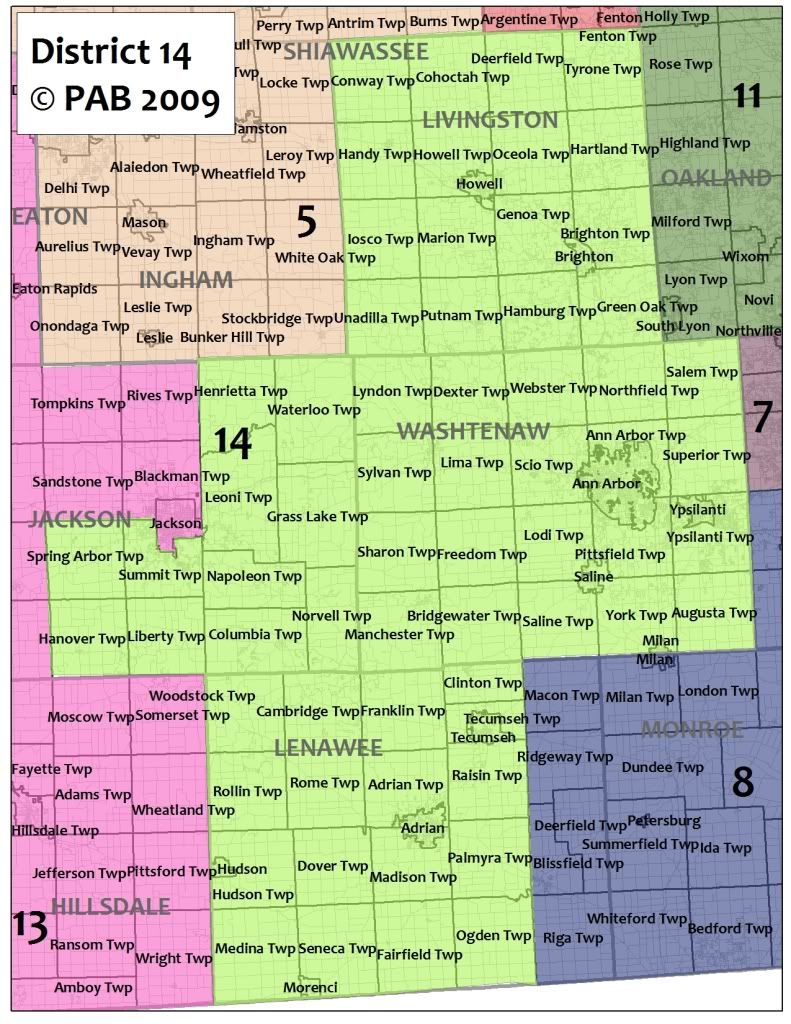
14th Congressional District (2008 Democratic Baseline of 57.6%).  This District covers Livingston and Washtenaw Counties, while also including portions of Lenawee and Jackson Counties.  Largely rural, the district’s heart is Ann Arbor, which provides the Democratic base for this seat.  A strong Democratic candidate from eastern Washtenaw County could win this district, although he or she would need to appear to the conservative Livingston County voters.  That said, this new district would invite Republican Representative Mike Rogers to run a losing campaign to hold his seat.  This isn’t Mr. Rogers neighborhood anymore.

Conclusion

This proposed 2011 redistrict makes Michigan’s congressional boundaries much more friendly for Democratic candidates.  There are seven safe Democratic seats (Districts 5, 6, 7, 8, 9, 10, and 12), one strongly Democratic District (District 14), and two leaning Democratic Districts (District 1 and 13), giving the MDP 10 Congressional Seats.  The Michigan Republicans would have three safe seats (Districts 2, 4, and 11), while the 3rd Congressional District is arguably a swing seat.  

This proposal also forces many GOP incumbents into retirement, which is something a good plan always does.  Forcing Upton to run against Hoekstra’s replacement in the new 2nd District, and placing Mike Rogers and Thad McCotter into unwinnable seats is something sure to give Democratic loyalists a smile on Election Day.  Should the Michigan Democrats win control of the Michigan State Senate in November 2010, 10 Democratic Congressional seats are a real possibility.  

The Vote on the Clean Energy Bill

Tonight’s vote on the American Clean Energy and Security Act was the closest so far on a final bill in the House this year. The legislation passed by just seven votes (219-212), with eight Republican “yeas” providing the margin. Forty-four Democrats voted no. The Republicans in favor were you usual handful of threatened “moderates,” with Chris Smith of New Jersey being the closest thing to an outlier:


District Representative PVI
NJ-04 Smith, Chris R+6
CA-45 Bono Mack R+3
NJ-07 Lance R+3
NY-23 McHugh R+1
WA-08 Reichert D+3
NJ-02 LoBiondo D+1
IL-10 Kirk D+6
DE-AL Castle D+7

Meanwhile, the Democrats opposed were almost entirely from conservative districts, with a few liberal purity votes and a classic Artur Davis defection thrown in:


District Representative PVI District Representative PVI
CA-13 Stark D+22 PA-17 Holden R+6
AL-07 Davis, Artur D+18 AZ-01 Kirkpatrick R+6
OH-10 Kucinich D+8 WV-03 Rahall R+6
IN-01 Visclosky D+8 TN-08 Tanner R+6
CA-20 Costa D+5 AR-04 Ross R+7
IL-12 Costello D+3 AR-01 Berry R+8
OR-04 DeFazio D+2 PA-10 Carney R+8
GA-12 Barrow D+1 IN-08 Ellsworth R+8
IL14 Foster R+1 SD-AL Herseth Sandlin R+9
NY-24 Arcuri R+2 WV-01 Mollohan R+9
IN-02 Donnelly R+2 GA-08 Marshall R+10
NC-08 Kissell R+2 ND-AL Pomeroy R+10
TX-27 Ortiz R+2 AL-05 Griffith R+12
OH-06 Wilson, Charlie R+2 LA-03 Melancon R+12
PA-03 Dahlkemper R+3 OK-02 Boren R+14
TX-23 Rodriguez R+4 MS-01 Childers R+14
NY-29 Massa R+5 TN-04 Davis, Lincoln R+14
NC-07 McIntyre R+5 UT-02 Matheson R+15
AZ-05 Mitchell R+5 AL-02 Bright R+16
VA-02 Nye R+5 ID-01 Minnick R+18
CO-03 Salazar R+5 TX-17 Edwards, Chet R+20
PA-04 Altmire R+6 MS-04 Taylor R+20

Among Dems in D+ seats that we don’t typically see on lists like this, Pete Stark called the bill “watered-down,” Visclosky said it would cost jobs in the Northern Indiana steel industry, Jim Costa’s objection is inscrutable, and Jerry Costello has nothing on his website, though a tradmed story paraphrased him as believing the legislation would “result in higher electric bills.”

Weekly Open Thread: What Races Are You Interested In?

Remember, if it’s not on SSP, it’s not worth reading.

PS: I’d like to take this opportunity to give a big shout-out to the third graders SSP user bombino for writing a new script that allows our new sortable tables to be sorted by the PVI column. Just check out our most recent House Open Seat Watch to see this radtacular new feature in action. (You may need to hit a hard refresh if the PVI sorting doesn’t seem to work.)