Chatter away!
We Need a Hardass
Rep. Debbie Wasserman Schultz (D?) has been busy kneecapping some of our best challengers this cycle. Amazingly, she is part of the DCCC leadership – she’s currently co-chair of the Red to Blue program, which is tasked with helping our most promising challengers. But this isn’t the first time we’ve seen something like this. From Naftali Bendavid’s The Thumpin’ (p. 78-79):
“I’ve got hundreds of examples of members screwing us. I’ve got members telling our challengers, ‘I won’t help you to challenge that X Republican.'” Emanuel continued, “I did say to one colleague once, ‘You have an interesting concept of the word team. But when they come after you, I’ll remind you of what you said to me. Because they will come after you.’ I can give you chapter and verse of people acting like knuckleheads.”
In one example, Congressman Adam Schiff of California, who served on the DCCC’s recruitment committee, declined to recruit a challenger to a California Republican congressman. Schiff explained that he was seen as a bipartisan type and wanted to keep it that way. “I thought Rahm was going to strangle him,” said the staffer who recounted the story. “I’m sure you’ve seen that look before.” (Emphasis added.)
It’s pretty stunning to me that anyone who would take on a leadership role in the DCCC would be so willing to undermine the cause. Yet where we had Adam Schiff dragging his feet last cycle, we now have Debbie Wasserman Schultz doing the same – if not worse – this time out.
This job is not for the faint of heart. Rahm Emanuel knew that. As Larry Sabato said of Rahm, “You need someone whose favorite word is not a or the but fuck.” In other words, we needed a hardass – and we got one, and we won. Rahm did not tolerate sandbagging, whether from Adam Schiff or Alcee Hastings or anyone else.
And we need Chris Van Hollen, the current DCCC chair, to have the same zero-tolerance policy. We know that he has a very different approach from Rahm, but being a hardass isn’t about cursing, or withering glares, or high-decibel rants. It’s about not accepting bullshit from people who want to call themselves your fellow Democrats, whether backbenchers or leaders.
By whatever methods he chooses, Van Hollen needs to make Debbie Wasserman Schultz fall in line. If we want to expand our majorities this fall, we can’t have party leaders holding us back. Health insurance, stem cell research, global warming, the war in Iraq – these are all issues which Democrats are champing at the bit to address. Surely Chris Van Hollen can’t let Debbie Dubya’s personal friendships with the likes of Ileana Ros-Lehtinen stand in the way.
AL-05: Democrat Cramer to Retire
Congressman Bud Cramer (D-AL) announced this evening that he won't be seeking another term:
This was a difficult decision, but after 28 years of public service it is time for me to step aside, spend more time with my family and begin another chapter in my life,” he said. “I believe that this is a good time for me to step aside and transition to new leadership.
Cramer's seat is probably a Democratic hold, with likely candidates on our side including Public Service Commissioner Susan Parker and State Senator Parker Griffith (D-Huntsville). On the Republican side, the bench is rather weak and the only name that comes to mind is State Senator Arthur Orr (R-Decatur). Within the district, Orr is the only Republican state senator and there are but a handful of Republicans who hold state house seats. So while the seat has a PVI of R+6.5, this district is solidly Democratic on the state and local level.
KY-01: Ryan vs. Whitfield On Two Essential Issues
In Kentucky’s First Congressional District we managed to field a great Democratic woman who believes in fighting for the working american, for equal opportunity for everyone, and for the American dream. She believes that every American who works hard should be rewarded with fair wages and benefits. Now, in the coming campaign I am sure Ed Whitfield will run as a “moderate”, who cares about everyone. This record doesn’t bear itself out, and there are monumental differences between the priorities of Exxon Ed Whitfield and Heather Ryan, who wants to work for the betterment of ALL the people of our district.
One has only to look at the rankings put forth by the Shriver Center to see glaring differences in the committments of these two candidates toward supporting the working, average Kentuckian and American and towards supporting the goal we should all have of creating One America for all. Take the Employee Free Choice Act. This legislation would have empowered millions of Americans to fight against rampant corporate greed and have the power to negotiate for fair wages and benefits. Organized labor is the most effective deterent to poverty. Don’t just take my word for it, look at this overview of H.R. 800:
– Requires the National Labor Relations Board to review petitions filed by employees for the purpose of creating a labor organization for collective bargaining, and to determine whether or not a majority of employees have signed the petition (Sec 2 (a) (6))
–
Requires the National Labor Relations Board to not hold an election, but to certify the bargaining representative if a majority of employees have signed the petition (Sec 2 (a) (6))
–
Requires the parties to begin bargaining within 10 days of the receipt of the petition, or within a longer time frame acknowledged by both parties (Sec 3 (h) (1))
–
States that if the parties are unable to agree in the bargaining after 90 days, either party may contact the Federal Mediation and Conciliation Service, which will mediate and attempt to facilitate an agreement (Sec 3 (h) (2))
–
States that if an agreement has not been reached within 30 days of the request for mediation, the Federal Mediation and Conciliation Service may refer the matter to an arbitration board which in turn will render a decision binding to both parties for two years, unless both parties agree to amend the terms within that two years (Sec 3 (h) (3))
–
Provides civil penalties for employers who engage labor practices in violation of the National Labor Relations Act to affect the formation of a union, including back pay and liquidated damages for employees, and a penalty to be determined by the National Labor Relations Board not to exceed $20,000 per infraction (Sec 4 (b) (1)) (Sec 4 (b) (2))
http://www.govtrack.us/congres…
Of course, because of his close ties with the Chamber of Commerce, and his membership in the McConnell Machine of corrupt Kentucky Republicans, Ed Whitfield voted against this valuable legislation to give the citizens of his district a chance at a better future, while his own numerous stock holdings are making him even richer.
Well, Heather Ryan believes in the working Kentuckian and wants to give them more opportunities for a better future for themselves and their children, she supports the aims of organized labor, including the Employee Free Choice Act. Her is her recent email answer to my question about what can be done to strengthen the labor movement once more:
Our country has seen an all out assault on Organized Labor in the last several decades. We believe Organized Labor is essential in achieving fair wages and benefits for workers. We believe we need to rebuild our Union movement by passing the Employee Free Choice Act and give workers real choices in forming a union. We believe penalties for breaking labor laws should be tougher, and enforced faster. We also support banning the permanent replacement of striking workers. We should also defend and restore a workers right to overtime. We also need to end the practice of mislabeling workers as an independent contractorsÂ? to avoid paying benefits and taxes. We should expand minimum wage protections to tipped workers and home healthcare workers. We should give public employees every opportunity to compete with private contractors and evaluate a companies record on tax, labor and environmental standards before awarding them any federal or state contracts. Finally, we should recognize that any work that involves essential government functions should not be privatized.
Now, we all know how we are always hearing how Republicans will lower your taxes and Democrats will raise them. We have all fallen prey at one time or another to the term, “tax and spend” liberal. Well, from what I have seen, Exxon Eddie is the one who believes in raising taxes, as long as it isn’t on himself, or his fellow millinaires. Why else would he vote against HR 3996? Just look at what this bill attempted to accomplish:
This bill amending the Tax Code includes a provision that greatly benefits low-income families by expanding the Child Tax Credit
(CTC).1 The CTC is a par tially refundable tax credit aimed at
offsetting some of the expenses of raising a child.2 Under current law, families must have earnings above $12,050 to qualify for the refundable CTC; this bill lowers the threshold to $8,500.
3 This change in the CTC would benefit the families of thir teen million
low-income children, including three million whose families would
become newly eligible for the CTC and ten million whose families
would see their credit increase.4 The House vote was on passage.The Senate cloture vote was the
decisive vote on whether the Senate would approve an expansion
of the CTC.
So Exxon Eddie rails against raising taxes. Unless of course it is on the backs of working Americans, not his fellow Exxon and Chevron stockholders.
Contrast that with the position Heather Ryan has taken on taxes, also recieved by me via email:
We need to rewrite our tax code. Our tax code should be more simple and fair. We need to ensure that the tax code rewards American workers and not just the wealthy. To do this we should triple the Earned Income Tax Credit (EITC) for single adults and cut the marriage penalty. We should also at least double the Child and Dependent Care Credit making it up to $2500 per child. Also, we need to restore a fair investment income tax rate so that the wealthy don’t pay less taxes on investments than workers pay on income. Additionally, we need to repeal the Bush tax credits for the rich which gives tax breaks to those who make over $200,000 a year. Finally, we need to close loopholes that allow the wealthy to pay just 15% of taxes on their huge incomes while American working families often pay twice as much.
It is pretty easy to see who has the interests of the majority of Kentuckians and indeed Americans at heart. Heather Ryan actually fights for tax policies that loosen the tax burdens on millions of working Americans, while Ed Whitfield stubbornly clings to the failed “trickle-down” policies that failed once, and are now failing again as our economy crashes.
We need to win this seat not only for the people of Kentucky, but for Americans everywhere who are seeing the policies of our government, which are set up to benefit the very wealthy and multi-national corporations destroy their lives and the futures of their children.
Heather Ryan will be a constant voice for One America and will fight with tenacity for a Democratic vision for our country that means hard work translates to success. She believes in unions and the work that they do, and she would fight to restore a fair tax system where work, not only wealth is rewarded.
We need your help in this race. Our national party seldom supports the great Democrats here in Kentucky and we expect nothing different this time. We have 62% registered Democrats in this district and getting our message out to them means victory. Please help expand our Congressional majorities and bring another Democratic vote to Kentucky’s delegation.
I have started “Americans for Ryan” to raise $1500 by May 20. I am already just under one-third of the way there. Please help us fight for our state, and elect a “Fighting Democrat” to the Congress who will not forget what she was elected to fight for here:
http://www.actblue.com/page/am…
Visit her site and sign up for email updates:
http://www.ryanforkentucky.com/
Also, don’t miss this awesome diary and interview with Heather here:
http://www.dailykos.com/story/…
Please help us in our quest to take back this seat with a Democrat, and to make history in electing the first woman to this seat!!
Cost of Tom Cole’s Haircut: $740,000
For Tom Cole and his hapless colleagues at the NRCC, it’s enough to make you cry:
The National Republican Congressional Committee overstated by $740,000 its cash on hand as of Jan. 31 due to fraud allegedly committed by a former employee, an NRCC document obtained by Roll Call reveals.
An ongoing investigation into accounting irregularities at the NRCC has determined that ex-committee Treasurer Christopher J. Ward allegedly funnelled “several hundred thousand dollars” from the NRCC into his own bank accounts since at least 2004. The probe has also found that Ward submitted to the NRCC’s bank and to House GOP leadership “bogus” audit reports for years 2002-2005, with an additional “bogus” audit report provided to the NRCC’s bank for 2006. […]
The NRCC originally reported $6.4 million on hand as of Jan. 31. That figure should have been about $5.7 million.
This isn’t exactly the kind of news that the cash-starved NRCC wants to hear these days.
A Lesson for Meek and Wasserman Schultz: Perceived “Moderation” Doesn’t Work
I address this screed to Congressman Kendrick Meek and Congresswoman Deborah Wasserman Schultz. I know that both of you have been under much scrutiny here in the blogosphere, based upon your recent recusals from campaigning against your neighboring Republican congresspersons. I suspect that you probably have your eyes on a senate race at some point in the future. In preparation for that, you probably think that you're positioning yourselves to be perceived as moderates who can work well across the aisle. However, I'm here to show you that if you consider such positioning to be part of a winning strategy, you are terribly mistaken.
One need not look further than the results of 2006 to learn that authenticity works. During that crucial election season, the Democratic party was faced with the outrageously tall order of winning at least six senate seats. As is the usual tendency of the deck, it was once again stacked against us. Our GOP opponents appeared to have financial advantages. At the outset of the year, we didn't even have six, let alone seven, viable seats, and severe party infighting threatened at least one critical race (Ohio). From that mess, the DSCC scrounged up seven viable challengers in Rhode Island, Pennsylvania, Ohio, Virginia, Tennessee, Missouri, and Montana. Of these seven, six won. I will not focus on the Rhode Island race, since it was an unusual scenario in a state whose dynamics do not mirror those of swing states or of the nation at large. I'll also leave out Pennsylvania, since that was an instance of an incumbent who was so off his rocker, a piece of cardboard could've defeated him. And the Virginia race has been written about ad nauseum, so I'll skip that one as well. I will instead focus on Ohio, Missouri, Montana, and Tennessee; three wins and a loss, and why it turned out that way.
When Sherrod Brown prevailed over Paul Hackett in the primary for the Ohio senate, many Democrats became nervous; Hackett, an Iraq War veteran, seemed like a more viable option to run against incumbent Republican Mike DeWine than the unabashedly liberal Cleveland congressman whose record on the hot-button social issues was completely progressive. In the fabled state that won the election for Bush in 2004, it seemed like a bad idea to run a candidate whose record was to the left of John Kerry's. Well, as it turned out, Sherrod Brown proved to be an excellent candidate. Instead of fudging his answers and trying to make himself look like something he wasn't, he proudly stood up for his principles, emphasizing his economically progressive ideals, but without attempting to conceal his stances on the social issues. His unapologetic championing of the disadvantaged called to mind another progressive who never backed down from his core beliefs: the late, great Paul Wellstone.
Over in Missouri, then-State Auditor Claire McCaskill waged a tough fight against Jim Talent, the incumbent GOP senator. The stem cell initiative was on the ballot in that state, a potential risk in a state with such a high number of evangelicals. It was, therefore, a pleasant surprise when McCaskill put Talent on the defensive on that issue, and on the issue of abortion, in nearly every debate. In a key appearance on Meet The Press, Talent lobbed Republican talking points at McCaskill, and, rather than attempting to fit her responses into those frames, she effectively twisted them around to leave Talent as the weaker candidate, hemming and hawing and making excuses for his every statement. McCaskill's margin of victory was small, but in a very conservative state like Missouri, it was enough!
Out on the ranges, where libertarianism runs strong, the Montana senate race saw a battle between two very colorful characters: the doddering embarrassment Republican Conrad Burns, who was often looked upon as something of a senile uncle even by his fellow GOPers, and the plain-spoken, buzz-cut-sporting Jon Tester, who won the senate primary over a less progressive state official. Burns trotted out the old canard of fearmongering, trying to to use Tester's opposition to the PATRIOT Act as a political bludgeon. Had Tester been a weaker candidate, he would have attempted a nuanced explanantion, trying to convince people that he could be patriot without supporting the PATRIOT Act, accepting the right wing's frames instead of creating his own. Luckily, Tester unleashed the no-nonsense directness that is a trademark of the Mountain West; in one key debate, in which Burns accused Tester of wanting to “weaken” the PATRIOT Act (clearly a standard GOP frame, portraying the Democrats as weak on terror and weak in general,) Tester famously responded, “I don't want to weaken the PATRIOT Act, I want to repeal it.” Had John Kerry been anywhere near this bold in 2004, Bush would not have had a second term.
After looking at the victories of Brown, McCaskill, and Tester, I now turn to the only high-profile loser on our side, Harold Ford Jr. of Tennessee. Yes, I am well aware of the racist tactics that the Republicans used against Ford in the infamous “Call Me” ad (a frame-by-frame analysis is available here,) but I remain convinced that a stronger candidate, one with more backbone and more confidence in his own platform, would have been able to fight back and prevail. Ford embodied the ideals of a DINO at best. He appeared in a clumsy ad in a church, going too far into the territory of unsubtlety in an attempt to prove his religiosity. (I had serious flashbacks to John Kerry's 2004 proclamation of himself to be the “candidate of conservative values.” The minute we accept the GOP frames, we're dead in the water). On the campaign trail in '06, Ford frequently trumpeted his opposition to gay marriage. He spoke in tones that ranged from cautious to mildly complimentary toward Bush's Iraq policies, all the while distancing himself from the Democratic leadership in the senate. In short, he ran as a Republican. And why would anyone vote for a Republican who doesn't have the conviction to actually run within the party that actually represents the conservative values he preaches, when they could vote for an actual Republican whose voting patterns are more sure-footed?
You see where I'm going with this. 2006 was a Democratic tidal wave, yet Harold Ford lost because of his own spinelessness and willingness to act like a Republican. The moral of the story here is to stick to your guns, champion your own progressive record, and be who you are. It's obvious that if you have achieved anything in Congress, you have been able to work with the other side. Playing “footsie” with Republicans does nothing to further your goals; in fact, it undermines them, since progressive voters might doubt your convictions. I certainly hope that your aides and advisors read this post, as it is crucial that you absorb its message. (For all the readers of this blog, I suggest writing to these Florida congresspersons and calling their offices to relay a similar message). Please, be a Sherrod Brown or a Jon Tester. Don't be a Harold Ford. Your political futures will be brighter for it, if recent history is any indicator!
Enough Good Things
“I can’t say enough good things about Ileana Ros-Lehtinen.”
I wonder, exactly, what sort of good things Debbie Wasserman Schultz can’t say enough of about her BFF, Republican Ileana Ros-Lehtinen.
Perhaps it was Ileana’s vote to repeal the estate tax? Hmm, Debbie voted no on that one.
Ileana’s vote to approve weak fuel efficiency standards for cars? Nope, Debbie voted in favor of stricter rules.
How about drilling in the Arctic Wildlife Refuge? Debbie certainly doesn’t support that – but Ileana does.
I know that Debbie voted against making the PATRIOT Act permanent. I just checked, though, and Ileana voted in favor of it.
Now, what about CAFTA? Maybe Debbie approves of Ileana’s support for the bill? Naw, Debbie gave a thumbs-down there.
Alright, alright, let’s see. The House had a big vote on the McGovern bill last year, authorizing withdrawal of our troops from Iraq. Debbie was in favor… Ileana, not so much.
Maybe the Military Commissions Act – you know, the bill which eviscerated habeas corpus rights? Debbie said ixnay. Ileana? All for it.
I’ve got it. Warantless wiretapping – that’s the ticket. Debbie sensibly said “no” when this bill came up in the House last summer. Ileana… oops, she voted for it.
Okay, this is an easy one. What reasonable person opposes stem cell research? Not Debbie, of course. And surely not Ileana, right? Sorry to disappoint – she thinks that blastocysts = human lives.
Man, I’m almost out of ideas, but I still have one more. Debbie obviously voted in favor of SCHIP – only the worst crumb-bums could possibly be so heartless as to deny healthcare to kids. But damn, wouldn’t you know it – Ileana is indeed exactly that sort of crumb-bum.
On the major issues of the day, these women are far, far apart. Debbie, to her credit, strikes a strong progressive stance. Yet Ileana, despite her allegedly “moderate” image, stands with the worst of the GOP in supporting endless war in Iraq, and continued environmental degradation while opposing stem-cell research and healthcare for kids.
It seems to me that saying even one good thing about Ileana Ros-Lehtinen would be more than enough, yet Debbie Wasserman Schultz just can’t get her fill. It’s clear to any rational outside observer that Ros-Lehtinen stands in the way of progressive change, and that Annette Taddeo’s candidacy is our best shot at removing that roadblock we’ve had in a long time. Why can’t Debbie Dubya see that?
More US House races filled as we steam towards 400!
Candidate filing is sailing along with lots of states now having completed candidate filings. And other than an unfortunate performance by the Texas Democratic Party we are humming along.
Below the fold for details and once again go and take a look at the 2008 Race Tracker Wiki.
***I have included Cook PVI numbers where possible after blogger requests to do so!***
Lots of House races now have Democratic candidates that have bobbed up in the last week or so:
AL-02 – R+13,
CA-02 – R+13,
CO-05 – R+15.7,
IL-18 – R+5.5,
MO-08 – R+11,
NE-03 – R+23.6,
OR-02 – R+11,
UT-01 – R+26,
But one race goes to the uncontested in 2008 list:
AR-03 – R+11,
And one race comes off the list entirely!:
IL-14 – R+5 following Bill Foster’s superb special election victory last Saturday.
So 398 races filled! This of course includes 234 districts held by Democratic Congresscritters.
But we also have 164 GOP held districts with confirmed Democratic opponents.
So here is where we are at (GOP Districts):
Districts with confirmed candidates – 164
Districts with unconfirmed candidates – 1
Districts with rumoured candidates – 13
Districts without any candidates – 15
Filing closed – No Democratic candidate – 8
The GOP held districts with confirmed Democratic challengers are as follows:
AL-01 – R+12,
AL-02 – R+13,
AL-03 – R+4,
AL-04 – R+16,
AK-AL – R+14,
AZ-01 – R+2,
AZ-02 – R+9,
AZ-03 – R+6,
AZ-06 – R+12,
CA-02 – R+13,
CA-03 – R+7,
CA-04 – R+11,
CA-19 – R+10,
CA-21 – R+13,
CA-24 – R+5,
CA-25 – R+7,
CA-26 – R+4,
CA-40 – R+8,
CA-41 – R+9,
CA-42 – R+10,
CA-44 – R+6,
CA-45 – R+3,
CA-46 – R+6,
CA-48 – R+8,
CA-49 – R+10,
CA-50 – R+5,
CA-52 – R+9,
CO-04 – R+9,
CO-05 – R+15.7,
CO-06 – R+10,
CT-04 – D+5,
DE-AL – D+7,
FL-01 – R+19,
FL-04 – R+16,
FL-05 – R+5,
FL-07 – R+3,
FL-08 – R+3,
FL-09 – R+4,
FL-10 – D+1,
FL-12 – R+5,
FL-13 – R+4,
FL-14 – R+10,
FL-15 – R+4,
FL-18 – R+4,
FL-21 – R+6,
FL-24 – R+3,
FL-25 – R+4,
GA-01 – R+?,
GA-09 – R+?,
GA-10 – R+?,
ID-01 – R+19,
IL-06 – R+2.9,
IL-10 – D+4,
IL-11 – R+1.1,
IL-13 – R+5,
IL-15 – R+6,
IL-16 – R+4,
IL-18 – R+5.5,
IL-19 – R+8,
IN-03 – R+16,
IN-04 – R+17,
IN-05 – R+20,
IN-06 – R+11,
IA-04 – D+0,
IA-05 – R+8,
KS-01 – R+20,
KS-04 – R+12,
KY-01 – R+10,
KY-02 – R+12.9,
KY-04 – R+11.7,
LA-01 – R+18,
LA-04 – R+7,
LA-06 – R+7,
MD-01 – R+10,
MD-06 – R+13,
MI-02 – R+9,
MI-04 – R+3,
MI-07 – R+2,
MI-09 – R+0,
MI-11 – R+1.2,
MN-02 – R+2.7,
MN-03 – R+0.5,
MN-06 – R+5,
MO-02 – R+9,
MO-06 – R+5,
MO-07 – R+14,
MO-08 – R+11,
MO-09 – R+7,
MS-01 – R+10,
MS-03 – R+14,
MT-AL – R+11,
NE-01 – R+11,
NE-02 – R+9,
NE-03 – R+23.6,
NV-02 – R+8.2,
NV-03 – D+1,
NJ-03 – D+3.3,
NJ-04 – R+0.9,
NJ-05 – R+4,
NJ-07 – R+1,
NJ-11 – R+6,
NM-01 – D+2,
NM-02 – R+6,
NY-13 – D+1,
NY-23 – R+0.2,
NY-25 – D+3,
NY-26 – R+3,
NY-29 – R+5,
NC-03 – R+15,
NC-05 – R+15,
NC-06 – R+17,
NC-08 – R+3,
NC-09 – R+12,
NC-10 – R+15,
OH-01 – R+1,
OH-02 – R+13,
OH-03 – R+3,
OH-04 – R+14,
OH-05 – R+10,
OH-07 – R+6,
OH-08 – R+12,
OH-12 – R+0.7,
OH-14 – R+2,
OH-15 – R+1,
OH-16 – R+4,
OK-05 – R+12,
OR-02 – R+11,
PA-03 – R+2,
PA-05 – R+10,
PA-06 – D+2.2,
PA-09 – R+15,
PA-15 – D+2,
PA-16 – R+11,
PA-18 – R+2,
PA-19 – R+12,
SC-01 – R+10,
SC-02 – R+9,
TX-03 – R+17,
TX-04 – R+17,
TX-06 – R+15,
TX-07 – R+16,
TX-08 – R+20,
TX-10 – R+13,
TX-12 – R+14,
TX-13 – R+18,
TX-19 – R+25,
TX-24 – R+15,
TX-26 – R+12,
TX-31 – R+15,
TX-32 – R+11,
UT-01 – R+26,
VA-02 – R+5.9,
VA-04 – R+5,
VA-05 – R+6,
VA-06 – R+11,
VA-07 – R+11,
VA-10 – R+5,
VA-11 – R+1,
WA-04 – R+13,
WA-08 – D+2,
WV-02 – R+5,
WI-01 – R+2,
WI-06 – R+5,
WY-AL – R+19,
The following GOP held districts have a candidate that is expected to run but is yet to confirm:
WA-05 – R+7.1,
The following GOP held districts have rumoured candidates – please note that some of these “rumours” are extremely tenuous!
FL-06 – R+8,
GA-03 – R+?,
GA-06 – R+?,
GA-07 – R+?,
GA-11 – R+?,
NJ-02 – D+4.0,
NY-03 – D+2.1,
OK-03 – R+18,
OK-04 – R+13,
SC-04 – R+15,
TN-07 – R+12,
UT-03 – R+22,
VA-01 – R+9,
The following districts have not a single rumoured candidate:
AL-06 – R+25,
CA-22 – R+16,
ID-02 – R+19,
LA-05 – R+10,
LA-07 – R+7,
MI-03 – R+9,
MI-06 – R+2.3,
MI-08 – R+1.9,
MI-10 – R+4,
OK-01 – R+13,
SC-03 – R+14,
TN-01 – R+14,
TN-02 – R+11,
TN-03 – R+8,
WI-05 – R+12,
And last but not least the list I did not want to have to include.
The following Republicans will not have a Democratic opponent in 2008:
AR-03 – R+11,
KY-05 – R+8
TX-01 – R+17,
TX-02 – R+12,
TX-05 – R+16,
TX-11 – R+25,
TX-14 – R+14,
TX-21 – R+13,
Finally due praise to those states where we already have a full slate of house candidates – Alaska, Arizona, Colorado, Connecticut, Delaware, Hawaii, Illinois, Indiana, Iowa, Kansas, Maine, Massachusetts, Maryland, Minnesota, Mississippi, Missouri, Montana, Nebraska, Nevada, New Hampshire, New Mexico, North Carolina, North Dakota, Ohio, Oregon, Pennsylvania, Rhode Island, South Dakota, Vermont, West Virginia and Wyoming.
It is also interesting to note that we have only one race left to fill in Alabama, Arkansas, California, Florida, Idaho, Kentucky, New Jersey, New York, Utah, Virginia, Washington and Wisconsin. Thats 31 states with a full slate, and 12 states with one race to fill! That is more than 85% of the states with a full or nearly full slate of candidates 7.5 months before election day, an impressive feat indeed!
Please note that in some races others at the racetracker site have confirmed candidates that I haven’t. This is because to satisfy me a confirmed candidate has either filed with the FEC, The Sec of State or has an active campaign website, or even if they come and blog and say yep I am running. Others are not so rigorous.
It is also great to see candidates in AZ-06, CA-42, FL-12, LA-06, MS-03, VA-04, VA-06 and WI-06; 8 of 10 districts we did not contest in 2006! Of the other 2 TX-11 will again go uncontested whilst AL-06 does not currently have a Democratic candidate.
We were on track to beat the 425 races we contested in 2006 but with the Texas unfilled races it now seems unlikely.
*** Tips, rumours and what not in the comments please.***
The Connecticut for Leiberman Party has new blood!
John Mertens has agreed to become the new chair of the Connecticut for Lieberman Party.
John Mertens shown here accepting the Chairpersonship from John Orman.

The Connecticut for Lieberman Party has asked for the Senator’s resignation,
which brought us to the attention of Wall Street Journal, who mentioned us under the byline “Bottom Stories of the Day”.
The Party’s Over
From the (Bridgeport) Connecticut Post, another story that reads like something out of the Onion:Connecticut for Lieberman Party Chairman John Orman called Tuesday for Sen. Joe Lieberman to resign, saying his advocacy of a military strike against Iran could explode into a global conflict.
We have requested that the Connecticut Secretary of State investigate whether Senator Lieberman knowingly circulated a false petition in his Senate race against Ned Lamont:
(Secretary of State Susan Bysiewicz’s response):
“Believe me, I know there are people who feel very frustrated with Senator Lieberman’s choices because we hear from them every day in our office,” Bysiewicz said Wednesday. But “the next time people will have the opportunity to opine on Mr. Lieberman’s candidacy will be in 2012.”
However, a new generation has agreed to carry the torch.

The Connecticut for Lieberman Party has voted to endorse Barack Obama.
We have elected new officers:
Party Chair: John Mertens
Party Treasurer: Tomoyo Wakamatsu
Party Secretary: Mark Friedman
Two additional State Central Committee members:
Paul Borucki
Ann Marie Krupski
Parliamentarian: Mark Friedman
We have elected Candidates for State Representative
1st District: Mark Friedman
4th District: Bryce Snarski-Pierce
20th District: John Mertens
29th District: Tomoyo Wakamatsu
90th District: Peter Votto
We have new members:

All of our members are aware that our Senator has voted for the FISA Amendments Act of 2007 (S. 2248) to protect telecoms:

Some of our new officers:

Our new website has a Pay Pal account, to assist in the continuation of the party’s political action.

Biplots of congress
When we look at large amounts of data, it’s hard to grasp all the relationships just from numbers. If we just have lots of subjects but not a lot of variables there are some fairly common graphs to help show the data (see graphics: the good, the bad, and the ugly for some methods).
But if we have a lot of variables, as well, then even those plots aren’t a complete solution. One attempt to model data like this, with lots of subjects and lots of variables, is the biplot. More below the fold
There are various types of biplots; we’re only going to be talking about the most common kind: The principal component biplot. There are a few steps to making one of these. You can get all math-y, but I’m not going to. I’ll try to keep it as simple as possible, but if you hate math, and want to get to the politics…. well, look at the figure and then skip down to where I have the phrase “Interpreting the biplot”
This type of biplot works with variables that are continuous, or nearly so. That is, variables that can take on any value, not just a few. Things like weight, height, and so on, rather than things like religion, or hair color, that can only take certain values.
I had data on various demographic aspects of each of 435 congressional districts:
% White non-Latino, % Black non-Latino, % Latino, % other
Median income, % in poverty
% Rural
% Veterans
Cook PVI
and whether the Rep was a Democrat or Republican
Except for the last, all these are continuous, or nearly so. I changed Cook PVI a little, giving negative values to those that were R and positive to those that were D.
How can we represent all these data on one graph:
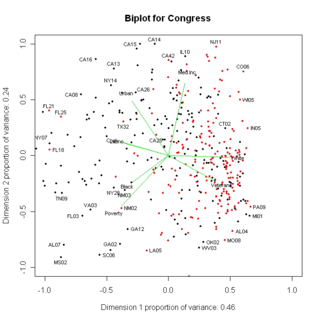
(it’s a little bigger here )

wow…. what’s that?
Well, the first thing I did was a principal components analysis (PCA) . Skipping a lot of possibly important information — Get a correlation matrix of the data. The goal of PCA is to find new variables that are linear combinations of the original variables. The first PC should represent as much of the variance in the table as possible. The second PC should represent as much of the remaining variance as possible, subject to being orthogonal to the first PC (you can think of orthogonal as meaning ‘unrelated’, although that isn’t exactly right).
In the figure above, note that the x-axis (that’s the horizontal one) is labeled Dimension 1: Proportion of variance .46. That means that one variable, a linear combination of all the other variables, represents about half the variance in all those variables. In other words, if you wanted to predict all of the original variables using only one number, this new number (the PC) would account for about half the variance in all those other numbers. The y-axis (the vertical one) says that dimension 2 represents .24 of the variance. So, together, this plot represents about 70% of the variance in all the original variables.
Next, each district gets a score on each of the PCs. Those are the dots. I’ve labeled some of them (more below).
Next, each variable gets whats called a loading on the PCs (never mind the details). These are represented by lines.
Interpreting the biplot.
OK, no more math (well…. I hope not!)
How to interpret the biplot? First, note that the two proportions add to .7. This biplot leaves out a lot (more below). But it can still be useful. Next, look at the lines. For example, poverty goes to the lower left. So the variable poverty is low on PC1 and low on PC2. Both Cook and Latino are off to the left, so they are low on PC1 and moderate on PC2. White is off to the right.
The CDs in the lower left (AL07, MS02, SC06, GA02) are high on poverty and high on Black….indeed, these are all “Black districts”. The ones all the way on the left (NY07, FL18, 21, 25) are highly Latino districts, that aren’t Republican (more later). The ones on the lower right have a lot of veterans. And so on.
Now, we can use this biplot to find districts that might be vulnerable. When there’s a black dot (Democratic rep) in a sea of red dots (Republicans) or vice versa, that might be a seat that’s vulnerable.
Vulnerable Republican seats include FL18, FL21, FL25, CA42, NM02, CA25, CA21 (that’s the red dot near NY28).