Long-Term Republican Majority in the House?

OK, I realize that there is a tendency to overreact after a wave election, and we too often hear right after such an elections claims that the beneficiary of the wave is destined for long-term dominance. So my title may be a bit over-the-top. And I don’t think America is a “center-right” country or even that this election was particularly ideological (as opposed to reflecting the state of the economy). It’s pretty close to 50-50 right now, ideologically.

But I do worry that Republicans will find it increasingly easy to achieve and maintain their hold on the House over time, due to a couple serious structural disadvantages Democrats face. I’ll explain after the flip.

It seems pretty clear that the parties have become more polarized over the past couple decades, and that people are becoming more likely to vote straight-ticket. States that are Republican at the presidential level are becoming more likely to vote Republican for all state and federal races (witness, for example, even the traditionally Democratic state legislatures in places like Alabama switching this year). And vice-versa.

It would seem, therefore, that fewer districts that vote Republican for President will elect Democratic Reps., and fewer Democratic districts will vote for Republicans. This certainly seemed to come into focus over the past three election cycles, when Democrats nearly wiped out Republicans in Democratic districts in 2006 and 2008 and Republicans pretty soundly defeated Democratic Reps. in red districts in 2010.

Here’s the basic problem: there are a lot more Republican districts than Democratic districts. According to the list of districts sorted by Cook PVI, there are 234 districts that are at least R+1, and only 192 that are at least D+1 (with 9 right in the middle at D+0). If we only look at the districts that have a particularly strong lean –say, 5 points in either direction — there are 189 “strong” Republican districts (R+5) and only 156 (D+5) “strong” Democratic districts.

A big part of this, of course, is because of gerrymandering. Unfortunately, because Democrats have an urban base, they are a lot easier to pack into very Democratic districts than are Republicans. Republicans, in other words, are more efficiently distributed across districts. One of the fears, as others here have noted, is that the Republicans’ substantial victories at the state levels will make this gerrymandering even more “efficient” for the Republicans. My point, however, is that even if they fail to alter the status quo it’s clear the Democrats have a structural disadvantage in the House.

To some extent, this structural disadvantage may be true in the Senate as well, due to there being more safe Republican states (on the Presidential level) than safe Democratic states (Republican voters again being more efficiently distributed). But this is more ambiguous, and, as Clinton and Obama both proved, Democrats can turn a majority of the states into blue states.

In any case, the upshot of all this is that with greater party polarization and more straight-ticket voting, it’s becoming much more difficult for Republicans to win in Democratic areas and Democrats in Republican areas. Because of the disparity in the number of Republican- and Democratic-leaning districts, however, this development would seem to be a major boon to the Republicans in the House, whether or not they gerrymander the hell out of the areas they now control.

This structural disadvantage has another effect as well — it allows the Republicans to be more conservative and forces the Democrats further to the political center. Republican don’t have to worry about winning ANY Democratic districts and not more than a handful of swing districts (that nevertheless lean slightly Republican). Democrats, on the other hand, must win several Republican-leaning districts to maintain a majority. While the Republicans in Republican districts can get away with being fire-breathing conservatives, I doubt you’ll get many strong progressives in these Republican-leaning areas necessary to capture to obtain a majority.

This is the kind of thing keeping me up at night. Am I overreacting in suggesting that we’ll have big problems holding the House in future years following the retirements/defeats of nearly all our Republican-district Democrats (something that has little to do with the fact that America is a “center right” country but rather with the structural set-up increasingly stacked against Democrats)? Somebody talk me off the ledge here.

WA-Sen: Seattle Times Calls It For Murray

The lone spot of good news in all this for Dino Rossi? Now he won’t have all those Senatorial duties cluttering up his planning activities for his 2012 gubernatorial run.

Sen. Patty Murray pulled further ahead this afternoon , taking 68 percent of the nearly 70,000 votes counted in King County on Thursday.

The King County boost widened Murray’s statewide lead to more than two percentage points — nearly 50,000 votes — over Republican Dino Rossi statewide even as Rossi-leaning counties began to report new totals. The biggest Rossi counties, Spokane and Clark, both reported results today but his gains there were swamped by King County.

Also worth noting: Rick Larsen in WA-02 seems to be moving into healthier shape against John Koster. He’s now up more than 1,400 according to the SoS, suggesting that Dem-friendly precincts are late to report in the 2nd too.

Competitive 2012 senate races as of 11/4/10

2 years is an eternity in politics but Democrats put on the best rose tinted glasses you have, Republicans bring out the fireworks…. Anyway grab a cup of Hot Coco, sit back and start reading.

Competitive Democratic senate races

Ben Nelson (D-NE): Lean Republican (+1 GOP)

Ben Nelson is dead. That’s it. There is no way Democrats will win this race, short of the GOP nominee completely imploding because of a personal scandal a few weeks before the election. His grandstanding during the health care debate has mortally wounded him and damaged his standing in the state.

Even if Obama is doing relatively well enough in 2012 that he puts Lee Terry’s district into play on the presidential level (Nebraska is one of only two states, Maine the other one, that awards some of its electoral votes to whoever wins a specific congressional district) it will not be enough to save Ben Nelson. Obama only has to win Lee Terry’s district to claim some sort of a victory in Nebraska, Nelson has to win the entire state to claim victory. Big difference.

The only interesting action going on this race will be on the GOP side to see who wins the right to cruise into the senate in January of 2013.

Update: That was fast, Nebraska’s GOP attorney general Jon Bruning is planning to run against Ben Nelson. He’s not going to be the last, this is going to be a fun primary.

Claire McCaskill (D-MO): Tossup/Tilt Republican (+1 GOP)

2010 was a massacre for Democrats in Missouri. Robin Carnahan was smoked big time by Roy Blunt, her brother barely won reelection to the house in a race no one was watching, Congressman Emanuel Cleaver won reelection by a shocking 9 points and turnout sunk to abysmal levels in Democratic St. Louis and Kansas City.

On top of that while Obama was cleaning McCain’s clock, swing state wise, he barely lost the state, even though Obama left no stone unturned looking for votes in St. Louis and Kansas City suggesting that the rural areas are just too tough for someone named Obama to win. (Bill or Hillary Clinton who have more of a pull on rural voters could still win the state.)

Enter Claire McCaskill who already had a huge bulls eye painted on her back. McCaskill beat incumbent GOP senator Jim Talent (who happened to defeat another member of the Carnahan family 4 years earlier) by a razor thin margin in 2006, which was a good year for Democrats across the board.

McCaskill has a huge hill to climb if she wants to win reelection. Ideologically McCaskill isn’t that out of sync with Missouri but she’ll be facing an electorate that has become more hostile towards Democrats than in 2006. She has a much better chance of winning reelection that Ben Nelson does. Missouri’s democratic governor, Jay Nixon will be up for reelection in 2012, and the presidential contest will dramatically increase turnout in St. Louis and Kansas City. McCaskill has a small string to thread the needle through though.

Jim Webb (D-VA): Tossup/Tilt Republican (+1 GOP)

Oh how much in two years has the pendulum in Virginia swung so wildly against the Democrats. In a span of two years, Democrats lost the governor’s office, a boat load of seats in the House of Delegates, and Congressman Nye, Perriello, Boucher washed away with the anti Democratic wave a few days ago with Rep. Connelly holding on in his Northern Virginia district with the skin of his teeth.  

Jim Webb, who knocked off incumbent GOP senator George Allen thanks to Allen not choosing his words carefully and the Dem wave of 2006 only did so by such a small margin the result wasn’t known until late into the morning the next day.

And George Allen is gunning for a rematch. And he’s most likely going to get one. Unless the tea party intervenes and runs someone like Virginia’s batshit crazy Attorney General, but that ain’t going to happen.

Webb does have the presidential contest to look forward too though. Obama will most likely turnout Democrats in Northern Virginia and in the college towns to give Webb a boost. But that’s it.

Or worst, Webb could choose to retire which is most certainly possible and wouldn’t be surprising. Then you could kiss this seat goodbye. The Democratic base in Virginia has been absolutely wiped out. Tim Kaine could run, but his close ties to the administration would hurt him, Tom Perriello could try a comeback and would play well in Northern Virginia, but would be no match for someone of the likes of George Allen. Better dig up a Democrat Ron Johnson or clone Mark Warner in this case. And for the love of god do not let Creigh Deeds anywhere near this race!!!!!

Jon Tester (D-MT): Tossup/Tilt Republican (+1 GOP)

And the NRSC hunters goes Big Sky country seeking to slay one person with a flattop haircut by the name of Jon Tester.

Jon Tester is another member of the Dem class of 2006 who just knocked off a incumbent senator, in this case Conrad Burns who was hurt by his ties to Jack Abramoff. Montana is one state that still friendly to Democrats, their governor is a Democrat, and control of both houses of the legislature has been seesawing between both parties since 2004. Tester is also quite a populist, with his opposition to the Patriot Act which earns him mega points among the liberal blogosphere while an avid defender of the Second Amendment.

Tester’s going to have a pretty strong opponent in 2012 though, their at-large GOP congressman, Dennis Rehberg who visit NRSC headquarters earlier this year to most likely discuss his run against Tester. This race could go either way, but I’m giving an early edge to Rehberg who nearly knocked off Max Baucus in 1996.

Bill Nelson (D-FL): Lean Democratic

Florida, like most other swing states in the nation was a train wreck for Democrats on Tuesday. In one foul swoop, Democrats in the state now hold the same number of house seats they did in 2006, minus one with blue dog Allen Boyd going down big time in his Panhandle district. Alex Sink also lost a hotly contested governor’s race to Rick Scott who scammed the Federal government twice! Also Marco Rubio cruised to victory in the senate race thanks to the anti-Rubio vote being split between Charlie Crist and Kendrick Meek.

Bill Nelson lucked out in 2006. He was not only helped by the Dem wave, but the fact his opponent was Katherine Harris of 2000 recount fame. She lost the makeup, but she lost her sanity in exchange. Harris was so bad no one, including Jeb Bush would touch her with a 100 foot long stick and all of Florida’s newspapers endorsed her opponents during the primary. Ouch!

Bill Nelson will be high on the NRSC’s target lists come 2012. And with the GOP winning control of the house, several ambitious backbencher congressman such as Connie Mack IV could jump in. Connie Mack IV probably hoping to reclaim his father’s senate seat. Soon to be Lieutenant Governor Jennifer Carroll who Crist was thinking of appointing to the senate seat vacated by Mel Martinez could also jump in to take on Bill Nelson.

Obama’s dismantling of NASA’s space program is sure not to help, as also the idea engraved in senior’s minds that Obama wants to take away their Medicare and toss them into death camps.

Nelson will be helped by Obama though, who is sure to contest the state heavily and bring out the vote in Democratic South Florida.

Or he could retire, he is 68 and in the land of the old people he could decide to retire to some nice senior home on the coasts of Florida. In that case, Democrats should quickly hit the panic button! Charlie Crist could try to take another stab at an independent, with a lot of work done before hand to clear any legitimate Democrats away and becoming the de facto Democrat in the race. Alex Sink could be another choice as well, except if she is eying a 2014 rematch against Rick Scott, losing a senate race wouldn’t do her any good.

Suzanne Kosmas or Ron Klein who lost their seats on Tuesday could be up to the task as well. Alan Grayson’s probably off to his cable gig on MSNBC and Kendrick Meek to some comfortable lobbying job. Or if all fails, better find some rich person not by the name of Jeff Greene.

Joe Manchin (D-WV): Lean Democratic

Joe Manchin was one bright spot in an otherwise dismal night for Democrats. He beat off John Raese by badmouthing the Obama administration and literally putting a bullet through a copy of the cap and trade bill.

Manchin is up for reelection in 2012 for a full six year term. Good news, if he acts like an independent voice for West Virginia as he said he would, he’ll win and he’ll have the seat for life. He has to watch his back though, Obama’s on the ballot and this was one of only a handful of states that McCain carried by a larger margin than Bush did in 2004. Also the cap and trade bill scared the hell out of everyone in the state.

John Raese could try again, this would be his 4th senate run since the 80’s or Shelly Moore Capito could run. She took a pass because she knew Raese would teabag her. David McKinney will be busy fending off a strong Democratic challenge to even look at this race.

Sherrod Brown (D-OH): Lean Democratic

On Tuesday night, anyone who had a (D) by their name was taken out and shot. Sherrod Brown is the only Democrat left standing in a political battlefield filled with the bodies of Democrats by the name of Ted Strickland, Lee Fisher, Mary Jo Kilroy, Zack Space, etc.

Sherrod Brown, who’s probably more liberal than what you would expect in Ohio knocked off GOP senator Mike DeWine in 2006 who staged a spectacular political comeback by knocking off Democratic Attorney General Richard Cordray on Tuesday night. 2012, the NRSC is going to make sure Sherrod Brown goes down. But it won’t be easy, especially with Obama bringing out the vote in Ohio’s cities. Expect this race to go down to the wire on election night.

There are already reports that GOP congressman Jim Jordan is preparing to run against Sherrod Brown. Also Mike DeWine could run again, he’s not up for reelection until 2014 and Kasich could appoint his successor if he beats Brown in a rematch. Kasich’s running mate could run as well, short, there will be no shortage of ambitious GOP politicians gunning for Sherrod Brown in 2012.

Bob Casey Jr. (D-PA): Lean Democratic

Like Sherrod Brown, Bob Casey Jr. was forced to watch Democrats get wiped out in Pennsylvania on Tuesday night. And like Brown, Casey Jr. is going to get a tough race in 2006. In fact Casey Jr. had it easy in 2006, Rick Santorum was too batshit crazy he turned off everyone, including the crucial suburban vote that carried the GOP to huge victories on Tuesday night.

The Casey name is still golden, especially in places like Mark Critz’s district. Also Obama will bring out the crucial Philadelphia vote that he and Casey will need to offset the bleeding of suburban votes to the GOP.

Now for the bad news, Rick Santorum isn’t going to be his opponent. He’s off to seek a quixotic bid for the presidency in 2012 that will probably flounder quickly. Two people Casey does not want to face is GOP Reps. Jim Gerlach and Charlie Dent. Both of them dispatched touted Dem challengers on Tuesday night and occupy suburban districts. And they aren’t crazy social warriors like Rick Santorum was. Though they would be leaving their swing seats open, which wouldn’t be good news to the NRCC.

Debbie Stabenow (D-MI): Lean Democratic

Michigan has had it hard economically for the last few decades. They’ve taken out their anger on whoever was in power, in this case the Democrats on Tuesday night. And Stabenow is probably next. And her opponent will probably be a millionaire in the Ron Johnson template. Obama will help bring out the vote in Detriot though, whatever that’s worth.

Competitive Republican senate races

Scott Brown (R-MA): Tossup/Tilt Democratic (+1 Dems – woohoo!)

A perfect storm of circumstances helped carry Scott Brown to victory in the special election in January. Martha Coakley (who should never run for anything again) and the national climate. He won’t have that storm to rely on in November of 2012. Obama is still popular in this state and the Northeast was relatively immune from the anti-Dem wave on Tuesday. Brown will also be facing the presidential headwinds head on. Deval Patrick held on and Democrats held onto the seat of retiring Rep. Bill Delahunt which Brown carried by a large margin during the special election.

Scott Brown is going to fight hard to hold this seat, and don’t expect this seat to fall easily to Democrats. Brown is sitting on $12 million dollars and is going to raise much more over the next year and he is an able campaigner. Or one who’s not afraid of shaking hands outside ballparks unlike one person who’s name shall not be mentioned. Mike Capuano who lost the special election primary to Martha Coakley and conservative Democrat Stephen Lynch are mulling running here. Mike Capuano would be the better choice here.

John Ensign (R-NV): Lean Republican

Probably the most shocking political story out of Nevada on Tuesday was that Harry Reid beat Sharron “Loony Toons” Angle by a comfortable margin. Pollsters had left him dead for weeks while Jon Ralston, Nevada’s go to guy for everything Nevada politics claimed pollsters were getting it wrong here. Well Ralston’s know it all attitude doesn’t come without years of experience right?

GOP Senator John Ensign got caught up in the summer of 2009 in a shitload of trouble surrounding his personal life due to his admission of an extramarital affair and trying to cover it all up. In theory he should be DOA. Ya…just ask David Vitter how dead he was on Tuesday night.

The problem surrounding the whole “John Ensign is dead” theory is that it happened years before the election. Enough time for the outrage to fade in the voter’s minds and for it to become an afterthought. And enough time for Ensign to repair his standing among the voters. And not to insult anyone from Nevada on this site….but crazier more outrageous things have happened here.

Though with Obama on top of the ballot and with a lack of offensive opportunities elsewhere, Democrats will go after this race like a mad rabid dog. Don’t expect much help from Harry Reid though, he and John Ensign have had a non aggression pact against each other ever since Ensign nearly knocked off Reid in 1998.

Tea party fun!!!!!!

Olympia Snowe (R-MA)

Olympia Snowe as well as her more hawkish colleague, Susan Collins have been on the target lists of the conservative wing of the Republican party for years. And with Paul LePage, who’ll probably become memorable for being the first governor to tell Obama on the phone before Air Force One lands in Maine to “get out of my state” or “go to hell” winning (thanks Libby for nothing), Olympia Snowe knows her reelection prospects have taken a hit. If she’s taken out in the primary, this seat will be almost a certain pickup for Democrats unless 1) the climate’s really bad, 2) the Democrat sabotages himself like Jack Conway did, 3) the sane vote is split up like this year.

Orrin Hatch (R-UT)

DOA. Like his soon to be former colleague, Bob Bennett, he won’t make it onto the ballot on his party’s convention which will be dominated by tea partiers. Even with his hard right turn these last two years, tea partiers won’t forgive his friendship with Ted Kennedy or the fact he’s worked with Democrats over the years on things like SCHIP and Ted Kennedy’s “Serve America” bill.

Roger Wicker (R-MS), John Barasso (R-WV), Bob Corker (R-TN)

These three ended up on a tea party hit list circulated by Erick Erikson on Redstate yesterday. What the fuck have these two done to end up on here?

Christine O’Donnell for senate 2012.

Common you know you want to laugh.


Sleeper races

Herb Kohl (D-WI): Possible retirement

Seeing how Democrats got wiped out on Tuesday night with Russ Feingold being crushed by millionaire, stimulus hypocrite, pedophile priest protector Ron Johnson, the one bright side is that Herb Kohl is an institution and would win reelection in a walk. He’s old though and could retire in 2012. In that case expect a hard fought race to be fought by both sides to determine who succeeds Kohl.

Democratic congresswoman Tammy Baldwin could take a stab at it, hoping to become the first openly lesbian elected to the United States senate and her colleague, Ron Kind might take a stab at it as well. Russ Feingold’s probably off to teach political science at some university or something. Paul Ryan will probably not want to give up his gavel as head of the House Budget committee come January so you can count him out. Maybe Sean Duffy could attempt to become the first celebrity elected to the US Senate, if you count out Scott Brown’s nude cameo in Cosmo magazine.

Kent Conrad (D-ND): Possible retirement

The good news is that Kent Conrad doesn’t have to worry about John Hoeven anymore. He’s going to be his colleague in 2011. The GOP could make a push against Conrad, but they don’t have anyone of Hoeven’s statue on the horizon yet. Conrad’s still pretty young, Dorgan was older, but a retirement is not out of the question. If that happens, this seat is gone. Earl Pomeroy could attempt a political comeback, but he’s no spring chicken and even if he wins, he’ll be renting this seat for 1 maybe 2 terms at most.

Jeff Bingamen (D-NM): Possible retirement

Democrats lost the governorship and Harry Teague was defeated on Tuesday, but to be fair, Denish ran a poor campaign and couldn’t shake Bill Richardson off her. Harry Teague was in a hostile district and would have had a though challenge anyway. The good news is that Martin Heinrich survived a tough challenge in his Albuquerque centered district.

Jeff Bingamen is getting pretty old, he’s been in the senate a good thirty years so he could retire in 2012. If that happens, Democrats have a pretty deep bench here. Martin Heinrich comes immediately to mind here, which is one reason why Republicans made a concerted effort to knock him out. The best Republicans could come up with here is former Congresswoman Heather Wilson who lost a brutal primary to Steve Pearce to determine who would go up against Tom Udall in the race to succeed retiring Republican senator Pete Dominici. (Udall won by the way.)

Heather Wilson screams RINO here, and Democrats could be helped by a tea party candidate taking out Wilson. Heinrich would be helped by Obama at the top of the ballot anyway, so this race would be at worst tossup with a slight Dem lean. This is assuming the national climate will be better for Democrats in 2012.

Bob Menendez (D-NJ): Race to Watch

Menendez has never been too popular up in New Jersey, politicians actually have never been too popular up there. And he beat Tom Kean Jr. by only 9 points in 2006 in a bruising campaign in a good Democratic year. Menendez is still a strong favorite up here, but with Chris Christie having disarmed the New Jersey Democratic party and Adler going down, with Holt and Pallone escaping with the skins of their teeth on Tuesday, anything could happen.

Jon Kyl (R-AZ): Possible retirement

Jon Kyl is no spring chicken, and only won with 53% of the vote in 2006. So he could retire. Even then, Republicans will be a favorite to win here, especially if their not over their high with SB 1070 by 2012.

If Kyl retires, the eyes of the DSCC will turn onto Gabrielle Giffords who managed to survive Tuesday night. She’s also a rising star and scares the hell out of the GOP explaining why they’re so determined to knock her out before she can become a threat. Though Giffords will be under heavy pressure from the DCCC not to vacate her swing district so odds are she would take a pass unless the Republicans nominate a wack job or an idiot like Ben Quayle who’s only in congress because of the wave.

In that case, Terry Goddard would be the DSCC’s fall back option, or even Jim Peterson.

Richard Lugar (R-IN): Possible Retirement

Lugar’s a dying breed of senators, respected by both parties for his common sense and sage like wisdom on foreign affairs and nuclear arms is getting really old. If he runs again, which he says he would, he will win in a cakewalk. Democrats didn’t even care to field a challenger against him in 2006.

If he does choose to retire, Democrats would have a 35-40% chance of picking up his seat. In reality it would be 20% even in a neutral year. Obama could contest Indiana again, that all dependents on the national climate though.

Who could run? Well Baron Hill or Brad Ellsworth, last seen being crushed by Dan Coats trying to keep Evan Bayh’s seat (thanks for nothing Bayh) blue could run here. The Republicans have a plethora of choices here. Mike Pence is going to run for governor, but could decide to run for the senate instead if Lugar retires. Seeing how Evan Bayh is preparing to be the next Jerry Brown.

But let’s not get too excited here, even if Lugar retires, Democrats face a steep, 89.9 degree hill to climb here. Even when the stars aligned for Obama, he only won Indiana by 1%, and that wasn’t known until the early morning after the election.

IL-Gov: Quinn Wins (And Other Updates)

IL-Gov: The DGA is sending ’round a press release congratulating Pat Quinn on his who’da-thunk-it re-election victory. No official call yet, but the trendlines in the count (with a margin now of 20,000 votes) make it pretty clear what’s happening. Bill Brady says he isn’t ready to concede… yet. UPDATE: CNN has called it.

CT-Gov: More vacillation in the Connecticut count, this time with Dan Malloy back on top by about 6,000 votes. This doesn’t seem to have anything to do with actual counting, but simply with the AP getting its facts straight (it seemed to be missing a large slab of urban and assumedly heavily Democratic votes, mostly from New Haven). Final tallies remain unknown because we’re still waiting on Bridgeport (another Dem stronghold), although SoS Susan Bysiewicz has promised results by the end of the day. (Doesn’t seem like she’ll make it, though.) Relatedly, Dan Debicella in CT-04 is “waiting and seeing” what the Bridgeport situation is before conceding, although that race has already been called against him.

FL-Gov: This was pretty well decided yesterday, but Alex Sink officially conceded, finalizing the transaction on Rick Scott’s self-financed purchase of the gubernatorial election.

NE-Sen: Ben Nelson says he won’t switch parties. (Why the heck would he want to, considering that the Dems still have a Lieberman-proof majority in the Senate, that he’s part of? He’d just get teabagged to death in the 2012 GOP primary a la poor Parker Griffith.) It’s worth wondering, though, if any House Dems are considering a switch… but, with the possible exception of Dan Boren, all of the most likely suspects have already lost, saving us the trouble of such speculation. UPDATE: Although here’s an interesting post-script to the Nelson story: GOP Gov. Dave Heineman, who’s led a few hypothetical polls against Nelson for 2012, has already announced that he won’t run for the Senate in two years.

NV-Sen: The one major race where the polls really seemed off was Nevada, where Harry Reid’s 4-pt average deficit turned into a 5-point victory and in retrospect, that’s easy to explain: pollsters weren’t reaching Latinos. Exit polls suggest that Latinos did turn out well in Nevada (thanks in no doubt to the Reid-friendly hotel unions in Las Vegas). Nate Silver graphs the variance in other states with large Latino populations: it may also have played a role in Colorado, although the poll variance wasn’t as bad there, though it was enough to predict a Ken Buck victory… and Latino turnout didn’t seem to work in Texas, where Rick Perry exceeded polling predictions (and which explains the sudden and probably brief appearance of Rep. Blake Farenthold).

KY-06: Here’s a race that’s definitely going to recount. Andy Barr, trailing Ben Chandler by about 600 votes, has formally requested a “routine recanvass.”

NC-02: Here’s one more race where we’re not quite dead yet. Bob Etheridge hasn’t conceded, it turns out, nor should he: he’s down only 1,646 votes, after cutting his deficit against Renee Elmers by more than 500 in late counting yesterday.

NC-11: When Heath Shuler announced that he’d challenge Nancy Pelosi for Speaker, the proper response was laughter, although my main question at the time was whether he planned to challenge her for minority leader. It sounds like, yes, he does still plan to go through with his kooky gambit (made all the kookier because there aren’t any core Blue Dogs left besides him who need to follow through on their promises to not vote for Pelosi). Anyway, the scuttlebutt seems to be leaning toward a voluntary sword-falling and a painless transition to Steny Hoyer, in which case the Shuler challenge would be even more pointless.

WV-01: After maintaining for most of yesterday that he wasn’t dead yet (given the narrow margin, currently 1,357), Mike Oliverio did wind up conceding eventually late yesterday.

Redistricting: As much as the mess in the state legislatures really messes up hopes of wresting an advantage out of the redistricting process, here’s some good news: Amendment 6 in Florida surprisingly passed, clearing the super-high 60% hurdle at 63%. This doesn’t create a commission, but it does impose requirements that redistricting be done without political consideration (but without violating federal law, namely the Voting Rights Act). However, two U.S. Reps… probably the two in Florida who have the most to lose from having less friendly districts drawn for them… Corrine Brown and Mario Diaz-Balart, are challenging the law in court. With the passage of Proposition 20 in California, though, which creates an independent redistricting commission there, it’s all kind of a wash, as a less-bad Florida map is balanced out by not being able to aggressively redistrict California. (Similarly, while it takes some sting out of Alex Sink’s narrow loss, it also deflates the impact of Jerry Brown’s victory.)

StochasticDemocracy: Post mortem- most accurate House predictions

This is a diary by Stochastic Democracy, evaluating our final forecasts for the 2010 House of Representative Elections and comparing our predictions to those of other forecasters. Cross-posted at DKos, where you can find the pretty version of the post– SSP doesn’t buy all the HTML code. EDIT: Okay, DKos doesn’t buy it either, check out the StochasticDemocracy frontpage for the good style.DailyKos post.

While there are still a couple of uncalled districts out there, enough returns have come in to start looking at the results and how the model did:

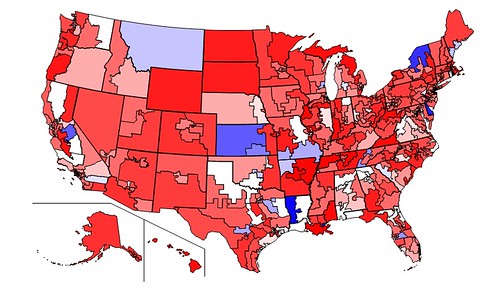
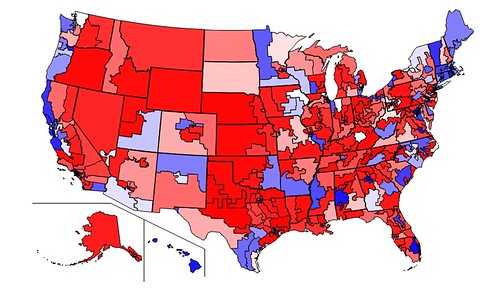
2010VoteMap

Behold our new Congress, based on provisional returns, colored according to Democratic Vote-Share. Compare with map on side-bar that shows our projections. 2010SwingMap

Swing in vote from 2008 to 2010. Red indicates districts where Republicans did better then last year, Blue indicates districts where Democratic standing improved, and White indicates no change. 

 Please click here to see a comparison of various predictions by John Sides of the Monkey Cage:

Stochastic Democracy predicted that Democrats would obtain 197 seats in the House of Representatives, 5 more than the currently projected outcome. This was the third most accurate forecast, 5 seats more accurate than FiveThirtyEight, and the most accurate one that also provided district-by-district vote estimates.

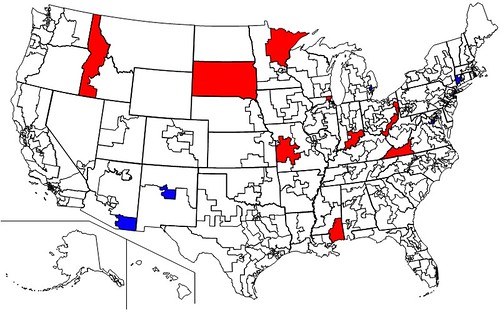
Called

Red indicates the 10 districts that Democrats were predicted to win but did not, Blue indicates 5 districts Republicans were predicted to win but did not. White indicates the 418 correctly called districts, with 2 districts still uncalled (NY-25 (Maffei) and CA-20 (Costa).

Note that Dan Maffei currently looks likely to lose, which would add another miss to our tally, while Costa will almost certainly hang on, as projected by us.

While this method of grading makes our site look good, it’s not a very informative one due to two reasons:

1) Everyone could get a majority of seats right- not very hard to forecasts the outcome of elections in Manhattan or rural Nebraska. A map that gets 30 districts wrong, like Pollster.com seems to have done, would still  be mostly white, despite a pretty underwhelming performance.

2) The record number of competitive districts this year. If you have a bunch of 50-50 districts, it’s basically a matter of luck how many of them you get right. That’s why sites like 538.com and us are doing probabilistic forecasts: We’re giving both candidates credit for having a shot to win the district for their side. Therefore, a much better way to evaluate forecasters is to look at how well they managed to predict vote-share district by district.

District by district, our model seems to have over-estimated Republican vote-share by about half a point. This is because the regression model appears to have inappropriately applied a uniform national swing to heavily Democratic urban districts- in downtown Chicago or New York, Democrats always win about 80-20, no matter what happens in the rest of the country, really. If we restrict ourselves to the 357 districts where the result was between 25 and 75%,  the bias effectively disappears (4 hundredths of a percent toward the Republicans).

Mean absolute error was 3.2 points, while median absolute error was 2.6 points. This goes down to 2.8 and 2.5 respectively for the 25-75% districts.

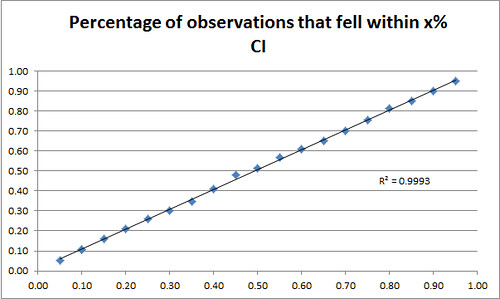
But we provided full probability distributions as well as vote estimates for each candidate. It seems that our stated standard errors were quite accurate: 94.7% of results fell within our 95% confidence intervals. More generally:

CIGraph

5.2% of results came within our 5% confidence interval, 10.6% in our 10% interval, etc.

In other words, our standard errors were well calibrated. Not only were we not wrong very often, but we were able to predict precisely how wrong we would be. That’s really amazing and can’t be stressed much enough: While most models really agree roughly on the mean of most predictions, they disagree heavily on how that should be converted to a percentage chance of winning. Nate Silver essentially had a very, very wide variance around his projections, so that he gave even candidates who were solidly ahead only a 70% or 80% chance of winning. We got the win percentage exactly right- about 95% of the candidates who we projected to have a 95% chance to win won, and the same is true for any other percentage.

We don’t have easily assessible data yet for the forecasts of FiveThirtyEight or Electoral-Vote, the only other forecasters we’re aware of who provided district level forecasts, and so we can’t yet replicate this analysis to see how our performance compares. On the other hand, Andrew Gelman, a renowned statistics professor at Columbia University, has looked at FiveThirtyEight’s forecasts and found that Nate’s confidence intervals were too wide:

So, yes, Nate’s forecasts do seem underconfident! There were 37 races where he gave the Republican candidate between 60% and 90% chance of winning, and the Republicans snagged all 37. Apparently he could’ve tightened up his predictions a lot.

We don’t think that looking at win-percentages solely is a fair measure, since most races are not close at all and race outcomes are not necessarily independent. Gelman agrees:

But . . . before jumping on Nate here, I’d suggest some caution. As we all know, district-by-district outcomes are highly correlated. And if you suppose that the national swing as forecast was off by 3 percentage points in either direction, you get something close to calibration.

Some other notes of interest:

Stochastic Democracy’s House forecasts were really a blend of two almost independent models: 1) A fundamentals-based regression model that took into account Incumbency, past election results, Income, Cook Ratings, and the Generic ballot adjusted for House Effects. And 2) A Bayesian state-space model that filtered polls, taking house effects, design effects, and potential industry bias into account.

The poll model shows that Democrats should have gotten 205 seats, while the regression model forecasted 186 seats. Paradoxically however, the poll model outperformed the Regression model in 52% of the individual races where polling was available.

Yet for races where polling and the fundamentals differed considerably, ID-1 (Minnick), AL-2 (Bright), MS-4 (Taylor), VA-9 (Boucher) etc (And CT-5 (Murphy) on the Dem side), the regression was considerably more accurate. There are a couple of theories as to why that could be, and it’s definitely something we’ll be looking at in the next couple of days.

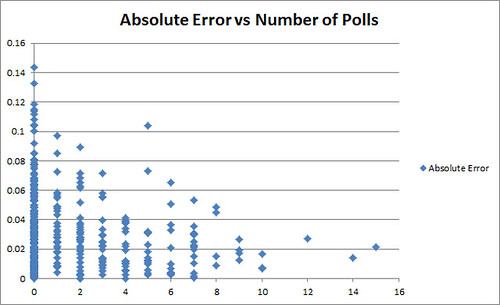
PollsvErr

Absolute Error of our forecast in a district vs the Number of Polls in the District


One potential concern is if there is sufficient race-to-race correlation, then well-calibrated confidence intervals could in fact mean badly calibrated confidence intervals. See Gelman. More on this later.

Another graph:

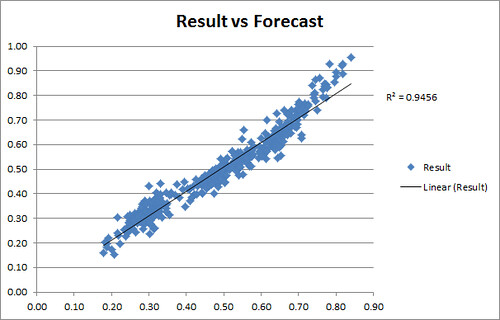
rsquared

Our final race forecasts graphed against election results. For comparison, FiveThirtyEight and Pollster’s R^2  seemed to have been .73 and  .55 respectively.

First Look at 2012 Senate Picture

It’s still the week of Election Day, which means it’s time to take an incredibly premature look at the Senate races developing in 2012. As you may have heard, the map favors the GOP, suggesting that the party may have their second big cycle in a row. However, theoretically, the Democrats had a favorable map in 2010 and they ended that without a single pick-up.

Instead of making predictions that are sure to be outdated in two months, let alone two years, I’m embracing the uncertainty. For each race, this preview will look at:

The best-case and worst-case scenario for the incumbent party; a rating on which scenario is more likely to happen (1 for worst-case, 10 for best-case)

Likely candidates, mostly made up of this year’s “Tommy Thompsons”. If you’ll recall, for most of 2009 and early 2010, pundits and observers thought the only way Russ Feingold would be in trouble is if Tommy Thompson ran. In nearly every state, there’s the “obvious” candidate(s) that conventional wisdom cements as the “only viable” candidate(s)-Schwarzenegger in California, Huckabee in Arkansas, Napolitano in Arizona, and these projections are more often wrong than right.

Retirement shock: every cycle features retirements, some expected and some unexpected. This looks at where such a retirement would fall. (1 for expected (like Bunning), 10 for completely shocking (like Bayh))

And for kicks and giggles, a “cattle call” to be preserved for posterity, so we can look at this diary 23 months from now and look at all the things we didn’t know would happen.


Democrats (and those who caucus):


California, Diane Feinstein

Best-case scenario: Given the lean of the state and disinterest among strong contenders, Feinstein fails to attract a major nominee and runs against a Dick Mountjoy-esque candidate.

Worst-case scenario: California’s budget woes only get worse under Gov. Brown, resulting in high dissatisfaction across the state; the GOP nominates a Hispanic candidate for President or Vice-President while other Hispanic national stars become more prominent, stopping or even reversing the hold Democrats have on the Hispanic vote; Obama’s victory in California is secured while he is mired campaigning full-time in a dozen battleground states away from the Pacific West, so he spends little time getting out the vote. Feinstein loses in a squeaker to a moderate, governance-minded Republican.

Scenario rating: 6 out of 10; Feinstein will probably pick up a more serious challenger, but have little problem defending her seat.

Possible candidates: Tom Campbell, Steve Poizner, Steve Cooley

Retirement shock: 5 out of 10; At age 77, she’s far from “old” for the Senate, and she stated she’s running again at a recent Boxer rally.

Race rating: DEM Favored


Connecticut, Joe Lieberman

Best-case scenario: Lieberman retires or runs and is easily defeated in the primary.

Worst-case scenario: Lieberman defects and runs as a Republican, or Lieberman runs third-party and who knows what happens.

Scenario rating: ??? out of 10; who knows?

Possible candidates: Chris Murphy, Joe Courtney, Ned Lamont, Sam Caliguiri, Tom Foley, Rob Simmons

Retirement shock: 3 out of 10; it wouldn’t shock anyone, but it’s not expected.

Race rating: Lean DEM


Delaware, Tom Carper

Best-case scenario: With no bench and Carper’s decision to run again, the GOP leaves the race unchallenged, or worse, nominates Christine O’Donnell.

ALTERNATIVE: Carper retires and Beau Biden decides to run for the seat.

Worst-case scenario: Carper decides to retire, and Mike Castle decides to run; having learned their lesson last time, he is unchallenged for the nomination.

Scenario rating: 8 out of 10; I think a Carper-Biden swap is likely, and the reason why Biden didn’t run in 2010.

Possible candidates: Beau Biden, Mike Castle, Christine O’Donnell, Michele Rollins

Retirement shock: 2 out of 10; Carper has repeatedly denied health issues but has had a long and successful political career. At age 63, he could easily run again but his retirement likely wouldn’t catch anyone off guard.

Race rating: Safe DEM


Florida, Bill Nelson

Best-case scenario: Rick Scott implodes as a Governor; Obama makes a major push to win Florida again; the GOP nomination is beset with infighting and a far-right and battle-fatigued candidate emerges from the scrum.

Worst-case scenario: The GOP nominates a solid candidate that keeps the party unified; the economy stays in similar shape; Marco Rubio is on the 2012 ticket or otherwise barnstorms around the state with his arm around the shoulder of the GOP nominee.

Scenario rating: 3 out of 10; Nelson will be a big target, and Crist’s defection left the state GOP remarkably solidified. There are a number of GOPers on the bench that could make this a marquee race.

Possible candidates: George LeMiuex, Jeb Bush, Connie Mack IV

Retirement shock: 8 out of 10

Race rating: Toss-up


Daniel Akaka, Hawaii

Best-case scenario: Akaka runs for re-election and Linda Lingle, Duke Aiona, and Charles Djou pass on the race.

Worst-case scenario: Akaka doesn’t run for re-election and Linda Lingle, Duke Aiona, or Charles Djou runs.

Scenario rating: 4 out of 10; Akaka says he’s “definitely running again”, but either way I think one of those three runs. Half of either scenario coming true would make this a 5 out of 10, but since I think Akaka’s retirement is moderately possible, I’ll downgrade it to 4.

Possible candidates: Linda Lingle, Duke Aiona, Charles Djou, Ed Case, Mufi Hannemann

Retirement shock: 4 out of 10

Race rating: DEM Favored


Ben Cardin, Maryland

Best-case scenario: Cardin is ignored in his bid for a second term.

Worst-case scenario: Some scandal tars the entire state party and Bob Ehrlich runs.

Scenario rating: 10 out of 10; Ehrlich has said he’s done with elections and Michael Steele is running for RNC Chairman again.

Possible candidates: Mary Kane

Retirement shock: 10 out of 10; Cardin is a freshman and will likely hold the seat as long as he wants.

Race rating: Safe DEM


Debbie Stabenow, Michigan

Best-case scenario: A brutal GOP primary made up of lackluster candidates produces a far-right but unqualified nominee.

Worst-case scenario: A pragmatic-minded GOP candidate gets the party unified behind him/her and runs a solid campaign against Stabenow.

Scenario rating: 3 out of 10; There’s always the potential for a sideshow, but Rick Snyder’s nomination and landslide victory provides a good template for the state GOP to use. If the party gets its act together, Stabenow will be in real trouble.

Possible candidates: John Engler, Terri Lynn Land, Candice Miller, David Camp, Mike Cox

Retirement shock: 6 out of 10; it’s not particularly likely, but given the turmoil in the Michigan Democratic Party, not that many people would be searching for a reason why.

Race rating: Toss-up


Minnesota, Amy Klobuchar

Best-case scenario: Most interested parties pass on the race, preferring to take on Franken in 2014 when Obama won’t be on the ticket, and Klobuchar is given a free pass against a minor nominee.

Worst-case scenario: She attracts a major challenger.

Scenario rating: 7 out of 10; we’re now looking at the personal whims of a handful of candidates who could theoretically make this a race, but it just seems unlikely that the GOP will be playing significant offense here.

Possible candidates: Norm Coleman, Tom Emmer, Jim Ramstad, Erik Paulsen, Paul Koering, Steve Sviggum

Retirement shock: 10 out of 10

Race rating: DEM Favored


Missouri, Claire McCaskill

Best-case scenario: A Tea Party candidate emerges from the primary on a far-right platform.

Worst-case scenario: The GOP primary unifies behind a solid nominee.

Scenario rating: 2 out of 10; while anything can happen in a primary, the Missouri GOP seems to be able to keep things under control. This is going to be one of the top targets for the GOP, and they’ll do anything they can to keep it that way.

Possible candidates: Jim Talent, Sarah Steelman, Jo Ann Emerson, Sam Graves

Retirement shock: 9 out of 10

Race rating: Toss-up


Montana, Jon Tester

Best-case scenario: The big name candidates decide to run for the open Governor’s seat instead of challenging him.

Worst-case scenario: The best-case scenario doesn’t happen.

Scenario rating: 2 out of 10

Possible candidates: Denny Rehberg, Marc Racicot

Retirement shock: 9 out of 10

Race rating: Toss-up


Ben Nelson, Nebraska

Best-case scenario: The big names pass on the race and Nelson faces another underwhelming or unknown opponent.

Worst-case scenario: Dave Heineman enters the race and clears the primary field.

Best-case scenario (for Nelson, not Democrats): Nelson agrees to a deal where he switches parties in exchange for not being primaried.

Scenario rating: 2 out of 10; even if Heineman decides not to run, there are still others who would make this a competitive race.

Possible candidates: Dave Heineman, Jon Bruning, Jeff Fortenberry, Lee Terry, Adrian Smith

Retirement shock: 6 out of 10; Nelson seems to be committed to the idea of running again, which is good because Democrats really don’t have that many other options here.

Race rating: Lean GOP


New Jersey, Bob Menendez

Best-case scenario: The state unifies behind a weak nominee or several big names pass on the race, leaving perhaps an underfunded and too conservative candidate.

Worst-case scenario: A strong and pragmatic nominee emerges with the support of Chris Christie, who receives a spike in approval ratings.

Scenario rating: 5 out of 10; this is a purely candidate-driven race. In a state like Jersey, the Democrats have the advantage.

Possible candidates: John Crowley, Tom Kean Jr., Steve Lonegan

Retirement shock: 10 out of 10

Race rating: Lean DEM


Jeff Bingaman, New Mexico

Best-case scenario: No real challenger emerges and Bingaman coasts to another election.

Worst-case scenario: Bingaman retires and Democrats are left unprepared.

Scenario rating: 9 out of 10.

Possible candidates: Heather Wilson, Pete Domenici Jr., Allen Weh

Retirement shock: 7 out of 10; Even though he’s a five-term Senator, Bingaman is only 67 years old.

Race rating: Safe DEM


New York, Kristen Gillibrand

Best-case scenario: Like in 2010, no big name rises to the occasion to challenge her.

Worst-case scenario: Gillibrand simultaneously receives a primary challenge that empties her bank account and leaves her scatched coming out of the September primary, while a strong GOP challenger awaits.

Scenario rating: 9 out of 10; 2010 was the time for either of those two things to happen.

Possible candidates: George Pataki, Rick Lazio

Retirement shock: 10 out of 10

Race rating: Safe DEM


North Dakota, Kent Conrad

Best-case scenario: Conrad runs again and with John Hoeven already in the Senate, there’s no one left to challenge him.

Worst-case scenario: Conrad retires.

Scenario rating: 7 out of 10; I don’t know what Conrad is going to do, but right now there’s no obvious reason why this would be a race.

Possible candidates: Rick Berg, Jack Dalrymple, Wayne Stenehjam

Retirement shock: 5 out of 10; after Dorgan’s retirement, I don’t think anyone would be shocked to death if this happened.

Race rating: Safe DEM


Ohio, Sherrod Brown

Best-case scenario: The GOP nominates a lackluster candidate while Obama’s ground-game massively turns out of the vote.

Worst-case scenario: The GOP nominates a solid candidate and Obama’s campaign team focuses on other battleground states.

Scenario rating: 5 out of 10; I think Obama will focus here, so it depends on who the nominee will be.

Possible candidates: Jim Jordan, Jon Husted, Mike DeWine, Mary Taylor

Retirement shock: 10 out of 10

Race rating: Toss-up


Pennsylvania, Bob Casey

Best-case scenario: Casey attracts only a minor candidate, or an otherwise roughed-up or far-right candidate.

Worst-case scenario: Casey attracts a solid candidate who runs with a unified party behind him/her.

Scenario rating: 5 out of 10; a lot could go wrong for either side here.

Possible candidates: Jim Gerlach, Rick Santorum

Retirement shock: 10 out of 10

Race rating: Toss-up


Rhode Island, Sheldon Whitehouse

Best-case scenario: Sheldon Whitehouse runs for re-election.

Worst-case scenario: Whitehouse is discovered to be a serial killer.

Scenario rating: 10 out of 10

Possible candidates: Don Carcieri, John Robitaille, John Loughlin

Retirement shock: 10 out of 10

Race rating: Safe DEM


Vermont, Bernie Sanders

Best-case scenario: Sanders runs for re-election.

Worst-case scenario: Vermonters suddenly decide they don’t like socialists.

Scenario rating: 10 out of 10

Possible candidates: Les Britton, Paul Beaudry, Brian Dubie, Jim Douglas

Retirement shock: 9 out of 10; Sanders is 69, but he’s also a freshman.

Race rating: Safe DEM


Virginia, Jim Webb

Best-case scenario: The Virginia GOP nominates someone from the far-right, like Del. Bob Marshall

Worst-case scenario: Webb declines to run again, catching the party off-guard, while the GOP nominates a solid candidate.

Scenario rating: 5 out of 10; a lot could go wrong here for both parties.

Possible candidates: George Allen, Bob Marshall, Corey Stewart, Ken Cuccinelli, Bill Bolling, Tom Davis, Rob Wittman

Retirement shock: 5 out of 10; Webb has been low-profile and all reports indicate he doesn’t enjoy life in the Senate.

Race rating: Toss-up


Washington, Maria Cantwell

Best-case scenario: Deflated from losing in 2010, the Washington GOP gives this race a pass while focusing on the Governor’s race instead.

Worst-case scenario: Cantwell attracts a strong challenger and is caught flat-footed in campaigning.

Scenario rating: 7 out of 10; I can see a decent challenger emerging, but Cantwell will probably be fine.

Possible candidates: Clint Didier, Don Benton, Dave Reichart, Cathy McMorris-Rodgers

Retirement shock: 8 out of 10

Race rating: Safe DEM


West Virginia, Joe Manchin

Best-case scenario: Manchin threads the needle of being a Washington D.C. Democratic incumbent with maintaining his popularity back home.

Worst-case scenario: Manchin is viewed as “going Washington” at the same time he’s down-ballot from Obama.

Scenario rating: 5 out of 10; it could really go either way here, however the GOP still needs a strong challenger.

Possible candidates: Shelley Moore Capito, Betty Ireland, David McKinley

Retirement shock: 10 out of 10

Race rating: Lean DEM


Wisconsin, Herb Kohl

Best-case scenario: Kohl runs for re-election.

Worst-case scenario: Kohl retires.

Scenario rating: 5 out of 10; I’ve heard both, but I’ve also heard of people preparing for Kohl to retire, so it looks like no one would be caught off guard.

Possible candidates: Ron Kind, Tom Barrett, Paul Ryan

Retirement shock: 2 out of 10

Race rating: Lean DEM


Republicans:


Arizona, Jon Kyl

Best-case scenario: No serious candidate emerges against Kyl

Worst-case scenario: A serious candidate emerges against Kyl

Scenario rating: 3 out of 10; how serious remains to be seen, but this looks to be near the top of a short list for Democrats.

Possible candidates: Gabrielle Giffords, Terry Goddard, Felicia Rotellini

Retirement shock: 8 out of 10

Race rating: Lean GOP


Indiana, Richard Lugar

Best-case scenario: Lugar runs for re-election and isn’t seriously challenged

Worst-case scenario: Lugar retires or is primaried by a far-right hardliner

Scenario rating: 6 out of 10; Lugar has announced for another term, but he’s near the top of the Tea Party hitlist. We’ll see who they come up with and if they follow through.

Possible candidates: Marlin Stutzman, Brad Ellsworth

Retirement shock: 4 out of 10; Lugar will be 80 in 2012.

Race rating: GOP Favored


Maine, Olympia Snowe

Best-case scenario: Snowe isn’t primaried.

Worst-case scenario: Snowe is primaried.

Scenario rating: 5 out of 10; if Snowe is the nominee, she’ll coast to victory as she always has and always will. If the Tea Party is stupid enough to challenge her and wins, they’ll have given Democrats another seat for free.

Possible candidates: Chandler Woodcock, Elias Cutler, Tom Allen

Retirement shock: 8 out of 10

Race rating: GOP Favored


Massachusetts, Scott Brown

Best-case scenario: Martha Coakley runs again.

Worst-case scenario: Democrats put forward a strong nominee while Scott Brown has to fight to get out of the primary, if he’s even able to.

Scenario rating: 3 out of 10; I see Brown getting re-nominated pretty easily, but he’ll have a tough challenger regardless.

Possible candidates: Mike Capuano, Joe Kennedy, Ted Kennedy Jr., Stephen Lynch, Ed Markey, Marty Meehan, John Tierney, Elizabeth Warren

Retirement shock: 10 out of 10

Race rating: Lean DEM


Mississippi, Roger Wicker

Best-case scenario: Wicker runs again.

Worst-case scenario: Some major skeleton is found in Wicker’s closet.

Scenario rating: 9 out of 10; there’s some talk of a primary challenge to Wicker, but it’s not clear who or if it would even matter.

Possible candidates: Travis Childers, Gene Taylor

Retirement shock: 10 out of 10

Race rating: Safe GOP


Nevada, John Ensign

Best-case scenario: Ensign retires or resigns quietly, the GOP nominates a solid alternative, and Democrats fail to capitalize on the situation.

Worst-case scenario: Ensign somehow wins the nomination or a far-right candidate wins; meanwhile more embarrassing stuff about Ensign comes out throughout the cycle.

Scenario rating: 5 out of 10; this state has been a constant headache for the GOP.

Possible candidates: Brian Krolicki, Dean Heller, Dana Titus, Rory Reid, Shelley Berkley, Oscar Goodman

Retirement shock: 2 out of 10; Ensign says he’s running but that may not hold up.

Race rating: Toss-up


Tennessee, Bob Corker

Best-case scenario: Corker is unchallenged in the primary and Democrats, still reeling from 2010, decline to pursue.

Worst-case scenario: Corker gets a primary challenge and Democrats nominate a solid candidate.

Scenario rating: 8 out of 10

Possible candidates: Steve Cohen, Phil Bredesen

Retirement shock: 10 out of 10

Race rating: Safe GOP


Texas, Kay Bailey Hutchison

Best-case scenario: Hutchison quietly retires and a strong GOP emerges from the primary, while Democrats pass on the race.

Worst-case scenario: GOP infighting produces a roughed-up nominee while the Democrats coalesce behind an up-and-comer.

Scenario rating: 5 out of 10; it could go either way.

Possible candidates: Michael Williams, Roger Williams, Elizabeth Jones, David Dewhurst, Tom Leppert, Bill White, John Sharp, Chet Edwards

Retirement shock: 1 out of 10; it’ll be a shock if she runs again.

Race rating: Lean GOP


Utah, Orrin Hatch

Best-case scenario: Whether Hatch is primaried or not, the GOP puts up a candidate for the race.

Worst-case scenario: Republicans nominate someone extremely radical while Jim Matheson runs for the Democrats.

Scenario rating: 1 out of 10

Possible candidates: Jason Chaffetz

Retirement shock: 4 out of 10; whether a retirement is forced or not, Hatch’s departure wouldn’t shock anyone.

Race rating: Safe GOP


Wyoming, John Barrasso

Best-case scenario: Barrasso runs again, or doesn’t.

Worst-case scenario: In the greatest paperwork snafu of history, Republicans accidentally forget to file and are without a nominee.

Scenario rating: 1 out of 10

Possible candidates: Gary Trauner

Retirement shock: 10 out of 10

Race rating: Safe GOP


Summary:

Anything could happen. Everyone learned that lesson coming into the 2010 cycle. However, it strains the imagination to come up with a scenario where Mississippi, Tennessee, Utah, or Wyoming become winnable for Democrats, and states like Indiana and Maine would require a series of events to come onto the map. The only targets otherwise are Arizona, Massachusetts, Nevada, and Texas; as far as maps go, that’s pretty favorable for Republicans.

Meanwhile, it all depends on candidate recruitment, but assuming no real failures (like FL-2006 or DE-2010), Florida, Michigan, Missouri, Montana, Nebraska, Ohio, Pennsylvania, and Virginia are top targets immediately. Developments could put Minnesota, New Jersey, North Dakota, West Virginia, and Wisconsin on the map, while California, Hawaii, and Washington remain long-shots.

Putting even the fringiest of races on the table, Republicans have 6 targets to defend to the Democrats 12-15. Looking at likely targets, its 4 to 8. It’s possible, like 2010 for the GOP, those 8 races all break for the incumbents while the 4 races stay as targets and others come onto the map. However, even if the 2012 cycle was a neutral cycle, this would still favor Republicans.

Now we just have to sit back, wait for retirements to come in, see if any unexpected appointments or tragic passing put another race on the map, and watch as our best combined conventional wisdom falls apart in front of our eyes.

Here’s my initial 2012 cattle call. What’s yours?

1. Nebraska (D)

2. Massachusetts (R)

3. Montana (D)

4. Virginia (D)

5. Missouri (D)

6. Nevada (R)

7. Florida (D)

8. Michigan (D)

9. Ohio (D)

10. Pennsylvania (D)

11. Arizona (R)

12. West Virginia (D)

13. Texas (R)

14. Wisconsin (D)

15. New Jersey (D)

16. Indiana (R)

17. Connecticut (D/I)

18. North Dakota (D)

19. Minnesota (D)

20. Washington (D)

21. Maine(R)

22. Hawaii (D)

23. California (D)

24. Tennessee (R)

25. Delaware (D)

26. New Mexico (D)

27. New York (D)

28. Mississippi (R)

29. Maryland (D)

30. Utah (R)

31. Vermont (D/I)

32. Rhode Island (D)

33. Wyoming (R)
GOP Flips at Least 19 State Legislative Chambers

The list, so far:

Here’s a full list of the state legislative chambers flipped by Republicans on Tuesday: Alabama House and Senate, Colorado Senate, Indiana House, Iowa House, Maine House and Senate, Minnesota House and Senate, Michigan House, Montana House, New Hampshire House and Senate, North Carolina House and Senate, Ohio House, Pennsylvania House and Wisconsin House and Senate.

Additionally, the New York state Senate is looking bad.

Scenes From the Campaign Trail, 2010

One story, from August, sums up an entire election:

Leslie Pearce frowned as Congresswoman Suzanne Kosmas entered the near-vacant Bandshell on Saturday morning.

“Here comes Suzanne. I’m going to hide under the table,” said Pearce, president of the Democratic Women’s Club of Volusia County. Pearce had organized the 10 a.m. rally for local Democrats, but didn’t get the turnout she wanted.

The crowd maxed out at about 30 when Kosmas spoke just before 11.

Kosmas, who is fighting to keep the District 24 seat she won in 2008, joked as she took the stage about the “throngs of supporters” she was about to address before railing against Republicans. […]

“We know that this is going to be a difficult time for us. That’s why we need you there,” Kosmas said before turning the stage over to Dan Gelber, a candidate for Florida Attorney General.

As Gelber finished his speech, screams of “Kraut dog! Somebody order a kraut dog?” reverberated through the Bandshell. The shouts came from a hot dog stand adjacent to the Bandshell. No one came forward to claim the hot dog. […]

Donna Garcia, who runs DJ’s Hotdogs and Sausages with her husband, John, said she wished someone had told her about the rally, but not for political reasons.

“I wish I knew. I would have opened earlier,” Garcia said, before looking over at a hot dog smothered in sauerkraut. “I also wish I could find whoever ordered that kraut dog.”

In the end, we were all left holding the kraut dog.

Over-Time

  • AK-Sen: Right now, write-ins account for 41% of the vote in Alaska, while Joe Miller has 34% and Scott McAdams 24%. State election officials have bumped up the start of the write-in count to Nov. 10th (from Nov. 18th). Murkowski is one of 160 declared write-in candidates, but obviously quite a few write-ins ballots would have to be spoiled, or for other candidates, for her to lose.
  • WA-Sen: Patty Murray’s lead widened to 1.6% as votes were counted in the populous Democratic stronghold of King County. The trends look poor for Dino Rossi, who took 40% here in 2004 (when he almost tied Christine Gregoire in the gubernatorial race), but is now at 37% this year.
  • CT-Gov: Yikes – the AP withdrew its call for Dem Dan Malloy. This one could get seriously topsy-turvy. Whatever the hell is going on here might also impact Jim Himes (vs. Dan Debicella) in CT-04. Not good.
  • MN-Gov: With 100% of precincts reporting, Dem Mark Dayton holds an 8,854-vote lead over Republican Tom Emmer, within the half-percent margin which would prompt an automatic recount. No recount can start until after Nov. 23rd, when the vote is certified. Note that Norm Coleman’s election-day lead was just 725 votes in 2008. So even though GOP lawyers are already laying in a supply of amphetamines, it’s possible the Republicans will abandon what looks like a futile effort.
  • IL-Gov: Man, did anyone dig a mangier rabbit out of a shabbier hat than Pat Quinn? After a day of counting more votes in Cook County (Chicago), Quinn’s lead has expanded to 19,000 votes, and Republicans are getting ready to throw in the towel on behalf of Bill Brady. Pretty amazing, for a guy who seemed DOA just a couple of months ago.
  • OR-Gov: As we noted yesterday, various media sources have called the race for Dem John Kitzhaber over Chris Dudley.
  • AZ-07: As we noted yesterday, Dem Rep. Raul Grijalva has declared victory over Ruth McClung, with a 3% lead. A Grijalva spokesman said that the remaining ballots are in Pima County, which favors Dems.
  • AZ-08: Dem Rep. Gabby Giffords leads by 2,349 votes over Jesse Kelly, but again, Pima – they have some 47,000 votes still outstanding. Pima was one of only four counties to go for Kerry – and for Obama, too.
  • CA-11: With an unclear number of votes left to be counted, Dem Rep. Jerry McNerney has inched into a 121-vote lead over David Harmer. It’ll take four weeks for the vote to get certified, at which point the loser can seek a recount (at his own expense).
  • CA-20: Dem Rep. Jim Costa trails Andy Vidak by almost 2,000 votes, but there may be something like 30,000 uncounted ballots from Fresno County, which Costa won on e-night by a 2-to-1 margin. So maybe we’ll get lucky here.
  • IL-08: With 100% of the vote in, Dem Rep. Melissa Bean is trailing in a shocker to Jim Walsh by 553 votes. She isn’t conceding yet, though.
  • KY-06: With 100% of votes counted, Dem Rep. Ben Chandler has a 619 vote lead over Andy Barr. Barr has until next Tuesday to request a “recanvass,” which would be completed by Nov. 12th. Barr could then ask for a formal recount, but he’d have to foot the bill.
  • NY-25: Really barfy: As we noted yesterday, Republican Ann Marie Buerkle has moved into the lead, after late results from Wayne County came in. She’s now up by 659 votes. Some 8,300 absentee ballots have been returned so far (out of 11,600 requested), though more are trickling in. Maffei would have to pull in something like 54% or so out of the absentees to pull this one out.
  • TX-27: It’s looking pretty bad for Dem Rep. Solomon Oritz, who trails Blake Farenthold by 799 votes with 100% in. Farenthold has declared victory, but Ortiz claims his legal team is conducting a review and that he may seek a recount – which he would have to pay for (unless it changes the final results). And check out how far the apple has fallen from the tree:
  • Farenthold is grandson of Frances “Sissy” Farenthold, a Democrat who served two terms in the state House and ran unsuccessfully for governor in 1972. That same year, she finished second in balloting to become George McGovern’s vice presidential candidate at the Democratic convention.

  • VA-11: With 100% of precincts reporting, Dem Rep. Gerry Connolly leads Keith Fimian 111,621 to 110,696. The vote will get certified on Nov. 22nd, at which time Fimian can seek a recount if the margin remains less than half a percent (recounts are not automatic).
  • WA-02, WA-09: As we noted yesterday, a number of media outlets have called the 9th CD race for Dem Rep. Adam Smith over Dick Muri. Meanwhile, Rick Larsen has taken his first lead over John Koster, albeit a narrow one (30% of votes remain to be counted).
  • Very Early Look at 2012 House Elections

    As of 3:30 AM on Nov. 4th the Republicans have a 239 seat majority in the House which is 21 seats over the 218 needed for the majority.

    So I started taking a VERY EARLY look at 2012 House Seats and seeing if there are at least 22 seats the Democrats should realistically be able to take a run at if 2012 is a normal election year (50-50 turnout).

    So the seats we lost that I think we’d have a 40% chance of winning and up are AZ-01 (R+4), AZ-05 (R+5), CA-20 (D+5), FL-02 (R+6), FL-08 (R+2), FL-22 (D+1) FL-24 (R+4), IL-08 (R+1), IL-11 (R+1), IL-14 (R+1), IL-17 (D+3), MI-01 (R+3), MI-07 (R+2), MN-08 (D+3), NV-03 (D+2), NH-01 (EVEN), NH-02 (D+3), NJ-03 (R+1), NY-13 (R+4), NY-19 (R+3), NY-20 (R+2), NY-24 (R+2), NC-02 (R+2), OH-01 (D+1), OH-06 (R+2), OH-15 (D+1), OH-16 (R+4), PA-07 (D+3),  PA-08 (D+2), PA-11 (D+4), TX-23 (R+4), TX-27 (R+2), WA-03 (EVEN), WI-07 (D+3), and WI-08 (R+2). Right there is 35 seats, if I counted correctly, where the Dems should be able to win at least 1/2 of them by it simply not being 2010 Part II.

    Then we could add in the Republican seats that should be up for a challenge in a Presidential election like AZ-03 (Quayle won by 11.6%), CA-03, CA-44, CA-45, CA-49, FL-12, FL-25, IL-10, MN-06 (Bachmann is bound to shoot herself in the foot soon), PA-06, PA-07, SC-02 (Wilson won by 9.8% in this year, imagine when AA turnout is higher), and WA-08. The Dems have a much smaller chance at winning any of these districts, aside from IL-10, but 1/2 of 35 is 17.5 and adding 2-3 seats here would put Democrats within 2 seats of re-taking the House.

    Now I’m sure redistricting will shake things up and some senior Democrats and Republicans will retire but as of today I think the Democrats could just have an average election year and still take back the House albeit with a tiny minority. If Obama gets a re-election bounce similar to Clinton in 1996 then maybe his coattails could elect another 10 or so Democrats.

    P.S. If you see any seats that I forgot to list please let me know.

    P.P.S I looked at a combination of a districts PVI and 08/10 election numbers.