I jump in it.
SSP Daily Digest: 8/20 (Afternoon Edition)
• FL-Sen: Charlie Crist has to be feeling good about having limited this damage: few major Republican donors have switched over from Crist to Marco Rubio, after his switch to an independent campaign. Only five of Crist’s donors who gave more than $200 pre-switch have given similar amounts to Rubio since then, totalling only $6,340.
• LA-Sen: Clarus Research, on behalf of local TV station WWL, finds a somewhat closer Senate race in Louisiana than other pollster have; they see David Vitter leading Charlie Melancon 48-36 (with Vitter sporting a 51/37 approval). Vitter’s also in solid shape in his primary (suggesting that Chet Traylor internal was pretty thoroughly ginned-up with “informed ballot” questions); Vitter leads Traylor 74-5, with 3 for Nick Accardo.
• MO-Sen: The Missouri Senate race, not the recipient of much national attention until just recently, is now at the epicenter of ad spending. The DSCC is plowing $4 million into ads here (along with $1.3 million in KY-Sen), while Karl Rove-linked American Crossroads is also launching a new ad in Missouri, as well as one in NV-Sen. The combined buy is for $2 million (no word on how it breaks down between the states); maybe not coincidentally, Crossroads raised $2 million in July, almost all of which came from exactly two donors (prominent conservative donors Harold Simmons and Jerry Perenchio).
• WA-Sen: Maybe that usual calculus of adding Dino Rossi and Clint Didier votes in the primary to see if they add up to the Patty Murray votes shouldn’t apply… Didier just held a press conference today to announce that he’s not endorsing Rossi (at least not yet). He said he’d back Rossi if he promised to pledge to support no new taxes, sponsor an anti-abortion bill, and… get this… never vote for anything that would “increase the federal budget.” We’ll have to see if Rossi even bothers dignifying that with a response.
• WV-Sen, WV-Gov: A new “MindField Poll” (yes, that’s what they call it) by local pollster R.L. Repass finds an unsurprisingly large lead for Gov. Joe Manchin in the Senate special election; he leads GOPer John Raese 54-32, and is sitting on a 65% approval. They also look at the gubernatorial election in 2012 in the post-Manchin world, and find GOP Rep. Shelly Capito in the best shape. She beats all Democrats mentioned: Senate President (and Governor, if Manchin quits) Earl Ray Tomblin (43-29), state House Speaker Rick Thompson (44-29), Treasurer John Perdue (44-32), and SoS Natalie Tennant (40-37). Former Republican SoS Betty Ireland was also polled, but loses to all the Democrats (by margins as large as 44-24 to Tennant).
• CO-Gov: On what seems like a quest to be the first ever major party candidate to get 0% in a gubernatorial race, Dan Maes is busy pissing off his one remaining clutch of supporters, the teabaggers, with his choice of the somewhat centrist Tambor Williams as his running mate. She was a supporter of anti-TABOR Referenda C and D, but more aggravating to Maes backers is that although she says she’s anti-abortion, she’s taken some notably pro-choice votes in the leigslature. Maes hasn’t lost any major endorsers over it, but is running damage control on the right.
• IL-Gov: It seems like Pat Quinn may be racing Maes to the bottom, in terms of campaign woes. He and his media team — David Axelrod’s former firm, AKPD — parted ways, seemingly at Quinn’s decision. AKPD doesn’t seem to sad to be heading out the door; their terse statement about the parting of ways was, “We and the Quinn campaign agreed that our divergent approaches to disciplined, professional communications are incompatible. We wish Pat well.”
• FL-08: Daniel Webster is getting some last minute help on the stump in the closing days of the Florida primary campaign. Mike Huckabee (who endorsed Webster a long whiel ago) will appear with him this weekend.
• FL-22: Here’s a hilarious little piece on Allen West’s attempts to surround and conquer his district, rather than actually do anything in it: he just opened his new campaign office in West Palm Beach… in FL-23. He recently also held a town hall in FL-19, and perhaps most significantly, lives in Plantation, in FL-20. (It is worth noting the 22nd is one convoluted-looking district.)
• Mayors: That vaunted “anti-incumbent” year hasn’t panned out much in the primaries, but there is one other race coming up soon that looks like it’s on track for a loss by an incumbent. A new Clarus poll of the Washington, DC mayoral race finds Vincent Gray leading incumbent mayor Adrian Fenty, 39-36, in the Democratic primary.
• Rasmussen:
• AL-Gov: Ron Sparks (D) 34%, Robert Bentley (R) 58%
• AR-Sen: Blanche Lincoln (D-inc) 27%, John Boozman (R) 65%
• RI-Gov: Frank Caprio (D) 38%, John Robitaille (R) 20%, Lincoln Chafee (I) 32%
• RI-Gov: Frank Caprio (D) 40%, Victor Moffitt (R) 17%, Lincoln Chafee (I) 33%
• WY-Gov: Leslie Petersen (D) 24%, Matt Mead (R) 58%
KY-Sen: Ipsos Shines a Light on Their Methodology
Earlier this week, we wrote about the latest Ipsos poll of the Kentucky Senate race, and highlighted some reservations made by Jonathan Singer on inconsistencies between Ipsos’ turnout model and turnout statistics from the Kentucky Board of Elections. Clifford Young of Ipsos reached out to us via email in order to explain the math, and I thought it would only be fair to share his explanation with you:
[T]here was mention that our turnout estimates were incongruent with past Kentucky board of election turn out figures-that they were too high. On your specific point, we agree that the official Kentucky electoral turnout results are lower than our estimates (approximately 50% versus 70%).
We, however, shy away from using electoral board results as such data sources are notorious for double counting people that have moved and not culling those who have died. In our estimate, such data sources over-estimate by 20 to 30% the actual registered vote count.
Instead, we rely on the Census Bureau’s CPS (Current Population Survey) for our estimates. In November of every electoral year, the CPS includes a registered voter and turnout module on the survey and produces official estimates of turnout. See here for an example.
For full disclosure, in the below table, I include our estimates of registered voter turnout based on CPS data.
Percent Turnout in Kentucky by Registered Voters and Citizen Adult Population
Source: Current Population Survey, US Census
1998
2002
2006
Percent Registered
Voters who Voted
68%
68%
67%
Percent Total Population
of Citizens who Voted
46%
45%
49%
I think it worthwhile to point out that the Kentucky election results that you cite indicate that in 2006 there were a total of 2,766,288 registered voters, while the CPS estimates that there were 2,240,000 registered voters-an approximate 500,000 voter difference. If the Kentucky registered voter numbers were right, that would mean that about 91% of the adult citizen population is registered to vote–which is too high by any standard.
For these very reasons, we use the CPS estimates-with all the caveats in using sample surveys-as our turnout estimates.
Hope this clarifies our rationale. I hope this was not too esoteric. Keep up the good work.
Best,
Cliff Young
Managing Director, Public Sector
Ipsos Public Affairs
IL-Gov: Brady Clobbering Quinn
Public Policy Polling (8/14-15, likely voters, 6/12-13 in parens):
Pat Quinn (D-inc): 30 (30)
Bill Brady (R): 39 (34)
Rich Whitney (G): 11 (9)
Undecided: 20 (27)
(MoE: ±4.2%)
Just brutal. Some numbers: Pat Quinn’s job approval rating is an off-the-rails 23-53, he’s in third place among independents (at 15% to 19% for Whitney and 40% for Brady), and can only muster up 60% of Democrats to support his campaign.
Bill Brady may be a crazy, conservative SOB, but this is the type of year where voters may be willing to give crazy a chance — or at least, enough of them seem prepared to not stand in crazy’s way while it barrels down on Mr. Unpopularity like a freight train. After all, it’s not like the DGA isn’t trying to define Brady in the minds of voters. We just aren’t seeing any positive polling results so far for all their efforts.
SSP Daily Digest: 8/20 (Morning Edition)
Is there any better way to start your day than with the SSP Daily Digest? There is not.


Meanwhile, also in OH-16, Republican Jim Renacci (and soon-to-be DavidNYC opponent in the race for NYC Zoning Board) has filed a lawsuit against AFSCME, which is spending $750K on an ad buy against him. Renacci is alleging the ad, which accuses him of “cheating on his income taxes,” is defamatory. It’s more typical to threaten the TV stations running the ad, though, as they generally are pretty pliant when it comes to removing potentially questionable third-party ads from the air. Maybe he’ll try that as well.
GA-Gov, GA-Sen: Slim Lead for Nathan Deal, Isakson Under 50
InsiderAdvantage for WSB-TV (8/18, likely voters, no trend lines):
Roy Barnes (D): 41
Nathan Deal (R): 45
John Monds (L): 5
Undecided: 9
(MoE: ±4%)
InsiderAdvantage is out with their first general election poll of Georgia, and all signs are pointing to a tight race this fall. Among independents, a demographic that’s been giving Dems a hard time across the country, Deal leads Barnes by only 41-38.
Deal’s camp is spinning the results as if they represent something of a high-water mark for Barnes, arguing that their candidate just emerged from a bloody runoff (not to mention several days of Barnes attack ads), and is still standing on top. Maybe, but I can’t help but get the feeling that this race is just getting warmed up.
Also of interest is an accompanying article by InsiderAdvantage CEO Matt Towery on the poll’s results. One graf in particular stands out:
Make no mistake – this will be a tight race. But for Barnes to win he must shed the country boy image he has been projecting on television and go after the independent voters who seem inclined to consider voting for him. Barnes must become the metro Atlanta candidate, and that means the real Roy Barnes, who is articulate and sophisticated, must emerge in his commercials. For Deal to win, he must convince voters that he is familiar with statewide issues and that he is not tainted by ethical problems, tax problems or other questions that would be left hanging were he to be elected governor.
Interesting food for thought: Can Barnes successfully resurrect the old rural/urban Democratic road map to statewide victory in Georgia, or is he going to need to write a new playbook?
Meanwhile, we’ve also got some Senate numbers:
Michael Thurmond (D): 35
Johnny Isakson (R-inc): 47
Chuck Donovan (L): 7
Undecided: 11
(MoE: ±4%)
Pretty weak tea for Isakson — this guy is hardly beloved by any means. Still, it’s hard to see Thurmond powering himself to anything beyond a respectable showing.
Previewing Senate Elections: California, Section 1
This is the third part of a series of posts analyzing competitive Senate elections in blue states. It will focus on California. Because California is such a big and complicated state, it will have two sections – of which this is the first. The second part can be found here.
California, Section 1
In the greatest state of the union, a fierce senatorial battle is brewing. Former HP executive Carly Fiorina is mounting a tough challenge to incumbent Democrat Barbara Boxer. In an anti-Democratic national environment, polls show the race close and competitive. This post will examine the obstacles Ms. Fiorina will face as she seeks to overcome California’s formidable Democratic geography.
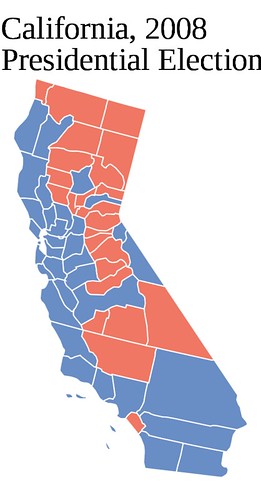
As America’s most populous state, California contains a number of distinct regions. This post, and the one following, will examine each.
More below.
Upper California and the Sierra Nevada
When people think of California, the northern forests and year-round snow of the Sierra Nevada generally do not come into mind. These regions, geographically expansive yet thinly populated, tend to vote loyally Republican (although until the 1970s Democrats had a base of support in several northeastern counties).
Not all of this region is Republican-voting, unpopulated wilderness. Exurban Placer County, for instance, contained 173,812 voters in 2008. Other parts – especially the liberal coast – tend to vote Democratic, eating in to Republican strength.
Ms. Fiorina will probably need something like 70% of the vote in places like Placer County to win. Strong margins from this Republican stronghold constitute the first, easiest step to a Republican victory.
The Bay Area
In many ways, the Bay Area is what makes California a blue state. Without the Bay Area, for instance, President George W. Bush would – almost – have won California in 2004, losing by a mere 0.7%.

Unfortunately for Republicans, the Bay Area – one of the richest, most diverse, and most liberal places in the country – does indeed exist, and it votes strongly Democratic. A popular attack against Senator Boxer is to call her a San Francisco liberal; this generally works less well in San Francisco.
In addition, voting habits in the Bay Area tend to be “sticky.” If the rest of California moves ten points more Republican, the Bay Area will tend to move only five points right. San Francisco and Alameda counties are sometimes the last two counties standing during Republican landslides.
There is a glimmer of hope for Republicans, however. The counties surrounding San Francisco and Berkeley tend to be one degree less intense in their liberalism. Ms. Fiorina will not win them, but a well-run campaign can reduce Democratic margins somewhat.
Central Valley
Home to some of the richest farmland in America, the counties composing Central Valley once leaned Democratic but now vote Republican in all but Democratic landslides. Conservative and heavily populated – although not by California standards – Central Valley provides somewhat of a reservoir to offset the enormous Democratic margins radiating from the Bay Area.
There is, however, one important exception: Sacramento, a populous county whose Democratic leanings deny Republicans a vast store of potential votes.
In the long run, Central Valley is a ticking time bomb. Democratic-voting Latinos compose 30-50% of the population in many of these counties, and their numbers will only increase. For now Ms. Fiorina is safe – Latinos do not vote their numbers, especially in mid-terms – but future Republicans cannot take Central Valley for granted.
The Challenge of Southern California

It is in the urban sprawl of SoCal, however, where Republicans face their greatest challenge. Ms. Fiorina has two tasks here. The first is to win the counties outside Los Angeles, and win them big. The second is to keep Los Angeles itself within single digits.
The next post will expand upon SoCal and offer a conclusion on Republican prospects of winning California.
–Inoljt, http://mypolitikal.com/
KY-Sen: Conway Noses Paul in New Poll
Braun Research for cn|2 (8/16-18, likely voters, 8/2-4 in parens):
Jack Conway (D): 42 (31)
Rand Paul (R): 41 (41)
Undecided: 16
(MoE: ±3.5%)
cn|2 is reporting this one as a tie, and it essentially is — down to decimal points, Conway leads by a margin of 41.7 to 41.2 for the rogue ophthalmologist. (Update: Not that we think it’s legit to go to so many significant digits…)
Rand Paul’s campaign is questioning Braun for its gyrating results, but cn|2 notes that other results from the last two polls, such as Obama’s approval (40%) and the generic ballot (a 12-point GOP advantage), have been consistent. Perhaps the shift is legit, and perhaps it could be explained in part by Paul’s controversial comments on how the illicit drug trade in Kentucky is not a “real pressing issue” and that federal funding for anti-drug initiatives should be pulled. That sort of talk didn’t go over too well with law enforcement officials in Eastern Kentucky, where the problem is particularly pronounced; it’s worth noting that the Congressional District with the biggest jump in support for Conway was the Eastern 5th CD. Conway trailed in that district by 24-38 two weeks ago, and now trails by only 38-42. (Yes, the usual caveat about obese margins of error applies for small sub-samples like these.)
There’s still some life in this one, yet.
SSP Daily Digest: 8/19 (Afternoon Edition)
• LA-Sen: That ginned-up internal poll that Chet Traylor released a few days ago (showing him within 12 of David Vitter) seems to have served its intended purpose, for what its worth: the contributions have started coming in at a much greater pace over the last few days. He pulled in $30K in three days, almost doubling up on the $42K he raised over the previous duration of his campaign (and most of which he blew on his new anti-Vitter radio ad). And this can’t please Vitter, either: a local paper is reporting to Vitter’s troublesome ex-aide, Brent Furer, traveled back from DC to Louisiana several times on the public’s dime, at points that just happened to coincide with his various trials on charges of drunk driving.
• NV-Sen: Sharron Angle seems to be wandering all over the map in search of a position on Social Security privatization, one that’s extreme enough to satisfy her teabagging core supporters but not so extreme that it scares off, y’know, old people. She’s removed the words “transitioned out” from her website (regarding Social Security) but, when pushed yesterday, said that she hasn’t changed her view that that’s how she feels about it (despite running ads claiming that she wants to “save” Social Security).
• PA-Sen: Joe Sestak, meet Raul Labrador? As you probably know, there’s a common-sense rule of thumb that you don’t release your internal polls unless they show you, y’know, ahead of your opponent. Nevertheless, somebody (unclear whether it was the DSCC or the Sestak camp) leaked NBC a Peter Yang internal of the race giving Pat Toomey a 2-point lead over Sestak, 46-44. Obviously, that’s not designed to create a sense of Sestak’s inevitable victory as most internals are designed to do, but it’s pushback against this week’s PPP poll, where the switch to LVs hurt Sestak’s numbers, probably oriented toward letting contributors know that this race is still in play. The DSCC has also been nailing Toomey on the rather arcane issue of derivatives, which had a key role in inflating the asset bubble that popped and left all our faces covered in pink sticky goo in 2008. Somehow I doubt more than 1% of the nation can offer a cogent explanation of what derivatives (especially credit default swaps) do, but at any rate, they’ve tracked down three separate times when Toomey as Congressman, on the House floor, praised the use of derivatives, something he’s lately tried to distance himself from.
• WA-Sen: We’re up to 67% reporting in Washington, with the numbers not really having budged from Tuesday night (still 46 Patty Murray, 34 Dino Rossi, 12 Clint Didier), but more than three-quarters of the remaining precincts are in the Dem-friendly King, Pierce, and Snohomish Counties, so look for some future budging. Meanwhile, here’s a comparison that only true politics junkies will get… remember Fred Heineman? (The one-term Republican House member from NC-04 swept in in 1994, who then said that his $183,000 salary made him “lower-middle-class” and that the middle class extended up to $750K, and promptly got swept out in 1996.) Dino Rossi has apparently decided that he should be Washington’s answer to Heineman, as he essentially said that one-third of Washingtonians make over $200K per year. More specifically, he said 2.5 million Washingtonians would benefit from keeping the Bush-era tax cuts for those making more than $200K/yr. (In reality, 105K households, or 1.6% of the state’s population, fit that profile.)
• CA-Gov: Here’s an iceberg in the way for the serene cruise of the Queen Meg: activists at a convention of state conservatives this weekend plan a rude welcome for her. They plan to lambaste her on her non-extreme positions on an Arizona-style immigration law in California, and her support for greenhouse gas-limiting Proposition 19 23. Also, here’s some quantitative evidence for something that I’ve long suspected: Whitman has so oversaturated the airwaves with advertising that it went well past the point of having its desired effect and is now just getting people pissed off at her. A Jerry Brown staffer leaked that nugget from internal polling, finding that her own advertising has helped Whitman with 8% of voters and hurt her with 27% of voters.
• IA-03: Hot on the heels of the David Rivera story in FL-25, here’s another uncomfortable blast from the past for another Republican House candidate: records reveal that Brad Zaun, the GOP’s nominee against Leonard Boswell, had to be told by West Des Moines police to stay away from his ex-girlfriend after a late night visit to her house to pound on her windows and call her names.
• MO-03, MO-04: Odd little pollster We Ask America seems to be entering another period of being prolific, as now they’re out with a couple House polls from the underserved state of Missouri. They find Russ Carnahan fairly comfortable against Republican challenger Ed Martin in the 3rd, leading 48-39, but find veteran Dem Ike Skelton in a tighter race in the 4th, leading Vicky Hartzler 45-42. Skelton still draws the support of 27% of Republicans and 37% of indies, crucial to surviving this dark-red district.
• CfG: The Club for Growth is starting to switch gears from primaries (where they seem to have had a more productive run this year than in previous cyles) to the general. They’ve endorsed four Republican challengers who all cleared the primary bar: Stephen Fincher in TN-08, Todd Young in IN-09, Mick Mulvaney in SC-05, and Tim Griffin in AR-02.
• Ads: The most attention-grabbing ad today seems to be from Indiana Dem Joe Donnelly, who already tried to distanced himself from “the Washington crowd” in his previous ad. Now he’s basically thrown in the towel on trying to fight the messaging war and just start running with Republican memes, touting his opposition in his newest ad to “Nancy Pelosi’s energy tax.” Other ads worth checking out today include an RGA ad for Duke Aiona in HI-Gov, a Joyce Elliott ad in AR-02, a Michelle Rollins spot in DE-AL, and a Mike McIntyre ad in NC-07.
• Rasmussen:
• MD-Gov: Martin O’Malley (D) 45%, Bob Ehrlich (R) 44%
• NV-Gov: Rory Reid (D) 36%, Brian Sandoval (R) 52%
• WA-Sen: Patty Murray (D) 48%, Dino Rossi (R) 44%
AR-02: Griffin Up by 17 Points
Talk Business Research/Hendrix College for Talk Business (8/17, likely voters, no trend lines):
Joyce Elliott (D): 35
Tim Griffin (R): 52
Lance Levi (I): 3
Lewis Kennedy (G): 1
Undecided: 9
(MoE: ±3.7%)
Oof. The story is in the favorables: Griffin, who won his two-way primary back in May without a runoff, has a net favorable rating of 53-21. Elliott, who slogged through two rough rounds of primary balloting, is underwater at 32-45. Griffin even leads in Dem-friendly Pulaski County, which was one of those rare spots in Arkansas that voted for Barack Obama back in 2008.
The NRCC is already telegraphing that they consider this race in the bag, going so far as to highlight the open seat race in Arkansas’ 1st CD as a target for ad dollars this fall while signaling that they’re prepared to let Griffin stand on his own.
SSP currently rates this race as Lean Republican.