Cost of War is budgetary ‘Elephant in the Room’

In challenging times like ours, it is important to step back and look at the big picture. In the Senate we wrestle with painful choices to balance the state budget. Some factors affecting the budget are outside of our control, some we can control, and others fall somewhere in-between. While most legislative work addresses things we have direct control over, we should at least understand other factors influencing the resources available.

The cost of the Iraq and Afghan wars is the budgetary “elephant in the room.” It’s enormous and it’s right in front of us, yet we don’t talk about it as we face our economic woes. We don’t need to get into arguments about the wars to consider the burden war places on our economy.

President Dwight Eisenhower, one of our nation’s greatest military leaders, late in life, expressed deep concern about what he called “the military industrial complex.” Eisenhower stated, “Every gun that is made, every warship launched, every rocket fired, signifies in the final sense a theft from those who hunger and are not fed, those who are cold and are not clothed.”

During World War II, people were told that the war would require blood, toil, tears, and sweat — real sacrifice, not just for soldiers overseas, but also for the people back home.

In contrast, for the current Iraq and Afghan wars, people were told they wouldn’t have to sacrifice at all; taxes would be cut, not raised. President Bush told people after 9/11 that the patriotic thing to do was to “go shopping.” Perhaps that was due to delusional ideology, or perhaps it was a trigger-happy leader who recognized that if people understood the true cost, the war would be unjustifiable.

What this means for Minnesota’s economy is clear. In addition to the incredible sacrifices made by so many military families, Minnesota’s share of the cost of the wars now exceeds $5 billion for every two-year state budget cycle. Think of the investments that could be made in our communities if the federal government invested that money in the states instead of in the war. We could have avoided the layoffs of teachers and police and firefighters and health care workers. Think of the investments in living wage jobs, the investments in nursing homes for seniors, the investments in early childhood and helping at-risk kids succeed, the investments in public infrastructure.

Minnesotans working to build a better future face growing setbacks: Young people on the “six year plan” to get a two year college degree because they work two jobs to pay tuition. Parents struggle to find a safe place for their young kids during the workday because of cuts in sliding-fee child care. Employers unable to hire older workers because their pre-existing conditions would send the employer’s insurance premiums through the roof. People with disabilities face shrinking state programs that once covered them.

Those setbacks occur because states are unable to help people get a fair shake due to budget problems. It is time to press Washington to change its priorities away from war and into facing human needs in our communities.

The military budgets of all other nations of the world combined, barely exceeds the $693 billion the U.S. will spend on the military this year. And the $693 billion doesn’t include the $42 billion for Homeland Security, nor the undisclosed budget for the National Intelligence Program.

Based on population, Minnesota’s share of total military spending, including the two wars, is almost $12 billion every year. That’s two-thirds as large as our entire state general fund budget of roughly $17 billion/year. Imagine what we could accomplish if we cut our military spending by half. The savings would balance the state budget and make huge investments in education and community development.

President Eisenhower said, “I hate war, as only a soldier who has lived it can, as one who has seen its brutality, its futility, its stupidity.” He was clear in his message: “This world in arms is not spending money alone. It is spending the sweat of its laborers, the genius of its scientists, the hope of its children.”

Sixty years later, we can see that the endless war has a real cost here at home. For the first time in our history, we are losing ground: High school students today have a lower graduation rate than their parents’ generation. Fewer young adults have access to health care than their parents have. Today’s workers will be less likely to have a decent pension than their parents enjoy. Eisenhower warned us. In spending money on war, we are truly taking away the hope of our children.

If we care about our future, ignoring the economic cost of war is just as foolish as ignoring the human cost.

___

I am seeking the governorship this year in my home state of Minnesota. Please visit my website @ http://www.johnmarty.org – Would love to hear your thoughts.

Texas Primary Results Thread

1:25am (J): Team SSP is signing off for the night. Feel free to keep the flame going in the comments, though.

12:43am (J): Ugh, the AP has called the TX-22 Dem nomination for LaRouchite nutcase Kesha Rogers. Check out these pics that we pulled from her campaign website.

12:36am: Man, check out that Land Commissioner race: Austin attorney Hector Uribe leads east Texas realtor Bill Burton by 236,921 to 236,634. That’s less than 300 votes.

12:20am: Ultra-geezer Ralph Hall is winning with just 58%. A united front could surely unseat him in 2012 – if he doesn’t retire. His weakness perhaps suggests his district might also be on the chopping block come redistricting. Despite his extraordinarily advanced age, he just doesn’t have that much seniority in the GOP caucus, since he only switched in 2004.

12:12am (D): TX-17 and TX-23 Republican primaries will go to runoffs, between Flores/Curnock and Canseco/Hurd respectively. Meanwhile, over in TX-22, some f*cking LaRouchie is leading the Dem field with 53% of the vote. Hard to believe Nick Lampson was our nominee here less than two years ago.

11:59pm: Looking at the Board of Eduaction again… Over in the ominously-named District 9, “moderate” Republican Tom Ratliff is ahead of lunatic Republican Don McLeroy by just under 2000 votes with most of the votes counted.

10:59pm (J): The AP has called the Ag Commish race for Hank Gilbert. Kinky Friedman will have to find some other way into this show.

10:56pm: TX-18: Sheila Jackson Lee has been declared the victor. Jarvis Johnson got into the race too late.

10:37pm (J): Despite the snoozefest at the top of the ballot, there are some pretty suspenseful elections for the TX Board of Education — especially in District 9. Darth Jeff has the details.

10:32pm: Looks like her wish came true: KBH just called Rick Perry to concede. Presumably her brain trust ran the numbers and found he’d stay over 50% no matter what.

10:27pm: The saddest thing is that KBH is up in her hotel suite praying that Rick Perry doesn’t fall below 50%.

10:12pm: The TX-23 Dem primary has been called for Ciro Rodriguez – no surprise there. The GOP side is a bit more interesting, with Quico leading Hurd 37-31. Still three quarters of the vote to count, so maybe Quico will lose again. UPDATE: Of course, there’s still the little matter of the run-off….

10:10pm (D): Check out the race for Land Commissioner – the two Dems are literally tied at 50% apiece.

10:09pm (J): 18% in, and Perry sits at 52.2%.

9:59pm (David): 13% and Perry’s at 52.5%. I’m not optimistic.

9:36pm: With 6.9% in, Perry’s take has nudged down to 52.6%.

9:24pm: Wowza. Incumbent Republican Railroad Commissioner Victor G. Carrillo is losing his primary to newcomer David Porter by 19 points. That’s a shockingly huge spread to me, but I wasn’t giving that race any attention at all. Can any local commenters fill in the gaps on this one?

9:17pm: Let’s look at some House races! With 8.3% in, TX-04 fossil Ralph Hall is checking in at under 57%. In TX-17, Bill Flores leads ’08 candidate Rob Curnock by 36-27. And in TX-23, Quico Canseco leads Will Hurd by 36-30.

9:08pm: The AP calls it for White, which was expected, but still good news. Perry’s at 52.9% with just 2.8% of precincts reporting.

9:04pm: Just looking further down the totem poll here… Surprisingly (to me, at least), Kinky Friedman is down by about 8 points to Hank Gilbert in the Ag Commissioner race. Linda Chavez-Thompson has a bigger lead on Ronnie Earle for the Lt-Governor nod, but there are still tons of votes left to count.

8:47pm (James): Wow. It looks like Democrat Eileen Filler-Corn just barely retained the swingy VA-HD41 seat by a margin of 42 votes. I’d expect a recount!

8:31pm: While the Texas results trickle in, that VA House race is super-close. However, Johnny thinks the remaining precincts probably favor the Dem.

8:15pm: Some early numbers (less than 1% reporting) show White just crushing while Perry is over 50%.


Polls have just closed in most of Texas (though they are still open another hour in the El Paso area). We’ll be bringing you returns as they come in. If you have any other good sites for results links, please let us know.

Results: Politico | Associated Press | Secretary of State

Updated with new Houston Districts!-Texas GOP Gerrymander with Political Data

I had been working on Texas maps for a few months but wasn’t fully sure about how my districts would turn out without political data. Now that Dave’s Redistricting App has political data for Texas, I have created a 36 seat map that should produce a 25-11 GOP majority. All current incumbents remain safe for the near future, with the exception of Chet Edwards, whose seat is completely dismantled. Four new seats are created, one for the Dems, and three for the GOP. It was interesting to see what’s possible, though I definitely wouldn’t support this plan in real life. Here are some maps as well as my analysis of each district:

Whole State
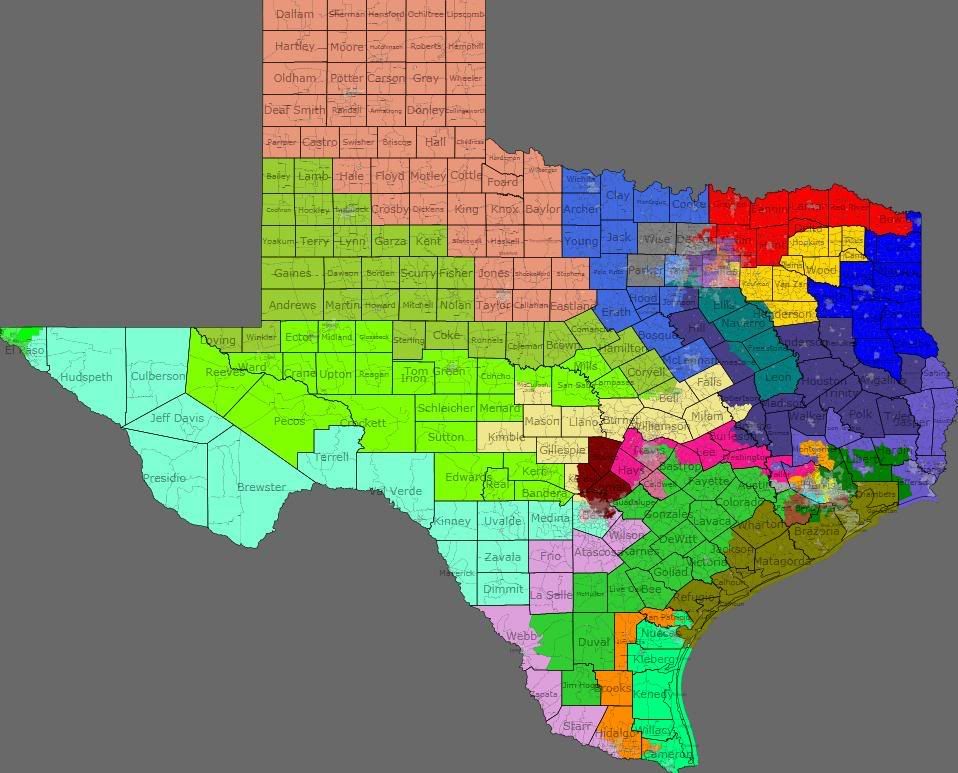
Photobucket

The Districts

East Texas

District 1 (Blue): East Texas-Tyler, Longview, Texarkana; Louie Gohmert (R)

New 2008 results: 68% McCain-32% Obama

Old 2008 results: 69% McCain-31% Obama

Racial stats: 70% white, 20% black, 8% Hispanic

This is still a solidly-Republican district in East Texas, although the district moves north slightly. Louie Gohmert or any Republican will be more than safe here.

Houston
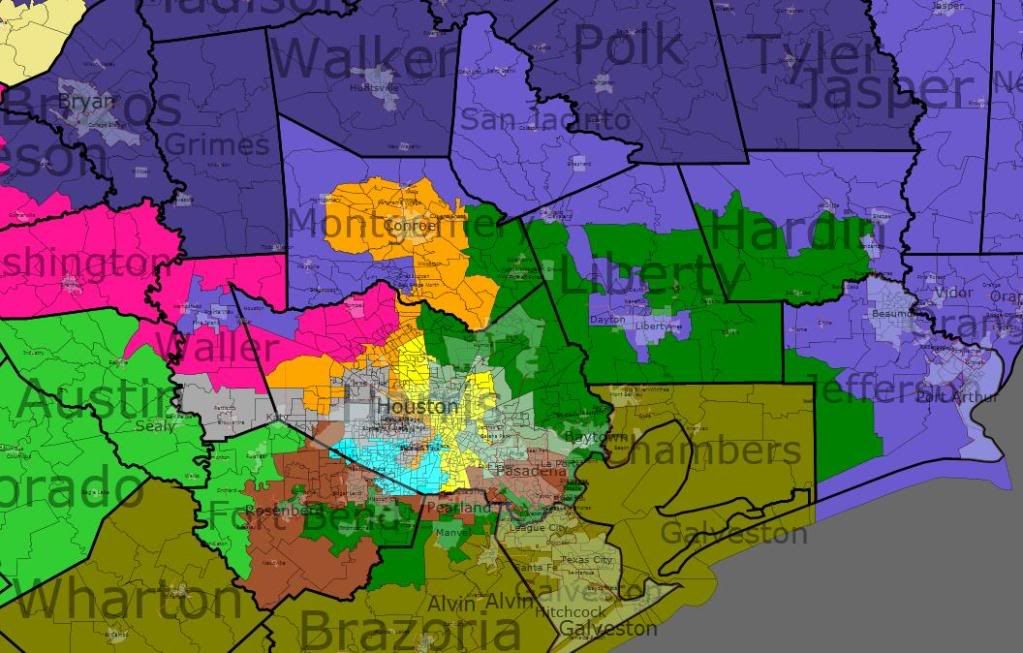
Photobucket

District 2 (Dark Green): Montgomery County, Humble, Northern Harris County, Fort Bend County; Ted Poe (R)

New 2008 results: 61% McCain-38% Obama

Old 2008 results: 60% McCain-40% Obama

Racial stats: 66% white, 18% Hispanic, 11% black, 5% Asian

This district loses nearly all of its territory in East Texas, including Democratic areas in Liberty, Port Arthur, and Beaumont. It now reaches into Montgomery County. It also stretches down into Brazoria and Fort Bend Counties, as well as Pasadena to help shore up Pete Olson. Still a safe GOP district, and the Republican performance in fact increases.

District 7 (Gray): Houston and western Harris County, Katy; John Culberson (R)

New 2008 results: 62% McCain-37% Obama

Old 2008 results: 58% McCain-41% Obama

Racial stats: 65% white, 20% Hispanic, 9% Asian, 6% black

This district remains, at its core, a heavily Republican district, and in fact becomes more Republican, although the demographics are shifting. Culberson will probably not be in much danger anytime soon seeing as he faced a decent opponent in 2008 and still did very well. The district had to lose some of its Republican areas in the northern half to help create TX-36, a new Republican district, but gains areas to the west from TX-10

District 8 (Light Blueish Purple): Montgomery County, East Texas; Kevin Brady (R)

New 2008 results: 63% McCain-36% Obama

Old 2008 results:  74% McCain-26% Obama

Racial stats: 71% white, 19% black, 8% Hispanic

This district sees a huge drop in Republican performance to help shore up some neighboring districts, but it should not put the GOP in any electoral danger anytime soon. It loses territory in Montgomery County to TX-02 and the new Republican TX-36 and picks up the Democratic areas of Liberty, Beaumont, and Port Arthur from TX-02. Maybe with the diminished influence of Montgomery County Jim Turner or Nick Lampson could have won here in 2004.

District 9 (Light Blue): Southern Harris County; Al Green (D)

New 2008 results: 74% Obama-25% McCain

Old 2008 results: 77% Obama-23% McCain

Racial stats: 34% black, 32% Hispanic, 21% white, 13% Asian

This district keeps a black plurality and remains safely Democratic, so Al Green should be happy and protected from a primary challenge by a Hispanic for the time being. The district became 3 points less Democratic for contiguity reasons, but changed very little.

District 14 (Bronze): Galveston, Brazoria County, Texas coastline; Ron Paul (R)

New 2008 results: 64% McCain-35% Obama

Old 2008 results: 66% McCain-33% Obama

Racial stats: 63% white, 22% Hispanic, 12% black

This district loses its share of Fort Bend County as well as all of Victoria County, but it gains all of Galveston County from TX-22 and some areas from TX-15 and TX-27. Republican performance decreases somewhat, but Ron Paul or any Republican should still be safe here for a long time.

District 18 (Banana Yellow): Houston; Sheila Jackson-Lee (D)

New 2008 results: 83% Obama-17% McCain

Old 2008 results: 77% Obama-22% McCain

Racial stats: 49% black, 31% Hispanic, 15% white

This is now the most Democratic district in Texas and also the most partisan for either party, with a whopping 66% margin for Obama. The black percentage rises to 49%, which will probably isolate Sheila Jackson-Lee from a Hispanic primary challenge, although Al Green may push for some of those black voters for his own district. The Republican and competitive areas on the western edge of the district are lost to the new TX-36, and in return the district picks up some more territory to the south from TX-09.

District 22 (Brown): Sugar Land, Pearland, Pasadena, Rosenberg; Pete Olson (R)

New 2008 results: 61% McCain-38% Obama

Old 2008 results: 58% McCain-41% Obama

Racial stats: 62% white, 19% Hispanic, 11% Asian, 8% black

This already Republican district becomes even more GOP-friendly, and the district shrinks, losing Democratic areas in Fort Bend and Brazoria Counties to TX-02 and all of its territory in Galveston County to TX-14. Pete Olson should be more than okay for now, although the demographics in the district may shift over the next decade. He would probably have performed better against Lampson in 2008 in this district as it lacks now lacks any of Galveston County.

District 29 (Light Grayish Olive): Houston; Gene Green (D)

New 2008 results: 63% Obama-37% McCain

Old 2008 results: 62% Obama-38% McCain

Racial stats: 66% Hispanic, 22% white, 10% black

This district is essentially unchanged from its current form as a Democratic and Hispanic-majority East Houston district, so the only thing Gene Green has to worry about is a Hispanic primary challenger, although that hasn’t been a losing issue for him yet over the last 18 years.

District 36 (Mango): Houston, Conroe, Montgomery County; new Republican district

New 2008 results: 62% McCain-37% Obama

Old 2008 results: New district

Racial stats: 65% white, 23% Hispanic, 7% black, 5% Asian

I thought there was still room in the Houston area to create a new Republican district without really weakening any Republican incumbents and it was indeed possible to so. The district takes all the Republican western parts of Sheila Jackson-Lee’s district and also takes a bit from Culberson, Poe, and McCaul’s districts, although it doesn’t put any of them in serious danger electorally. It also gets a big GOP boost by taking a lot of of Montgomery County from TX-08, which pushes it over the 60% mark. If the Republicans can’t win this new seat it would be shocking.

Dallas/Forth Worth Area
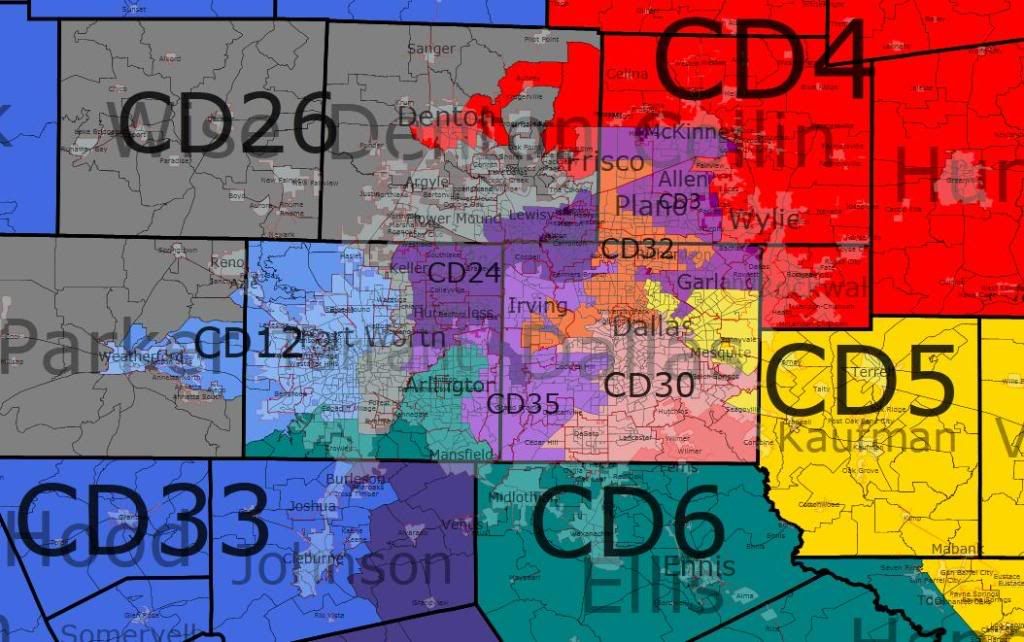
Photobucket

District 3 (Grapy Purple): Plano, Garland; Sam Johnson (R)

New 2008 results: 57 % McCain-42% Obama

Old 2008 results: 57% McCain-42% Obama

Racial stats: 66% white, 16% Hispanic, 9% black, 9% Asian

This district’s 2008 results remain the same, but the district itself changes. The district moves north and east to take in some Collin County areas from TX-04 and loses some Republican areas in Plano to make TX-32 safer. This district should remain in GOP hands for the immediate future, even after Sam Johnson retires.

District 4 (Red): North Texas border counties, Fort Worth suburbs, Denton, Collin County; Ralph Hall (R)

New 2008 results: 67% McCain-32% Obama

Old 2008 results: 69% McCain-30% Obama

Racial stats: 80% white, 10% Hispanic, 7% black

This district becomes a bit less Republican, losing some of its East Texas counties to TX-01 and TX-05 and some of its Collin County territory. It also picks up Democratic areas in Denton to strengthen TX-26. It’s more than safe for Hall or any Republican, although it’s quite different from the East Texas-based district that Hall was elected from earlier in his career.

District 5 (Yellow): Northeast Dallas, rural East Texas counties; Jeb Hensarling (R)

New 2008 results: 63% McCain-36% Obama

Old 2008 results: 63% McCain-36 Obama

Racial stats: 72% white, 14% Hispanic, 12 % black

This district changes geographically but the political realities remain mostly the same, with the district losing some Democratic areas to TX-30 and the rural East Texas part of the district moving north somewhat. Still a safe GOP seat for a while to come.

District 6 (Dark Teal): Arlington, Forth Worth suburbs, Ennis; Joe Barton (R)

New 2008 results: 62% McCain-37% Obama

Old 2008 results: 60% McCain-40% Obama

70% white, 14% Hispanic, 11% white

The district remains essentially in its present form, although it loses some of the southern parts of the district to TX-17. The district becomes more Republican as it loses some Democratic areas in Tarrant County.

District 12 (Periwinkle): Forth Worth, Weatherford; Kay Granger (R)

New 2008 results: 60% McCain-39% Obama

Old 2008 results: 63% McCain-36% Obama

Racial stats: 64% white, 25% Hispanic, 6% black

This district becomes smaller in area as it loses Wise County and much of Parker County to TX-26, but it remains quite Republican. That combined with Kay Granger’s popularity in Forth Worth should keep it red.

District 24 (Dark Purple): Lewisville, Irving, Carollton, Hurst; Kenny Marchant (R)

New 2008 results: 62% McCain-37% Obama

Old 2008 results: 55% McCain-44% Obama

Racial stats: 71% white, 15% Hispanic, 8% Asian, 6% black

While this district may be trending Democratic in the long-term, the southern parts of the district that were more Democratic such as Grand Prairie and Duncanville are now in the new TX-35. The new district is also 71% white, which counters many of the demographic shifts over the past district. The result is a 7% jump in Republican performance, which should keep Kenny Marchant or another Republican safe for the next decade.

District 26 (Dark Gray): Denton suburbs, Fort Worth, Flower Mound, Wise/Parker counties; Michael Burgess (R)

New 2008 results: 62% McCain-38% Obama

Old 2008 results: 58% McCain-41% Obama

Racial stats: 71% white, 14% black, 12% Hispanic

Any improvements that Democrats have made in Fort Worth and Denton County will be cancelled out by this plan. This already Republican district picks up most of the Wise and Parker County areas from TX-12, and the Democratic parts of Denton go to TX-04, which remains quite Republican as well. I didn’t touch the Fort Worth part of the district, which is a remnant of the dismantling of Martin Frost’s old TX-24 and has a lot of Democrats, but it shouldn’t matter too much for now because of Republican strength elsewhere. The district should be a safe GOP hold throughout the decade.

District 30 (Orangish Pink): Dallas; Eddie Bernice Johnson (D)

New 2008 results: 79% Obama-21% McCain

Old 2008 results: 82% Obama-18% McCain

Racial stats: 39% black, 32% Hispanic, 27% white

This remains a heavily Democratic, black-plurality district based in metro Dallas that Eddie Bernice Johnson should be more than happy with. It changes very little although it trades a little territory with TX-05 and TX-32, as well as the new TX-35.

District 32 (Burnt Orange): Dallas, Plano, Richardson, University/Highland Park; Pete Sessions (R)

New 2008 results: 61% McCain-37% Obama

Old 2008 results: 53% McCain-46% Obama

Racial stats: 75% white, 16% Hispanic, 6% black

Perhaps no GOP district swung more to the Democrats than Pete Sessions’ TX-32, which gave John McCain a measly 7% margin of victory in 2008. The district in its current form has only a white plurality, although now it is 74% white. The district becomes more Republican by expanding north into Plano and losing minority areas in Irving and Cockrell Hill to the new TX-35, so Pete Sessions should be safe in his new district, although who knows how demographics will change over the next decade.

District 35 (Grapish Purple): Dallas, Duncanville, Fort Worth, Irving, Cockrell Hill; new Democratic district

New 2008 results: 63% Obama-35% McCain

Old 2008 results: New district

Racial stats: 38% white, 35% Hispanic, 20% black, 6% Asian

In order to make TX-24, TX-26, and TX-32 more safely Republican, I thought it was necessary to draw a new Democratic seat in the Dallas-Fort Worth area. The population growth in the area requires at least one new district around here, and the GOP is stretched pretty thin as it is. So this very-Democratic majority-minority district, which is a bit like Martin Frost’s 2002-2004 district, is created as a result. I think it will probably elect a Hispanic, but I don’t know what the voting-age stats for the district, so maybe Hispanics have less influence than it would seem from the surface. This should be a safe Democratic pickup.

Austin/Central Texas
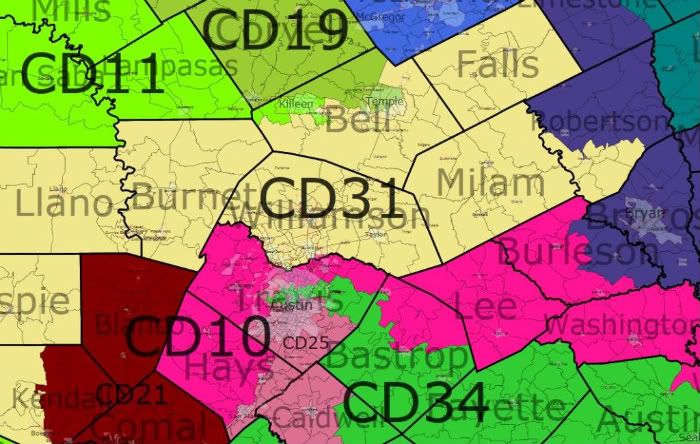
Photobucket

District 10 (Magenta): Austin/northern Travis County, Hays County, western Harris County; Mike McCaul (R)

New 2008 results: 58% McCain-40% Obama

Old 2008 results: 55% McCain-44% Obama

Racial stats: 74% white, 14% Hispanic, 6% black, 5% Asian

This district has been trending more Democratic and it remains similar to its current form, with a few tweaks to make it more Republican as McCain’s 2008 performance increases by 3 points. It loses some of its Democratic areas in Austin and takes in the more conservative areas of Travis County in the north and west, as well as the conservative western half of Hays County. The eastern half of the district, especially in Harris County, loses its influence somewhat as a result. Also, the Hispanic population is reduced to just 14%. This is now much friendlier turf for Mike McCaul.

District 17 (Dark Blueish Purple): Forth Worth suburbs, Bryan, Huntsville, Lufkin, several rural East Texas counties; Chet Edwards (D) or Republican pickup

New 2008 results: 67% McCain-32% Obama

Old 2008 results: 67% McCain-32% Obama

Racial stats: 69% white, 15% black, 13% Hispanic

Chet Edwards will have a difficult time winning reelection with this map, as he sees his current district dismantled. His base in Waco is put in a new heavily Republican 33rd district along with Wichita Falls and West Texas, while TX-17 retains the more hostile parts of his current district and picks up Republican areas to the east from TX-06, TX-08, and TX-01. I think that Edwards would run in this district as it has more of his current territory, although the East Texas parts of the district would probably be very hostile to him. But Edwards is a fighter and may well survive in this district, just as he has in his current district.

District 25 (Dark Pink): Austin, San Marcos; Lloyd Doggett (D)

New 2008 results: 68% Obama-31% McCain

Old 2008 results: 59% Obama-40% McCain

Racial stats: 51% white, 34% Hispanic, 10% black, 5% Asian

In order to make TX-10 safer for McCaul and create a new Republican TX-34, this district becomes even more of an Austin district and a Democratic stronghold, with Obama’s performance increasing by 9 points to a whopping 68%. The GOP has kind of already ceded this district to Lloyd Doggett, and he will have a much friendlier district.

District 31 (Beige): Temple, Williamson County, Brady, rural West Texas counties

New 2008 results: 61% McCain-37% Obama

Old 2008 results: 58% McCain-42% Obama

Racial stats: 75% white, 16% Hispanic, 6% black

This district becomes more Republican in order to protect John Carter from any possible shifts in Williamson County over the next decade. His district loses Killeen and Temple and some of the northern counties, but gains area in West Texas from TX-11 and TX-21. It should remain easily Republican for the near future.

District 33 (Ocean Blue): Waco, Wichita Falls, North Texas border counties; Chet Edwards (D) or new Republican district

New 2008 results: 71% McCain-29% Obama

Old 2008 results: New district

Racial stats: 77% white, 13% Hispanic, 8% black

This district is heavily Republican and combines parts of West and North Texas from TX-13 such as Wichita Falls, Erath County from TX-31, and parts of Chet Edwards’ 17th district, including his base in Waco. Edwards could run here because it has parts of his old district, most importantly Waco, but it would be an uphill battle given the new territory in North/West Texas. If Edwards doesn’t run here, consider it a safe GOP pickup.

West Texas

District 11 (Lime Green): Midland/Odessa, San Angelo, Killeen; Mike Conaway (R)

New 2008 results: 68% McCain-31% Obama

Old 2008 results: 76% McCain-24% Obama

Racial stats: 57% white, 29% Hispanic, 10% black

While the Republican performance drops 8 points from the current district, it remains extremely Republican. The district loses much of its northern territory to TX-19, and as a result, it shifts east and south to take in territory from TX-21 and TX-23. It also takes in the Democratic areas of Killeen in Bell County, which in turn helps make TX-31 more Republican.

District 13 (Tannish Brown): Amarillo, Abilene; Mac Thornberry (R)

New 2008 results: 77% McCain-22% Obama

Old 2008 results: 77% McCain-23% Obama

Racial stats: 70% white, 23% Hispanic, 5% black

This is still the most Republican district in Texas and one of the most Republican districts in the nation. It changes significantly, losing Wichita Falls and most of the eastern territory to the new TX-33, but picks up Abilene and shifts south into the current TX-19. Interestingly, it is quite possible that if Charlie Stenholm had run in this district in 2004 he could have survived as it has much of his rural base and Abilene. But no other Democrat will win this district for a long time.

District 16 (Bright Green): El Paso; Silvestre Reyes (D)

New 2008 results: 65% Obama-34% McCain

Old 2008 results: 66% Obama-34% McCain

Racial stats: 76% Hispanic, 18% white

This district doesn’t change much at all and remains based in El Paso as a heavily Democratic and Hispanic district. Silvestre Reyes will be in office for as long as he wants.

District 19 (Olive Green): Lubbock, West/Central Texas, Temple; Randy Neugebauer (R)

New 2008 results: 71% McCain, 28% Obama

Old 2008 results: 72% McCain, 27% Obama

Racial stats: 64% white, 26% Hispanic, 8% black

The district loses the city of Abilene and much of its northern territory to TX-13, so it expands eastward to take in parts of TX-31 and picks up Temple and Democratic areas in Bell County. The district becomes only slightly less Republican and Neugebauer and the GOP can consider it a safe hold for years to come.

South Texas

District 15 (Orange): McAllen, Harlingen, Alice; Ruben Hinojosa (D)

New 2008 results: 64% Obama-35% McCain

Old 2008 results: 60% Obama-40% McCain

Racial stats: 84% Hispanic, 15% white

While several of the northwestern counties are lost to the new TX-34 and TX-14, the district remains centered on the border cities of McAllen and Harlingen. It is one of the most Hispanic districts in the country, and Democratic performance increases as well, making victory assured for Hinojosa or any Hispanic Democrat running here.

District 27 (Greenish Turquoise): Corpus Christi, Brownsville; Solomon Ortiz (D)

New 2008 results: 54% McCain-45% Obama

Old 2008 results: 53% McCain-46% Obama

Racial stats: 70% Hispanic, 26% white

This district is virtually unchanged and remains heavily Hispanic and safe for Solomon Ortiz. It only went for Obama by 9 points in 2008 and probably voted for Bush by in 2004, although I don’t think this will become a Republican seat any time soon and I wasn’t going to try at the expense of the new Republican Hill Country district, TX-34.

District 28 (Rose Pink): Laredo, Brownsville; Henry Cuellar (D)

New 2008 results: 63% Obama-36% McCain

Old 2008 results: 56% Obama-44% McCain

Racial stats: 84% Hispanic, 14% white

After losing several eastern Republican counties to the new TX-34, Democratic performance in this district goes up by 7 points, and at 84% it is possibly the most Hispanic district in the country. I wonder if maybe this district could get a better representative than Henry Cuellar now that it is more Democratic…

District 34 (Tropical Green): Austin, Victoria, Texas Hill Country; new Republican district

New 2008 results: 58% McCain-41% Obama

Old 2008 results: New district

Racial stats: 59% white, 30% Hispanic, 8% black

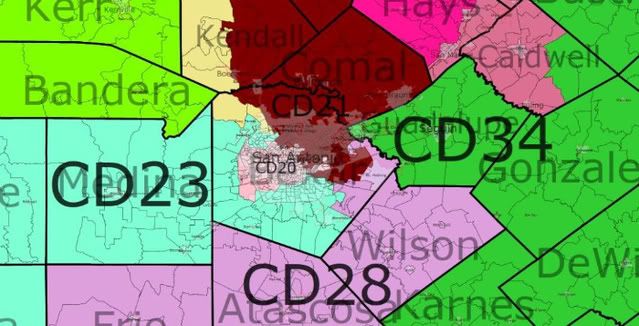
This is one of the most diverse districts in the entire state, containing liberal areas in Austin, conservative areas west of Houston, Victoria and the Central Texas counties known as the Texas Hill Country, and Hispanic areas in South Texas stretching nearly to the Mexican border. It is derived from seven current districts: TX-10, TX-14, TX-15, TX-21, TX-22, TX-25, and TX-28.While the district is just 59% white, it is still very Republican, and would probably elected a Republican easily enough. The demographics may change considerably by the end of the decade though.

San Antonio
Photobucket

District 20 (Peach): San Antonio; Charlie Gonzalez (D)

New 2008 results: 63% Obama, 35% McCain

Old 2008 results: 63% Obama, 36% McCain

Racial stats: 68% Hispanic, 23% white, 6% black

Essentially the same district centered on the city of San Antonio; remains heavily Hispanic and Democratic and becomes even more compact. Not a liability for the Democrats or for Charlie Gonzalez.

District 21 (Reddish Brown): Northern Bexar County/San Antonio, New Braunfels; Lamar Smith (R)

New 2008 results: 61% McCain-38% Obama

Old 2008 results: 58% McCain-41% Obama

Racial stats: 64% white, 24% Hispanic, 8% black

Lamar Smith’s district contracts in area, losing its portions of Travis County and Austin, as well as much of its western parts. It is now almost entirely a Bexar County district, gaining Republican areas from TX-23, which increases the GOP performance by three points, making it an easy hold for the GOP.

District 23 (Sky Blue): El Paso, San Antonio, Eagle Pass; Ciro Rodriguez (D)

New 2008 results: 57% Obama-42% McCain

Old 2008 results: 51% Obama-48% McCain

Racial stats: 68% Hispanic, 26% white

This district goes from swing to heavily Democratic, in large part because of the need for the Republican counties to the north to be taken up by TX-11 and the population growth along the border counties. I think the GOP will concede this one to Rodriguez to avoid weakening TX-21, as well as to make sure that they don’t violate the VRA and have a court redraw the districts again as was the case with the old TX-23 represented by Henry Bonilla from 2004 to 2006. This district was trending Democratic already anyway, now that process is just being accelerated.

By what margin will Bob Shamansky win?

View Results

Loading ... Loading ...

Texas Primaries Prediction Thread

While we’re sitting around waiting for the main event to start, let’s hear your predictions on tonight’s primaries in the Lone Star State. Can one-time sure-thing Kay Bailey Hutchison somehow pull off the upset and beat Rick Perry? OK, OK, you can stop the laughing now… can KBH somehow keep Rick Perry from clearing 50% and avoiding a runoff? Will enough teabaggers show up at the polls for an impressive showing for Debra Medina (and for primary challenges to Ralph Hall and Pete Sessions), or are their 15 minutes of fame/2 minutes of hate coming to a close? Will the long-anticipated matchup of Ciro Rodriguez and Quico Canseco finally come to pass, or will Canseco’s run of primary bad luck continue? And can Bill White clear 50% himself, or will hair care guru Farouk Shami force him into a resource-draining runoff? To prep yourself for answering all these questions, check out DavidNYC‘s preview from last night.

Polls close at 7 pm CT in most parts of the state and will start reporting then, although El Paso (on Mountain Time) closes an hour later. And in the meantime, don’t forget there are state House special elections on tap in Virginia and Connecticut.

SSP Daily Digest: 3/2

AR-Sen: That didn’t take long; Lt. Gov. Bill Halter is already hitting the TV airwaves in his freshly-launched primary challenge to Blanche Lincoln. Now, you may be wondering how he’s paying for that, considering that he’s starting almost from scratch. Turns out he’s coming into this with promises of huge financial backing from organized labor; three unions under the AFL-CIO umbrella are committing $3 million to independent expenditures in the race, which in the cheap Arkansas media markets will allow him to get on a solid footing against Lincoln’s $5 mil. That’s on top of $600K that poured in from the netroots (from MoveOn and the PCCC). See what happens when you piss off your base?

Rasmussen also snapped into action, putting out some further Arkansas numbers, and oddly, they aren’t anywhere near as catastrophic for Lincoln as last month. They still don’t have her in salvageable shape, though: Lincoln loses to Rep. John Boozman 48-39 (compared with 54-35 last month), state Sen. Gilbert Baker 45-40 (compared with 52-33 last month), state Sen. Jim Holt 45-38, state Sen. Kim Hendren 43-38, and businessman Curtis Coleman 43-41. This is Rasmussen’s first time testing Bill Halter, and for now, he’s performing about the same or somewhat worse than Lincoln. Halter trails Boozman 52-33, Baker 44-37, Holt 42-38, Hendren 42-35, and Coleman 38-35.

CA-Sen: DavidNYC’s description of this development pretty much speaks for itself: “The lord taketh away Harold Ford, but may grace us with — I know it’s hard to imagine — an even BIGGER douchebag.” Mickey Kaus, the contrarian, Conservadem blogger, is apparently considering a run for Senate in California, taking out (though not yet filing) the appropriate candidate paperwork. Interestingly, I see no discussion of whether he plans to run in the Democratic primary against Barbara Boxer, or as an indie or a GOPer — not that he’s likely to provide much more than comic relief in any of the three categories.

GA-Sen: Democrats may be kicking themselves for dropping the recruitment ball this year on a challenger to Johnny Isakson for his first re-election bid to the Senate. Rasmussen found him leading Generic D by a not-overwhelming 49-36 last week, and now PPP finds him with a similar but even less convincing win over Generic D, 46-37. Isakson’s approvals are a rather Richard Burr-ish 36/38. However, as seen in North Carolina, Generic D overperforms Real D: in case AG Thurbert Baker was considering jumping over from the gubernatorial race (where he badly lags ex-Gov. Roy Barnes in the primary), he trails Isakson 49-31. Jim Martin, who performed fairly well in the 2008 Senate election, does a little better, losing 47-35.

KY-Sen: As Jim Bunning keeps up his Bizzaro-world Mr. Smith Goes to Washington impression (filibustering to cut off Boy Scouts’ dads’ unemployment compensation), he’s drawing the attention of two of his would-be successors. Democratic Lt. Gov. Dan Mongiardo has called for a rally at Bunning’s Lexington office to protest Bunning’s crazy last stand, while Rand Paul’s campaign in now responding with its own counter-rally in support Bunning’s efforts. (Paul won’t be there himself, and it’s not clear if Mongiardo will either.)

NY-Sen-B: There’s speculation that Harold Ford Jr.’s decision to abandon his Senate plans may have a lot to do with the likelihood of a Mort Zuckerman run on the Republican side — and that a lot of Ford’s moneybags donors were telling him they were with Zuckerman instead if he got in. Or, maybe Ford just got wind of his poll numbers in today’s Marist poll (pdf), giving him little shot at pulling the upset. In the Dem primary, Ford trailed Kirsten Gillibrand 50-19 (with 3 for Jonathan Tasini). Considering that Ford collapsed from an already-bad 44-27 in late January’s Marist poll as he gained notoriety all last month, that seems like plenty of incentive to get out. Gillibrand trails the unlikely-to-run George Pataki in the general 48-45, but demolishes Zuckerman, 59-26, as well as the already-running Bruce Blakeman, 58-28. In the other Senate race, undeclared candidate Larry Kudlow might want to save his money; Charles Schumer leads Kudlow 69-24.

OK-Sen: Rasmussen keeps polling everything that’s pollable, and today that includes the Oklahoma Senate race. No Democrat of note has stepped up to challenge Tom Coburn, and that may be just as well, as the Dems’ best possible candidate, the state’s popular, termed-out Democratic Governor  Brad Henry, still finds himself losing a hypothetical battle to Coburn, 52-40.

TX-Sen: Kay Bailey Hutchison is still insisting that she’s going to resign from the Senate at some point this year, despite the very very very very high likelihood of not winning the Texas gubernatorial primary which looked like hers for the taking a year ago. She still isn’t sure about a date, although it’s pegged to the legislative calendar, as before resigning she plans to, in her words, “stay and fight health care.” PPP’s Tom Jensen sees some interesting possible winners in Hutchison’s fall: Robin Carnahan and Lee Fisher. The scope of Hutchison’s loss tonight may give some insight into just how much this year’s discontent is an anti-Beltway insider, rather than anti-Democratic, bubble. The former, of course, would be a boost to statehouse vets Carnahan and Fisher (ahem, or Jennifer Brunner) as they fight DC hacks Roy Blunt and Rob Portman.

CA-Gov: Apparently, after having spent months meditating away whatever bad vibes he may have felt about the role thrust upon his shoulders as the only man who can save California, Jerry Brown has emerged from his Fortress of Solitude and officially declared his candidacy for Governor. Unfortunately, while he was away, Ursa and Non have had uncontested months to rampage around the city destroying things… although thanks to Brown’s super-powers of bafflement and misdirection, they’ve gotten bamboozled into slugging it out viciously with each other instead. (Meanwhile, General Zod has already left town for the more interesting Senate race.)

GA-Gov: Insider Advantage has polls of both primaries in the Georgia gubernatorial race, although no general election head-to-heads. No surprises on either side: on the Dem side, Roy Barnes is cruising at 36, followed by Thurbert Baker at 7, DuBose Porter at 3, and David Poythress at 2. On the GOP side, John Oxendine leads at 27, followed by Karen Handel at 13, Nathan Deal at 9, Eric Johnson at 7, and Other at 8. While Nathan Deal’s resignation is being spun as allowing him to focus full-time on his seemingly tractionless bid, there’s a darker side to it, too: TPM reports on how he was getting out one step ahead of the Ethics Committee, which was starting to look into allegations of Deal pressuring state officials to intervene on behalf of an auto inspection business that Deal co-owns. With Deal out of the House, the case is closed, at least at the federal level.

MI-Gov: May the Schwarz be with us! It may be the only way we can salvage the Michigan gubernatorial race. Joe Schwarz, the ticked-off moderate ex-Rep. from MI-07 (who got teabagged by Tim Walberg in a GOP primary before getting teabagged was fashionable), is launching an exploratory committee for a gubernatorial run as an independent. This could be a big break for Dems in the gubernatorial race — especially if obnoxious Rep. Peter Hoekstra is the GOP nominee, as Schwarz seems poised to soak up a fair number of moderate votes unenthused by Hoekstra’s right-wing grandstanding. Schwarz seems more likely to be Chris Daggett than Jesse Ventura, though, and if things get really scrambled — for instance, an all-centrist three-way between Andy Dillon, Rick Snyder, and Schwarz — he could potentially harm the Dems as much as the GOP.

NY-Gov (pdf): Marist also takes a look at the Governor’s race. Seeing as how this is their first poll after David Paterson’s announcement that he wouldn’t run for re-election, it’s also the first poll in a long time to contain any good news for Paterson: only 28% of respondents want him to resign, as opposed to 66% who say finish his term. And only 18% think Paterson has done anything illegal, as opposed to a mere 40% who think he merely did something unethical, not illegal. (The bad news: his approval is down to 23/71, which has to be a new low.) With the participants in November’s election now pretty much locked in, they find AG Andrew Cuomo beating ex-Rep. Rick Lazio 64-28. Cuomo’s halo may be shining even brighter as his office begins investigating Paterson; Cuomo’s approval is 67/28.

RI-Gov: One more Rasmussen poll to add to the pile, and they’re seeing more or less what Brown Univ. saw last week, regarding the Rhode Island gubernatorial race. Independent ex-Sen. Lincoln Chafee is definitely in the driver’s seat, although Dem state Treasurer Frank Caprio polls better against him than does AG Patrick Lynch. Only difference here: Rasmussen sees Republican John Robitaille performing much better, although he’s still deep in third place. Chafee wins the Caprio race 37-27-19, while he wins the Lynch race 38-24-22.

GA-07: One of the guys considered a heavyweight in the GOP field in this newly-opened-up seat in the R+16 7th has decided against a run. State Sen. David Shafer announced he’ll take a pass. Fellow state Sen. Don Balfour is already in the running, with state Rep. Clay Cox and Gwinnett Co. Commissioner Mike Beaudreau also expected to join him soon.

MA-10: Maybe I spoke too soon in thinking that Joe Kennedy III’s decision not to run next year was an indication of another term of William Delahunt. It turns out Delahunt has been on a bit of a grotesque spending spree, burning through $560K of his campaign cash last year (including campaign staff salaries for a number of family members). This cuts his war chest in half, and he only raised $42K last year — all actions of a man eyeing the exits. If Delahunt needs something to do with his money, I can think of a certain “DCCC” that could really use help right now, probably much more so than his family members. (H/t Adam B.)

MI-03: State Sen. Bill Hardiman (termed-out from his current job) announced that he’ll run for the open seat in the 3rd, left behind by retiring Vern Ehlers. Hardiman faces state Rep. Justin Amash, already coronated as frontrunner by western Michigan GOP power brokers Dick and Betsy DeVos. If the former Kentwood mayor survives his primary, he’s on his way to returning the Republicans back to having at least one African-American in Congress.

NY-St. Sen.: Give Hiram Monserrate credit for persistence, I guess. Having become the first sitting New York state Senator to get expelled in decades after an assault conviction, Monserrate promptly picked himself up, dusted himself off, and began running in the special election to replace himself. This time, Monserrate is running as an independent, against Democratic Assemblyman Jose Peralta. Peralta has the advantage of the support of the entire Democratic establishment, but Monserrate has one thing on his side: name recognition (not necessarily for good PR, but still…).

Ads: 501(c)(4) League of American Voters is running anti-health care reform TV ads against a whole slew of swing-district Democrats, hoping to sway a few wobblies in the run-up to the next House vote: Mike Arcuri, Dan Maffei, Chris Carney, Paul Kanjorski, Kathy Dahlkemper, Baron Hill, Steve Kagen, Alan Mollohan, Nick Rahall, Tom Perriello, Mark Schauer, Zach Space, and Harry Teague.

Special elections: And you thought the Texas primary was all that was on tap tonight? No, there are two special elections for state Houses, both of which look pretty competitive. The Dems are trying to hold a seat in Virginia in HD-41 in a swingy part of Fairfax County, recently vacated by Dave Marsden’s promotion to the state Senate. The Democratic candidate, Eileen Filler-Corn, may have the edge, in that she has a 3-to-1 fundraising edge over Kerry Bolognese, and the district went for Obama with 57%. On the other hand, Bolognese came within 50-49 of Marsden last fall, and Bob McDonnell won the district with 55%. (Both candidates, unappealingly enough, are lobbyists by day.) The GOP has the edge in the House of Delegates, 59-38-2. And in Connecticut, Democrats are gunning for a pickup in the Stratford-based HD-120, which was vacated by Republican John Harkins becoming Stratford mayor. Democrat Janice Anderson lost against Republican state Sen. Dan Debicella in 2008, although she beat Debicella in the portion of that district that comprises the 120th. She faces off against GOPer Laura Hoydick; the stakes are a little lower here, as the Dems control the state House 114-36.

2010 House elections

After look to very much races, I will try to explain my point about 2010 elections at House level in this diary.

In few words I think they are not data what make me think democrats would lose more than 15 house seats.

Looking to the political level of incumbents and challengers, the rating of the districts, and the fundraising numbers of candidates I will make a rank of house seats, giving too the numbers of the last poll for the race if they are. This is not a rank of vulnerability, this is a rank by political level difference between the current candidates for every district looking to the political level of candidates and looking to the district too.

The rank is based in a little system of score what I create for try see better the difficult races for booth parties. Two examples of the score:

DE-AL currently a republican seat has 4.5 points of difference for the challenger party (Democratic Party). They are 3.0 points for dems by difference between political level of the candidates of booth partys, 0.5 points for dems by lead fundraising and 1.0 points for dems by the district democratic leaning.

TX-17 currently a democratic seat has 0.5 points of difference for the challenger party (Republican Party). They are 1.0 point for dems by difference between political level of the candidates of booth partys, 0.5 points for dems by lead fundraising and 2.0 points for republicans by the district republican leaning.

RANK BY POLITICAL LEVEL OF CANDIDATES FOR EVERY DISTRICT

Sure the system of score can improve still but I think give us a rank so logical.

Possitive difference for the challenger party (high weakness of the incumbent party)

4.5 points DE-AL D+07 Rep seat Last poll -10% R Research 2000 (D)

4.0 points TN-06 R+13 Dem seat

3.0 points KS-03 R+03 Dem seat

2.5 points IL-10 D+06 Rep seat

1.5 points IN-08 R+08 Dem seat

1.5 points ID-01 R+18 Dem seat

1.0 point  LA-03 R+12 Dem seat

1.0 point  NY-29 R+05 Dem seat

1.0 point  LA-02 D+25 Rep seat

0.5 points NM-02 R+06 Dem seat Last poll -02% D PPP

0.5 points IN-09 R+06 Dem seat Last poll -08% D Survey USA (R)

0.5 points ND-AL R+10 Dem seat Last poll -06% D Rasmussen Reports (R)

0.5 points SD-AL R+09 Dem seat Last poll +07% D Rasmussen Reports (R)

0.5 points TX-17 R+20 Dem seat

Tied

0.0 points AR-02 R+05 Dem seat

0.0 points NH-02 D+03 Dem seat Last poll -07% D University of NH

0.0 points PA-07 D+03 Dem seat

0.0 points MI-07 R+02 Dem seat Last poll -10% D National Research (R)

0.0 points NY-23 R+01 Dem seat Last poll +02% D 2009 special election results

0.0 points MS-01 R+14 Dem seat

0.0 points MO-04 R+14 Dem seat

0.0 points MD-01 R+13 Dem seat Last poll -13% D Tarrance Group (R)

Possitive difference for the incumbent party

0.5 points AR-01 R+08 Dem seat

0.5 points TN-08 R+06 Dem seat

0.5 points FL-25 R+05 Rep seat

0.5 points OH-18 R+07 Dem seat

0.5 points SC-05 R+07 Dem seat Last poll +07% D PPP

1.0 point  PA-11 D+04 Dem seat

1.0 point  OH-01 D+01 Dem seat Last poll -17% D SurveyUSA (R)

1.0 point  PA-08 D+02 Dem seat

1.0 point  MA-10 D+05 Dem seat Last poll -03% D McLaughlin & Associates (R)

1.0 point  VA-05 R+05 Dem seat Last poll =00% D PPP

1.0 point  AZ-05 R+05 Dem seat Last poll =00% D American Viewpoint (R)

1.0 point  AZ-08 R+04 Dem seat

1.0 point  IL-14 R+01 Dem seat

1.0 point  NY-24 R+02 Dem seat

1.0 point  PA-06 D+04 Rep seat

1.0 point  WA-08 D+03 Rep seat

1.0 point  NC-08 R+02 Dem seat Last poll +14% D PPP

1.0 point  CA-11 R+01 Dem seat

1.5 points NE-02 R+06 Rep seat

1.5 points MN-06 R+07 Rep seat Last poll +16% R PPP

1.5 points SC-02 R+09 Rep seat Last poll -01% R PPP

1.5 points AL-03 R+09 Rep seat

1.5 points CA-44 R+06 Rep seat Last poll +14% R Tulchin Research (D)

1.5 points NH-01 EVEN Dem seat Last poll -10% D University of NH

1.5 points NY-01 EVEN Dem seat Last poll +02% D Survey USA (R)

1.5 points CA-03 R+06 Rep seat

1.5 points KY-06 R+09 Dem seat

1.5 points CO-04 R+06 Dem seat

1.5 points AL-02 R+16 Dem seat Last poll +24% D Anzalone-Liszt Research (D)

1.5 points MS-04 R+20 Dem seat


2.5 points FL-12 R+06 Rep seat Last poll -04% R Greenberg Quinlan Rosner Research (D)

In the first two groups I bold emphasize the results of polls what favore incumbent party. In the third group I bold emphasize the results of polls what favore challenger party.

These groups of house races include all negative polls for incumbent party.

The first and second groups include difficult races for the incumbent party, with majoritary bad polls for the incumbent party, but not all. Between the first places, they are three republican seats where democrats are favored this year.

The number of seats in this two groups give a difference of +15 seats for republicans. But not all polls are negative for the incumbents in these groups, and not all the seats in these groups will change of party in 2010 elections.

The third group lean clearly toward the incumbent parties and is a group much more balanced with seats of booth parties. They are some unfavorable polls for booth parties, 3 for democrats and 2 for republicans. I think this group of races will give to republicans low number of net gains if the numbers change not to worse.

The polls will be surely the best information for every district, but this rank show us a so low number of districts without poll in the risk zone. This is important now for try stablish limits to loses and for see where is needed more work.

For all that, and looking specially to the polls, I think we have not evidence still of democrats will lose more than 15 seats.

About the seats where GOP is the incumbent party, like I tell before, they are three seats where democrats are favored (all in the first group of races), and they are some others what democrats can make vulnerable. Some days before, in my comments, I give a list of seven seats, but today will be six because I think the chance of win AZ-03 low without P Gordon. This is the list:

1.0 FL-25 (with J Garcia in)

1.0 PA-06

1.0 WA-08

1.5 SC-02

2.0 PA-15 (if J Callahan improves fundraising)

2.5 FL-12 (if L Edwards improves fundraising)

I think FL-25 (the effect of J Garcia running is not included in the rank still) and FL-12 are seats what give so good chance for fight strong. With the lead in  fundraise for democratic side, FL-12 district would low until 0.5 points for the incumbent party (republican party). In very few districts democrats can improve more with lower effort. For PA-15 I think J Callaham needs too take the lead fundraising, and with that, PA-15 race would be in the same level than PA-06 or WA-08 (1.0 points for the incumbent party).

They are more districts in lower level of risk for republicans. I would not forget this district and the other districts with 1.5 points where so unpopular republicans can fail.

PD: Just today one good level republican announce a bid for MI-03 and that makes I update my comments about this race. With higher level republicans, lower chance for democrats in republican open seats.

By what margin will Bob Shamansky win?

View Results

Loading ... Loading ...

RI-Gov: Chafee leads

http://www.rasmussenreports.co…

Rasmussen (2/25):

Chafee (I) 37 Caprio (D) 27 Robitaille (R) 19

Chafee (I) 38 Lynch (D) 24 Robitaille (R) 22

I’m surprised that Robitaille is even within the MoE against Lynch but this is Rasmussen and I think Caprio will win the nomination anyway. Of course things can change between now and September but I would be surprised, especially given that Caprio is dominating fundraising.

PA-Sen: Quinnipiac Gives Specter 7-Point Lead

Quinnipiac (2/22-28, registered voters, 12/8-14 in parentheses):

Arlen Specter (D-inc): 49 (44)

Pat Toomey (R): 42 (44)

Undecided: 8 (11)

Joe Sestak (D): 36 (35)

Pat Toomey (R): 39 (40)

Undecided: 24 (22)

(MoE: ±2.6%)

Arlen Specter (D-inc): 53 (53)

Joe Sestak (D): 29 (30)

Undecided: 14 (15)

(MoE: ±3.9%)

This ought to shake up some of that growing pessimism about the Pennsylvania Senate race — although most of that pessimism seems to come from the fact that only Rasmussen and Franklin & Marshall have been polling this race reliably for the last few months. (And recall that Franklin & Marshall offers both LV and RV models, where Toomey wins the LV matchup and Specter the RV matchup, meaning that, well, Rasmussen and Quinnipiac — which is polling registered voters right now — may both be right.)

The improvement in the matchup between Arlen Specter and Pat Toomey is all the more interesting because Specter and Joe Sestak have been going hammer and tongs at each other while Toomey is out of the fray. In fact, Toomey’s favorables indicate how unbesmirched he really is: he’s at 26/8, with a whopping 65% “haven’t heard enough” (note to Specter or DSCC or somebody: start defining Toomey as Club for Growth wingnut ASAP). Sestak is in a similar boat, with favorables of 18/6, while pretty much everyone has already decided about Specter, who has an approval of 48/45, which has changed very little since December’s 47/45. I hate to start prematurely acting like the Democrats have weathered the worst of the storm and the momentum going into November has changed direction, but with nothing else having significantly changed about this race in the last few months, it seems like changes in the national environment have to be at least partially responsible here for the changed toplines. (Discussion underway in conspiracy‘s diary too.)

RaceTracker Wiki: PA-Sen

PA-Sen: Quinnipiac – Specter surges back into the lead

This I like.

Specter 49 (44)

Toomey 42 (44)

Toomey 39 (40)

Sestak 36 (35)

Specter 53 (53)

Sestak 29 (30)

Specter has positive job approval, 48-45. Though voters don’t believe he deserves to be re-elected by a 52-38 margin.

“Sen. Arlen Specter seems to be having a good winter politically. He is back ahead of Republican Pat Toomey after having been essentially tied with him since last summer, and there remains no evidence that his primary challenger, Congressman Joe Sestak, has made much progress as we get within three months of the May primary,” said Peter Brown, assistant director of the Quinnipiac University Polling Institute. “Specter’s lead over Toomey is built upon a 52 – 36 percent margin among women voters, while Toomey has a small 49 – 46 percent lead among men, an indication that the gender gap remains alive and well.”

http://www.quinnipiac.edu/x128…

More evidence of things turning a little. First Strickland, now Specter. I wonder if we actually end up seeing Scott Brown’s win in Massachusetts as having been the GOP high point this cycle rather than the harbinging of more doom and gloom.