Redistricting 2011: Ala., Ariz., & Ky.

Here is Episode 9 of my never-ending redistricting series, in which I cover three states (Alabama, Arizona, and Kentucky) with little in common demographically other than all voting for John McCain.

Previous efforts:

Diary 1: Massachusetts and Texas

Diary 2: Michigan and Nevada

Diary 3: Iowa and Ohio

Diary 4: Georgia and New Jersey

Diary 5: Florida and Louisiana

Diary 6: Pennsylvania and Utah

Diary 7: Illinois and South Carolina

Diary 8: Indiana, Missouri, and Oregon

Jump below!

Note that Arizona was originally intended to share a diary with New York, but the delay in the NY-20 election has forced me to put off a final New York plan (if Tedisco wins, my NY map applies, but if Murphy pulls it out in the final count, I need a do-over).

Alabama

The overriding goals here were clear, and are regardless of which party wins the governor’s mansion in 2010. Either a Republican or Democratic Governor will contend with a legislature controlled by conservative Democrats, and so protecting Rep. Bobby Bright of Montgomery will be Priority #1 (a major flaw in my reasoning here: if Bright loses to a Republican in 2010, a very real possibility, the 2nd will be preserved more or less as-is or made more Republican to accommodate the hypothetical freshman GOPer). Anyway, I assumed Bright survives 2010 and is the big winner from redistricting. As a direct result of protecting Bright, another winner is made clear, Republican Mike Rogers of Anniston (his district was carved to elect a Democrat in 2002 and, well, that didn’t work out, so for the sake of helping Bright, Rogers will get more favorable turf).

The other districts weren’t altered much; Artur Davis’ VRA-protected 7th was made a tad less heavily African-American but should still be about 60% so, keeping it clear from controversy, and the other four seats barely change at all in partisan or racial composition.

Alabama (split) width=500

District 1 – Jo Bonner (R-Mobile) — heavily Republican Gulf Coast districts stays mostly unchanged.

District 2 – Bobby Bright (D-Montgomery) — again, this map assumes he survives in 2010. Race tracking closely with partisan behavior in this state, the obvious tack was to boost the 2nd’s black population, so I dumped the district’s southernmost counties and anchored it in the eastern half of Alabama’s Black Belt, with the main population band stretching from Selma almost to the Georgia border, adding an arm up in Talladega.

District 3 – Mike Rogers (R-Anniston) — Rogers would now represent the only clear gerrymander in the state, and its lines are, I assure you, only as ugly as they are for a good purpose: I had to connect the heavily Republican counties northeast of Talladega with the heavily Republican counties bordering Florida’s Panhandle, so that meant creating a skinny north-south band along the Georgia line, in counties that were otherwise reserved for Bright. It’s unaesthetic, yes, but it gets the job done, and I wouldn’t be surprised to see legislative Democrats and Republicans agree on a plan like this for the mutual benefit of helping both Bright and Rogers.

District 4 – Robert Aderholt (R-Haleyville) — heavily Republican Appalachia-Tuscaloosa-exurban Birmingham mix.

District 5 – Parker Griffith (D-Huntsville) — as before, it’s socially conservative and mostly white, but with a good bench of local Democrats. Unlike Bright’s district, the 5th couldn’t be shored up much since there are no African-American areas nearby that aren’t necessary to keep the 7th VRA-protected.

District 6 – Spencer Bachus (R-Vestavia Hills) — meant to soak up every possible Republican between Birmingham and Montgomery.

District 7 – Artur Davis’ (D-Birmingham) replacement — Davis is running for Governor in 2010, but whichever Democrat succeeds him will retain a black-majority district anchored in Birmingham, Tuscaloosa, and the heavily black counties of western Alabama.

Arizona

The nonpartisan redistricting commission typically seeks to draw districts with geographical communities of interest in mind, and does little or nothing to protect incumbents. This means we shouldn’t expect a plan that explicitly shores up any of the three marginal Democratic districts (the rural 1st, suburban 5th, or mixed urban-rural 8th). While the 2001 plan created a new Hispanic-majority district for the Democrats and a competitive new rural seat (dubbed the 1st), I found that 2011’s map is due for a GOP seat in the suburban/exurban Phoenix area, based in fast-growing Pinal County. Since Arizona will be gaining two seats, the other may be of a less predictable nature, though everyone expects that it, too, will be based in metro Phoenix. My proposed 10th is a mixed Phoenix district with a considerable Hispanic population (one problem: said Hispanic pop. under my plan may be big enough to move the VRA-protected 7th out of majority-Hispanic status, which would be a non-starter).

One thing that made my numbers less-than-perfect was the lack of reliable data on Hopi Reservation population in northern Arizona (Hopi and Navajo areas are kept in separate districts due to traditional tensions between the two tribes). I used rough statistical guesstimates to separate the reservations into the 2nd and 1st, respectively. This, and my lack of certainty regarding the Hispanic percentage in Grijalva’s 7th District in this map, are the two potential demographic issues present here (and note that I used 2007 Census estimates, before 2008 numbers were available, making the data already obsolete).

All those caveats aside, I think the general spirit of Arizona’s next district map is present here:

Arizona (I) width=500

District 1 – Ann Kirkpatrick (D-Flagstaff) — still rural with the highest Native American population in the state. Personally, as someone who is admittedly ignorant about Hopi/Navajo history, I think it unfortunate that the tribes insist on being separated, since moving the Hopi reservation into this district would put its Native population over 25% and possibly close to 30%, a clear VRA opportunity when coupled with the district’s Hispanic and other minority populations.

District 2 – Trent Franks (R-Glendale) — though it appears rural, this district is a lot more Maricopa County-heavy than one might assume.

District 3 – John Shadegg (R-Phoenix) — Republican neighborhoods of Phoenix and suburban Maricopa County keep Shadegg in the clear, for the near future at least.

District 4 – Ed Pastor (D-Phoenix) — combines the Latino neighborhoods of Phoenix to remain a strong VRA seat.

District 5 – Harry Mitchell (D-Tempe) — as before, this comprises traditionally Republican Phoenix suburbs that are trending the other way with time. In Mitchell’s current 5th, Obama garnered a respectable 47%, though I haven’t a clue how he would have fared in my 5th since my method is so low-tech and crude.

District 6 – Jeff Flake (R-Mesa) — weary though I am of this guy and his precious privileged resolutions, this 6th would stay safe for him.

District 7 – Raúl Grijalva (D-Tucson) — if the Hispanic pop. is under 50-55% in this proposed Maricopa-free iteration (and it may indeed be), then it is worth a reconfiguration, this time using 2008 stats. Regardless how accurate my map may or may not be, the commission will ensure a VRA majority-Hispanic seat for Grijalva.

District 8 – Gabrielle Giffords (D-Tucson) — now very Tucson-dominated and free of Hispanic-majority Santa Cruz County.

The new District 9 – anchored in Pinal County with significant chunks of Maricopa and Pima for a Republican-leaning suburban/exurban seat between Phoenix and Tucson.

The new District 10 – entirely within southwest Maricopa County, possibly Hispanic opportunity (but cannot dilute the Hispanic pop. in District 7, so I question whether the commission would draw something quite like this…I’m a bit more certain of the rough boundaries for a new GOP seat in District 9).

This being a commission-run redistricting process, no incumbents are deliberately protected, and only logic, geography, and racial consideration go into the process. It’s a double-edged sword, really, but makes a private citizen’s map-making simulation much simpler (no gerrymandering to help Congressman X, that is). Other than my possible trespass in District 7, I’m not aware of any probable controversy with boundaries roughly akin to these.

Kentucky

Like Alabama, the process here is likely to be split between the parties, and Democrats are assured a strong hand by holding both the governor’s mansion and the House. Even if redistricting is delayed after the 2011 elections and a Republican is elected Governor, the Democratic House majority seems too large to overcome in a couple cycles, making it likely that Rep. Ben Chandler (D-Versailles) will be protected (and that, of course, assumes he doesn’t run for another office in 2010 or 2011). Making Chandler’s 6th a tad more Democratic for future insurance was the only clear priority of this map, which otherwise leaves lines mostly unaltered.

Kentucky (split)

District 1 – Ed Whitfield (R-Hopkinsville) — expands in area due to lagging population growth, but remains strongly Republican and mostly rural or “small town”.

District 2 – Brett Guthrie (R-Bowling Green) — changes only minimally, remains GOP-friendly with several pockets of urban population and (somewhat outnumbered) Democratic votes.

District 3 – John Yarmuth (D-Louisville) — comprises 99.7% of Jefferson County, and that’s it. Talk about simple!

District 4 – Geoff Davis (R-Hebron) — looks virtually identical to its prior incarnation as an Ohio River-based, heavily GOP district.

District 5 – Hal Rogers (R-Somerset) — heavily rural and Republican, possibly the most socially conservative seat in Kentucky, but drops some traditionally Dem areas for the 6th’s benefit, picking up the slack elsewhere.

District 6 – Ben Chandler (D-Versailles) — McCain won Chandler’s current 6th 55-43 but the incumbent is very popular and is likely unbeatable. Still, he has long held statewide ambitions, and one of these days he will vacate for bigger things, making it a priority for House Democrats and the Governor to shore up the 6th for a future Democratic candidate. Thus, an equestrian-heavy Central Kentucky seat is reconfigured as a Frankfort-Lexington-coal mines district with stronger Dem history. McCain may still have won here, but not with more than 51-53%, making it that much easier for a future Dem to win.

Other states I hope to cover soon include: Colorado, Kansas, Maryland, Mississippi, New Mexico, Oklahoma, and West Virginia. There are some key states (among them, California, Minnesota, North Carolina, Tennessee, Virginia, Washington, and Wisconsin) that could or will require two maps each based on different hypothetical outcomes regarding seat distribution or partisan control. It isn’t clear what the seat count will be in California, North Carolina, or Washington, and in the other four states, partisan control of redistricting is utterly up in the air between now and after the 2010 elections. So most likely, these states will be those that I cover last.
SSP Daily Digest: 4/9

NJ-Gov: The latest poll of the New Jersey governor’s race shows that things aren’t getting any worse for Jon Corzine, but he is settling into a deep rut. Fairleigh Dickinson finds that he loses 42-33 to Chris Christie, the same 9-pt margin as their previous poll one month ago (41-32). Corzine’s approval rating is 40/49, and he beats even nuttier GOPer Steve Lonegan by only 37-36. There is some good news, though: he’d still win in a Democratic primary, if for some reason senate president Richard Codey or Newark mayor Corey Booker challenged him.

Could An incumbent Democratic governor of New Jersey come back after trailing by double digits in the polls for most of the campaign? It happened once before, when Gov. Brendan Byrne beat Republican Raymond Bateman, despite being down as much as twelve points in September of 1977. “Hopeful” at Blue Jersey does some excellent digging through the archives to tell Byrne’s story. (D)

VA-Gov: National politics just injected itself into the Virginia governor’s race in a big way, as the GOP-held House of Delegates rejected $125 million in federal stimulus funds that would have extended unemployment benefits. Republican gubernatorial candidate Bob McDonnell supported his party’s callous move.

AK-Sen: Ted Stevens just filed his exploratory paperwork to get his old job back, by running for senator in 2014 (when he’ll be 91). Don’t actually expect to see Ted 2.0, though; his spokesman says it’s just a receptacle to receive donations that came in after the November election.

FL-Sen, NH-Sen: In other unlikely comeback news, though, this one appears to be for real: Bob Smith, the former senator from New Hampshire, has filed the paperwork to run for Senate again… in Florida, where he now lives. This seems odd, since there are political titans jostling for the Florida nomination while the New Hampshire nomination still seems to be pretty much free for the asking. (As an indication of how far down the totem pole the NH GOP is looking, Ovide Lamontagne, last seen losing the 1996 gubernatorial race, is now eyeing NH-Sen.)

AR-Sen: Mediocre polling and pressure on EFCA seem to have gotten Blanche Lincoln worried, but she may be able to breathe a little easier after her first quarter fundraising haul: $1.7 million, with $1 million of that coming at a campaign kickoff event headlined by Joe Biden.

MI-Gov: Oakland County Executive L. Brooks Patterson has announced that he won’t seek the GOP nomination for the governor’s race next year. Patterson narrowly led the primary field in a recent poll, so that leaves a wide-open field with a possible advantage to 2nd-place finisher Rep. Pete Hoekstra.

TN-Gov: State senator Roy Herron entered the race for the Democratic gubernatorial nomination, joining former state house majority leader Kim McMillan and Nashville businessman Ward Cammack. Mike McWherter, son of former governor Ned McWherter, also seems a likely candidate.

PA-06: We have at least a warm body lined up in PA-06: Doug Pike, who hasn’t held elected office but wrote for the Philadelphia Inquirer for a number of years, was an aide to Paul Tsongas, and is the son of Rep. Otis Pike (of New York). A better-known candidate may still crop up, especially if Rep. Jim Gerlach follows through on his likely plans to bail on his increasingly-Democratic seat (Obama won 58-41) and run for Pennsylvania governor instead.

KY-Sen: Conway Makes It Official

It’s been widely rumored for several weeks, but today it became official: Kentucky AG Jack Conway will be running for the Democratic nomination in the 2010 Senate race.

Attorney General Jack Conway said today that he will seek the Democratic nomination next year for the U.S. Senate seat held by Republican Jim Bunning….

The attorney general is expected to kick off his campaign with a press conference Monday attended by Luallen, Chandler, U.S. Rep. John Yarmuth, D-3rd District, and perhaps other Democratic leaders who are backing him.

This comes hot on the heels of yesterday’s blockbuster PPP poll that showed every possible Democrat beating Jim Bunning. The poll showed Rep. Ben Chandler in the best position vis a vis Bunning, leaving me momentarily wondering if Chandler would try elbowing Conway aside, but it looks like the informal troika of Chandler, Conway, and Luallen have successfully resolved the issue of who gets to run for Senate, and will all be appearing together. (The same poll shows Conway beating Bunning by 9, so we’re still in great shape with him.)

This won’t be an uncontested primary. Far from it, as Conway will still need to get past Lt. Gov. Dan Mongiardo, who doesn’t match up as well against Bunning according to PPP, but has the advantage of having come within a few points of Bunning in 2004, and who has the endorsement of Gov. Steve Beshear. As with the Democratic primary in Ohio, the trick will be keeping the primary competitive enough that the candidates get the free media needed to raise their profiles going into the general, but keeping it from lapsing into the negativity that can wound the primary winner going forward. (H/t MediaCzech and generalleeferd.)

KY-Sen: Conway Enters the Race

Kentucky Attorney General Jack Conway announced this morning that he will enter the Democratic primary in the 2010 Senate race. He will be kicking off his campaign Monday with Crit Luallen, Ben Chandler, and John Yarmuth at his side. With none of them entering, it will likely be a two man race between Conway and Mongiardo to see who will be our nominee against (hopefully) Bunning. I hope it’s Conway, based both on ideology and his more favorable numbers from the PPP poll that was released yesterday.

http://www.courier-journal.com…

His campaign site is up as well.   http://jackconway.org/

Introducing the next Senator from KY, Jack Conway

(crossposted at Barefoot and Progressive)

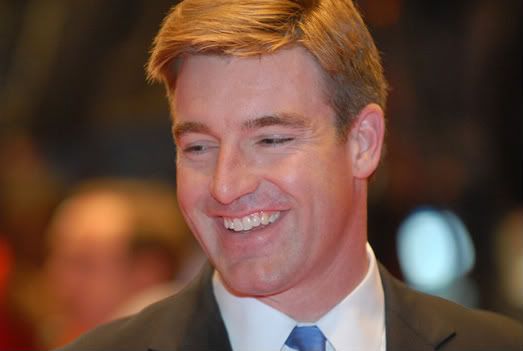
I’m thrilled to report that the next Senator from the state of Kentucky has just announced his candidacy this morning. Our state’s 11-year nightmare of Jim Bunning is about to end in November 2010, and here is the man that will end it.

Meet KY Attorney General Jack Conway.

.

Photobucket

As you can see in his announcement video on his site, Conway will have his official in-person rally to kick off his campaign Monday in Louisville. I can’t go into all of the details now, but let’s just say that Ben Chandler, Crit Luallen, John Yarmuth, and about every big KY Democrat past and present whose name isn’t Steve Beshear will be there. And a “surprise guest”.

Now, let me discuss the primary battle that we face here in Kentucky over the next year.

There are those who say that since Kentucky is a conservative state, we have to settle for a conservative Blue Dog Democratic candidate in order to compete for the Senate seat. Dan Mongiardo is the Blue Dog that some are pointing to, as he co-sponsored the Rovian anti-gay amendment here in 2004, he constantly shills for the abomination that is mountaintop removal mining, and he has no problem speaking at NRA conventions in between Glenn Beck, Karl Rove and Mitt Romney bashing Democrats who will “take away their guns”.

Let me say, in no uncertain terms, that the PPP poll that came out yesterday absolutely killed that meme. DEAD.

Not only are the much more progressive Jack Conway’s approval ratings higher than Dan Mongiardo’s (Conway at 40/21, Mongiardo at 41/34), but Conway performs better in a head-to-head match-up against Bunning, winning 42%-33%.

We don’t need a Blue Dog to beat Jim Bunning. Jack Conway is a progressive Democrat with integrity that can whip Jim Bunning any day of the week.

But let’s say that KY Republicans like Mitch McConnell are able to successfully force Bunning out of the race and replace him with the much more formidable KY Sec. of State Trey Grayson. Even in this scenario, the PPP poll shows Jack Conway beating Grayson by 4 points. Mongiardo? He loses to Grayson by 4 points.

Again: we don’t have to settle for a conservative Blue Dog in this race. We have Jack Conway.

Kentucky progressives are already stepping up and showing that we don’t have to settle for the lesser of two evils in this race. The Facebook group I started “Kentuckians Against Homophobia, Mountaintop Removal, and Dan Mongiardo” has more members than the Mongiardo for Senate Facebook group. We know that Bunning is vulnerable, and we don’t have to settle for another Ben Nelson or Blanche Lincoln.

Please check out Jack Conway’s campaign website, and please consider throwing some turkee his way. We have a great candidate with a great shot of taking another big seat away from the Party of No in November 2010.

Swingnut Demographics

The discussion regarding “Ferris Bueller’s Day Off” surprised me in that a number of people volunteered their age and were, on the whole, younger than I imagined the members of this site to be.  To test this hypothesis, (since the Bueller sample may have been self selecting, for obvious reasons) I’ve created a poll.  The age spreads are a bit narrower for the younger ages.  If people enjoy this, I will perhaps do more demographic polls in the future.

By what margin will Bob Shamansky win?

View Results

Loading ... Loading ...

Murphy Looks Set to Win Absentees (Update, Tedisco Takes a cheap political move)

I got this email from the Murphy campaign:

“We’re pleased that domestic absentee ballots  are starting   to be counted today,” said Henry T. Berger. “The people of the 20th Congressional District need their votes counted without endless delays, so they can be represented in Congress as quickly as possible during these tough economic times. We are confident that once all the absentee ballots are counted, Scott Murphy will win this election.”

In Delaware County, the first county where absentee votes have been completely counted to date, Scott Murphy won the absentee ballot count by 20 votes. On Election Day, Tedisco won Delaware County. There is a Republican registration advantage of 63,000 to 48,000 there.

Exciting news. While Muprhy did shocking well in Delaware county to begin he still lost it narrowly. To be picking up twenty absentee ballots there is a huge indicator. Murphy also gained about a hundred votes when the total was certified. Murphy’s campaign also sites a 16 vote gain in Dutchess, not bad but an indicator that the margins are razor thin in all the counties so far but still favoring Murphy, like the General itself.

The best news is that Murphy’s three best counties were all strong overrepresented in the absentee county and that should strengthen his advantage, while Saratoga’s share fell significantly. So, when Washington, Warren and Columbia come in this whole thing should be wrapped up for Murphy, even if he didn’t win Reneslauer county like he should have.

I’m beginning to feel very confident that Murphy should win this in the end by a few hundred votes. Still. Way too close for comfort.

UPDATE: http://www.dailykos.com/storyo…

Read through that link. He’s challenging a huge set of Democratic absentee ballots cast from people who live primarily downstate but have homes in Columbia county and vote there. Its legal, and has been proven legal, but in a cheap and disgustingly desperate move he’s challenging these votes, which are almost entirely Democratic. Murphy’s margin in Columbia would be about twice as large if not that.

By what margin will Bob Shamansky win?

View Results

Loading ... Loading ...

OHIO 2008 – a gentle shift to victory

I have done an intensive county-by-county analysis study of the state of OHIO vis-a-vis the presidential election from 2008.

The document is in three parts and published at GOOGLE DOCS.

Part I

Part II

Part III

The excel spreadsheet with all the raw data

As was the case with INDIANA, the study of OHIO was fascinating and provides much thought provoking information.

The advantage of GOOGLE DOCS is that I can continue to update and correct a document and it will be automatically republished without the link changing.

Next state for intensive county by county study: VIRGINIA

Pres-by-CD: Most Votes

Time for another installment in the slicing ‘n’ dicing of our presidential-election-results-by-congressional district dataset. One interesting thing I noticed (that has sort of a “well, duh” feel to it if you think about it for a minute) is that the districts that had the largest raw numbers of votes for Obama or for McCain were rarely the same districts that gave them the best percentages.

The raw vote numbers instead can point to a variety of factors: districts that experienced rapid population growth since redistricting, districts that started out the decade with high population (for instance, some at-large districts haven’t grown much, but have always been very big), districts in civic-minded states (like Wisconsin and Oregon) where turnout is always high, and low-income minority-majority districts (where, despite increased turnout for Obama, overall turnout is still comparatively low).

District Rep. Obama
votes
District Rep. Obama
votes
WA-07 McDermott 308,226 TN-01 Roe 75,255
PA-02 Fattah 298,834 AL-06 Bachus 74,657
WI-02 Baldwin 286,089 TX-08 Brady 74,545
NC-04 Price 275,205 NE-03 Smith 73,099
MD-04 Edwards 270,377 GA-09 Deal 70,366
CA-08 Pelosi 266,210 TX-29 Green 66,808
IL-02 Jackson 260,869 TX-19 Neugebauer 65,020
CA-09 Lee 260,662 AL-04 Aderholt 58,863
OR-03 Blumenauer 260,128 TX-11 Conaway 58,326
IL-07 Davis 255,470 TX-13 Thornberry 53,860

The biggest Obama vote totals tended to come in districts that don’t necessarily have the highest PVIs, but are the some of the most stereotypically “liberal” districts centered on mostly-white cities with left-leaning traditions (Seattle, Madison, San Francisco, Portland). Some of the more relatively affluent African-American-majority districts round out the list. (The lowest Obama totals did in fact come from the districts with the worst Obama percentages, with one big exception: TX-29, which Obama won easily, but has the fewest total votes of any district.)

District Rep. McCain
votes
District Rep. McCain
votes
FL-05 Brown-Waite 249,328 CA-35 Waters 27,789
WI-05 Sensenbrenner 243,597 CA-33 Watson 27,672
AL-06 Bachus 243,465 CA-31 Becerra 25,441
MT-AL Rehberg 242,763 NY-12 Velazquez 23,504
GA-03 Westmoreland 235,263 NY-06 Meeks 22,302
FL-01 Miller 234,185 NY-11 Clarke 20,709
FL-04 Crenshaw 233,446 NY-10 Towns 19,677
CO-06 Coffman 229,715 IL-04 Gutierrez 18,453
TN-07 Blackburn 229,068 NY-15 Rangel 14,954
FL-06 Stearns 228,651 NY-16 Serrano 8,437

The highest McCain vote totals mostly came in rapidly growing suburban districts that lean Republican (MT-AL is also here, simply by virtue of its size). Half of these districts are ones where Obama got at least 40% of the vote, so these aren’t necessarily the most right-wing territory (heh, except for AL-06). However, these are districts that will need to shed population with 2012 redistricting, so their Republican lean may leach out into currently neighboring districts. (The districts with the most pitiable McCain totals tend to overlap the districts with the highest PVIs.)

District Rep. Total
votes
District Rep. Total
votes
MT-AL Rehberg 491,092 TX-15 Hinojosa 167,821
FL-05 Brown-Waite 446,316 NY-16 Serrano 167,443
NC-04 Price 438,937 CA-43 Baca 164,830
CO-06 Coffman 437,740 CA-34 Roybal-Allard 142,774
WI-05 Sensenbrenner 421,962 CA-31 Becerra 142,662
WI-02 Baldwin 414,638 IL-04 Gutierrez 139,546
DE-AL Castle 412,412 AZ-04 Pastor 132,076
MN-06 Bachmann 412,408 CA-20 Costa 129,561
FL-06 Stearns 408,014 CA-47 Sanchez 128,277
FL-07 Mica 401,966 TX-29 Green 108,507

For context, here are the districts with the highest and lowest total number of votes. The districts with the greatest numbers of votes are mostly ones we’ve already seen, depending on whether they lean Democratic or Republican. The lowest totals are in Hispanic-majority districts, where citizenship and language barriers are at issue.

SSP Daily Digest: 4/8

IL-05: Congratulations to our newest House member, Mike Quigley. The Cook County Commissioner won the special election in this safe Dem seat last night, defeating GOPer Rosanna Pulido 70-24 (with the balance going to Green Party candidate Matt Reichel). (There were only about 34,000 votes cast in this election, compared with about 58,000 in the primary, since that’s where all the action was.)

AK-Sen: Gov. Sarah Palin will not be challenging Sen. Lisa Murkowski in the 2010 senate primary; in fact, she’ll be assisting Murkowski with raising money (despite simmering tensions between the two factions). It remains to be seen whether she’ll be running for re-election as governor in 2010, or bailing out after one term to focus on the 2012 presidential race (which, geographically speaking, is hard to do from Alaska).

VA-Gov: If there’s one thing Terry McAuliffe is good at, it’s raising money. He raked in $4.2 million in the first quarter for his gubernatorial campaign. He started April with $2.5 million CoH as the race heads toward the June 9 primary.

IA-Gov: With Iowa’s Supreme Court having effectively made same-sex marriages legal, the 2010 governor’s race could turn into a proxy referendum on the issue (with Gov. Chet Culver unwilling to amend the state constitution to block the courts). And this may draw a higher-profile challenger to the race: nutty GOP Rep. Steve King, whose name has been occasionally associated with this race, says the sudden rise of this issue makes him “more likely” to enter the race.

GA-Gov: As noted by fitchfan28 in diaries, state House minority leader Dubose Porter has thrown his hat into the ring for the Democratic nomination for Georgia governor. He joins AG Thurbert Baker and former SoS David Poythress as announced candidates, with former governor Roy Barnes scoping out the race as well.

NJ-12: Rush Holt may receive a credible challenge in 2010, from Fair Haven mayor Mike Halfacre, who just filed exploratory paperwork. Fair Haven is in Republican-leaning Monmouth County; the district as a whole, though, is blue, if not overwhelming so (Obama won 58-41).

EFCA: In the wake of yesterday’s announcement that Blanche Lincoln would oppose EFCA’s current form, two more moderate Dem wafflers got off the fence in favor of EFCA (or, more technically, in favor of cloture): Mark Udall and Mark Warner. Campaign Diaries has a very handy head count, indicating that possible passage is still very close, and an unpacked version of the bill (for instance, containing the binding arbitration portion, leaving ‘card check’ for another year) may still be passed.

CfG: With Pat Toomey about to leave the helm of the Club for Growth to pursue his senate bid against Arlen Specter, they need someone new to wave the sword for the circular firing squad. Looks like the job may fall to yet another ex-Rep who brought the crazy to a swing district, Chris Chocola. (Chocola got bounced from IN-02 in 2006 by Joe Donnelly.)

Omaha-Mayor: In last night’s Omaha mayoral all-party primary election, former GOP Rep. Hal Daub (himself a former Omaha mayor) squeaked into first place with 35.6% of the vote to Democratic concilman Jim Suttle’s 34.3%. Republican Councilman Jim Vokal came in third, picking up 28.2% of the vote. New Nebraska Network’s Kyle Michaelis argues that despite the Republican candidates picking up more votes overall, Daub’s weak finish is not a good sign for his chances in the general election. (J)