How Did Our Reruns Do?

It’s become something of blogospheric conventional wisdom, over the last few years, that running for the House two times in a row was the right approach: that in some cases it takes one cycle to build name recognition and make fundraising connections, and one more cycle to close the deal with voters. Fans of Paul Hodes, Jerry McNerney, Nancy Boyda, or Joe Donnelly (he must have a netroots fan somewhere?) could point to their successes in 2006, on the second try, as evidence.

On the other hand, for every Hodes or McNerney in the House, there’s a “where are they now?” bin with Lois Murphy, Diane Farrell, Patty Wetterling, or Francine Busby in it. 2008 seemed to have a particularly large number of Democratic candidates giving it a second shot, so it may be worth stopping to examine those races.

Unfortunately, there wasn’t a particularly high success ratio: of the 14 races that were considered competitive where the Democratic candidate was making a second run, only three four made it over the finish line (Dan Maffei, Eric Massa, Mary Jo Kilroy, and Larry Kissell). These candidates seemed to benefit from a perfect storm of traction from a repeat run, and running against weakened opponents (a different opponent for Maffei in the wake of Jim Walsh’s retirement and a bungled GOP recruitment, and befuddled, unlikable opponents for Massa and Kissell). (On the following table, * indicates a different opponent in 2008.)

The others seemed to falter, either in the face of a nutty GOPer but too red a district (Brown, Wulsin, probably Esch) or an uncontroversial ‘moderate’ incumbent with a strong hold on a suburban district (Seals, Burner, Feder). By contrast, because of the confluence of swing districts and craptacular opponents, NY-25, NY-29, and NC-08 seem like races we likely could have won with or without a returning opponent (although the prospect of a Maffei rematch may have caused Walsh’s retirement)… which isn’t to say that we should avoid rematches, simply that it may not provide as much of an advantage as conventional wisdom currently holds.

Also, I can’t help but notice one troubling pattern: the male reruns improved on their 2006 numbers. The female reruns declined. If you look at the names above from the 2004-06 cycles, you see the same pattern (Nancy Boyda excepted). I won’t attempt to psychoanalyze that, but it’s disappointing nonetheless.

UPDATE: A reader helpfully points out that I left out Mary Jo Kilroy, who ran against a different opponent in 2008. I was prepared to have to admit that this screws up my theory, but interestingly, even though she won on her second try, the rate at which she improved her margin was still lower than any of the male rerun candidates.

UPDATE II: Another reader points out Gary Trauner, another repeat runner but against a different opponent. So there is, in fact, one male candidate who lost ground (albeit while running in Wyoming in a presidential year).

District Dem 2006
margin
2008
margin
Diff.
NY-25 Dan Maffei * -1.6 (49.2/50.8) 12.9 (54.8/41.9) 14.5
NC-08 Larry Kissell -0.2 (49.9/50.1) 10.8 (55.4/44.6) 11.0
NE-02 Jim Esch -9.4 (45.3/54.7) -3.8 (48.1/51.9) 5.6
NY-29 Eric Massa -3.0 (48.5/51.5) 2.0 (51.0/49.0) 5.0
CA-04 Charlie Brown * -4.5 (45.4/49.9) -0.6 (49.7/50.3) 3.9
IL-10 Dan Seals -6.8 (46.6/53.4) -5.2 (47.4/52.6) 1.6
OH-15 Mary Jo Kilroy * -0.5 (49.7/50.2) 0.7 (45.9/45.2) 1.2
WA-08 Darcy Burner -3.0 (48.5/51.5) -5.6 (47.2/52.8) -2.6
VA-10 Judy Feder -16.3 (41.0/57.3) -20.0 (38.8/58.8) -3.7
NV-02 Jill Derby -5.5 (44.9/50.4) -10.4 (41.4/51.8) -4.9
OH-02 Victoria Wulsin -1.1 (49.4/50.5) -7.3 (37.5/44.8) -6.2
NJ-07 Linda Stender * -1.5 (47.9/49.4) -8.0 (42.2/50.2) -6.5
WY-AL Gary Trauner * -0.5 (47.8/48.3) -9.8 (42.8/52.6) -9.3
FL-13 Christine Jennings -0.2 (49.9/50.1) -18.0 (37.5/55.5) -17.8

Just to make sure that I wasn’t focused on high-profile losses while missing races that flew under the radar (which, as best as I can remember, was where Hodes, McNerney, Boyda, and Donnelly all flew in 2004), I looked at all the non-competitive races where I could find Democratic reruns as well. With a couple exceptions in California (which may have to do mostly with the surprisingly strong coattails Obama generated for Dems downticket in that state), the lower-profile reruns also gained little traction.

District Dem 2006
margin
2008
margin
Diff.
CA-03 Bill Durston -21.6 (37.9/59.5) -5.5 (44.0/49.5) 16.1
CA-48 Steve Young -22.8 (37.2/60.0) -15.1 (40.6/55.7) 7.7
NC-03 Craig Weber -37.2 (31.4/68.6) -31.8 (34.1/65.9) 5.4
NJ-11 Tom Wyka -25.5 (36.6/62.1) -24.8 (37.0/61.8) 0.7
AZ-02 John Thrasher -19.7 (38.9/58.6) -22.2 (37.2/59.4) -2.5
FL-05 John Russell -19.8 (40.1/59.9) -22.4 (38.8/61.2) -2.6
PA-19 Phil Avilo -30.5 (33.5/64.0) -33.2 (33.4/66.6) -2.7
PA-09 Tony Barr -20.6 (39.7/60.3) -27.8 (36.1/63.9) -7.2
TX-04 Glenn Melancon -31.0 (33.4/64.4) -39.5 (29.3/68.8) -8.5
IN-06 Barry Welsh -20.0 (40.0/60.0) -30.5 (33.4/63.9) -10.5

OH-Sen: Portman Holds Early Lead

Public Policy Polling (1/17-18, registered voters):

Jennifer Brunner (D): 34

Rob Portman (R): 42

Undecided: 24

Lee Fisher (D): 39

Rob Portman (R): 41

Undecided: 20

Tim Ryan (D): 34

Rob Portman (R): 40

Undecided: 26

(MoE: ±4.1%)

Portman begins the race with an early edge over the potential Democratic field, but it’s nothing insurmountable. Name recognition may be something of a factor here, but interestingly, Portman registers the highest percentage of ambivalence among voters of the four names tested; a full 49% have no opinion of him, while his favorable/unfavorable score clocks in at 28-23.

By comparison, Fisher’s numbers are 40-32, Ryan’s are 26-27, and Brunner (Ohio’s Secretary of State) has the highest unfavorables of the bunch at 34-36. Undoubtedly, Brunner’s involvement in a plethora of lawsuits during and after the election (most notably surrounding early voting, but also the drawn-out OH-15 saga) drew a good deal of scorn from the Ohio GOP. Perhaps those numbers might settle down some when the ’08 election fades farther away in our rear view mirrors — or perhaps not.

Portman also scores very highly among Republican voters — he draws in a full 80% of Republicans off the bat against Fisher and Brunner (and 74% against Ryan), while the potential Democratic candidates are only drawing between 59% (Brunner) and 68% (Fisher) of Democrats. Still, with the kind of baggage that Portman is carrying, a good campaign should be able to shore up these numbers over the next two years.

IL-05: Filing Deadline Tomorrow

Yes, tomorrow is Martin Luther King, Jr. Day, but it’s also the filing deadline for the IL-05 special election to replace Rahm Emanuel, and the IL Board of Elections will be open to receive nominating petitions. That’ll finally give us some clarity on the Democratic field. The special primary, by the way is March 3rd. The general is on April 7th, but that will almost surely be a formality – Kerry won this district 67-33, and Obama 73-26.

Also, one of the candidates running released an internal poll for the Dem primary. Anzalone-Liszt for Mike Quigley (1/8-13, likely voters, no trendlines)

Mike Quigley: 19%

Sara Feigenholtz: 11%

John Fritchey: 8%

Justin Oberman: 2%

Cary Capparelli: 1%

Jan Donatelli: 1%

(MoE: ±4.4%)

You can find a run-down of these names at Wikipedia. One big difficulty with this poll is that it didn’t include labor lawyer & netroots fave Tom Geoghegan, who declared shortly before this poll went into the field. So I’m not really sure what to make of these numbers.

I wouldn’t be surprised if we see more polling once the field is set. But like almost all specials, this one will likely be a bear to survey accurately.

NJ-Gov: Christie Has Narrow Lead

Rasmussen (1/13, likely voters, no trendlines):

Jon Corzine (D-inc): 40

Chris Christie (R): 42

Other: 5

Undecided: 13

(MoE: ±4%)

I remain convinced that this race is not like the last however many statewide races in New Jersey, where a not especially well-liked Dem beat a much less likable Republican. Perhaps Corzine can be saved by his money and Obama and Biden campaigning for him. Perhaps.

And maybe Christie will sputter once he hits the trail in earnest – this is his first real run for office, apart from an election some years ago as a Morris County freeholder. (A “freeholder” is New Jersey’s term for a county legislator.) Then again, Christie Whitman’s entire elective experience before beating Jim Florio in 1993? Somerset County freeholder.

UPDATE: Another poll, this one from Monmouth University (1/12-14, registered voters, no trendlines):

Jon Corzine (D-inc): 38

Chris Christie (R): 36

Jon Corzine (D-inc): 45

Steve Lonegan (R): 29

Jon Corzine (D-inc): 41

Rick Merkt (R): 27

Jon Corzine (D-inc): 44

Brian Levine (R): 27

(MoE: ±4.8%)

Levine (whom we did not canvass in our look at FDU’s recent poll) is the supposedly moderate Republican mayor of Franklin Twp., a largely Democratic township of about 50,000 people in wealthy Somserset County, located in north-central Jersey. I don’t believe Levine has formally declared yet, but he has formed an exploratory committee.

2010 Outlook: Michigan U.S. House Races

This is part one of my three part series of diaries that I will be publishing this weekend handicapping the major 2010 races in the state of Michigan.

Today I will be publishing my U.S. House outlook, tomorrow the State Senate, and Sunday the State House of Representatives.  

House District 1: Upper Peninsula and Northern Lower Peninsula.  On Monday, Republicans announced that they plan to challenge Bart Stupak again in 2010.  Apparently Pete Sessions has not learned the lesson that Tom Cole learned in 2008.  For those not familiar with the story, State Rep. Tom Casperson was recruited to run against Stupak by Tom Cole, and national Republicans hyped Casperson as a top tier challenger and golden opportunity for Republicans to knock off the popular moderate Democrat.  No such thing happened, and Casperson was pounded by Stupak 65-33.  

Now, maybe Sessions thinks that Stupak will retire.  I’ll admit, it’s possible.  But that still leaves them with the problem of recruiting a Republican with any significant name recognition.  Casperson may run again, or he may run for the State Senate.  Either way, if he couldn’t break 35% against Stupak, I doubt he could win an open seat.  Another Republican possibility is State Rep. Kevin Elsenheimer who will be term limited in 2010, but Elsenheimer is from the lower peninsula, not the U.P.  I doubt that any Republican could win this if they aren’t from the U.P., and even a downstate Democrat would have a hard time if the Republican is from the U.P.  Elsenheimer is the only Republican state legislator who lives in the 1st District, so he may start out as a front runner if he runs.

As for Democrat Candidates if there’s an open seat, the favorite should be term limited State Senator and Minority Leader Mike Prusi, but State Reps. Mike Lindberg, Mike Lahti, and Gary McDowell would all be formidable opponents to any Republican.

Rating: Safe Democrat, (Leans Democrat if Stupak Retires).

District 2: Lake Michigan Shoreline, Muskegon, Ottawa County.  The 2nd District is the most Repulbican in the state of Michigan.  It is historically conservative, very Evangelical, and has a high Dutch population.  Congressman Pete Hoekstra has already announced that he is going to retire in 2010, probably to run for Governor.

Encouraged by Barack Obama’s good showing in this district, some might be inclined to view this as a potential Democratic pickup.  I think that the chances of a Democrat winning this district is slim to none.  Republican state legislators are already lining up to succeed Hoekstra, and I doubt any notable Democrat would risk there political career to run against any one of them.

State Senator Wayne Kuipers (R) and State Rep. Bill Huizenga (R) are both running already.  Both are from Ottawa county, the conservative base of the District.  State Senator Gerald VanWoerkom, a Republican from Muskegon, may run as well.  VanWoerkom is far more moderate, and if Kuipers and Huizenga split the conservative, Ottawa County vote, VanWoerkom could sneak up and win the Republican primary.

Democrat State Reps. Mary Valentine and Doug Bennett are the only Democrat elected officials in the district, but I doubt either would take on such a suicide mission.  Former State Rep. Julie Dennis may run, but I do not think she would be a very legitimate candidate.

Rating: Likely Republican

District 3:  Kent County (Grand Rapids).  The third District is also very republican, but not as conservative as the second District.  Vern Ehlers is safe if he runs for re election.  If he retires, Republicans would have a clear advantage, but the right Democrat could win this district.

If Ehlers retires, State Senators Jud Gilbert or Mike Hardiman would be likely replacements.  Former State Representative Michael Sak, a Democrat, would make a good candidate.  He is moderate, and from Grand Rapids city, but was recently criticized for alledgedly appearing drunk at a Governors assosciation meeting.  State Reps. Robert Dean or Wayne Schmidt could also run.

Rating: Safe Republican (Leans Republic an in Ehlers Retires)

District 4: Central lower Peninsula, Midland.  Rep. Dave Camp will likely run for re-election in 2010, and Democrats will likely not give him a vigorous challenge, even though the 4th is a swing district that Barack Obama won.  Freshman State Rep. Mike Huckleberry may challenge Camp, he already did so in 2006, but he is unlikely to do any better than he did then.  And I doubt he would want to give up his new seat, anyway.

Rating: Safe Republican

District 5: Flint, Saginaw, Bay City.  If Dale Kildee does not retire in 2010, expect a primary challenge from State Senator John Gleason.  Gleason considered challenging Kildee in 2008, but opted to stay in the Senate.  He is term limited in 2010.  Republicans will not seriously contest this seat, no matter who wins the Democratic Primary.  

Rating: Safe Democrat

District 6: South-West MI, Kalamzoo.  Moderate Republican Fred Upton may or may not run for re-election in 2010.  If he does, he is probably safe.  If not, the 6th District becomes a pure tossup.  Obama got 54% in this District, but Democrats have no significant bench of candidates here.

Robert Jones is the only elected Democratic legislator in the district, but he and his predeccessor, Alexander Lipsey, are both African-American.  I doubt an African American could win this district (it has a lot of conservative voters in Berrien and Van Buren Counties).  However, former Kalamazoo mayor and current Vice-Mayor Hannah McKinney would make a decent candidate.

Republicans Tonya Schuitimaker, John Proos, and Ron Jelinek could all run to succeed Upton if he retired.

Rating: Safe Republican (Tossup if Upton retires)

District 7:  South MI, Battle Creek, Jackson.  Freshman Mark Schauer will likely face a difficult re-election in 2010.  He only beat Rep. Tim Walberg 49-46 in 2008, certainly a smaller margin than I expected.

Possible Republican candidates include former Rep. Mike Nofs, Sen. Cameron Brown, and Rep. Rick Jones.  Walberg may run agian, but he is unlikely to beat Schauer in a rematch.  

Obama won this district, and the Republicans in this district tend to vote for Conservative Republicans in the Primary, rather than moderates (See Schwarz, Joe vs. Walberg, Tim).  A conservative Republican would have an uphill climb against Schauer.  All in all, Schauer will have the advantage of incumbency going for him, and should be favored.

Rating: Leans Democrat

District 8:  Lansing, Livingston County, N. Oakland County.  This may finally be the year that Democrats seriously challenge Mike Rogers.  In 2000, Rogers barely beat Democrat Diane Byrum to succeed Democrat Debbie Stabenow, who ran successfully for the Senate.  Since then, he has not been seriously challenged in this marginal district.

Rogers may run for governor, which would give Democrats an even better chance at picking up this district.  we have a strong bench here, as the district is centered around heavily Democratic Ingham County, home of Lansing.  Possible Democrats include Lansing mayor and former State Senator Virg Bernero, State Rep. and former East Lansing Mayor Mark Meadows, State Senator Gretchen Whitimer, State Rep. Joan Bauer, and State Rep. Barb Byrum, daughter of 2000 candidate Diane Byrum.

If Rogers does run for Governor, Livingston State Senator Valde Garcia would be the likely Republican candidate.

Rating: Likely Republican (Tossup if Rogers runs for Governor)

District 9: Central Oakland County.  Freshman Gary Peters is the heavy favorite in this suburban Detroit district, even though he just defeated Republican incumbent Joe Knollenberg last November.  Like many suburban districts nationwide, this one has been trending Democratic for a while now.  Joe Knollenberg’s son state Rep. Marty Knollenberg may try to retak his father’s seat, but when an incumbent loses by 9%, his son is unlikely to do much better.

Rating: Likely Democrat

District 10: “The Thumb”, Northern Macomb County.  Republican Candice Miller is not likely to be challenged in 2010.  The former secretary of state may run for governor, however.  If she does, advantage still goes to the Republicans here.  Dem. John Espinoza may run for the open seat.  Republican Sen. Alan Sanborn is the likely favorite in an open seat.

Rating:  Safe Republican

District 11:  West Oakland County, North-East Wayne County.  Thad McCotter is in a very dangerous spot right now, and he knows it.  He only managed 51% in this once strongly Republican suburban district against a nobody in 2010.  He apparently senses the danger, and is willing to sell his soul to save his seat.

Democrats have a very strong bench in this district.  House speaker Andy Dillon lives here, and the DCCC will likely try to recruit him, as well as State Senator Glenn Anderson, who represents the Conservative city of Livonia.  Other candidates include State Reps. Marc Courriveau and Richard LeBlanc.  

McCotter used to be able to count on his base in Livonia to get re elected, but Livonia, like all of Wayne county, continues to trend Democratic. Novi, in Oakland County, was also a reliably Democratic part of the District.  But like the 11th District as a whole, Novi was won by Barack Obama.

Rating: Tossup

District 12: Parts of Oakland and Macomb Counties. Sander Levin is likely to run for re-election, but if he doesn’t look for his son, Andy Levin to run for his seat.  If not Levin, State Senator Gilda Jacobs may run.  Either way, the district is safe.

Rating: Safe Democrat

District 13:  Detroit.  The big question here is: Has the Kilpatrick scandal blown over?  If so, Carolyn Cheeks Kilpatrick will be safe.  If there are still lingering doubts about her suport for her son, then she may well see a another vigorous Primary Challenge.  Mary Waters will probably run again, but there are other Detroit area legislators that may want to take her on as well.  Barack Obama may have broken 90% in this majority Black District, so the winning the Democratic Primary will be tantamount to winning the General Election.

Rating: Safe Democrat.

District 14:  Detroit.  Nothing to see here.  John Conyers is safe.

Rating: Safe Democrat

District 15:  Detroit suburbs, Monroe County, Ann Arbor.  I fully expect John Dingell to retire in 2010.  He just lost his committee chairmanship, and on top of that, he can barely walk.  If he does, watch either his wife, Debbie Dingell, or his son, Christopher Dingell.  Also watch former Congresswoman Lynn Rivers, who lost the 2002 primary to Dingell after the two were drawn together by redistricting.  Rivers is quite liberal and would made a very good congresswoman, in my opinion.

Rating: Safe Democrat
Vulnerability Index for House Elections

Over the holidays, SSP readers seemed to have a lot of fun with the vulnerable House Republicans and vulnerable House Democrats threads. This left me wondering, as so many things seem to do, “is there a way to quantify that?” In other words, is there a data-driven way to approach the question instead of just relying on perceptions (and also to make sure that potentially overlooked races don’t fall through the cracks)?

Here’s what I tried. It’s actually a bit reminiscent of my PVI/Vote Index, in that it measures representative performance against the district’s lean, except here performance is measured by the rep’s margin in the last election. (The data for many of the 2008 electoral margins is available in the recent “How’d We Do?” post, conveniently arranged in order from closest to least close.)

Look at the top 20 most vulnerable Republicans to see how it works. As pretty much everyone would expect, Anh Cao in LA-02 is the most vulnerable GOPer. He had the 5th weakest margin of any Republican who survived 2008 (beating Bill Jefferson by 2.7%, behind only Fleming (0.4%), McClintock (0.6%), Calvert (2.4%), and Luetkemeyer (2.5%). Needless to say, he’s in the GOP-held district with the least favorable PVI (D+28, using “old,” i.e. 00-04, PVI). At #2 is Jim Gerlach in PA-06; he had the 9th worst margin at 4.2%, and he’s in the 6th worst district for a GOPer at D+2. And so on…

District Rep. Margin
rating
PVI
rating
Total
LA-02 Cao 5 1 6
PA-06 Gerlach 9 6 15
IL-10 Kirk 13 4 17
WA-08 Reichert 16 5 21
MI-11 McCotter 17 16 33
MN-03 Paulsen 22 12 34
NJ-07 Lance 24 13 37
OH-12 Tiberi 34 14 48
CA-50 Bilbray 11 40 51
MN-06 Bachmann 6 46.5 52.5
FL-25 Diaz-Balart 18 37 55
CA-44 Calvert 3 55 58
AL-03 Rogers 25 34 59
LA-04 Fleming 1 60 61
FL-15 Posey 31 30.5 61.5
MN-02 Kline 39 23 62
CA-26 Dreier 33 30.5 63.5
MO-09 Luetkemeyer 4 60 64
NY-26 Lee 38 27 65
PA-15 Dent 58 8 66

Is this much different from SSP readers’ predictions? No, not much; it’s the wisdom of crowds at work. Still, I see a few names on there that didn’t get much of any mention in our prediction thread: especially Pat Tiberi in OH-12 (34th worst margin at 12.6%, 14th worst district at R+1) who seems to fly under the radar every single freakin’ election. Other names revealed by this list that wouldn’t necessarily be intuitive picks include Thad McCotter, John Kline, Mike Rogers (AL), and Bill Posey, who benefited from our big-time recruitment failure in the FL-15 open seat.

Here’s the flipside: the Democratic seats that seem likeliest to flip, based on 2008 numbers. Some of these may not be much cause for alarm; Chet Edwards, for instance, is probably not in any imminent danger except in case of a 1994-sized event, but he’s probably doomed to uncomfortable margins for all eternity. On the other hand, time will tell whether Walt Minnick can quickly fortify himself, or if we’re only renting ID-01 for a couple years.

District Rep. Margin
rating
PVI
rating
Total
ID-01 Minnick 5 1 6
AL-02 Bright 2 5 7
MD-01 Kratovil 4 10 14
TX-17 Edwards 19 2 21
VA-05 Perriello 1 26.5 27.5
AL-05 Griffith 10 20 30
MS-01 Childers 25.5 8.5 34
NY-29 Massa 6 29.5 35.5
VA-02 Nye 15.5 22 37.5
CO-04 Markey 34 11.5 45.5
PA-10 Carney 35 14 49
GA-08 Marshall 39 13 52
FL-08 Grayson 12.5 44 56.5
MI-07 Schauer 7 49.5 56.5
NM-02 Teague 33 23.5 56.5
WI-08 Kagen 20 38.5 58.5
OH-15 Kilroy 3 58 61
AZ-05 Mitchell 23 38.5 61.5
PA-03 Dahlkemper 8 54 62
OH-16 Boccieri 27.5 40 67.5

More over the flip…

In describing this method to DavidNYC, he quite rightly asked “Wait, does this thing actually work?” So, after a lot more data entry and some testing based on how well the 2006 numbers would have predicted the 2008 results, I can conclude it does work fairly well. Here is what the 2006 numbers would have predicted for GOP held seats in 2008.

District Rep. Margin
rating
PVI
rating
Total
NM-01 Wilson 3 7 10
NY-25 Walsh 9 5 14
PA-06 Gerlach 7 9 16
CT-04 Shays 16 2 18
WA-08 Reichert 14.5 8 22.5
NV-03 Porter 10 13 23
IL-10 Kirk 24 4 28
NJ-07 Ferguson 8 20.5 28.5
OH-15 Pryce 4.5 24.5 29
MI-09 Knollenberg 22 16 38
OH-01 Chabot 20 18.5 38.5
NC-08 Hayes 1.5 38.5 40
PA-15 Dent 33 11 44
FL-13 Buchanan 1.5 46.5 48
IL-06 Roskam 12.5 36.5 49
MI-07 Walberg 41 10 51
NY-03 King 17 34 51
AZ-01 Renzi 28 30.5 58.5
IL-11 Weller 34 24.5 58.5
NY-13 Fossella 45 14 59

One problem leapt out at me: the role of open seats, and the accompanying loss of the benefits of incumbency. So, I performed a tweak that took open seats into account (by taking out the margin, and just leaving the open seat’s strength based only on its PVI rating). That takes it a little closer to the way things actually shook out. 13 out of the top 20 were pickups, which seems like a good but not amazing rate of prediction.

Without doing a lot of putting your thumbs on the scales of individual races, I don’t know how you’d build a model that somehow predicted, say, Tom Feeney’s implosion, or the fizzle in the open seat in NM-02, or Dave Reichert’s confounding staying power, or Bob Roggio’s amazing lack of name recognition… or that Bill Sali was vulnerable (he was #106) if only because of sheer malice and stupidity. Any good prognostication has to include at least some kind of qualitative analysis of candidates’ levels of, well, suckiness.

By the way, in case you’re wondering what this formulation means would happen to Peter King’s seat if he bails out to run for NY-Sen, it would vault up to #2 on the list if it were open. (It’s the 7th most Dem PVI of any GOP-held seat, so for 2010 the score of 7 would slot an open NY-03 right before LA-02.) So, a year from now, once we have a sense of where seats will open up, I’ll have to revisit this project.

District Rep. Margin
rating
PVI
rating
Total
NY-25 Open 0 5 5
NJ-03 Open 0 6 6
NM-01 Open 0 7 7
NY-13 Open 0 14 14
PA-06 Gerlach 7 9 16
CT-04 Shays 16 2 18
MN-03 Open 0 18.5 18.5
NJ-07 Open 0 20.5 20.5
VA-11 Open 0 20.5 20.5
WA-08 Reichert 14.5 18 22.5
NV-03 Porter 10 13 23
IL-11 Open 0 24.5 24.5
OH-15 Open 0 24.5 24.5
IL-10 Kirk 24 4 28
AZ-01 Open 0 30.5 30.5
MI-09 Knollenberg 22 16 38
OH-01 Chabot 20 18.5 38.5
NC-08 Hayes 1.5 38.5 40
NY-26 Open 0 42 42
PA-15 Dent 33 11 44

Finally, here’s what the 2006 numbers would have predicted for the Democratic-held seats in 2008, including the tweak for open seats (of which we didn’t have many). Three of the top 10 did, in fact, fall. Plus, LA-06 isn’t on the list because it changed hands during a special election. However, my back-of-the-envelope calculation for Cazayoux based on his 3% margin in the special election and an R+6.5 would’ve given him a score around 24, good for 4th place. On the other hand, the fifth Dem seat to fall, LA-02, clocks in at #187!

District Rep. Margin
rating
PVI
rating
Total
GA-08 Marshall 4 9 13
AL-05 Open 0 17 17
KS-02 Boyda 11 11 22
IN-09 Hill 15 12.5 27.5
PA-10 Carney 18 10 28
TX-22 Lampson 29 4 33
NC-11 Shuler 23.5 12.5 36
WI-08 Kagen 6 30.5 36.5
TX-17 Edwards 39 1 40
FL-16 Mahoney 5 38.5 43.5
IL-08 Bean 21 23 44
AZ-05 Mitchell 14 30.5 44.5
UT-02 Matheson 43 2 45
NY-19 Hall 12.5 36 48.5
PA-04 Altmire 7.5 41 48.5
IN-02 Donnelly 25 26 51
IN-08 Ellsworth 44.5 8 52.5
CA-11 McNerney 20 33 53
TX-23 Rodriguez 26 27.5 53.5
OR-05 Open 0 55 55

NY-Gov: Lazio Mulling a Run

Snort:

Former Representative Rick Lazio, a Long Island Republican who rose to prominence by challenging Hillary Rodham Clinton in her first Senate race, is exploring the possibility of running for governor next year.

In recent weeks, Mr. Lazio, who retired from Congress in 2000, has had conversations with Republican elected officials, party leaders and fund-raisers to discuss the pros and cons of a possible candidacy, according to three people he has consulted about the race.

It’s a pretty sad state of affairs for the New York GOP when the only guy on their bench who is publicly considering this race is a pathetic retread who got pounded by Hillary eight years ago and pulled a disappearing act ever since.

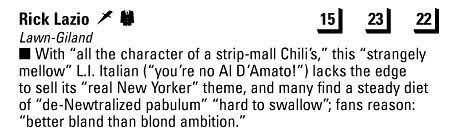
But don’t take my word for it. When in doubt — consult Zagat’s!

VT-Gov 2010 Racine’s in, Douglas proposes changing school funding, Spaulding will decide soon.

During the 2008 gubernatorial season democrats waited until May to field a candidate.  This cycle, Vermont democrats stepped up with Doug Racine announcing that he would take on Jim Douglas come 2010.  Racine was a former Lite governor who lost to Douglas in 2002, 47-44.  

“Racine, 56, who expects to return as chairman of the Senate Health & Welfare Committee, said he is focused on the 2009 legislative session. He said he informed several Douglas administration officials Monday of his plans to run for governor and that he doesn’t expect it to affect his work with them.”

There have also been rumblings of stronger candidates mounting a challenge against Douglas.  

“Several high-profile Democrats are considering a run, amid pressure from party activists to get an early start. State Treasurer Jeb Spaulding said he’s still considering a run and expects to decide within a few months.”

Spaulding has been Treasurer since 2002, is the president of the national association of state treasurers, and was a state senator from1995-2001.  This would make him one of the strongest candidates to challenge Douglas since Racine’s first challenge back in 2002.  He will decide within three months.  

The race is also complicated by Douglas’ recent proposals to deal with the recession.  The biggest issue will be scrapping act 68, the way that Vermonters pay for education, without offering any sort of alternative way to fund education.  

“If local school boards want to spend more per pupil than they are doing in the current year, any additional funds would have to be paid for entirely by local residential property taxpayers. Income sensitivity provisions – under which homeowners pay school taxes based on income, not property values – would not apply.”

Reopening this can of worms could potentially weaken Governor Douglas’ popularity.  Normally Douglas survives by not doing or proposing anything too controversial, then benefits from the independence of the electorate and the left far left split.  A violent education battle could be the issue that makes Douglas vulnerable.

If Douglas is indeed weakened by the education battle or seems weak, then Spaulding will most likely join the fray, as could sec of state Deb Markowitz.  If however Douglas runs for re-election, and doesn’t appear vulnerable, Racine will have the nomination all to himself, and will most likely face a three way race with Anthony Pollina.  Pollina was the progressive turned independent who beat Gaye Symington in the 2008 election.  

If Douglas retires, the election will quickly become bedlam.  The Vermont political scene is constipated, with every statewide official, as well as many aspiring state senators and mayors stuck.  Should Douglas retire, plethora of positions open up.  The governors seat will free up first, then the lite govs seat, if lite gov Brian Dubie runs for governor, or retires.  From there, Markowitz and Spaulding will run hopefully for those two positions, or will primary each other for the governor’s seat.  This will open the treasurer’s position and secretary of state.  If Douglas retires, Racine will most likely lose the primary battle, and democrats will be favored for all of the aforementioned positions.  There are some wildcards however.

1. Leahy retirement/Death:  in his seventies, Leahy could decide to retire in 2010 giving Douglas and Dubie the option to run for senate.  They passed on the open seat in 2006, but both knew they couldn’t beat Bernie Sanders.  For the democrats the only dems who could win would be Markowitz, Spaulding and current House rep Peter Welch.  Welch is popular, but Douglas and Dubie have been on the statewide scene the longest.  This would be his only chance to become a senator as Bernie will almost certainly run for re-election in 2012.  By the time an open seat comes up in 2016 or 2018 Welch will be 67-70. 67-70 Year olds do not run for freshman terms in the senate unless they know they can’t win.  By 2016/2018 Welch will have seniority and will probably be looking towards either a good committee assignment, house leadership role, or cabinet position depending on who wins in 2016.   With Markowitz and Spaulding, who knows?

2.  Howard Dean returns to Vermont politics:  there haven’t been any rumblings of this, but with the whole “Obama is dissing Dean Meme” it’s possible that dean will return to Vermont either to run for senator if there’s a retirement or governor again.  I put the chances in the low single digits, but were it to happen, it would change everything.  

3.  Further economic downturns.  Who knows how this could affect the race, but it probably will.

http://www.burlingtonfreepress…

http://www.rutlandherald.com/a…