WI-Sen: Univ. of Wisconsin Hammered for Partnering on Polls with Conservative Think Tank

Wow, this looks pretty ugly. Last year, the University of Wisconsin announced a partnership with the Wisconsin Policy Research Institute, which offered the school and poli sci Prof. Ken Goldstein money to support their polling. The problem is that WPRI is a conservative think tank, and UW-Madison and Goldstein have started taking a lot of heat for for accepting interest group money in order to fund polling. This is something that other universities simply don’t do:

“It does compromise the independence and brings into question the accuracy,” said Lee Miringoff, director of the Marist College Poll. “It doesn’t mean that’s necessarily fair, but it does tend to do that in this very ideologically partisan time we live in.”

This shady alliance has already produced foul fruit:

Scot Ross, a liberal muckraker who runs the group One Wisconsin Now, was critical of the deal from the beginning. He said his “worst fears were confirmed” after he obtained e-mails under the open records law showing WPRI President George Lightbourn lobbied Goldstein to publicize results from one question in a way favorable to its agenda.

The question asked whether government funding should be used for school vouchers, which WPRI supports. A majority of residents statewide were opposed, but those surveyed from Milwaukee County were in favor.

Lightbourn wrote Goldstein he was concerned critics would portray the data as showing a lack of support for vouchers and asked for the Milwaukee County results to be emphasized. The university’s press release read: “School choice remains popular in Milwaukee.”

And there’s a horserace aspect to all of this as well:

That wasn’t the only question to generate controversy. Participants were asked if they supported former Republican Gov. Tommy Thompson in a matchup against Democratic U.S. Sen. Russ Feingold – even though Thompson had shown little interest in the race.

WPRI is run by Lightbourn, Thompson’s former administration secretary, and its board chairman is Jim Klauser, another former top Thompson aide. After receiving results showing Thompson was favored 43-39, WPRI sent a press release claiming the poll showed Thompson would defeat Feingold.

But Goldstein scolded Lightbourn for sending the release without his knowledge and not including his more balanced analysis. A release Goldstein later approved said the race would be competitive, that undecided voters may favor Feingold and Thompson would be re-evaluated after not running for office for years.

It’s digusting that Goldstein would engage in this kind of behavior. Unless and until UWM totally disavows its partnership with WPRI, it’s going to be very hard to take anything they produce seriously. I’m certainly not going to put much stock in their newest poll, that’s for sure.

Five State California (horrible Democratic gerrymander :P)

Before I give everyone the details of this, I'd like to mention that this is not a realistic division of California, for a realistic view of California's political divisions; see californianintexas's diary.

Now that we have that out of the way, I'd like to present you with dgm's unholy atrocity that is the five states of California:


 Let's get to the carnage, shall we?


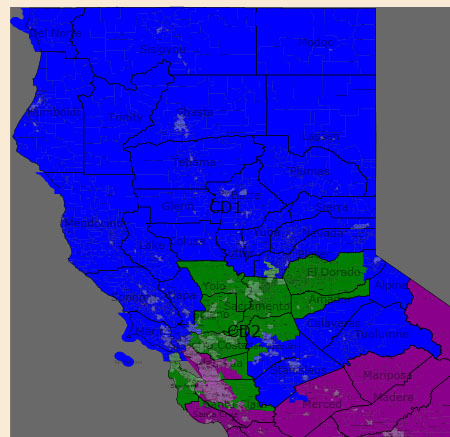
State 1 (New Marin)(Blue)

Population: 3,870,989
Demographics: (White 65%, Hispanic 19%)
Partisanship (Obama 59%; McCain 38%)
Population centers: (Marin County)

Notes: You might be asking yourself, why did I name this state “New Marin”? Well, the answer is because it was originally not going to include Marin County (and was going to be a roughly 54-44 state) but at the last minute, I decided that Marin County could be taken from the San Francisio based state and moved over here to effectively create 4 totally safe Democratic states.


State 2 (San Sacramento)(Green)

Population: 4,808,296
Demographics: (58% white, 15% Asian, 17% Hispanic)
Partisanship (Obama 65%; McCain 33%)
Population centers (San Francisco, Sacramento)

Notes: Say hello to, hypothetically, the most latte-sipping, free-loving, liberal hippie state in the entire country! Interestingly, this is only the second most Democratic state of the five Californias, but it is probably the most liberal of them all (what with a good chunk of it's population being comprised of San Francisco (as well as San Mateo County).


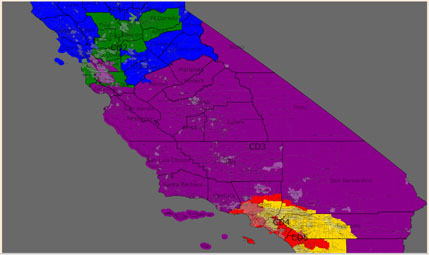
State 3 (California Grande)(Purple)

Population: 9,472,898
Demographics: (48% White, 11% Asian, 31% Hispanic)
Partisanship (Obama 60%; McCain 38%)
Population centers: (Fresno)

Notes: This is probably the least egregious of the states I've come up with (not that that's saying much but still…) It basically takes up the entire interior of the state, as well as the costal area between San Francisco and Los Angeles.


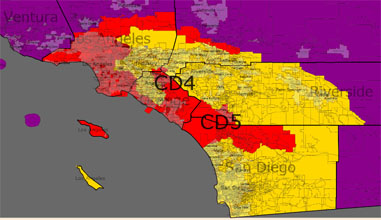
State 4 (Angeles Anaranjados)(Red)

Population: 8,252,698
Demographics: (39% White, Black 10%, Asian 11%, Hispanic 36%)
Partisanship: (Obama 66%, McCain 32%)
Population Center: Los Angeles

Notes: If anyone thought that creating at least 4 safe states out of California would be pretty, then you were very, very wrong (well, at least if you aren't willing to cede anything to the Republicans in the fifth state). This is more or less eastern Los Angeles combined with the Republican parts of Orange and San Diego counties (which is why this state is “only” a 66% Obama state, it would've easily been over 70% otherwise).


State 5 (Los Diegos)(Yellow)

Population: 10,700,726
Demographics (40% White, 11% Asian, 41% Hispanic)
Partisanship (Obama 46%; McCain 42%)
Population centers: (Los Angeles and San Diego)

Notes: What? Ok, ok, this is a true atrocity, but at the same time this is, in many ways, the worst of all worlds for California Republicans. On the one hand, even in a bad year, it still leans Democratic, but the Republicans here are probably going to be completely unable to take advantage of it (considering the lunatics Orange County and San Diego Republicans tend to like). Yes, it's quite obvious that the only reason it's like this is to give the Democrats an advantage, but I'm actually ok with that fact!


In conclusion: These 5 states are more or less guaranteed to go Democratic at the presidential level, elect two strong Democratic Senators (with the possible exception of Los Diegos), and have majority Democratic house delegations, so a little ugliness (and city-splitting) is a small price to pay for it :D.

Rasmussen Reports, You Decide, Vol. 10

More fresh meat from Scott Rasmussen’s sausage factory.

LA-Sen (3/10, likely voters, 2/10 in parens):

Charlie Melançon (D): 34 (33)

David Vitter (R-inc): 57 (57)

Undecided: 6 (7)

(MoE: ±4.5%)

MN-Gov (3/10, likely voters):

Mark Dayton (D): 38

Tom Emmer (R): 35

Tom Horner (I): 7

Undecided: 20

Margaret Anderson Kelliher (D): 34

Tom Emmer (R): 37

Tom Horner (I): 10

Undecided: 18

R.T. Rybak (D): 38

Tom Emmer (R): 35

Tom Horner (I): 9

Undecided: 18

Tom Bakk (D): 29

Tom Emmer (R): 36

Tom Horner (I): 8

Undecided: 27

Tom Rukavina (D): 29

Tom Emmer (R): 38

Tom Horner (I): 7

Undecided: 25

Matt Entenza (D): 28

Tom Emmer (R): 37

Tom Horner (I): 8

Undecided: 26

Mark Dayton (D): 38

Marty Seifert (R): 39

Tom Horner (I): 7

Undecided: 16

Margaret Anderson Kelliher (D): 35

Marty Seifert (R): 39

Tom Horner (I): 8

Undecided: 19

R.T. Rybak (D): 38

Marty Seifert (R): 38

Tom Horner (I): 8

Undecided: 16

Tom Bakk (D): 30

Marty Seifert (R): 37

Tom Horner (I): 9

Undecided: 24

Tom Rukavina (D): 30

Marty Seifert (R): 39

Tom Horner (I): 9

Undecided: 22

Matt Entenza (D): 30

Marty Seifert (R): 38

Tom Horner (I): 9

Undecided: 23

(MoE: ±3%)

MO-Sen (3/9, likely voters, 2/10 in parens):

Robin Carnahan (D): 41 (42)

Roy Blunt (R): 47 (49)

Not sure: 8 (6)

(MoE: ±4.5%)

NH-Gov (3/8, likely voters, 1/12 in parens):

John Lynch (D-inc): 51 (51)

Jack Kimball (R): 32 (32)

Undecided: 13 (12)

John Lynch (D-inc): 54 (53)

Karen Testerman (R): 28 (30)

Undecided: 14 (12)

John Lynch (D-inc): 50

John Stephen (R): 35

Undecided: 14

(MoE: ±4.5%)

IA-Gov: A closer look at the Rod Roberts campaign

I expected former four-term Governor Terry Branstad to drive all of the lesser-known Republicans out of the governor’s race. To my surprise, State Representative Rod Roberts has not followed the lead of Paul McKinley, Christian Fong, Jerry Behn and Chris Rants. Roberts has insisted that he is staying in the governor’s race all the way to the June primary, and another Republican has already filed in the Iowa House district Roberts has represented for five terms.

Join me after the jump for closer look at Roberts and his campaign strategy. I doubt he has any chance of winning the primary, but he is becoming a politically correct alternative to the more conservative Bob Vander Plaats for Republicans who aren’t wild about a fifth term for Branstad.

Rod Roberts faces long odds in the primary, having much lower name recognition than Branstad or Vander Plaats, less cash on hand for his campaign, no paid campaign staff and not much support from the GOP activist base. He started running radio ads in January to boost his name recognition. You can listen to the ads on his campaign website, but I decided to transcribe them as well. In this ad, Roberts reads the entire script himself:

This is State Representative Rod Roberts, Republican for governor. I’m running for governor because I think our state needs new leadership. State government is spending taxpayer dollars at record highs. Next year’s budget gap could run over one billion dollars, and over 100,000 Iowans are out of work. The Roberts for Governor campaign is about using common-sense conservative values to solve these problems. As a five-term state representative, I have real experience being both a fiscal and a social conservative. As governor, I promise to restore fiscal discipline and to stop out-of-control state spending, and I will continue to be a strong advocate for policies that are pro-life and pro-traditional marriage. The Roberts for Governor campaign is about building a better Iowa. It’s time for new leadership, a fresh face, and a new direction for the state of Iowa. Visit www.robertsforgov.com to find out more about me, Rod Roberts, Republican candidate for governor. Paid for by Rod Roberts for governor.

The second ad features male and female voice-overs:

Man: Iowa needs leadership from their next governor. Over 100,000 Iowans are currently out of work. State spending is at a record high, and the state could face future budget deficits of one billion dollars or more. Who can Iowans trust as their next governor?

Woman: Rod Roberts, the conservative Republican choice for governor. Rod Roberts is a state representative. He has a record of being both a fiscal and a social conservative. Rod Roberts has fought for lower taxes, less spending and he has led efforts to give Iowans the right to vote on the definition of marriage.

Man: Rod Roberts will use common-sense conservative values to build a better Iowa. He doesn’t just talk the conservative talk, he walks the conservative walk. As governor, Roberts will work for everyday Iowans by creating new jobs and fighting for traditional family values.

Woman: Visit www.robertsforgov.com It’s  time for new leadership, a fresh face, and a new direction for the state of Iowa. Rod Roberts, Republican for governor.

Man: Paid for by Rod Roberts for Governor Committee

This generic Republican message is designed to help Roberts position himself as a unifying figure for the Iowa GOP, where social conservatives have clashed with establishment figures in recent years. Last May, Carroll-based journalist Douglas Burns depicted Roberts as a strong candidate for governor because he could appeal to both Republican camps. Even with Branstad in the race, some analysts see Roberts as the candidate with more potential to unite the party.

Republican moderates as well as some conservatives in the business community don’t care for Vander Plaats. Key donors recruited Branstad back into politics in part because Vander Plaats was the heavy favorite for the nomination among the declared candidates last summer.

Meanwhile, many social conservatives do not trust Branstad, partly because of his record as governor, partly because he is not emphasizing social issues on the campaign trail, and partly because his backers include Doug Gross, a longtime nemesis of the religious right wing. Some Republicans view Gross as “baggage” for Branstad.

Roberts doesn’t have much baggage and seems to have made no enemies during ten years in the Iowa House. In keeping with his nice guy reputation, he is mostly spreading a positive message at his campaign stops. He talks about creating a friendly business climate and advocates eliminating the state corporate income tax. He talks about the need to reduce spending and supports a constitutional amendment to “limit state spending to 99 percent of projected revenue.” Like most Republicans, he supports “the traditional definition of marriage” and promises to give Iowans the right to vote on a constitutional amendment that would ban same-sex marriage. He has pointed out his ability to win votes from independents and conservative Democrats in the Carroll area.

During this year’s legislative session, Roberts has introduced a bill to abolish the state corporate income tax as well as a bill that would increase the number of Iowa Supreme Court justices and require them to represent different regions in Iowa.

It’s fine for candidates to be positive, and I’ve never heard a Republican say anything bad about Roberts, but I don’t see how he breaks through in the primary campaign without making a more direct case against Branstad and Vander Plaats. It’s not enough to be a fresh face; Roberts has to explain why he would be a better governor and/or better general election candidate than the better-known candidates. So far he has criticized some of Branstad’s decisions as governor, but that hasn’t been a focus of his campaign speeches or press releases. The Des Moines Register’s Kathie Obradovich suggests the “nice-guy candidate” with a “vanilla ice cream” demeanor could “appeal especially to older Iowans, who in recent polls have been the least supportive of Branstad but still tend to be the most reliable voters.” For that to happen, Roberts would need to draw more contrasts with Branstad. But he’s not an attack-dog type like Chris Rants, and I doubt he will spend his campaign’s limited resources to go negative on Branstad.

To my mind, having Roberts in the race is great for Branstad, the clear favorite in the primary thanks to his campaign cash and establishment connections. The best hope for Vander Plaats would be to unite social conservatives who distrust Branstad. But Roberts is competing for the conservative niche, as this February 22 press release indicates:

The Roberts for Governor Campaign announced today that current State Representative Jason Schultz and former State Representative Dan Boddicker have endorsed Rod Roberts’s campaign for governor. Schultz, who is a seven-year veteran of the Iowa National Guard, is from the western Iowa town of Schleswig and represents Iowa House District 55. Boddicker, who served in the Iowa House from 1993-2005, lives near the eastern Iowa town of Tipton and represented Iowa House District 79.

“Iowa needs new leadership, and I believe that Iowa needs Rod Roberts as its next governor. In my time in the Iowa House, I have found Rod to be a strong advocate for the common-sense, conservative principles that are important to me and my fellow Republicans,” said Schultz, who currently serves on the Economic Growth Committee and the Economic Development Appropriations Subcommittee in the Iowa House.

Boddicker echoed Roberts’s conservative credentials.

“Rod is the type of man we can count on to fight for conservative values, and I strongly believe he should be Iowa’s next governor,” said Boddicker. “By supporting limited-government policies, Rod will be a fresh face to take Iowa in a new direction.”

Jason Schultz doesn’t impress me, to put it mildly, but he may have clout with some conservative activists. He co-sponsored a bill this session to “remove sexual orientation and gender identity as definitions used for purposes of protecting students in public and nonpublic schools from harassment and bullying.” Schultz also co-sponsored a bill that would bring back elections for the Iowa Supreme Court justices.

So far in March, five more Iowa House Republicans have endorsed Roberts (see here and here). All of them are from western Iowa, where Vander Plaats probably needs to do very well to win the primary. One of the Roberts backers, Clel Baudler, also serves on the board of the National Rifle Association.

Branstad still has the most state legislator endorsements by far, but I believe Roberts has now surpassed Vander Plaats in that area. As far as I know, three current members of the Iowa House are supporting Vander Plaats for governor.

In addition, Bill Schickel, a former state legislator and Mason City mayor stepped down as secretary of the Iowa GOP in order to back Roberts. Schickel also maintains the the conservative news aggregator The Bean Walker, which attempts to be Iowa’s version of The Drudge Report.

One of Iowa’s leading conservative bloggers, Shane Vander Hart, endorsed Roberts last month:

Rod Roberts is a fiscal, small government, pro-life, and pro-family conservative.  He is the complete package.  I don’t want to have to choose.  He has demonstrated competency.  He understands how state government works, and how it can be better.  He knows what he will do on day one, but also knows how he’ll govern on day 2 and 100.  He is a man of integrity.  He is a servant-leader and has demonstrated not only in the Iowa House, but also in his role with the Christian Churches/Churches of Christ in Iowa.  He is a humble man, but confident that he can lead Iowa competently.  He also isn’t overly partisan, and is genuinely likeable.  He has also run a very positive campaign.  I think he’s set up well to be competitive and end up being a surprise in June.

I am proud to know him and consider him a friend.  I hope that my fellow Iowans will join me to support his candidacy.  Let’s help him become better known.  I believe that when Iowans get to know him they’ll like what they see.  I also encourage all conservatives to consider financially supporting the Reagan conservative in this race.

Vander Hart alluded to the fact that Roberts is an ordained minister. He hasn’t been playing up that part of his resume in this campaign, but it can’t hurt him with social conservatives.

Without Roberts in the race, the Republican primary for governor would be a clear choice between the old establishment and the more consistently conservative Vander Plaats. Roberts gives Republicans who are unsure about Branstad another place to go, which may be particularly appealing for those who doubt the wisdom of Vander Plaats’ promise to issue an executive order on day one halting gay marriage. Vander Plaats has been winning straw polls, but he hasn’t picked up many endorsements from within the Republican establishment since Branstad entered the race.

Roberts lacks the money to run a significant statewide paid media campaign, so I would be surprised if he became a force to be reckoned with in the primary. That said, every vote he gets lengthens the odds for Vander Plaats.

I wouldn’t go so far as to claim Roberts is a stalking horse for Branstad, but if he didn’t exist, the Branstad campaign might have reason to invent him. (Some Vander Plaats supporters also see Roberts indirectly hurting their candidate.)

Roberts may end up as Branstad’s running mate. His presence on the ticket might reassure social conservatives who are still upset that Branstad picked moderate Joy Corning to be his lieutenant governor in the 1990s. Other potential lieutenant governor choices for Branstad include the young conservative from Cedar Rapids, Christian Fong, and Des Moines-area insurance company executive Doug Reichardt.
Many more House Districts now have Democratic candidates.

In less than 10 months the midterms will be upon us.

In 2006 we fielded candidates in 425 districts and in 2008 candidates in 421.

How will we go in 2010?

Since my last update many more brave Democrats have stepped up to run in Republican held Districts.

AL-05 (Griffith) – R+12,

AL-06 (Bachus) – R+29,

CA-02 (Herger) – R+11,

CA-04 (McClintock) – R+10,

CA-46 (Rohrabacher) – R+6,

CA-49 (Issa) – R+10,

GA-09 (Deal OPEN) – R+28,

IN-04 (Buyer OPEN) – R+14,

IN-06 (Pence) – R+10,

KY-01 (Whitfield) – R+15,

KY-02 (Guthrie) – R+15,

NJ-02 (LoBiondo) – D+1,

NJ-04 (Smith) – R+6,

NJ-07 (Lance) – R+3,

NC-03 (Jones) – R+16,

NC-05 (Foxx) – R+15,

NC-06 (Coble) – R+18,

OH-03 (Turner) – R+5,

OH-04 (Jordan) – R+15,

OH-05 (Latta) – R+9,

OH-07 (Austria) – R+7,

OH-08 (Boehner) – R+11,

OR-02 (Walden) – R+10,

TX-03 (Johnson) – R+14,

TX-04 (Hall) – R+21,

TX-05 (Hensarling) – R+17,

TX-08 (Brady) – R+25,

TX-10 (McCaul) – R+10,

TX-11 (Conaway) – R+28,

TX-12 (Granger) – R+16,

TX-14 (Paul) – R+18,

Below the fold for all the details and hey go check out the 2010 Race Tracker Wiki over at Open Congress for all your House, Senate and Gubernatorial needs.

(Cross posted at Daily Kos, MyDD and Open Left)

Well for starters I think we can safely assume that we will field candidates in all 257 of the Districts that we currently hold.

So onto the Republican held districts:

GOP held Districts have confirmed Democratic Party candidates. This includes  in states where candidate filing is still open:

AL-03 (Rogers) – R+9,

AL-05 (Griffith) – R+12,

AL-06 (Bachus) – R+29,

AK-AL (Young) – R+13,

AZ-03 (Shadegg OPEN) – R+9,

AZ-06 (Flake) – R+15,

AR-03 (Boozman OPEN) – R+16,

CA-02 (Herger) – R+11,

CA-03 (Lundgren) – R+6,

CA-04 (McClintock) – R+10,

CA-19 (Radanovich Open) – R+9,

CA-24 (Gallegly) – R+4,

CA-25 (McKeon) – R+6,

CA-26 (Dreier) – R+3,

CA-41 (Lewis) – R+10,

CA-42 (Miller) – R+10,

CA-44 (Calvert) – R+6,

CA-45 (Bono Mack) – R+3,

CA-46 (Rohrabacher) – R+6,

CA-48 (Campbell) – R+6,

CA-49 (Issa) – R+10,

CA-50 (Bilbray) – R+3,

C0-06 (Coffman) – R+8,

DE-AL (Castle OPEN) – D+7,

FL-01 (Miller) – R+21,

FL-05 (Brown-Waite) – R+9,

FL-06 (Stearns) – R+10,

FL-07 (Mica) – R+7,

FL-10 (Young) – R+1,

FL-12 (Putnam OPEN) – R+6,

FL-13 (Buchanan) – R+6,

FL-14 (Mack) – R+11,

FL-15 (Posey) – R+6,

FL-16 (Rooney) – R+5,

FL-21 (Diaz-Balart OPEN) – R+5,

FL-25 (Diaz-Balart OPEN) – R+5,

GA-09 (Deal OPEN) – R+28,

GA-10 (Broun) – R+15,

IA-04 (Latham) – R+0,

IA-05 (King) – R+9,

KS-01 (Moran OPEN) – R+23,

KS-04 (Tiahrt OPEN) – R+14,

LA-02 (Cao) – D+25,

MD-06 (Bartlett) – R+13,

MI-02 (Hoekstra OPEN) – R+7,

MI-11 (McCotter) – R+0,

MN-02 (Kline) – R+4,

MN-03 (Paulsen) – R+0,

MN-06 (Bachmann) – R+7,

MO-08 (Emerson) – R+17,

MT-AL (Rehberg) – R+7,

NV-02 (Heller) – R+5,

NJ-02 (LoBiondo) – D+1,

NJ-04 (Smith) – R+6,

NJ-07 (Lance) – R+3,

OR-02 (Walden) – R+10,

PA-06 (Gerlach) – D+4,

PA-15 (Dent) – D+2,

PA-16 (Pitts) – R+8,

PA-18 (Murphy) – R+6,

PA-19 (Platts) – R+12,

SC-01 (Brown OPEN) – R+10,

SC-02 (Wilson) – R+9,

SC-03 (Barrett OPEN) – R+17,

TN-03 (Wamp OPEN) – R+13,

TN-07 (Blackburn) – R+18,

VA-01 (Wittman) – R+7,

VA-10 (Wolf) – R+2,

WA-04 (Hastings) – R+13,

WA-08 (Reichert) – D+3,

WI-01 (Ryan) – R+2,

WI-05 (Sensenbrenner) – R+12,

Included in this total are 20 GOP held Districts with candidates in states where filing has closed:

IL-06 (Roskam) – R+0,

IL-10 (Kirk OPEN) – D+6,

IL-13 (Biggert) – R+1,

IL-15 (Johnson) – R+6,

IL-16 (Manzullo) – R+2,

IL-18 (Schock) – R+6,

IL-19 (Shimkus) – R+9,

IN-03 (Souder) – R+14,

IN-04 (Buyer OPEN) – R+14,

IN-05 (Burton) – R+17,

IN-06 (Pence) – R+10,

KY-01 (Whitfield) – R+15,

KY-02 (Guthrie) – R+15,

KY-04 (Davis) – R+14,

KY-05 (Rogers) – R+15,

MS-03 (Harper) – R+15,

NE-01 (Fortenberry) – R+11,

NE-02 (Terry) – R+6,

NE-03 (Smith) – R+24,

NC-03 (Jones) – R+16,

NC-05 (Foxx) – R+15,

NC-06 (Coble) – R+18,

NC-09 (Myrick) – R+11,

NC-10 (McHenry) – R+17,

OH-02 (Schmidt) – R+13,

OH-03 (Turner) – R+5,

OH-04 (Jordan) – R+15,

OH-05 (Latta) – R+9,

OH-07 (Austria) – R+7,

OH-08 (Boehner) – R+11,

OH-12 (Tiberi) – D+1,

OH-14 (LaTourette) – R+3,

TX-03 (Johnson) – R+14,

TX-04 (Hall) – R+21,

TX-05 (Hensarling) – R+17,

TX-06 (Barton) – R+15,

TX-08 (Brady) – R+25,

TX-10 (McCaul) – R+10,

TX-11 (Conaway) – R+28,

TX-14 (Paul) – R+18,

TX-19 (Neugebaeur) – R+26,

TX-21 (Smith) – R+14,

TX-22 (Olsen) – R+13,

TX-26 (Burgess) – R+13,

TX-32 (Sessions) – R+8,

WV-02 (Capito) – R+8,

4 GOP held Districts have Democratic Party candidates that are considering a run:

NY-03 (King) – R+4,

WI-06 (Petri) – R+4,

2 GOP held Districts have rumoured Democratic Party candidates:

FL-18 (Ros-Lehtinen) – R+3,

OK-01 (Sullivan) – R+16,

GOP held Districts don’t have any Democratic Party candidates:

AL-01 (Bonner) – R+14,

AL-04 (Aderholt) – R+26,

AZ-02 (Franks) – R+13,

CA-21 (Nunes) – R+13,

CA-22 (McCarthy) – R+16,

CA-40 (Royce) – R+8,

CA-52 (Hunter) – R+9,

C0-05 (Lamborn) – R+14,

FL-04 (Crenshaw) – R+17,

FL-09 (Bilirakis) – R+6,

GA-01 (Kingston) – R+16,

GA-03 (Westmoreland) – R+19,

GA-06 (Price) – R+19,

GA-07 (Linder) – R+16,

GA-11 (Gingrey) – R+20,

ID-02 (Simpson) – R+17,

KS-02 (Jenkins) – R+9,

LA-01 (Scalise) – R+24,

LA-04 (Fleming) – R+11,

LA-05 (Alexander) – R+14,

LA-06 (Cassidy) – R+10,

LA-07 (Boustany) – R+14,

MI-03 (Ehlers OPEN) – R+6,

MI-04 (Camp) – R+3,

MI-06 (Upton) – R+0,

MI-08 (Rogers) – R+2,

MI-10 (Miller) – R+5,

MO-02 (Akin) – R+9,

MO-06 (Graves) – R+7,

MO-07 (Blunt OPEN) – R+15,

MO-09 (Luetkemeyer) – R+9,

NJ-05 (Garrett) – R+7,

NJ-11 (Frelinghuysen) – R+7,

NY-26 (Lee) – R+6,

OK-03 (Lucas) – R+24,

OK-04 (Cole) – R+18,

OK-05 (Fallin OPEN) – R+13,

PA-05 (Thompson) – R+9,

PA-09 (Shuster) – R+17,

SC-04 (Inglis) – R+15,

TN-01 (Roe) – R+21,

TN-02 (Duncan) – R+16,

UT-01 (Bishop) – R+21,

UT-03 (Chaffetz) – R+26,

VA-04 (Forbes) – R+4,

VA-06 (Goodlatte) – R+12,

VA-07 (Cantor) – R+9,

WA-05 (McMorris Rodgers) – R+7,

WY-AL (Lummis) – R+20,

Included in this total are 6 Republican held districts where there is not a Democratic candidate on the ballot as at the closing of candidate filings:

TX-01 (Gohmert) – R+21,

TX-02 (Poe) – R+13,

TX-07 (Culberson) – R+13,

TX-13 (Thornberry) – R+29,

TX-24 (Marchant) – R+11,

TX-31 (Carter) – R+14,

So we now have candidate in House Districts, 4 Districts with candidates considering their options and 2 with rumored candidates.

In this stage in 2007 we had candidates in about 370 Districts but we do now hold 20 more districts. All things considered not a bad position to be in.

Whilst at this stage there is no real cause for concern vis a vis candidate recruitment, so much more remains to be done.

On the upside we already have a full slate in 23 states – Alaska, Arkansas, Connecticut, Delaware, Hawaii, Illinois, Iowa, Kansas, Maine, Maryland, Massachusetts, Minnesota, Mississippi, Montana, Nebraska, Nevada, New Hampshire, New Mexico, North Dakota, Rhode Island, South Dakota, Vermont & West Virginia.

We also have only 1 district to fill in 8 states – Arizona, Colorado, Idaho, Oregon, South Carolina, Washington, Wisconsin and Wyoming.  

On the other hand we have Texas where 6 GOP incumbents will be unopposed in November!

Any news, gossip or thoughts in the comments please.

New California Fault Lines

With so much talk of splitting California up into different states, I decided to give it a stab with Dave’s redistricting app. I decided to keep counties whole for simplicity. I also did very rough calculations for the House seats.

Image and video hosting by TinyPic

Image and video hosting by TinyPic

NorCal Urbana

The North Coast is an overwhelmingly Democratic powerhouse, and if it were a separate state, it would be the most Democratic in the country. And fortunately for Democrats, this part of California is very populous, almost as big as New York City. That is enough to give the area 11 very reliably Democratic seats.

Population: 7,938,731

Demographics: 51% White, 21% Hispanic, 17% Asian, 6% Black, 5% Other

2008 Vote: Obama 73%, McCain 25%, Other 2%

Capital: San Francisco

Other Major Cities: San Jose, Oakland, Monterey, Santa Cruz, Santa Rosa, Arcata

Congressional Seats: 11

New Montana

At 51,687 square miles, New Montana is bigger than the eight smallest states combined (Rhode Island, Delaware, Connecticut, Hawaii, New Jersey, Massachusetts, New Hampshire, Vermont). But that’s it for “big” here. The population is not big (for California standards, anyway), barely beating Rhode Island, nor is the diversity, allowing this region to be the only Republican of the 5 “Californias”.

Population: 1,146,333

Demographics: 83% White, 9% Hispanic, 8% Other

2008 Vote: McCain 54%, Obama 44%, Other 2%

Capital: Redding

Other Major Cities: South Lake Tahoe

Congressional Seats: 2

Central Valley

The nation’s fruit/veggie/nut basket varies politically, with Democratic centers in Sacramento and Fresno, and Republican strongholds in Bakersfield and the rural regions. The former was big enough to put Obama over the top here.

Population: 4,794,704

Demographics: 50% White, 33% Hispanic, 7% Asian, 6% Black, 4% Other

2008 Vote: Obama 51%, McCain 46%, Other 2%

Capital: Sacramento

Other Major Cities: Stockton, Modesto, Fresno, Bakersfield

Congressional Seats: 7

SoCal Desert

The SoCal Desert is also big in area and has slightly fewer people than L.A. Despite being very sparsely populated, the desert region is much more Hispanic and moderate, giving Obama a narrow win.

Population: 3,393,184

Demographics: 46% White, 39% Hispanic, 7% Black, 4% Asian, 4% Other

2008 Vote: Obama 51%, McCain 47%, Other 2%

Capital: San Bernardino

Other Major Cities: Calexico, Palm Springs, Riverside

Congressional Districts: 5

SoCal Urbana

Our journey ends at the SoCal megalopolis. Once a Republican stronghold, Republicans of yore counted on large margins in Orange (especially) and San Diego Counties, and narrow Dem margins or outright Republican wins in Los Angeles County to win the state and the presidency. Now, with increasing diversity and Obama having won this area at the same percentage that he won statewide, SoCal Urbana is about to become like NorCal Urbana, and eventually we will see a big beautiful strip along the California coast, as blue as the Pacific Ocean, along with some very boffo popular vote numbers for the Democrats. Hard to believe that Obama’s margin in California alone, 3 million, alone contributed to 30% of his 10 million margin nationwide.

Population: 16,608,696

Demographics: 41% White, 38% Hispanic, 11% Asian, 7% Black, 3% Other

2008 Vote: Obama 61%, McCain 37%, Others 2%

Capital: Los Angeles

Other Major Cities: San Diego, Long Beach, Santa Ana, Ventura, Santa Barbara

Congressional Districts: 21

Breaking up Texas

After reading this entry http://www.fivethirtyeight.com… by Nate Silver at FiveThirtyEight about dividing Texas up into 5 states I became interested in other possibilities.  After all, as the second most populous state in the nation there is certainly enough people to make several decently sized states.  To pay homage to Nate Silver for the idea I decided to keep a few of the states names, one of which is almost identical to what he did since it was so awesome.  Using Daves redistricting application this is my vision of Texas.  A few major differences between the 538 version and my version is that I have no problem splitting up metropolitan areas.

Plainland

The plains of west Texas are conservative.  So conservative that Plainland would be the most conservative state in the United States giving Barack Obama a mere 24% of the vote to John McCain’s 75%.  If you are not familiar with Texas do not let the geographic size fool you, it is the least populated of the new states.  If a Liberal, Progressive or Democrat gets off on getting crushed in elections and wants to put on a token campaign Plainland is the place.

Population:  2,547,860

Demographics:  71% White, 4% Black, 23% Hispanic, 2% Asian

2008 Vote:  McCain 75% Obama 24% Other 1%

Major Cities:  Lubbock, Amarillo, Witchita Falls

Congressional Seats: 3

East Texas

East Texas is slightly more populated that Plainland.  The small population increase may be enough to give East Texas an additional congressional seat.  The partisan difference between Plainland and East Texas is minimal.  Giving Barack Obama 29% of the vote compared to John McCain’s 70%.  Don’t expect much love for Liberals, Progressives or Democrats here since Plainland would be the second most conservative state in the United States based on 2008 Presidential Election results.  East Texas expands down into the greater Houston Metro area and is home, like Plainland, to several of the lesser populated DFW Metro area counties.

Population:  2,775,191

Demographics:  75% White, 13% Black, 10% Hispanic, 2% Asian

2008 Vote:  McCain 70% Obama 29%, Other 1%

Major Cities:  Tyler, Longview, College Station-Byran

Congressional Seats: 4

Trinity

Names after the trio of major cities which comprise the majority of the states population, Dallas-Fort Worth-Arlington.  The four county conglomeration comprises the overwhelming majority of the population with the most of the remainder along I-35 running south including the cities of Waco, Killeen-Temple, Georgetown and Round Rock.  Dallas and Fort Worth would run the show and I suspect a death match of monumental proportions would ensue to see who gets the title of “State Capitol.”  At last we have a state where there is a county which voted for Barack Obama.  Dallas County gave Barack Obama a respectable 57% of the vote in 2008, also Dallas County has by itself has a population roughly equal to Plainland.  However in Trinity Dallas County was the only county to vote for Obama.  Based on the 2008 results Trinity would essentially be a smaller  version of old Texas mirroring the 55%-44% McCain-Obama results.  Given the large population Trinity would be home to 11 congressional seats.  

Population:  7,620,736

Demographics:  62% White, 13% Black, 20% Hispanic, 5% Asian

2008 Vote:  McCain 55% Obama 44%, Other 1%

Major Cities:  Dallas, Fort Worth, Arlington, Waco

Congressional Seats: 11

Gulf Land

With a population of 9,142,795 Gulfland is the most populous of the new states.  Austin would remain as the state Capital and the largest city is Houston.  Barack Obama would have won Gulf Land in by a slim 3% margin, roughly 73,000 votes.  As a slightly GOP leaning swing state Democrats would have to rely on serious get out the vote efforts in Travis, Harris and Hidalgo Counties to pull off wins.  One item I have neglected to speak about up to this point is demographics.  As seen in Plainland and East Texas they are rather bland, very white, Trinity is a bit more diverse.  However Gulfland would join the rank of majority-minority states at 44% white, 38% hispanic, 13% black and 5% asian.  

Population:  9,142,795

Demographics:  44% White, 13% Black, 38% Hispanic, 5% Asian

2008 Vote:  Obama 51% McCain 48% Other 1%

Major Cities:  Houston, Austin, Corpus Christi, McAllen-Edinburg

Congressional Seats: 13

El Norte

This would be a Democratic strong hold.  Obama would have won El Norte with a 13% margin, larger than Pennsylvania.  The cities of San Antonio and El Paso bring the majority of the population here.  However El Norte is not that populous, in fact it’s population is only about half a million larger than Plainland.  However that may be enough to give El Norte 5 seats.  

Population:  3,155,854

Demographics:  28% White, 5% Black, 64% Hispanic, 4% Asian

2008 Vote:  Obama 56% McCain 43% Other 1%

Major Cities:  San Antonio, El Paso

Congressional Seats: 4 or 5

The congressional seat estimates were done in an incredibly rough manner.  

By what margin will Bob Shamansky win?

View Results

Loading ... Loading ...

User Diaries

When it comes to user diaries, we have a few basic requirements that are listed before you are able to hit that magic “Post” button. They are (emphasis added):

   * The Swing State Project is about campaigns & elections. Your diary should be, too.

   * Please preface your diary with headers like “MT-Sen” as appropriate.

   * Aim for three original paragraphs of writing.

   * Don’t copy-and-paste entire copyrighted articles.

We also have an informal rule that users should attempt to limit themselves to no more than two of the ten listed diaries in the “recent diaries” list. We have these rules in the interests of fairness; some people invest an incredible amount of energy and time into their diaries, and we want people to be able to have a fair chance to read and comment on these diaries.

Occasionally, some diarists have neglected to consider rule number three (for instance, see here, here, and here). I realize there is a temptation to post breaking news very quickly via the diaries, but if you do not have time to offer any analysis or information other than a single sentence and a hyperlink, these types of diaries should instead be comments in open threads. And, just to remind you, we now have three types of open threads for your use: one every Friday for weekend chatter, and now, two Daily Digests each weekday: one in the early morning, and another in the afternoon. There really is no excuse not to use these threads for brief “grab-bag” commentary.

So be warned: In the future, we will exercise the right to delete diaries that don’t meet our “three paragraphs” rule. Thanks for your cooperation.

FL-Gov: Sink Trails McCollum by 13 Points

Public Policy Polling (3/5-8, registered voters, no trend lines):

Alex Sink (D): 31

Bill McCollum (R): 44

Undecided: 25

Alex Sink (D): 27

Charlie Crist (R): 47

Undecided: 26

(MoE: ±3.4%)

Getting back into the gube race must look like a pretty tempting option for Crist at this point… were it not for the fact that McCollum is waxing Crist’s ass by a 49-35 spread in a hypothetical GOP primary.

This is PPP’s first look at Florida this cycle, and the numbers for the gube race have to be considered a big (if not unsurprising) disappointment for DGA strategists who were giving each other back-slaps when this race opened up last year. There’s nothing that Alex Sink can do at this point to fix the political environment, but there is a good deal of evidence out there suggesting that there are plenty of things that she can do to right the course of her campaign: a more coherent and substantive communications approach, a willingness to “work a room” and meet with grassroots activists, and perhaps signing up for a “Media Relations 101” boot camp. Let’s hope she gets her act together — and quickly.