Ohio, Part 2

By: Inoljt, http://thepolitikalblog.wordpr…

This is the second part of an analysis on the swing state Ohio.

Photobucket

Unlike Florida and Pennsylvania, Ohio cannot be easily divided into geographically distinct regions (although they do exist). Instead, I will be examining it through the lens of both partys’ strongholds in the state.

History

During the late eighteenth century Ohio was a consistently Republican state, the equivalent today of North Dakota or Arizona. Democrats often came close behind – four or five points – but never quite won the state until 1912. Their stronghold lay in a ring of rural counties populated by German immigrants (a pattern that has completely disappeared today). But this was never enough to overcome Republican strength everywhere else.

It was Franklin Roosevelt who changed this pattern forever. He laid the foundations of Ohio’s structural politics, which exist to this very day. Roosevelt brought in previously hostile working-class counties along the northeast section of the state. He also shifted most of Ohio’s northern cities to the Democratic side – which had previously leaned Republican.

To see the effect, here is Roosevelt’s 2.85% victory in 1932:

Photobucket

Here is his 4.4% victory eight years later:

Photobucket

The maps are practically inverses of each other – courtesy of the New Deal.


Democratic Ohio

Today Roosevelt’s coalition remains, for the moment, intact; Democrats still dominate the union vote and northern cities. Because both populations reside along Ohio’s northern and eastern borders, Ohio’s Democratic results often form a blue “7.” The greater the Democratic margin of victory, the “fatter” and more defined the shape becomes.

For example, below the flip is Bill Clinton’s 1996 performance, in which he took the state by 6.4%.

Barack Obama is not a traditional Democrat as understood in Ohio. Unlike Bill Clinton, who was incredibly strong with working class folk, Barack Obama was and is an ill-fit for the Democratic base in Ohio. Nevertheless, because Obama represents what the Democratic Party is rapidly becoming (and because Barack Obama – not Bill Clinton – is our president), an analysis of the 2008 election is more pertinent to the state of affairs in Ohio today.

Obama’s county performance is at the top of this post. Let us look instead at his margins.

Photobucket

Obama won by assembling a coalition quite different from Clinton’s.  He did best in the southern cities of Columbus and Cincinnati, while doing fairly poorly in the east and southeast – places strong Democrats typically win.

Note the importance of industrial northeast Ohio. Democratic votes in Akron and Youngstown (Mahoning County) are vital for countering the Republican tilt of other parts of the state.

Then, of course, there is Cuyahoga County – Cleveland. Both the most populous and most Democratic county in Ohio, it is the foundation of Democratic strength in Ohio. Without Cleveland, Ohio would be convincingly Republican in each and every close presidential election.

Photobucket

Like many dying Midwestern cities, Cleveland is strongly segregated by race. White flight devastated the city, and it has never really recovered. Cleveland is not a liberal city like Seattle and Manhattan are; it votes Democratic due to the union-workers and African-Americans who live in it.

The same holds true for Ohio’s traditional Democratic base in general. Like much of the state itself, the industrial unionized workers and great northern cities have been declining together for decades. Cleveland has been losing population for five decades now. Toledo and Akron are both shedding population. The plight of Youngstown and its once-great unionized steel industry has continued through Carter and Reagan and Bush and Clinton and now Obama.

The day may soon come when these people become susceptible to Republican appeals on cultural issues, especially as the Democratic Party changes into the natural home of the coastal wealthy. Already a Rust Belt steelworker probably has more in common with a deep-fried Southern conservative than a Seattle environmentalist. If Ohio’s working class has anything in common with next-door West Virginia, they will start voting the same way too – although this has not happened yet.

There is one exception to this, however: the city of Columbus. In many ways Columbus is the opposite of Ohio. It is growing. It is diverse. It is liberal – in every sense and connotation of the word – and is moving swiftly to the Democrats, much like Fairfax County in Virginia.

So there may come a day – unlikely as it now seems – when Democrats anchor their strength not in the union workers in Youngstown and Akron but in Cleveland and Columbus, two opposite cities in every sense.
Ohio, Part 2

By: Inoljt, http://thepolitikalblog.wordpr…

This is the second part of an analysis on the swing state Ohio.

Photobucket

Unlike Florida and Pennsylvania, Ohio cannot be easily divided into geographically distinct regions (although they do exist). Instead, I will be examining it through the lens of both partys’ strongholds in the state.

History

During the late eighteenth century Ohio was a consistently Republican state, the equivalent today of North Dakota or Arizona. Democrats often came close behind – four or five points – but never quite won the state until 1912. Their stronghold lay in a ring of rural counties populated by German immigrants (a pattern that has completely disappeared today). But this was never enough to overcome Republican strength everywhere else.

It was Franklin Roosevelt who changed this pattern forever. He laid the foundations of Ohio’s structural politics, which exist to this very day. Roosevelt brought in previously hostile working-class counties along the northeast section of the state. He also shifted most of Ohio’s northern cities to the Democratic side – which had previously leaned Republican.

To see the effect, here is Roosevelt’s 2.85% victory in 1932:

Photobucket

Here is his 4.4% victory eight years later:

Photobucket

The maps are practically inverses of each other – courtesy of the New Deal.


Democratic Ohio

Today Roosevelt’s coalition remains, for the moment, intact; Democrats still dominate the union vote and northern cities. Because both populations reside along Ohio’s northern and eastern borders, Ohio’s Democratic results often form a blue “7.” The greater the Democratic margin of victory, the “fatter” and more defined the shape becomes.

For example, below the flip is Bill Clinton’s 1996 performance, in which he took the state by 6.4%.

PBI (Party Brand Index) Part 7: Ohio

PBI or Party Brand Index is a concept I developed (with some much appreciated help from pl515) as a replacement for PVI.  PVI (Partisan Voting Index), which is measured by averaging the percentage of the vote from the last two presidential elections in each house district, and comparing it to the nation as a whole, is a useful shorthand for understanding the liberal v. conservative dynamics of a district. But PVI in my opinion it falls short in a number of areas. First it doesn’t explain states like Arkansas or West Virginia. These states have districts who’s PVIs indicates a Democrat shouldn’t win, yet Democrats (outside of the presidency) win quite handily. Secondly why is this the case in Arkansas but not Oklahoma with similar PVI rated districts?

Lastly PVI can miss trends as it takes 4 years to readjust. The purpose of Party Brand Index is to give a better idea of how a candidate does not relative to how the presidential candidate did, but compared to how their generic PARTY should be expected to perform. I’ve tackled IN, NC, CO, VA, MO, OK, AR, WV, and NH. Now I will look at the swing state of Ohio.

I had to take a break from my analysis for personal reasons, but I will try to return to my pattern of one diary a week. Like always I would like to post the data, then I will offer some analysis. My basic pattern is to work my way “out” from the “Purple States” to the more Blue and Red ones. (Although once in a while I like to skip my normal pattern of working out from purple states.  I’m often curious on how my model would work in states like that are deeply blue at the local level, but deeply red at the presidential level.) Let’s examine the swing state of Ohio, the first large state I have examined.

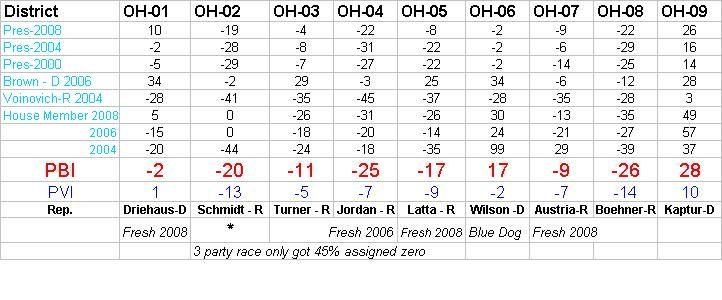
OHIO Part 1

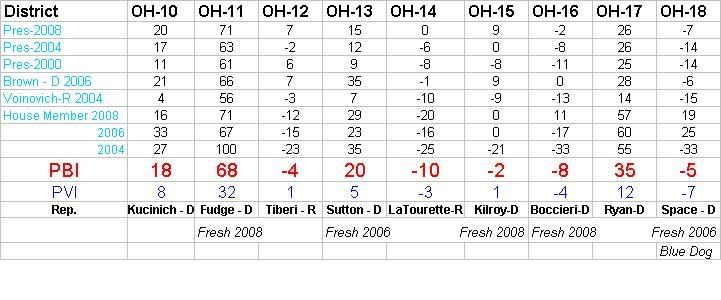
OHIO Part 2

Based on the difference between PVI and PBI I will conjecture the following. Rep. Tiberi R-OH who according to PVI is in a D+1 District will continue to survive as PBI shows him to actually to have a 4% GOP edge in a house race. Representatives Driehaus (+1D PVI, – 2 PBI), Kilroy (+1D PVI, – 2 PBI), and  Boccieri (+4 R PVI, – 8 PBI) will be in for slightly tougher than expected races, while Rep. Space will win by a slightly larger than expected margin (+7 R PVI, – 5 PBI) My source for the election result data for Ohio is the Ohio Secretary of State.

One final note after I come across a few “conservative” Democrats, I run a “correction” factor to account for them being Blue Dogs. The general idea is that the distance they are able to maintain from the national party may help them win over voters who are more reluctant to vote for Democrats. I want to examine another swing state before I “recompute” Ohio’s Blue Dogs.

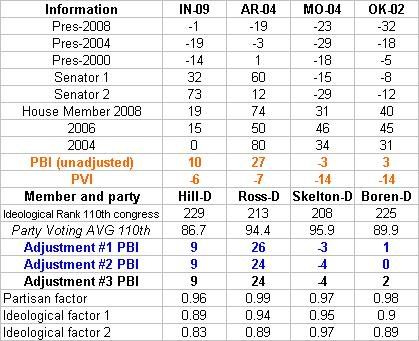
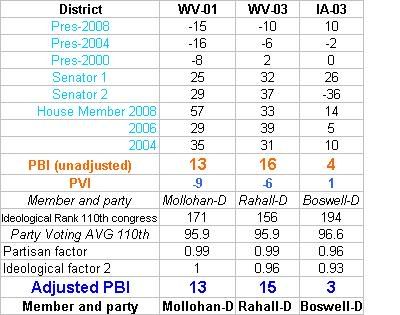
As a recap, here are the first “batch” of Blue Dogs, and rural Democrats (West Virginia’s Democrats aren’t members of the Blue Dogs) that I examined correcting for partisanship and ideology.

FOUR BLUE DOGS

THREE BLUE DOGS

As a reminder ranking a members ideology is a somewhat subjective decision. Potentially what’s one person “liberal” position, is another person “conservative” ones, remember the wingers developed a model that ranked the Sen. Obama as more liberal than Bernie Sanders or Russ Feingold. But partisanship, how often a member votes with their party is an absolute number. A Democrat who represents a “republican district” would be expected to “break with their party” on votes that don’t reflect their districts values.

I couldn’t find a website that ranks all the districts based on their PVI (I only could find list of them by state not rank, help please anyone), therefor I substituted a PVI ranking with where each member ranked in the Democratic caucus. In the 110th Congress the average Democrat had an ideological ranking of 170 (by the way this is a result of several members being tied, this is the medium not the midpoint). The average of members towards the center was 191, former Daily Kos celeb Ciro Rodriguez fell at exactly 191. The average of members towards the liberal side was 121, which falls between Rep. Larson of Conn. and Rep. Eshoo of CA. As or partisanship in the 110th Congress the average Democrat voted with their party 92.3% of the time.

As a clarification in Adjustment #1, I used a deviation factor based on how far each member was from the center of the Democratic caucus. Adjustment #2 was based on how far each member was from outside the standard deviation of the caucus. In Adjustment #3 I removed the partisanship factor to see what effect it would have. As I explained a few diaries ago I will use ADJUSTMENT FACTOR 2 in all subsequent corrections.

Because there are “only” 50 states (as opposed to evaluating 435 house members), I will at a later date have all the states ranked by PVI so I can adjust the Senator’s rankings. I developed Senate factors for the four states the four blue dogs came from. In the interest of full disclosure, my source for ideological rankings is Voteview, and for partisanship it was the Washington Post. This is still a work in progress, I’m making adjustments, and continuing to crunch numbers for more states. I also will use the adjustment factor on a liberal member of congress to see what effect that will have.

Anthology

PBI (Party Brand Index) Part 6 WV and NH

PBI (Party Brand Index) Part 5 Nevada and Iowa

PBI (part 4) MO, AR, OK

Party Brand Index (part 3) North Carolina

Party Brand Index (part 2) Colorado and Virginia (updated)

Introducing PBI, Party Brand Index (Updated)

Poll Roundup (9/25)

We can’t walk from one desk to the other over here in SSP World Headquarters without tripping over another new poll that we haven’t written up yet. Let’s take care of ’em in a roundup. All polls must go!

  • AZ-Gov/Sen: Arizona GOP Gov. Jan Brewer is not only imperiled in the general election, she’s also extremely vulnerable to a primary challenge, according to PPP. State Treasurer Dean Martin leads Brewer by 37-26, but Brewer manages to come out on top against ex-Gov. Fife Symington by 39-31. However, in a three-way race against Martin and Symington, Brewer comes in last; Symington leads with 34, Martin clocks in at 26, and Brewer only registers at 22%. Ouch.

    And in case you were wondering, John McCain doesn’t have anything to worry about in a primary race: he’s dispatching Minutemen founder Chris Simcox by a 61-17 spread.

  • CA-Sen: Everyone’s favorite pollster, Rasmussen Reports, has dipped its toes back in the sunny California surf, and they have some better news for Democratic Sen. Barbara Boxer. Boxer leads Carly Fiorina by 49-39 (up from 45-41 in July), and Chuck DeVore by 46-37.
  • CO-Gov/Sen: The Tarrance Group, a GOP firm, is out with a new poll of the Senate and gubernatorial primaries in Colorado. For Governor, Scott McInnis leads Josh Penry by 40-13, and Jane Norton has a 45-15 edge over Ken Buck in the Senate race. On the Democratic side, Michael Bennet leads Andrew Romanoff by 41-27.
  • IA-Gov/Sen: Rasmussen finds Democratic Gov. Chet Culver in a world of trouble, trailing wingnut Bob Vander Plaats by 43-39, and ex-Gov. Terry Branstad by 54-34. While I don’t doubt that Branstad is ahead of Culver at this point (Selzer says as much), the margins may have more to do with the Rasmussen Effect than anything else.
  • MA-Gov: Suffolk came out with their latest poll of the Massachusetts gubernatorial race, and it provides some of the sunniest results for Deval Patrick in recent memory. Despite being saddled with an atrocious 29/56 re-elect rating, Patrick comes out on top of three-way match-ups against Dem-turned-indie Tim Cahill and GOPers Charlie Baker and Christy Mihos. Take your pick: Patrick 36, Cahill 23, Baker 14; or Patrick 36, Cahill 24, Mihos 17.
  • MI-Gov: Two polls here; one from Mitchell Research for the Detroit News, and another by IMP/MRG. Mitchell Research finds GOP AG Mike Cox leading Democratic Lt. Gov. John Cherry by a disturbing 45-32 margin. In the GOP primary, Cox beats Rep. Pete Hoekstra and Oakland County Sheriff Mike Bouchard, 30-23-11. The IMP/MRG poll has Cherry on top of businessman Rick Snyder by 42-34, but losing to Bouchard by 41-38. Bizarrely, they also decided to pit Cherry and Cox in a three-way race with Andy Dillon, the Democratic Speaker of the MI House, as an independent. In such a match-up, Cox leads Cherry by 35-33, with 13% of the vote going to Dillon.
  • NY-Gov/Sen-B: I think I’ve seen more New York polls this year than I’ve seen rats on the Q line. Rasmussen finds the same old story: Andrew Cuomo would face little difficulty in winning the Governor’s office, while Paterson would lose to Rudy and faces a dogfight against Rick freakin’ Lazio, of all people. In the Senate race, incumbent Dem Kirsten Gillibrand leads George Pataki by 44-41.
  • OH-Gov/Sen: Rasmussen is seeing Tossups everywhere. In Ohio, Republican John Kasich leads Democrat Ted Strickland by 46-45, while ex GOP-Rep. Rob Portman edges Lee Fisher by 41-40 and Jennifer Brunner by 40-38 in the Senate race.
  • VA-Gov: InsiderAdvantage came out with their first take on Virginia’s gubernatorial race, and it’s a tight one: 48-44 for McDonnell. This seems to generally correlate with a growing sense that the race is seeing some tightening (just take a look at that Pollster.com chart), despite us not having any trend lines to mark this one against.

IA-Sen: Will Grassley get the “race of his life”?

Senator Chuck Grassley is seeking a sixth term in 2010, and Iowa Democrats have never managed to give him a tough re-election race before. However, today Iowa Democratic Party chair Michael Kiernan spoke confidently about a “first-round draft pick” who is ready to run against Grassley, Kay Henderson reported for Radio Iowa.

“I’m going to tell you here today that Chuck Grassley is going to be in for the race of his life.” […]

“You’re just going to have to wait to find out,” Kiernan said this morning during taping of this weekend’s “Iowa Press” program.  “We want to wait ’til, obviously, after Terry Branstad announced his candidacy for governor.”

Kiernan isn’t revealing the characteristics this phantom candidate may have either. “I’ll just wait for the announcement,” Kiernan said.  “You will be impressed.” […]

“I’m here to tell you today that it will be the toughest race that Chuck Grassley has faced since John Culver,” Kiernan said.

Grassley defeated Senator John Culver (Governor Chet Culver’s father) in the 1980 Reagan landslide.

Speaking to reporters after today’s taping, Kiernan said the big-name challenger is “100 percent committed” to this race.

Your guess is as good as mine. A retired politician? Former first lady Christie Vilsack? A celebrity in a non-political field? Someone from the business world? (Retired Principal Financial Group CEO Barry Griswell has ruled out running, as has Fred Hubbell, the incoming interim director of the Iowa Department of Economic Development.)

Grassley’s approval rating has fallen this year, but it’ll take a lot to convince me that we can defeat him. He’s still got a strong brand name and 30 years of constituent service behind him.

SSP Daily Digest: 9/25

MA-Sen: A superior court judge today ruled that Deval Patrick did not overstep his authority by unilaterally declaring that there was an emergency that required immediate implementation of the new temporary Senate appointment law (instead of the usual waiting period). Bring on the usual Republican kvetching about judicial activism, but the judge did note that the GOP did “not cite any case law in support of its argument.” (Another interesting tidbit: Mitt Romney used his “emergency” power 14 times while in office, including to raise the boating speed limit in Charlton.) At any rate, this frees up Paul Kirk to be sworn in by Joe Biden this afternoon as the Bay State’s junior senator until January.

CA-Sen: Carly Fiorina has unleashed her killer app: her new website, titled “Carlyfornia Dreamin’.” Unfortunately, the only killing that seems to be going on here is of her own credibility, as both Democrats and conservative Republicans alike are aghast at the site’s… well… vapidity. It’s more fuel for the fire for conservatives left wondering what — if, as rumored, Fiorina isn’t going to self-fund, her one potential advantage — she brings to the table.

KY-Sen: Following his latest “moneybomb” (Sep. 23, timed to coincide with Trey Grayson’s DC fundraiser with much of the GOP Senate establishment), Rand Paul says he’s raised more than $900K this quarter and expects to report $1 million at month’s end.

AZ-Gov: Fresh from posting godawful numbers in this week’s PPP poll, Jan Brewer is already facing her first Republican primary opponent: Paradise Valley mayor Vernon Parker. Parker, who was the Bush administration’s Asst. Sec. of Agriculture for Civil Rights, is African-American; Phoenix suburb Paradise Valley is small (pop. 13,000) but the state’s wealthiest place (2000 MHI $150K).

CA-Gov: With stories dogging Fiorina and Linda McMahon for their spotty voting records, now it’s Meg Whitman’s turn in the spotlight. A Sacramento Bee investigation finds that her failing to vote “on a few occasions,” as she’s previously said, actually means “almost always,” with little record of voting or even registration in the six states and dozen counties where she’s lived.

MI-Gov: Moderate businessman Rick Snyder, who’s languishing in the low single digits in the polls in the GOP gubernatorial field in Michigan, got a high-profile endorsement yesterday: from Bill Ford, chairman of Ford Motors.

NV-Gov: CREW has filed an ethics complaint against ex-AG, ex-federal judge Brian Sandoval, who recently quit his judgeship to move to the Republican gubernatorial primary (against DOA incumbent Jim Gibbons). There are strict prohibitions against political activity by the federal judiciary, but he may have had conservations with political consultants who then included him in polling, which could have crossed the line.

PA-Gov: In the Pennsylvania Republican primary in the open seat governor’s race, conservative AG Tom Corbett got a big endorsement from moderate ex-Gov. Tom Ridge. Meanwhile, the moderate option in the primary, Rep. Jim Gerlach, unveiled a rather less impressive endorsement: conservative ex-Rep. John Peterson.

KS-03: Steve Rose, the Republican publisher of the Johnson County Sun, announced last week that he’d run for the House against Rep. Dennis Moore. Today, he’s already out of the race, citing health reasons.

DGA: Another sign of Barack Obama’s increasing engagement with the gubernatorial sphere (after the row over his involvement in the New York race): he’s headlining a DGA fundraiser in DC on Oct. 1 expected to raise at least $500K.

House: An interesting lawsuit was filed in federal court this week, demanding that the size of the House be increased. The crux is the disparity between, say, WY-AL with less than 500K residents and MT-AL with more than 900K residents; the suit invokes the “one person one vote” requirement with its roots in Baker v. Carr, but that’s never been applied across state lines, only to equalizing districts within a state. It’ll be interesting to see how far this gets. (By the way, Tom Schaller looks at how a bigger House would create a small partisan advantage for the Dems in the Electoral College. No discussion on whether it would lead to a bigger advantage in the House, although that would obviously turn on how the new smaller districts get gerrymandered into existence.)

WATN?: The Abramoff investigation may finally take down ex-Rep. John Doolittle, who was just named as a co-conspirator by federal prosecutors in the corruption case of former aide Kevin Ring.

Pollsters: The American Association for Public Opinion Research took the unusal step yesterday of reprimanding Strategic Vision, LLC (the one whose polls you often see here… not to be confused with well-thought-of market research firm Strategic Vision, Inc.) for failing to respond to requests for basic information about the make-up of their polls. Pollster.com’s Mark Blumenthal had previously flagged SV for suspicious behavior.

NY-23: Club For Growth Poll Points to Three-Way, Scozzafava Hammered From Both Sides in New Ads

Basswood Research for the Club For Growth (9/17, likely voters):

Bill Owens (D): 17

Dede Scozzafava (R): 20

Doug Hoffman (C): 17

Undecided: 45

(MoE: ±5.7%)

The Club For Growth seems ready and eager to jump into the fray in upstate New York after releasing this poll showing their homeboy Doug Hoffman in spitting distance of Scozzfava. The results are even more optimistic for Hoffman than those of Hoffman’s own polling (which had Scozzafava ahead by 30-19, with 20% going to Democrat Bill Owens). Both polls, with their fat MoEs (and in this case, a single-day sample), appear to have been done on the cheap, though. The fact that the Club For Growth appears to be ready to throw down must be music to the DCCC’s ears here.

Both party committees are up on the air with ads, but the NRCC has made the bigger investment: $120K vs. the DCCC’s $55K. But Team Blue is getting an assist from Hoffman, who’s up on the air with a new ad hammering Scozzafava from the right. Both the DCCC’s and Hoffman’s spots are available here:

RaceTracker: NY-23

SSP Daily Digest: 9/24

AZ-Sen (pdf): John McCain is probably safe for re-election in 2010. PPP released the second half of their Arizona sample, and find McCain beating two strong opponents who seem to have no intention of running anyway: Sec. of Homeland Security and ex-Gov. Janet Napolitano (53-40) and Rep. Gabrielle Giffords (57-30). He also leads Tucson city councilor Rodney Glassman, who is at least a rumored candidate, 55-25. McCain only has 48/42 approvals, but with kind of a bipartisan spin: an unusually low 65% of Republicans approve, while an unusually high 32% of Democrats approve.

IL-Sen: Facing some unrest on the right flank, the RNC’s Michael Steele has withdrawn sole support from Rep. Mark Kirk in the Illinois Senate GOP primary, according to the Chicago Observer. He’s back to a neutral position, which certainly counts as a victory for Patrick Hughes, who’s been gaining some momentum at coalescing the party’s right-wing. Considering how Kirk acted when Andy McKenna was going to run, is another temper tantrum in the offing? On the Dem side, Alexi Giannoulias got the endorsement of the SEIU, which led his new rival, former Chicago Inspector General David Hoffman, to “go there,” invoking the specter of Rod Blagojevich, who was elected via SEIU support.

NH-Sen: This isn’t going at all according to plan for Kelly Ayotte (or the NRSC). Yet another random rich GOPer is showing up to scope out the Senate race, the third in a week. Today it’s Jim Bender, an investor who used to be the CEO of Logicraft in the 1990s.

OH-Sen: Everyone forgets about wealthy auto dealer Tom Ganley in the GOP primary in Ohio against establishment pick Rob Portman, probably because he doesn’t have a built-in constituency. Looks like he’s trying to hook up with the teabaggers as a result, positioning himself as a populist alternative to the free-trading Portman. Ganley is also getting some help from a Republican insider: an endorsement from Bay Buchanan (sister of Pat), pleased by Ganley’s anti-immigrant rhetoric.

WV-Sen: Looks like Robert Byrd’s stay in the hospital was a lot shorter than his stint this spring; he was released today.

GA-Gov: Strategic Vision looks at the primary fields in the Georgia governor’s race, and finds not much has changed since last time. For the Dems, ex-Gov. Roy Barnes is at 45%, with Thurbert Baker at 30, David Poythress at 5, and Dubose Porter at 2. (It was 45-29 last month.) For the GOP, Insurance Comm. John Oxendine leads at 38, with Karen Handel at 15, Nathan Deal at 10, and four other guys in single digits. (Oxendine was at 39 last month, although Deal was in 2nd last month at 13, so maybe he took a minor hit from that corruption probe.) No head-to-heads yet, unfortunately.

MI-Gov: Here’s another poll of a potentially exciting gubernatorial race, but primaries only. An Inside Michigan Politics finds a tight GOP primary, with AG Mike Cox in the lead at 27, followed by Rep. Pete Hoekstra at 23 and Oakland Co. Sheriff Mike Bouchard at 15 (with businessman Rick Snyder and state Sen. Tom George each at 2). Lt. Gov. John Cherry is at 40 in the Dem primary with only light opposition from state Rep. Alma Wheeler Smith (9) and former state Rep. John Freeman (8). A March poll from the same pollster had Cox at 17 and Hoekstra at 15 (but both losing to Oakland Co. Exec L. Brooks Patterson, who isn’t running).

NJ-Gov: Two very different pictures from partisan pollsters of the New Jersey governor’s race out there. First comes one from Democracy Corps, who have the race as close as anyone has had it since early spring: Chris Christie leads Jon Corzine and Chris Daggett 40-39-11, and Christie has net negative favorables for the first time, at 32/34. (Their poll two weeks ago had Christie up 41-38-10.) The other is Strategic Vision, who see Christie up 46-38-8. Still an improvement from their last poll in July: 53-38-5… like most pollsters, they see Corzine essentially unable to move up, but succeeding in dragging Christie’s numbers down. One more bucket of mud for Corzine to throw at Christie arrived yesterday: news that Christie owned stock in Cendant Corp. at the same time as he was investigating them through the US Attorney’s office.

NY-Gov, NY-Sen-B (pdf): Marist has a poll out that finds New Yorkers thinking that Barack Obama should butt out of New York governor’s race, by a 62-27 margin. Nevertheless, only 25% think David Paterson should run next year (63% say no); they just want him to arrive at that decision on his own. While the poll doesn’t contain gubernatorial matchups (not that we need any more of them), it does have some Senate numbers, confirming other local pollsters, finding the not-running Rudy Giuliani beating Kirsten Gillibrand 51-40 and the probably-not-running George Pataki beating Gillibrand 45-41.

Meanwhile, the NYT has a profile of a rather melancholy Paterson, saying “I didn’t sign up for this.” They also have a quote that could be seen as hopeful that he may still bail out on seeking another term: “if I got to a point where I thought that my candidacy was hurting my party, obviously it would be rather self-absorbed to go forward.” (Unless he’s made peace with just being self-absorbed.) If you’re wondering what’s taking him so long to make a decision, though, Josh Goodman has a nice pithy summary of the decisionmaking process, not just for Paterson, but all the race’s players:

Paterson thinks he can beat Lazio, but not Giuliani, so he doesn’t want to decide whether he’s running until Giuliani makes up his mind. Giuliani thinks he can beat Paterson, but not Cuomo, so he doesn’t want to decide whether he’s running until Cuomo makes up his mind. Cuomo thinks he can beat anyone, but doesn’t want the messiness of a primary battle, so he doesn’t want to decide whether he’s running until Paterson makes up his mind.

VA-Gov: It looked briefly like ex-Gov. Doug Wilder might endorse Creigh Deeds after all, but today he backed down and said he won’t endorse. Wilder also leveled some criticism at Deeds for proposing tax increases to fix northern Virginia’s increasingly dire transportation problems. It’s a wtf? moment from the mercurial Wilder, whose endorsement would do a lot to move African-American turnout for Deeds, where he hasn’t generated much excitement yet.

MO-04: No surprise here, but state Sen. Bill Stouffer made it official that he’ll be taking on 17-term Dem incumbent Ike Skelton in the dark-red 4th. Christian Right former state Rep. Vicky Hartzler is already in the race; Stouffer, however, seems to be working more of a fiscal discipline angle.

PA-07: While state Rep. Bryan Lentz seems to have the inside track on the Dem nomination (despite no formal announcement), another Democrat is getting in the race: Teresa Touey, a political consultant who has worked for Joe Sestak and Ted Kennedy. One problem for her, though: although she is a native of the 7th, she’s been living in Massachusetts since the early 1990s.

NYC-Mayor: Quinnipiac finds mayoral results in line with just about everybody else: incumbent Michael Bloomberg leads Dem comptroller William Thompson 52-36, with Conservative Party candidate Stephen Christopher pulling in 2.

Redistricting: Roll Call has a detailed piece on how the parties are ramping up financially for the post-2010 redistricting fights. A new 501(c)(4), euphemistically titled Making America’s Promise Secure, with Newt Gingrich and Trent Lott among its founders, will be coordinating the effort (since campaign reform passed since 2002 prevents the RNC from using soft money to spearhead the effort now). The DCCC’s counterpart is the National Democratic Redistricting Trust, although a 527, the equally euphemistic Foundation for the Future, looks like it’ll do the financial heavy lifting.

IA-Gov: Rasmussen shows Culver losing to Branstad, Vander Plaats

The Republican polling firm Rasmussen Reports surveyed 500 “likely voters” in Iowa on September 22 and came up with bad numbers for Governor Chet Culver. Former Governor Terry Branstad leads Culver by 54 percent to 34 percent, and Bob Vander Plaats leads Culver by 43 percent to 39 percent. Culver’s approval rating is 43 percent, with 53 percent of respondents disapproving of the job he is doing.

Topline results and favorability ratings are here. Culver was viewed very or somewhat favorably by 43 percent of respondents and viewed very or somewhat unfavorably by 50 percent. Branstad’s favorability was 64 percent, and his unfavorable numbers were just 29 percent. Vander Plaats was viewed favorably by 45 percent and unfavorably by 30 percent.

These numbers will encourage Branstad, who appears likely to seek his old job again. He has said he’ll decide by October, and I’ve heard rumors that Branstad will announce his candidacy very soon (September 28 according to one person, October 3 according to someone else). I believe that the numbers we see for Branstad this month will be his high water mark, since no one has campaigned against him for 15 years.

Vander Plaats will surely cite the Rasmussen poll as proof that he can beat Culver. The whole “draft Branstad” movement grew out of fears that Vander Plaats could not win a general election.

As a rule, Rasmussen polls tend to come in with somewhat better numbers for Republican candidates and worse numbers for Democrats. Go to Pollster.com and click on almost any national or state-level race to compare recent results from different pollsters.

The recent Selzer Iowa poll for the Des Moines Register found much better numbers for Culver (50 percent approve, 39 percent disapprove). Selzer polled 803 Iowans over a three-day period (3.5 percent margin of error), while Rasmussen polled 500 “likely voters” on a single day (4.5 percent margin of error). Selzer did not poll Culver against Branstad or any other Republican.

I am seeking further information about the likely voter screen Rasmussen used, as well as the proportion of Democrats, Republicans and no-party voters in the sample. I will update this post if I receive more details. If any Rasmussen premium subscriber is reading, feel free to post a comment here or e-mail me at desmoinesdem AT yahoo.com.

The same Rasmussen poll shows Senator Chuck Grassley leading Democrat Bob Krause 56 percent to 30 percent. Chase Martyn looks at the trendlines and concludes that Grassley could become vulnerable next year. In my opinion, Grassley is still well outside the danger zone for an incumbent despite his falling approval numbers.

Click here for Rasmussen’s results on how Iowans view President Obama, the economy and health care reform proposals.