AZ-Sen: Rep. Jeff Flake (R) Reportedly to Announce Senate Run Today

So says Dan Nowicki of the Arizona Republic:

Rep. Jeff Flake, R-Ariz., will announce Monday that he will run for the U.S. Senate being vacated by Sen. Jon Kyl, a source has told The Arizona Republic.

Flake, who was first elected to Congress in 2000, has long expressed interest in running for the Senate. He will make it official at an 8 a.m. news conference at the same Phoenix hotel where Kyl on Thursday announced that he will retire when his current term ends in January 2013.

The Hotline’s Sean Sullivan points out that Flake has $627K in his House campaign account. Flake’s 6th CD would become the third open seat this cycle (not counting the resignations in CA-36 and NY-26), and of course, we can’t really predict what this district will look like after Arizona’s redistricting comission finishes its work. But it’s pretty brutally red (McCain 61%, though that was actually worse than Bush), so there probably won’t be a lot of open seat excitement in this corner of the state.

UPDATE: It’s official. This is what he’s focusing on, at least for now:

Flake says his priorities include balancing the federal government’s budget, securing the border and working on transportation and water policy issues.

Flake says broader action is needed on illegal immigration than just border security but that border security “needs to be the focus.”

On the budget, Flake says everything needs to be on the table, including possible changes to Social Security. But he said changes shouldn’t apply to current beneficiaries.

Redistricting: A Maryland Monstrosity (7-1 Dem Map)

Maryland, my Maryland. The Democrats currently have a 6-2 edge in representation in this fairly blue state, and with redistricting just around the corner, the question on Democrats’ minds is how can we make this an even larger edge? An 8-0 map has seemed impossible to make where it would sufficiently protect the incumbent Democrats, although I’m confident that someone will make one. I know there have been recent attempts but those created an essentially perfect swing district in MD-01 to get us to 7-1 (or 8-0).

My goal is to create a 7-1 map where MD-01 is sufficiently blue so that a moderate Democrat like Frank Kratovil can retake the district and hold it while accounting for:

1.Based on Nathaniel90’s recent “Redistricting Outlook” that discussed Maryland, it appears that I need to keep two minority-majority black districts while I pursue the goal of 7-1.

2. Keeping the Democratic incumbents’ hometowns in their respective districts (I actually ended up drawing both Republicans out of their residences).

3. Increasing the partisan advantage of the more “vulnerable” incumbents.

As for how this map turned into a monstrosity…When you add together the sandbox atmosphere of Dave’s Redistricting App with the already crazily drawn districts in Maryland, you can end up with an absurd map like this one.

NOTE: I used the new population estimates with voting precincts.

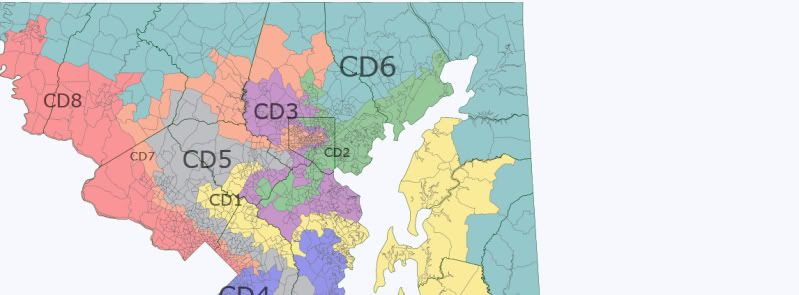
So here’s what I came up with:
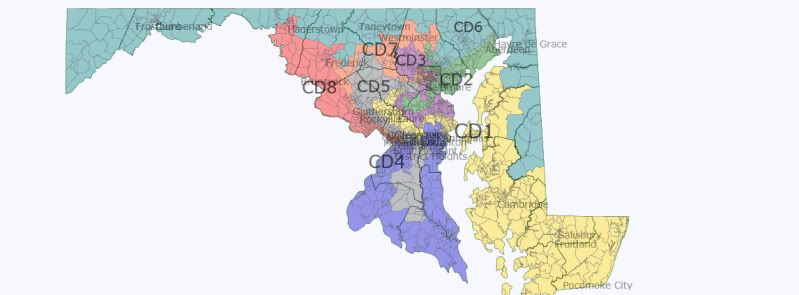
Photobucket

Clearly, there are some ridiculous districts on this map. But let’s break them down.

MD-01 (Yellow)

Naturally, we’ll start with MD-01.
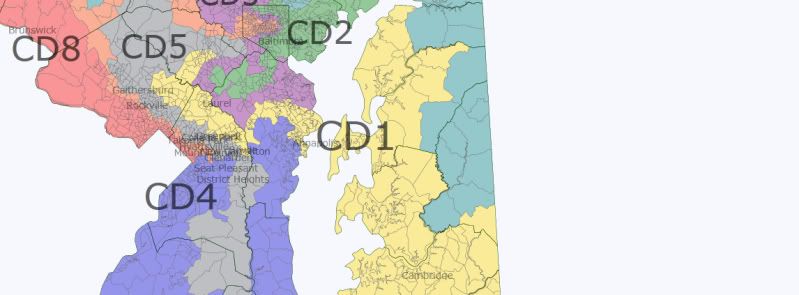
Photobucket

Here’s the data on Mr. Kratovil’s old and hopefully new district:

Photobucket

A zoom in on this district’s mainland “hook”:
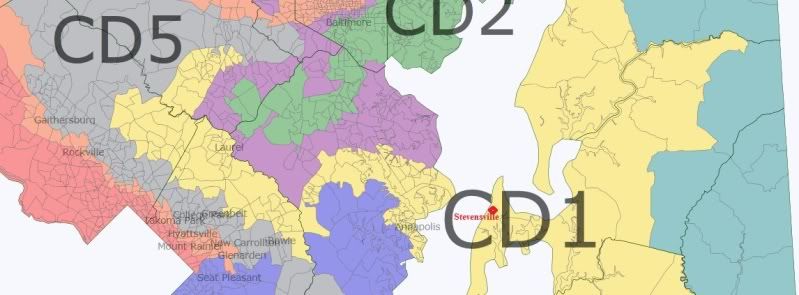
Photobucket

Based on Wikipedia, the old PVI for this district was R+13. With the President’s numbers from 2008, the new district would be a solid D+5, thus very winnable for a candidate like Kratovil (whose hometown Stevensville is shown above). Most importantly, Kratovil’s hometown is in this district whereas GOP incumbent Andy Harris’ is not (it’s in the new 7th and he would have to challenge Elijah Cummings to return). The only question mark about this district is whether or not crossing the Chesapeake Bay allows the district to still be considered “contiguous.”

MD-02 (Green)

Now, for MD-02. Dutch Ruppersberger’s new district looks like this:
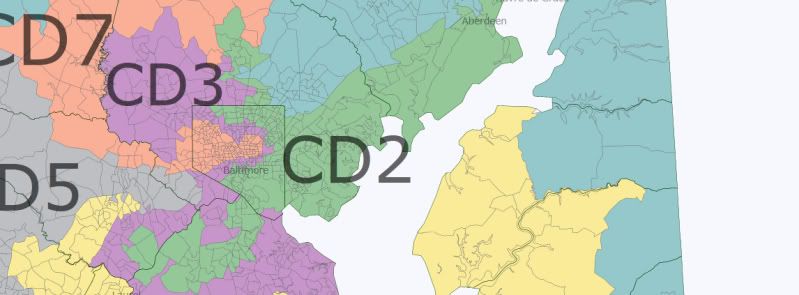
Photobucket

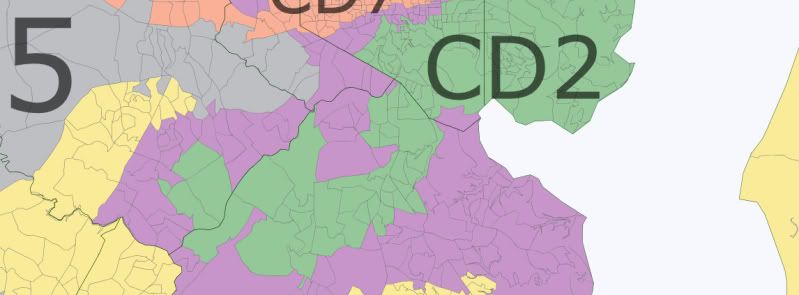
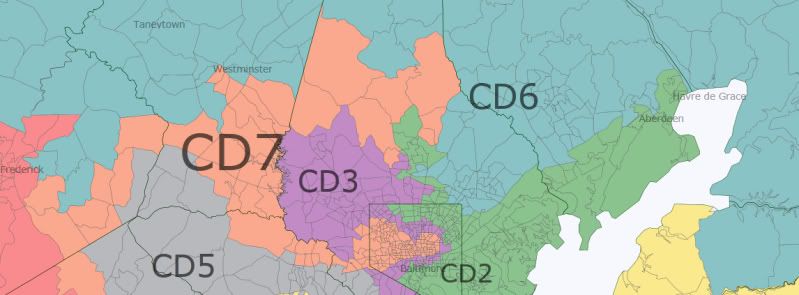
The most north-central part stretches up to snare Cockeysville, Ruppersberger’s hometown (Andy Harris lives somewhere in the vicinity as well because his hometown is listed there, too). The rest of the district is based somewhat on his current set up except that now his seat is even more secure. The data:

Photobucket

Some more pictures of the new MD-02. Here’s the most northern part so you can actually see its fullest extent:
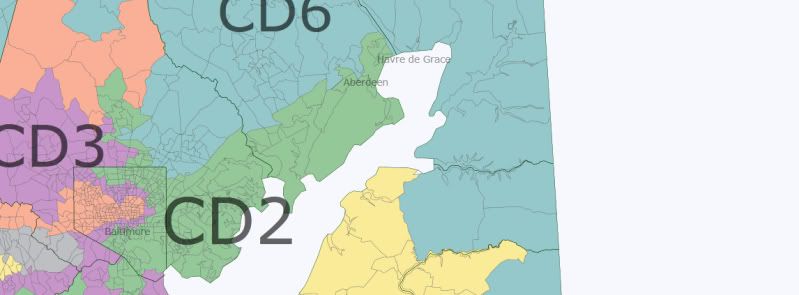
Photobucket

The central part where Cockeysville is:
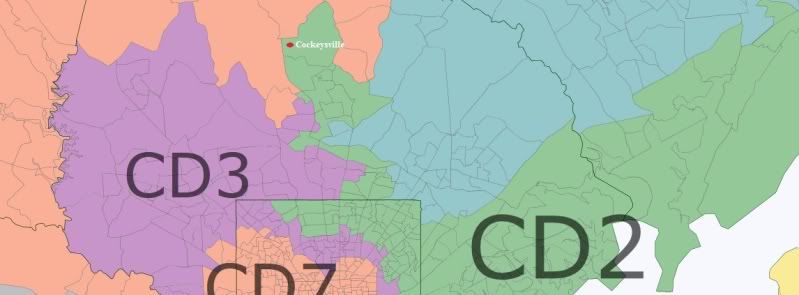
Photobucket

And the southern section:

Photobucket

MD-03 (Purple)

Now, the other non-minority-majority Baltimore district, MD-03. Incumbent John Sarbanes is fairly safe but I’ve made his work even easier.
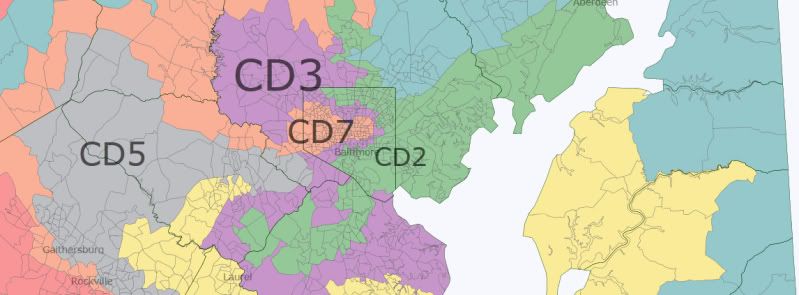
Photobucket

And the data for MD-03:

Photobucket

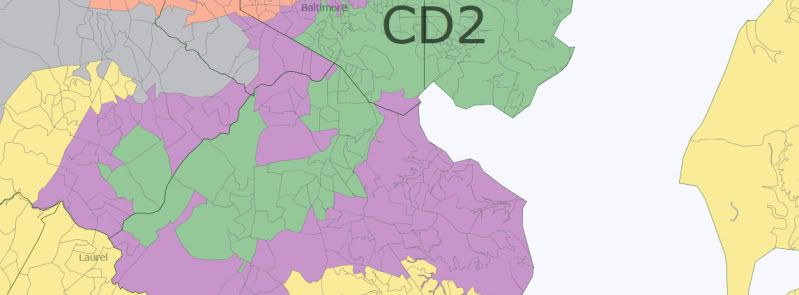
While I know which district on this redistricting map is the “worst,” this one is certainly competing for the second most meandering. Like Ruppsberger’s hometown, Sarbanes’ Towson is barely in his district.
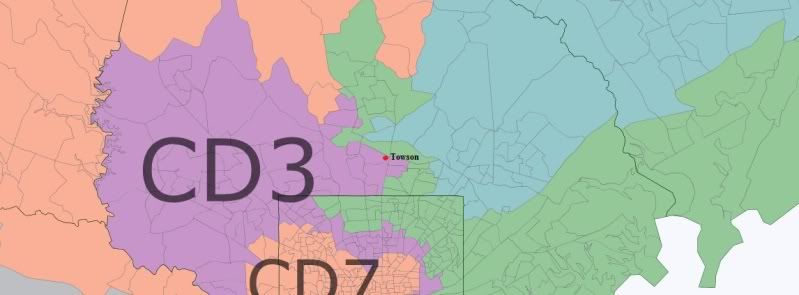
Photobucket

And the most southern part of the MD-03, curling in with MD-02 and MD-01:
Photobucket

MD-04 (Blue)

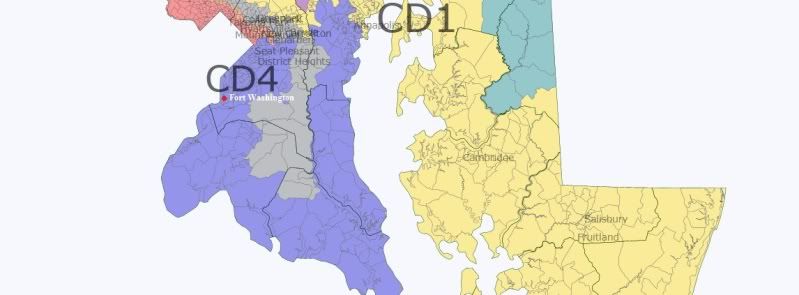
Moving on, we have MD-04, represented by Donna Edwards. It’s the first minority-majority district to discuss. Basically, much of the district is Steny Hoyer’s old district, forming a large U from D.C. to suburban Annapolis for reasons to be explained shortly in the MD-05 (gray) section. Edwards lives in Fort Washington, so that’s not an issue.
Photobucket

The data for MD-04:

Photobucket

Fifty-one percent African American puts it over the hump for continuing to be a minority-majority district. Although it loses some PVI, it had plenty to lose in the first place.

MD-05 (Gray)

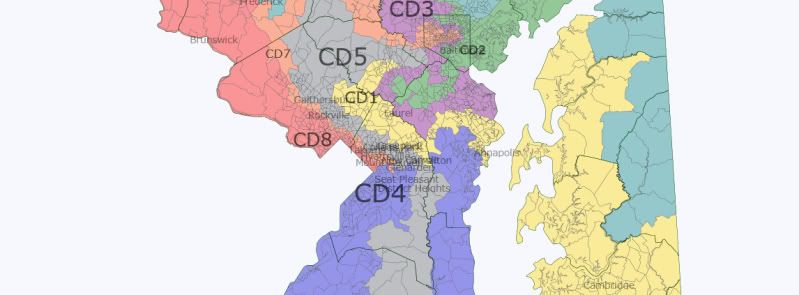
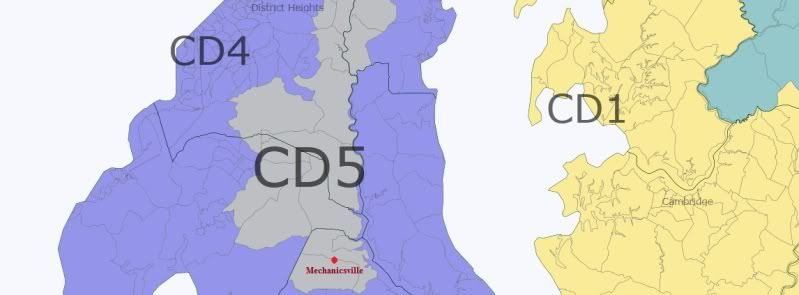
Originally when I was drawing up this map, I gave Donna Edwards all of southeastern Maryland because I thought Steny Hoyer lived closer to College Park. Turns out his home is in Mechanicsville, and I don’t think you can draw the Democratic Minority Whip out his district. Thus, the even more extended nature of his district, which I had going into the suburbs of Annapolis first. Now Edwards goes there and Hoyer stretches down to his hometown.
Photobucket

More specifically, the southern part of the district and Hoyer’s hometown:
Photobucket

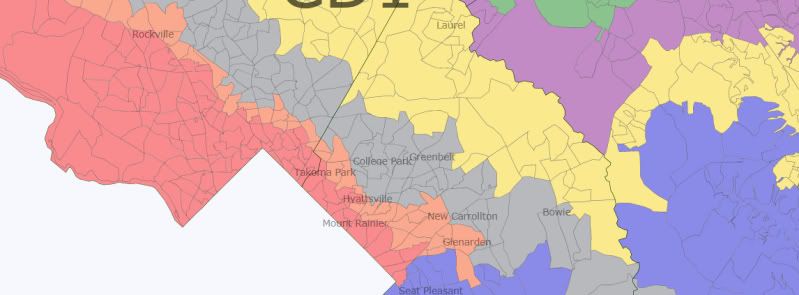
Hoyer’s district, like the prospective MD-01, crosses through the D.C. suburbs and stretches northwest. That stretch looks like this:
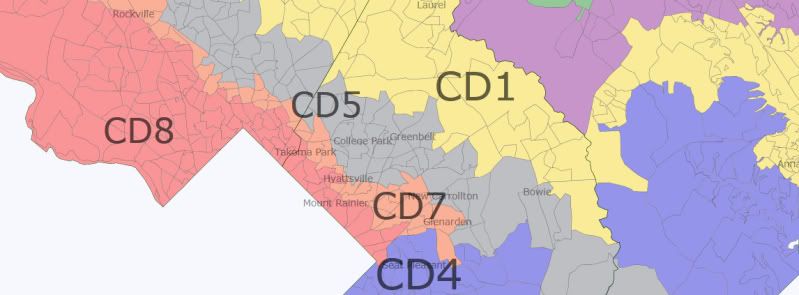
Photobucket

The northern-most part looks like this:
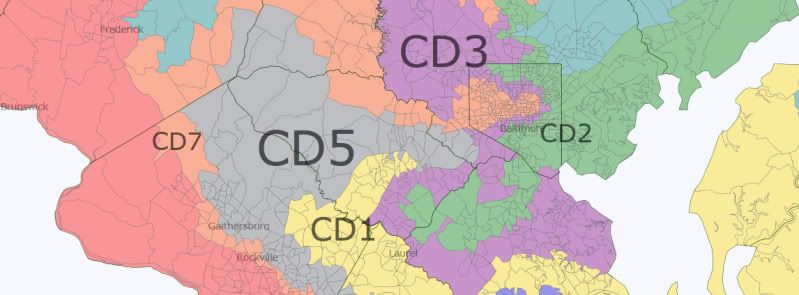
Photobucket

And MD-05’s overall result? A safer district for Steny:

Photobucket

MD-06 (Teal)

Now for the lone safe Republican seat on this map. The giant L of a district has to violate any rules about compactness but it sure isolates the Republicans. As Roscoe Bartlett lives in Frederick, this map actually draws him out of his district because Frederick is now in Chris Van Hollen’s MD-08.

The western part of the district:
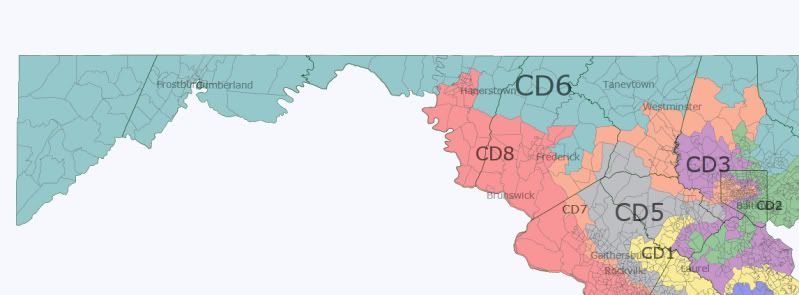
Photobucket

And the eastern part:

Photobucket

MD-06’s data:

Photobucket

MD-07 (Orange)

People are going to ask how in the hell did I end up sending this district from central Baltimore all the way to Prince George’s County. Basically, I was having trouble keeping the 7th over 50% black because it is the other minority-majority district. My original draw out had made MD-04 nearly 60% black so I decided I would “steal” African American voters from it, and at the same time I could leave more of the less-black Democratic areas of greater Baltimore to Sarbanes and Ruppersberger. At the same time, I managed to eat up a lot of blank GOP space that wouldn’t have to go into Hoyer or Van Hollen’s district as I stretched it west. I also drew Andy Harris into the 7th, forcing him to either move or find something else to run for. The end result was the “claw.”
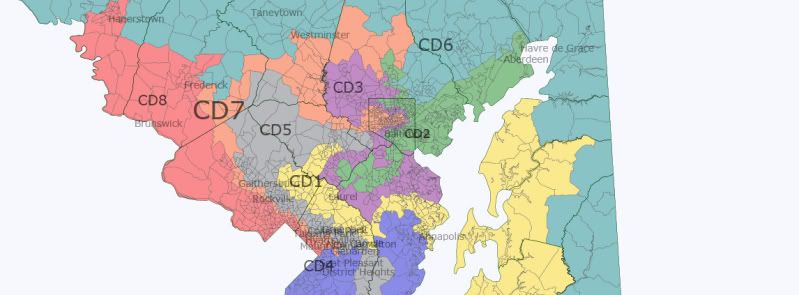
Photobucket

Obviously, this would seem to break any rule on “communities of interest” as we’d have central Baltimore coupled with part of Laurel in suburban D.C. But it satisfied the minority-majority clause as we can see from the data:

Photobucket

The northern part of the district:

Photobucket

The narrow stretch curling down into greater D.C.:
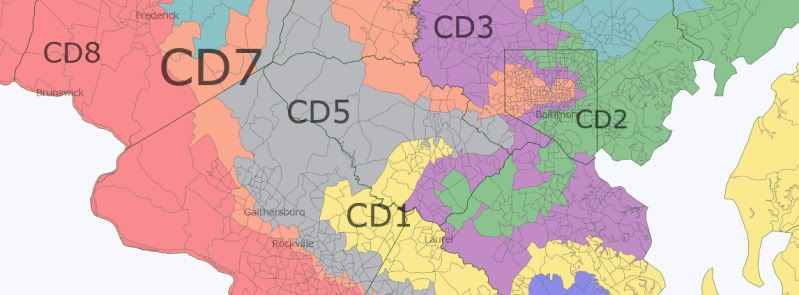
Photobucket

And the suburban D.C. area:

Photobucket

MD-08

Lastly, we have Chris Van Hollen’s MD-08 which now stretches well beyond suburban D.C. all the way to Hagerstown, capturing the few very Democratic areas in Frederick and Hagerstown.
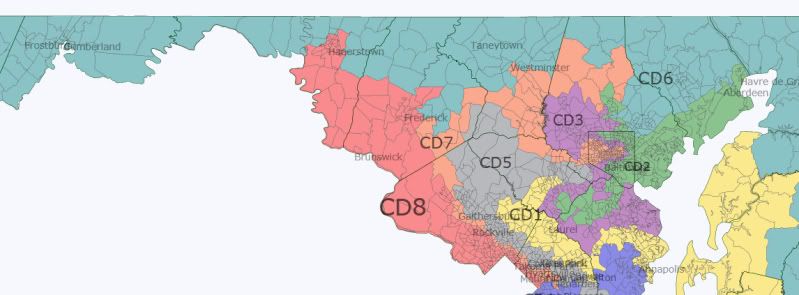
Photobucket

In the southern part of the district, it mixes in with MD-04 and MD-07:
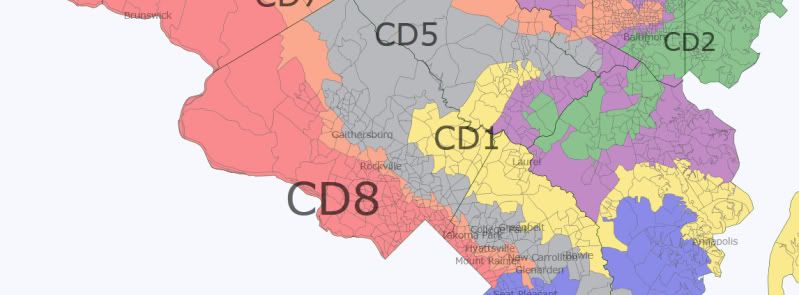
Photobucket

And lastly, MD-08’s data:

Photobucket

In conclusion, here is the data from all eight districts:

Photobucket

Thanks for reading!

Possible Iowa Map

I drew this map upon release of the new Census data for Iowa.  I paid no attention to partisanship and tried to correlate each district with a geographical area of the state.  Starting with Des Moines, I drew a district around it, then drew a district for the southeast, northeast and western Iowa.  My goal was to have each district within 1,000 persons of the ideal district population.  Amazingly, my configuration worked out on my very first try (which means there’s probably many possible combinations to how the state can be drawn).  Nevertheless, I kind of like the map here because I think it does a good job in keeping the different regions of the state together (in that respect, I think it’s better than, for example, the 1990’s Iowa map which had one district run from Des Moines to  the western border).

The population numbers are as follows:

blue – 762,255

green – 761,010

purple – 760,876

red – 762,214

ideal pop. is 761,589

Photobucket

I originally posted my map as part of  a comment on another diary , http://www.swingstateproject.c…  and reader OGGoldy crunched the partisan numbers for the map as follows:

blue – 55.3% Obama, 44.7% McCain

green – 58.8% Obama, 41.2% McCain

purple – 58.9% Obama, 41.1% McCain

red – 46.3% Obama, 53.7% McCain

Growing Republican Strength Along the Rio Grande River?

By: Inoljt, http://mypolitikal.com/

The state of Texas is one of the Republican Party’s most valuable strongholds. It adds a good 38 electoral votes to the Republican candidate’s electoral vote; Democrats have not been competitive in the state for at least a decade.

One of the only Democratic regions in Texas lies along the Rio Grande River:

Photobucket

More below.

This region is the part of Texas that borders Mexico. It is readily apparent in the map above as the only group of blue counties that President Barack Obama won outside of a major city.

The area is one of the most Hispanic areas in the United States; there are places, especially next to the border of Mexico, where the Hispanic percentage approaches 100%. Some of these people have lived along the Rio Grande for hundreds of years, with roots dating back to when Texas was a part of Mexico.

There are several other distinguishing characteristics. The parts of Texas along the Mexican border are among the poorest regions in the United States. Politically speaking, voter turn-out is very low – perhaps lower than any other part of the country.

When the rest of Texas moved steadily Republican, South Texas swung leftwards for much of the twentieth century. In 1996 the Democratic presidential nominee won almost every single county south of San Antonio, some with over 80% of the vote.

Since then, however, Republicans have recovered their verve. President George W. Bush did incredibly well amongst Hispanics in Texas; in 2004 he even won 86% Hispanic Cameron County in the Rio Grande Valley. In 2008 the Democratic presidential candidate once again posted solid numbers along the Rio Grande. Nevertheless, they ran well behind their 1996 performance throughout the region:

Photobucket

(Note: Edited NYT Image)

Compared to 1988 – a year in which the Democratic presidential candidate suffered a resounding national defeat – the 2008 nominee, despite winning a solid national victory, also failed to improve markedly in the Rio Grande area:

Photobucket

(Note: Edited Center For American Progress Image This image can be accessed here.)

Note that in 2008 Democrats lost Texas by 11.8%; in 1988 they lost Texas by 12.6%.

In the 2010 midterm elections Republicans also made several gains in South Texas, winning two heavily Hispanic congressional districts. The first was the 23rd congressional district, which is 65.5% Hispanic; the second the 27th congressional district, which is 71.6% (!) Hispanic.

Photobucket

These patterns are not unique to Texas. In rural south Colorado, for instance, traditionally Hispanic counties have also trended Republican since the 1990s.

Whether the areas of Texas bordering the Rio Grande River will continue moving Democratic or Republican is up-to-question. In Texas, the effects of Mr. Bush’s appeal to Hispanics still are heard; Hispanics in the state are some of the more conservative in the country. The Texas Republican Party has also been relatively moderate on immigration issues. For instance, Republican Governor Rick Perry – a firecracker on other issues – opposes SB 1070.

Needless to say, Republican success at cutting Democratic margins in the counties bordering the Rio Grande would constitute a major achievement for the party.

If a Democrat is ever to win Texas – and none has done so for more than a decade – he or she will need enormous margins there. If Republicans go from 30+% to 40+% of the vote in El Paso or Hidalgo County, it is very difficult to imagine Democrats ever winning Texas.

For more than a decade Democrats have latched onto the Great Hispanic Hope: that growing numbers of Democratic-voting Latinos in Texas will one day turn the state blue. Republican success at winning Hispanics would crush that dream.

8-0 Maryland Revisited

My last diary attempted to draw an effective 8-0 map of Maryland. This ran into problems, because my idea of drawing MD-01 across the Chesapeake from the Eastern Shore to St. Mary’s county left Steny Hoyer without a clear district to run in. In light of that, I have played around some more with the map of Maryland, and this is the best way I have come up with to guarantee Hoyer a district while drawing 8 democratic districts:

In the west the pattern is similar to my last plan. Chris Van Hollen’s MD-08 takes in the panhandle and becomes 61%O/38%M. MD-06 now stretches down into Montgomery County and is now 60%O/38%M. MD-05 is a district drawn for Steny Hoyer. It’s basically his ideal district, composing Southern Maryland, Eastern PG Co, and part of Anne Arundel County. It is 61%O/38%M, and should be safe for Hoyer. MD-04 stretches out of PG Co to take up the part Anne Arundel that isn’t in MD-05 (except for two precincts that are in the 2nd). It is just barely majority-black (51%B/38%W), but safely democratic at 73%O/25%M. The 1st district composes Frank Kratovil’s base in the Eastern Shore, Aberdeen Proving Ground in Harford Co, some parts of SE Baltimore county, and some heavily Democratic areas in Baltimore city. The district as a whole is 50%O/49%M. That is much more democratic than the previous district, but still Republican leaning on a national level. I believe, however, that this would be even better for Kratovil than the district I drew for him in my last diary. Most of the voters in this district’s section of Baltimore county are conservative Reagan Democrats who vote Republican on a national level but still elect conservative Democrats at a local level. These voters should be generally friendly to a conservative Democrat like Kratovil. In addition, these conservative Democrats would help make act as a buffer against an unelectable liberal democrat winning the primary. Between them, the Democrats in Baltimore city, and the Eastern Shore voters who have typically been Kratovil’s base, I think Kratovil should not have trouble winning this district. The 7th stretches up along the 95-or along I-95, as some east coast people say (see the old diary for those who don’t get the reference). It takes in many conservative areas, but is still 51%B/43%W and 68%O/31%M. The 3rd composes most of the close-in suburbs of Baltimore and is even safer D than before (63%O/35%M). The 2nd takes in the northern part of Baltimore county, some rural areas, much of Howard county, and some DC suburbs in PG and MontCo. The partisanship is the same as it is now, 59%D/39%R.

The big problem with this district is not political but regional. In this map, the PG+Montgomery areas of the 2nd district composed around 300K of the district’s 700k people. The areas outside of PG, Montgomery, and Howard counties only total 200K of the district’s population. This means that a majority of the Democratic primary in that district would probably be DC area voters instead of Baltimore area voters, because the areas in PG and Montgomery are much more Democratic than the other areas and because turnout rates are higher in Democratic primaries in PG Co and Mont Co as the Democratic primaries there are effectively the general election. I don’t know whether or not Ruppersburger would face a primary challenge (he could move to Columbia, which would put him in the center of the district and would probably be a good idea anyway given that these districts are going to have to be drawn somewhat differently from the above map due to population shifts to that area), but I know that the Baltimore area state legislators would not be happy with losing the influence of one congressman, especially since Andy Harris who lives in the Baltimore area would be gone as well. With that in mind, I drew another map of the state that preserves Baltimore’s influence in Congress, however with less clean lines overall.

This map draws MD-03 down into PG county a little and gives MD-02 some majority-black areas of Baltimore county. This has the effect of making both districts a little closer to each other in partisanship (MD-02 is 61%O/37%M and MD-03 is 62%O/36%M), and it allows the Baltimore area to dominate both districts. None of the other districts are changed. This map has many advantages, but it definitely looks more gerrymandered than the first one.

Utah: 2 Obama Districts ??

I was inspired by Alizarin’s diary “Republican Gerrymander of New York”: http://www.swingstateproject.c…  as well as abgin’s “finding limits” series of diaries to try to make a Utah map with two Obama districts.  The resulting map actually has both districts at McCain under 50% — in the green district, Obama has a plurality, while in the blue one McCain is slightly ahead, though still under 50%.  

The partisan data was not in the Application.  The major problem I had was lack of precinct data from the various counties.  I did this map purely for fun so I used a variety of data sources and estimation techniques here – some of which may come with caveats.  Therefore, I cannot guarantee that my end result is exactly accurate.  The point, nevertheless, is not whether one can actually have 2 Obama districts BUT that one can certainly draw 2 districts in Utah that at least come very close to being Obama plurality or majority. (In all likelihood, though, it would probably be technically possible to draw 2 Obama districts in Utah if certain precincts could be split and the map was a little more gerrymandered than the one here.  I also played with this using the “old” population numbers, and in that case I can guarantee that two Obama districts could be drawn.)

For Salt Lake County, I used city data provided by sysm29 in the diary “Let’s Redistrict Utah !”: http://www.swingstateproject.c… (I estimated/extrapolated the numbers for a couple of precincts in unincorporated areas).  For Davis, Tooele and Utah Counties good precinct data was available, although I had to use maps provided on the county sites to match existing precincts to those in the Application, as the borders and numbers have changed in many cases over the last decade.  For San Juan and Uintah counties I estimated the percentages based on some information I had re. how Native American areas voted.  (In San Juan, for example, the total county vote was 51 McCain – 47 Obama, but that hides the fact that the Navajo areas voted overwhelmingly for Obama, while the white areas were overwhelmingly for McCain).

For many counties, like Weber and Wasatch I couldn’t find precinct breakdowns; thus I was very limited in how to create the districts.  I decided to include the whole county in both cases in my green Obama plurality district as the Obama percentages were relatively high for the state.  I feel that if I had precinct data, especially for Weber, I could redo this map so that 2 districts would result with Obama pluralities.  Nevertheless, here is the map in its imperfect form.  The population deviation, using the “new” population estimates was 266 to 388 persons above an ideal district size for the blue, green and purple districts, and 967 persons under the ideal size for the red district:

Photobucket

Photobucket

Photobucket

Here’s a breakdown of each district (please NOTE that the partisan data comes with a caveat explained above, so may not be completely accurate):

Green: Obama 48.4 – McCain 48.3

Blue: Obama 47.2 – McCain 49.9

Purple: Obama 23.1 – McCain 74.1

Red: Obama 21.0 – McCain 75.7

One interesting fact: to show you just how Republican much of Utah still is, it turns out that the most Democratic part of Davis Co. is Hill Air Force Base !

I should also note that approximately 27% of the population of the green district would be current constituents of Jim Matheson, while about 49% of the population of the blue district would be Matheson’s current constituents.  If there’s a parallel universe somewhere out there where the Democrats control their version of Utah, they should definitely go with this map.

AR, IA, IN, and MD: Population by CD for Four More States

Four more states were released this week; again, we pick out the population by CD to see the relative standings of each district.


District Population Deviation
AR-01 687,694 (41,286)
AR-02 751,377 22,398
AR-03 822,564 93,585
AR-04 654,283 (74,697)
Total: 2,915,918


District Population Deviation
IA-01 596,443 (165,146)
IA-02 620,856 (140,733)
IA-03 642,116 (119,473)
IA-04 609,487 (152,102)
IA-05 577,453 (184,136)
Total: 3,046,355


District Population Deviation
IN-01 705,600 (14,822)
IN-02 679,254 (41,168)
IN-03 723,633 3,211
IN-04 789,835 69,413
IN-05 809,107 88,685
IN-06 676,548 (43,874)
IN-07 676,351 (44,071)
IN-08 694,398 (26,024)
IN-09 729,076 8,654
Total: 6,483,802


District Population Deviation
MD-01 744,275 22,581
MD-02 700,893 (20,801)
MD-03 719,856 (1,838)
MD-04 714,316 (7,378)
MD-05 767,369 45,675
MD-06 738,943 17,249
MD-07 659,776 (61,918)
MD-08 728,124 6,430
Total: 5,773,552

SSP Daily Digest: 2/11

AZ-Sen: As the dust settles from Jon Kyl’s retirement, the biggest name on the Dem side may also be the biggest question mark: Rep. Gabby Giffords, who it turns out had been telling her staff that she’d planned to run for Senate in 2012 if an open seat arose, but whose recovery timetable is entirely unclear at this point. Local Dems are saying she has “the right of first refusal,” but it may be a while till we get a decision out of her, so the Dem field is very much up in the air. One other major Dem is publicly expressing his interest, though: Phoenix mayor Phil Gordon, who’s termed-out of his job this year. (The same article also finds former Arizona Diamondbacks star Luis Gonzalez declining a run; not sure why he was being asked in the first place.) On the GOP side, Gov. Jan Brewer acted quickly to quash any speculation that she might run. However, J.D. Hayworth, last seen getting creamed by John McCain in the 2010 primary, says he’s interested in another run, while another unappetizing leftover, ex-Gov. Fife Symington, says he won’t rule it out (as well as floating the name of former NFL quarterback Kurt Warner). If you want to see all the many potential names in one place, here’s The Hill’s mega-rundown.

FL-Sen: Scratch one more of the state’s myriad GOP House members from the list of possible Senate candidates. FL-16’s sophomore Rep. Tom Rooney says the Senate may be an eventual goal someday, but he’d rather focus on building up his credentials in the House first.

ME-Sen: It seems like his extended period of talking to himself is over, as local tea party leader Andrew Ian Dodge announced (at CPAC, instead of in Maine) that he will in fact challenge Olympia Snowe in the GOP primary. I’m not sure if Snowe is really shaking in her boots, though, if this is the best that the teabaggers can find: Dodge, though able to self-fund, is a bit of an iconoclast (and one might charitably describe his appearance as “scruffy”), and doesn’t really seem to fit in with any of the various subconstituencies within the tea party umbrella. He’s uninterested in social issues (he’s pro-gay and indifferent to abortion) and more of a fiscal hawk, but doesn’t have much common cause with the Paulists either, breaking with them on foreign policy. If he loses social con votes to the other teabagger in the race, little-known Scott D’Amboise, that split basically ensures Snowe another nomination. Further complicating matters, Dodge is allied with Tea Party Patriots, archenemy to the DC-based astroturf-flavored Tea Party Express. For what it’s worth, TPX officially declared that Snowe is one of their top targets for 2012 (um, was there any doubt about that before yesterday?), but there’s no word on who they plan to back in the race, and I can’t imagine it being Doge.

MI-Sen: Former state party chair Saul Anuzis may be getting cold feet about a Senate run all of a sudden, if his new comments are any indication: he said he’d rather see someone else run. One name he dropped as a preferred alternative to himself is (no surprise) ex-Rep. Peter Hoekstra, but another is perhaps the one potential candidate with even less name rec than Anuzis (and also the likeliest person to run, it seems): wealthy businessman Tim Leuliette.

NM-Sen: In case Jeff Bingaman does (contrary to current expectations) resign, don’t look for a Bill Richardson run to succeed him. The ex-Gov. leaves office under a cloud according to PPP, with a 34/55 approval, and 50% saying they’d never vote for him for anything again. Everyone else in New Mexico is pretty popular; Tom Udall is at 56/31 and new Gov. Susana Martinez is at 53/29.

UT-Sen: Looks like Orrin Hatch, who’s in full cozy-up-to-the-tea-party mode this week, can’t count on any help from his new colleague Mike Lee; Lee just confirmed that he’ll remain neutral in any primary that Hatch might face. Hatch, for his part, at CPAC today, just said that he’s sorry for his bailout vote, but that the bailout helped prevent a depression. So… he’s sorry about having helped prevent a depression?!? Let me sit and ponder that one for a bit.

VA-Sen: Here’s some good news: ex-Rep. Glenn Nye says he has “absolutely no interest” and has made “zero calls” about the Senate race on the Dem side. (That contradicts yesterday’s reports that he was calling around; the “absolutely no interest” part may be true though, inasmuch as that’s what he got on the other end of the line.) However, Rep. Gerry Connolly isn’t doing anything to downplay his name; he isn’t ruling it in or out, but is pitching himself as “viable.” (Woooooo! Viable!!! The audacity of viability! We have nothing to fear but inviability itself! Mr. Gorbachev, this wall is not viable!) Connolly blanches at the pricetag though, saying this will likely be a $25 million race.

MT-Gov, MT-Sen: Well, this pretty much makes it clear that Denny Rehberg will have a stroll to the Senate nomination. Military/security-complex businessman Neil Livingstone was one of the two initial non-Rehberg names associated with the GOP side of the Senate race; with Steve Daines now in the House race, Livingstone now has decided to announce for the gubernatorial race instead. He doesn’t face anyone of Rehberg size there, although ex-Rep. Rick Hill is still a pretty imposing obstacle.

WV-Gov: With tomorrow’s filing deadline for the gubernatorial special election fast approaching, it’s worth noting how few people (of the many, many possibles) have actually signed up. All we have so far are Natalie Tennant, Earl Ray Tomblin, Rick Thompson, and a Some Dude candidate (Arne Moltis) on the Dem side, and Clark Barnes on the GOP side. Betty Ireland was planning to file today, though, and there will probably be a rush tomorrow.

NY-26: Kathy Konst isn’t the only Dem who seems to be moving forward with seeking the nomination in the upcoming special election; Erie Co. Clerk Kathleen Hochul is interested, too. (She lives slightly outside the district’s boundaries in Hamburg.) Meanwhile, lots of GOPers took their names out of contention: ex-Rep. Tom Reynolds, Assemblyman Jim Hayes, state Sen. Michael Ranzenhofer, and state Sen. Joe Robach. (With George Maziarz also apparently a no, that’s pretty much all the GOP state Senators who’d been floated, lessening the likelihood of more 31-31 fun.)

Mayors: There are mayoral polls in both Chicago and Philadelphia, neither one offering a surprise. In the Windy City, Rahm Emanuel finds himself just shy of clearing the runoff hurdle in a poll from Chicago Tribune/WGN; he’s at 49, with 19 for Gery Chico, 10 for Carol Mosely Braun, and 8 for Miguel del Valle. (Last month’s Tribune poll had Emanuel at 44 and CMB at 21.) In the Hey, Up Yours City, incumbent Michael Nutter wins easily despite some ambivalent approvals, according to Franklin & Marshall. His approval is 50/32 (60/24 among whites but only 42/41 among African-Americans, who, despite the fact that he’s African-American himself, tend to be his weakest constituency); despite that, 53% say he doesn’t deserve to be re-elected. Nutter beats Tom Knox 46-28 in a general election matchup (which is odd because Knox isn’t a Republican, although I guess he could become one to avoid another primary loss to Nutter, which is what happened in 2007). Nutter’s only announced opponent so far is former state legislator Milton Street, the brother of ex-mayor John Street; Street has a bit of a liability, though, in that he’s currently on supervised release after spending 20 months in federal prison for tax evasion.

Dark money: The billionaire Koch brothers have, over the last year, suddenly gone from anonymous rich guys who like to fund right-wing think tanks to, with their efforts to move more into funding activism and advertising, public enemies #1 on the dark money front. They’ve set a new target for the 2012 cycle that shows just what we’re up against money-wise: they plan to contribute and raise $88 million for funding micro-targeting efforts as well as ads. It’s not clear whether that would all happen under the aegis of their Americans for Prosperity, or if that money would get spread around the dark money universe, but Politico’s article makes it sound that the secretive Kochs aren’t closely allied with, if not directly in competition with, other groups like American Crossroads.

Republican Gerrymander of New York

This diary presents a theoretical Republican gerrymander of New York (27 representatives) that should, in the normal course of events, yield a 16D-11R delegation. Exactly how Republican a seat needs to be to be safe is a matter for debate, but in none of the projected Republican seats did Obama receive more than 47% of the vote which I feel should be safe most of the time. This map make makes quite a bit of use of water contiguity both around Long Island and Lake Ontario, however there is no touch point contiguity. Population deviations are all less than 1000 (within 0.15%).

Districts are numbered in reverse order to the current system, low numbered districts are upstate and high numbered are downstate.

NY-1 (Blue): More or less similar to the current 28th including the most Democratic parts of Buffalo, Niagara Falls, and the western Democratic parts of Rochester. Uses water contiguity on Lake Ontario instead of following the coastline which helps to push the PVI a little more Democratic. O 71% M 27%  

NY-2 (Green): Reasonably similar to the current 26th in that it includes parts of the Buffalo and Rochester suburbs and the areas in between. O 47% M 51%  

NY-3 (Dark Magenta): At this point upstate New York starts to take departures from reality and no longer resembles the current districts. The western parts of the southern tier, the south Buffalo suburbs, and wraps around Rochester to take in the eastern suburbs.  O 47% M 52%  

NY-4 (Red): Eastern and southern democratic leaning areas of Rochester, water contiguity to Oswego and a thin strip to metro Syracuse, tendrils to both Utica and Ithaca. O 64% M 35%  

NY-5 (Gold): The remainder of the southern tier, the territory between Syracuse (including its western suburbs) and Rochester, wraps around to southern Syracuse avoiding Ithaca. O 47% M 51%  

NY-6 (Teal): Northern Syracuse, northern Utica, Rome, north along the Lake Ontario coastline before turning east and then south, terminating short of Albany. O 47% M 52%  

NY-7 (Dark Grey): The Democratic leaning northernmost counties, a narrow strip running down the eastern state line, Saratoga Springs, Schenectady, and Albany. O 62% M 36%  

NY-8 (Slate Blue): Otsego County centred, with arms running off in every direction sucking in Republican leaning districts. O 47% M 51%

NY-9 (Cyan): Both the east and west state lines with convoluted lines grabbing the most Republican parts of Rockford County O 46% M 52%  

NY-10 (Deep Pink): Binghampton, Middletown, Peekskill, Newburgh, Poughkeepsie, Kingston, and the land connecting them. O 60% M 39%  

NY-11 (Chartreuse): The Democratic parts of Rockland and parts of Westchester, down the Hudson river coastline a little. O 66% M 33%

NY-12 (Cornflower Blue): More of Democratic Westchester, including New Rochelle and Mount Vernon, plus some of the northern Bronx. O 85% M 14%  

NY-13 (Dark Salmon): Southern Bronx, much like the current 16th. O 93% M 7%  

NY-14 (Olive): Northern Manhattan, much like the current 15th. O 92% M 7%  

NY-15 (Dark Orange): Southern Manhattan. O 82% M 17%  

NY-16 (Lime): Little bits of Kings, Queens, the Bronx, and Manhattan. O 79% M 20%  

NY-17 (Dark Slate Blue): Mostly Queens. O 81% M 19%

NY-18 (Yellow): North-eastern Kings. O 95% M 5%  

NY-19 (Yellow Green): North-western Kings and the northern shore of Staten Island. O 90% M 9%

NY-20 (Pink): South-western Kings and Staten Island minus its north shore. O 47% M 53%

NY-21 (Maroon): South Eastern Kings, and connected by water contiguity, the entire south coast of Long Island from Long Beach to Montauk.

O 46% M 53%

NY-22 (Sienna): Mostly Queens. O 71% M 29%

NY-23 (Aquamarine): Horrendously tortuous district picking up everything republican in southern Westchester, Bronx County, Queens, and Nassau and using repeated water contiguity over Eastchester Bay and the Long Island Sound to do it. O 47% M 52%

NY-24 (Indigo): Republican areas north of Jamaica bay in Queens, as well as southern Nassau, and a little south-western Suffolk.  O 47% M 52%

NY-25 (Pale Violet Red): The most Democratic parts of central and southern Queens and Nassau. O 90% M 10%

NY-26 (Grey): The republican parts of Eastern Long Island O 47% M 53%

NY-27 (Spring Green): The Democratic parts of Eastern long island, in four sections, each connected by water contiguity along the Long Island Sound. O 63% M 37%