Redistricting outlook: Kansas-Maryland

Now that it’s 2011, the redistricting games will soon begin in earnest, with more detailed Census data expected in the coming weeks and some states holding spring legislative sessions to deal with drawing new maps. Long ago I planned to do state-by-state rundowns of the redistricting process as soon as 2010 election results and Census reapportionment were clear. Now that time has arrived, and it’s time to look at Kansas, Kentucky, Louisiana, Maine, and Maryland.

Previous diary on Alabama, Arizona, and Arkansas

Previous diary on California, Colorado, and Connecticut

Previous diary on Florida, Georgia, and Hawaii

Previous diary on Idaho, Illinois, Indiana, and Iowa

The rest below the fold…

Kansas

Photobucket

Districts: 4

Who’s in charge? Republicans

Is that important? Nope

With an all-Republican delegation, GOP mapmakers may simply try to ensure that Kevin Yoder avoids a close race in the next decade.

Kentucky

Photobucket

Districts: 6

Who’s in charge? Split (Dem Governor and House, GOP Senate)

Is that important? Perhaps

I have heard rumors that Republicans hope to stall the redistricting process past the 2011 state elections, expecting to topple both Gov. Beshear and the Democratic House majority this November. But assuming a continuation of the status quo, Ben Chandler should get a slightly more favorable district than the one he nearly lost in 2010.

Louisiana

Photobucket

Districts: 6, down from 7 in 2002

Who’s in charge? Split (GOP Governor and House, Dem Senate)

Is that important? Not really

The outcome of reapportionment in Louisiana has scarcely been in doubt since Jeff Landry was elected last November. He will be forced against fellow Republican Rep. Charles Boustany in a coastal district. Meanwhile, Cedric Richmond’s VRA-protected seat will have to absorb a lot of new population near Baton Rouge, and Rodney Alexander’s underpopulated northern seat will expand southwest a bit.

Maine

Photobucket

Districts: 2

Who’s in charge? Nonpartisan commission

Is that important? No

Maine does not even traditionally redraw its maps before the election year ending in 2. Sometime in 2013, the commission will make some boundary adjustments, and both Mike Michaud and Chellie Pingree should remain reasonably secure should they still be in office two years from now.

Maryland

Photobucket

Districts: 8

Who’s in charge? Democrats

Is that important? Perhaps

The question here is how aggressive Democrats perceive they can afford to be. They already constructed a master gerrymander in 2002, moving the delegation from a 4-4 split to a thoroughly safe 6-2 Democratic edge. Now, some are pushing for a 7-1 map that remakes Andy Harris’s Eastern Shore seat for a moderate Dem like Frank Kratovil. However, such a map presents serious issues: how to maintain VRA-mandated black majorities in the 4th (represented by Donna Edwards) and 7th (Elijah Cummings)? How to keep the four other Dem incumbents completely safe? With today’s redistricting technology, it can probably be done, but the 1st cannot be made securely Dem lest other districts be jeopardized…only politically competitive enough for Kratovil to stage a comeback.

NM-Sen: Smooth Sailing for Bingaman

Public Policy Polling (2/4-6, New Mexico voters, no trendlines):

Jeff Bingaman (D-inc): 51

Gary Johnson (R): 40

Undecided: 9

Jeff Bingaman (D-inc): 57

Steve Pearce (R): 34

Undecided: 9

Jeff Bingaman (D-inc): 56

Heather Wilson (R): 37

Undecided: 7

Martin Heinrich (D): 43

Gary Johnson (R): 44

Undecided: 14

Martin Heinrich (D): 53

Steve Pearce (R): 38

Undecided: 10

Martin Heinrich (D): 50

Heather Wilson (R): 39

Undecided: 11

Ben Ray Lujan (D): 40

Gary Johnson (R): 45

Undecided: 15

Ben Ray Lujan (D): 49

Steve Pearce (R): 37

Undecided: 14

Ben Ray Lujan (D): 48

Heather Wilson (R): 40

Undecided: 12

(MoE: ±4.2%)

I’ll confess that two things about PPP’s new poll of New Mexico surprise me: one, that the Democrats perform this well in general, seeing as how they just lost the governor’s race and NM-02. The poll’s 55-29 Dem/GOP split at first glance seems optimistic, but this sample broke 55-39 for Obama/McCain in 2008, pretty consistent with the actual 57-42 spread. Given presidential-level turnout instead of 2010-style suckage, Jeff Bingaman (with 56/27 approvals) easily holds the seat against any top-tier Republican. That assumes he’s running again (he’s fundraising, but another run is apparently not a done deal), but PPP still also finds the state’s two Democratic Reps. (NM-01’s Martin Heinrich and NM-03’s Ben Ray Lujan) winning two of three open seat configurations apiece.

The other thing I’m surprised about is how much ex-Gov. Gary Johnson overperforms the other Republicans in the field; he’s the one GOPer who beats Heinrich and Lujan. (I would have expected ex-Rep. Heather Wilson to be the one who overperformed, but she’s little better than NM-02’s polarizing Steve Pearce.) For those not familiar with him, Johnson (in office 1994-2002) is currently a boutique flavor of the month in the GOP presidential field, appealing to the libertarian-minded college-kid demographic that got mixed in with the Paulist crowd in 2008 because of the pot, peace, and financial discipline aspects, but weren’t so interested in the gold standard and black helicopters stuff. That seems to give him enough moderate crossover appeal that he’s competitive in the open seat scenario; there’s no indication, though, that he’s interested in dropping down to that from his quixotic presidential bid. At 44/32, Johnson is the only GOPer with positive favorables.

SSP Daily Digest: 2/8

HI-Sen: I don’t know whether this means that Linda Lingle isn’t interested in a Senate bid and attention is turning elsewhere, or if the now-unemployed ex-Rep. Charles Djou is just looking to parlay his accidental half-a-year in the House into something else to do. At any rate, Djou is getting back in the public eye with a new anti-Dem op-ed, and his name is correspondingly getting floated as a possible opponent to Dan Akaka. (Recall that Djou swore off electoral politics a few months ago though, in what seemed like pretty conclusive fashion at the time.)

IN-Sen: Richard Lugar just keeps sticking it to the tea partiers, telling them one more time to “Get real” (this time in connection with their opposition to START… because nothing says “fiscal discipline” like buying a lot of nuclear missiles). Roll Call’s Tricia Miller also takes a look today at the increased efforts by the tea partiers to not split their votes against Lugar in the primary, which may actually lead to an informal statewide caucus in September to pick their prize pig. The latter article also mentions Rep. Joe Donnelly and ex-Rep. Brad Ellsworth (who officially says he “wouldn’t rule it out”) as potential challengers, suggesting that Dems are sensing this might turn into a winnable race if the primary teabagging is successful.

MO-Sen: Ed Martin, who originally reported that he outraised both Claire McCaskill and fellow GOP primary candidate Sarah Steelman in December (with $229K raised and $176K CoH), has had to issue a little amended FEC report, seeing as how that number was… how do you say… completely wrong. He instead said he has $25K CoH, and blamed it on a “computer problem.” (A “computer problem” that gets it off by a factor of seven? What is he using, a Commodore 64?)

MT-Sen: Hmmm, a little too soon after the murder of a federal judge to be making that kind of remark? Rep. Denny Rehberg (who seems to be running a full-throated teabagger campaign despite not having any primary opposition anymore), while appearing before the state legislature yesterday, remarked that he’d like to “put some of these judicial activists on the Endangered Species List.” That comes only a few days after his joint appearance with Michele Bachmann where he said “President Bachmann… that sounds pretty good” (although an adviser later appeared with mop and bucket to say that shouldn’t be construed as an actual endorsement).

NE-Sen: You may have already seen this yesterday, but the bombshell revelation is that AG Jon Bruning, the apparent frontrunner for the GOP nomination to face Ben Nelson (and, let’s face it, frontrunner in the general too) was a librul!!1!! back when he was in college and law school. Some of his writings from that era surfaced, no doubt to the delight of potential primary opponents like Don Stenberg.

VT-Sen: Fresh off his financial success in the wake of the publicity over Filibernie, Bernie Sanders actually seems to have taken to this whole fundraising thing with gusto. (It probably also helps that in 2012 he may face a challenger who’s credible, at least on paper, in the form of state Auditor Tom Salmon.) He’s holding a fundraiser in Boston this weekend.

CA-36: Los Angeles city councilor Janice Hahn wasted no time in lining up some big name support for her House bid, from mayor (and the man who defeated her brother) Antonio Villaraigosa. (She also rolled out Joe Trippi as her media consultant.) We also have some additional names that we didn’t get yesterday: James Lau, former director of the California League of Conservation Voters Education Fund and narrow loser of an Assembly race last year, is interested. However, former Assemblyman Ted Lieu (currently running for a vacant state Senate seat in a special election to be held later this month) and Assemblyman Warren Furutani have ruled it out. On the GOP side, ’10’s sacrificial lamb, Mattie Fein, says she may run again; higher up the food chain, former NFL player Damon Dunn is mentioned as a possibility (which could set up a strange rematch of last year’s SoS election). Speaking of which, Debra Bowen seems to be in the race, at least privately; she’s reportedly the only candidate who has told the state Dem party that she is running, and she has an ActBlue page already set up.

The Fix also has a few other possible names: on the Dem side, state Controller John Chiang, and on the GOP side, county commissioner Don Knabe, or Nathan Mintz, a tea party fave who lost an Assembly race last year. The Sacramento Bee also mentions Craig Huey as a possible GOP candidate; he runs JudgeVoterGuide.org to help evangelical conservatives pick judicial candidates.

NC-07: Republican Ilario Pantano, who came fairly close to beating Rep. Mike McIntyre last year despite some, um, glaring problems on his resume (y’know, like that murder charge and that working for Goldman Sachs), confirms he’s back for another try. The real question here is what happens to the district in the redistricting process? I’m wondering if he could wind up running in NC-08 if the GOP legislature decides to target Larry Kissell instead of McIntyre (it’d be very hard to do both while trying to protect Renee Ellmers in NC-02).

NH-02, WI-01: Want to see your netroots dollars at work? Americans United for Change and Daily Kos are running 60-second radio spots targeting Charlie Bass in NH-02 and Paul Ryan in WI-01, in their first foray into issue advertising hitting them on their support for HCR repeal. (I’m especially pleased to see R+2 WI-01 treated as a target.) Blue America PAC is also running similar ads in FL-24 and NJ-07.

Mayors: As if he needed any more momentum behind his candidacy, Rahm Emanuel got the endorsement of the one figure in Chicago politics who actually seems mostly beloved instead of just feared: SoS Jesse White. Meanwhile, in Philadelphia, incumbent mayor Michael Nutter is looking like he may have a similarly easy race this year. Perhaps his biggest-possible-name opponent, state Sen. Anthony Hardy Williams, has decided not to run; Nutter also picked up the endorsement of the Black Clergy of Philadelphia (I’m not sure whether the Williams dropout or the Clergy endorsement came first, but I’d bet they’re related.)

Colorado GOP: Wow, you know the Republican Party has gone off a cliff when Dick Wadhams (Karl Rove protégé and svengali to George Allen) is suddenly the voice of reason in the room. Faced with a tea party challenge to his leadership, the Colorado state party chair just reversed course and said he won’t seek another term leading the state GOP. On his way out, he leveled some blasts at the very rank-and-filers that he helped whip up into a frenzy and lost control of:

“…frankly, I just got tired of the people who see a conspiracy behind everything we do, people who don’t have any clue what the role of the state party really is.”

We Love the 90s: If you’re feeling the ground shaking, it’s because there’s a whole lot of dancing throughout the liberal blogosphere on the grave of the Democratic Leadership Council, which is shutting down. While I will gladly join in the Nelson Muntz-style ha-haing and agree that the primary factor in their demise was the fundamental crappiness of their product, it’s worth noting that their sudden rise in irrelevance seemed to go hand in hand with the sudden lack of celebrity power behind them, with the seeming end of the Clinton dynasty (and the failure of Harold Ford Jr. to pick up that flag for the next generation), and also just with the rise in polarization over the last few years, meaning less audience for their little portion of the political spectrum. I’d also point out that they provided a launching pad for some guys who are doing really good work these days, like Simon Rosenberg and Ed Kilgore.

Something I might diary at DK on the merger

Update — I have decided to go through with this.

The intent of this diary will be to test reactions from the DK community.

I will wait a few days to post this on DK. My target date will be the day it is discussed on the FP there, probably when DavidNYC returns from his vacation. My username is the same there. If you’re free at that time, your support will be appreciated.

Title: Will Daily Kos welcome the full range of Swing State Project users?

Subtext: Can a not so liberal Democrat feel Welcome at Daily Kos?

SubSubtext: Can a poster who feels lost in a huge fast moving community feel comfortable in a big city environment like Daily Kos?

I am a Democrat. I mostly left Daily Kos (DK) a while back in ’07, in part because it had grown a bit too large for me. In addition, I was starting to feel out of place, given the tenor of some of the comments. But I am currently a regular poster at Swing State Project (SSP). I felt like I had a home there, because of the focus on more Democrats, because they welcomed more conservative Democrats, and even have a significant population of “respectful” moderate and conservative Republican posters. Now that they are being merged under the DK umbrella, I feel like I’m being pushed back. I feel like I’m about to lose my community.

Susan Gardner, DK executive editor, has tried to make us feel welcome. http://www.swingstateproject.c… She has tried to reassure us that SSP will be able to retain its culture, post-merger. In context, her welcome reminds me of the promises from China just before they took Hong Kong back from the UK. One liberal blogsphere, two systems?

First, I’m not implying any similarity between DK and Communism, Maoism, or any sort of authoritarianism.

With that in mind, here’s a little background on my analogy: There was considerable fear in the first half of 1997, as the UK was preparing to return Hong Kong to Chinese sovereignty. The fear came from the differences, not only in size, but in systems. The principle used to reassure the people of Hong Kong was “one country, two systems”.

By two systems, I’m referring to how SSP works differently from DK, and how I hope its culture is preserved after the merger.

One important difference is that SSP has welcomed Republican posters as guests. We’ve had several prized posters who’ve clearly identified themselves as R, who’ve provided excellent data and analysis — and overall have participated with honor. (We also have our share of New Democrats and Blue Dogs.)

It is important to me for the SSP section of DK (known as Daily Kos Elections [DKE]) to retain that same welcome. IMO, SSP works because that welcome extends to Democrats and Republicans of all ideologies, as long as they follow the standards of the SSP community.

I am one SSP user. I might be near the middle of the spectrum there. I support more Democrats. I believed it was important to support those Democrats who are less popular here on DK, such as Bart Stupak, Bobby Bright, and Gene Taylor, because they’re the best Ds we can realistically hope for from their districts. I think the move to primary Democrats like Scott Matheson was foolish, but wish someone would take out Dan Lipinski. I love those Democrats who represent me here in Oregon, as they represent me well. I believe we are a big party, better because we represent so many different points of view.

I want to be able to root for Democrats like Jon Tester, Ben Nelson, Heath Shuler, Joe Manchin, and Dan Boren here on DK without fear. I do not know if that is possible. Bluntly, one thing that unified many of us as SSP users is that common fear, based on our experiences at DK.

In general, SSP users don’t discuss policies, except in the context of how it affects election prospects. I believe some policies unpopular among DK users were the reason Democrats were able to hold the line against the R wave in ’10 here on the west coast. I support the fastest possible increases immigration consistent with our security, and want to move up that emerging Democratic majority.

I was discouraged by diaries like this http://www.dailykos.com/story/… where so many Democrats here at DK declared that they would vote for a Republican against the Democratic majority leader.

It’s not like I run every time I hear a bit of criticism. I’ve participated in and even helped moderate mixed forums before. By mixed, I mean a group which ranged from Kucinich Democrats through Michelle Malkin Republicans. Frankly, I was not sad when I needed to sanction R users. But I found it necessary at times to criticize people who are politically more like myself, when their behavior went over the line.

However, I’m not the fastest person to react. I try to take time to formulate the my responses. By the time I’ve reacted in the past Daily Kos, I feel like most posters have moved on to the next issue — and have stopped listening.

So I went looking for a smaller community. I tried OpenLeft for a while. I appreciated the quality of the work from the main diarists. But the language and actions from some of the main diarists towards commenters was discouraging.

I eventually found a home of sorts at Swing State Project (SSP), and started to post there regularly in mid-’09.  But now, SSP is being incorporated under the Daily Kos umbrella. Despite the reassurances being given by great moderators like DavidNYC, JamesL, Crisitunity, and Jeffmd, I feel fear.

Perhaps this diary is a passive-aggressive reaction, and I am sorry for that. But given my experiences here at DK, I am gun shy about the coming merger. I do not know if I’ll come along for the ride. Back to my Hong Kong analogy, there have been and still are significant problems. However, many have been surprised by the autonomy retained by the Hong Kong “Special Administrative Region,” over a decade after the merger.

The current SSP welcomed Republican users, as long as they didn’t push issues. They kicked off a number of disruptive Democratic users, when they pushed issues. It is a Democratic site, with a clear bias towards more Democrats. I fear this is about to change. I know some of the Republicans on SSP do not feel comfortable coming along as SSP is brought under the DK umbrella in the coming weeks. I know that some excellent Democrats also do not feel comfortable coming along as well. Some are more, others are less liberal than I. I do not want to come into an echo chamber. While I understand that DK prides itself on being “reality-based,” there’s a peer pressure in numbers that’s often inescapable.

Nevertheless, I am thankful and grateful to DavidNYC, JamesL, Crisiunity, and JeffMD for the great site they created, and the welcome they’ve given to users like myself. I am glad for the opportunities they now have as part of the DK community. I wish them well in their new ventures.

Exciting News for the Swing State Project

I have some exciting news about the future of the Swing State Project that I’m very pleased to share with our community here. As many of you know, I got my start blogging at Daily Kos, and I still serve as a front-page contributing editor there. SSP has always had a close relationship with “the mothership,” with a lot of cross-pollination of users and content. So I’m thrilled to announce that SSP will soon get “beamed up” to DK – that is to say, the entire site will soon have a new home at Daily Kos, likely to be named “Daily Kos Elections,” with a new URL as well. (The old address will re-direct there.)

In practical, day-to-day terms, I can assure you that not much will change. It will still be the same great community – and you’ll still be seeing the same great content – that you’ve grown accustomed to. Our hallmark qualities will remain exactly the same: We will stay laser-focused on the electoral horserace, and we’ll steer clear of policy debates, just as ever before. I recognize that the communities at DK and SSP operate differently, but DK Elections will be its own sub-site, and we’ll retain our distinctive flavor. The comment boards will be friendly, on-topic, and free of personal attacks, just as they are now.

For the moment, we’re staying put. In a week, Daily Kos will undertake a major transition to a new software platform (which you can play with here). As you might imagine, the DK tech team has their hands full, so we won’t get ported over for a little while after that. (We’ll make sure our archives make the jump, too.) In the meantime, if you don’t have one already, I encourage you to create an account at the actual Daily Kos site (not the beta site linked to just above) so that you can hit the ground running when SSP makes its move.

One thing that will change is that I will be working for Daily Kos full-time, which will allow us to amp up our coverage. The rest of the crew will be staying on board – James, Crisitunity, and Jeff – and will continue to contribute as well. DK’s current horserace specialists, Arjun Jaikumar and Steve Singiser, will also join the squad. We’ll expand out our coverage a bit to include presidential primary polls – I think the GOP primary is just too fun not to cover. And when the time is right, we’ll also start looking at presidential polling – but, again, we’re going to stay an issue-free zone.

My official title at DK will be “Political Director,” and in addition to running DK Elections, my responsibilities will include, among other things, managing our polling operations and our Orange to Blue fundraising list on ActBlue. I look forward to getting your input in both areas – for instance, I definitely plan to do some “Where should we poll?” site polls, just like Tom Jensen does now over at PPP. (As you may know, Public Policy Polling is DK’s pollster, and we’ll continue to work with them.)

I do have one request to make of the community: Stick with us. Give it a shot – there will be some changes, but nothing too dramatic. And help us out. We’ll need you over at the new site. While, as I said, we’ll have our own sub-site, it’ll be fairly easy for other Daily Kos users who aren’t familiar with the SSP ethos to migrate over to DK Elections – and we’ll need you, all the longtime, experienced, and chill SSP users, to take newcomers by the hand and explain how things work. The mods will still be there in comments to regulate as needed, but it’s a big world out there, I will be grateful beyond words for your patience and assistance in helping new people adjust. As I’ve said many a time, this community is what makes me keep coming back every day, and regardless of what our web address is, or whether our color scheme is puke green or in-your-face orange, I really hope we can all stay together.

And not like I really need to say this, but if you have any questions, please fire away in comments!

UPDATE: Thank you for all the support in the comments. I also understand the reservations that have been expressed by many of you. I share some of those concerns myself, but I want to re-iterate: We’re going to do everything we can to preserve the SSP community, rules, ethos, and comment moderation policy. And we aren’t going to be swallowed up by Daily Kos – we’ll be our own sub-site, which you’ll probably access by going to http://elections.dailykos.com. That address will feature only horserace content posted by the SSP writers (plus Arjun and Steve) – in other words, it’ll look almost exactly like what the site looks like right now. So I really urge you to give us a shot.

UPDATE 2: I’d like to encourage everyone to read this comment from Susan Gardner, the executive editor at Daily Kos, about what we can expect as we make the transition.

SSP Daily Digest: 2/7

AZ-Sen: One more fundraising number to report from Q4: Republican #2 and potential retiree Jon Kyl raised $106K, leaving him with $682K CoH. That’s a difficult number to assess as a tea leaf: it’s too much for him to look like he’s clearly about to hang it up, but also not enough to make it look like he’s actively engaging his race yet.

CT-Sen: Rep. Chris Murphy looks like he can count on a lot of hometown backing in his bid for the Senate (where the real challenge may be getting out of the Dem primary). He just rolled out the endorsement of 60 Democratic leaders from around CT-05, including three state Reps.

IN-Sen: State treasurer Richard Mourdock confirmed over the weekend at the Tippecanoe County Republican Women’s Club that he’ll be challenging long-time incumbent Richard Lugar in the GOP Senate primary in 2012, although he didn’t serve up much tea-spiked red meat in doing so, instead ladling on the praise of Lugar but touting the need for competition of ideas. He specified Feb. 22 as the official date of his campaign launch, though.

MI-Sen: Saul Anuzis (who I’ve just noticed is one typo away from being the Egyptian jackal god… maybe getting tough on grave robbers will be at the top of his agenda) is now the subject of a draft website, encouraging him to get into the Michigan Senate race.

MN-Sen: Buried deep in this article about Amy Klobuchar is some pretty clear indication that Rep. Michele Bachmann isn’t going to run for Senate in 2012; the GOP state party chair says that Bachmann was “very emphatic” to him that she wasn’t going to run. (Does she have any mode other than “very emphatic?”)

MT-Sen: In case you were hoping that all those leaks and rumors last week about Denny Rehberg announcing for the Senate were some sort of gigantic miscommunication, sorry, no such luck. The Republican Rep. officially announced his bid against Jon Tester on Saturday.

NJ-Sen: That Woody Johnson-for-Senate rumor a few weeks ago is continuing to get some continued oxygen, with revelations that the New York Jets owner dined at Drumthwacket (sorry, I just like saying “Drumthwacket”) with both Chris Christie and Mitt Romney several weeks ago. To me, this seems more like Johnson, a big Republican donor (although a John McCain backer in 2008) being there on Romney’s behalf than a Senate tea leaf. (Just found out he’s actually “Robert Wood Johnson IV,” as in the do-gooding Robert Wood Johnson Foundation, and big pharma company Johnson & Johnson.)

SC-Sen: Lindsey Graham — not up until 2014, so this is mostly academic at this point — is sporting some rather Olympia Snowe-ish approval numbers in the way they break down. He’s at 40/37 overall in PPP’s South Carolina sample, but at 31/38 among Democrats and only 43/36 within his own party. He’s looking better positioned to win the general in ’14 than to win his own primary.

UT-Sen: Orrin Hatch is grinning and bearing it: eager to avoid the fate of fellow Senator Bob Bennett, who ignored the tea partiers at his own peril, Hatch will participate in an online town hall sponsored by Tea Party Express (whose Sal Russo offered Hatch some rhetorical cover last week). He’ll be the establishment odd-man-out, sharing face time with Rand Paul, Michele Bachmann, and Steve King.

KY-Gov: Republican state Senate president David Williams, the establishment canddiate in the Kentucky gubernatorial GOP primary, looks to be pretty safe from a teabagging, if his own internal poll is any indication. A poll from Got Focus shows him at 47, with Bobbie Holsclaw at 10 and tea-flavored businessman Phil Moffett at 9.

PA-Gov: Here’s an intriguing rumor, although one that doesn’t have much to it beyond eavesdropped rumblings at the state Democratic committee meeting: ex-Rep. Joe Sestak for governor in 2014. Can he be the one who stops the state’s clockwork alternation between the parties for 8-year gubernatorial terms?

WV-Gov: You can count Republican zillionaire John Raese, who lost the 2010 Senate race by an unexpectedly wide margin, out from this year’s gubernatorial special election; he said “no thanks” (after already having declined a 2012 senatorial rematch against Joe Manchin). And the election dates are finally official, with acting Gov. Earl Ray Tomblin signing off on the compromise legislation that set the primary on May 14 and general on Oct. 4.

FL-25: The hits just keep coming for freshman Rep. David Rivera. On top of the $500K in mysterious dog track money and the $60K in mystery expenditures while a state legislator, now the AP is reporting on an entirely separate $150K paid from the Miami-Dade Republican Party to a key ally of Rivera (to consultant Esther Nuhfer for “media” expenses) without any of the usual paper trail. $35K was used to purchase radio ads, but the whereabouts of the remainder is anybody’s guess.

LA-03, LA-07: While we reported on Friday that Jeff Landry was considering a state AG run as a way out of his likely redistricting-related demise, it looks like he’s still fighting to keep a viable House district for himself too. He and LA-07’s Charles Boustany are publicly at odds over the state’s new redistricting map. Landry wants a district that spans the whole coastline of the state (which would put him on a collision course with the Lafayette-based Boustany), while Boustany says there needs to be one district for the New Orleans suburbs (which would probably wind up pitting Landry against Steve Scalise in current LA-01 instead).

MI-09: It sounds like Democratic Rep. Gary Peters may also have a Plan B in the event of the elimination of his district via redistricting. Based on the war of words emerging between Peters and Republican Oakland Co. Executive L. Brooks Patterson, it’s possible that Peters is eyeing a 2012 run to become head of the state’s second largest county. Oakland Co. is one of those prototypical mostly-affluent inner-ring suburban counties that has moved pretty solidly into the Dem column at the presidential level but still has a lot of Republican strength further down the ballot; MI-09 currently occupies most of the county.

MO-05, MO-06: In that one or two weeks where it looked like Rep. Sam Graves was going to run for Senate (thus opening up the 6th), that prompted Republican state Rep. Jerry Nolte to officially throw his hat into the ring for the presumably open seat. Now that he knows Graves is sticking around, though, Nolte apparently isn’t going to let his newly-opened federal account go to waste. He says he might run against Emanuel Cleaver in MO-05 instead. (Nolte lives in Gladstone in the KC suburbs, currently in the 6th but a possible inclusion in the 5th after redistricting, as the 5th will need to gain a lot of population.)

Redistricting: The Fix’s ongoing series of profiles on state redistricting turns to Pennsylvania this week, the state whose 2002 map became almost synonymous with one of our favorite words here: “dummymander” (i.e. a map that looks like a coup at first but is so flimsy that it blows up in your face the minute the political winds turn against you). The state GOP, in charge of the process again in 2012, seem to have learned from their mistakes and don’t plan to get so “greedy” this time. As we’ve mentioned here, the likeliest approach to lose the one seat will be to draw western PA Reps. Jason Altmire and Mark Critz into one district. The alternative would be to try to take out the seemingly-indestructible Tim Holden in PA-17, although reddening his already GOP-leaning district would probably make things even worse for Lou Barletta, whose PA-11 is currently D+4.

2012 Prez: Jake McIntyre’s presidential cattle calls have been a rich tradition over at Daily Kos for years now, and this one is no exception. (It’s so good we’re actually breaking the first rule of Swing State Project: no talking about presidential politics.)

CA-36: Rep. Jane Harman (D) to Resign

The first resignation of the 112th Congress:

California Rep. Jane Harman (D) will resign from Congress, according to two senior Democratic leadership aides, a surprise announcement that will set off a special election in her 36th district.

NBC’s Andrea Mitchell, who broke the news of Harman’s resignation, has reported that the California Congresswoman will take over as director of the Woodrow Wilson Center in Washington. That job is currently held by former Indiana Rep. Lee Hamilton (D).

This district went for Obama 64-34 and Kerry 59-40, almost identical to the numbers in CA-10, which saw a special election last year to replace the departing Ellen Tauscher. In that race at the other end of the state, Dems held on with a closer-than-desirable 10% (but for 2010, I’ll take it). In recent years, Harman had twice faced primary challenges from the left from liberal activist Marcy Winograd, but Winograd never came close – Harman’s unbelievable personal wealth (worth something like $200 million) and good connections kept her safe.

Harman also faced a pretty hefty scandal last year – she was accused of offering to help reduce espionage charges against politically-connected lobbyists in exchange for assistance in lobbying Nancy Pelosi for the top spot on the intelligence committee. Pelosi never did appoint Harman to the post, an incident cited as evidence of the frosty relationship between the two. I’m willing to speculate that that – being on the outs with House leadership – combined with being deep in the minority and not knowing what your district will look like in a year’s time, was the motivating factor in Harman’s departure.

L.A. City Councilwoman Janice Hahn (who lost the Lt. Gov. Dem primary to Gavin Newsom last year) has in the past told people she’s interested in running for Harman’s seat. Given that Hahn brought this up while Harman was still in office, I wonder if she had any reason to believe Harman would soon be leaving. Anyhow, I’m sure we’ll hear other names soon. Also note that this race will be held under California’s new “top-two” jungle-type primary rules (voted into place by ballot proposition last fall). This means that all candidates face off in a single primary, and the top two vote-getters move on to the second round.

UPDATE: While House vacancies in California usually unleash a torrent of state legislators looking to move up, thanks to the state’s term limits law, but that may not be the case here: the state Senate district that overlaps most of CA-36 is SD-28, currently vacant with the October death of Jenny Oropeza (whom you might remember from losing the CA-37 special election primary to Laura Richardson a few years ago). The two Assembly members in the district are both pretty new (Betsy Butler in AD-53, elected in 2010, and Bonnie Lowenthal in AD-54, elected in 2008), leaving the most prominent local legislator an ex-legislator: Ted Lieu, who just got termed out of AD-53 and is currently running in the special election in SD-28. SoS Debra Bowen also represented SD-28 until 2006, so conceivably she could make a run here, but she may be eyeing something else statewide as her next move. (On the Republican side, most likely we’ll see a candidacy from Tom McClintock.)

Jerry Brown must call the special election for within 112 to 126 days after the vacancy is declared.

ANOTHER UPDATE: Wow, here’s some evidence that Debra Bowen is heading toward this race, post haste: her campaign consultant is already saying that she is “very, very seriously considering running.”

One other interesting consideration we didn’t mention: Harman is a Blue Dog, one of the few from a suburban district and, of all the Blue Dogs, the one with the fourth bluest district (CA-36’s D+12 puts her slightly behind GA-13’s David Scott, CA-29’s Adam Schiff, and CA-43’s Joe Baca). Harman’s departure, on top of the onslaught suffered by Blue Dogs in red southern districts, means that the ranks of the Blue Dogs will be down to 25, down from 54 before the 2010 election.

YET ANOTHER UPDATE: And we have our first announced candidate already: it’s Los Angeles city councilor Janice Hahn. Hahn’s been trying to move up for a long time now: she ran for the Lt. Gov. nomination in 2010 (losing to Gavin Newsom), but way back in 1998, when CA-36 was an open seat, she ran and lost against GOPer Steve Kuykendall. (Harman, first elected here in 1992, had vacated to run for Governor; she came back and won her old seat back from Kuykendall in 2000.) Kuykendall may be the GOP’s best bet here if he decides to run (he ran for AD-55 in 2004 and lost, so he may still be looking to get back in the game), but through a mix of boundary-moving in 2002 and bluening of the suburbs, this is a much safer Dem district than it was in 1998.

Bipartisan Upstate NY Map – 6D, 5R

Here is my take on what will happen in redistricting in upstate New York.  Some ground rules…

1.  I went in with the assumption two seats are going to be eliminated, one Republican, and one Democrat.  

2.  The Republican, most likely, will be Ann Marie Buerkle of NY 25.  There are several reasons for this.  First, she won a D+3 district in an upset, and she lives in the most Democratic part of the district (Syracuse), meaning giving her a much better district would be difficult.  Second, she is considered too conservative for her district.  Both mean she’s probably the most untenable incumbent.  Finally, Bill Owens is going to need some Democrats to shore up his seat, and Syracuse is the best place to poach them.

3.  The downstate district eliminated is not pictured on the map, but it is likely a NYC-based district not considered a VRA seat.

I didn’t redistrict the sixteen downstate districts for a number of reasons.  First, racial demographics play a much larger role downstate in drawing districts than partisan data.  We don’t have up-to-date racial data with the voting districts, and given the rapid shifts in NYC neighborhoods, it’s really needed.  Second, I don’t know very distinctly the residences of existing reps.  I can say I think the Democrats should have 2-3 majority-black districts (one in Queens, 1-2 in Brooklyn), and 3 majority Latino districts (2 in Bronx, one in Brooklyn and Queens).  

I should also note that in keeping with NY law, I in all cases but one did not split up townships or cities.  the exception was Rockland County.  This was partially because Rockland County has huge “towns” similar to Long Island which were split under the old map.  It’s also because within the towns there are huge ideological ranges, with Hasidic areas which were 90% McCain next to black areas which were 90% Obama.  

Anyway, all of these seats should be reasonably safe for the incumbents.

Away we go…in descending order.

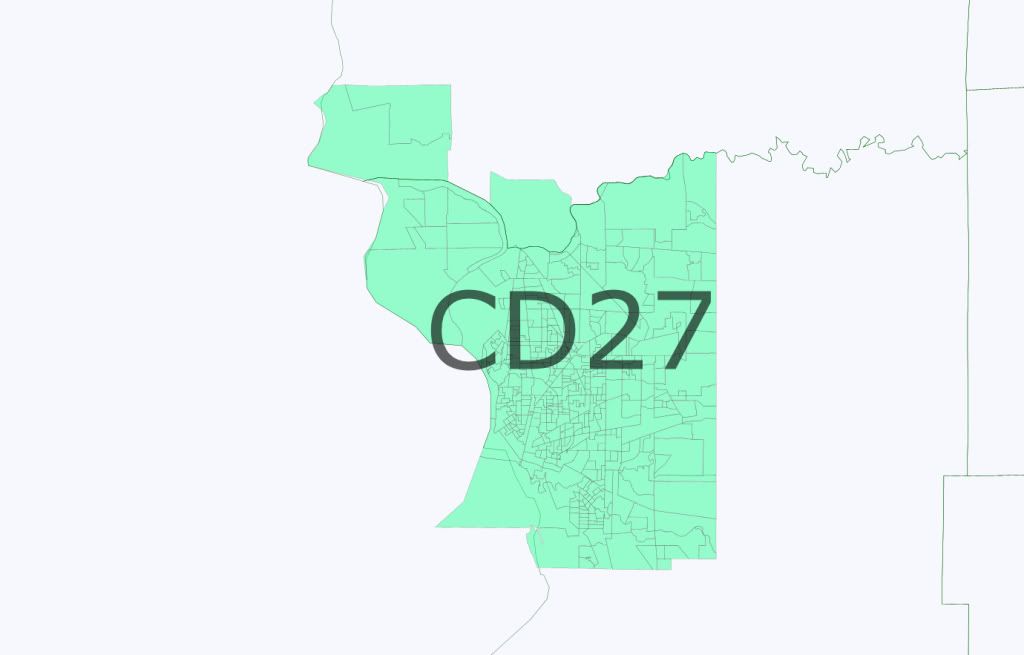
NY-27:

Incumbent: Brian Higgins

D+10

One of the four upstate districts which keeps its old number.  Draws in tightly to Buffalo and becomes far more Democratic.

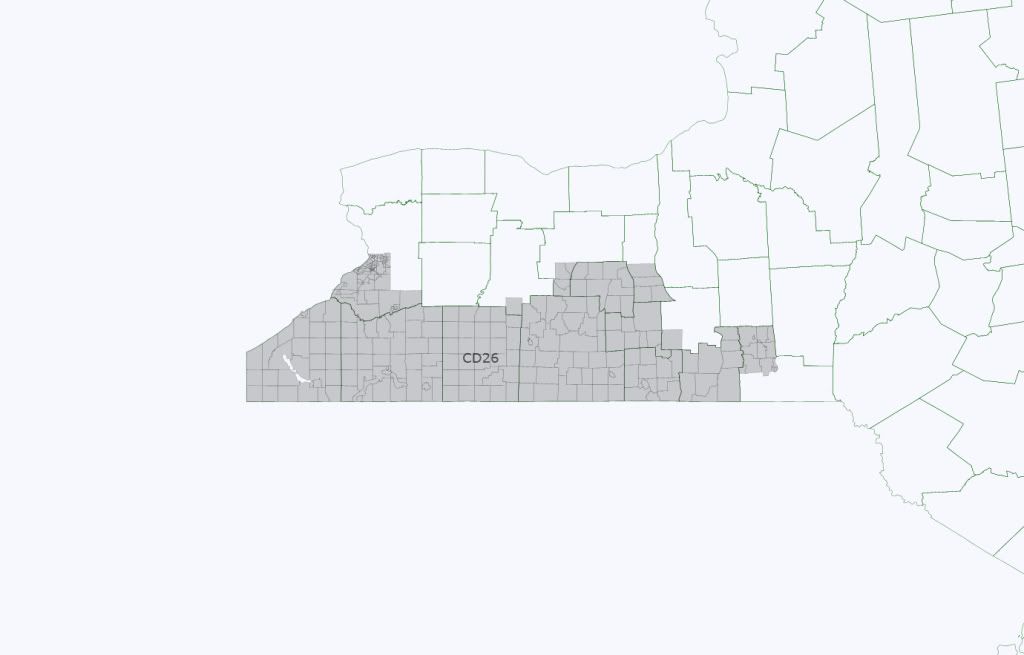
NY-26:

Incumbent: Tom Reed

R+7

Tom Reed gets a more compact district which hews closely to the southern tier, while taking in some narrowly Republican suburbs south of Buffalo.  A bit more Republican than his old seat.  

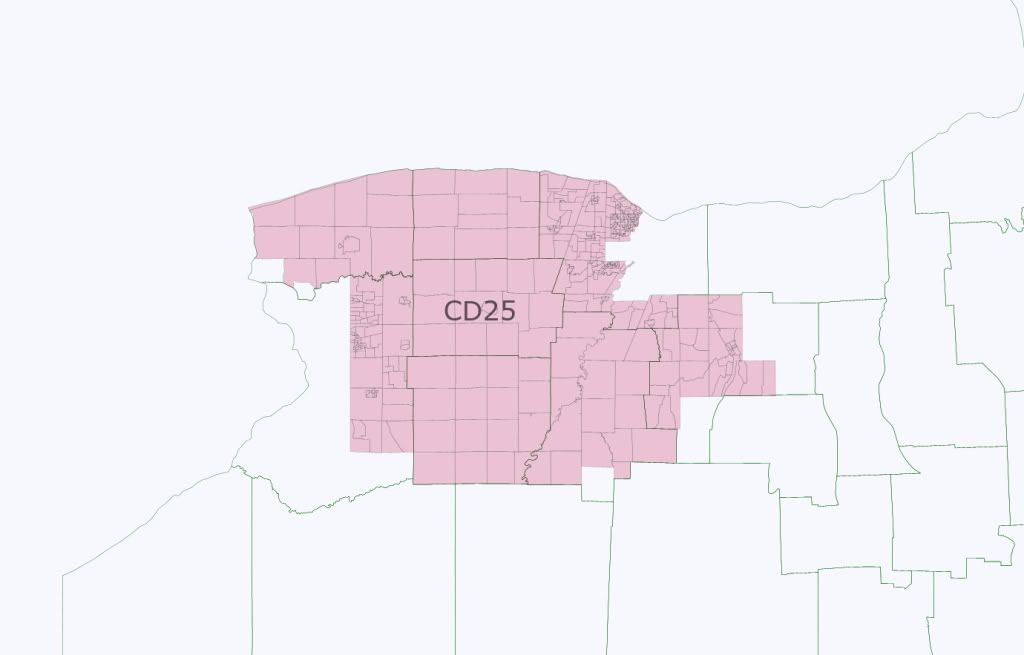
NY-25:

Incumbent: Chris Lee

R+9

The district is essentially NY-26.  It gets smoothed out a bit, but still maintains itself as being mainly Republican suburbs of Buffalo and Rochester, with some rural areas in-between.  Is more Republican than the old seat.  

NY-24:

Incumbent: Louise Slaughter

D+10

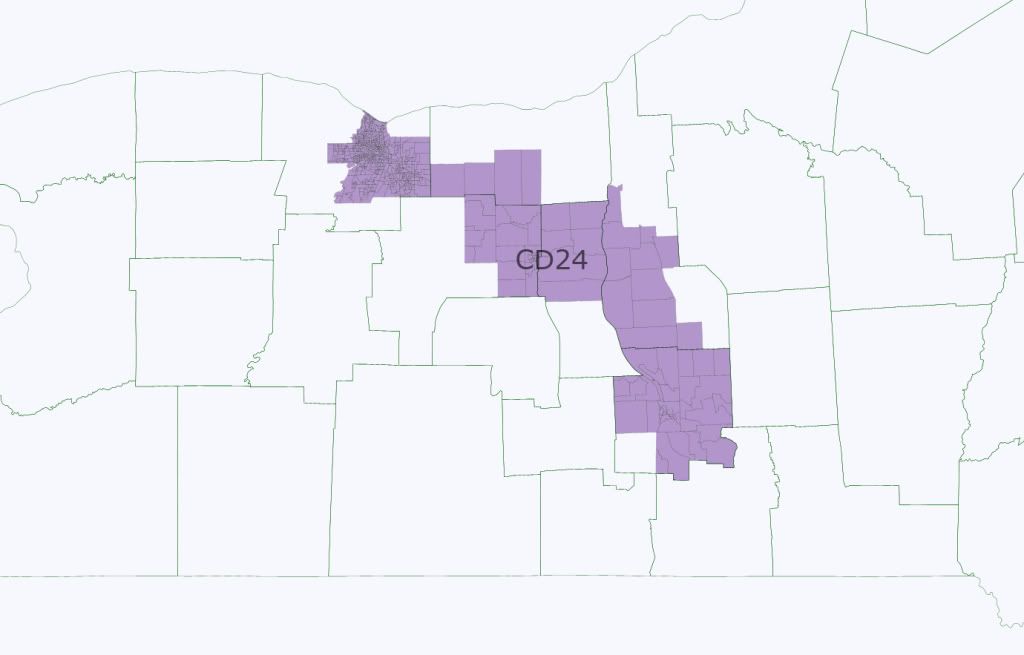
The earmuffs are gone!  Instead, the district takes in the more Democratic suburbs of Rochester, then makes a beeline Southeast to take in Icatha.  This is a little less Democratic than the old seat, which was D+15, but it’s still quite safe.  

NY-23:

Incumbent: Bill Owens

D+6

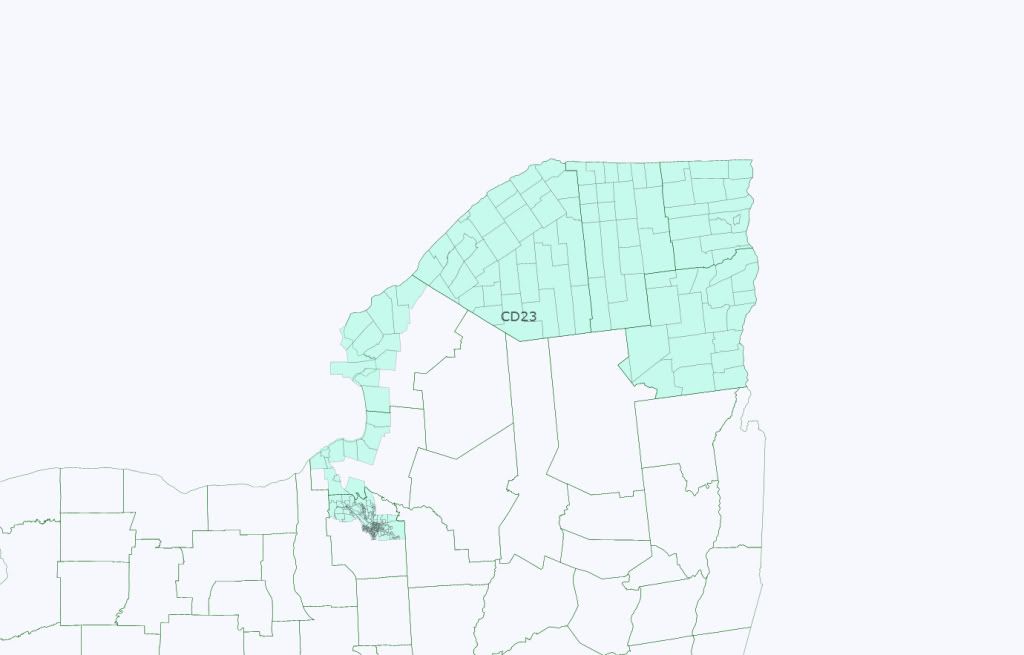
The second Upstate district which doesn’t change numbers.  Bill Owens keeps the four most Democratic counties in North Country.  He gets added to his district Syracuse, the most Democratic-leaning suburbs of it, and a salient connecting the two.  A bit of a ugly gerrymander, but what can you do?  

NY-22:

Incumbent: Richard Hanna

R+5

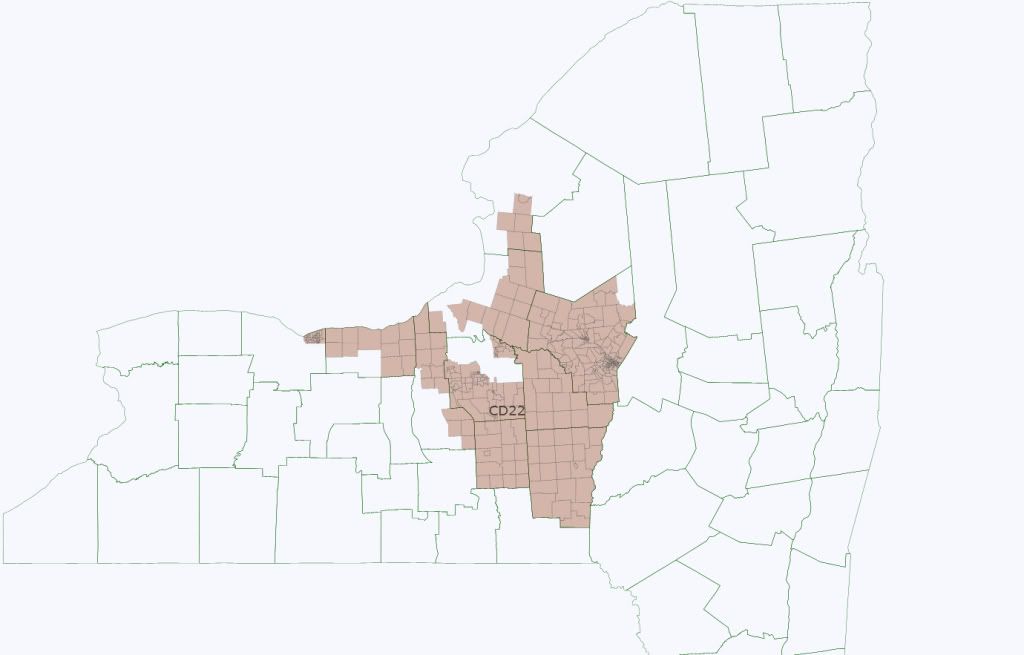
The district is broadly similar to the old NY-24, in that it still forms a U around Syracuse, although the U is much tighter.  The district is marginally better than the old R+2.  

NY-21:

Incumbent: Paul Tonko

D+6

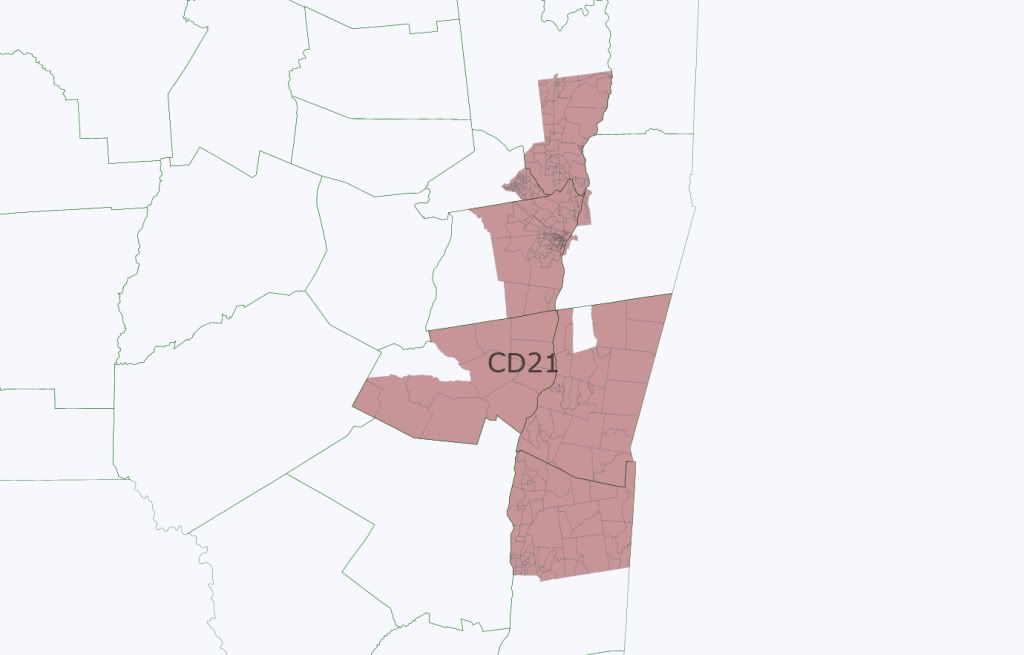
Another district not switching numbers.  It changes quite a bit, although it remains Albany-focused, shedding some of the more Republican areas to the west, but adding some Democratic-leaning areas in the mid-Hudson region.  The PVI is essentially unchanged.  

NY-20:

Incumbent: Chris Gibson

R+6

This district transforms quite a bit.  It loses all of Duchess and most of Columbia counties, and swaps them for conservative areas mostly swiped from NY-23.  Significantly better than the old PVI of R+2

NY-19:

Incumbent: Maurice Hinchey

D+5

This is more or less the old NY-22.  It is more compact, having lost Icatha, but gained  Poughkipsie.  The PVI declined by one from the old PVI (D+5), but it should still be a solid seat for the Democrats.  

NY-18:

Incumbent: Nan Hayworth

R+7

A major improvement from the old district, which had a PVI of R+3.  Admittedly, the heavy gerrymandering of Rockland County helped a lot.  I’m guessing that if I followed village lines I would have been less questionable here, but I think even with that the PVI shouldn’t have declined much.  

NY-17:

Incumbent: Nita Lowey

D+9

Basically NY-18.  Still Westchester based, with a bit of Orange.  PVI is identical to the old district.  

At the end, I was left with a sliver of Westchester County at the bottom of the map – Mount Vernon, Pelham, and the southern portions of New Rochelle and Yonkers.  I could have gone two ways with this, either keeping Elliot Engle’s seat, but making it more compact (containing these regions and the non-Latino sections of the Bronx), or if I chose to eliminate his seat, splitting the region between several NYC-based districts.  I think the former would have been easier.  

Anyway, love to hear thoughts.  I think in retrospect I could have done better with NY-19, and I’m unsure if NY-18 is legal under New York law, but besides that I think this is a pretty good map.  

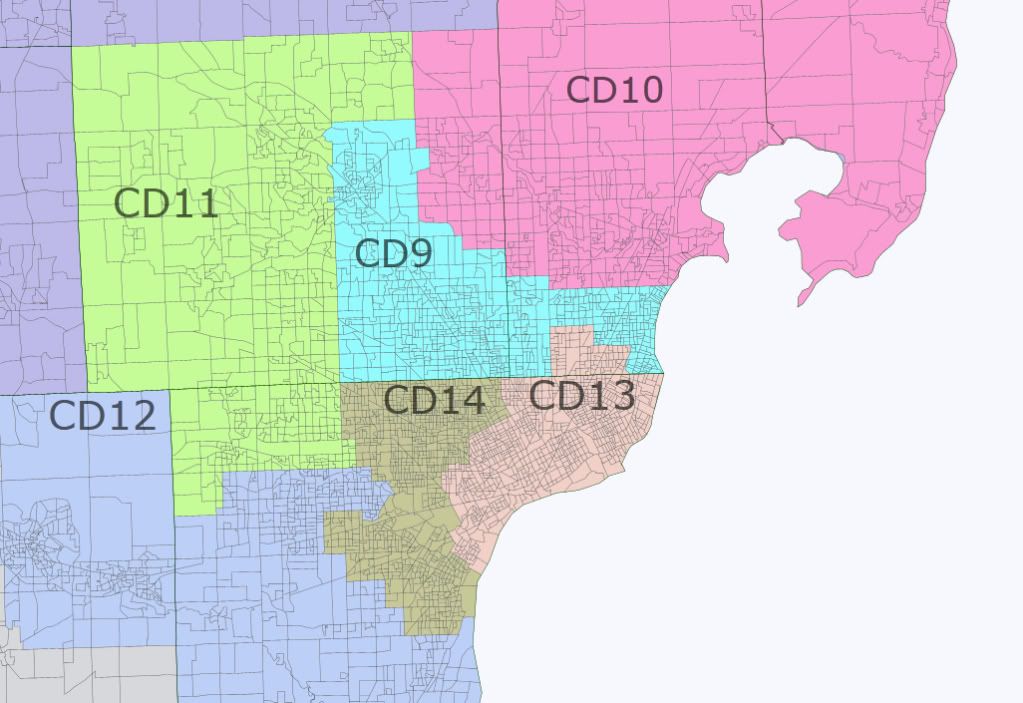
Michigan redistricting: rolling the dice?

The Michigan Republicans are in the enviable position of controlling the governor’s office and both houses of the legislature, as they were back in 2001. The state has a fairly restrictive redistricting law that stresses respecting city and county boundaries and forbids really abusive gerrymanders, so the state’s districts will probably look more or less like they do on the current map, which is Republican-friendly but has nothing outrageous.

The state will lose one of its seats, and like most people I assume that they will throw Dem incumbents Gary Peters and Sander Levin into one district. Most of the population losses have been in the inner Detroit area, and they probably can’t mess with Hansen Clarke’s MI13 or John Conyers’ MI14  too much as it is easy to draw two compact majority-black districts for them. The Republicans must face a major decision: do they try to hold all 9 seats they currently have and risk losing a bunch of them in a blue wave year, or do they sacrifice one of them to shore up some of the others? They have one glaring problem: Ingham county. As in Ohio, the seat of state government and a huge public university create a big blue menace in the middle of a bunch of Republican-held districts. Obama won it by 50k votes, about 2-1. Michigan Reeps attached it to Republican areas further east in Mike Rogers’ MI8, thus creating two swing districts instead of one red one and one blue one. This worked out for them except in 2008 when Mark Schauer took MI7 south of Lansing from Tim Walberg. Maximizing the number of winnable districts worked well for the Reeps for most of the 00s, and for that reason I expect them to try it again. However, the state as a whole has been trending blue for some time and I think they would have an easier time holding the House if they try to push up their floor instead of their ceiling. So here are two scenarios: one in which they sacrifice a seat in the Lansing area and one in which they try to hold everything.

Scenario 1: Throw Walberg under the bus!

Here they create a Democratic sink in the Lansing area primarily from Walberg’s district to make things easier for Rogers and Justin Amash. The state map:
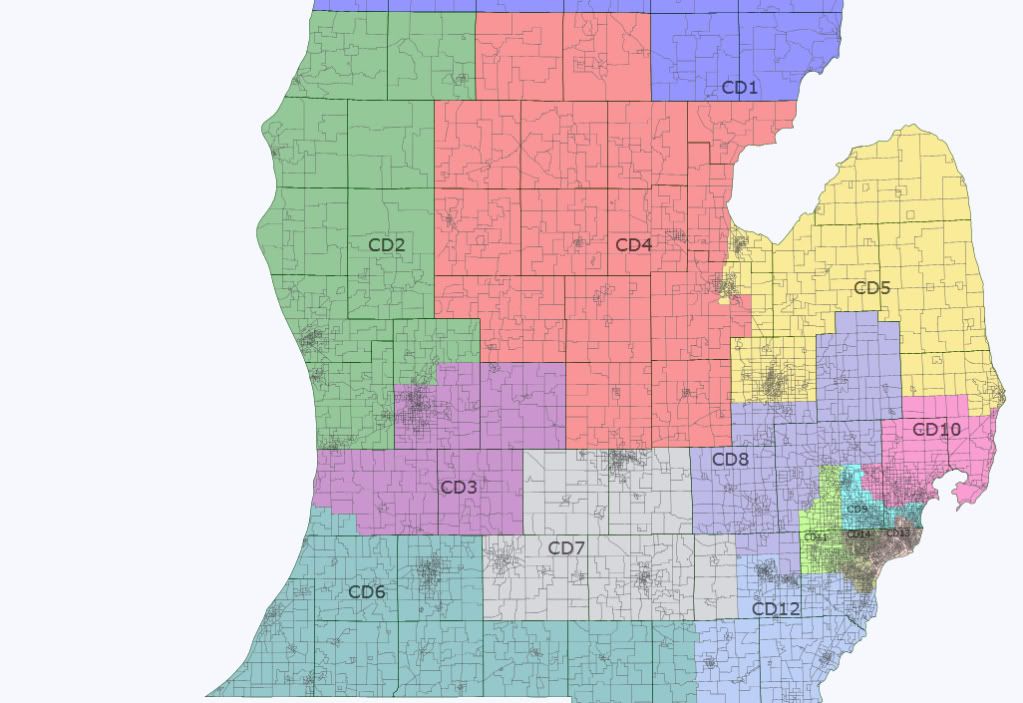
Michigan

Everything north of the top edge is in Dan Benishek’s MI1. The Detroit-area closeup:
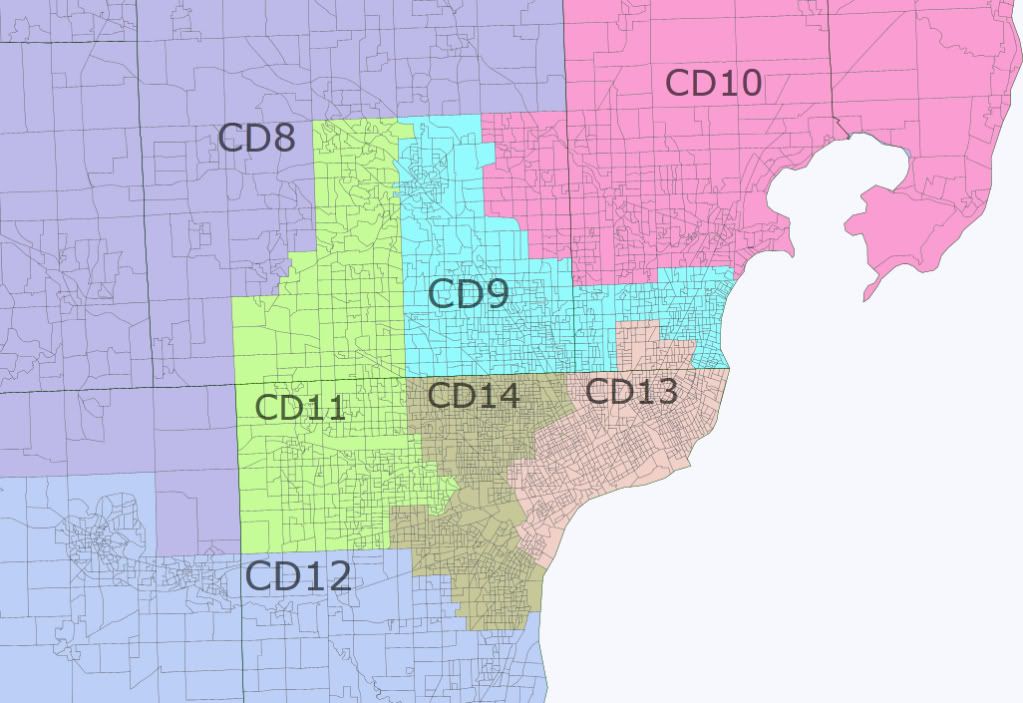
Detroit area

Notes on districts follow. In each case O or M followed by a number indicates Obama’s or McCains’s 2008 margin in thousands of votes.

MI1 (blue): Loses Arenac and Gladwin which combined are O1, and the northern part of Bay which is probably more like those two counties than the rest of Bay, which was O9 overall. Gains Kalkaska, Grand Traverse, Benzie, and Leelanau which collectively are M1. There isn’t much opportunity for mischief here since the district is shoved into the northern end of the state and the northern lower peninsula has very few counties where either candidate won by as much as 10%. It would still be R+3.

MI2 (green): Rookie Bill Huizenga’s district loses Benzie and northern Allegan and gains suburban and exurban precincts north of Grand Rapids. The current district is the reddest in the state at R+7 and this would not change much.

MI3 (purple): Amash’s district will probably be pushed south to some extent as MI1 needs to expand, which will likely push MI2 into MI3. Here the lost northern suburbs and exurbs are replaced with most of Allegan, which was M6 (roughly R+9). The current district is R+6 and the new one would likely be about the same.

MI4 (red): Dave Camp is the chair of the Ways and Means committee and I think the Reeps will ensure that his district, currently just R+3, is not weakened. Here it swaps out marginal areas near Traverse City with similar areas near Saginaw Bay (see MI1 above), loses a few (bluish?) precincts near Saginaw, and picks up O0 (that’s Obama by less than 500 votes, roughly R+3) Clinton and the southern part of O3 Shiawassee.

MI5 (yellow): Dale Kildee’s district will be pushed east if Levin and Peters are thrown together. The thumb has to go somewhere, and it can’t stay in Candice Miller’s MI10. Here it loses (bluish?) suburbs and exurbs south of Flint, and gains M1 Huron, M2 Sanilac, and most of O2 St.Clair. This district is currently D+11 and would probably be D+9 or D+10 under the proposed map. It serves the same purpose: a blue sink with Flint, Saginaw, and Bay City.

MI6 (teal): Fred Upton’s district makes up for the loss of much of Allegan with M1 Branch and M2 (roughly R+10) Hillsdale, along with less-populated parts of purple Lenawee. Overall PVI of zero before and after. Kalamazoo (O25, D+7) is this district’s big problem, but you may not be able to legally make a blue sink that takes in both Lansing and Kalamazoo.

MI7 (gray): Here we create a blue sink from what used to be Walberg’s R+2 district. He loses Branch, Hillsdale, Lenawee, and purplish areas of Washtenaw and gets stuck with O49 (D+13) Ingham. The new MI7 also has O5 (D+1) Eaton, O6 (D+1) Calhoun, O2 (R+2) Jackson, and the west end of Washtenaw. Obama won the whole thing by at least 60k, and it’s hopeless for a Republican. Joe Schwarz might be able to lose respectably here, but he wouldn’t be able to win.

MI8 (blue-gray): Rogers moves east, ridding himself of Ingham, Clinton, and southern Shiawassee and swaps in M1 (R+5) Lapeer and suburban/exurban parts of Oakland, Washtenaw, and Genesee. The district’s new areas are less red than M13 (R+10) Livingston, but it’s likely R+6 to R+8 overall whereas the current MI8 is just R+2.

MI9 (toothpaste blue): What’s left after you merge Peters and Levin is another blue sink with blue pieces of southern Oakland and Macomb. For what it’s worth Levin lives here and Peters doesn’t.

MI10 (pink): Miller has to pick up some vacated areas from the current MI9 and MI12, and she gets Rochester Hills, much of Troy, Mt. Clemens, and part of Sterling Heights. This area is probably less safe overall than the reddish areas of the thumb that she has to vacate, and I suspect that the district’s PVI would drop from R+5 to R+3 or R+4. But there isn’t much of an alternative if you want to merge Levin and Peters.

MI11 (pea soup green): Thad McCotter’s district moves east but retains its base in northwestern Wayne County. In Wayne, it drops Belleville and blue Redford and picks up Dearborn Heights. In Oakland, he keeps Novi and not much else, losing the exurban western areas to MI8 and picking up Waterford and the (more problematic?) West Bloomfield and Farmington Hills from MI9. The current MI11 has a PVI of zero and I suspect the new changes would be about a wash. I think the biggest problem with the new MI11 is that is Peters lives there. Having MI8 reach down to pick up W. Bloomfield might violate the compactness or community of interest provisions of the redistricting law, although it might be feasible  to swap some northern parts of Oakland county for pieces of Washtenaw and Livingston that I have going into MI8.  

MI12 (lighter blue-gray): John Dingell’s old MI15 moves slightly west, but still contains Ann Arbor and Ypsilanti and is therefore a blue fortress. His home in Dearborn will probably end up in MI14 as the Detroit districts need to expand.

MI13 (faded pink): Clarke’s district has to cross 8 Mile to pick up part of Warren and Eastpointe. It’s 56% black.

MI14 (brown): Conyers’ district moves west to pick up Dearborn, Redford, and Inkster. It’s 53% black. Both MI13 and MI14 still have PVIs of D+fuhgeddaboutit.      

Scenario 2: A 9-5 map, if you can keep it

Here Rogers keeps Lansing, and as before most of the other central and eastern districts have to move in the direction of the areas vacated by merging Levin and Peters. State map:
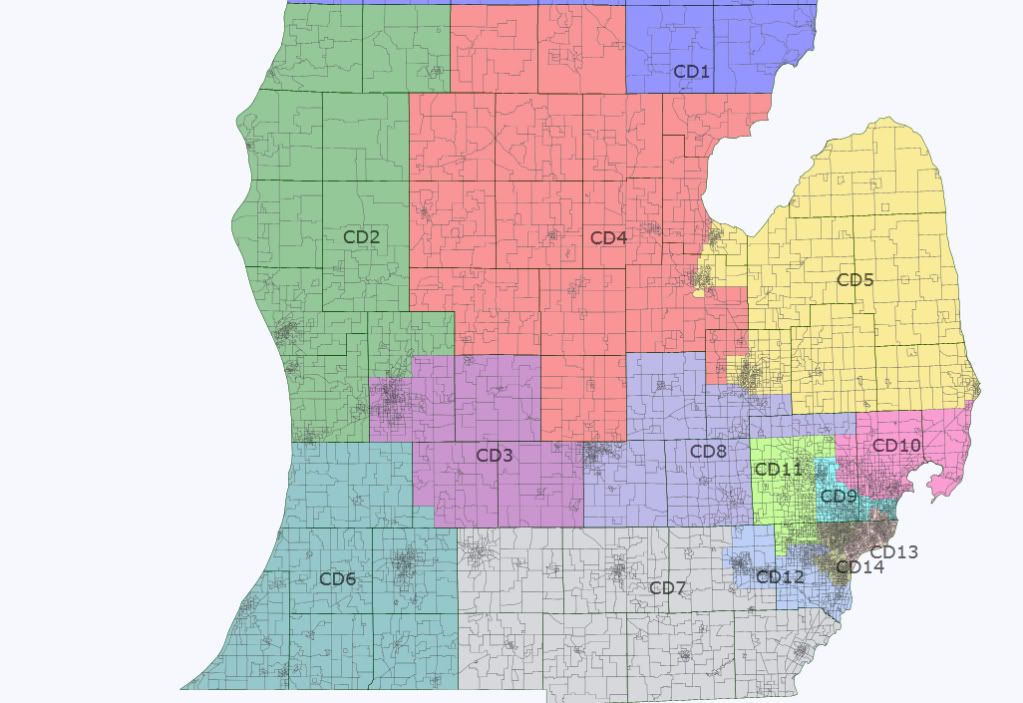
Michigan1

Detroit area map:

Detroit1

District comments. Unless otherwise noted, “changes” here are relative to the map discussed above, not the current map.

MI1, MI2: no changes.

MI3: Here Amash cannot pick up Allegan, as Upton will need the rest of it as a substitute for Branch and Hillsdale. He has nowhere to go but Eaton, and the result is a district that Obama won: Ionia was M1, Barry M3, and Eaton O5. Kent was O2, and Amash’s piece (Grand Rapids and everything south or west of it) is clearly more blue than the county average. Overall the new MI3 would be R+3 at best, and Amash would likely be vulnerable in a year that is average or better for Dems.

MI4: Here Camp loses northern Shiawassee and replaces it with suburban/exurban areas of Genesee and Saginaw. Probably minimal impact.

MI5: Picks up Lapeer and some of St. Clair, loses bits of Genesee and Saginaw, still a blue sink.

MI6: Picks up the rest of Allegan instead of Branch and Hillsdale. Probably about a wash.

MI7: This time it isn’t sacrificed. Relative to the current MI7 it has to move east, so it swaps out O5 (D+1) Eaton for O3 (R+1) Monroe and makes minor changes in Washtenaw and Calhoun. Probably still R+2, which doesn’t bode well for Walberg after his narrow win on the red wave of 2010.

MI8: Again relative to the current map, it swaps out O0 (R+3) Clinton and part of exurban northern Oakland for northern Shiawassee (O3, D+1) and southern Genesee. This appears less favorable for Rogers than his current district, and would likely move it from R+2 to R+1 or even.

MI9, MI10: Trivial changes.

MI11: Loses much of its Wayne turf including Dearborn Heights, Westland, and Canton and retains more of western and northern Oakland. Possibly better for McCotter than the MI11 from the first map, but this time he is in no position to get any favors from Rogers who is saddled with a shaky district.

MI12: Has more of Dingell’s old stomping grounds. Still a blue sink.

MI13, MI14: no changes.

In the first map, the Reeps give up Walberg’s seat to make Amash somewhat safer and Rogers much safer. Alternatively, they may be able to have Rogers take on a bit more risk (albeit much less than he has now) to make McCotter somewhat safer. The second map is a dummymander in my opinion. Amash, Walberg, and possibly Rogers would all be at serious risk. McCotter would almost certainly be vulnerable to a challenge from Peters, although this is also true of the first map as shown. Politically Michigan is much more like Wisconsin than Ohio: it has lots of purple and not much deep red, and it’s difficult to do a Republican gerrymander.


By what margin will Bob Shamansky win?

View Results

Loading ... Loading ...

“Start spreading the blues…I want to be a part of it, New York, New York.”

In a perfect world, with New York losing a seat in the 2010 reapportionment, we could create 28 districts that would, more-or-less, give the Democrats a shot at winning 27 of them, some more easily than others. To do this, I had to ignored political reality, as you will see in the way districts were shaped (e.g. the sole GOP district or Staten Island’s bifurcation). As a corollary to ignoring political reality, I also did not attempt to make as many completely safe Dem seats as possible; otherwise, it would have been difficult to create 27 legitimately lean-Dem or better seats. However, I believe I did a fairly good job of creating favorable numbers for New York Democrats, at least in the sense that President Obama only won three of the 27 Democratic districts by less than 10% in 2008.

Note: I actually did this back in November ’10 but only now am I posting my efforts. It’s possible that updates have occurred to New York’s data since then. Also, I’m aware that New York ended up losing two seats in reapportionment, not just one as I originally thought while drawing this up.

Given that the great majority of Republican vote in New York lies Up State, I started out with the 28th district and sought out the most Republican voting districts. What I ended up creating was essentially a large U. How perfect for “Up State,” don’t you think?

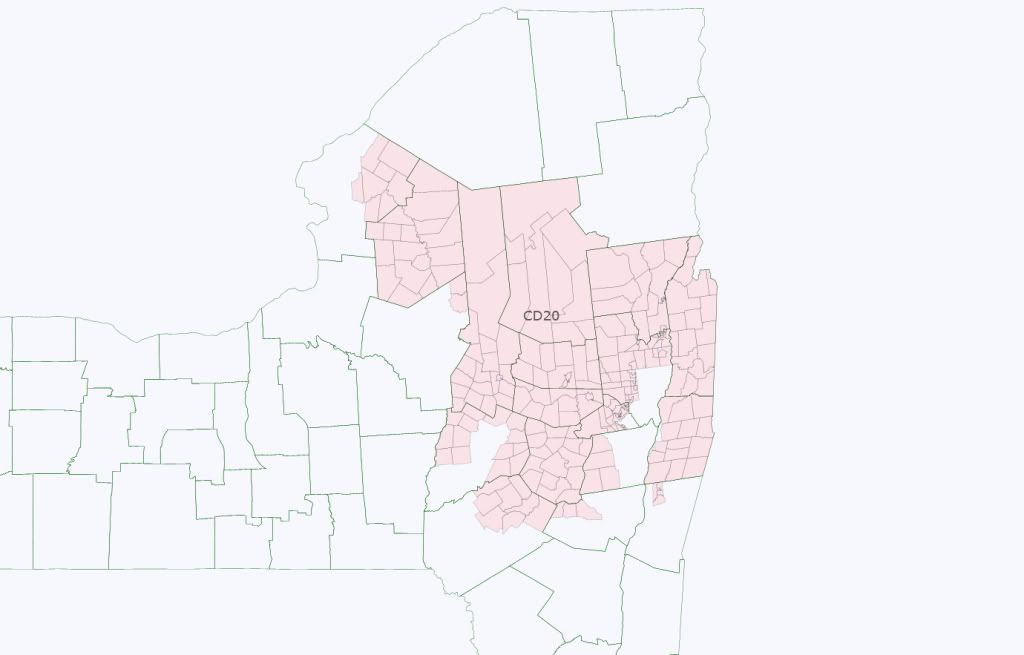
Here’s how the northern part of New York turned out:

Photobucket

And here is the data for the eight most easily seen districts here, 20 through 28. Note that “Dev.” is deviation from the ideal population for each district. I believe the rest of the data is self-explanatory.

Photobucket

Unsurprisingly, the least diverse district in the state is the U-district, 28, with a stunning 95% white percentage, something one only sees in Utah. Or Wyoming. Clearly, this district would get struck down in any court outside of North Carolina or Florida. But I think people in Batavia, Elmira, Little Falls, and Johnstown actually have a lot in common and would enjoy having a common Member of Congress to represent their roughly 225-mile long district.

Among the Dem-tilting districts, District 22 is the only one to have an under D+10 net based on the 2008 election as the east coast of Lake Ontario is not the most liberal place in the state.

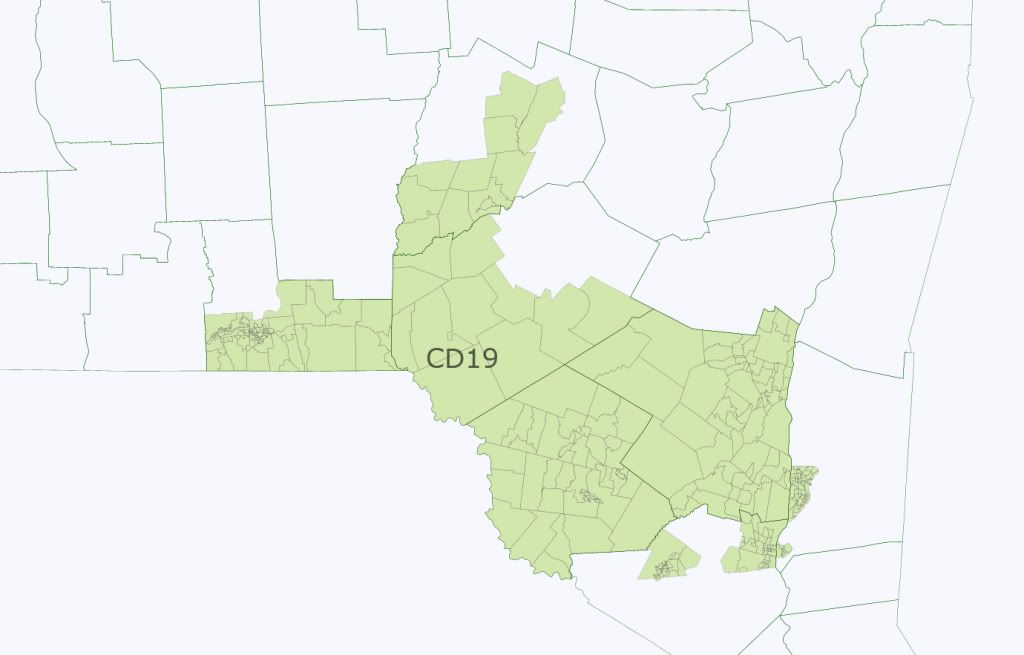
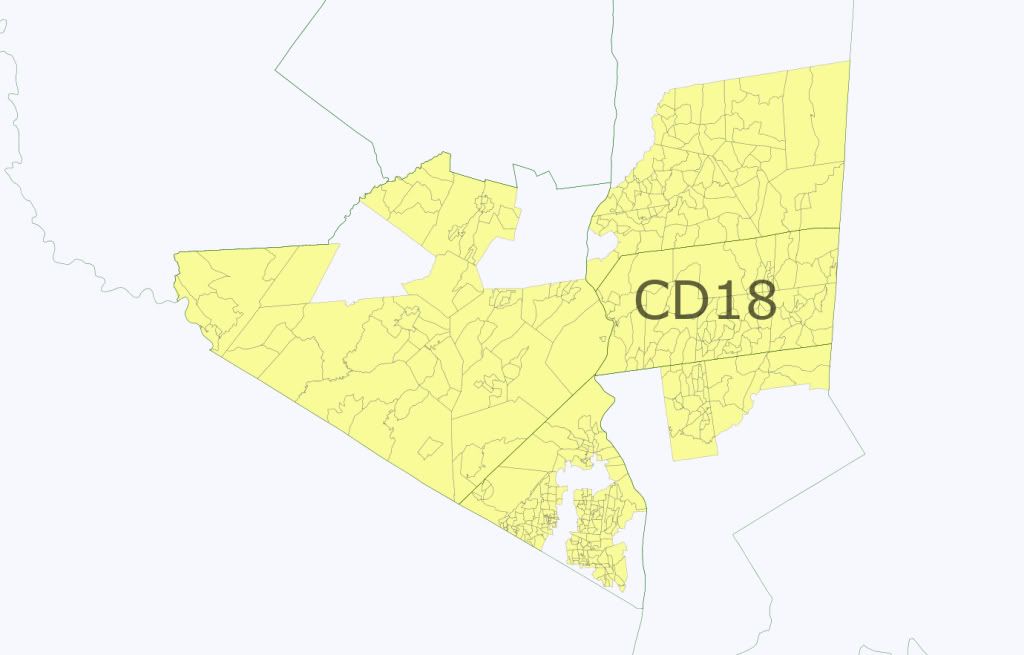
As we move further south in the direction of the city, we find Districts 18 and 19, both exurban and suburban.

Photobucket

And their info:

Photobucket

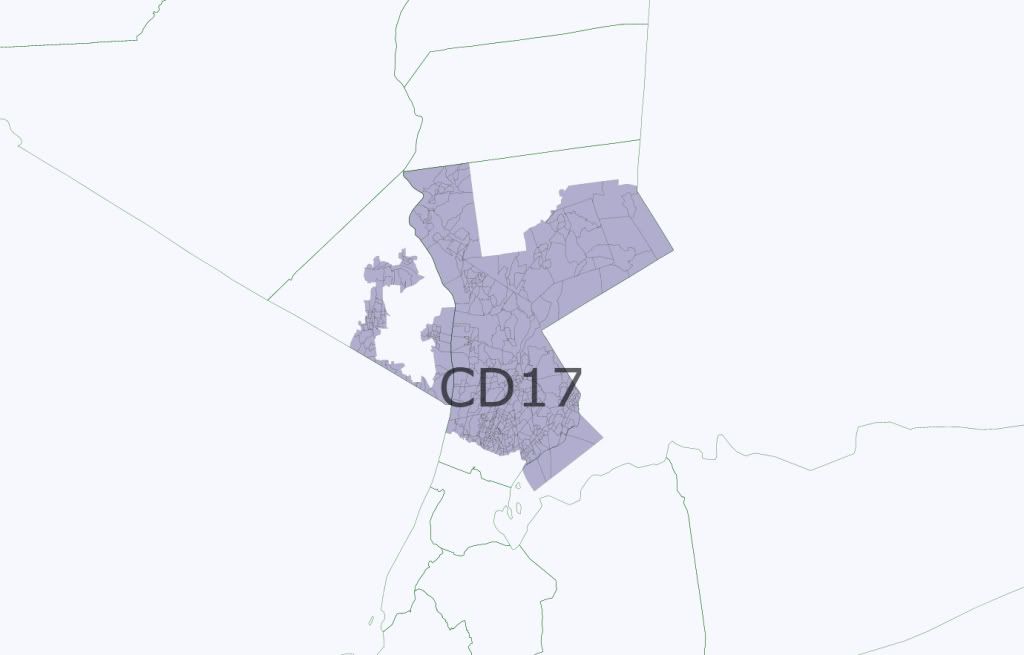
Just below these two is CD-17, and its image allows us to see the little part of CD-18 that stretches down below the previous shot of it (around White Plains, and Rye below that).

Photobucket

And CD-17’s info:

Photobucket

Now we get into the bluest part of the city, specifically the Bronx and upper Manhattan:

Photobucket

Here are the nice numbers:

Photobucket

Moving down the peninsula and east, we see Lower Manhattan and western Queens:

Photobucket

Numbers:

Photobucket

Getting a little out of order in CD numbers (I don’t feel like re-numbering), we’ll move down to Brooklyn and Staten Island. Clearly, in real life Staten Island would be very difficult to divide politically. However, for the sake of creating Dem-leaning or safe districts, it is absolutely vital to split up the Staten Island vote. And that is what I have done here, creating two Brooklyn-Staten Island districts. Additionally, the backward-S Brooklyn-based CD-6 and almost completely Brooklyn-based backward-C CD-9 can be seen here:

Photobucket

And the info for those four districts:

Photobucket

Moving back up into Queens, we find CD-10 which slightly abridges the Kings and Queens County border to cut into northern Brooklyn.

Photobucket

And CD-10’s numbers:

Photobucket

Next, CD-11 stretches across northern Queens and into northwestern Nassau. Since it’s an awkward district to get a picture of with Dave’s App, this picture will serve as kind of an update on where we are at this point:

Photobucket

Photobucket

Now we’ve reached the challenge of Long Island. Honestly, creating the U-district was easy compared to all the time I spent adjusting the borders of these districts in an attempt to get the most Dem-leaning districts possible.

First, CDs 4 and 5. CD-4 crosses southern Queens, Nassau, and even has one voting district from Suffolk County in its boundaries. Meanwhile, CD-5 does the same, stretching from the Queens’ coast to even deeper into Suffolk.

Photobucket

And the info for these two districts:

Photobucket

CD-3 also crosses from Queens to Suffolk, clearly to get more Dem votes to make up for the Republican lean of some of the Long Island areas this district crosses.

Photobucket

CD-2 covers the southern and eastern coast of much of Long Island (“Strong Island” to quote a former roommate of mine from there). It is tied with CD-19 as the least Democratic district besides CD-28. Meanwhile, CD-1 covers the remaining northern half but reaches into some Democratic stretches of Nassau to gain votes.

CD-2:

Photobucket

And a somewhat better shot of CD-1:

Photobucket

Finally, the info for CDs 1, 2, and 3:

Photobucket

In sum, here’s a table of all the districts and their statistics:

Photobucket

Thanks for reading my first diary.