SSP Daily Digest: 1/28

CT-Sen: The Chris Murphy/Susan Bysiewicz primary still could turn into a chaotic battle royale, based on this week’s indications. Rep. Joe Courtney is “leaning toward” the run (although that’s not Courtney’s own words, just another insider’s interpretation), and says he’ll have a decision soon. Ted Kennedy Jr. also doesn’t have anything official to say, but he does seem to be stepping up his appearances around the state, including one in Bridgeport next week. One Dem we can probably rule out, though, is former state Treasurer and former Hartford deputy mayor Frank Borges, who disputed reports that he was looking into the race. Here’s also one other Republican who might make the race who seems to have access to big fundraising pools, although it seems like he’d be starting in a big name rec hole against, say, Linda McMahon: state Sen. L. Scott Frantz, who represents wealthy Greenwich in the state’s southwestern tip.

MI-Sen: After sounding pretty thoroughly disinterested in his few public comments about the possibility of a Michigan Senate race, ex-Rep. and 2010 gubernatorial primary loser Peter Hoekstra is now publicly expressing some interest. He says that he’s “considering it” and will make a decision in a few months. There’s also a poll out of the GOP primary from GOP pollster Strategic National (no word on whose behalf the poll was taken) showing Hoekstra well in the lead, which may be prompting him to get more interested: he’s at 33, with Terry Lynn Land at 15 and Saul Anuzis at all of 1, with 50% still undecided.

ND-Sen: Rep. Rick Berg has been mentioned often as a potential GOP candidate for the open seat being vacated by Kent Conrad, and chatter seems to indicate the local party seems to have him at the top of the list in terms of someone to unite behind to avoid a divisive primary. Moving from the House to the Senate after only one term is still a pretty unusual move (although it may be less momentous in an at-large state). (In fact, here’s a trivia question for you all, for which I don’t know the answer: who was the last person to successfully jump to the Senate after only one term in the House? I can’t even think of a one-termer getting his party’s nomination since 1994, when Dem Sam Coppersmith ran and lost an open seat race in Arizona to Jon Kyl.) There’s one other name bubbling up to add to the list of the ten-or-more Republicans already listed as possible candidates: Fargo-area state Sen. Tony Grindberg.

NE-Sen: You might remember that the mysterious GOP dark money group American Future Fund ran some radio ads in North Dakota last month and Kent Conrad was announcing his retirement within a few weeks after that? Not that there’s likely a causal relationship there, but maybe they’re feeling like lightning might strike twice, and now they’re running a similar ad against Ben Nelson in Nebraska.

TX-Sen: San Antonio mayor Julian Castro had already given some vague statements of not intending to run for the Democratic nomination for the open Senate seat, but put a finer point on that today by announcing that he’s kicking off his campaign for a second term as mayor. One Republican who has expressed some interest in the race but doesn’t seem likely to run is Rep. Mike McCaul from TX-10; the likelier scenario, at least according to one expert, is that McCaul plans to run for state Attorney General in 2014, which will probably be vacated by current occupant Greg Abbott moving up to the Lt. Governor slot, presuming that David Dewhurst either becomes Senator or doesn’t run again in ’14.

UT-Sen: You thought that Hasselbeck vs. Cromartie Twitter fight was exciting? That’s got nothing on a good social media smackdown between rival right-wing astroturfers Club for Growth and Tea Party Express. In the wake of TPX head Sal Russo’s comments yesterday praising Orrin Hatch, CfG just dissed TPX, saying they seem “to like Hatch’s record in support of TARP, earmarks…” Roll Call has more on the Club’s plans to go aggressively after Hatch. Russo also seems like he’s getting undercut by his fellow TPX leader, Amy Kremer, who says that Hatch isn’t off the hook yet and will be under their microscope for the cycle.

VA-Sen: Jamie Radtke, the only person in the race so far offering a challenge from the right to presumed GOP frontrunner George Allen, let everyone know yesterday where she’d stand, putting in an appearance at the initial unveiling of the Senate Tea Party caucus (and its four members… or five if you count Pat Toomey, who was willing to speak to them but not join). Other interesting reading regarding Virginia is this profile of Jim Webb which doesn’t offer many surprises but is a good overview of his ambivalence about the Senate race is pretty much in keeping with everything else about him. And buried in another boilerplate article is a pretty sharp smack at Allen from a fellow GOPer and the last person to successfully pivot from getting bounced out of the Senate to winning a later race (in 1988), Slade Gorton. Gorton says Allen, to win, will first need to apologize to voters, saying “I don’t see anything from him about how he screwed up, even though he did.”

LA-Gov: See you later, Al Ater. After some semi-encouraging statements about a possible candidacy, the Democratic former Secretary of State now says he won’t run for Governor this year. That still leaves the Dems without any sort of candidate to go against Bobby Jindal, with the clock definitely starting to tick louder.

WV-Gov: Don’t get too comfortable with the idea of a primary to pick the gubernatorial candidates in West Virginia (tentatively set for June 20); the legislature still has to enact that and there are some grumblings that it might not happen because of the expense involved, which would mean party conventions instead. That could give a boost to one of the less-known Democratic candidates who have stronger relations to organized labor, like House speaker Rick Thompson or treasurer John Perdue. The article also mentions a few other Republicans whose names are emerging in the race, most notably Putnam Co. Prosecutor Mark Sorasia (who’ll be participating in an upcoming candidate forum), also mentioning former state Sen. Steve Harrison and state Del. Troy Andes.

CT-05: The dance cards in the 5th district are definitely filling up. On the Democratic side, Audrey Blondin is saying that she’ll run; she’s a former Selectwoman from Litchfield, a member of the state party committee, and briefly ran for SoS in 2005. Also considering the Democratic primary is J. Paul Vance, the former leader of the Waterbury board of aldermen and a narrow loser to Michael Jarjura in the 2009 Dem mayoral primary. On the Republican side, Mike Clark is in; he’s Farmington town council chair but he’s best known for leading the FBI team that took down corrupt Gov. John Rowland, and was on Tom Foley’s LG short-list. Several other possible names on the Republican field that are mentioned include state Sen. Kevin Witkos, Torrington mayor Ryan Bingham, and one possible heavyweight in the field (and the guy who actually was Foley’s running mate), Danbury mayor Mark Boughton.

FL-25: Freshman Rep. David Rivera seems to be in a world of trouble, with an entirely new angle on his corruption arising courtesy of an AP investigation: he paid himself nearly $60K in “unexplained” campaign reimbursements during his eight years in the state legislature. Between that and the already mounting investigation by Florida authorities and the FEC into potential payoffs from a dog track, there’s apparently growing discontent with him behind the scenes in Republican leadership, who may be feeling pressure to make an example out of him as part of their “drain the swamp” promises (although Ethics Committee rules prevent them from using that vehicle, since they can’t take up matters that are already under criminal investigation). Rumors persist that both parties are already sounding out candidates for a potential special election. He isn’t getting much public support from John Boehner, whose only on-the-record comments are that he’s taking a wait-and-see attitude on how things unfold.

WI-01: Is this just a bit of monkeying around with Paul Ryan now that he’s temporarily a celebrity, or are Dems seriously thinking about making a target out of him now that he’s more notorious? (He’s in what’s currently an R+2 district, certainly within reach in a Dem-friendly year with a good candidate, and leads veteran House Republicans in terms of ideological out-of-whackness with his district lean… though that may have changed with the newest crop of teabaggers) At any rate, mailers are being sent out to voters in his district, having a bit of sport with his Medicare-voucherization proposals.

Chicago mayor: We Ask America is out with another poll of the Chicago mayoral race (taken during the brief period when it looked like Rahm Emanuel might have been off the ballot). It looks like, as speculated, the whole debacle may have actually increased sympathy for Emanuel (with 72% of respondents saying his name should stay on the ballot), as this is the first poll to show him over the magic 50% mark that would help him avoid a runoff. He’s at 52, with Gerry Chico at 14, Carol Mosely Braun at 11, and Miguel del Valle at 4. It also provides support for the theory that Chico, not Mosely Braun, would have been the chief beneficiary if Emanuel had gotten kicked off, as Chico led a Rahm-free option at 33, with Mosely Braun at 17 and del Valle at 7 (with 38 undecided).

Nassau Co. Exec: This may pretty much spell doom for any future political efforts by Republican Nassau Co. Exec Ed Mangano, who was elected in a narrow upset over Tom Suozzi in 2009. Mangano has, since then, closely stuck to the teabagger/underpants gnome playbook of governance (step 1: cut taxes; step 2: ???; step 3: profit!), and lo and behold, found his county government insolvent. The state government has been forced to step in and seize control of the finance in the county on Long Island, one of the nation’s wealthiest.

Redistricting: I can’t see this going anywhere legislatively even if Dems still held the majority (and I’m not sure it would pass constitutional muster anyway), but Heath Shuler and Jim Cooper are introducing legislation in the House that would switch every state away from partisan redistricting to requiring use of a five-person bipartisan commission. (They’re picking up the flag from fellow Blue Dog John Tanner, for whom this was a personal hobby horse for many years until he recently left the House, but they may also have some personal stake in wanting this to succeed, seeing as how they suddenly find themselves in states where the Republicans now control the trifecta.) Also, the public rumblings of worry from prominent Republicans about how the GOP isn’t financially or mentally prepared for this round of redistricting (something that seems dramatically out of character for them) seem to keep coming, this time from Ed Gillespie.

Voting: Montana seems to be taking a cue from its nearby neighbors Oregon and Washington, and moving toward a vote-by-mail system. The measure cleared the House and will soon move to the state Senate. Despite the fact that the GOP controls that chamber and this was a Democratic bill, there was enough Republican support to move it forward. (Studies have shown that vote-by-mail tends to noticeably increase participation by traditionally-Democratic constituencies that ordinarily aren’t very likely voters.)

Women in the 112th

Right after the 2010 elections (and immediately before) there was some very public handwringing in the media about the number of women in congress decreasing. According to the CS Monitor, the election was “tough on all Democrats, but particularly on female lawmakers.” I think some of this is misguided. Granted, as markhanna wrote in November, 2010 was definitely not another “year of the woman.” But even though the number of women shrank (ever so slightly) in the red wave, as MassGOP suggested it might, the proportion of women within each party grew, and in the long run this isn’t much of a setback. You could even read it as progress.

The percentage of women in the House Republican conference, the House Democratic caucus, the Senate Republican conference and the Senate Democratic caucus all went up, even as the overall number of women went down in the House and stayed the same in the Senate. This somewhat counterintuitive situation is the result of a shift in representation from the more heavily female Democratic caucus to the less heavily female Republican conference. But within their parties, both sides have a higher proportion of women than in the last congress. As long as Democrats have more women, the constant shifts in balance between the parties will always affect the number of women in congress, so I don’t think it’s anything to get worked up about. The GOP deserves some credit for electing more of their own women even though they brought the overall numbers down.

Regardless of what happens in 2012, the number of women will probably go up in the next election. Democrats are more heavily female than ever, and if they have a good year the number of women legislators will probably shoot upwards. Republicans probably won’t take many more seats next cycle, but if they maintain a similar majority, the natural turnover in their party should lead to more women; in the House their freshman class was more heavily female than the Republican conference as a whole and in the Senate the proportion of non-incumbent female nominees was a record high.

The 112th House

Right now, 89 of the 535 voting members of the 112th Congress are women, about 16.6%. There are 17 women in the Senate and 72 women in the House, excluding three non-voting delegates. (Delegates aren’t included in any of the numbers in this diary. Sorry, Guam.) The total numbers are not far off from the 111th Congress, which had 90 women at its close. That figure was actually higher in the opening days of the 111th, before Hillary Clinton (D-NY), Hilda Solis (CA-32), and Ellen Tauscher (CA-10) vacated their seats to join the Obama administration. Kirsten Gillibrand (NY-20) was appointed to Clinton’s Senate seat, and Judy Chu won CA-32 in a special election. But then Gillibrand and Tauscher were succeeded by Scott Murphy and John Garamendi, respectively.

Although the total number of women didn’t change much, there was quite a bit of turnover in the House. Fourteen women left (2 Republicans and 12 Democrats) and thirteen women joined (9 Republicans and 4 Democrats). The freshman class totals 96 this year, and the thirteen new congresswomen account for about 13.5%. That’s much lower than the overall ratio of just under 16.6% in the House, and about one third of the freshmen women came from the tiny Democratic freshman class. But breaking it down further, the results are less discouraging.

On the Democratic side, Diane Watson (CA-33) retired; Carolyn Cheeks Kilpatrick (MI-13) was defeated in her primary; and Ann Kirkpatrick (AZ-01), Betsy Markey (CO-04), Suzanne Kosmas (FL-24), Melissa Bean (IL-08), Debbie Halvorson (IL-11), Carol Shea-Porter (NH-01), Dina Titus (NV-03), Mary Jo Kilroy (OH-15), Kathy Dahlkemper (PA-03) and Stephanie Herseth Sandlin (SD-AL) all lost to Republican challengers. The four new Democratic congresswomen are Karen Bass (CA-33), who took Watson’s seat; Terri Sewell (AL-07), who succeeded gubernatorial candidate Artur Davis; Frederica Wilson (FL-17), who replaced senatorial candidate Kendrick Meek; and Colleen Hanabusa (HI-01), who defeated an incumbent Republican. Of the women who lost to Republicans, only Kosmas and Herseth Sandlin were succeeded by women. At the time of the election, there were 255 voting members of the Democratic caucus, of whom 56 were women – about 22.0% of the caucus. After the election, the Democratic caucus shrank to 193 voting members, of whom 48 are women – about 24.9% of the caucus.

On the Republican side, Ginny Browne-Waite (R-FL) retired and Mary Fallin (R-OK) ran a successful campaign for governor. Their safe red seats were both won by Republican men. Diane Black (TN-06) and Jaime Herrera Beutler (WA-03) succeeded retiring male Democrats, while Martha Roby (AL-02), Vicki Hartzler (MO-04), Renee Ellmers (NC-02), Nan Hayworth (NY-19) and Ann Marie Buerkle (NY-25) defeated Democratic male incumbents. Sandy Adams (FL-24) and Kristi Noem (SD-AL) defeated Democratic women – Kosmas and Herseth Sandlin. At the time of the election, there were 180 voting members of the Republican conference, of which 17 were women – about 9.4% of the conference. After the election, the Republican conference expanded to 242 members, of whom 24 are women – about 9.9% of the conference.

There were noticeable differences between the freshman classes in each party. There were only nine Democratic freshmen this year, and four of them were women – that’s a whopping 44.4% of the Democratic freshmen. There were actually only two straight white men, out of nine. Just as the founding fathers intended! On the other side of the aisle, the tidal wave of 87 freshman Republicans includes only nine mama grizzlies, which works out to 10.3%. But even though it’s a low number, it’s still better than the overall rate for House Republicans, which is why overall representation of women in the Republican conference increased.

Looking at the whole class of 2010 candidates, there were 47 women among the 431 Republican nominees and 91 women among the 417 Democratic nominees. So 10.9% of Republican nominees were women and 21.8% of Democratic nominees. The Republican figure is better than the Republican rate in the House and among freshmen, while the Democratic figure is a little bit lower than the 24.9% of Democrats in the House (and way worse than the outlier freshmen). Overall, 139 of the major parties’ 848 candidates for voting seats in the congress were women, and there were ten races featuring women from both major parties (CA-36, CA-37, FL-20, FL-24, KS-02, MN-04, MN-06, NY-28, SD-AL and WV-02).

Of course, nominating a woman to run against a safe incumbent isn’t necessarily a sign of progress, and a few dozen of these candidates never had much of a chance.  Of the 24 Republican women who lost their races, only five cleared 40% – Beth Ann Rankin v. Mike Ross (AR-04), Ruth McClung v. Raul Grijalva (AZ-07), Marianette Miller-Meeks v. Dave Loebsack (IA-02), Jackie Walorski v. Joe Donnelly (IN-02), and Anna Little v. Frank Pallone (NJ-06). On the other side of the aisle, seven non-incumbent Democratic women lost but got at least 40%, including two who challenged incumbents. Four of these women were running to succeed retiring Democrats – Joyce Elliott (AR-02), Stephene Moore (KS-03), Annie Kuster (NH-02) and Julie Lassa (WI-07) – while Lori Edwards (FL-12) put up respectable numbers trying to take an open Republican seat. Meanwhile, Paula Brooks (OH-12) made a decent run at Pat Tiberi and Suzan Delbene lost a close race to Dave Reichert (WA-08).

Including the 89 women who won their races, there were 101 races featuring women who received over 40%. Apart from this 40%+ crowd, there were a few other women who mounted serious challenges, notably Tarryl Clark (MN-06). And there were some other memorable challengers like Krystal Ball (VA-01) and Star Parker (CA-37). There’s a decent chance that Walorski, Kuster and Delbene all show up in the 113th.

Fun facts: there are some seriously woman-less parts of the country. For example, Georgia has 13 seats but only nominated one woman (who lost); Indiana similarly has nine seats but only nominated one woman (who lost). New Jersey had two women in its field of twenty-six major party candidates, and they both lost. Pennsylvania was about the same, even though Allyson Schwartz is hanging in there. And no women were nominated to contest any of Kentucky’s six seats. Meanwhile, Republicans contested all 53 Californian seats, but nominated only three (!) women, and the only one who won is a congressional widow. On the other hand, Democrats put up 51 nominees in California, and 23 were women. Yeah, that’s 45%. Pretty impressive given the sample size. And yet, California Democrats can’t compete with 100% female Republicans in Wyoming, 100% female Democrats in New Hampshire and 100% female everything in South Dakota.

The 112th Senate

On the Senate side of things there was no net change in 2010, with Blanche Lincoln (D-AR) losing to John Boozman and Kelly Ayotte (R-NH) replacing Judd Gregg. The overall proportion remains stuck at 17%, where it’s been since Jeanne Shaheen and Kay Hagan were elected in 2009. Martha Coakley would have given us 18%, but she didn’t, because that’s how she rolls. Sixteen new senators were seated following the 2010 election, which means that women – er, Ayotte – accounted for only 6.3% of the freshman class, much worse than the overall ratio of 17%. But although the freshman class was male-heavy, both sides of the aisle have a higher proportion of women in their caucuses. There are now five Republican women, about 10.6% of the Republican caucus, compared with 9.8% at the time of the 2010 elections. Even though the 13-member Republican class was only 7.7% female, five of the new male senators replaced outgoing male senators, so the overal proportion went up. By contrast, there are twelve Democratic women, about 22.6% of the Democratic caucus, whereas the 111th Democratic caucus was 22.0% female at the time of the election. Even though 100% of the Democratic freshmen (Coons, Manchin, Blumenthal) are men and the Democratic caucus lost Lincoln, they lost so many men that the remaining women make up a greater proportion.

But compared to recent elections, both parties did a pretty decent job nominating women in competitive races. In addition to Ayotte, Republicans put up Carly Fiorina (R-CA), Linda McMahon (R-CT), Christine O’Donnell (R-DE) and Sharron Angle (R-NV) in contests that were considered competitive at some point in the cycle. Angle and O’Donnell were a bit of a fluke, and Delaware was hardly a race after O’Donnell was nominated, but the powers that be also backed plausibly viable candidates Sue Lowden (R-NV) and Jane Norton (R-CO) before they tanked in the primaries. On the Democratic side, Robin Carnahan (D-MO) and Roxanne Conlin (D-IA) were both good candidates under the circumstances, even if Conlin never had a chance. North Carolina Democrats nominated Elaine Marshall over the beltway’s objections and Jennifer Brunner (D-OH) was considered a viable candidate by some. And then there were the five incumbents who were reelected: Lisa Murkowski (R-AK), Barbara Boxer (D-CA), Barbara Mikulski (D-MD), Kirstin Gillibrand (D-NY) and Patty Murray (D-WA).

Although Ayotte and Gillibrand were the only newly-elected women in the 112th senate, it’s noteworthy that there were so many non-incumbent women in the pipeline this year. By the numbers, there were 73 major party candidates for the Senate this year, and there were 15 women. According to an analysis by CAWP (PDF), that’s the highest number ever. (The previous record was 12 in 2006.) And at 20.5%, it’s also better than overall representation in the Senate. Among Democrats, nine of 36 were women (25%) and among Republicans it was six of 37 (16.2%). Both of these numbers are better than the current caucus figures.

Leaving out the 23 incumbents who were nominated to contest their seats (including six women), there were nine women among the 50 non-incumbent nominees, which is 18% – just about the rate in the Senate as a whole. Interestingly, the Democratic pool of non-incumbent nominees was slightly more male than the Republican class of nominees. 18.5% of the non-incumbent Republican nominees were women (5 of 27), as opposed to 17.4% of Democratic non-incumbent nominees (4 of 23). For Republicans to be about even with Democrats is remarkable.

But of course, not all nominees are created equal. Lisa Johnston (D-KS) didn’t crack 30% of the vote and Roxanne Conlin only got to 33.2%. Elaine Marshall, Robin Carnahan, Christine O’Donnell, Sharron Angle, Linda McMahon and Carly Fiorina all failed to reach 45%, although Angle and Fiorina kept their losses within single digits. No one did better than 45% except Kelly Ayotte. Embarassingly, Blanche Lincoln had the third-lowest vote share, after Johnston and Conlin.

Although the overall number of women in congress will probably go up or stay about the same in 2012, there’s a chance the number of women in the Senate will decrease. Kay Bailey Hutchison (R-TX) is retiring, and so far only one woman – Elizabeth Ames Jones – is running to replace her. Claire McCaskill (D-MO), Olympia Snowe (R-ME) and Debbie Stabenow (D-MI) are all considered somewhat vulnerable, to varying degrees, and Dianne Feinstein (D-CA) could always end up as a surprise retirement. But there are already women exploring Senate runs – Sarah Steelman, Ann Wagner and Jo Ann Emerson have all been bandied about in the past couple days as McCaskill challengers, for example. And is there a Sen. Shelley Berkley (D-NV) on the horizon? If Obama appoints Sen. John Kerry (D-MA) to replace Hillary Clinton, might Deval Patrick scan through comment threads on SSP and give us Sen. Sonia Chang-Diaz?

By what margin will Bob Shamansky win?

View Results

Loading ... Loading ...

SSP Daily Digest: 1/27

IN-Sen: Wow, for a late-70-something, Dick Lugar’s got a major pair of huevos. He keeps on giving the tea partiers the middle finger despite the great likelihood of a primary challenge, and maybe took that up a notch yesterday, calling the movement out for offering only “cliché” and not being able to “articulate the specifics.”

MI-Sen: You’d expect a poll from Republican pollster Wilson Research to offer worse news for Debbie Stabenow than PPP would, but that’s not the case, as they find wider margins against Peter Hoekstra and Terry Lynn Land. Not that Stabenow should be popping the champagne corks yet, as she’s still in the proverbial danger zone; she beats Hoekstra 47-41 (whom she led by only 1, in PPP’s December poll) and beats Land 46-41. She also sports a definite re-elect of 33%, compared with a “consider someone else” of 36% and 23% definitely “vote against.”

NV-Sen: Well, this is a vague tea leaf that Sharron Angle might be too busy to run for Senate in 2012 as some have speculated; instead, she might be too busy running for President, if her strange visit to Iowa is any indication.

UT-Sen: This is a striking piece of news, considering that the Tea Party Express attacked pretty much every Republican to the left of Jim DeMint in 2010 and seemed to be gearing up for another round in 2012 (with rumors that he was looking into a primary challenge to John Barrasso!). But today TPX’s head, Sal Russo, said that Orrin Hatch, one of the big three teabagger targets among GOP incumbents up in 2012, won’t be a TPX target. He even went so far as to call Hatch “an original tea partier.” Gotta wonder what Russo’s angle is here. This comes only shortly after John Cornyn basically said that Hatch was on his own in the primary, that the NRSC wouldn’t be getting involved on his behalf.

AL-Gov: “Sir” Charles Barkley has been threatening to run for Alabama Governor for seemingly ages, but it seems like the dream has finally died. He says he’s no longer considering it, saying politics is “a bad business right now.” Also, speaking of Alabama, it looks like 2010 gubernatorial loser Ron Sparks has quickly landed on his feet, picking up a job in the administration of the man who defeated him, new Gov. Robert Bentley. Sparks will be the first head of the newly-created Alabama Rural Development Office.

IN-Gov: Today was supposed to be the big decision day for Mike Pence, but we really wound up only getting half a decision (although the other half looks pretty clear, by implication). He said that he won’t be running for President, and that his “heart is in Indiana.” That seems a pretty clear suggestion that he’ll be running for Governor instead, but he stopped well short of actually saying that today, simply saying he’ll decide “later this year” what to do next.

CT-05: Here’s some more movement in the GOP field in what’s the earliest-developing open seat race of 2012. Justin Bernier, who narrowly lost the three-way primary in 2010 (and who’d started in pole position until Sam Caligiuri dropped down from the Senate race), makes it official, saying he’s going to run again. Also, state Sen. Andrew Roraback is talking himself up for the race; he’s loudly touting his moderate credentials, even citing Mike Castle as a legislative role model.

PA-St. House: It looks like the Pennsylvania state House didn’t quite get the memo on civility that was passed around a few weeks ago. Video of the House floor meltdown is available at the link, although as far as legislative riots go, they still have a long way to go before they can rival the Taiwanese.

Redistricting At Large States (Sans Alaska)

Just for fun, I wanted to see what I could come up with in the event the House of Representatives increases in size so that each state with an at-large representative (excluding Alaska which isn’t yet supported) gets a second rep.

Couldn’t remember it being done (if it has, sorry for the repetitiveness).

Funny, I read left to right, but redistrict right to left.  I guess it’s that manifest destiny thing, moving from east to west.

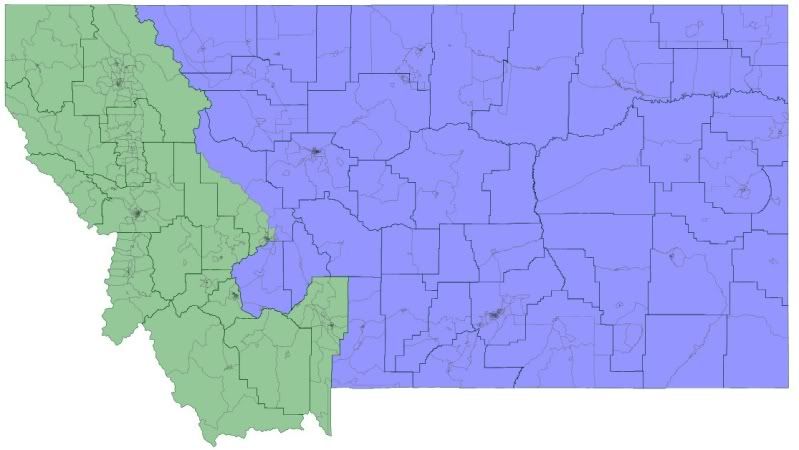
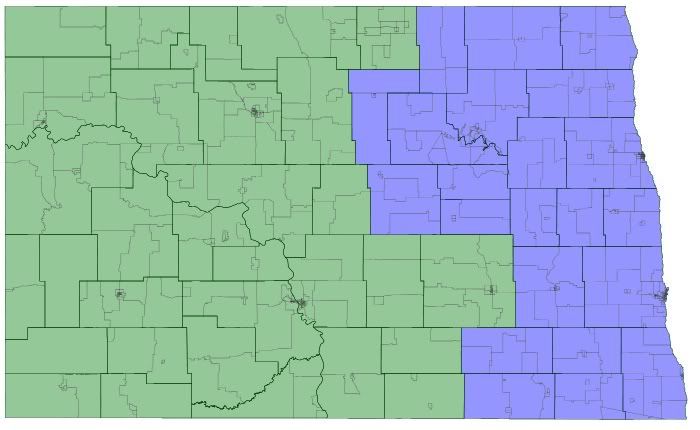
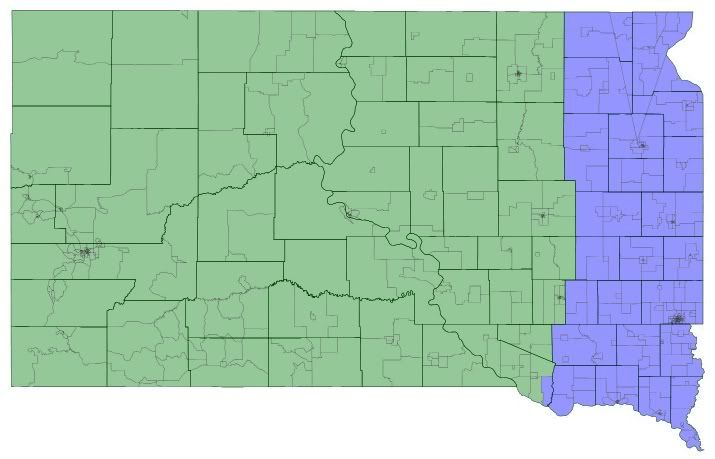
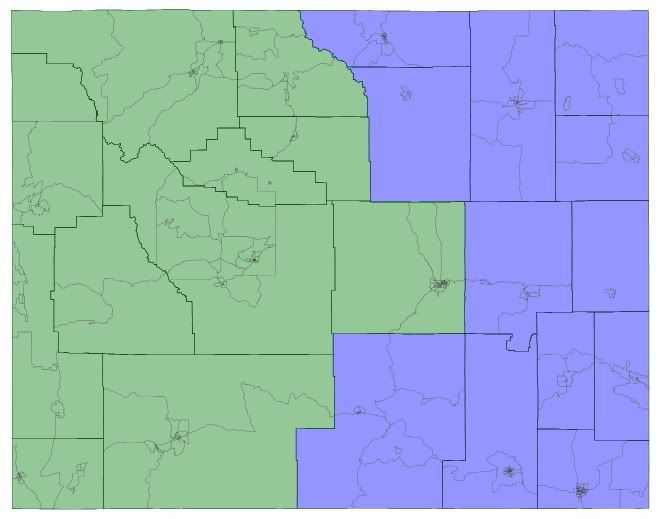
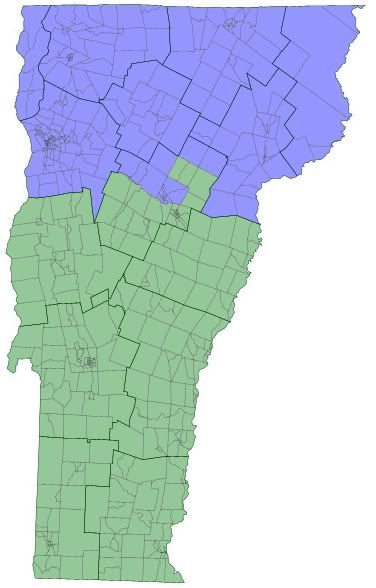
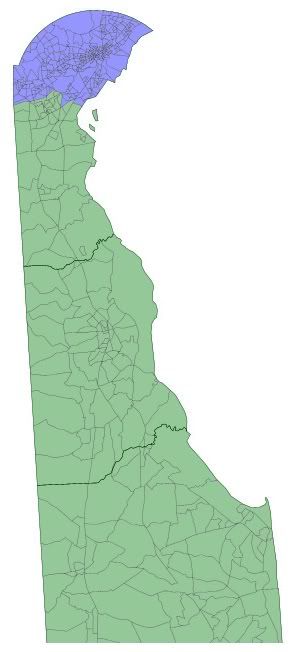
Delaware, Montana, North Dakota, South Dakota, Vermont, and Wyoming.

CD1, Lean Republican

Blue

86% White, 9% Native American, 2% Hispanic

54% McCain/46% Obama

CD2, Lean Democratic

Green

93% White, 3% Native American, 2% Hispanic

51% Obama/49% McCain

Even though the app doesn’t have the presidential breakdown, it’s pretty easy to figure it out when you keep the counties together and then just get the county figures. The county that’s split in Montana had a corresponding map that I was able to allocate the votes.

CD1, Lean Democratic

Blue

94% White, 3% Native American

52% Obama/48% McCain

Earl Pomeroy might still be a Congressman with this district.

CD2, Safe Republican

Green

90% White, 7% Native American

39% Obama/61% McCain

CD1, Lean Republican

Blue

94% White, 3% Native American

49% Obama/51% McCain

Stephanie Herseth-Sandlin might also still be in Congress with a district like this.

CD2, Likely Republican

Green

83% White, 13% Native American

42% Obama/58% McCain

CD1, Safe Republican

Blue

89% White, 7% Hispanic

34% Obama/66% McCain

CD2, Safe Republican

Green

89% White, 5% Hispanic, 3% Native American

33% Obama/67% McCain

This was a little interesting.  When I ran the 2006 numbers for the Congressional race between Gary Trauner (D) and Barbare Cubin (R) the result was a little different.

CD1, 50.12% Trauner/49.87% Cubin

45846/45624

CD2, 49% Trauner/51% Cubin

46478/47712

So by those numbers Gary Trauner would have been a Congressman by 222 votes.

CD1, Safe Democratic

Blue

95% White

70% Obama/30% McCain

CD2, Safe Democratic

Green

97% White

68% Obama/32% McCain

Surprisingly easy to break up Washington County (Montpelier) and allocate the votes.  Wikipedia had maps for the locations of the towns which is how the Secretary of State’s office broke down the election results in that county. Just put the towns into the right districts.

In case you might be wondering, since I ran the 2006 numbers in Wyoming, I also did it in Vermont (Peter Welch vs. Martha Rainville) where the Republicans had their big recruit.  Unfortunately for the Republicans, she lost in both districts.

CD1, 53% Welch/47% Rainville

69203/62567

CD2, 56% Welch/44% Rainville

70612/54456

CD1, Safe Democratic

Blue

70% White, 20% Black, 6% Hispanic, 3% Asian

63% Obama/37% McCain

CD2, Likely Democratic

Green

75% White, 17% Black, Hispanic 4%

55% Obama/45% McCain

A big asterisk needs to go by this map, because it is a big guesstimate. New Castle County didn’t have easy precincts or districts that corresponded to the map.  Or if it did, I couldn’t find it.  The election district maps I found at the Delaware Elections site were .pdfs of each small election district with breakdowns, but I didn’t feel like playing Match Game with them.

I used the state house races in New Castle and gave the Democratic votes to Obama and the Republican votes to McCain.  Obviously, I didn’t get the right numbers, I know. Again, I just did it for fun.

MO-Sen: McCaskill Up in SUSA Poll, Talent Is Out

SurveyUSA for Axiom Strategies (1/21-24, registered voters, no trendlines):

Claire McCaskill (D-inc): 48

Sam Graves (R): 44

Other/undecided: 9

(MoE: ±4%)

I think this is the first SurveyUSA poll of the 2012 cycle, and it seems consistent with the few other polls we’ve seen so far in the Show Me State: Claire McCaskill is below 50% in the danger zone but with a small lead against a non-Jim Talent candidate. In this case, it’s Sam Graves, the MO-06 Rep. and potential Senate candidate who has suddenly started to throw his weight around in this race with the Jim Talent decision not to seek a rematch. They find McCaskill with a 48/45 approval (no comparable numbers for Graves).

Worth noting: this poll wasn’t commissioned by a media outlet, but by the Republican consulting firm Axiom Strategies. From Tricia Miller’s description, it sounds like they polled other general election matchups and the GOP primary as well, but only released the Graves numbers, saying that Graves tested the best against McCaskill. (The Roll Call article also gets fellow Reps. Todd Akin and Blaine Leutkemeyer on the record as saying they won’t run, so now all the non-frosh GOP Reps. in the state are accounted for.)

As far as how we know that Jim Talent isn’t going to run, well, we have word from the horse’s mouth. Talent, in fact, publicly leaked it himself today (which means it really isn’t that much of a leak, doesn’t it?), telling the St. Louis Post-Dispatch that tomorrow he would make an official announcement that he wouldn’t run. As expected, Talent confirmed that he’s going to be focusing on Mitt Romney’s campaign instead.

Chicago Mayor: Emanuel Back on the Ballot

That was a quick about-face, putting a stop to a crazy half-week: the Illinois Supreme Court just reversed the intermediate appellate court decision that had removed Rahm Emanuel from the Chicago mayoral ballot. All seven of the seven justices agreed (including Anne Burke, the wife of Alderman and Rahm archrival Edward Burke, who had refused to recuse herself from the case… although she participated in a separate concurrence).

“This is a situation in which, not only did the candidate testify that his intent was not to abandon his Chicago residence, his acts fully support and confirm that intent.”

I won’t bore you with further long excerpts from the opinion, but the majority basically smacks the lower court down pretty hard over their contorted reasoning to reach the result they did. With that, we’re pretty much back where we were on Monday morning: with Emanuel substantially in the lead in terms of polling and money, with the election just weeks away.

TX-Sen: Dewhurst Leads in GOP Primary, Dems Getting Crushed in General

Public Policy Polling (PDF) (1/14-16, Texas Republican primary voters, no trendlines):

David Dewhurst (R): 23

Ron Paul (R): 21

Greg Abbott (R): 14

Joe Barton (R): 7

Elizabeth Ames Jones (R): 6

Ted Cruz (R): 3

Tom Leppert (R): 3

Michael Williams (R): 3

Roger Williams (R): 1

Other/undecided: 19

(MoE: ±4.9%)

With Kay Bailey Hutchison heading off to a farm upstate, PPP does another one of their genre-busting “let’s throw everyone into the pigpen and see who’s Head Hog” primary polls, a format I admit I’m growing to appreciate. In these early surveys, it’s always the guys with the most name rec who lead the way, so it’s no surprise to see Lt. Gov. David Dewhurst slopping it up at the head of the trough, though 39% of GOP voters still don’t know him. Ron Paul is next in line; PPP didn’t test his favorables, but we can guess they must higher than your average congressman’s – like, say, Smokey Joe Barton, dwelling in the single digits. State AG Greg Abbott occupies the “roast beef” slot, to round out the top tier.

Who are the other piglets? You’ve got Elizabeth Ames Jones, one of three members of the Texas Railroad Commission, all of whom are elected statewide. (Despite the name, the commission doesn’t supervise railroads, but rather the all-important oil-and-gas industry.) Teabagger fave Michael Williams is also on the RRC, and Ted Cruz is the former state Solicitor General, now making rain in private practice despite his tender age. Rounding out the list are Dallas Mayor Tom Leppert and former TX Sec. of State Roger Williams. Whew!

Interestingly, most of these potential candidates are already in the race or taking serious steps it. Cruz just made it official, and Jones, the only woman in the mix, did the same a few days later. Bush père-endorsed Roger Williams is already in the race. Michael Williams recently announced he plans to step down from the railroad commission, so that probably means only one thing. (In fact, he’ll supposedly announce today.) Leppert’s sending similar signals: a couple of weeks ago he said that he wouldn’t seek re-election as mayor.

Abbott’s still in “rumored” territory, and Barton’s saying he’s unlikely to run if the mega-wealthy Dewhurst gets in, which most folks seem to expect. A lot of people also seem to think that Dewhurst, thanks to his profile and money, will have magical field-clearing powers, but at least one columnist isn’t so sure. Since Dewhurst very firmly has “establishment” branded on his hide, it’s not hard to imagine a teabagger-fueled toppling. Just think about how Rick Perry positioned himself against KBH last year.

An additional name not on PPP’s list is Rep. Michael McCaul, who said he’s not ruling out a run. McCaul probably needs a redistricting bailout if he’s to survive into the next decade, and it would make the lives of Republican state legislators easier if they didn’t have to worry about him seeking re-election, but a senatorial run hardly seems like a better bet.

One guy who doesn’t seem likely to run is His Paulness. Ron initially said to Politico that he was “flattered” by his showing in this poll, and then told The Hill that the prospect of running for senate had “certainly crossed my mind.” But a day later, he was already telling the National Journal that “I don’t think it’s a real possibility.” Apparently, says the NJ, Paul is “waiting to see whether the strength of the nation’s currency improves before deciding whether to run.” It’s not clear to me which direction the dollar heads will make him more likely to get in, but as Crisitunity says: “Seeing as how we’re unlikely to return to the gold standard any time soon, draw your own conclusions.”

Public Policy Polling (PDF) (1/14-16, Texas voters, no trendlines):

Chet Edwards (D): 31

David Dewhurst (R): 50

Undecided: 19

Chet Edwards (D): 31

Elizabeth Ames Jones (R): 44

Undecided: 25

Chet Edwards (D): 30

Tom Leppert (R): 46

Undecided: 24

Chet Edwards (D): 31

Michael Williams (R): 42

Undecided: 27

John Sharp (D): 31

David Dewhurst (R): 49

Undecided: 19

John Sharp (D): 30

Elizabeth Ames Jones (R): 44

Undecided: 26

John Sharp (D): 30

Tom Leppert (R): 42

Undecided: 28

John Sharp (D): 30

Michael Williams (R): 42

Undecided: 28

Julian Castro (D): 25

David Dewhurst (R): 53

Undecided: 23

Julian Castro (D): 27

Elizabeth Ames Jones (R): 48

Undecided: 25

Julian Castro (D): 25

Tom Leppert (R): 48

Undecided: 27

Julian Castro (D): 26

Michael Williams (R): 45

Undecided: 29

(MoE: ±3.3%)

Doesn’t look good out there. Ex-Rep. Chet Edwards, former state Comptroller John Sharp, and San Antonio Mayor Julian Castro can’t get higher than 31% against any Republican in the field.

The Future of the Asian-American Vote

Asians are one of the most ignored constituencies in American politics. When most politicians think about the Asian vote, they don’t.

Yet the Asian-American population is increasing, both in absolute terms and relative ones. By 2050, the Census estimates that Asians will compose 7.8% of the American population. Although their voting rates will still fall far short of this, the population is becoming more influential. Predicting their future voting path therefore has some utility.

In previous posts, this blogger has argued that the Latino vote will likely trend Republican, as Latinos follow the path of previous immigrants and become more assimilated.

Will the same happen for Asian-Americans?

More below.

Probably not:

Photobucket

As the graph above shows, the Asian vote has steadily moved Democratic, in quite a significant manner. In 1992 Republican President George H.W. Bush won 55% of the Asian vote while losing the popular vote. 12 years later, his son won only 41% of Asians, despite winning the popular vote.

The trend also does not look bright for the Republican Party. Asian-Americans who have been born in the United States are, if anything, more Democratic than those who immigrated into the country (to be fair, the latter group dominates the Asian population and will continue to do so unless immigration is drastically curtailed).

Take, for instance, the Vietnamese-American population – strong supporters of the Republican Party. The Asian American Legal Defense and Education Fund, after conducting an extensive exit poll of Asians (perhaps the only detailed exit poll of the group in the country), found that:

Vietnamese American voters gave McCain the strongest support of all Asian ethnic groups at 67%. However, further analysis of Vietnamese American voters revealed 69% of those born in the U.S. and 60% of those 18-29 years old voted for Obama. Among Vietnamese American respondents, 15% were born in the U.S. and 25% were between the ages of 18 and 29.

The analysis goes on to conclude that:

AALDEF’s exit poll data shows that younger, U.S.-born, more recently naturalized, and English proficient Asian American citizens voted for Barack Obama for President by wide margins. Older, foreign-born citizens with limited English proficiency and who had been naturalized more than ten years ago voted in greater proportions for McCain.

There are several explanations for why this is happening. One quite plausible argument is that immigration has shifted the Asian-American population from Orange County anti-communists to Silicon Valley liberals.

Another revealing insight can be gained by comparing Asians to another very Democratic group: Jews. In many ways the two have a startling amount in common. Both groups are highly educated; both are primarily located in urban metropolitan areas; both have achieved substantial success in American society; and both have encountered quite similar types of discrimination. Even the stereotypes are similar.

Given these similarities, it is very conceivable that Asians could end up voting like Jews – one of the most liberal-minded groups in the nation.

–Inoljt, http://mypolitikal.com/

SSP Daily Digest: 1/26

MO-Sen: Most likely you already saw this story yesterday, but the big story in the Missouri Senate race is that Politico’s Dave Catanese seems to be the recipient of various leaks that ex-Sen. Jim Talent will announce soon that he isn’t going to run for Senate. We won’t start jumping up and down and honking our clown horn until we actually hear it from Talent, but this isn’t a surprise, based on previous rumors out of the Show Me State and Talent’s seeming decision to focus on hitching his wagon to Mitt Romney’s star instead. Without a dominant establishment candidate in the field, it looks like even more GOPers are starting to sniff out the race: MO-08 Rep. Jo Ann Emerson is now on the record as at least “considering” a run. Emerson, who’s had some mavericky moments in the House, would easily be the most moderate GOPer in the field if she ran (and may see a path there, with multiple tea partiers seeming poised to cannibalize each others’ votes). Emerson’s potential departure would create an open seat in the currently R+15 8th, an area that actually went for Bill Clinton but has fallen off the cliff for Dems in recent years, most recently with the fizzle of the touted Tommy Sowers campaign last year.

NJ-Sen: PPP, while “cleaning out their fridge” as they said, found some week-old GOP Senate primary numbers from their New Jersey sample. They find state Sen. and 2006 candidate Tom Kean Jr. in good shape, with support from both moderates (which is probably what he would qualify as) and conservatives; he leads Lou Dobbs 42-30 with Lt. Gov. Kim Guadagno at 7, “someone else” at 6, and 15 undecided.

KY-Gov: Filing day came and went without any last-minute shenanigans in Kentucky. Steve Beshear will get a totally free ride in the Democratic primary (looks like that primary from the scrap metal dealer didn’t materialize), and will face one of three GOP opponents: state Senate president David Williams, teabagging businessman Phil Moffett, or Jefferson Co. Clerk Bobbie Holsclaw. The general election field in the AG race is already set; Jack Conway and Todd P’Pool didn’t draw any primary challengers. The most activity seems to be in the Ag Commissioner race (vacated by Richie Farmer, who’s running for Lt. Gov.), with 5 Dems and 2 GOPers running.

MN-08: This probably isn’t a surprise, but after his upset loss last year, 76-year-old Jim Oberstar has decided to opt for retirement rather than a rerun against new Rep. Chip Cravaack. Two other high-profile Dems, Duluth mayor Don Ness and state Sen. Tony Lourey have also recently said no. Two DFLers who are considering the race, though, are Duluth-based state Sen. Roger Reinert and Daniel Fanning, Al Franken’s deputy state director.

Omaha mayor: Omaha mayor Jim Suttle narrowly survived a recall attempt in last night’s special election. He won 51-49. Suttle vows to do a better job of communicating with voters in the election’s wake, although it remains an open question whether he runs again in 2013.

Redistricting: Here’s a new wrinkle in the fight over the Fair Districts initiatives in Florida: Rick Scott seems to be stalling implementation of the new standards (which would limit the state legislature’s ability to gerrymander districts). The state “quietly withdrew” its request that the federal DOJ approve implementation of the initiatives, which jeopardizes whether they’ll be in place in time for the actual business of redistricting. Florida, as a one-time part of the Deep South, is one of those states that requires DOJ preclearance for changes to its electoral regime under the Voting Rights Act.

Politico also has an interesting article today about the Congressional Black Caucus and redistricting, which will reshape many of their districts, seeing as how some of their members’ districts have had the biggest population losses of any districts in the nation (OH-11, MI-13, MI-14, and MO-01 in particular). These districts seem like they can absorb some suburban votes without losing their lopsided Dem advantages, but they’re probably more worried about members getting pitted against each other (as might happen with the two Detroit districts) or against another Dem (possible for Marcia Fudge and Lacy Clay). Other lingering questions are whether Sanford Bishop’s GA-02 (the only CBC-held district that’s legitimately swingy) gets shored up or made worse, and whether South Carolina can be compelled to eke out a second VRA seat.

Turnout models: I rarely get the chance to say this, but if you look at only one scatterplot today, it should be this one. It’s a remarkably-clear slope showing how predictable presidential approval is across demographic groups, and more evidence that the swing in the 2010 election was uniform across groups in response to macro factors (i.e. the stupid economy) rather than a failure of microtargeting. And here are some further thoughts on the matter from Larry Sabato’s new book, pointing out the really steep dropoffs in 2010 turnout for the groups I tend to label the “casual voters” (reliably Dem lower-information voters, mostly young and/or people of color, who turn out for presidential races but not the less compelling stuff in between), and how the 2010 model isn’t anything like what the 2012 model will resemble.

WV-Sen, WV-Gov: Manchin Leads for Senate, Capito Leads for Gov

Public Policy Polling (1/20-23, West Virginia voters, no trendlines):

Joe Manchin (D-inc): 50

Shelley Moore Capito (R): 41

Undecided: 10

Joe Manchin (D-inc): 57

David McKinley (R): 28

Undecided: 14

Joe Manchin (D-inc): 60

John Raese (R): 31

Undecided: 9

(MoE: ±2.9%)

I think, if you were to try and set up West Virginians’ feelings about their politicians as a mathematical equation, it would look something like this: Joe Manchin > Shelley Moore Capito > (very large gap) > various other Dems > various other Republicans. This can be seen in PPP’s sample this week, which starts with their look at the 2012 Senate race, with Manchin beating all Republican opponents and having made the jump to federal office with sky-high approvals down somewhat but mostly intact, at 52/32 (with much of the drop in approvals coming from liberals, believe it or not). Capito is in similar very-positive terrain at 54/30, but nevertheless loses to Manchin, probably because of the disparity in Dem vs. GOP registrations in West Virginia and that there’s little Dem defection from Manchin.

Public Policy Polling (1/20-23, West Virginia voters, no trendlines):

Earl Ray Tomblin (D): 40

Shelley Moore Capito (R): 48

Undecided: 12

Earl Ray Tomblin (D): 54

Clark Barnes (R): 22

Undecided: 24

Earl Ray Tomblin (D): 49

Betty Ireland (R): 32

Undecided: 19

Earl Ray Tomblin (D): 53

Mike Stuart (R): 20

Undecided: 28

John Perdue (D): 33

Shelley Moore Capito (R): 52

Undecided: 15

John Perdue (D): 41

Clark Barnes (R): 23

Undecided: 36

John Perdue (D): 37

Betty Ireland (R): 37

Undecided: 26

John Perdue (D): 41

Mike Stuart (R): 21

Undecided: 38

Natalie Tennant (D): 37

Shelley Moore Capito (R): 49

Undecided: 13

Natalie Tennant (D): 49

Clark Barnes (R): 23

Undecided: 28

Natalie Tennant (D): 43

Betty Ireland (R): 32

Undecided: 26

Natalie Tennant (D): 48

Mike Stuart (R): 22

Undecided: 31

Rick Thompson (D): 29

Shelley Moore Capito (R): 54

Undecided: 18

Rick Thompson (D): 34

Clark Barnes (R): 24

Undecided: 43

Rick Thompson (D): 31

Betty Ireland (R): 37

Undecided: 32

Rick Thompson (D): 33

Mike Stuart (R): 22

Undecided: 45

(MoE: ±2.9%)

If you have the stamina to wade through all 16 of these gubernatorial permutations, you can see a definite pattern: Dems win big, unless the GOP gets Shelley Moore Capito into the race, in which case she’s favored (or unless Rick Thompson wins the nomination, as he manages to lose to Betty Ireland). The question PPP asks specifically says “If the candidates for governor this year were…” so, however, keep in mind that Capito has basically declined to run in the special election. Nevertheless, she hasn’t ruled out a run in 2012, so assuming these numbers stay valid for another year, there’s a distinct possibility that whichever Dem wins the special election in 2011 could have a very short tenure if Capito does decide to run in 2012. In fact, if Earl Ray Tomblin doesn’t win the Dem primary, we could have two one-year gubernatorial terms in a row. Tomblin starts in a good place, though, with 42/20 approvals; Betty Ireland seems to fare the best of the “other” GOPers, with 33/19 faves.

If you’re wondering, here’s who all these various people are:

Earl Ray Tomblin: Democratic state Senate president and acting Governor until the October 2011 special election

John Perdue: Democratic state Treasurer

Natalie Tennant: Democratic Secretary of State

Rick Thompson: Democratic state House speaker

Shelley Moore Capito: Republican Rep. from WV-02

Clark Barnes: Republican state Senator

Betty Ireland: Republican ex-SoS

Mike Stuart: Republican state party chair