1. IL-10 – Bob Dold – Dems should be able to beat Dold without changing district much.
2. NY-25 – Ann Marie Buerkle – How did Maffei lose this to an anti-abortion activist?
3. NH-02 – Charlie Bass – Would love to see Kuster run again.
4. NV-03 – Joe Heck – Harry Reid GOTV nearly carried Titus to victory.
5. MN-08 – Chip Cravaack – Dems should be able to beat this guy in historically Dem district.
6. WA-08 – Dave Reichert – DelBene re-run would be fine with me.
7. IL-08 – Joe Walsh – Bean re-run would be OK. Walsh a very poor candidate.
8. NJ-03 – John Runyan – Dems should find a candidate from outside Camden machine.
9. TX-27 – Blake Farenthold – Anybody but Ortiz.
10. PA-11 – Lou Barletta – Anybody but Kanjorski.
11. NC-02 – Renee Ellmers – Anybody but Etheridge.
12. WI-07 – Sean Duffy
13. PA-08 – Mike Fitzpatrick
14. WA-03 – Jaime Herrera
15. IL-17 – Bobby Schilling
16. OH-01 – Steve Chabot
17. FL-22 – Allen West
18. PA-07 – Pat Meehan
19. MI-07 – Tim Walberg
20. IL-14 – Randy Hultgren
21. NY-24 – Richard Hanna
22. OH-06 – Bill Johnson
23. PA-06 – Jim Gerlach
24. NY-19 – Nan Hayworth
25. NY-13 – Mike Grimm
26. WI-08 – Reid Ribble
27. TX-23 – Quico Canseco
28. PA-15 – Charlie Dent
29. OH-15 – Steve Stivers
30. NH-01 – Frank Guinta
31. NY-20 – Chris Gibson
32. CO-03 – Scott Tipton
33. VA-05 – Rob Hurt
34. OH-12 – Pat Tiberi
35. CA-45 – Mary Bono-Mack
36. IL-11 – Adam Kinzinger
37. MI-01 – Dan Benishek
38. AZ-05 – David Schweikert
39. PA-03 – Mike Kelly
40. CA-03 – Dan Lungren
41. MI-11 – Thad McCotter
42. FL-25 – David Rivera
43. FL-12 – Dennis Ross
44. OH-16 – Jim Renacci
45. MN-03 – Erik Paulsen
46. FL-08 – Dan Webster
47. IL-06 – Peter Roskam
48. AZ-01 – Paul Gosar
49. VA-02 – Scott Rigell
50. NJ-07 – Leonard Lance
Florida Gerrymander – 27 Districts
This is my first diary post using Dave’s App, so any suggestions are welcome 🙂
I tried to create a slight Democratic Gerrymander of Florida. I didn’t follow VRA very much, so I will be working to make a VRA map with 2 AA majority districts and 3 hispanic majority districts. I don’t believe the DOJ will require a 3rd in North Florida (Corrine Browns awful district.)
But being able to basically ignore the VRA in Florida opens amazing opportunities, especially in South FL. And luckily, some of the districts around the Tampa Bay area and a few others may end up being the actual districts with the new Fair Districts initiative being passed.
So, here are my maps:

Panhandle:
CD1 in Blue: It’s pretty hard to do anything here unless you want to send an arm from CD2 to to suck up Pensacola voters, but that would just look to crazy. This district is Safe Republican for the next decade at least.
76% White, 13% Black, 4% Hispanic
Rating: Safe R
CD2 in Green: This district is based in Tallahassee, and differs from the current district because it extends further north and east (Repubs drew an arm from Andrew Crenshaws district on the GA border over into CD2 to suck up Blue Dog voters and take out Allen Boyds home town in Monticello)
Here, I put a lot of traditionally Dem voting areas (Wakulla and Jefferson counties) along with very Democratic Leon county. This district is probably around even PVI, and I can easily see a Dem winning this (probably a moderate).
68% White, 24% Black, 4% Hispanic
Rating: Tossup

North Central FL and Jacksonville:
CD3 in Purple: This is a Gainesville based district. I toyed with trying to tie this to Tallahassee or Jacksonville, but decided to just give this district traditionally Democratic Madison county in the northwest part of the district, heavily Dem Alachua county and high AA parts of Ocala in the southern part of the district, and also extends over to Palatka in the east down through hispanic De Leon Springs. It has enough of an AA population along with the University of Florida to make it a competitive district. I am fairly unsure of what Obama % this district would be, but I think another fairly moderate Dem could easily hold this district barring another 2010.
70% White, 19% Black, 7% Hispanic
Rating: Tossup
CD4 in Red: This district sucks up heavily Republican suburbs of Jacksonville including all of Nassau county. It stretches further south to suck up rural white populations away from the east coast.
82% White, 8% Black, 5% Hispanic
Rating: Safe R
CD5 in Yellow: I decided to let Jacksonville have it’s own district, but at the same time keep it competitive for Dems. It’s only 55% white, but the Jacksonville area is very racially divided. However, with some liberal whites, a high AA populations, and some hispanics, this district will also probably be very competitive. It all depends on AA turnout in the city.
55% White, 34% Black, 6% Hispanic, 3% Asian
Rating: In Presidential years – Lean D In off years- Tossup
CD6 in Blue-Green: This district was designed to be as Dem as possible on the east coast. It takes in fairly wealthy beach towns, and heavily AA areas like Titusville and Holly Hill. It extends over towards Orlando to pick up heavily minority Sanford.
74% White, 12% Black, 10% Hispanic
Rating: Lean D
CD7 in Grey: I love this district. It covers heavily rural and Republican areas all through the big bend and central part of the state.
83% White, 7% Black, 8% Hispanic
Rating: Safe R
I’ll come back to CD 8 after the Tampa area.

Behold, Tampa!:
CD9 in Cyan: This is a solely Tampa based district and is plurality-white. It doesn’t include all of the New Tampa area (which is technically part of the city.) It stretches down a bit to take in Gibsonton and Riverview, and east to take in the diverse Brandon area and heavily AA Progress Village and Clair Mel City.
49% White, 21% Black, 25% Hispanic
Rating: Safe D
CD10 in Magenta? / Pink: A Tampa suburb district. This takes in Republican leaning areas in Pasco, down through heavily R Sun City, absorbing the rest of the R leaning Tampa suburbs.
72% White, 7% Black, 16% Hispanic
Rating: Likely R
CD11 in Pale Green: St. Petersburg district. If you look closely at the current district map, the actual city of St. Pete is gerrymandered out of this district, and linked to downtown Tampa and Bradenton to the south by water (awful.) So adding downtown St. Pete makes this district much more Dem friendly, considering it is already a Tossup. Once Bill Young retires, this would easily go D.
76% White, 12% Black, 7% Hispanic
Rating: Lean D after Young retires.
CD12 in Light-Bluish: Coastal Pasco and Hernando and Northern Pinellas. This district takes in Greek populations north of Clearwater, and suburban R leaning Pasco and Hernando. Bilirakis would probably run here and win, with his family name. As for the long term, this district may slowly trend D as its population explodes and suburbs continue to become slightly more D friendly.
Rating: Likely R, possibly Lean R by the end of the decade.

Now for the Orlando Area:
CD8 in Light Blue: This district is majority-minority when adding all minority groups. It includes the western half of Orlando, and heavily hispanic areas to the south and west of downtown Orlando. The Dem primary here would be interesting.
47% White, 25% Black, 20% Hispanic, 5% Asian
Rating: Safe to Likely D
CD14 in Ugly Brown/Green: I’m really unsure of the Obama % here. There is a decent minority vote here, along with the eastern half of downtown Orlando. I know this area is quickly growing, and becoming more D as the Puerto Rican population skyrockets. This district also slides east to pickup the space center and Merritt Island.
70% White, 7% Black, 17% Hispanic
Rating: Unsure… could be between Lean R and Lean D.
CD15 in Orange: One of my more gerrymandered districts that I am proud of. It is barely majority white. This takes in south Orlando, Kissimmee, St. Cloud, along with downtown Winter Haven and Lakeland. It could be tweaked maybe to make it majority-minority.
50% White, 12% Black, 33% Hispanic
Rating: Likely D

SW Florida and South Central FL:
CD 13 in Tan: I apologize for the colors here. This districts includes all of Brandenton, Sarasota, Venice, Punta Gorda, and Port Charlotte. Bye-bye, Vern Buchanan. He might run in CD10 or CD16 instead.
81% White, 7% Black, 10% Hispanic
Rating: Likely D
CD16 in Bright Green: Republican vote sink extraordinaire. Probably my favorite R vote sink in FL. This district sucks in all of the R heavy and R leaning areas from Hillsborough County all the way down through the spine of central FL, ending at Lake Okeechobee.
73% White, 9% Black, 16% Hispanic
Rating: Safe R
CD17 in Purple: Another fun east coast district, including Melbourne all the way down to Fort Pierce. Not too sure about this district either… I know the coastal areas are fairly swingy, but I assume Obama carried them narrowly, but lost the inland parts I put in CD16.
74% White, 12% Black, 10% Hispanic
Rating: Lean D to Tossup
CD18 in Pale Yellow: This district takes some very low population inland Everglades areas, and eat up part of the East coast and we approach the Miami area. I believe a lot of the white population here is wealthy, and also I think we are starting to get into some Jewish population areas. If anyone wants to help fill me in on the type of white population that lives here that would be awesome!
63% White, 17% Black, 16% Hispanic
Rating: Lean D to Tossup?
CD19 in Lime Greenish: This district includes Palm Beach. It has a decent AA and hispanic population (that I don’t think is too Cuban heavy yet.) We’re also getting into the more Jewish populated areas.
61% White, 14% Black, 22% Hispanic
Rating: Likely to Lean D
CD20 in Pale Pink: Fort Myers and Cape Coral. These heavily populated areas are Lean D, considering they are a huge hot-spot for retirees. This district is probably R leaning, but I may be wrong and it could elect the right D.
77% White, 6% Black, 14% Hispanic
Rating: Lean R
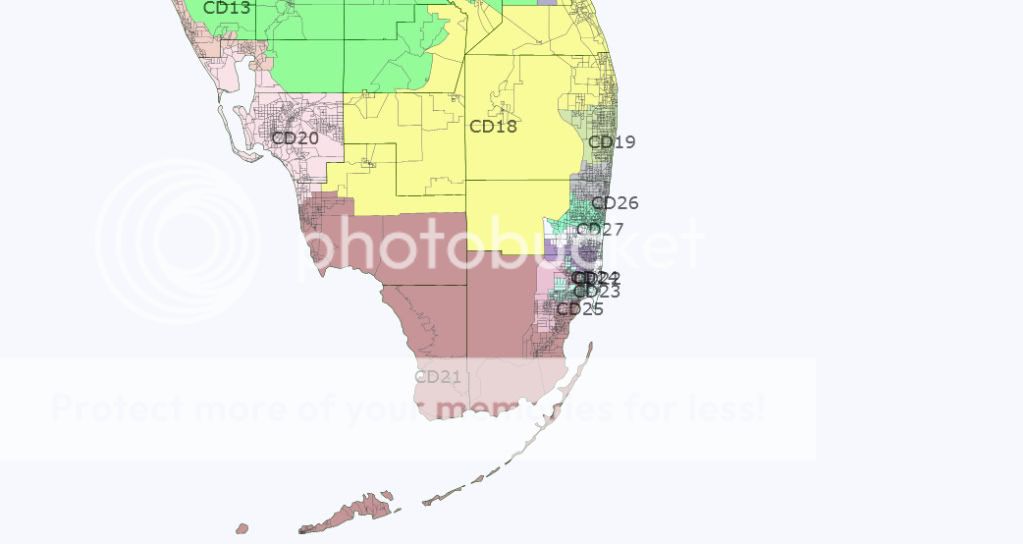
South Florida!:
CD21 in Brown: How do you make Rs in Florida pissed? Make them have a nasty primary between old white people in Naples and Cubans near Miami. Should be an R district, until the Cuban populations shift to Dems (hopefully soon)
48% White, 14% Black, 35% Hispanic
Rating: Likely R for now.
CD26 in a Greyish color below the Lime green district: Boca!
I apologize again for the picture here. This district should be heavily Jewish with a 12% AA population. I don’t think this district will leave the D column.
69% White, 12% Black, 15% Hispanic
Rating: Likely D
CD27 in Aquamarine: Ft. Lauderdale. This district was my leftovers kind of. It’s extremely diverse, but with over 30% AA and most of the white population being Jewish, it seems like it should be a Dem district.
42% White, 34% Black, 19% Hispanic
Rating: Safe to Likely D

Miami Area:
CD22 in White: Hollywood. A barely white majority district, diluting some of the Cuban power in the area. With the Jewish population and % AA population combined, it should be Lean D.
50% White, 8% Black, 36% Hispanic
Rating: Lean D
CD24 in Purple: North Miami. This is the only AA majority district I have here, so the VRA would be sad.
14% White, 52% Black, 30% Hispanic
Rating: Safe D

A closer look at the South Miami Area:
CD23 in Teal-ish color: Miami Cuban areas. Can’t get much more Cuban than this district.
9% White, 6% Black, 83% Hispanic
Rating: Safe R for one of the Diaz-Balarts or Ms. Ileana.
CD25 in Light Pink: Hialeah. This sucks in Hialeah and makes a C shape to suck in more Cuban populations to the south.
14% White, 5% Black, 79% Hispanic
Rating: Safe R
5D-2R in Colorado (UPDATED: Now with a VRA district as well)
The Dems came extremely close to controlling the redistricting trifecta in CO, losing the state house of reps by a single seat. If the Dems had won that house seat last year, or if they could somehow convince one of the Republicans in the house to switch parties or support a Democratic redistricting plan, here is one way the Democrats could draw a reasonably compact 5-2 map of Colorado.

Denver Area:

The two districts that are the most changed under this map are the 3rd and the 4th. The new 3rd is a C-shaped district that includes the Hispanic areas in the Southern part of the state, the liberal rocky mtn ski towns, and some swingy areas in Jefferson county. Despite the fact that the Jeff Co areas are swing regions, this district is safely Democratic as those areas only make up about one third of the district’s population. A GOP candidate could get up to 60% of the vote in the Jeff Co part of this district and still lose overall due to the heavy Democratic lean of the other areas. The one problem with this district is that rep Ed Perlmutter actually lives here. This shouldn’t be a problem in terms of losing to a Republican (he’s more vulnerable in his old district than here), but he may not want to represent a district composed of so much new territory.
The new 4th is composed of Greeley, Fort Collins-Loveland, and some mainly Hispanic areas in Weld and Adams counties. Between the white liberals in Greeley and Fort Collins and the Hispanics in Adams Co, it should be all but safe democratic. I could see this district maybe going red in a midterm year with low Hispanic turnout, but even that would probably be a stretch, and getting less likely with every passing year as this area trends more and more democratic. Still this is probably the least Democratic of the 5 D districts on this map, which is a testament to how Democratic this map is more than anything else.
The 2nd district around Boulder is almost unchanged. The 1st has shed some areas in Denver Co to the 7th and gained some suburban areas around Littleton in order to shore up the 7th. The 1st is now less Democratic but still enough for Diana DeGette to be completely safe. The 7th has lost a lot of territory in Adams and Jefferson counties, but it has gained some African-American and mixed African-American and Hispanic areas in Denver along with some areas in Weld and Morgan counties. At 59% White it is the most minority-heavy of all these districts, and should be much safer for Democrats now. Lastly, the 5th and 6th serve as GOP vote dumps in Colorado Springs and the outer areas of the state, respectively.
UPDATE
There was some discussion in the comments of the potential effects of the VRA on Colorado. It is actually possible to draw a compact plurality-hispanic district in Denver and Adams Co. My initial guess was that this would wind up hurting Democrats significantly. This turned out to be partially true, but much less than I originally thought. The basic methodology of the map remains the same; Draw a C-shaped district combining the Denver suburbs, the Hispanic areas in South CO, and the liberal ski towns, and attach Fort Collins and Greeley to something other than ruralconservativeland. It turns out looking like this:

Denver Area:

Under this map, the 1st district is 43% W, 8 %B, 44% H. It is possible to make it as much as 39-ish percent white if you want to, but once it crosses the 50% non-white line there is no legal obligation to make it more non-white so I decided to leave it 43% white in order to make the surrounding districts safer. One big change under this map is that the 4th is now drawn down to Boulder instead of Adams Co. This saves the Democrats the trouble of having to find someone to run in what was under the first map their weakest district. The other change is that the 2nd district is now mainly a Jefferson Co based district, with a bit of Arapahoe Co and the SW tip of Denver Co thrown in. This is probably the worst thing for the Democrats on this map, as I suspect the PVI of this district is something like D+2 or 3, making it only a slightly D-leaning seat. It also has no incumbent, as rep Perlmutter’s home is still in the 3rd. This area is trending Democratic very quickly, though, so if the Dems have to draw a VRA seat then I wouldn’t totally freak out about this one. The 7th, having lost a lot of nonwhite territory to the 1st, now has taken on the majority-white sections of Denver. I don’t know where Rep Diana DeGette lives in Denver, however I would guess she probably lives in one of the mainly white areas, so she probably runs in the 7th under this map, opening up the new 1st for a Hispanic representative. The 7th, like the 4th, has probably moved towards the Democrats under this map. The 3rd, OTOH, has moved to the GOP here, as it has taken on the rural areas previously in the 2nd, a tiny part of Douglas Co, and Crowley and Otero counties in the south which are GOP leaning but have significant Hispanic minorities. Overall, this new 3rd is probably Likely D at worst. So the net shift to the GOP from creating a new Hispanic-plurality district is at most one district. The biggest loser under this new VRA scenario seems to be compactness and community-of-interest contiguity (I particularly don’t like the idea of splitting Denver Co between multiple districts), not necessarily the Democratic Party.
SSP Daily Digest: 1/25
• CT-Sen: Murphmentum! Rep. Chris Murphy, in the race to replace Joe Lieberman, seems to have a sizable early edge in both the primary and general elections, at least according to his internal poll from the Gotham Research Group (with a Jan. 3-5 sample period, so pre-Murphy’s campaign launch and pre-Lieberman’s retirement). In the primary, he leads a two-way race against Susan Bysiewicz, 40-31. In the general, he leads Linda McMahon 54-35 and leads Rob Simmons 46-34 (which is quite the testament to McMahon’s toxicity). The spread on the primary numbers is close to the 47-35 mystery poll that was widely mentioned on Murphy’s announcement day, although the Murphy campaign reiterates that that poll wasn’t theirs.
• MN-Sen: Norm Coleman (currently heading American Action Network, who were big players on the dark money front in 2010) is saying that he’s not ruling out another run for office, although couching that by saying he’s enjoying being out of the news on a regular basis. No indication what he wants to run for, though.
• MO-Sen: Here’s one more name to add to the list for Missouri… or to add back to the list, after briefly being off the list while the pursued the chairmanship of the RNC. Ann Wagner, a former ambassador to Luxembourg, former RNC vice-chair, and former campaign manager to Roy Blunt (can’t get much more GOP establishment than that resume), is publicly weighing the race again. (She says she’d defer to Jim Talent, though, but that’s looking less likely.) And here’s an early endorsement for Ed Martin, the former MO-03 candidate who’s emerging as something of the tea party favorite in the field, if he decides to run; he got the endorsement of Phyllis Schlafly, Missouri-based 80s right-wing icon who still has a lot of pull in social conservative circles.
• OH-Sen: Rep. Jim Jordan is back in the news for saying that he’s “leaning against” a run against Sherrod Brown. If I recall correctly, he’s been “leaning against” the race for months, so things don’t seem to have changed much here.
• LA-Gov: Louisiana Democrats seem to be turning their attention toward something that’s previously eluded them: a potentially willing candidate to go up against Bobby Jindal. Former SoS Al Ater, well-regarded for getting the state electoral system back in gear after Hurricane Katrina in 2005, still sounds pretty noncommittal, perhaps most about the idea of spending his own money on the race (self-financing seems to be the Dems’ main criteria for the race, and while Ater has money, he doesn’t sound happy about spending much of it).
• IA-03: Christie Vilsack is seemingly moving toward a run for the House in 2012, meeting with donors and labor leaders to lay some groundwork. This seems strange, though, because all three of the state’s House Dems say they’re running for re-election, including 77-year-old Leonard Boswell. (Vilsack would be likeliest to run in the 3rd, or whatever the Des Moines-area district will be called once redistricting happens.) She won’t make a formal decision until April, when the new four-district redistricting maps will be unveiled, but for now it looks like, unless she’s going to run against Steve King, there’s a collision course with an existing Dem.
• Chicago mayor: Fresh off a surprising setback in the Illinois Appellate Court, which reversed lower court rulings that he was a Chicago resident and eligible to become mayor, Rahm Emanuel has appealed to the state Supreme Court; they’ve announced they’ll hear the case on an expedited basis, with no oral arguments, so we should be out of limbo pretty soon. There was a brief period where it looked like the city was going to go ahead and start printing ballots without Emanuel’s name (which would basically be the kiss of death), but also today, a stay was ordered that pushes back the ballot printing until the case is fully decided. Also, in case you though this was all just about a legitimate case of differences in statutory interpretation, with grownups disagreeing about what an inadequately-specific law means, guess again. (Forget it, Jake. It’s Chicago.) It turns out that two of the three Appellate Court judges on the case were slated by the 14th district Alderman Edward Burke, a local powerbroker who’s a staunch Emanuel rival and a key Gery Chico backer. This leads to the question of whether supreme court justice Anne Burke, who may have a certain loyalty to Edward seeing as how she’s married to him, will recuse herself from the Emanuel case.
• Omaha mayor: There’s one special election on tap today: a recall election in Omaha, against mayor Jim Suttle. There’s no scandal or malfeasance alleged, just anger about over usual teabagger grievances like “excessive taxes, broken promises, and union deals,” as well as the unspoken obvious: while it’s an ostensibly nonpartisan job, Suttle’s a Democrat. (Omaha seems particularly trigger-happy about recalls; Mike Boyle was successfully recalled in 1987.)
• Senate: Somehow it doesn’t seem unusual, but what George Allen is attempting (and what Jim Talent could attempt, too) is, in fact, highly unusual. Only five Senators have lost re-election and then come back to the Senate… but most of them (Slade Gorton most recently) were elected to their state’s other Senate seat. What Allen is doing is even more unusual: defeating the guy who beat you six years ago in order to reclaim your seat seems to have happened all of once in history. Thanks to UMN’s Smart Politics, it looks like the one time was in 1934, when Rhode Island Democrat Peter Gerry (the great-grandson of Elbridge Gerry, in case you’re wondering) beat one-term Republican Felix Hebert, who had knocked him out in the GOP tsunami of 1928.
• DGA: The Democratic Governor’s Association announced its new hires for the cycle, including the Patriot Majority’s Dan Sena as its political director. We’re especially happy to see their new hire for communication director: friend-to-the-site Lis Smith, last seen on Ted Strickland’s campaign.
• Redistricting: There’s some redistricting-related drama looming in New York, where the Senate Republicans are backing away from promises of a non-partisan redistricting map. Andrew Cuomo has signaled that he’d veto any map that wasn’t non-partisan, but is now suggesting he can negotiate on that, in exchange for other priorities. There was also a smaller battle in Georgia, won by Lt. Gov. Casey Cagle (who, in his role as Senate president, got to reassert his authority over the process), where the stakes are lower since the GOP controls the trifecta. The battle was against Senate president pro tem Tommie Williams… Williams is from the south (unlike Nathan Deal, Cagle, and the House speaker, all from the north) and has a stake in keeping the underpopulated southern part of the state’s interests represented at the table.
One of the big question marks for redistricting is Florida, where the initiative that passed, limiting gerrymandering, still has to run the gauntlet in the courts; the GOP in the state House are joining the suit against the initiative that was filed jointly by Mario Diaz-Balart and Corrine Brown (not surprising that they’d support it, since the GOP controls the trifecta and the legislature would get to resume gerrymandering if it’s struck down). Finally, the Pittsburgh Post-Gazette takes a look at Pennsylvania redistricting prospects, concluding (rightly, in my estimation) that the axe is likely to fall in the southwest corner of the state because of its stagnant population, and suggesting that the likeliest removal from the House will be the loser of a Jason Altmire/Mark Critz mashup.
Redistricting the Virginia State Senate: Can Democrats Maintain a Majority?
The problem: Democrats are going into redistricting with a 22-18 advantage in the Virginia State Senate. They have to either hold on to 21 of those seats or carve out new seats that they can win. The question is, can they succeed? I’ve tried my best to come up with a map that gives Democrats a good chance at holding their majority.
State Map
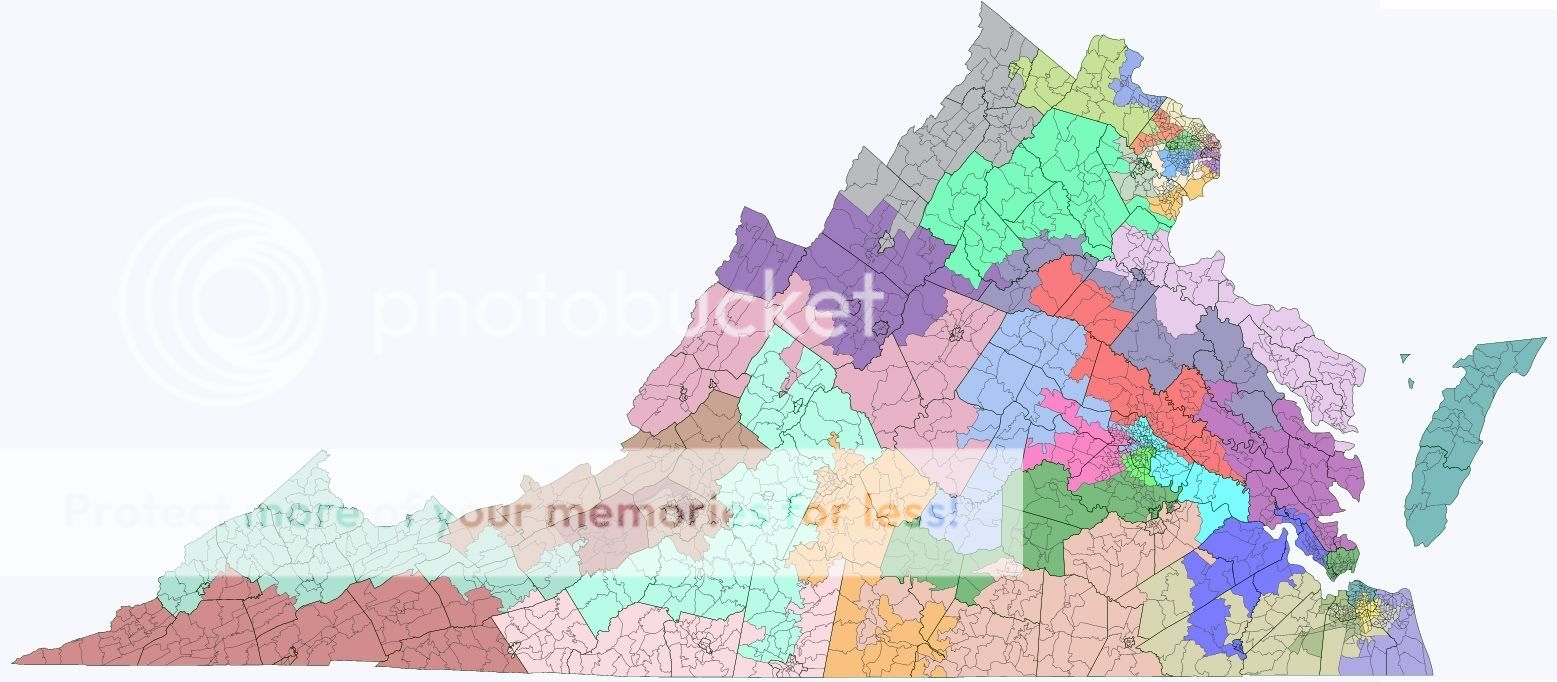
As you can see, it ain’t pretty. I attempted to maintain as much population equality as possible, trying to keep districts under 1,000 population variance; with districts that are targeted around 194,000 people, this is well within the normal variance allowed for state legislative districts. The Democrats may be able to massage the numbers some more than I was willing to try. To compare, you can see the 2007 results and existing Senate districts at the Virginia Public Access Project.
We’ll start in Southwestern Virginia and work our way around the state.

SD-40, incumbent: William Wampler Jr. (R)
Not much you can do with this part of the state. It’s pretty much the same as the existing district, except expanded a bit to the east to up the population.
SD-38, incumbent: Phil Puckett (D)
Believe it or not, Puckett went unopposed in 2007. Given the extreme shift away from the Democrats that this part of the state has undergone in the past couple years, I can’t imagine that will be the case this year. Again, there’s not much you can do here; the best I could do was stretch the district out to pull in Radford from SD-22.
SD-20, incumbent: Roscoe Reynolds (D)
Reynolds did have an opponent in 2007, but trounced him. I tried to help him out by putting Danville into the district, along with some parts of Pittsylvania County that have a high African-American population. The district’s black population is 25%.
SD-21, incumbent: John Edwards (D)
No, not that John Edwards. This is the one safe Democratic district this far south, as it contains Montgomery County, Roanoke, and not much else.
SD-22, incumbent: Ralph Smith (R)
Smith knocked off the incumbent in a primary in 2007, then barely beat the Democratic candidate. Rather than try to replicate that feat (because, quite frankly, if they couldn’t win it in 2007, they’re not going to win it in 2011), I just dumped all of the Roanoke suburbs into the district, so it will be safe for the Republicans.
SD-23, incumbents: Steve Newman (R), William Stanley (R)
A district had to be eliminated and spirited off to Northern Virginia, and the obvious choice is the existing 19th, as it has some Dem-friendly parts that can be appended to the 20th, and Stanley is the junior-most Senator, having just been elected this month. This is an extremely Republican district consisting of a rural swath of land between Lynchburg and Roanoke.
SD-15, incumbent: Frank Ruff (R)
Another very Republican district dominated by Lynchburg and Amherst County. It stretches down to the North Carolina border because Ruff lives in the very southeastern tip of the district.
On to Southside and Richmond…

SD-13, incumbent: none
This is where the Democrats need to get creative. The 13th used to be Republican Fred Quayle’s district, stretching from Portsmouth to Hopewell; I’ve created a district to replace it centered in Emporia, Petersburg, and the Southside counties with high black populations. In fact, this district is very narrowly majority-black (50.2%). It should be a prime pickup opportunity for the Democrats.
SD-11, incumbent: Stephen Martin (R) (possibly)
Martin’s residence is just listed as “Chesterfield County” on Wikipedia, and there’s nothing on his campaign website that says where in the county he lives, but this is the district he would run in. It’s a solidly Republican district that takes in Amelia and Nottoway Counties as well as part of Chesterfield.
SD-10, incumbent: John Watkins (R)
Watkins does live in this district. It’s another solidly-Republican suburban Richmond district.
SD-12, incumbent: Walter Stosch (R) (possibly)
Again, Stosch is just listed as being in Henrico County, which is chopped up between four districts. This is an attempt to create as Dem-friendly a district as possible. It’s still a Republican-leaning district, but it’s more likely a 55-45 district than the 60-40 district it is now.
SD-16, incumbent: Henry Marsh (D)
Marsh’s district was drawn to soak up as many black voters as possible. I’ve dropped it down to 51% black, as it loses the southern end of the district, including Petersburg. Still safe Dem.
SD-9, incumbent: Don McEachin (D)
This one loses part of Richmond and gains more of Henrico. Still majority-black, at 52%, and safe Dem.
Now we’re on to my part of the state, Hampton Roads.

SD-1, incumbent: John Miller (D)
Miller barely beat a nutcase back in 2007, so he really needs a better district. I axed the Poquoson/York/Hampton part of the district, gave him all of Newport News, and ran the district up to Williamsburg and across the James River to Surry/Sussex/Franklin. It should make his district much less Republican.
SD-2, incumbent: Mamie Locke (D)
Locke’s district consists of all of Hampton and the southern end of Newport News. Remains majority-black at 53%. Safe Dem.
SD-18, incumbent: Louise Lucas (D)
Maintains the African-American majority (53% black) without the ridiculous stretched-across-a-third-of-the-state shape that it has currently. Most of Portsmouth and part of Suffolk.
SD-5, incumbent: Yvonne Miller (D)
Another majority-black district; it’s the minority-heavy parts of Norfolk, Chespeake, and a few precincts from Virginia Beach. 55% black, safe Dem.
SD-6, incumbent: Ralph Northam (D)
Northam’s district is the white-majority half of Norfolk, the Eastern Shore, and one or two precincts in Virginia Beach. It’s 27% black. Should be pretty safe for Northam.
SD-7, incumbent: Frank Wagner (R) (possibly)
Wagner may or may not live here, I have no idea. He’s somewhere in Virginia Beach. This was an attempt to create as Dem-friendly a district as you can get in Virginia Beach. It’s certainly more diverse than the city at-large; it’s 60% white, 23% black, 7% Asian, and 7% Hispanic. It would still be an uphill climb for a Democrat to win here, but it is at least possible.
SD-8, incumbent: Jeff McWaters (R)
I’m pretty sure McWaters lives here, though. It’s the very Republican Virginia Beach/Chesapeake district.
SD-14, incumbent: Harry Blevins (R) (possibly), Fred Quayle (R)
Again, Blevins lives in Chesapeake, but I have no idea where. Quayle lives in Suffolk, but he’s probably retiring regardless of how the map looks, so that doesn’t matter. This district takes in the white parts of Chesapeake, Suffolk, Portsmouth, as well as parts of Sussex, Southampton, and Isle of Wight Counties. It should be a pretty Republican district.
Okay, that was a lot. Let’s move on to the Tidewater area.

SD-3, incumbent: Tommy Norment (R)
Norment gets a district consisting of a swath of Republican areas between Newport News and the Northern Neck.
SD-4, incumbent: Ryan McDougle (R)
This district actually shrinks, which is a good thing, because it contains some swing counties that I needed for the 17th. It’s centered in the Hanover County exurbs, which are bright-red.
SD-17, incumbent: Edd Houck (D)
A ridiculous snake of a district that attempts to shore up Houck as much as possible. He lives in Spotsylvania, and it stretches from Culpeper in the northwest down to King & Queen and Essex Counties in the southeast.
SD-28, incumbent: Richard Stuart (R)
Northern Neck to Stafford. Actually shrinks, since it used to go all the way up to Fauquier. Should remain in Republican hands; Del. Al Pollard would be about the only candidate to make it competitive, and he lost when the seat was open in 2007.
Okay, two more regions to go. First is the Shenandoah Valley.

SD-25, incumbent: Creigh Deeds (D)
The Deeds district. Pretty much the same as before, should remain safe Dem, as the population is centered in Albemarle/Charlottesville.
SD-24, incumbent: Emmett Hanger (R)
Not much changes here; still a heavily Republican district in Augusta/Rockingham.
SD-26, incumbent: Mark Obenshain (R)
Same as above. Stretches up to Frederick County to pull some territory out of the 27th.
SD-27, incumbent: Jill Holtzman Vogel (R)
JHV narrowly won in 2007, but she’ll be happy with this district; it cuts out the parts that she didn’t win that year (Loudoun and Clarke Counties and Winchester).
And finally, here’s Northern Virginia.

SD-19, incumbent: none
A new district formed out of parts of the 27th and 33rd. The parts from the 27th were won by the Democratic candidate, Karen Schultz. It also takes in the southern end of the 33rd. This is a winnable district for Democrats, but it would likely depend on the candidate quality and the climate.
SD-33, incumbent: Mark Herring (D)
Herring’s district is reconfigured to span Leesburg to Sterling, and Herring should be pretty happy with that.
SD-29, incumbent: Chuck Colgan (D)
Colgan is expected to retire, and I can’t say that’s a whole lot you can do with his district. The areas around Manassas are the most Dem-friendly parts of the old district, but with Del. Jackson Miller, a Manassas native, a likely candidate for the seat, it’s going to be tough for Democrats to hold it.
SD-36, incumbent: Toddy Puller (D)
Puller’s district remains one that stretches from Mt. Vernon to southern Prince William County.
SD-39, incumbent: George Barker (D)
After the 29th, this is probably the most vulnerable district in NoVa. I tried to strengthen it by running it up to inner Fairfax. It might just be a good idea to give up on the 29th and put as much of Prince William in that district, while making the 39th a mostly-Fairfax district.
SD-37, incumbent: Dave Marsden (D)
Marsden’s district, as currently drawn, is intended to be as polarized as possible. Redrawn, it’s centered around Marsden’s home of Burke, so it will be much safer for him.
SD-34, incumbent: Chap Petersen (D)
Chap lives in Fairfax City, and should have little trouble holding down this district.
SD-32, incumbent: Janet Howell (D)
Howell’s district currently stretches from Reston, through Great Falls, and into McLean. This district stretches from Reston around to the southwestern edge of the county. It might be somewhat less Democratic now, but someone’s got to take those Republican precincts.
SD-31, incumbent: Mary Margaret Whipple (D)
This district is currently mostly Arlington, but I decided to stretch it out to Great Falls. You’d think you could unpack these districts more, but it’s tough when all the surrounding territory is Democratic.
SD-30, incumbent: Patsy Ticer (D)
Arlington/Alexandria, probably the most Democratic district in this map.
SD-35, incumbent: Dick Saslaw (D) (possibly)
Saslaw lives somewhere in Fairfax, but where, I don’t know. It may require some precinct swapping to get him in this district. Either way, it’s safe.
So there you have it. I’m not sure if I can answer my question, because there are a lot of variables in play here. The Democrats’ majority is hanging by a thread, and there are a lot of Democrats in tough districts (at least as currently drawn). It’s going to be interesting to see how they proceed.
Republican House Targets for 2012
The key difficulty in drawing up target lists of potentially vulnerable House Republicans is, of course, redistricting. It’s simply hard for us to know what most districts will look like come 2012. But some seats simply can’t or won’t change too much, whether by virtue of geography, politics, law or custom. I’m thinking, for instance, that the 2012 edition of Charlie Bass’s NH-02 is unlikely to look very different from the 2010 version – and that Bass will be his usual weaksauce self, all but inviting a top-tier challenge. And Bass’s next-door neighbor, the corrupt Frank Guinta, will probably wind up in the same boat.
These can’t be the only two guys to make our early lists, though. Who else do you think will have a pretty stable district, and ought to face some trouble?
SSP Daily Digest: 1/24
• CT-Sen, CT-Gov: OK, we can probably scratch Republican ex-Ambassador and rich guy Tom Foley from the list of likely Republican candidates for Joe Lieberman’s Senate seat, if only by virtue of the fact that he’s rhetorically moving himself up to the front of the line for the 2014 gubernatorial race (which would be a rematch against Dan Malloy). He says he’ll keep intact his political operation from last time, where he lost narrowly. Meanwhile, I can’t see this ever becoming reality, but a little wish-listing can’t hurt: Connecticut liberals are already starting a draft movement to get the newly-available Keith Olbermann to think about running for the Senate seat.
• MI-Sen: The idea of Saul Anuzis (the state’s former GOP party chair, and recent RNC election loser) stepping out from behind the curtain and running for Senate still seems a little odd, but it sounds like he’s moving that way, dropping more public statements of interest and apparently polling the field now too. Meanwhile, this isn’t really Senate related unless Debbie Stabenow mysteriously decided to retire and a Dem replacement was needed (and even then it probably isn’t a good idea, considering how unpopular she became), but ex-Gov. Jennifer Granholm says she’s permanently done with politics and moving on to academia with a new position at UC-Berkeley’s school of public policy.
• MO-Sen: Ed Martin (whose main claim to fame is that he lost in MO-03 last year) has been doing everything he can to stay in the public eye, and it seems there’s a method to his madness: he seems to be moving more decisively toward a Senate run. That seems a likely route toward getting flattened by someone known statewide like Jim Talent or Sarah Steelman, but he probably figures he has a couple advantages: one, if Talent doesn’t run, Martin would be the only GOP primary candidate from the state’s largest media market (St. Louis), and two, Martin is tight with the state’s tea party grassroots, and while the Beltway astroturf types like the Club for Growth are big on Steelman, the actual teabagger boots on the ground have a lot of antipathy toward Steelman and are looking elsewhere.
• NJ-Sen: There are lots of politicians who are able to get away with having one penis reference in their names, but it seems like too much to overcome for someone with two penis references in his name. At any rate, New York Jets owner Woody Johnson is considering the race, although insiders concede he isn’t likely to go for it. Johnson has been a major Republican donor for years, and, as of yesterday, has some more time on his hands to consider the race.
• NV-Sen: More signs that John Ensign is moving full speed ahead on running for re-election: he’s convened a meeting of his re-election steering committee for Feb. 1. The invitation for the meeting (to be held at the NRSC) comes from his main fundraisers (indicating that, yes, he still has fundraisers working for him).
• VA-Sen: I suppose George Allen making it official that he’s running for Senate is big news, but we’ve known this for a week; it’s gotten so meta that there have been leaks about upcoming leaks about his candidacy. At any rate, he actually sent out his official e-mail announcement to supporters today and unveiled a new fully operational website for his Senate campaign. Jim Webb’s folks simply say that Webb’s decision about whether or not to run for another term will happen sometime “this quarter.”
• KY-Gov: When Jefferson Co. Clerk Bobbie Holsclaw started making noises about running for the GOP nomination in Kentucky, I assumed she was trying to leverage her way into getting the field cleared for her for a lower statewide office, but it looks like she’s actually following through on her long shot gubernatorial bid, which pits her in the primary against establishment fave David Williams and tea party-backed businessman Phil Moffett. Filing deadlines in Kentucky are tomorrow, so the field looks pretty set. (Dem incumbent Steve Beshear has only some token opposition in the Dem primary, and I’m not making this up: scrap metal dealer Otis Hensley.)
• MS-Gov: Even if SoS Delbert Hosemann doesn’t follow through on rumored plans to run for Governor, we’ll still have at least one candidate with a name that seems to have emerged straight from a Faulkner novel: Pearl River County Supervisor Hudson Holliday. He officially joined the field in the GOP primary, where he seems like he’ll be the third wheel against Lt. Gov. Phil Bryant and businessman Dave Dennis.
• NH-Gov: We already have a poll out of the Republican primary field in the 2012 gubernatorial race, from a never-heard-of-’em-before firm called Strategic National. It looks like Ovide Lamontagne, if he’s interested, may get a second whack at the governorship (remember he was the 1996 candidate, before falling off the map for a long time before re-emerging to almost win the 2010 GOP Senate primary); he leads the field at 37, with losing ’10 candidate John Stephen at 14, state Sen. and ex-Rep. Jeb Bradley at 13, and Manchester mayor Ted Gatsas at 4.
• CT-05: Here are a few more Republican names that have bubbled up, that might get into the field in the now-open seat in the 5th, beyond the obvious re-run from state Sen. Jim Sam Caligiuri. Both the losers in the 2010 primary are also likely to run again, ex-Rob Simmons aide Justin Bernier and rich guy Mark Greenberg. State Sen. Andrew Roraback is also saying he’s interested, while another state Sen., Rob Kane, is sounding pretty lukewarm about it.
• MI-09: Ex-state Rep. Rocky Raczkowski says he’s planning on a rematch against Rep. Gary Peters, after losing narrowly in 2010. However, Raczkowski openly realizes he has some potential problems there (that go beyond his own weaknesses as a candidate): Peters may not have a district left to run in, either. With Michigan losing a seat, Republicans controlling the process, the bulk of the state’s depopulation happening in the Detroit area, and the probable need to keep having two Detroit-area VRA seats, Peters is the likeliest target. (On the other hand, Peters could find himself drawn into a seat stretching across Detroit’s northern suburbs with Sandy Levin, which might prompt the elderly Levin to retire, and that seat probably would be much more Dem-friendly than Peters’ old seat.)
• NY-25: This strikes us as a disappointing move, given that he defended his progressive voting record pretty strongly during his campaign (although, unfortunately, most strongly in his concession statement): ex-Rep. Dan Maffei has taken a position with post-partisan centrist group Third Way. (Although, if nothing else, it points to the paucity of truly left-leaning think tanks and non-profits where Dems can park themselves and stay engaged within the Beltway for several years; there’s no shortage of Heritages and Catos on the right, but this may have been the best option Maffei could find.) No indication on whether Maffei intends to make a 2012 rematch (although he’ll probably want to wait to see whether the 25th winds up being the upstate district that gets chopped).
• UT-02: This may give a clue to the GOP’s plans for redistricting (where their choices are to create four GOP seats in what may risk being a dummymander, or to decide to tolerate Jim Matheson’s continued existence and create a Dem vote sink for him to strengthen their other districts). Incoming state GOP chair Thomas Wright has two goals for the cycle: raise $1 million, and beat “that rascal Jim Matheson.” (At least he didn’t call him a scalawag or a mugwump. Them’s fightin’ words.)
• CT-St. Leg.: There’s a total of nine special elections pending in the upcoming months in both houses of Connecticut’s legislature, all of which are seats that were previously held by Democrats (with eight of them heading off to join the Malloy administration and one of them heading to jail). To my eye (looking at the very helpful map provided by the Hartford Courant), these all look like they’re in Dem-friendly areas (with the possible exceptions of HD-36 and HD-101?), but Republicans are hopeful they can make some gains somewhere.
• PA-St. Sen.: The fields have been picked (by the party committees in Berks County) for the upcoming special election to replace Michael O’Pake in the light-blue SD-11. Dems, as expected, picked former Berks County Commissioner Judy Schwank, while the GOP picked Berks County Register of Wills Larry Medaglia. (Interestingly, PA-06 loser Manan Trivedi was one of the other names considered for the Dems.) The Mar. 25 election theoretically will be a big test of whether the state GOP has any more continued momentum in SE Pennsylvania suburbs after their gains in November, although there are rumors of polling showing the locally-well-known Schwank leading in the 20-point realm against all potential opponents.
• State parties: One of the big stories over the weekend was that assorted tea partiers won three of the four state GOP chair races that were being contested. Maybe the most attention-getting one, because of ’12 presidential implications, was the victory of Jack Kimball (who lost the ’10 gubernatorial primary to John Stephen) over the Sununu dynasty’s handpicked choice, Juliana Bergeron, in New Hampshire. However, the win of talk radio host Kirby Wilbur over incumbent Luke Esser in Washington also has substantial implications, inasmuch as former state Sen. Esser was a key ally of Rob McKenna (they both hail from suburban Bellevue and are among the last remnants of the state’s moderate establishment tradition), and this may presage increased willpower on the right to mount a strong primary challenge to McKenna in the ’12 gubernatorial race, despite the near-certainty that McKenna is the only Republican capable of winning the general election. Arizona also elected Tom Morrissey (against the wishes of both John McCain and Jon Kyl!). Oregon was the only state to buck the trend, electing Allen Alley (a moderate who lost the ’10 gubernatorial primary, although he actually got most of the tea party support in that primary against the also-moderate-but-vapid Chris Dudley, geriatric John Lim, and laughable Bill Sizemore, and still seemed to have some goodwill reserves among that set).
• Voter suppression: With Wisconsin and Minnesota’s Republican-held legislatures moving to maintain their power (by making it more difficult for Democrats to vote for Democrats, by imposing strict voter ID laws), the floodgates seem to be opening, indicating that the GOP’s main priority isn’t jobs but fighting the nonexistent rising tide of alleged voter fraud. Similar legislation is now emerging in legislatures in Texas, Kansas, and Iowa. It’s also becoming clearer that a voter ID law is just one step in the process in Wisconsin where the ultimate goal is elimination of Wisconsin’s fairly unique (and Dem-friendly) quirk of allowing same-day registration.
Chicago Mayor: Emanuel Kicked Off Ballot
We don’t usually front-page mayoral race news, but this is going to wind up being the day’s biggest story, I’m sure (sorry, George Allen, your hopes of winning the day just got buried). Rahm Emanuel, way in the lead in terms of fundraising and polling, is out of the race, at least at this point:
An appellate panel ruled 2-1 that Emanuel did not meet the residency standard to run for mayor.
Appellate judges Thomas Hoffman and Shelvin Louise Marie Hall ruled against Emanuel. Justice Bertina Lampkin voted in favor of keeping President Obama’s former chief of staff on the Feb. 22 ballot.
This decision comes from the Illinois Appellate Court, which is the state’s intermediate-level court (and it’s a surprise, since Emanuel had no trouble winning his case in front of the Chicago Board of Election Commissioners or at the trial level). It will, no doubt, promptly be appealed to the state Supreme Court, where it’s entirely possible it may be reversed and everything will be back to normal. So, while things are very scrambled for now (probably leaving Carol Mosely Braun the frontrunner, in a Rahm-free environment), we’ll have to wait and see.
Mini Redistricting Challenge: Alabama
Diarist roguemapper has a great post up featuring the creation of new majority-minority VRA districts in several southern states. I like these maps, but I don’t expect the Obama DOJ to be this aggressive in requiring new maj-min seats – and I also think that many southern legislators probably won’t be interested in drawing lines like these. As most Swingnuts are aware, heavily black districts have operated as Democratic vote sinks for two decades now, helping Republicans win seats abruptly depopulated of reliable blue votes. But with the southern realignment finally complete, I don’t think there are too many GOP officials in Alabama, for instance, who think they can’t easily hold 6 of 7 congressional districts.
In fact, this is exactly what the Republicans are planning on:
The likely result is a new congressional map that protects all six Republican congressmen and keeps intact the majority black district home to the only Democrat, according to U.S. Rep. Mike Rogers, R-Saks.
So the challenge to you is to create a map that packs as many African Americans into a single district in Alabama as you possibly can. No rules, and no prizes other than bragging rights (or maybe a job working for the Republicans on the redistricting committee). I figure there are three rough categories, though: compact (aka goo-goo fetishist-style), ugly but beautiful (aka abgin-style), and supremely ugly with touch-point contiguity (aka andgarden-style). Post as many entries (in as many styles) as you like.
Have fun, and share your results in comments!
P.S. If for some reason you’ve made it this far but haven’t yet encountered the glory that is Dave’s Redistricting App, well go and check it out! It’s the essential tool for any citizen redistricting efforts.
UPDATE: So far it looks like the most extreme gerrymander belongs to goohiost7, whose district is 81.5% African American.
AL/MS/LA/AR 7 VRA Seats
So, I’ve previously posted maps featuring 2 minority-majority seats in South Carolina and 6 minority-majority seats in Georgia. In the meantime, I’ve been working on maps designed to maximize majority-minority seats in the rest of the South (excluding Florida & Texas, for now).
I’ve decided to go ahead and post the maps that I’ve settled on for Alabama, Mississippi, Louisiana, and Arkansas below. I’ve managed to create 2 reasonably compact majority-minority seats for each state except Arkansas, where I’ve created 1 (more would be impossible). I haven’t marked district numbers, but rather have marked the minority percentage on the relevant districts.
For the record, it seems impossible to create 2 minority-majority seats in Tennessee (at least not with any semblance of compactness). The Memphis area seat is as good as it gets.
Anyhow, the maps are after the fold!
For Alabama, one district is a Birmingham based seat and the other is a Mobile to Montgomery seat.

With Mississippi, one seat is a Jackson based seat and the other covers the rural Mississippi River valley.

In Louisiana, I have the New Orleans based seat (which obviously has to pick up substantial geographic area since the state is losing a seat) and the other pulls together Baton Rouge, Lafayette, and Alexandria.

Finally, for Arkansas, I have a district that covers minority communities in Little Rock, Pine Bluff, the southwest corner of the state, and along the Mississippi.

I have no idea what VRA interpretation the DOJ will pursue in this round of redistricting (much less the DC Circuit), but for what it’s worth, these are the types of maps that I would propose for these states were it up to me. I think maximizing the number of (compact) minority-majority seats (particularly in the Deep South) is far preferable to the ultra-packed minority seats that currently predominate. And, I think it’s more consistent with the objectives of the VRA.
Whether the DOJ sees things my way is another matter.