Redistricting outlook: Idaho-Iowa

Now that it’s 2011, the redistricting games will soon begin in earnest, with more detailed Census data expected in February or March and some states holding spring legislative sessions to deal with drawing new maps. Long ago I planned to do state-by-state rundowns of the redistricting process as soon as 2010 election results and Census reapportionment were clear. Now that time has arrived, and it’s time to look at Idaho, Illinois, Indiana, and Iowa.

Previous diary on Alabama, Arizona, and Arkansas

Previous diary on California, Colorado, and Connecticut

Previous diary on Florida, Georgia, and Hawaii

The rest below the fold…

Idaho

Photobucket

Districts: 2

Who’s in charge? Nonpartisan commission

Is that important? Nope

Idaho competes with Hawaii for the prize of least interesting congressional redistricting process of the decade. The commission will move some precincts around to achieve population equality, and Reps. Labrador and Simpson will likely stay in office with huge majorities throughout the 2010s.

Illinois

Photobucket

Districts: 18, down from 19 in 2002

Who’s in charge? Democrats

Is that important? Extremely

This will be the first time in a long while that Democrats control redistricting in Illinois, and as their only obvious major gerrymandering opportunity of the decade, they will milk the state for every seat it’s worth. In such a blue state with an 11-8 Republican majority in its congressional delegation, big swings should not be difficult. They will likely eliminate a GOP seat in the Chicago area (my guess: force Bob Dold and Joe Walsh together in a more Republican North Shore district), though there’s been some discussion of eliminating a downstate district instead (say, Bobby Schilling’s or Aaron Schock’s). That is only the beginning. Lessening the minority percentages by just a little in the 1st, 2nd, 4th, and 7th could ruin suburban Republicans like Adam Kinzinger and Peter Roskam, while liberal urban districts like the 9th and 5th could easily stretch westward to lessen GOP fortunes in nearby seats. In using Dave’s application, I found it possible to create an ethnically diverse, heavily Democratic 11th District for Kinzinger simply by lowering the African-American percentages for Rush and Jackson to the 52-53% range.

I think the Democrats will seek to gain perhaps three seats, for an 11-7 Democratic edge. Given the necessity of VRA protection in those four Chicago seats, any more would be pushing their luck. The most likely Republican casualties are Dold, Walsh, Kinzinger, Roskam, and Schilling, though at least one of them will likely be strengthened by the new gerrymander.

Indiana

Photobucket

Districts: 9

Who’s in charge? Republicans

Is that important? Yes

The bad news for Democrats is that Joe Donnelly is almost certainly toast — split up South Bend and Michigan City between two districts and he will be running in a much more GOP-friendly seat than the current Obama-supporting 2nd District. The silver lining is that Republicans can’t make things much worse for them otherwise. Democratic vote concentration in Lake County and Indianapolis will ensure solid vote sink districts for Pete Visclosky and Andre Carson, and Gov. Mitch Daniels has urged his party not to go crazy with boundary lines (this probably applies more to legislative districts, since only the 2nd will be significantly politically altered in this case).

Iowa

Photobucket

Districts: 4, down from 5 in 2002

Who’s in charge? Nonpartisan commission, with legislative approval

Is that important? Yes

Since the commission will not want to combine two Democrats (Braley and Loebsack) or two Republicans (King and Latham), it is almost sure that Tom Latham will face Leonard Boswell in a politically competitive Des Moines/Ames district. Latham has generally overperformed GOP baseline in his district while Boswell has had a number of tough races over the years and will be 78 next year. I could see the latter retiring if forced to run against Latham. But time will tell. Boswell’s tenacity — winning races since 1996 that, more often than not, have been relatively close — may ultimately pay off.

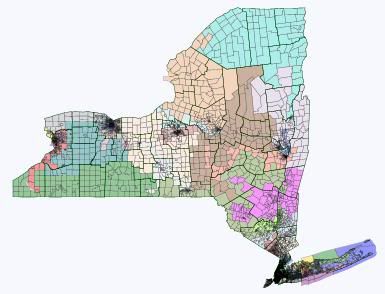
New York State Senate Redistricting: 43-19

After only two years of a slim 32-30 Democratic majority in the New York State Senate, Republicans in this past election barely took back the chamber that they had previously held continuously for more than forty years. People around the country endlessly ask the question: how is it possible that Republicans have a majority of state senators in a state as “blue” as New York?

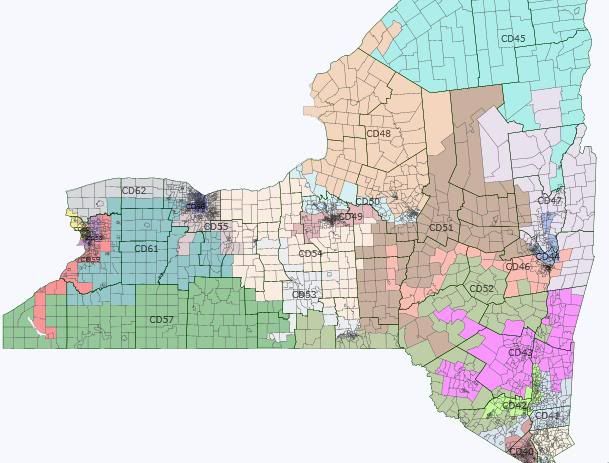
There is no simple answer to that question. Sufficed it to say, one of the most important factors is gerrymandering. Republicans did a masterful job of redistricting a very favorable map for themselves ten years ago. The current map is littered with Republican senators holding light blue Obama districts all over Long Island (9-0 Republican) and Upstate (21-4). With the great help of Daves Redistricting App 2.0, I set about in the task of redistricting New York's State Senate districts with three main goals in mind: 1.) connect Democratic towns and cities in Long Island, 2.) preserve majority-minority districts in New York City, and 3.) consolidate small cities Upstate. Much of the basis for my analysis comes from jeffmd's excellent post on the State Senate written in 2009 in which he looked at the numbers for the current districts. Inspecting the presidential toplines, it was determined that the cutoff between Republican and Democratic districts is about 58-60% Obama. My map uses that percentage as the benchmark. It would create 10 Democratic districts at over 58% in Upstate New York and another four at over 62% in Long Island. Combined with New York City, this would be more than enough to give Democrats a two-to-one majority in the State Senate. So without further ado, here is what I came up with:

New York 


District Pop. Center Pop. Wh% Bl% Asn% Hisp% Oth%
O% M%
D 1 Hamptons 318633 66 11 3 17 2
62 38
R 2 Brookhaven 318569 89 2 2 6 1
49 51
R 3 Lindenhurst 318229 89 2 1 6 1
47 53
D 4 Huntington 318189 60 17 3 18 2
63 36
R 5 Smithtown 318668 91 1 3 4 1
46 54
R 6 Massapequa 318525 90 0 3 5 1
44 56
D 7 Great Neck 318243 67 12 8 11 2
64 35
D 8 Hempstead 318681 51 26 3 18 2
69 31
R 9 Garden City 318620 86 1 5 7 1
43 56
D 10 Jamaica 317030 9 55 9 15 12 Black Majority 92 8
D 11 Bayside 317619 60 5 18 13 3
62 37
D 12 Astoria 315924 42 5 13 34 5
78 21
D 13 East Elmhurst 318053 15 9 16 57 3 Hispanic Majority 81 18
D 14 St. Albans 318613 22 55 4 13 5 Black Majority 82 17
D 15 Forest Hills 316488 59 5 15 17 5
63 36
D 16 Flushing 317432 24 3 48 21 4 Asian Plurality 68 31
D 17 Bushwick 317715 13 13 7 60 6 Hispanic Majority 87 12
D 18 Bedford-Stuyvesant 317273 26 51 2 17 4 Black Majority 90 9
D 19 Canarsie 317538 28 52 3 14 3 Black Majority 83 17
D 20 Brooklyn Heights 318797 25 51 3 18 3 Black Majority 93 6
D 21 Prospect 318898 19 51 5 22 3 Black Majority 92 7
D 22 East Flatbush 317890 21 56 6 12 5 Black Majority 85 14
R 23 Homecrest 316816 81 1 11 6 2
33 67
D 24 Brighton Beach 317711 56 6 21 13 3
55 44
D 25 North Shore 318201 49 13 10 24 4
66 34
R 26 Arden Heights 323582 84 1 6 7 1
37 62
D 27 East Village 311559 45 6 27 19 3
84 15
D 28 Upper East Side 309905 83 3 8 5 2
75 24
D 29 Upper West Side 310495 73 5 8 11 2
85 14
D 30 Spanish Harlem 309111 22 23 3 50 2 Hispanic Majority 91 8
D 31 Bedford Park 308720 12 19 5 61 3 Hispanic Majority 90 9
D 32 Harlem 309836 2 61 1 33 2 Black Majority 97 2
D 33 Washington Heights 309056 22 12 4 60 2 Hispanic Majority 90 9
D 34 Soundview 309592 10 28 3 55 3 Hispanic Majority 90 10
D 35 Belmont 308704 21 21 3 53 2 Hispanic Majority 84 16
D 36 Mount Vernon 309493 14 60 2 20 4 Black Majority 92 8
D 37 Harrison 309361 73 7 5 13 2
61 38
D 38 Yonkers 309287 56 14 5 21 3
64 35
D 39 Ossining 309454 76 7 3 13 1
59 40
D 40 Clarkstown 317946 72 10 5 10 2
53 47
R 41 Carmel 321768 88 3 2 6 1
46 53
D 42 Poughkeepsie 317728 71 12 2 13 2
58 41
D 43 Kingston 320216 85 6 1 6 2
60 38
D 44 Troy 317388 86 6 3 3 2
58 40
D 45 Plattsburgh 317612 94 2 1 2 2
58 40
D 46 Albany 315314 84 9 2 3 1
63 35
R 47 Moreau 317511 96 1 1 1 1
49 49
R 48 Rome 317470 91 4 1 3 1
44 54
D 49 Syracuse 317634 80 12 2 3 3
62 36
R 50 Utica 317412 91 4 1 2 1
54 45
R 51 Herkimer 316544 96 1 0 2 1
45 53
R 52 Blooming Grove 319845 90 3 1 4 1
46 52
D 53 Ithaca 318178 87 4 3 3 2
61 38
R 54 Penn Yan 317011 95 2 0 2 2
47 51
R 55 Perinton 316789 92 3 3 2 1
51 47
D 56 Rochester 318289 60 26 3 9 2
72 27
R 57 Corning 317311 95 1 1 1 2
42 56
D 58 Amherst 317906 80 14 2 2 1
61 38
R 59 Hamburg 318084 94 1 1 2 2
49 49
D 60 Buffalo 317816 67 23 1 6 3
69 29
R 61 Batavia 318545 94 2 0 2 1
41 57
R 62 Greece 318537 93 3 1 2 1
46 52

Note, also, that I broke the state into four regions for simplicity: Upstate, Westchester/Bronx/Manhattan, Brooklyn/Queens/Staten Island, and Long Island. Here is another table that breaks down the numbers by region:

Region County Population Districts (+/-) 316280 (+/-)
Long Island Suffolk 1516544


Nassau 1349555


2866099 9 0 318323 0.6
New York City Queens 2320449


Brooklyn 2588844


Staten Island 496246


5405539 17 1 317972 0.5

Manhattan 1646675


Bronx 1415056


Westchester 961565


4023296 13 1 309484 -2.1
Ustate New York Rockland 301308


Other 7010169


7311477 23 -2 317890 0.5

As you can see from the table, I redraw the map so that NYC gained two seats at the expense of Upstate New York, while Long Island remained the same at 9 districts. The population of each district in each region is very equal with the greatest deviation of -2.1% below the ideal population in the region of Westchester/Bronx/Manhattan. The rest of the seats compensate for this by being about .5% above the ideal. Before discussing the statewide changes that would occur under this redistricting plan, first let me go through the four regions themselves…

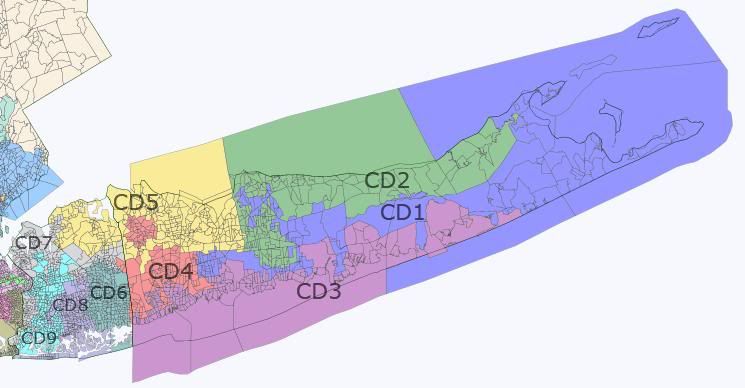
Long Island


District Pop. Center Pop. Wh% Bl% Asn% Hisp% Oth% O% M%

D 1 Hamptons 318633 66 11 3 17 2 62 38

R 2 Brookhaven 318569 89 2 2 6 1 49 51 Ken LaValle-1, Port Jefferson
R 3 Lindenhurst 318229 89 2 1 6 1 47 53 Lee Zeldin-3, Shirley Owen Johnson-4, West Babylon
D 4 Huntington 318189 60 17 3 18 2 63 36

R 5 Smithtown 318668 91 1 3 4 1 46 54 John Flanagan-2, East Northport Carl Marcellino-5, Syosset
R 6 Massapequa 318525 90 0 3 5 1 44 56

D 7 Great Neck 318243 67 12 8 11 2 64 35

D 8 Hempstead 318681 51 26 3 18 2 69 31 Charles Fuschillo-8, Merrick Dean Skelos-9, Rockville Centre
R 9 Garden City 318620 86 1 5 7 1 43 56 Kemp Hannon-6, Garden City Jack Martins-7, Mineola

(The table above is a portion derived from the table in the intoduction. However, included in this table and the three that are to follow it, the number for each district has a link to a picture of that district's new boundaries. Also, I included the incumbent senators in whichever district that they would live in if my map went into affect. Each senator's party is denoted by the font color, and the data entries include the number district that each senator currently represents in the State Senate, as well as where they live and a link to their official biographies.)

Long Island has been the province of Republicans in the New York State Senate for many decades. At the height of the Democratic wave in 2008, Long Island elected only two Democratic senators out of nine total. Both of them lost their seats in this last election, returning Long Island to its usual position of having only Republicans represent them in the State Senate. It's not as though Long Island is that conservative overall — indeed, all but one of the current nine senate districts in Nassau and Suffolk Counties was won by Obama. Republicans have been very effective in diluting Democratic votes, thereby allowing many independents who fear a complete Democratically-controlled Albany to elect Republican candidates for the State Senate.

Of the eight Obama-voting Long Island Senate districts, none of them were won by more than about 55%, which is a very managable percentage for incumbent GOP senators, including the new Majority Leader Dean Skelos, who hails from Rockville Centre in Nassau County. In this region, the goal was to be realistic about what could be achieved and very cautious in achieving it. I drew up four Democratic districts each at over 62% for Obama.

Three out of the four new Democratic districts that I created are left open for any Dem who wants them. The most Democratic district in the region — SD-8, based in Hempstead and Long Beach — is occupied by Skelos and Senator Charles Fuschillo. As the Black and Hispanic populations are spread throughout Long Island, each district retains their white majority.


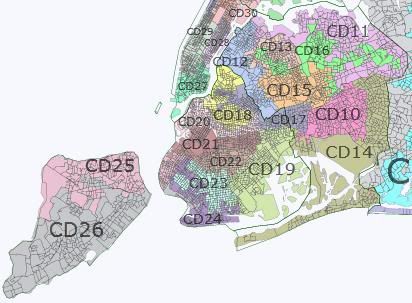
Queens, Brooklyn, and Staten Island


District Pop. Center Pop. Wh% Bl% Asn% Hisp% Oth%
O% M%


D 10 Jamaica 317030 9 55 9 15 12 Black Majority 92 8 Shirley Huntley-10, Jamaica

D 11 Bayside 317619 60 5 18 13 3
62 37 Tony Avella-11, Whitestone

D 12 Astoria 315924 42 5 13 34 5
78 21 Michael Gianaris-12, Astoria

D 13 East Elmhurst 318053 15 9 16 57 3 Hispanic Majority 81 18

Jose Peralta-13, East Elmhurst


D 14 St. Albans 318613 22 55 4 13 5 Black Majority 82 17 Malcolm Smith-14, St. Albans

D 15 Forest Hills 316488 59 5 15 17 5
63 36


D 16 Flushing 317432 24 3 48 21 4 Asian Plurality 68 31 Toby Ann Stavisky-16, Flushing

D 17 Bushwick 317715 13 13 7 60 6 Hispanic Majority 87 12 Joseph Addabbo-15, Ozone Park Martin Malave Dilan-17, Bushwick
D 18 Bedford-Stuyvesant 317273 26 51 2 17 4 Black Majority 90 9


D 19 Canarsie 317538 28 52 3 14 3 Black Majority 83 17 John Sampson-19, Canarsie

D 20 Brooklyn Heights 318797 25 51 3 18 3 Black Majority 93 6 Valmanette Montgomery-18, Boerum Hills Eric Adams-20, Crown Heights Daniel Squadron-25, Brooklyn Heights
D 21 Prospect 318898 19 51 5 22 3 Black Majority 92 7 Kevin Parker-21, Flatbush

D 22 East Flatbush 317890 21 56 6 12 5 Black Majority 85 14


R 23 Homecrest 316816 81 1 11 6 2
33 67 Martin Golden-22, Bay Ridge

D 24 Brighton Beach 317711 56 6 21 13 3
55 44 Carl Kruger-27, Sheepshead Bay

D 25 North Shore 318201 49 13 10 24 4
66 34 Diane Savino-23, Staten Island

R 26 Arden Heights 323582 84 1 6 7 1
37 62 Andrew Lanza-24, Great Kills

While much of Staten Island remains a stubborn Republican bulwark, Queens and Brooklyn voted overwhelmingly for Barack Obama in 2008. They are home to most of New York City's black population, as well as significant Hispanic and Asian communities. Since this area of the state is so heavily Democratic, the overriding goal for this region was not to squeeze out more Democratic seats, but to strengthen a few shaky ones and create new Voting Rights Act (VRA) districts wherever possible. Under my plan, this region would gain one additional seat as a result of new population estimates given by the Census Bureau. 

This map preserves the two African-American majority districts in Queens and adds a fifth black majority district to the four that already exist in Brooklyn. One of the best things about this map is that it creates an Asian plurality district that is based in Flushing and spread throughout many parts of Queens. The 16th district is currently represented by Sen. Toby Ann Stavisky, but if the Asian community were able to unite around a consensus candidate, she could well be displaced in a primary. I found it impossible to make the 16th District any more heavily Asian than 48%, but the next largest racial community was 24% of the population, so if Stavisky were to retire, this would most likely go to an Asian candidate. It also preserves the two Hispanic majority districts in Queens and Brooklyn.

The recently-flipped 11th and 15th Districts would be strengthened for the Democrats. Carl Kruger's 27th district in southern Brooklyn would be radically changed into the 24th district, both strengthening our vote there and also allowing for a primary challenge to the less-than-venerable “Amigo.” At 55% for Obama, the 24th is one of two districts that I created below the magic 58% line that I still counted in the Democratic column — largely because presidential voting patterns in southern Brooklyn are volatile and not necessarily indicative of a broader ideological differentiation. What Republican-leaning communities that do exist here would be consolidated into two large McCain majority districts: the 23rd in southern Brooklyn and the 26th in southern Staten Island, both of which are currently represented by Republican Senators anyway.


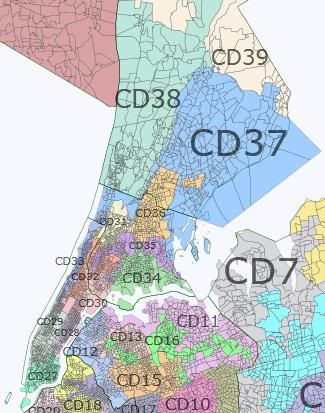
Manhattan, Bronx, and Westchester County


District Pop. Center Pop. Wh% Bl% Asn% Hisp% Oth%
O% M%

D 27 East Village 311559 45 6 27 19 3
84 15

D 28 Upper East Side 309905 83 3 8 5 2
75 24 Liz Krueger-26, Upper East Side
D 29 Upper West Side 310495 73 5 8 11 2
85 14 Thomas Duane-29, Upper West Side
D 30 Spanish Harlem 309111 22 23 3 50 2 Hispanic Majority 91 8 Jose Serrano-28, Spanish Harlem
D 31 Bedford Park 308720 12 19 5 61 3 Hispanic Majority 90 9 Gustavo Rivera-33, Kingsbridge Heights
D 32 Harlem 309836 2 61 1 33 2 Black Majority 97 2 Bill Perkins-30, Harlem
D 33 Washington Heights 309056 22 12 4 60 2 Hispanic Majority 90 9 Adriano Espaillat-31, Washington Heights
D 34 Soundview 309592 10 28 3 55 3 Hispanic Majority 90 10 Ruben Diaz-32, Soundview Jeffrey Klein-34, Throgs Neck
D 35 Belmont 308704 21 21 3 53 2 Hispanic Majority 84 16

D 36 Mount Vernon 309493 14 60 2 20 4 Black Majority 92 8 Ruth Hassel-Thompson-36, Williamsbridge
D 37 Scarsdale 309361 73 7 5 13 2
61 38 Suzi Oppenheimer-37, Mamaroneck
D 38 Yonkers 309287 56 14 5 21 3
64 35 Andrea Stewart-Cousins-35, Yonkers
D 39 Ossining 309454 76 7 3 13 1
59 40

This region, encompassing Manhattan, Bronx, and Westchester County, is the most strongly Democratic area in one of the most Democratic-leaning states in the Union. It is home to the largest Hispanic communities in the Northeast United States — mostly Peurto Rican, but also Dominican, Mexican, and other Latin American heritages. The white communities here also tend to be much more liberal than their counterparts in Brooklyn, Queens, and Staten Island. That is especially the case in Manhattan and Westchester, which are home to many educated urban white professionals.

All twelve districts here are represented by Democrats in the State Senate. That would stay the same under my plan, except for the addition of a thirteenth Democratic district. This is the second distric that comes at the expense of Upstate New York — the other one being in Brooklyn.

Both majority African-American districts would remain intact. The map also adds another Hispanic-majority district to the four that currently exist.

Upstate New York


District Pop. Center Pop. Wh% Bl% Asn% Hisp% Oth% O% M%

D 40 Clarkstown 317946 72 10 5 10 2 53 47 David Carlucci-38, Clarkstown
R 41 Carmel 321768 88 3 2 6 1 46 53 Greg Ball-40, Patterson

D 42 Poughkeepsie 317728 71 12 2 13 2 58 41 Bill Larkin-39, New Windsor Stephen Saland-41, Poughkeepsie
D 43 Kingston 320216 85 6 1 6 2 60 38

D 44 Troy 317388 86 6 3 3 2 58 40 Hugh Farley-44, Schenectady
D 45 Plattsburgh 317612 94 2 1 2 2 58 40 Betty Little-45, Queensbury Patty Ritchie-48, Heuvelton
D 46 Albany 315314 84 9 2 3 1 63 35 Neil Breslin-46, Albany James Seward-51, Milford
R 47 Moreau 317511 96 1 1 1 1 49 49 Roy McDonald-43, Stillwater
R 48 Rome 317470 91 4 1 3 1 44 54 Joseph Griffo-47, Rome
D 49 Syracuse 317634 80 12 2 3 3 62 36 David Valesky-49, Oneida John DeFrancisco-50, Syracuse
R 50 Utica 317412 91 4 1 2 1 54 45

R 51 Herkimer 316544 96 1 0 2 1 45 53

R 52 Blooming Grove 319845 90 3 1 4 1 46 52 John Bonacic-42, Mount Hope
D 53 Ithaca 318178 87 4 3 3 2 61 38 Thomas Libous-52, Binghamton Michael Nozzollio-54, Fayette
R 54 Sodus 317011 95 2 0 2 2 47 51

R 55 Perinton 316789 92 3 3 2 1 51 47 James Alesi-55, East Rochester
D 56 Rochester 318289 60 26 3 9 2 72 27

R 57 Corning 317311 95 1 1 1 2 42 56 Thomas O'Mara-53, Big Flats Catharine Young-57, Olean
D 58 Amherst 317906 80 14 2 2 1 61 38 Tim Kennedy-58, Buffalo
R 59 Hamburg 318084 94 1 1 2 2 49 49 Pat Gallivan-59, Elma Mike Ranzenhofer-61, Clarence
D 60 Buffalo 317816 67 23 1 6 3 69 29 Mark Grisanti-60, Buffalo
R 61 Batavia 318545 94 2 0 2 1 41 57

R 62 Greece 318537 93 3 1 2 1 46 52 Joe Robach-56, Greece George Maziarz-62, Newfane

Here more than anywhere else in the state, Republicans dominate in local and state politics. Recently, Democrats lost five of their ten Upstate congressional districts. This is also where Republicans picked up two Senate seats and gained about a half-dozen Assembly seats last fall. Nevertheless, there are still many strongly Democratic areas of Upstate New York: mostly medium- and small-sized cities and liberal inner-suburbs that dot the landscape from the Hudson Valley to the Great Lakes. The goal was to consolidate those areas and churn out as many new Democratic districts as possible. Here again, as in Long Island, the minority ethnic populations are too spread out to create any VRA districts. Instead, this is where the great bulk of Republican Senate seats would hit the buzz-saw.

The region as a whole would lose two seats, mostly from the equalization of populations in each Senate district — which Republicans largely disregarded during the last redistricting ten years ago — as well as the much greater population growth downstate.

I was able to get about half of these 23 districts in the Democratic column. The 40th District, based in Rockland County, is the second of only two districts in this entire map (the other being in southern Brooklyn) that I counted as a Democratic district even though Obama's vote there was less than 58%. The reason is that this seat was one of very few elected offices around the country that Democrats actually gained from the Republicans in this last election. The seat would also bolster its Democratic vote through redistricting, so I figured, if David Carlucci could pick it up for the Dems in a year like 2010, odds are pretty good that he'll be able to hold it in a lot of other political environments.

I was able to get ten of these districts at over 58% for Obama. One of the most certain Democratic gains under this plan would be my native 56th Senate District, based in the City of Rochester and the Town of Brighton. Republican Senator Joe Robach has vexingly been able to hold onto this district for years despite the fact that it voted by a two-to-one margin for Barack Obama in 2008 (66%-33%). Under this plan, Robach's hometown of Greece would be removed from the 56th and replaced by the Democratic-leaning suburbs of Gates and Irondequoit.

The four seats that we do hold here would be strengthened. The 60th District, which is even more Democratic district than the 56th, voted out a Democratic incumbent last fall. This district would remain largely unchanged in the hope that a different Dem might likely be able to win it back from freshman Republican Senator Mark Grisanti.

As is convention when State Senate seats are redistricted in Upstate New York, I left every town intact. In addition, only two cities are divided between different districts: Buffalo and Tonawanda (just south of Niagra Falls). The self-imposed requirement that towns be left undivided was a major constraint, but it would probably help a plan like this to survive a court challenge.


Summary:

A major drawback of this map is that without realizing it, I redraw the lines with no attention paid to which district each senator lives in. Hence, a lot of Democratic primaries and games of musical chairs would happen in this plan that might otherwise have been avoided. But, by the time I realized it, it was too late. In any event, many more Republicans get stuck together than Democrats, so that serves to counter-balance this problem.

This map pays tribute to the Voting Rights Act by creating three new majority-minority district: a new Black-majority district in Brooklyn, an Asian-plurality district in Queens, and a fifth Hispanic-majority district in the Bronx.

My plan also evens out the population disparities between regions by making every seat within only a few thousands residents off from the ideal population of 316,280 people per district. In applying a fairer division among the state's population and using new population estimates given by the Census, Upstate New York lost two districts to New York City.

I am confident that if this plan went into affect at the next election, Democrats would hold a large 43-19 majority in the New York State Senate for many years to come. But alas, Republicans won back this chamber last year and thus, it is not to be. However, I'm still convinced that with new population estimates, it will be extremely difficult for Republicans to redistrict another map that would allow them to retain the majority. Their luck has simply run out. They may be able to preserve many incumbents in Upstate and Long Island, but remember that Democrats only need to gain one seat for them to retake the majority (a 31-31 tie would allow Democratic Lt. Gov. Bob Duffy to act as the tie-breaker). And as I've shown through this analysis, downstate will have to gain two seats for the next redistricting plan to be in compliance with the Census.

It took many practice tries, but I believe this map provides the strongest possible plan for a large Democratic majority in the Senate that not only respects existing VRA districts, but also creates three new ones. In short, this is the ideal Democratic redistricting plan for the New York State Senate.

California: What Could Have Been !

I was almost done drawing this map last year when I realized that the passage of Prop 20 is a likely outcome.  A Democratic gerrymander of California then became moot of course and so I never finished.  However, I recently thought it would be neat to post anyhow, as many of the maps posted here are only theoretical and don’t have a chance of becoming reality (or anything close to reality).  So I finished my map – but perhaps not taking as much care as when I first started.  Hence, I should note that the area around Los Angeles and Kern Counties was drawn “after the fact” and is therefore not as “thought out” as other parts of the map.  

Nevertheless, I still tried to be true to my original goals: creating as many solid Democratic seats as possible, increasing the number of Hispanic and other minority-majority districts, and making sure that all Democratic incumbents kept as much of their current territory as possible.  The resulting map has only 7 Republican seats.  The other 46 districts are all at least 61% Obama districts — except for CA-3 and CA-4, which are 58% Obama (so really, 7 GOP, 2 districts 58% Obama, and 44 districts at 61% or more Obama) … I figured CA-3 and CA-4 could be left at the lower level as those two districts were almost won by Democrats back in 2008 even as their current configurations are a lot more Republican, and also because the percentage change between 2004 and 2008 was not as great in this part of California as it was in the rest of the state.  Hence, under my estimates, John Kerry would still have been the winner in my new versions of CA-3 and CA-4, as he would have been the winner in all the 61%+ Obama districts created.

I figured I would post this map despite the fact that a commission will now be drawing the districts.  I believe that it’s still instructive in some respects.  For example, it’s interesting to me that despite “packing” Republicans into just 7 districts, McCain got 60%+ of the vote in only 1 of those — meaning that the GOP brand is quickly thinning out in the state, and in the near- and mid-term future, even a non-partisan plan of the state is likely to result in a relatively small number of Republican representatives.  Another good example of how thinly-spread the GOP is becoming may be found by looking at San Diego Co. — historically one of the more Republican parts of the state.  In this map, I was able to draw three relatively compact 61 Obama/37 McCain districts (CA-50, 51, 53) wholly confined to the area around the city of San Diego/coastal part of the county, while drawing two other 61/62% Obama districts, both over 60% hispanic, that take in other significant chunks of the county (CA-47, 49).  The only GOP district left in San Diego Co. would be CA-52.

Another interesting thing was that the more minority-majority districts I created, the more Democratic districts I wound up with overall.  This may seem counter-intuitive at first, and certainly doesn’t fit the pattern in most other parts of the country, where the creation of more minority-majority seats means less Democratic seats overall.  Apparently, in California the minority population is pretty thoroughly or effectively spread out these days (no longer just concentrated in urban enclaves) that wherever you draw a district, there’s a good chance it will be a minority-majority district — even if a single ethnic/racial group does not form a majority.  In fact, in this map 30 out of 53 districts are minority-majority.  It appears that much of the hispanic population in the state is geographically interspersed among the GOP population.  Hence, even (and especially ?) when non-partisan districts are drawn much of the two populations will “mix” resulting in, overall, more Democratic districts as the highly-Democratic hispanic population will make the new compact districts lean more towards that side of the political spectrum (this is especially true over the long-term, and especially true if the GOP continiues to alienate hispanics with their policies).

Basically, the map makes the districts of many white Democratic incumbents (like Berman and Filner) more white, while many GOP seats are turned into new hispanic-majority seats.  Each Democratic incumbent save two also gets to keep at least 30% of his or her current constituents (in most cases, the percentage is significantly higher; the only exceptions are Chu — where I only keep her hometown area, but the new asian-plurality district is nevertheless drawn to her advantage; and, Napolitano, who gets to keep a bit under 30% of her constituents — but her new district is still centered around her hometown and is over 60% hispanic.  I should note that the district I “assign” to Linda Sanchez here is CA-39, and she currently represents slightly under 30% of the new district; however, Sanchez could just as well decide to run in what’s labeled as CA-40 on this map, where she would get to keep 50% of her current constituents, and her district would border her sister’s — this is all theoretical, of course, as this map will never happen !     …. I should also note that some districts here “look” as if they were completely “shifted” in terms of geography — Loretta Sanchez’s district is a good example — as the boundaries expand all the way into Oceanside in San Diego Co., and yet population-wise, the Congresswoman still gets to keep over 60% of her current constituents, as much of the population is concentrated in Santa Ana and Anaheim.)

The only districts which are 75% or more Obama are CA-8, CA-31 and CA-33.  The population deviation is  +/- under 1,000 persons.

Anyhow, here’s the map, and then a brief run-down of the districts:

Photobucket

Photobucket

Photobucket

Photobucket

Photobucket

Photobucket

Photobucket

Photobucket

Photobucket

The following districts are drawn to elect a Democrat:

CA-1 Thompson – 63 Obama, 35 McCain – above 70% white

CA-3 Lungren – 58 O, 40 M – above 60% white

CA-4 McClintock – 58 O, 40 M – above 60% white

CA-5 Matsui – 61 O, 37 M – above 50% white

CA-6 Woolsey – 70 O, 28 M – above 70% white

CA-7 Miller – 63 O, 35 M – above 50% white

CA-8 Pelosi – 85 O, 13 M – white plurality, above 30% asian

CA-9 Lee – 74 O, 25 M – white plurality, around 20% black

CA-10 Garamendi – 66 O, 33 M – above 50% white

CA-11 McNerney – 65 O, 34 M – above 50% white

CA-12 Speier – 74 O, 24 M – white plurality

CA-13 Stark – 73 O, 25 M – white plurality, above 30% asian

CA-14 Eshoo – 66 O, 33 M – above 50% white

CA-15 Honda – 68 O, 30 M – white and asian each around 40%

CA-16 Lofgren – 68 O, 31 M – white plurality

CA-17 Farr – 63 O, 35 M – above 60% white

CA-18 Cardoza – 61 O, 37 M – above 50% hispanic

CA-19 Denham – 61 O, 38 M – above 50% hispanic

CA-20 Costa – 61 O, 38 M – above 50% hispanic

CA-22 McCarthy – 61 O, 38 M – around 70% hispanic

CA-23 Capps – 61 O, 37 M – above 60% white

CA-24 Gallegly – 62 O, 37 M – around 70% white

CA-25 McKeon – 61 O, 37 M – above 50% hispanic

CA-26 Dreier – 61 O, 37 M – above 50% hispanic

CA-27 Sherman – 63 O, 35 M – above 50% white

CA-28 Berman – 63 O, 35 M – hispanic plurality (but less than current district)

CA-29 Schiff – 63 O, 35 M – white and hispanic each around 40%

CA-30 Waxman – 63 O, 35 M – above 50% white

CA-31 Becerra – 78 O, 20 M – above 65% hispanic

CA-32 Chu – 62 O, 36 M – asian plurality

CA-33 Bass – 75 O, 23 M – no dominant group, large numbers of whites, hispanics, blacks and asians

CA-34 Roybal-Allard – 73 O, 25 M – above 60% hispanic

CA-35 Waters – 72 O, 27 M – almost equal number of whites, blacks and hispanics

CA-36 Harman – 65 O, 33 M – white and hispanic each around 40%

CA-37 Richardson – 63 O, 36 M – significant numbers of hispanics, whites and blacks, with no group above 40% of population

CA-38 Napolitano – 62 O, 36 M – above 60% hispanic

CA-39 Sanchez – 66 O, 31 M – above 60% hispanic

CA-40 Royce – 62 O, 36 M – above 60% hispanic

CA-43 Baca – 64 O, 34 M – above 50% hispanic

CA-44 Calvert – 63 O, 35 M – hispanic plurality

CA-46 Rochrabacher – 61 O, 37 M – white plurality

CA-47 Sanchez – 61 O, 37 M – above 65% hispanic (asian pop. under 10%)

CA-49 Issa – 62 O, 36 M – above 60% hispanic

CA-50 Bilbray – 61 O, 37 M – above 50% white

CA-51 Filner – 61 O, 37 M – hispanic plurality (but less than current district)

CA-53 Davis – 61 O, 37 M – above 50% white

The following are the GOP seats:

CA-2 Herger – 40 Obama – 58 McCain – around 80% white

CA-21 Nunes – 36 O, 62 M – above 60% white

CA-41 Lewis – 38 O, 58 M – around 70% white

CA-42 Miller – 42 O, 56 M – around 60% white

CA-45 Bono Mack – 41 O, 57 M – around 70% white

CA-48 Campbell – 43 O, 55 M – around 70% white

CA-52 Hunter – 39 O, 59 M – above 70% white

SSP Daily Digest: 1/21

CT-Sen: If you think the Chris Murphy/Susan Bysiewicz primary is an open-and-shut case, guess again: Ted Kennedy Jr.’s name seems to be getting a lot of mention now too. If the 49-year-old lawyer does get elected, if would bring the Kennedy-free interregnum in Congress to a close after only two years. Meanwhile, I don’t think anybody was expecting him to give up his leadership slot for a run, but Rep. John Larson has confirmed he’s not running for Senate, and isn’t endorsing… yet. Rep. Chris Murphy seems to know that this race, with its expensive media markets, is going to cost a lot of money; he’s putting a $10 million figure out there, although that of course could go even higher if he finds himself in a general election against Linda McMahon. Luckily for Murphy, MoveOn seems to be backing him up; while they didn’t explicitly endorse, they e-mailed their donor base on his behalf today. If he can corner the “netroots candidate” niche in the primary, obviously that’ll help him go a long way toward that money goal.

MI-Sen: Could Saul Anuzis, who just lost his RNC chair bid, wind up being the Michigan Senate nominee for the GOP in 2012? Apparently that’s an option on the table for him, although he tells Dave Catanese he hasn’t “ruled it out or in.” Anuzis is a primarily behind-the-scenes player, though, who’s never won an election before. At least that gives him that much in common with Tim Leuliette, the only other person to have expressed much interest so far. Also, this isn’t exactly Senate related, but here’s another Greg Giroux special: a database showing the Michigan governor’s race breakdown by current congressional district.

MN-Sen: Marty Seifert, the state Rep. who lost the 2010 Republican nomination to the further-right Tom Emmer, has declined to run for either the 2012 or 2014 Senate races, leaving the state GOP still casting about for anyone to go up against Amy Klobuchar. They’re still laying the groundwork for a hard run, though, already launching a new website trying to tar the often-moderate Klobuchar with the dreaded “liberal.”

NV-Sen: John Ensign confirms yet again that he’s running for re-election (at least for now), though he says he expects a primary challenge and will have difficulty regaining the voters’ trust. The main thing, though, he’ll have difficulty is regaining money… he raised only $19K last quarter for his campaign account. (His legal fees are another story: he raised $550K for his legal defense fund last quarter, and spending $97K of that on lawyers. Likely rival Dean Heller, for his part, said at a press conference that he’s keeping an eye on the race, but without a specific timetable for an announcement.

RI-Sen: One well-known name (at least locally) who does seem interested in the Senate race (which so far hasn’t drawn any takers) is Alan Hassenfeld, the former CEO of locally-based toymaker Hasbro. (Does that make him the real-life inspiration for Mr. Weed on the Family Guy?) At any rate, Hassenfeld is registered independent and contributed to and voted for the Moderate Party’s gubernatorial candidate last year, so he seems like he might be running on their line, not for the GOP.

VA-Sen: The rest of the Democratic A-list in Virginia seems to be shying away from the Senate race, meaning either Jim Webb is pretty certain to run again or else we’re in a world of hurt. Terry McAuliffe, who in the end acquitted himself well in the ’09 gubernatorial race, says he won’t run if Webb doesn’t (joining Tim Kaine in the “no thanks” pile). That’s not a surprise, in that McAuliffe’s interest in another whack at the gubernatorial race in 2013 is well-known.

LA-Gov: We’ve been seeing a lot of polls with strange configurations lately, and this one from Market Research Insight (not a pollster we seem to have any track record from) may take the cake. As one might expect, they find Bobby Jindal looking pretty safe for re-election, but they test him against both Mary Mitch Landrieu (as a D) and John Kennedy (as an R) in what, I assume, is supposed to be a jungle primary format (despite no indications from either Landrieu or Kennedy that they’re interested). At any rate, it’s Jindal 51, Landrieu 25, Kennedy 10. More generically, they find Jindal with a 49/40 re-elect number.

WV-Gov: Now this is highly unusual. Faced with a court mandate to hold a special election this year, acting Gov. Earl Ray Tomblin (the main person wanting to kick the election back to 2012), has declared that the special election won’t be in November as one might expect, but rather on Oct. 4! The primaries will be held on June 20.

KY-AG: After some last minute rumors this week that he wasn’t going to run again, Jack Conway announced today that he’s filing for re-election as Attorney General and putting together a new campaign team. Needless to say, that’s a relief for those of us who want to keep building a bench in and contesting Kentucky.

Chicago mayor: There’s a new Chicago Tribune/WGN poll out of the mayoral race, and like other recent polls, it shows Rahm Emanuel with a big lead and continuing to climb, but still short of the 50% mark at which he could avoid a runoff. The poll finds him at 44, with Carol Mosely Braun (last seen sniping at Bill Clinton, telling him he’s “turning his back” on minorities) at 21, Gery Chico at 16, and Miguel del Valle at 7. Emanuel is also announcing his financial haul, which, as you might guess, is huge (Senate-sized, really): $10.6 million raised through mid-January. With that in mind, he’s sparing no expense when it comes to advertising, rolling out a $150K ad buy during the Bears/Packers game this weekend.

Oregon Redistricting R+1?

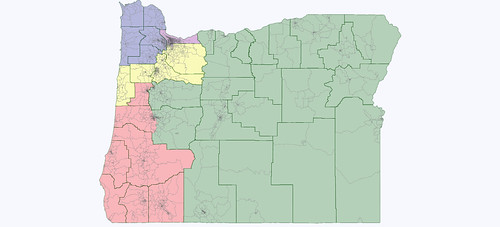
Here is a possible scenario for redistricting in Oregon. I followed county lines and geographical areas as close as possible and something like this could actually pass the legislature.

Oregon1 19-43-26

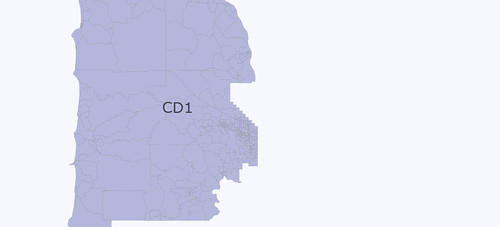
CD1: PVI of D+4 – David Wu ultimately could have gone down in this configuration or barley squeaked by, if not in 2012 due to current events. I took out all of Multnomah County and added Tillamook County, which went for Dudley in the 2010 gubernatorial election. Dudley would have won this district by a small margin.

Oregon1

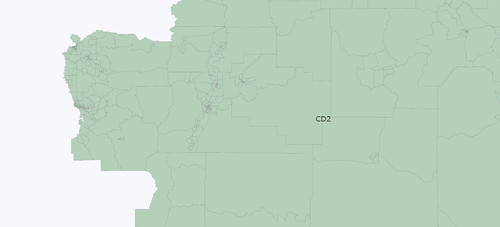
CD2: PVI of R+8 – This district is perfect for Greg Walden, it is a few points less Republican than before as the district includes east Lane County and Springfield. A tea partier might struggle if Walden decides to retire but this is still a solid GOP district for years to come.

oregon2

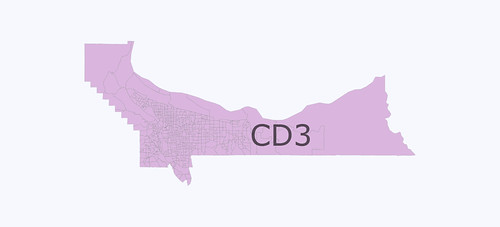
CD3: PVI of D+26 – This district is even more Democratic than before and contains only Multnomah County and parts of liberal Clackamas County (Gladstone, Milwaukie). There should be no shortage of electing Democrats in the future.

oregon3

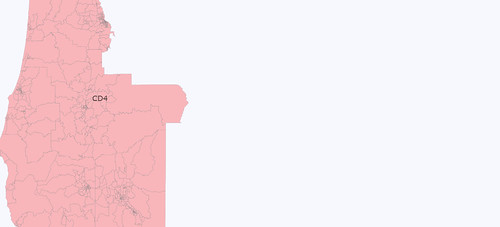
CD4: PVI of EVEN – The district is a true swing district as I have eliminated Springfield and east Lane County from the district and added Jackson County and the the entire Benton County to it. As it stands Peter DeFazio would have to run against Greg Walden, but he could easily move to Eugene. Art Robinson would have possibly won in 2010 but would be in trouble in 2012 if it is a strong Dem year. A moderate like Rick Dancer would be win election after election if he chose to run.

oregon4

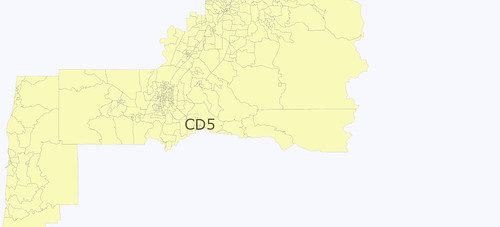
CD5: PVI of R+2 – This district includes the entire Clackamas County except with the poor parts of Gladstone and Milwaukie, but also includes a more liberal Lincoln County on the coast. Scott Bruun would have won against Kurt Schrader in 2010, and is no longer considered a swing district.

oregon5

My take on the GOP tide on Florida’s Legislative races

Here’s my belated analysis of last November’s results on selected Florida legislative races:

State Senate:

SD8 (Dem Target)

Deborah Gianoulis, the Dem candidate is well-known and decently funded.  However, Sen. John Thrasher is a household name in state GOP circles (he’s one time state house speaker and more recently, a caretaker state GOP chair), his incumbancy and the First Coast (St. Augustine, Jacksonville etc.) district’s GOP-lean is enough for him to hold on comfortably.

SD14 (Dem Target)

The Dem candidate here, Perry C. McGriff Jr. is a former one-term from state representative from  Gainesville.  He may be white and more moderate than Ed Jennings, the 2006 candidate and also from Gainesville.  However, incumbent Steve Olerich is a former Alachua County (Gainesville) Sheriff, and the district’s makeup mean that a Gainesville Dem is a liability in the rural portions of the district, unless he/she is a Rod Smith-type law-and-order candidate.  As the rural parts of the district (including rural Alachua outside Gainesville, which contributed to the ouster of an incumbent Dem County Commissioner, covered in a upcoming diary) turned hard right and the two candidates shared the Alachua County base, the Dem was held to a narrow victory there while losing some rural counties at a 2-1 margin, enabling Oelrich to hold on by 54%-46%

SD16 (GOP Target)

Sen. Charlie Justice’s ill-fated challange to US Rep. Bill CW Young for CD10 left this open seat highly vulnerable.  The GOP’s candidate, former Sen. Jack Latvala is relatively moderate, has high name ID and extremely well-funded (he’s the ex-husband of Pinellas County Commissioner Susan Latvala). He probably represented about the same area in his previous tenure (Please confirm this).  On the other hand, the Dem picked Nina Hayden, a young AA female and a first-term Pinellas County School Board member.  Her woeful fundraising capability, thin resume, race (sort of) and Alex Sink’s underperformance in the Tampa Bay area mean that Hayden never stood much chance.  And Latvala returned to the State Senate in the biggest landslide of all prominent State Senate races last year.

SD25 (Dem Target) and SD27 (GOP Target)

The Tea Party surge in coastal Palm Beach and Broward counties has probably undermined the Dem’s offensive effort at the legislative seats there. While this is the most GOP-friendly area in South Florida outside Cuban portions of Miami-Dade county, the GOPer’s tends to be strongly pro-business but socially moderate.  However, as fiscal issues became salient during last November, the GOP/Tea Party coalition were able to ride the popular dissent to unseat US Rep. Ron Klein in CD22 and undermine the supposedly solid effort from State Rep. Kelly Skidmore to take now-CFO Jeff Attwater’s open seat.  The GOP victor, Ellyn Bogdanoff, is admittedly a powerful State Rep. from coastal Broward and extremely well-funded as well.  More of the same happened in HD91 (Bogdanoff’s open seat) and Borard County Commission District 4 (more on that in a later diary).

As for SD27, this heavily gerrymandered seat formed with leftover parts of various counties happened to be the the most swingy State Senate seat. Campaigns there are mainly fought at two fronts, the Dem-heavy western Palm Beach County and the GOP-friendly eastern Lee County.  When Dave Aronberg (my former State Sen.)faced Lee County GOPer’s in his races, his is able to win the Palm Beach portion hands down (by 2-1 to 3-1) and hold the GOPer to a narrow margin in the Lee portion.  In last year, however, both candidate a bites are from the Palm Beach portion, thereby undercutting the advantage for the Dem candidate  (one-term State Rep. Kevin Rader)quite a bit (less than 2-1).  Coupled with the highly energized GOP

vote in SW Florida (Lee Conty), where the GOP candidate, former Wellington Councilwoman Lizbeth Benacquisto won by more than 2-1; and a controversial ad from Rader’s camp attacking Benacquisto’s opposition to abortion rights using her history as a rape victim that deemed to be off-putting for many female voters, the GOP was finally able to pick up this marginal seat that eluded two Lee County pols (County Commissioner Frank Mann and freshman State Rep. Matt Caldwell from HD73) with a Palm Beach candidate.

State House:

HD11 (GOP Target)

The Dem incumbent Debbie Boyd seemed to a victim of her HD’s hard turn to the right and suffered some spillovers from US Rep. Allen Boyd’s ouster from CD2 (In Suwannee and Lafayette Counties situated in HD11, where he got whipped by now US Rep. Steve Southerland)  She has, however, lost every county in the district (even in the Alachua county portion, supposedly the most Democratic part of that HD).  The right turn in rural Alachua, together with a GOP candidate with an elected office significant geographical base (Columbia County Commissioner Elizabeth Porter) cause a GOP pickup to materialize.

HD’s 44,47,57 and 60 (Dem Targets)

These three suburban Hillsborough County seats (plus one primarily Hernando County seat) are among the most prominent Democratic targets in the State House, and all feature semi-serious to serious Dem candidates.  Two of them (in HD’s 47 and 60), however, faced well-known/legacy GOP opponents and the third (HD57) has her own baggage, and a forth (HD44) faced an incumbent in more hostile territory than the other 3.

In HD44, former Hernando County Commissioner Diane Rowden is supposed to be a formidable candidate with strong local roots.  However, the circumstances behind her ouster in 2008 has probably left a bitter taste in the voters’ mouth, and Hernando County’s turn to the hard right under GOP’s chair Blaise Ingoglia’s influence is a huge drag on her campaign.  Together with portions of Sumter (itself a hard-right county dominated by older voters) and Pasco (also undergoing a rightward turn), incumbent Rep. Robert Schenck didn’t have to sweat for a 3rd term.

In HD47, the GOP candidate James Grant is the son of former State Sen. John Grant and he is able to take advantage of this connection (and the district’s GOP-tilt?) to carry the day over the supposedly well-funded Dem Michael Steinberg.

In HD57, connection to a local political scion seem to work the other way.  Stacy Frank, the Dem candidate is the daughter of well-liked former County Commissioner and current Clerk of the Circuit Court in Hillsborough County Pat Frank.  She is well funded and is supposedly competitive in a open-seat situation in a swing district.  Her work as a lobbyist behind the construction of cell phone towers on school grounds, however, seems to attract a dedicated cadre of opponents.  Together with the backlash against the “(Democratic) legacy candidate label” and Alex’s Sink under performance in the county, all these contribute to her loss to Dana Young, a GOP stay-at-home mom.

In HD60, the GOPer is former Tampa City Councilman Shawn Harrison.  He has the name recognition, elected political experience and geographical base to his advantage in his race against Dem Russ Patterson, and holds the open seat for his party comfortably.

(Can jncca, author of the bellweather county diary featuring Hillsborough County, Florida look up which towns do HD’s 47, 57 and 60 contain and help me to determine the political complexion there?  Thanks!)

HD’s 51 and 52 (GOP Targets)

This pair of neighboring Pinellas swing seats are the most remarkable of the 5 GOP’s pickups (all by defeating incumbents) in the state house, as they occur in territories probably carried by Alex Sink in her gubernatorial race.  Both Dem incumbents have two terms under their belt, but each committed a cardinal sin to enable GOP pickups.  

In Rep. Janet Long’s case (HD51), a controversial ad featuring her son, a decorated veteran, questioning GOP candidate Larry Ahern’s military credentials seems to have backfired, while Rep. Bill Heller’s campaign in HD52 seems to be caught asleep until it’s too late to stem GOPer Jeff Brandes surge.

HD’s 69 (GOP Target) and 73 (Dem Target)

In this pair of SW Florida seats, Rep. Keith Fitzgerald’s ouster from Sarasota’s HD69 proved to be the most painful for the House Dems, as his is an extremely smart professor from the New College of Florida and is pretty well-regarded for a Dem in a GOP-heavy (albeit politically moderate)region.  His GOP opponent, Ray Pilon, is no slouch either; as he is a former Sarasota County Commissioner.Pilon’s experience, geographical base together with Rick Scott’s coattail in SW Florida worked to pip him to the top by the 2nd narrowest margin among the GOP pickups (only Jeff Brandes’s is narrower, and HD52 is believed to be a tilt Dem district, while HD69 is tilt GOP)

In Cole Peacock, the Dems has the most serious State House candidate for a Lee County seat in years.  However, the Scott coattail and Lee County’s GOP lean proves too much for even a business-friendly Dem like Peacock to overcome, allowing Dave Aronberg’s 2008 GOP opponent in the SD27 race, Matt Caldwell to become the new Rep. after Nick Thompson vacated the least Republican seat in Lee County to pursuit a Circuit Court Judgeship.

HD’s 81 (GOP Target) and 83 (Dem Target)

In this pair of Treasure Coast/Northern Palm Beach swing seats, both Dems (incumbent Rep Adam Fetterman in HD81 and open seat challeger Mark Marciano in HD83) are well-funded.  In HD81, however, the foreclosure crisis seems to enable the rise of Tea Party sentiment and former State Rep. Gayle Harrell was able to capitalize on the GOP lean of the Martin County portion to regain her old seat, inflicting one of the only 2 double-digit defeats among the 5 Dem incumbent ousted (Only Debbie Boyd’s margin of loss is larger)

In HD83 vacated by Carl Domino due to his unsuccessful State Senate candidacy, the GOP candidate Pat Rooney is independently wealthy.  Hailing from the family owning Pittsburgh Steelers and being a brother of US Rep. Tom Rooney from CD16 (which overlaps with parts of HD83) don’t hurt either, and all these translates into a easy GOP hold.

HD’s 87 and 91 (Dem Targets)

These marginal coastal Palm Beach-Broward seats are supposedly ripe for Dems’ pickling in open situations.  However, the Dem’s frequet change of candidates in HD87 (due to the pursuit of neighboring, more Democratic HD86 by their original challenger Lori Berman due to Ted Deutsch election to CD19 and Maria Sach’s ascent to SD30); coupling with an experienced GOP candidate (former Boca Raton City Councilman Bill Hager); translates this into another easy GOP hold.

In HD91, while both GOPer George Moraitis and Dem

Barbra Anne Stern are political newcomers and serious candidates, the coattails from CD22 and SD25 proved to be enough for Moraitis to breeze through.

HD’s 112, 115, 117, 119 (Dem Targets)

Any path for the Dems to achieve relative parity with the GOP in the State House runs through open Hispanic-held seats in Miami Dade County; and they have to bank on generational shifts among Cuban Americans, as younger Cubans may be less obsessed with hard-line policies on Cuba and more focused on economic justice issues faced by many Hispanics.  In last November, Marco Rubio’s US Senate candidacy seems to cause these Democratic efforts to become naught, as he seems to cause the Hispanic voter turnout in Miami Dade to tilt older, Cuban and more conservative.

At least in HD112, the Dems has a candidate with elected experience in Doral City Councilwoman Sandra Ruiz, and she actually carried the Broward portion of the district.  However, her GOP opponent Jeanette Nunez dominated in the far more populous Miami Dade portion of this HD by about 2-1 and carried the day by the virtue of this margin.

Lisa Lesperance in HD117 is decently funded, but she runs in one of the most Republican Hispanic district outside Hialeah, and GOPer Michael Bileca held the seat vacated by Julio Robaina easily.  The same can be said for Jeffrey “Doc” Solomon in HD115, plus he has an ethnicity problem by running as a white candidate in a 65% Hispanic (2000 census figure) district, allowing Jose Felix Diaz to breeze through as the GOP candidate.

The most heart-breaking loss among these Democratic offensive efforts falls to Katie Edwards, a youthful executive director of the Dade County Farm Bureau.  She ran a well-funded campaign in the least Hispanic and least Republican seats held by a Hispanic GOP Rep (HD119).  However, she also ran into ethnicity problem in a 64.5% Hispanic district (2000 figures)  by being a white candidate, allowing GOPer Frank Artiles to succeed Juan Zapata, the first Colombian-American in the Florida State House.

HD’s 107 and 120 (GOP Targets)

Former State Rep. Gustavo A. Barreiro falls barely short in his effort to wrest his old seat from his successor, incumbent Dem Rep. Luis Garcia.  Garcia is probably saved by his least Republican Hispanic -Majority HD in Miami Dade, his extensive civic bond  in Miami Beach and his Cuban ethnicity.

The GOP tried to claim the scalp of the incoming Democratic leader Ron Saunders with former Key West Mayor Morgan J. McPherson.  Their efforts falls well short, as Saunders carried Monroe County handily even though he lost the Miami Dade County portion.  His political savvy from his previous service at the State House also helps.

One last not-so-competitive, but interesting race:

The Dems targeted HD26 opened up by Pat Patterson’s failed CFO candidacy by running  former deputy superintendent of Volusia County schools Tim Huth, banking on his civic ties to create a pickup opportunity.  However, in Ormond Beach Mayor Fred Costello, the GOP got its trump card with a candidate who has a political base locally and easily holds this open seat.

Conclusion:

It seems that in the recession-plagued Sunshine State, fiscal issues and job creation are in the forefront of voters’ minds, and the average Florida suburbanite’s anti-tax and pro-business sensibilities seem to prevail over concerns about the anti-immigration, service-cutting and socially conservative rhetorics form November’s crop of GOP legislative candidates, giving the GOP veto-proof majorities for the 1st time since Reconstruction.  

My only complaints are that voters seems to be ignorant to hypocritical when it comes to check and balance; as they seem to exercise that desire only against the party they oppose (National Dems) and see no problems when the party they favor dominates at the state and/or local level (Florida’s GOP).  Can anyone explain this irony? And please with my lengthy diary.  Thanks!

31, Asian American male, Dem-tilting Independent, FL-19 (former), MS-02 (present)

3 Majority-Minority Districts in Arizona

Arizona is gaining a ninth congressional district this year, and it is certain to be based in the Phoenix suburbs where the population has exploded recently. Generally it is believed that the new district will be Republican-leaning as are most of the Phoenix burbs, but it is actually possible to draw a compact new majority-minority district in the Phoenix area.

Phoenix Metro Area:

The new 9th district (light blue) is 39% White and 50% Hispanic. It encompasses east Phoenix areas drawn mainly out of the 2nd and 3rd districts with a little taken out of the 4th and 7th as well. To make up for that population loss in other districts, the 4th has taken on Tempe, which increases the white percentage in the district to 29% but those are mostly liberal white voters so it should be okay. The 3rd takes on some areas that had previously been in the 5th, and the 5th grabs Chandler from the 6th, evening out the population in the Phoenix area. Some other minor changes have taken place across the state to even out population changes, but nothing major that would change the partisan balance of power in these districts.

This new plan actually includes some things that conservatives could like. After losing Tempe and gaining Chandler, the previously swingy 5th district is now probably solidly conservative. The 2nd and 3rd have lost a considerable portion of their Hispanic populations, making them much safer for the GOP (this should help scandal-tainted rep Ben Quayle). And the new 9th is probably competitive for the GOP in a good year. I would consider it slightly leaning D, but with the gap in turnout between white and hispanic voters and the fact that SB 1070 may have changed the racial demographics slightly here since the census was taken mean that in a low-turnout midterm election this district may be close to a tossup. The only reason that the GOP would have reason to fight this district is that there is a possibility Rep Trent Franks has been redistricted into the 9th district under this map. He lives in Glendale, most of which is in this new 9th district. I highly doubt he would want to run in a majority-minority district, so he would probably fight this plan heavily. If this was a VRA-obligation, however, that might not matter.

As to whether the VRA requires this district, it may be open to interpretation. Important to note is that Arizona is one of the states that requires section 5 preclearance by the DOJ, so the Obama admin has a good chance to argue for the creation of a new majority-minority district if they wanted to. This district is pretty compact, but I think that Arizona could still make the case that you have to go out of your way to draw something like this. Overall I’m not sure if the Obama admin wants to challenge this in court, and I’m not sure if the Roberts court would be receptive to arguments for a new VRA district in Arizona, but I hope that the Obama admin at least tries here, because there is a chance they could succeed.  

Random Antics: Hypothetical Connecticut Redistricting

Well, I started thinking about ways the Connecticut Democratic Party can get Ted Kennedy, Jr., into politics without potentially screwing over Rep. Chris Murphy of CT-05, the bold young soul in a bid for the Senate seat held by retiring independent Sen. Joseph Lieberman. And I thought, “Well, what about starting him off with a nice House seat?” And that evolved into wondering about exactly how to negate the fact that CT-05 represents a pickup opportunity for the Republicans, provided they field a good candidate, now that Murphy is moving on to (hopefully) bigger and better things.

I came up with this map.

What I’ve done here is I’ve basically cracked the existing CT-05, giving pieces of it to CT-01 (pink), CT-04 (red), and the new south-central-based incarnation of CT-05 (blue). I can’t guarantee Rep. Jim Himes in CT-04 is going to be thrilled, considering he had a closer-than-expected reelection campaign against Dan Debicella (drawn into Rep. Rosa DeLauro’s CT-03 [purple] on this map); Rep. John Larson in CT-01 should be fine, considering the sizable Democratic tilt of Hartford. I think Democrats will have to concede one district as “fair fight” and hope the state’s strong Democratic proclivities and a mediocre Republican bench are enough to keep it in friendly hands, and I think they’d rather trust an incumbent member of Congress to hold it down rather than the likes of First Selectman Mary Glassman, whose ticket didn’t even come close to prevailing in the Democratic gubernatorial primary last year. Having two close districts, as they did last year, is a bit uncomfortable when the Republicans remain capable of winning statewide at least on the state government level.

I’m not too knowledgeable about Connecticut politics in particular. My idea here is that by drawing CT-03 a bit west, CT-04 a bit north, CT-01 over into the northwestern corner of the state (making it much more compact in the process), and CT-02 more into the north-central than the south-central part of the state, I could create a new, open-seat CT-05 without jeopardizing the Democrats’ control of the congressional delegation. This CT-05 is specifically drawn for Kennedy, who lives in Branford (just east of the new boundary with CT-03, in the vicinity of New Haven). With a seat tailor-made for his political debut, Kennedy might be less tempted to upset the apple cart by making a damn-the-torpedoes run at the Democratic nomination-a scenario the Democratic establishment in Connecticut and the DSCC would surely like to avoid.

SSP Daily Digest: 1/20

CA-Sen: Does Meg Whitman seriously not have anything better to do with her money? Rumors are bubbling up that she’s actually considering a return to politics… which, if it’s going to be in 2012, would mean a run against Dianne Feinstein (which, of course, would mean a run against the state’s most popular politician in a presidential year, instead of an open seat run in a down year for Dems).

MT-Sen: Republican businessman (and one-time LG candidate) Steve Daines did some serious fundraising in the last few months since announcing his candidacy, hauling in $225K since his announcement, with the majority of that money coming from in-state. The main target he’s probably trying to scare with that money isn’t Jon Tester (who has about $500K CoH), but Republican Rep. Denny Rehberg, who’s usually the GOPer most associated with this race but has sounded noncommittal so far; I’m sure Daines would like to see Rehberg stay out of the Senate primary. Rehberg has $594K. One other Montana Senate item, although it hopefully won’t be an issue any time soon: the Montana legislature is considering whether, in the event of a Senate vacancy, to switch over from gubernatorial appointment to a fast special election instead.

OH-Sen: Quinnipiac has a poll today of the Ohio Senate race, but, like their Pennsylvania poll last month, the lack of an obvious Republican opponent means the matchup is just against Generic R. Sherrod Brown does pretty well against G.R., especially considering that actual named candidates tend not to do as well as generics at least at this stage in the game; Brown leads 45-33, and has an approval of 45/25. This is definitely a race where we shouldn’t start celebrating short of the end zone, though, considering that PPP recently found Brown in much more of a pickle, and even Qpac points out he’s far from the 50% mark and in “decent but not overwhelming” shape. The Cleveland Plain Dealer’s writeup of the poll spends a lot of ink talking up Rep. Steve LaTourette as a possible GOP candidate; while he’d bring some geographic strengths to the race that other GOPers might not, there hasn’t been any indication so far that he’s interested.

RI-Sen, RI-Gov: Sheldon Whitehouse looks like he’s dodged at least one credible candidate in 2012; John Robitaille, who came close in the 2010 gubernatorial race (although that was only because of the center-left vote split between Lincoln Chafee and Frank Caprio) and has expressed interest in running for something else, now seems focused on a retry in the 2014 gubernatorial race. Partly, he admits, that’s because running statewide as a Republican in Rhode Island in a presidential year would be a kamikaze mission.

WV-Gov: SoS Natalie Tennant has gotten endless mentions as a likely gubernatorial candidate, but with the clock ticking to the now-only-nine-months-away special election, she’s made her candidacy official as of yesterday.

FL-25: OK, here’s a trivia question for you all (which I genuinely don’t know the answer to)… which House freshman holds the record for the shortest partial term, before having to resign in shame? (I’m wondering if Eric Massa actually holds the record, but I’d bet there’s some historical example of someone accomplishing it in less than one year.) The reason I ask is that things seem to be moving into a new phase in the investigation into David Rivera, and whether piles of money paid from a dog track that he helped, to his mother’s marketing company, found their way into his pockets. The Miami-Dade County’s state’s attorney, Katherine Fernandez Rundle, just turned the case over to the Florida Dept. of Law Enforcement. Although that sounds ominous, some observers are seeing the move as a downgrade, though, as the FDLE may not devote the same level of resources to it; Rundle has been viewed as a possible Dem challenger in this district, and may be punting the case to avoid it becoming a liability for her later.

MI-15: Rep. John Dingell (84 years old) says he’ll be back for an unprecedented 30th term in the House, running again in 2012. One important detail, though: whatever district he’s running in, it won’t be the 15th next time, as Michigan is about to lose a seat. Dingell has survived multiple bad redistrictings over the decades, including beating fellow Democratic Rep. Lynn Rivers in a 2002 primary mashup. (Thanks to Greg Giroux, we know now that Dingell will pass Robert Byrd in all-time legislative service in June of 2013.)

Mayors: Two mayoral races are in the news today, although both aren’t up for grabs until 2012. Two-term incumbent Buddy Dyer (who used to be the Democratic leader in the Florida state Senate) says he’s going to run for another term as mayor of Orlando. He also mentioned some vague gubernatorial aspirations. Also, Portland, Oregon will elect a new mayor in ’12; all the action will be in the Democratic primary, where it’s not certain that Sam Adams (damaged by a sex scandal several years ago) will run for a second term. One interesting possibility mentioned: former Senate candidate Steve Novick, who gained a lot of netroots attention during his ’08 Dem primary run, is seriously considering a run.

Votes: As you’re probably already aware, the Dems held the defections down to three on yesterday’s HCR repeal vote. It was the three likeliest suspects, given the combination of their dark-red districts and previous statements on the matter: OK-02’s Dan Boren, NC-07’s Mike McIntyre, and AR-04’s Mike Ross. UT-02’s Jim Matheson has the reddest district of any “no” vote, but he’s a member of leadership and may be sanguine about getting a better district out of redistricting next year (or just figuring that the worst is past).

Redistricting: Arizona legislative Republicans sort of succeeded with their quest to get three members of the state redistricting panel kicked off (on the grounds that they were serving in other political offices); however, it was a partial success because only two of the three challenged members got kicked off by the state supreme court and the one they were really targeting the most didn’t get kicked off. Also, if you’re in Virginia and you’re a college student, the state is having a redistricting contest. No word on whether you absolutely have to be part of a team or can do it individually, but the winners get a cash prize and get to present the design for new congressional and legislative maps to the Governor’s entirely-nonbinding advisory panel. (Actually, it looks like it’s too late to start a team if your college doesn’t already have one, but your college probably already has a team which you might be able to join. See here for the details.)