VA Redistricting D+1?

First of all, I’m rather new to Swing State Project, so my apologies ahead of time if this diary is treading ground that’s already been discussed.

In any case, I decided to do a Virginia redistricting map after reading that Governor McDonnell had created a bipartisan advisory committee.  Three points are worth noting about Virginia redistricting:

1) The legislature is under split control.

2) Virginia redistricting is always highly scrutinized for VRA purposes.

3) Virginia redistricting has tended to favor ‘least-change’ maps with whole county lines wherever possible.

In any case, I was just curious to do a ‘least-change’ map based on the new population estimates at Dave’s app to see whether it seemed any of the Virginia districts might be significantly affected from a partisan standpoint. The one that jumps out at me is VA-10. The only other district that changed significantly was VA-05, which picks up heavily Republican suburbs of Richmond.

Here’s my statewide map. More on VA-10 after the fold!

According to the estimates on Dave’s App, the NoVa seats need to shed population. That, of course, is to be expected considering NoVa accounts for the bulk of Virginia population growth. When applying the new population estimates at Dave’s app, VA-08 needs to gain 12,000 while VA-11 needs to shed 25,000 and VA-10 needs to shed 100,000. Even before I made my ‘least-change’ map it was readily apparent that VA-10 would have to contract into more of a Fairfax/Loudoun based district than it is now – and therefore would become more Democratic.

In any case, here’s a closer look at the district that I ended up with:

The VA-10 district was already an Obama district in 2008: Obama won the district 53% to 46%. The question then is how significantly the contraction might bump the Democratic performance.

On my map, VA-10 loses all of Warren County and all of Winchester City. It loses 60% of the Frederick County population and goes from half of the Fauquier County population to one third.  These areas combined voted 43% Obama to 56% McCain. Of these, only Winchester City voted for Obama, so it’s worth noting the GOP loss would be greater if, say, VA-10 retained Winchester and instead lost more of Fauquier. The district also loses 15,000 Fairfax Co. voters to VA-08 and VA-11 and gains 22,000 Prince William Co. voters from VA-01 – which is essentially a wash.

So, I looked at the 2008 countywide figures and came up with an estimate of VA-10 votes lost assuming that they were uniformly spread across these counties (this method should actually slightly favor the GOP, because NoVa gets steadily more Republican the further out you go). I then subtracted these figures from the actual 2008 VA-10 figures.

The outcome is a 55% Obama to 44% McCain district. So then, this would clearly give a boost to a Democratic challenger against Frank Wolf. More importantly, Wolf will be 73 years old in 2012, so an open seat such as this would be a prime Democratic target.

In any case, here’s a final map comparing my projected VA-10 district with the current district:

SSP Daily Digest: 1/10

CT-Sen: Democratic Rep. Chris Murphy is sounding very likely to challenge Joe Lieberman in 2012, at least if this WSJ piece primarily on Lieberman’s re-election chances is any indication. It quotes Murphy as “definitely considering” the race and says his decision may be only weeks away, given the nature of permanent campaigning these days. Meanwhile, Paulist economist Peter Schiff (whose rather quixotic bid wound up with him deep in third place in the GOP primary in 2010) is saying he’d like to run for office again, but 2012 won’t be the year, citing the likelihood of a Linda McMahon run and his inability to compete against her money. Finally, Lieberman himself has his mind on his money and his money on his mind, too… he’s hungry enough for money that he’s reaching out to his new friends from the No Labels movement and asking them to consider donating to politicians they don’t necessarily agree with. Interesting argument (especially considering that the No Labels people are probably the likeliest people out there to agree with Lieberman).

MA-Sen: Long-time Boston mayor Tom Menino has occasionally gotten some coverage as a possible opponent to Scott Brown in the 2012 Senate race, but he’s taking his name out of consideration, saying he’ll never run for anything but even more terms as mayor. Menino also offered some warnings to potential Dem candidates about the race, saying “There’s nobody that can beat him.” (Recall that Menino caught some flak for not really deploying the Boston Dem machine full-force on Martha Coakley’s behalf during the special election, so it’s unclear whether he’s truly fearful of Brown or just engaging in a little concern trolling on Brown’s behalf.)

MI-Sen: Here’s another indicator (after last month’s PPP poll that had her mired in the 40s) that Debbie Stabenow could have a tough race in 2012, given the right GOP opponent. A Glengariff Group poll for the Detroit News doesn’t include any head-to-heads, but gives her 37/39 approvals, and a 23% definite re-elect (vs. 43% someone new). Of course, the GOP will need to cough up someone more imposing than Tim Leuliette, the only publicly interested candidate so far.

MN-Sen: I hadn’t heard Rep. John Kline (the GOP Rep. in MN-02, who labors in right-wing anonymity thanks to a lot of cover from noisy neighbor Michele Bachmann) get associated with the 2012 Senate race before, and after today, he probably won’t again. He told a talk radio interview over the weekend that his “plate was full.”

MT-Sen: There’s been an uptick in speculation that Denny Rehberg may not run for Senate after all, given that he just landed a slot as not just one of the Appropriations cardinals (regarded by Beltway insiders as the uppermost tier in the House pantheon) but the subcommittee chair in charge of HHS, letting him carry the banner on any HCR repeal efforts. However, he’s still being coy about his 2012 plans (and in fact getting a little meta about the endless Beltway media parsing of political career planning), saying a decision is “down the road… which is similar to around the corner.”

NE-Sen: This has been pretty clearly telegraphed for a while now, but Republican state treasurer Don Stenberg is saying he’s “quite likely” to get into the Senate race. That, of course, would set up a high-profile primary with another statewide GOPer already a formal candidate, AG Jon Bruning. Meanwhile, GOP state party chair Mark Fahnelson removed an image from his personal blog of Ben Nelson inside a red bullseye. In good Republican fashion, he reaffirmed that he himself, in fact, was the victim in all this.

NV-Sen: Hoping for Sue Lowden to be the 2012 Senate nominee for the GOP? Don’t count your chickens before they hatch, because she’s saying she won’t consider running if Dean Heller is going to run (she would do it only if both John Ensign and Heller didn’t run). Rather candidly, she admitted that she had no shot of beating Heller in a GOP primary. Meanwhile, Sharron Angle has decided that, having had a shot at the big time, another run for the state Senate would just be chicken feed at this point. She says that she won’t seek the seat being vacated by resigning former GOP floor leader Bill Raggio (to whom she lost in a 2008 primary), although without saying anything more about another NV-Sen run or a NV-02 run if Heller runs for Senate.

TX-Sen: Here’s another poll showing a Senator who may have a rough go of it in 2012, although in Kay Bailey Hutchison’s case, the real hurdle is likely to be the GOP primary. A Blum & Weprin poll for various Texas newspapers found Hutchison with a 46% approval among all registered voters, and only 56% among Republicans. Hutchison, of course, has not given any indication whether she’s running for another term or not.

LA-Gov: That gubernatorial election is only 10 months away, and Louisiana Democrats still seem to standing around scratching their heads wondering who their nominee will be. With GOP incumbent Bobby “Kenneth the Page” Jindal sitting on a $7.2 million war chest and, while not super-humanly popular anymore, still in positive territory, willing victims do not seem forthcoming. Dems seem most interested in somebody who can self-finance, which would probably be oft-rumored Shaw Group CEO Jim Bernhard, although other more remote possibilities include losing Lt. Gov. candidate Caroline Fayard, PSC Commissioner Foster Campbell (who finished 3rd in the 2007 primary), retired Gen. Russell Honore (who was briefly the subject of speculation for a GOP primary challenge to David Vitter last year), and even a return engagement from ex-Gov. Kathleen Blanco.

AZ-08: Best wishes to Gabby Giffords for what will no doubt be a long, slow recovery after this weekend’s shooting. Physicians say that she is rapidly improving and may be removed from her breathing apparatus in several days if progress continues.

ND-AL: This has implications for North Dakota’s House seat, but also potentially for the Senate seat in 2012, if Kent Conrad (last seen ramping up to start advertising already) does a sudden turnaround and opts for retirement. Ex-Rep. Earl Pomeroy (who’s 58) is joining DC law firm Alston & Bird and says “I don’t see myself running for office again.”

NM-02: Similarly, Harry Teague has announced that he won’t run again for his old seat or anything else, saying he has no plans to seek another office. The 61-year-old (and independently wealthy) Teague plans to return to his family oilfield business.

Mayors: Another day, another poll showing Rahm Emanuel way in the lead (albeit not out of runoff territory yet). This one’s from Anzalone-Liszt on behalf of the Teamsters, and while it shows Carol Mosely Braun gaining ground (thanks to dropouts from Danny Davis and James Meeks), she’s still far behind. It’s Emanuel 42, Mosely Braun 26, Gerry Chico 10, and Miguel Del Valle 7. (November’s Teamster poll was Emanuel 36, Mosely Braun 13, Chico 10.) Meanwhile, Chico can now boast an endorsement from Rep. Luis Gutierrez, which seems like a bit of a thumbed-nose at Emanuel (who used to be Gutierrez’s neighbor in the House). And on the other side of the country, San Francisco has a newly-minted interim mayor: city administrator Ed Lee, who will fill in for the next 10 months as Gavin Newsom becomes Lt. Governor. The main thing that clinched it for Lee (who will be the city’s first Asian-American mayor) was his promise not to run for the job in the November election. One of Newsom’s last acts was to appoint a new DA in San Francisco, too (to replace the state’s new AG, Kamala Harris): he promoted police chief George Gascon to that job.

WATN?: Where are they now? On the prison bus, that’s where. At least that’s the case with former Republican House majority leader Tom DeLay, just sentenced this morning to three years on conspiracy charges associated with laundering corporate money into campaign donations.

Florida with 27 seats

The main questions I think are involved here are:

1) Will the fair districts law hold up in court?

2) Will Corrine Brown get a district that goes Jacksonville to Orlando, or will it go to Tallahassee?

3) How many “compact” Orlando seats are drawn, and how many go into rural areas?

I’m assuming (or at least hoping) that we will see some less gerrymandered lines.  It might be interesting to see what the best case GOP map is, though.  I don’t think 21-6 could work, 20-7 may have to be uglier than what we have now.

I’m not sure of the politics of some of these seats, but my take is that the Democrats gain one seat in the Orlando area, have better chances at two seats in the Tampa area (Bill Young and Vern Buchanan both lose some blatant gerrymanders), and probably pick up Allen West’s seat.  David Rivera is almost certainly gone in 2012 as well, though that might be a primary.

VRA – 3 plurality black seats, CD3 at 47B, CD17 at 47B, CD23 at 39B.  I’m not sure you can do much better with nice lines; there just aren’t enough blacks in Broward county to make Hastings’ seat more than plurality black.  Kathy Castor’s CD11 is at 46W, as is CD8 in Orlando.  The 3 Hispanic R Miami seats are all at least 65H.

Image Hosted by ImageShack.us

Per-district analysis below the fold.

Image Hosted by ImageShack.us

CD1 (blue, 76W 14B) – Still in the panhandle, contracts somewhat.  Very little that can be done to this district.  Scarborough Country is still safe for Jeff Miller (R).

CD2 (green, 79W 13B) – Loses parts of Tallahassee to CD3.  Stretches across the northern part of the state all the way to Jacksonville.  With the black portion of the district decreased by 9%, Steve Southerland (R) should be safe in this already conservative district.

Image Hosted by ImageShack.us

CD3 (purple, 47B 44W) – The previous district was 49% black.  I hope this is good enough for the VRA.  This district seems more compact than the previous monstrosity, and taking Democrats from a city (Tallahassee) represented by Republicans right now is better for them.  As noted in the opening, Corrine Brown (D) is safe here.

CD4 (red, 77W 11B) – Still wraps around Jacksonville, but gets the rest of its population from the south side rather than going along the north border to Tallahassee.  Ander Crenshaw (R) should still be safe.

CD5 (yellow, 82W 9H) – Mostly the same on the Gulf coast, loses a part of Lake County.  Should be fine for Richard Nugent (R)

CD6 (teal, 72W 15B) – More significant changes here.  Loses the Jacksonville area completely, and gets the entirety of the Gainsville and Ocala areas, previously gerrymandered into other districts, as well as Putnam County.  I don’t know how this district would turn out, but I expect it’s less safe for Cliff Stearns (R) than before.

CD7 (gray, 75W 12B 10H) – Pulls out further from the Orlando area, but gaining the towns of Sanford and Deland that were pushed into CD3 before.  Still includes Daytona and a bunch of the Atlantic coast.  I assume it is safe for John L. Mica (R) still.

Orlando

Image Hosted by ImageShack.us

CD26 (gray-ish square looking district, 63W 18B 14H) – Another new district in the Orlando area.  I really have no idea how this would turn out.  As noted below, Daniel Webster would probably run here.

CD8 (light purple, 46W 31H 17B) – My guess is Daniel Webster (R) will look for a different district to run in.  This become majority-minority and collapses to Orlando and suburbs.  It has been suggested that making this be more Hispanic, the other districts would be safer R.

CD24 (dark purple, 75W 14H) – Very similar, trades some Orlando suburbs around.  I expect this to remain a swing district for Sandy Adams (R).

Tampa:

Image Hosted by ImageShack.us

CD9 (bright blue, 82W 10H) – As many of these other districts have done, loses some outlying areas, and picks up a few precincts gerrymandered out before.  Guessing it’s safe for Gus Bilirakis (R).

CD10 (pinkish-red, 76W 12B) – Generally shrinks but gains Democratic areas gerrymandered out before.  Basically everything from Clearwater to St. Petersburg now.  Bill Young (R) won’t be happy, but I see no way the plan can do anything else with the new rules.

CD11 (green, 46W 26H 22B) – No longer gets minority or liberal areas from St. Petersburg or Bradenton.  Still should be safe D for Kathy Castor.

CD12 (cornflower blue, 70W 16H 11B) – Generally moves in towards Tampa, losing much of Polk County and gaining areas shed by other districts.  I don’t know how safe this is for Dennis Ross (R), but it shouldn’t be too bad.

CD13 (peach, 81W 10H) – Loses rural Hardee and Desoto counties, gains the liberal parts of Bradenton back from a gerrymander.  I assume Vern Buchanan (R) would have lost this district in 2006, and it’s probably a swing district in 2012 for him.

CD27 (aquamarine, 73W 15H) – The other new district appears in central Florida.  It stretches from Kissimmee in the north to the entirety of Port Charlotte and part of Fort Myers.  Once again, I’m not sure how this would fall politically.

CD14 (olive, 76W 15H) – Fort Myers/Naples based still, loses a lot of area and gains none.  Connie Mack IV (R) is probably as safe as before.

CD15 (turquoise, 73W 15H) – Same story, shrinks slightly.  Bill Posey (R) is probably safe, though I’ve never heard of him.

Southeast Florida

CD16 (ugly green, 65W 18H 14B) – covers Fort Pierce to Jupiter on the coast, as well as Lake Okeechobee and a lot of the Everglades.  Tom Rooney (R) is in the district.

CD22 (dark maroon, 57W 22H 18B) – a compact Palm Beach district.  Allen West (R) almost certainly is in trouble with anything not gerrymandered.

Image Hosted by ImageShack.us

CD19 (khaki, 70W 15H 11B) covers Boynton beach to Boca Raton, and then goes inland to pickup areas west of Fort Lauderdale.  Ted Deutch (D) presumably is still safe.

CD23 (sky blue, 39B 39W) – Deerfield Beach to Fort Lauderdale.  Plurality black; it can pretty easily be made 42B 36W with a tendril to Hollywood, but I don’t think it can do much better without a very thin line to Palm Beach.  Alcee Hastings (D) might not like it, but I don’t care.

CD20 (pink, 54W 28H 14B) – Coastal areas in Broward county, mostly.  Debbie Wasserman Schultz (D) should be safe.

Image Hosted by ImageShack.us

CD17 (dark blue, 47B 30H 20W) – North Miami.  Frederica Wilson (D) should be fine.

CD21 (dark red, 76H 16W 6B) – Hialeah, other Miami suburbs to the west.  Mario Diaz Balart (R) is probably as safe as before.

CD18 (yellow, 65H 27W) – Miami and the Keys.  Ileana Ros-Lehtinen (R) is probably fine here.

CD25 (pink, 68H 20W 9B) – more of the everglades, picking up population from Miami as well as Naples/Fort Myers.  David Rivera (R) is probably in trouble more because he’s a corrupt idiot than because of changes in the district.

The Worst Republican Senate Candidates of 2010, Part 1

This is the first part of two posts analyzing patterns in the 2010 Senate midterm elections. The second part can be found here.

The 2010 congressional midterm elections constituted, by and large, a victory for the Republican Party. In the Senate Republicans gained six seats. While this was somewhat below expectations, it was much better than Republican hopes just after 2008 – when many expected the party to actually lose seats.

The Senate results provide some interesting fodder for analysis. The table below indicates which Republicans Senate candidates did the worst in 2008. It does so by taking the Republican margin of victory or defeat in a given state and subtracting this by the Cook PVI of the state (the Cook PVI is how a state would be expected to vote in a presidential election in the event of an exact tie nationwide). Given that Republicans won the nationwide vote this year, the average Republican candidate would be expected to do better than the state’s PVI. A bad Republican candidate would actually do worse than the state’s PVI.

Let’s take a look at this table below the flip.

State Republican Margin Cook PVI Republican Overperformance
South Dakota 100.00% 8.9% 91.10%
North Dakota 53.91% 10.4% 43.51%
Kansas 43.72% 11.5% 32.22%
Iowa 31.05% -1.0% 32.05%
Idaho 46.25% 17.4% 28.85%
Oklahoma 44.50% 16.9% 27.60%
Florida 28.69% 1.8% 26.89%
South Carolina 33.83% 7.8% 26.03%
New Hampshire 23.22% -1.6% 24.82%
Arizona 24.14% 6.1% 18.04%
Alabama 30.47% 13.2% 17.27%
Ohio 17.44% 0.7% 16.74%
Georgia 19.31% 6.8% 12.51%
Arkansas 20.96% 8.8% 12.16%
Missouri 13.60% 3.1% 10.50%
Illinois 1.60% -7.7% 9.30%
Louisiana 18.88% 9.7% 9.18%
Utah 28.79% 20.2% 8.59%
Indiana 14.58% 6.2% 8.38%
North Carolina 11.77% 4.3% 7.47%
Wisconsin 4.84% -2.4% 7.24%
Pennsylvania 2.02% -2.0% 4.02%
Kentucky 11.47% 10.4% 1.07%
Washington -4.73% -5.0% 0.27%
Alaska 11.94% 13.4% -1.46%
Colorado -1.63% 0.2% -1.83%
California -10.01% -7.4% -2.61%
Nevada -5.74% -1.3% -4.44%
Connecticut -11.94% -7.1% -4.84%
Delaware -16.58% -7.0% -9.58%
Oregon -17.98% -4.0% -13.98%
New York (S) -27.84% -10.2% -17.64%
Maryland -26.44% -8.5% -17.94%
West Virginia -10.07% 7.9% -17.97%
Vermont -33.41% -13.4% -20.01%
New York -34.10% -10.2% -23.90%
Hawaii -53.24% -12.5% -40.74%
Total/Average 5.54% 2.3% 8.08%

(Note: The data in Alaska and Florida refer to the official candidates nominated by the parties, not the independent candidates – Senator Lisa Murkowski and Governor Charlie Crist – who ran in the respective states).

This table reveals some fascinating trends. There is a very clear pattern: the worst Republican candidates ran in the bluest states – and the bluer the state, the more the Republican underperformed. This does not just mean that these Republicans lost, but that they lost by more than the average Republican was supposed to in the state. Republican candidates did worse than the state’s PVI in thirteen states; nine of these states had a Democratic PVI.

There seems to be a PVI tipping point at which Republicans start underperforming: when a state is more than 5% Democratic than the nation (PVI D+5). Only one Republican in the nine states that fit this category overperformed the state PVI (Senator Mark Kirk of Illinois ).

Something is puzzling about this pattern. It is true that states like Connecticut or Maryland will probably vote Democratic even in Republican victories. The Cook PVI predicts that Democrats will win by X% in the event of a national tie in the popular vote. One would thus have expected Republican candidates to do better than this in 2010, given that 2010 was the strongest Republican performance in a generation.

Yet this did not happen. In a lot of blue states Democrats actually did better than the Cook PVI would project them to do – that is, said blue states behaved like the Democrats had actually won the popular vote, which they certainly did not in 2010. The bluer the state, the stronger this pattern.

There are a couple of reasons why this might be. The first thing that comes to mind is the money and recruiting game. The Republican Party, reasonably enough, does not expect its candidates to win in places like New York and Maryland . So it puts less effort into Republican candidates in those states. They get less money – and therefore less advertising, less ground game, and so on. Nobody had any idea who the Republican candidate in Vermont was, for instance. That probably contributes to Republican underperformance in deep-blue states.

The second factor might be a flaw in the model the table uses. Democratic and Republican strongholds, for whatever reason, behave differently from “uniform swing” models. In almost all the counties President Barack Obama won, for instance, he improved upon President Bill Clinton 1992 and 1996 performance – despite the fact that Mr. Clinton won by similar margins in the popular vote. This holds true from San Francisco to rural Mississippi . In the 2010 Massachusetts special Senate election, the most Democratic areas of Massachusetts swung least towards Republican Senator Scott Brown. The fact that the worst Republican candidates ran in the bluest states fits the pattern.

The table presents another startling pattern, which will be discussed in the next post: there are surprisingly few Republicans who did worse than they were supposed to in red states.

–Inoljt

Redistricting outlook: Florida-Hawaii

Now that it’s 2011, the redistricting games will soon begin in earnest, with more detailed Census data expected in February or March and some states holding spring legislative sessions to deal with drawing new maps. Long ago I planned to do state-by-state rundowns of the redistricting process as soon as 2010 election results and Census reapportionment were clear. Now that time has arrived, and it’s time to look at Florida, Georgia, and Hawaii.

Previous diary on Alabama, Arizona, and Arkansas

Previous diary on California, Colorado, and Connecticut

Extend a thought today to Rep. Giffords, her family, and the families of those killed yesterday in Arizona.

The rest below the fold…

Florida

Photobucket

Districts: 27, up from 25 in 2002

Who’s in charge? Republicans

Is that important? Yes, but how important?

To date, Florida’s map has been one of the most effective Republican gerrymanders in the country, with Democrats packed efficiently into six ultra-safe seats: the VRA-protected black-majority 3rd (stretching from Jacksonville to Gainesville to Orlando), 17th (in north Miami), and 23rd (in Palm Beach/Broward), and three liberal, mostly white, urban districts: the 11th (Tampa Bay), 19th (Palm Beach/Broward), and 20th (mostly Broward). There are two seats you could call swing districts – the 8th, around Orlando, and the 22nd, on the north end of South Florida’s wealthy Gold Coast, and at the moment they are both represented by Republicans (Dan Webster and Allen West, respectively).

With the state gaining two seats, the GOP should superficially be primed for more gains, but 19-6 is a pretty lopsided majority in a state that voted for Obama and closely matched nationwide margins in 2000 and 2004. Worse for the Republicans, voters passed referenda in 2010 aimed at curtailing gerrymandering in the state. The language of the initiatives – using terms like “compact” and “existing political/geographic boundaries” – was definitely open to interpretation, but if GOP legislators preserve monstrosities like the 16th, for example, they are likely to face lawsuits on the basis of Amendment 6 (whose own validity is being questioned in court right now by Reps. Brown and Diaz-Balart). Even if Amendment 6 is struck down by the district court, though, it is hard to imagine Republicans carving out another two seats. My guess is they will seek to protect their 19 incumbents, add a new GOP seat along the Gulf Coast, and add a new Dem seat in Central FL (near Orlando or Kissimmee, perhaps) to soak up liberal-leaning voters currently represented by Sandy Adams or Dan Webster.

I have mapped Florida multiple times on DRA and have tried to create a 21-6 GOP majority. As I usually draw the new central district, it could potentially be won by a moderate Republican with appeal in the Hispanic community. But it would be a strong Obama ’08 seat and good territory for a Dem legislator like Darren Soto. Really, 20-7 is about the best any party can hope to do in a swing state, even one that tilts its own way.

Georgia

Photobucket

Districts: 14, up from 13 in 2002

Who’s in charge? Republicans

Is that important? Sort of

Republicans should have no trouble adding a new GOP seat in the Atlanta suburbs (most likely around Gwinnett, Rockdale, Walton, and Newton Counties), but from there it gets more complicated. Most observers agree they will make Sanford Bishop’s district VRA-protected, adding mostly black areas of Macon to protect Austin Scott from competition in the 8th, but we seem to be divided over whether they will target John Barrow for defeat. Arguments for: he’s white, it’s not a VRA-protected district, and his bases of support in Augusta and Savannah could easily be lumped with neighboring safe Republican districts to ruin any chances he had for reelection. Arguments against: a VRA lawsuit would be inevitable because black voters currently hold sway in the district’s Democratic primaries, Jack Kingston and Paul Broun don’t particularly want a bunch of new Dem-voting constituents, and there are a lot of rural African-Americans in eastern and east-central Georgia who have to go somewhere and will comprise a large portion of the district however it is drawn.

Personally, I don’t think they will target Barrow much; they may attempt to dilute his black % a little bit, or they may do the opposite to make serious primary competition more likely. Either way, there are too many Democrats in that part of the state for mapmakers to crack the district very effectively.

Hawaii

Photobucket

Districts: 2

Who’s in charge? Nonpartisan commission

Is that important? No

Well, this is the snoozeville of congressional redistricting right here. Dem incumbents Hirono and Hanabusa are already fairly safe and native son Barack Obama will be on the ballot in 2012. The commission will very slightly tinker with the lines and it should mean nothing for either woman’s reelection prospects.

Later: Idaho, Illinois, Indiana, and Iowa!

AZ-08: Rep. Gabby Giffords Shot by Gunman

UPDATE 3: Huffington Post reports that a surgeon is “very optimistic” on Giffords’ chances of recovery. Sadly, at least one patient taken in from the shooting, a child, has died. Altogether, six people have died, including a Giffords aide.

UPDATE 2: Politico says that Giffords’ office is saying she is not dead.

UPDATE: NPR is now saying Rep. Giffords has died. Several others as well.


My god:

U.S. Rep. Gabrielle Giffords of Arizona was shot outside a grocery store in Tucson while holding a public event, Arizona Public Media reported Saturday.

Giffords, who was re-elected to her third term in November, was hosting her first “Congress on Your Corner” event at the Safeway in northwest Tucson when a gunman ran up and started shooting, according to Peter Michaels, news director of Arizona Public Media.

At least five other people, including members of her staff, were hurt. Giffords was transported to University Medical Center in Tucson. Her condition was not immediately known.

Giffords was talking to a couple when the man ran up firing indiscriminately, and then ran off, Michaels said. According to other witnesses, the was tackled by a bystander and taken into custody.

This is just beyond, beyond, beyond horrible. All I can do is just hope everyone is okay.

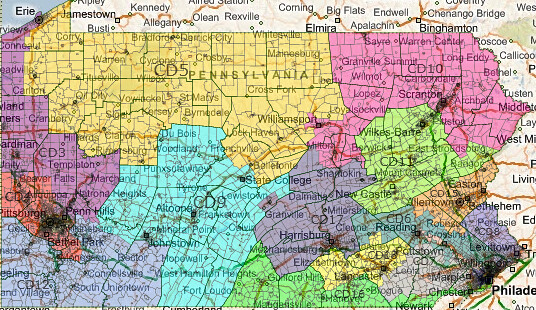
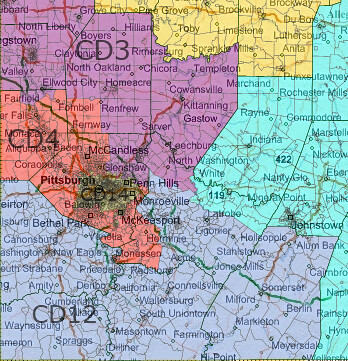
A 14-4 GOP (Dummy?)mander of PA

Following dramatic gains in the House of Representatives, I think most state legislatures controlled by the Republicans will try to be aggressively maximize their seats.  After 2008, we were proposing 28-0 maps of New York and assuming anything that went even slightly for Obama would be ours in perpetuity, so the Republicans are likely having similar thoughts now.  With that preface, I present my map of Pennsylvania.

The whole State

PA-05, Gold, 52%M 46%O

G.T. Thompson (R)

The 5th takes half of Erie, becoming more Democratic, but it had some room to spare.

PA-09, Cyan, 54%M 44%O

Bill Shuster (R) vs Mark Critz (D)

Johnstown is severed from the 12th district a lumped in with the more conservative 9th.  Critz may choose to run in the new 12th instead.

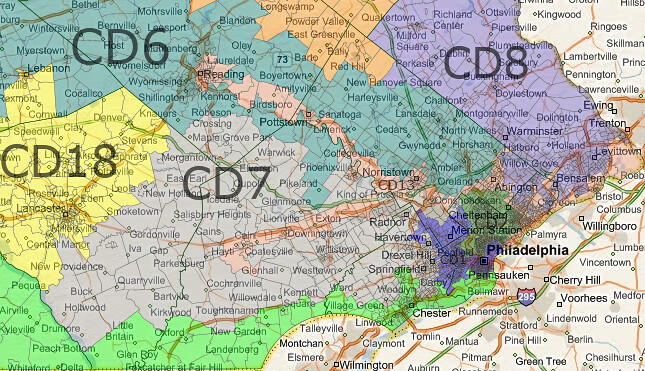
Southeast

PA-01, Blue, 85%O 14%M

Bob Brady (D)

This district shifts to the North some, losing the tentacle to Chester while grabbing white liberal areas in Delaware and Montgomery counties, but retails its Black plurality (43%).

PA-02, Green, 91%O 9%M

Chaka Fattah (D)

Still a Black majority district but less so (52%).  Gains some of the Hispanic parts of Philly, while losing some of West Philly to the 1st district.

PA-13, Salmon, 64%O 35%M

Allyson Schwartz (D)

Little known fact: The current 13th was drawn to be winnable by a Republican.  Not any longer.  The new form is quite sinuous, picking up as many dem areas in the Philly burbs as possible.  

PA-06, Teal, 51%O 48%M

Jim Gerlach (R)

While this district bears rather little in common with its former self, it is significantly more Republican than the old 6th which went 58% for Obama.

PA-07, Gray, 50%O 50%M

Pat Meehan (R)

We trade urban parts of Delaware county for some rural parts of Chester and Lancaster, making the district safer. It now went for Obama by only 127 votes.

PA-08, Periwinkle, 52%O 47%M

Mike Fitzpatrick (R)

Still a Bucks County centered district, it does some precinct swapping with the 13th to become marginally more Republican.

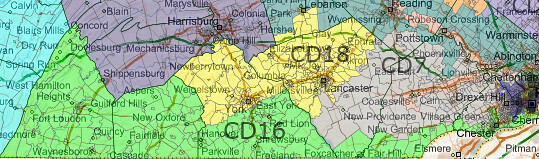
PA-16, Lime, 52%M 46%O

Joe Pitts (R)

The 16th now stretches from South Philly to Chambersburg.  Pitts will have to introduce himself to a lot of new voters, since most of his former territory has been moved to other districts.

PA-18, Yellow, 53%M 46%O

Todd Platts (R)

This district is actually a good fit for the moderate Platts, giving him the rapidly Bluing cities of York, Lancaster and Lebanon as well as some Conservative rural areas connecting them.

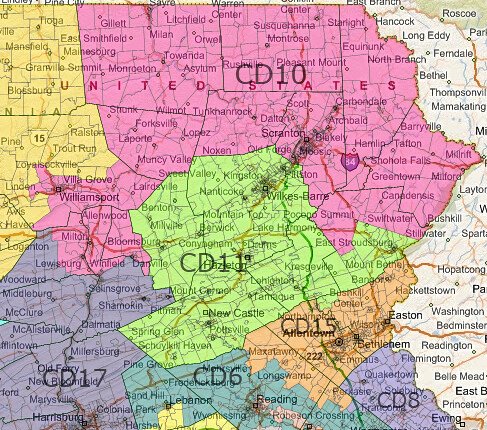
Northeast

PA-17, Indigo, 53%M 46%O

Open or Tim Holden (D)

In attempt to get rid of Holden, his home county (Schuylkill) is removed from the district and more conservative territory to the West is substituted.  He may choose to run here anyway or he may run in the 11th.

PA-15, Orange, 56%O 43%M

Charlie Dent (R)

The 15th is not strengthened or significantly changed since Dent rather effortlessly survived both ’06 and ’08.  If it ain’t broken, don’t fix it.

PA-11, Chartreuse, 51%O 48%M

Lou Barletta (R) vs Tim Holden (D)

This district is made significantly more Republican, but it may not help if Barletta gets tossed in front of the legendary Holden steamroller.  Of course Holden hasn’t had serious challenge in years so he may be rusty and Barletta may be able to ride anti-immigrant sentiment to victory.  Holden may also choose to run in the 17th.  Even then Barletta may not be completely safe, but I did warn you that this map was a reach.

PA-10, Pink, 51%O 48%M

Tom Marino (R)

Marino better hope 2012 is good year for the GOP because adding Scranton makes this an Obama district and he doesn’t have much time to get established.

Southwest

PA-03, Purple, 53%M 45%O

Mike Kelly (R)

Losing part of Eire makes this district safer.

PA-04, Red, 55%M 44%O

Jason Altmire (D) vs Timothy Murphy (R)

Here we try to eliminate narrow 2010 survivor Altmire by setting up a dogfight between him and long time rep Murphy.  While the district is not any more Republican than the current 4th, The territory just over half from the old 18th and he would be up against a fellow incumbent.

PA-14, Olive, 68%O 31%M

Mike Doyle (D)

Not much change here.

PA-12, Cornflower Blue, 55%M 43%O

Open or Mark Critz(D)

If Critz tries to run here rather than the 9th, he’ll find it more Republican than his old district, where he only narrowly survived 2010.

SSP Daily Digest: 1/7

ND-Sen: This may be the earliest the air wars have ever been launched, especially in a Senate race, but there’s already a major ad duel going on in the tiny (and dirt cheap) state of North Dakota, probably with an eye toward goading Kent Conrad into retirement (or backing him up so he doesn’t get any ideas). On the GOP side, mysterious Iowa-based IE group American Action Forum fired the first shots (worth only $60K), hitting Conrad over TARP and HCR; Dem group Commonsense Ten fired back (for $30K, all radio), defending his fiscal hawkishness. And now comes word that Conrad himself is also going to dip into his war chest starting next week, also hitting back against AAF. NWOTSOTB, but it’ll be a 60-second radio ad that runs all week. The bright side to the Conrad early alarm bells: that doesn’t seem like the action of a man contemplating retirement.

KY-Gov: In Kentucky, incumbent Dem Gov. Steve Beshear just filed his papers for re-election, coming up in November. As expected, his running mate will be former Louisville mayor Jerry Abramson, rather than Dan Mongiardo. Beshear is sitting on $3.5 million for the race; while that’s a lot more than the $624K that the GOP David Williams/Richie Farmer ticket has, note that Williams only started raising in the last quarter of 2010 and pulled in $753K. Williams’ tea-flavored GOP primary rival, businessman Phil Moffett, has only an $8K balance after raising $20K last quarter but spending $30K. (UPDATE: Here’s one other breaking bit of news that’s an interesting consideration: GOP Secretary of State Trey Grayson has sped up his getting-the-hell-out-of-Kentucky timeline, resigning shortly to take a job at Harvard’s Institute of Politics. That means Beshear gets to appoint a Dem to the SoS position, increasing the chances of holding the position in 2011. Beshear just announced that Bowling Green mayor Elaine Walker will get the position.)

MT-Gov: Also on the financial front, ex-Rep. Rick Hill is in pole position among the various contestants for Montana’s open gubernatorial seat. He’s raised $103K so far (Montana, of course, is a small and cheap state), compared with fellow GOP rival Corey Stapleton’s $86K so far. The only Dem who has declared, state Sen. Dave Wanzenried, has raised a grand total of $2K, leaving me to wonder if insiders expect AG Steve Bullock to get in shortly. (Bullock has raised $73K, although that could be used for either a gube or AG bid.)

GA-08: Add ex-Rep. Jim Marshall to the growing list of Dems interested in trying to fight their way back into the House two years from now, saying he’s not sure but “won’t preclude” another run. With the GOP controlling redistricting in Georgia, though, Marshall might find himself with an even-more-unfriendly 8th in 2012.

OH-06: And here’s one more to add: Charlie Wilson says “I would like to run again,” but with one big caveat: that there’s a district drawn that’s “somehow fair” for him. The GOP also controls the process in Ohio but will probably also need to chop at least one GOP-held seat, which may well come out of the state’s depopulated southeast quadrant. A mashup of the swingy 6th and the more-reddish 18th would be less favorable to Wilson than the seat he just lost.

California: Finally, here’s another interesting data dump from Greg Giroux, looking at how California’s gubernatorial and Senate races from 2010 broke down according to congressional district. If you’re looking for an indication of how polarized (and/or expertly gerrymandered for incumbent protection) California’s districts are, there was almost no deviation between how the House races broke and the statewide races broke. The only deviations: Meg Whitman and Carly Fiorina both won in Jerry McNerney’s CA-11, while Jerry Brown eked it out in Dan Lungren’s CA-03.

PA-Sen: Casey in Command (For Now)

Public Policy Polling (1/3-5, Pennsylvania voters):

Bob Casey, Jr. (D-inc): 51

Charlie Dent (R): 31

Undecided: 18

Bob Casey, Jr. (D-inc): 49

Jim Gerlach (R): 33

Undecided: 18

Bob Casey, Jr. (D-inc): 48

Rick Santorum (R): 41

Undecided: 10

Bob Casey, Jr. (D-inc): 47

Mark Schweiker (R): 34

Undecided: 18

Bob Casey, Jr. (D-inc): 50

Marc Scaringi (R): 27

Undecided: 22

(MoE: ±4.2%)

PPP’s first look at the 2012 Pennsylvania Senate race finds Bob Casey Jr. in, superficially, very good shape, leading most of his potential challengers by substantial double digits. He also sports a robust 41/29 approval rating (the best rating for any of the statewide politicians polled). I say “superficially,” though, because his mondo leads seem to be based mostly on the sheer unknown-ness of most of his opposition and the fact that he’s still only hanging around the 50% mark. Charlie Dent and Jim Gerlach, for instance, seem little known outside their districts and aren’t getting the benefit of the doubt from those who don’t know them, sporting 6/18 and 9/17 favorables respectively.

I’d expect those numbers to tighten quite a bit over the course of a real campaign, if only because the one candidate Casey isn’t dominating is probably the weakest candidate the GOP could put up against him but is, if nothing else, the best-known option: Rick Santorum, who lost to Casey 59-41 in 2006 and hasn’t done anything to rehabilitate his image since then. The numbers against Santorum seem consistent with the ones Quinnipiac found a month ago running Casey against Generic R (where Casey won 43-35, based on 39/29 approval). At any rate, even before this poll it seemed highly unlikely that Santorum, Dent, or Gerlach runs… not that there’d be much utility right now in polling somebody like state Sen. Jake Corman who’ll probably wind up the eventual candidate but for now is utterly unknown (as seen in the numbers for Marc Scaringi, a former Santorum aide who’s the only announced candidate so far).