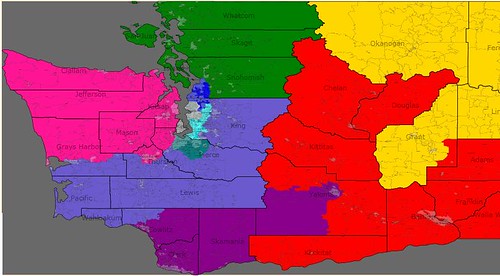
Washington in 10 Districts or Less

As you may know if you haven’t been under a rock, Washington State will be receiving ten districts next year, up from nine this past decade. this is my effort to read the minds of the 5 men responsible for drawing those districts.

In no particular order:

westwash

District 2 (green) All four northern counties along with most of Snohomish (Rick Larsen might not quite live here, if so, minor adjustments would resolve this)

District 8 (blue-gray) I could have sworn more people lived in eastern King and Pierce. Because they don’t, this district now extends all the way to the Pacific Ocean, not my best work. Lewis County should let Reichert sleep better on election nights.

District 3 (purple) Basically a dumbbell anchored by Vancouver and Yakima. I’d have liked to add a few more rural Central Washington counties so Rep Beutler could claim she represented Hispanics other than herself but this district is only 11%.

District 6 (pink) If you know the colors of Dave’s App, you’ll noticed that I screwed up. Apparently, though he’s long represented it, Rep Dicks does not live in Tacoma. He’ll be fine here though. I had the opposite problem to Dist. 8, more people live in the Olympic than I was aware of so I had to split Grays Harbor County, nonetheless, with all of Kitsap County and the Olympia area added, Rep Dicks should be quite content.

soundwash

And now to some districts I’m not ashamed of.

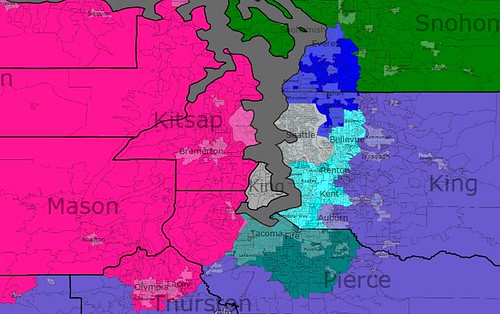
District 1 (blue) North suburbs. This district loses its salient across the sound and gets beautifully compact and solidly Democratic. Inslee doesn’t live here but he’s running for governor. If he doesn’t, hey he already moved once, he can do it again.

District 7 (grey) Seattle, Vashon, Mercer. Nuff said. (I think this is limited to dead girl, live boy would still get McDermott re-elected).

District 9 (teal) South and west suburbs. Contained in King County. Mr. Smith stays in Washington, DC that is.

District 10 (dark greenish something) Tacoma apparently never had its own district. That’s changed. I’m sure locals will tell me which up-and-coming local pols will want it.

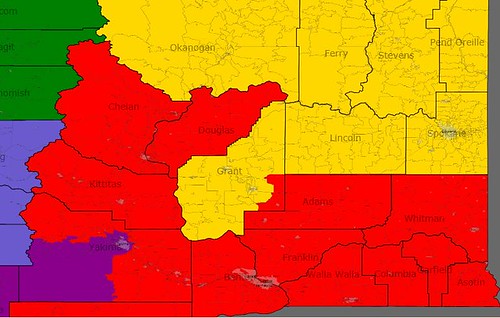
eastwash

District 4 The southern portion of Eastern WA. Tri-Cities, rural Yakima County, some other counties that are no doubt very important to their residents. The Doc stays in the US House.

District 5 Spokane… and some other stuff (eastern Washingtonians will begin sending me hate mail) CMR is all set.

In summary, all the incumbents should be comfortable and the new district goes to Pierce County, the second largest in the state and to the Democrats. 6-4 is actually a little generous to the GOP but hey, Dems could have taken two more if they really wanted to. e.g. beating Reichert once in 3 tries and holding WA-3.

SSP Daily Digest: 1/6

NE-Sen: After a few months in exploratory committee purgatory (and after screwing up many of the documents associated with said committee), Republican AG Jon Bruning has made it official. He’s now upgraded to Candidate, against Ben Nelson in the 2012 Senate race.

TX-Sen: Local insiders seem to think that Kay Bailey Hutchison is increasingly moving toward another run for Senate in 2012 (after having postponed her resignation a number of times amidst the gubernatorial race, and then having dropped the subject altogether). That speculation seems based mostly on her sheer silence on the issue, though.

IA-Gov: On his way out the door, outgoing Gov. Chet Culver talked up state Sen. majority leader Mike Gronstal as a possible 2014 gubernatorial candidate for the Dems. Culver said Gronstal won’t suffer for his reluctance to put gay marriage up for a statewide vote, which seems to be one of the state’s big flashpoints right now.

WA-Gov, WA-08: This is very unexpected, considering that GOP AG Rob McKenna has had the 2012 gubernatorial nomination staked out for about six years now, but Rep. Dave Reichert is publicly expressing some (or at least not ruling out) interest in a gubernatorial run (a race he’d been encouraged to run in 2004 back when he was King Co. Sheriff, although he ran for House instead). I’m sure local GOPers would prefer he run for Senate, where no viable GOP nominee seems to be on the horizon, rather than creating a fractious gubernatorial primary that might hobble their best shot in decades at winning the governorship. Actually, I’m sure they’d prefer he continue to hold down WA-08 rather than open up the 8th while embarking on a fool’s errand against Maria Cantwell, and with redistricting likely to give him a safer district in Seattle’s southeastern exurbs while opening up a solid-blue WA-10 on the true Eastside, that’s probably what he’ll keep on doing.

CO-03: New Gov. John Hickenlooper just appointed recently-defeated Rep. John Salazar as the state’s agriculture commissioner. Salazar has already said he was open to a rematch with Scott Tipton; the question is whether this makes a rematch less likely or if it’s designed to keep him in the public spotlight. (Speaking of Hickenlooper, if you haven’t read the NYT Magazine section’s long profile of him, it’s worth a read.)

FL-25: Add one more mysterious bit of financial information to the mounting pile of sleaze that’s engulfing David Rivera in his first week on the job: he sold a condominium to his mother’s marketing company (the same company that’s under criminal investigation for its relationship to the Flagler Dog Track) in November, shortly before he paid off $137K in undisclosed loans… also to that same marketing company.

IA-03: Buried in an article on the Iowa redistricting conundrum, which will see the state compacted to four House districts, is an important piece of unexpected news: septuagenarian Democratic Rep. Leonard Boswell, who’s been a prime candidate for retirement for a number of cycles now, tells Roll Call that he will be running again in 2012, regardless of what district he gets stuck into. Tom Latham, Bruce Braley, and Dave Loebsack all plan to “plow ahead” as well; only Steve King didn’t comment, although his district, by virtue of geography (having the state’s western half pretty much to itself) seems least likely to get messed with. A collision between Des Moines-based Boswell and Ames-based GOPer Latham seems likeliest to me, but with a commission making the decisions, almost any configuration seems possible.

NC-07: Rep. Mike McIntyre — already in the news today as one of only two Dems who voted against HCR to also say that he’d go ahead and support Republican repeal efforts — is now about to draw a Democratic primary challenger from the left, although one who seems kind of on the Some Dude end of the spectrum. Business counselor Del Pietro says he’ll take on McIntyre.

California: This piece is mostly about House redistricting in the Golden State, but has some thoughts about potential retirements too, given the possibility that redistricting via commission may result in less incumbent protection and various House members getting stuck together (and also given the advanced age of many of California’s long-timers). Jerry Lewis and Pete Stark are listed as most noteworthy possibilities, along with Elton Gallegly (who’s waffled about retirement before), Lois Capps, Gary Miller, and Howard Berman… and Bob Filner is mentioned as a possible San Diego mayor candidate in 2012.

House: This Roll Call piece is mostly a grab-bag of vague quotes and speculation (of course, what article in the Beltway press isn’t), but it does do some useful handicapping on which sought-after House members are likely or unlikely to make the jump to running for Senate in 2012. New York’s Peter King says “I really don’t expect it,” Pennsylvania’s Charlie Dent says he hasn’t “been actively pursuing it,” and Ohio’s Jim Jordan is “leaning against it.” Wisconsin’s Paul Ryan didn’t comment, but has repeatedly said he isn’t looking for higher office anytime soon (and here’s some further confirmation on that from today), while Florida’s Connie Mack IV seems to be moving definitely moving in a Senate direction and Montana’s Denny Rehberg remains studiously vague.

DCCC: DCCC head Steve Israel announced his team of lieutenants for the 2012 cycle, which includes the two other likeliest chairs who got passed over, Joseph Crowley (in charge of fundraising) and Debbie Wasserman Schultz (incumbent retention and redistricting). Also on board are Allyson Schwartz (recruitment), Keith Ellison (community partnerships), and Puerto Rico’s Pedro Pierluisi (constituency mobilization).

Mayors: State Sen. Anthony Hardy Williams (last seen barely hitting the double-digits in the Democratic gubernatorial primary) has a new gig in mind: he’s publicly expressing his interest in running for Philadelphia mayor, one of the many mayoral races up in November. The only other person to have actively looked into challenging fairly-popular incumbent Michael Nutter is wealthy businessman Tom Knox, who also made a brief appearance in last year’s governor’s race Dem primary.

Twitter: We made it over the 4,000 mark on Twitter; thanks to all our new followers. We’re still taking new applications, though, so we encourage any other fans of microscopic bits of political wisdom to sign on, too.

NV-Sen: Huge Performance Difference Between Ensign, Heller

Public Policy Polling (1/3-5, Nevada voters):

Shelley Berkley (D): 45

John Ensign (R-inc): 42

Undecided: 13

Oscar Goodman (D): 45

John Ensign (R-inc): 35

Undecided: 20

Catherine Cortez Masto (D): 44

John Ensign (R-inc): 42

Undecided: 14

Ross Miller (D): 40

John Ensign (R-inc): 39

Undecided: 21

Shelley Berkley (D): 38

Dean Heller (R): 51

Undecided: 11

Oscar Goodman (D): 38

Dean Heller (R): 45

Undecided: 16

Catherine Cortez Masto (D): 37

Dean Heller (R): 46

Undecided: 16

Ross Miller (D): 34

Dean Heller (R): 46

Undecided: 21

(MoE: ±3.2%)

Want to make sure Democrats win the 2012 Senate race in Nevada? Find a way to make sure that John Ensign is the GOP nominee. Conversely, want to make sure Democrats lose? Find a way to make sure that Dean Heller is the nominee. At least that’s the initial takeaway from today’s PPP poll. The general electorate seems to loathe Ensign, giving him 35/50 approvals (way below those of Harry Reid, who’s at 46/50), and 56% say he shouldn’t run again in 2012 (compared to 29% who say he should). Heller, by contrast, has 46/23 favorables; the only Dem who competes with that is Oscar Goodman, at 45/21. Shelley Berkley, generally thought to be the Dems’ strongest contender here, has the narrowest fave/unfave spread of any Dem, at only 34/29.

You might remember that in November PPP came out with a poll of the GOP primary, showing Ensign surprisingly far ahead of Heller (and Lt. Gov. Brian Krolicki as well), 45-37. So, we might be able to hope for Ensign salvaging his primary (and thus boosting Dem hopes for the general). The primary, of course, still has several ways to not happen… Heller has sent many a conflicted message, happy with his new committee assignments in the House, but on the other hand, many with their finger on the local political pulse seem sure that Ensign won’t even bother trying to run. Jon Ralston, in fact, is out with another piece today predicting just that; his scenario is that midway through the year Ensign is likely to announce he won’t run again, Heller will run to replace him, and the biggest fireworks will be in the NV-02 primary to replace Heller, potentially pitting Krolicki against Sharron Angle.

[Updated] Daves Redistricting 2.0.4 and Survey!

I’ve just uploaded a new version and created a survey, which is now open.

What’s new in 2.0.4: a new way of coloring districts. I really like it and I hope you agree. The old way is still there, too, so you have a choice.

You can toggle between the old and new way to color from the File Menu. Also, if you let the “How To” banner appear on startup, you’ll get a dialog box to choose. More detail below the fold.

App Launch page

Survey Launch

The new coloring method is similar to the old, but makes 2 key changes, that I hope you agree are improvements:

(1) You can click the “Color Districts” button (labeled “Coloring Is Off” for the old way) to turn on coloring. (Double-click also still toggles Coloring Mode.)

(2) You have to hold down the mouse button as you sweep to color districts, so you can maneuver better in coloring mode.

Advantages:

(1) You don’t as often accidentally color districts you don’t want.

(2) You can move to the control panel and change CDs or opacity without leaving Coloring Mode.

(3) You can hover over a district and get its population data tooltip, so you can decide whether to color it or not.

And this allows for an additional feature that I’m very excited about: Draw a box and color everything inside it. When you hold down the Ctrl key and mouse button and move the mouse (called Ctrl-Drag) you draw a box on the map. When you release the mouse button all districts in the box are colored. I’ve been trying this out and it allows you to work much faster!

The survey is 22 questions, most short and easy. It’s open until January 17th. Please take it after you’ve tried the new coloring method. I really value your feedback.

Survey Launch

I’m in the midst of planning for this year. It’s not a done deal yet, but I’ve got some good leads on funding for the app and I plan to focus full time on it for most of this year. The survey will help me improve and enhance the app.

Thanks!

[Update] I bought a MacBook and started looking at the interaction with the app:

— Drawing a box to color indeed does not work, because the Ctrl key maps to a Right Mouse Button Click. I will be able to fix this by using a different key, but that will take a little time.

— For sweeping to color districts with the New Way, you can use the three-finger metaphor on the trackpad; it is the same as pushing down on the trackpad with 1 finger and sweeping with another. The three finger approach seems much easier to me.

— I am still not able to repro the cases where panning flies off the screen.

Thanks for all of your responses to the survey. It will be open for 1 more week!

SSP Daily Digest: 1/5

IN-Sen: Richard Lugar and local leaders in the tea party movement had a sitdown at an Indianapolis hotel last month. I’m not sure if it was actually intended by Lugar to try to deter a GOP primary challenge, but it seemed to have none of the desired effect if so; the net result seemed to have been cordial but with a sense of “game on,” with the main question left being who the challenger will be.

WI-Sen: With this his first day out of the Senate, Russ Feingold will be, instead of heading for the K Street gravy train, taking a position at Marquette University’s law school. When asked about his 2012 plans in the event of a Herb Kohl retirement, Feingold simply said that he hopes Kohl runs again and would support him if so.

IN-Gov: Democrat Jonathan Weinzapfel looks poised to become the first entrant in the Indiana gubernatorial race. He’s announced that he won’t seek another term as mayor of Evansville (which would require running for re-election this year), and says that he’ll take a “good, hard look at” the governor’s race and make a decision sooner rather than later.” Meanwhile, after the Beltway collectively decided yesterday that Mike Pence was going to run for Gov. on the GOP side, there’s yet more conflicting evidence today, as seen in his plans to appear with other GOP presidential hopefuls at a conference in Georgia, just across the border from pivotal South Carolina.

MA-Gov: Deval Patrick is vowing today that he’ll serve out his full second term (something that a Massachusetts governor hasn’t done in decades, not since Mike Dukakis), but won’t seek a third term in 2014. That would seem to (at least for now) put the kibosh on any speculation that he might look to challenge Scott Brown in 2012.

MN-06: The news that produced spit-takes all across America this morning: Michele Bachmann is floating her name for president in 2012. Obviously a failed vanity presidential bid is no deterrent to a return engagement in the House if you hit the ejector seat early enough (just ask still-Rep. Ron Paul), but this bit of laughable presidential weirdness could have some major downballot implications if it truly leads to an open seat (especially if Tarryl Clark is indeed looking to run again).

WI-07: It looks like we might already have a serious contender in the on-deck circle in the 7th, which at D+3 is one of the bluest districts that the GOP picked up thanks to David Obey’s retirement. Former state Sen. Kevin Shibilski was one of the short-list of candidates to run in Obey’s stead (state Sen. Julie Lassa eventually became the consensus pick), and is now saying he’s seriously interested in a 2012 run. Shibilski owns two resorts and apparently has serious self-funding capacity. Shibilski still sounds a little wary, though, preferring to wait and see whether new Rep. Sean Duffy stays a boilerplate Republican or turns into the sort of moderate who’s been able, in the past, to hold down a rural Wisconsin seat (a la Steve Gunderson, or Mel Laird, if you want to go way back to Obey’s predecessor). (H/t alphaaqua.)

IA-St. Sen.: The year’s barely started and the Dems have already lost their first special election! I don’t think anybody had particularly high hopes for last night’s fight, though: it was a GOP-leaning seat in Iowa’s rural southwestern corner, held to replace Kim Reynolds, who just became Iowa’s Lt. Governor. Montgomery County auditor Joni Ernst held the seat for the GOP, beating Dem nominee Ruth Smith, with 67% of the vote. The Dems still control the state Senate 26-23, with one more formerly-GOP-held special election pending.

NV-St. Sen.: This is big news by Nevada standards: state Sen. Bill Raggio, the state GOP senate leader for decades but deposed recently from his perch in a tea party-ish palace coup (in the wake of his endorsement of Harry Reid), has announced that he’s resigning later this month rather than completing his term. This may have Sharron Angle’s antennae twitching, as you might remember she tried and failed to primary out Raggio in his Reno-area seat in 2008, and she might be interested in trying that again, adding the state Sen. to the list of her myriad other possibilities like another NV-Sen run or an NV-02 run if Dean Heller vacates (although it’s worth noting this won’t lead to a fast special election, as Nevada, like several other western states, fills legislative vacancies temporarily via appointment).

NY-St. Sen.: This seems like strange posturing that will probably vaporize once the Democrats are back in the majority in the state Senate, but four of New York’s Senate Democrats just broke off from the Dem caucus and formed their own little club, the Independent Democrat Caucus (meaning the breakdown is either 32-30 or 32-26-4, depending on how you want to view it). Interestingly, it’s not the usual most-uncooperative Dems (Ruben Diaz, anyone?), but a clutch of reform-minded Dems (led by the barely-re-elected David Valesky, and also including the newly-elected David Carlucci) who apparently didn’t want to get boxed into voting for John Sampson as Dem leader.

PA-St. Sen.: The special election to replace long-time Democratic state Sen. Michael O’Pake in the light-blue SD-11 has been set for March 15. As I’ve mentioned before, this could turn into an interesting bellwether on where Pennsylvania’s southeastern suburbs are headed.

Votes: Today’s attention-getting vote was the number of defections against Nancy Pelosi in the Speaker vote: 19 Democrats voted for someone else (or present). Heath Shuler led the way with 11, while other votes included Steny Hoyer, John Lewis, and even neighbors Dennis Cardoza and Jim Costa voting for each other.

Redistricting: Two news stories concern the independent commissions that will be in charge of redistricting in two states gaining seats, Arizona and Washington. In Arizona, they’re already litigating the issue of who even gets on the commission in the first place; new state Sen. president and all-around jackass Russell Pearce is suing on the basis that three of the people nominated to serve are technically ineligible. (Interestingly, two of the three are Republicans, although maybe the problem is they weren’t hardliners enough for Pearce’s tastes.) Meanwhile, in Washington, Skeletor has re-emerged from a decade of suspended animation: evil genius and ex-Sen. Slade Gorton will be one of the two designated Republicans on the commission. Luckily, the lead Dem going up against Gorton will be Tim Ceis, the former Seattle deputy mayor who’s well-known for his own elbow-throwing abilities.

Finally, the Fix has its latest installment in its state-by-state redistricting look, and I agree with both their conclusions about Ohio: that, mostly because of geography, Betty Sutton is the likeliest Dem to get squeezed rather than Dennis Kucinich (since she faces pressure from other Dems from the north, west, and east), and that, because of depopulation in the state’s Appalachian southeast and the fact that they’re both obscure freshmen, Bob Gibbs and Bill Johnson are the GOPers likeliest to get pitted against each other for the state’s other lost seat.

California Redistricting!

We’ve already had a lively discussion with regard to California redistricting in this diary below, but now that I have diary rights I want to finally post my own projected map of the new California districts. Needless to mention, redistricting California is a daunting task, particularly in light of the newly approved ‘nonpartisan’ commission. So, a few notes and caveats are in order.

1) My map is only as good as the data provided by Dave’s Redistricting App. Clearly then, to whatever extent that data is invalid, my output will be likewise.

2) In this installment I’ll mainly just outline the process that I followed in placing the districts. I might go over the political results or the VRA ramifications in a subsequent installment if there seems to be enough interest. In short, I welcome any feedback or criticism regarding my decisions. I want to be reasonably confident about the validity of my mapping scheme before I go into much detail about how it affects individual districts.

3) I did not take any account of the current districts when putting together my map. However, I went back and numbered them based on the closest current district merely so as to facilitate discussion. I have added the incumbent that holds that currently numbered district, though I generally have no idea whether they’d still live in said districts. Also, when I doublechecked this afternoon I realized that several of the LA County and OC County districts were not optimally labelled in the map I posted to the other thread. More on that when I get to it.

4) The purpose of this exercise is in part to counter the popular notion that we can’t project some reasonably accurate version of the new California district configuration. My basic premise is that: If the commission simply follows the rule of crossing county and city boundaries only when necessary, then in most cases it’s obvious which way to go, so long as you have a starting point.

5) None of my districts deviate by more than +/- 600 people. The majority deviate by less than +/- 200. Again, this is based on Dave’s app of course. And, speaking of Dave’s app: It’s glitchy at spots. I’ve edited these glitches out of the maps below.

So, without further ado, here we go:

To begin with, here’s my statewide map:

Now I chose San Francisco as a natural starting point. The simple reason for this being that it’s bounded on three sides by water boundaries. It’s also one of the state’s leading cities and a classic tenet of purely geographic districting is to minimize the subdivision of major population centers. Below is my final map of the Bay Area. This is the process by which I arrived at these boundaries:

1) I began with CA-08 in San Francisco County, then simply added voting blocks horizontally until I reach the correct population. Now, there’s been some discussion about the idea of instead dividing the county roughly in half and joining the northern district with Marin County across the Bay. For the record, I tried that just to see what happens. In short, all of these compact districts around the Bay are heavily Democratic districts, and taking CA-08 north into Marin simply rotates them clockwise, still leaving you with a set of heavily Democratic districts. The only meaningful difference is that population centers are harder to keep intact.

CA-08 (Pelosi – D): 85% Obama / 13% McCain

2) I started CA-12 with the remainder of San Francisco County and finished it with San Mateo County except for Redwood City.

CA-12 (Speier – D): 74% Obama / 24% McCain

3) I started CA-14 with Redwood City and added Santa Clara to complete the district. I then put San Jose in its own CA-15 district, and then started CA-16 with the rest of Santa Clara County.

CA-14 (Eshoo – D): 73% Obama / 25% McCain

CA-15 (Honda – D): 70% Obama / 28% McCain

4) I wasn’t sure which way to go with CA-16, so I switched gears to start CA-17 with Santa Cruz County. I then added Monterey County to CA-17. It then became clear enough that I should add San Benito County to CA-16, because if I added it to CA-17 it would not take up the whole county.

5) At this point it became clear enough that I should complete CA-16 with the eastern part of Alameda County.

CA-16 (Lofgren – D): 64% Obama / 34% McCain

6) All of central Alameda County can then become CA-13 (Fremont, Union City, Pleasonton, Hayword) and then Oakland can take up most of CA-09.

CA-13 (Stark – D): 72% Obama / 26% McCain

7) I then finished up CA-09 with the western tip of Contra Costa County, then added CA-10 to take up the central county through Concord and Danville.

CA-09 (Lee – D): 89% Obama / 9% McCain

CA-10 (Garamendi – D): 69% Obama / 30% McCain

8) I wasn’t sure where the rest of Contra Costa belonged, so I started CA-07 with Solano County. I wasn’t sure where to go for the rest of CA-07 so I switched to CA-06 in Marin County, then finished it up with most of Sonoma County.

CA-06 (Woolsey – D): 76% Obama / 22% McCain

OK, so now what? More after the map…

Below I have my maps of Northern California and the Sacramento area.

9) As I pondered CA-07, I realized that I could add all of Napa County and all of Yolo County except for West Sacramento. The alternatives would either create a weirdly shaped district or unnecessarily divide Sacramento.

CA-07 (Miller – D): 65% Obama / 33% McCain

10) I then started CA-01 with Mendocino, Trinity, Humboldt, Del Norte, and Lake counties. It also became clear that the rest of Sonoma belonged in CA-01. The CA-01 district still needed 365,000 people.

11) I went ahead and added CA-05 in West Sacramento (Yolo County) and Sacramento proper. Sacramento should clearly anchor 2 districts, so I placed CA-03 fully in the eastern part of the county.

CA-05 (Matsui – D): 69% Obama / 29% McCain

CA-03 (Lungren – R): 50% Obama / 48% McCain

12) I still had 55,000 people left in the southwestern salient of Sacramento County. It now became clear enough that CA-11 should take those, the remaining half of Contra Costa County, and San Joaquin including half of Stockton.

CA-11 (McNerney – D): 59% Obama / 39% McCain

13) I now added Colusa, Glenn, Tehama, Shasta, and Siskiyou counties to CA-01. I still needed 23,000 more people. The most efficient way to finish up CA-01 was with Modoc County and part of Lassen County.

CA-01 (Thompson – D): 50% Obama / 47% McCain

14) I could now start CA-02 with the rest of Lassen. I then added Plumas, Butte, Sierra, Yuba, Nevada, and Sutter. This left me needing 170,000 people. The obvious place to get them was Placer County except for the Rocklin/Roseville corner.

CA-02 (Herger – R): 47% Obama / 51% McCain

15) It now made sense to start CA-04 with this corner of Placer, and to add the sparsely populated eastern counties of El Dorado, Amador, Calaveras, Alpine, Mono, Tuolomne, and Mariposa. But, where to go now? More after the maps…

Below I’ve added my maps of the Central Valley and Southern California. The next set of decisions involving the Central Valley are the ones that I think are most debatable, as I’ve stated previously. In any case, here’s my reasoning

16) It made sense to start CA-18 with the rest of San Joaquin County and then finish it off in Stanislaus County, including the city of Modesto.

CA-18 (Cardoza – D): 54% Obama / 44% McCain

17) I then started CA-19 with the remainder of Stanislaus County and all of Merced County. At this point, the next population center was Fresno, but I had to decide what to do with Madera County that was in the way. I played with several alternatives and realized that my options were to either split Madera County or split the city of Fresno or end up with several weirdly shaped districts. I chose to split Madera County and then finish off CD-19 with western half of Fresno County.

CA-19 (Denham – R): 49% Obama / 49% McCain

18) It then made sense to give Fresno it’s own CA-21 district, and to place the sparsely populated eastern remainder of Madera & Fresno counties in CA-04.

CA-21 (Nunes – R): 51% Obama / 47% McCain

19) At this juncture, it seemed fairly obvious to start CA-20 with Kings and Tulare counties. Once I did that, it was obvious that CA-04 should finally be completed with Inyo and the sparsely populated east of San Bernardino County.

CA-04 (McClintock – R): 42% Obama / 56% McCain

20) I now decided it was time to switch back to the coast. It was clear that I should finish CA-17 with the Cambria corner of San Luis Obispo County. I could then start CA-23 with the rest of San Luis Obispo and add all of Santa Barbera County, which left me needing 67,000 people.

CA-17 (Farr – D): 71% Obama / 27% McCain

21) I then switched back to CA-20, finishing it in Kern County. Then I added CA-22 fully contained in Kern County, which left 12,000 people in one corner. I decided to add these to CA-04, swapping them out for 12,000 in San Bernardino (which didn’t change the partisan breakdown of CA-04).

CA-20 (Costa – D): 43% Obama / 56% McCain

CA-22 (McCarthy – R): 39% Obama / 59% McCain

22) I then added CA-41 in central San Bernardino County, finished CA-23 in northern Ventura County, and placed CA-24 in southern Ventura County. This left me with 34,000 people in Ventura County and I was ready to start on LA – after the maps!

CA-41 (Lewis – R): 44% Obama / 53% McCain

CA-23 (Capps – D): 58% Obama / 40% McCain

CA-24 (Gallegly – R): 55% Obama / 44% McCain

Below is my LA County map. Note that the district numbering has changed from the map that I posted in the other thread, because when I went back over it I realized that the current Dreier district (CA-26) had been dismantled and that the one which I had labeled as CA-26 should’ve been Chu’s CA-32, while the one that I originally labelled as CA-32 should’ve clearly been CA-39 (Linda Sanchez).

23) Anyhow, here is how I proceeded with LA County (with the above amendments):

CA-25: I started with northern LA County, and added the San Fernando Valley.

CA-30: I finished Ventura County, and added the Westside cities.

CA-27: I took the rest of San Fernando, Burbank, and Glendale.

CA-33: I started with Culver City, added Santa Monica, and Beverly Hills.

CA-28: Centered on Hollywood.

CA-29: Centered on Pasadena.

CA-32: I started in Glendora and took in the northern suburbs.

CA-35: Centered on Inglewood.

CA-36: Centered on Rancho Palos Verdes – with Redondo Beach and Manhattan Beach.

CA-38: Centered on Pomona and Covina.

CA-31: Centered on downtown LA.

CA-34: Centered on Huntington Park.

CA-37: Centered on Compton.

CA-39: East LA, leaving the southeast waterfront corner of Los Angeles County.

CA-25 (McKeon – R): 53% Obama / 45% McCain

CA-27 (Sherman – D): 71% Obama / 27% McCain

CA-28 (Berman – D): 80% Obama / 18% McCain

CA-29 (Schiff – D): 69% Obama / 29% McCain

CA-30 (Waxman – D): 63% Obama / 35% McCain

CA-31 (Becerra – D): 80% Obama / 17% McCain

CA-32 (Chu – D): 58% Obama / 40% McCain I think Dreier actually lives here.

CA-33 (Bass – D): 77% Obama / 22% McCain

CA-34 (Roybal-Allard – D): 76% Obama / 22% McCain

CA-35 (Waters – D): 88% Obama / 11% McCain

CA-36 (Harman – D): 59% Obama / 39% McCain

CA-37 (Richardson – D): 84% Obama / 15% McCain

CA-38 (Napolitano – D): 64% Obama / 34% McCain

CA-39 (Linda Sanchez – D): 60% Obama / 38% McCain

With LA out of the way, it’s time to wrap up SoCal after the map.

Below I have added my final maps. The first covers Orange County & the Inland Empire; the second covers the San Diego area. Here is how I proceeded to map these districts.

24) I started with Orange County by taking the last bit of LA and joining it with Huntington Beach to make CA-46. I then put CA-47 in Fullerton, Anaheim, and Buena Park and Irvine/Newport Beach in CA-48.

CA-46 (Rohrabacher – R): 48% Obama / 50% McCain

CA-47 (Loretta Sanchez – D): 52% Obama / 46% McCain

CA-48 (Campbell – R): 55% Obama / 43% McCain

25) I then put the city of San Bernardino in CA-43, and finished off San Bernardino County with CA-42, which still needed about 90,000 people. However, I wasn’t sure whether these should come from Orange County or Riverside County.

CA-43 (Baca – D): Obama 61% / McCain 37%

26) I now switched to Riverside County by placing CA-45 in the eastern 2/3 anchored with  Palm Springs, and then centered CA-44 on the city of Riverside and Moreno Valley. I think CA-44 might actually be the vacant seat, so maybe I should’ve labeled it CA-26..

CA-45 (Bono Mack – R): 51% Obama / 48% McCain

CA-44 (Calvert – R, or maybe vacant): 58% Obama / 40% McCain

27) I then started CA-51 with Imperial County and added eastern San Diego County basically up to the coastal strip. That still left me needing 440,000 people, and neatest way to add them was to take the South Bay area (Chula Vista & Imperial Beach).

CA-51 (Filner – D): 51% Obama / 47% McCain

28) The city of San Diego can clearly anchor two compact districts, so I just split it down the middle with CA-52 and CA-53. I then added CA-50 along the coast, and started CA-49 in Oceanside.

CA-50 (Bilbray – R): 50% Obama / 48% McCain

CA-52 (Hunter – R): 55% Obama / 44% McCain

CA-53 (Davis – D): 66% Obama / 32% McCain

29) At this point it’s clear that if CA-49 goes into Riverside County, either Riverside or Orange will be subdivided once more than necessary. So, I finish off Orange County with CA-49 and CA-40, leaving 15,000 people in the southeast corner.

CA-40 (Royce – R): 43% Obama / 55% McCain

CA-49 (Issa – R): 46% Obama / 52% McCain

30) This leaves only Riverside County, where I wrap up CA-42 with Norco, and create what is essentially a new Inland Empire seat from Temecula to Corona (along with those 15,000 people from the corner of O.C.) I’ve numbered it CA-26, but it doesn’t actually overlap Dreier’s current district, and I think Calvert lives here in Corona, which would make the CA-44 district the vacant one.

CA-42 (Miller – R): 53% Obama / 45% McCain

CA-26 (Dreier – R; but actually either vacant or maybe Calvert – R): 44% Obama / 55% McCain

Whatever the case, I think that more than covers it! Please let me know what you think of my maps. Am I on track or way off base??

Potential GOP House targets in 2012

The GOP right now is in a very similar situation to the Dems after the 06/08 cycles. Having come off a very successful wave election where they picked up most of their potential targets, there simply aren’t as many Dem seats that the GOP can capture in 2012 as there were in 2010. Still, there’s actually a fairly decent list of seats that the GOP could target, not enough to give them gains like they had this year, but enough that they could pull off a 10-20 seat gain if 2012 turns out to be a good year for them. These are what I consider to be there best targets. I’m grouping these into three tiers. Tier 1 consists of seats that the GOP have a good chance of picking up. Tier 2 consists of seats that are probably uphill battles for the GOP, but certainly not out of their reach. Tier 3 consists of seats that are truly longshots, or are conditional on certain things happening that are far from certain right now.

Tier 1

*PA-04/12 (Critz/Altmire) Word is that these two will be packed into a seat together, and that seat will probably be pretty unfavorable to dems. If Critz and Altmire are forced to spend resources on a bloody primary battle that could hurt them in the general as well.

*KY-06 (Chandler) Anyone who wins by such a narrow margin as Chandler did is probably vulnerable in the next election.

*NY-23 (Owens) The margin between Owens and his GOP challenger was less than the vote won by Conservative Party candidate Doug Hoffman (Hoffman had dropped out but his name was still on the ballot). This seems to suggest that if the GOP could unite behind one good candidate here than they could win this district. Redistricting may determine how competitive this seat is, and that’s kind of a wild card right now.

*GA-12 (Barrow) Could be killed by GOP controlled redistricting.

*MI-09 (Peters) Peters won by a very narrow margin, and he will have to go into the next election with a GOP-drawn district.

*NC-08 (Kissell) The Gov has no say in redistricting under NC law, so this will be left up to the GOP legislature. It’s pretty easy to draw a terrible district for Kissell without really endangering anybody else.

*MO-03 (Carnahan) Pretty easy to see him losing in 2012. Whether or not he goes may depend on how much of STL is in the new district.

*CA-11/18/20 (McNerney/Cardoza/Costa) The CA redistricting commission is a wild card right now, but it seems likely to me that one of these guys will get a tough seat to run in. Some have speculated that McNerney’s seat will get axed to give a seat to the Inland Empire, and while it seems more likely to me that someone like Stark gets cut it’s still not impossible. Still, it seems like one of these seats will be competitive come 2012.

TOTAL: 9

That’s all the low-hanging fruit I can see right now for the GOP. Now on to the ones that will be a little harder for the GOP to pick up.

Tier 2

NC-07 (McIntyre) McIntyre is in a fairly similar situation to Kissell. If the NC GOP wants to be ambitious, they could try to take out both, which is certainly possible without fully going into dummymander territory. But it would be a little more ambitious. You could probably switch out NC-07 or NC-08 and it wouldn’t make much of a difference. They could kill either with redistricting, and possibly both.

IA-01/02/03 (Braley/Loebsack/Boswell)

NY St. Senate Fair Redistricting: Let the Court Draw It

During the last redistricting, the Democrats and the Republicans allowed for a split redistricting plan: Dems redraw the Assembly, the GOP drew the Senate, and they both drew the House map. Now, with split control again, I think it would be best to allow the Courts to draw the redistricting map, even if it means Dems lose about twenty Assembly seats–Dems already control about 70% of the vote share!

So, I tried to draw the map as if I were the courts. Sorry if my naming of colors throws you off.

My plan is a fair plan:

I make as many minority-majority seats as I think would be necessary;

No district is designed specifically for any current senator;

County splitting is avoided as much as possible;

Almost all towns are kept together: no joke, there is not a single town outside of Nassau and Suffolk that is split. In Suffolk, Islip is too big, so three precincts are moved to NY-02. In Nassau, some hamlets might be split, but I’m pretty sure there aren’t that many that are;

In the City, I tired to respect racial groups;

Upstate, I tried to keep regions together.

To that end, Democrats would surely take the State Senate under this map. I’ve classified everything from R+1 to D+3 as a swing district. If you give Republicans all swing districts, they’ll only muster 25 seats. Kudos to the 2000 GOP, they made one heckuva map. Can you imagine if Dems made a Senate map? They could easily make 45 seats, but that’s a different story.

Here’s my map:

Photobucket

Photobucket

NY-1 D+1 Blue

South Hampton, Part of Brookhaven

NY-2 R+0 Green

Part of Brookhaven, Three Precincts of Islip

NY-3 D+1 Purple

Rest of Islip

NY-4 R+4 Red

Huntington, Smithtown

NY-5 R+2 Yellow

Babylon, Part of Oyster Bay

NY-6 D+2 Teal

Part of Hempstead

NY-7 D+2 Gray

Part of Hempstead

NY-8 D+3 Bluish Purple

Part of Hempstead, Part of North Hempstead

NY-9 D+1 Turquoise

Part of North Hempstead, Part of Oyster Bay

Photobucket

NY-10 D+14 Pink

Queens

NY-11 D+18 Light Green

Queens

NY-12 D+27 Light Blue

Queens

NY-13 D+27 Beige

Queens

NY-14 D+10 Mustard Green

Queens

NY-15 D+40 Dark Blue

Queens

NY-16 D+27 Orange

Queen, Brooklyn

NY-17 D+44 Lighter Green

Brooklyn

NY-18 R+5 Yellow

Brooklyn

NY-19 D+44 Green

Brooklyn

NY-20 D+42 Light Pink

Brooklyn

NY-21 D+39 Velvet Red

Brooklyn

NY-22 D+28 Brown

Brooklyn

NY-23 R+4 Darker Turquoise

Brooklyn

NY-24 D+12 Dark Purple

Brooklyn, Staten Island

NY-25 R+15 Pinkish Red

Staten Island

NY-26 D+41 Dark Gray

The Bronx

NY-27 D+31 Green

Brooklyn, Manhattan

NY-28 D+31 Dark Pink

Manhattan

NY-29 D+33 Green Gray

Manhattan

NY-30 D+23 Orange Red

Manhattan

NY-31 D+43 Yellow

Manhattan

NY-32 D+39 Red

Manhattan

NY-33 D+43 Blue

The Bronx

NY-34 D+25 Green

The Bronx, Queens

NY-35 D+32 Purple

The Bronx

Photobucket

NY-36 D+37 Orange

The Bronx, Mount Vernon

NY-37 D+9 Blue

Yonkers, New Rochelle

NY-38 D+11 Turquoise

White Plains, Rye

NY-39 D+5 Yellow

Peekskill, Clarkstown

NY-40 R+3 Red

Ramapo, Orangetown

NY-41 EVEN Gray

Middletown, Newburgh

NY-42 R+2 Light Green

Poughkeepsie, Beacon

Photobucket

NY-43 D+6 Pink

Kingston, Hudson

NY-44 D+9 Reddish

Syracuse

NY-45 D+9 Blue

Ithaca, Auburn, Cortland

NY-46 R+6 Prange

Elmira

NY-47 R+6 Light Pink

Rome, Utica, Oneida

NY-48 R+6 Orange

Watertown, Oswego

NY-49 R+1 Red

Binghamton, Vestal, Oneonta

NY-50 R+6 Gray Blue

Gloversville, Amsterdam

NY-51 D+5 Brown

Schenectady, Troy

NY-52 D+8 Dark Green

Albany, Rensselaer

NY-53 D+5 Gray

Plattsburg, Potsdam, Ogdensburg

NY-54 R+2 Light Beige

Saratoga Springs, Glens Falls

NY-55 D+4 Dark Beige

Part of Rochester, Perinton, Geneva

NY-56 D+12 Blue

Rest of Rochester

NY-57 R+11 Green

Olean, Corning

NY-58 R+5 Purple

Jamestown, Dunkirk, Pomfret, Orchard Park

NY-59 D+15 Red

Part of Buffalo, Lackawanna

NY-60 D+8 Yellow

Part of Buffalo, Niagara Falls, Tonawanda, North Tonawanda

NY-61 R+5 Turquoise

Amherst, Lockport

NY-62 R+8 Gray

Greece

Photobucket

SSP Daily Digest: 1/4

CT-Sen: Joe Lieberman, in a recent interview, gave some more insight into how he might approach the various ways in which he might lose in 2012. He says he’s “leaning toward” running again, and it will likely be as an independent (although he’d need to create yet another ballot line for himself, having lost control of CfL), although he says some Senate colleagues have encouraged him to run as a Democrat.

NE-Sen, NE-02: One of the items on the agenda for the legislative session this year in Nebraska (in its ostensibly-nonpartisan but practically-GOP-held unicameral body) is fixing a small hole that could theoretically wind up costing the GOP the presidency in a close election. Nebraska is one of only two states that allocates some electoral votes by congressional district, and Barack Obama took advantage of that to win 1 EV in Nebraska by narrowly winning NE-02. It’s worth noting that if this option is taken off the table before 2012, it makes it much less likely that the Obama campaign will put any money or manpower into the Omaha market, making Ben Nelson’s re-election hopes slimmer and also making it harder to take out Rep. Lee Terry, who was vulnerable in 2008. (That same link also mentions one potential other GOP Senate candidate, despite there already being a long list of possible challengers to Nelson: Mike Simmonds, whose main claim to fame seems to be owning 73 Burger King franchises.) Speaking of Nelson, he does have one new talking point that won’t help him much in the blogosphere but may help him get a little mileage in his red state confines: CQ’s new unity scores for last year are out, and Nelson was the least likely Senator to vote with his party, doing so only 46% of the time.

NM-Sen: This seems a little unexpected: GOP ex-Rep. Heather Wilson, after taking the 2010 cycle off (when she, in retrospect, could have pretty easily gotten elected governor), may be interested in getting back into the political game in 2012, which would have to involve a seriously-uphill race against long-time Dem incumbent Jeff Bingaman for Senate. Of course, that presumes Bingaman runs again. His fundraising schedule suggests that he will run again, but maybe Wilson’s engaging in some early saber-rattling in the hopes of scaring the 68-year-old Bingaman into retirement, which would make her task easier.

IN-Gov: Mike Pence seems to be making the sensible choice given the options of a longer-than-long-shot presidential bid and (with Becky Skillman out of the primary and Evan Bayh out of the general) what’s looking like a lightly-contested lay-up in the Indiana gubernatorial race. Insiders are looking at his newly planned schedule of events, with Lincoln Day Dinners scheduled all over Indiana, as an indication that he’s moving pretty firmly toward the gubernatorial race.

FL-25: Usually Representatives wait until at least after they’ve gotten sworn in before getting involved in criminal investigations, but David Rivera is a real go-getter. In the wake of inquiries into Rivera’s support for a push to bring slot machines to Miami-Dade County, Rivera is now having to disclose $137K in never-before-mentioned loans from his mother’s marketing company (the same company under investigation for receiving payments from the Flagler Dog Track).

IN-02: Jackie Walorski may be back in 2012 for another run against Rep. Joe Donnelly, saying another run is “possible.” Her main calculation seems to be what happens to the 2nd, which could be mutated into a much more Republican-friendly district if the state’s GOP legislature wanted to experiment with strange shapes.

Mayors: Rahm Emanuel got one more seal of approval for his Chicago mayoral candidacy today: a state circuit court judge just ruled today that Emanuel meets residency requirements and his name can remain on the Feb. 22 ballot, upholding the decision by the city’s Board of Election Commissioners. It’s not a done deal though as an appeal to the Illinois Appellate Court is imminent. Also, Salt Lake City is another one of the many cities holding mayoral elections this November; one-term incumbent Ralph Becker has announced he’s running for re-election, and, with a whopping 84% approval rating, it’s sounding like he won’t face more than a token challenge. The GOP may not even wind up running someone against him (Becker’s a Democrat, although it’s officially a nonpartisan post), and while there have been rumblings of a challenge to him from the left (with former SLC mayor Rocky Anderson a possibility), there doesn’t seem to be enough dissatisfaction with him to make that viable either.

2010 Leftovers: Two of the leaders of the Dems’ efforts in 2010 are in the news today, including outgoing DGA executive director Nathan Daschle, who let loose a curious tweet stating that “The purity test on display at yesterday’s RNC chair debate is one more reason why we need something other than 2 parties.” Now, given his previous aptitude at messing with Republicans’ heads via concern trolling, I’m going to give him the benefit of the doubt and assume he’s subtly encouraging some sort of full-on split between the sane Republican party and the crazy wing while the Dems remain intact, rather than him going all No Labels on us. Meanwhile, Jon Vogel, the former exec director of the DCCC, is moving to the private sector, launching a political media firm with fellow consultant Steve Murphy. (This seems like a good time to queue up the best line from Ghostbusters: “You don’t know what it’s like out there! I’ve worked in the private sector! They expect results!”)

Redistricting: Here’s an interesting interview with Democratic redistricting guru Matt Angle, who was Martin Frost’s right-hand man during the post-2000 round. Angle’s particular area of expertise is Texas, and he has some thoughts about what we can expect there. While he seems confident that at least two of the four new districts will be Hispanic-majority, he sounds a warning about last-remaining-Anglo Dem Lloyd Doggett, who may find himself drawn into either a Republican or VRA district (although it’s worth noting that already happened to Doggett once, as he briefly had a Hispanic-majority seat in the immediate pre-litigation aftermath of the DeLayMander).

Twitter: We’re up to 3,981 followers on Twitter, but that’s not a nice, round number with a lot of zeroes in it that we can arbitrarily feel good about. Please help us reach 4,000!

Redistricting in Georgia and Washington

Everyone says Georgia can’t eliminate John Barrow, but I don’t really see why not.  His district isn’t VRA Protected like Sanford Bishop, so far as I know. And anyways, 4 out of 14 VRA for Georgia is better than, say, 1 out of 7 in Alabama.  

Here’s my take:

Photobucket

Chatham Co. only gave Obama a margin of 15,000 votes, and if you add in the two suburban counties, it is only 50-50.  That plus all the GOP rural areas combine Barrow and Kingston into a Lean/Likely GOP district. (Light Blue) 60% White

from the 51% White Barrow’s current district is

Sanford Bishop (Green) gets a 46% White district, a slight improvement.  He adds Macon, making GA-8 completely safe for Austin Scott (periwinkle), who gets a 65% White district.  

The new 1st district (Dark Blue) is 66% White and fit for someone like St. Sen John Bulloch or St Sen Jeff Chapman, who ran for Governor in 2010.

The 4th, 5th, and 13th remain similar

Photobucket

Phil Gingrey’s district is eliminated, but since he is pushing 70, he’ll probably just retire.

Tom Price’s 6th (Teal) isn’t going blue anytime soon.  It could be a problem around 2020, though, but the new redistricting will be approaching by then.

Rob Woodall’s 7th (Gray) has to shed quite a bit of population, now being 63% White and nearly all in Gwinnett County.  This is the district I’d worry about most going Blue in the decade, particularly if the White percentage keeps dropping.  The 22% who are Hispanic or Asian is a wild card, as many don’t vote, at least not yet.

The New 11th (Green) is 60% White, with 10% the Hispanic/Asian wild cards.  Somehow, I can find no veteran State Senators from the district, so I’m not sure about the bench.  It’s mostly suburban Republicans, though.

Westmoreland’s purple 3rd is still safe for him, as are Graves’ 9th (Northwest) and Broun’s 10th (Northeast).  

On the east side, including Augusta, is the other open seat, the new 14th.

Now on to Washington, and their bipartisan incumbent protection map.

Photobucket

There it is.  

And the Seattle area is here:

Photobucket

In Eastern Washington, the two swing counties, Whitman and Spokane, are split up.  That’s the only big difference.  McMorris Rodgers (Yellow) and Hastings (Red) are safe.  Herrera Beutler (Purple) now has to extend a bit further East, as it loses Longview, Pacific Co., and Olympia, making it much safer for her, probably going from Toss-Up to Lean R.  

Dicks’ 6th (West), which needs to be made a bit safer for when he retires, as the Western lumber counties are trending a bit away from us, adds Pacific Co., Longview, and Olympia from the 3rd, loses some of S. Kitsap Co., as well as Central Tacoma, and remains a swingy Tilt D district.  

Reichert’s 8th (Purple) gets much bigger, losing the Microsoft Area to the new 10th (Pink) and taking up nearly all of the non-Coastal Northern Coast Counties from Larsen, making his Green 2nd a bit safer in the process (he nearly lost this year).  This means Larsen needs to take up more Suburbs, making Inslee (Blue) take a bit of Seattle, moving McDermott (Gray) into some low-income suburbs as well as Seattle, and making Adam Smith, the new Armed Services chair, in light blue, take in the AFB and Army Base, as well as all of Tacoma.