SSP Daily Digest: 1/3

AK-Sen: Last Friday, Joe Miller finally pulled the plug on continued legal challenges to Lisa Murkowski’s win in the 2010 election, despite earlier comments that standing down was not an option. (Apparently it actually was an option if no one could be found willing to foot the legal bill for a trip to the 9th Circuit.) So now the 2010 election really, truly is over. And in case Miller was going to get any bright ideas about what do to in 2012, Rep. Don Young (no stranger to primary challenges from the right, having barely survived a CfG-led purge in the 2008 primary) is already firing some shots over Miller’s bow with his rusty old harpoon gun.

FL-Sen: Depending on who you listen to, George LeMiuex either is or isn’t about to launch a Senate bid. Roll Call’s Steve Peoples says no, pointing to not only LeMieux’s weak poll numbers and ambivalent-sounding statements but also his new cushy job as chair of the board of directors of one of the state’s largest law firms (a decidedly different role from being there just as a part-time rainmaker/show pony). Other observers have noticed he’s been sounding out potential consultants for a run, though, including GOP ad impresario Fred Davis, fresh off such smashing successes as Christine O’Donnell’s “I am not a witch” ad and the anti-Patty Murray tennis shoe ad. Meanwhile, Rep. Cornelius McGillicuddy IV (or Connie Mack, as he’d prefer you call him) is gearing up for a run, if a recent fundraising letter citing a run against Bill Nelson sent around by Mack (and Jeb Bush) ally Jorge Arrizurieta is any indication.

ME-Sen: Affordable-housing developer Rosa Scarcelli got some good buzz during her run in the Democratic gubernatorial primary last year, and now she’s talking a bit about a Democratic run for the Senate in 2012. However, she seems to be reserving judgment, waiting to see whether the promised teabagging against Olympia Snowe ever happens, saying any decision would depend greatly on that.

OH-Sen: In what’s certainly not a surprise, Mike DeWine (perhaps compelled to say something after faring pretty well in one of PPP’s recent let’s-test-everyone Senate polls) says he won’t consider running for his old Senate seat in 2012, having just successfully hit the ‘reset’ button his career with an election to the state AG slot. Newly-elected Lt. Governor Mary Taylor seems to be the top GOP option here, but for now she’s simply saying it’s too early, but isn’t ruling out the possibility (and also saying that no one from the national party has contacted her about it, which stretches the boundaries of credulity).

PA-Sen: Remember back in the spring of 2010, when the DC press corps, for a couple slow news days there, actually willingly ran with the idea that the allegation that a political job offer was sorta-kinda relayed from the Obama administration to Joe Sestak was the Watergate-esque moment that was going to bring the entire Obama edifice down? Um, yeah… now that it’s not an electoral talking point and now that Darrell Issa’s is actually in charge of Oversight, he’s admitting that that isn’t a line of inquiry that he’s going to pursue, seeing as how, in his own words, Republicans “did the same thing.” (Sighing loudly and walking away shaking head.)

RI-Sen: Keep an eye on outgoing Gov. Don Carcieri, who while not saying anything tangible about a Senate run, said a number of candidate-ish things in a recent interview, including “I’m not going away” and “I have views, national as well, so I intend to be visible.”

UT-Sen: Here’s an interesting take on the redistricting issues surrounding Utah’s new fourth House seat: one possible outcome would be the Republicans packing all the state’s Dems into one seat in order to avoid weakening any of the other three. And while superficially that might seem to benefit Rep. Jim Matheson, that could actually hurt him by making the district too liberal for Matheson (one of the remaining high-profile Blue Dogs) to win a primary (the article cites former SLC mayor Rocky Anderson as a potential rival). The article also suggests that could instead push Matheson into a Senate run, especially if it’s against the more polarizing Jason Chaffetz instead of Orrin Hatch (although I’d think a gubernatorial run might be likelier, seeing as how that’s up in 2012 again and Utah is one of those red states that’s more forgiving of Dems at the state level than for federal office).

IN-Gov: Rumors are bubbling up that Democratic Evansville mayor Jonathan Weinzapfel is making moves to be the first to declare his candidacy for the 2012 gubernatorial race, mindful of the advantages that accrue to early declarers.

MS-Gov: Today Republican Lt. Gov. Phil Bryant is finally making official his candidacy for the 2011 Mississippi gubernatorial election, an open seat as his boss hogg Haley Barbour is termed-out. While Bryant’s stiffest competition will probably occur in the GOP primary (where possible opponents include the delightfully-named SoS, Delbert Hosemann), businessman and Democratic candidate Bill Luckett also appears to be making it official today.

WV-Gov: I’m wondering if maybe Shelly Moore Capito has let people know that she’s not running for Governor? It seems like the floodgates have suddenly opened for lesser GOPers to declare their interest in the race, starting with ex-SoS Betty Ireland last week, but now the state’s GOP party chair, Mike Stuart, is also publicly talking himself up for the role. Of course, no one has any idea yet whether that special election will happen in 2011 or 2012.

AZ-08: Jesse Kelly, who narrowly lost to Gabrielle Giffords in November, is rumored to be moving toward a rematch. His odds would seem to be slimmer in a rematch, as Latinos and youth voters are likelier to show up in a presidential year, but he may figure he has an ace in the hole, in the form of the likely presence of a Kelly ally, Christopher Gleason, on Arizona’s ostensibly independent redistricting commission, who might be able to tinker with the boundaries in a more GOP-friendly direction.

NV-04: Cue the hordes of screaming fans, weeping with joy and fainting from sheer ecstasy: Rory Reid, fresh off his domination in the Nevada gubernatorial race, is the subject of speculation that he might be bringing his own special brand of dynamism and excitement to the open House seat that will be created in the Las Vegas suburbs. (For his part, Reid won’t confirm or deny it yet.)

Chicago mayor: It looks like the African-American community may actually be coalescing around a single non-Rahm candidate in the mayoral race, with the dropout of Rep. Danny Davis from the race. He (along with state Sen. James Meeks, who also dropped out several weeks ago) lent his support to ex-Sen. Carol Mosely Braun, the last one standing. (Note that this is the second time Davis has tried to run for municipal office and then done a U-turn back to his House seat in the last year.) Don’t start writing the saga of an Emanuel/Braun runoff just yet, though, as ex-schools chief Gerry Chico is a major wild card here, and now it looks like he has the money to back that up: he reports he raised $2.5 million for the race last quarter, a number that would be boffo even in many Senate races.

History: The Univ. of Minnesota’s Smart Politics blog occasionally comes up with real historical gems like this one, using the possibility of a Russ Feingold run for Herb Kohl’s seat as a springboard for looking at Senators throughout history who’ve leapt from one state’s seat to the other. Only two current Senators (Kent Conrad and Frank Lautenberg) meet that criteria, although some other famous names have done so (including Hubert Humphrey and Barry Goldwater). However, neither Conrad nor Lautenberg did so because of a loss (the most recent example of that would be Washington’s Slade Gorton, though UMN finds nine other historical examples).

Photos: This is one of those precious photos that’s worth a thousand words, one that Eric Cantor probably already wishes he’d re-thought. (H/t to Brian Valco for this and several other of today’s links.)

Redistricting outlook: California-Connecticut

Now that it’s 2011, the redistricting games will soon begin in earnest, with more detailed Census data expected in February or March and some states holding spring legislative sessions to deal with drawing new maps. Long ago I planned to do state-by-state rundowns of the redistricting process as soon as 2010 election results and Census reapportionment were clear. Now that time has arrived, and it’s time to look at California, Colorado, and Connecticut.

Previous diary on Alabama, Arizona, and Arkansas

The rest below the fold…

California

Photobucket

Districts: 53

Who’s in charge? Nonpartisan commission

Is that important? Heck yes

Boy, is this the big kahuna. With California’s delegation comprising 12.2% of the entire House, and 17.6% of the whole Democratic caucus, the Golden State was already a dominant player in the nationwide redistricting wars, but with its recent switch from legislative control (which would have meant a Democratic gerrymander in 2011) to a nonpartisan commission, any semblance of certainty is out the window. The commission must preserve VRA-protected minority seats, of which there are at least 12 (Barbara Lee’s 9th, Jim Costa’s 20th, Xavier Becerra’s 31st, Judy Chu’s 32nd, Karen Bass’s 33rd, Lucille Roybal-Allard’s 34th, Maxine Waters’s 35th, Laura Richardson’s 37th, Grace Napolitano’s 38th, Linda Sanchez’s 39th, Joe Baca’s 43rd, and Loretta Sanchez’s 47th) and  several more if you interpret the law as protecting Latino-majority/plurality districts represented by non-Hispanic whites.

Republicans say the losers in California redistricting will be white Democrats representing less-than-completely-solid seats (such as Jerry McNerney and Dennis Cardoza), seats likely to be broken up and redistributed between other districts (such as Lois Capps), or seats likely to be turned into VRA-protected minority districts (such as one of the San Fernando Valley Dems: Berman, Sherman, or Schiff). Democrats say that the current map is not that gerrymandered in their favor, and is instead an incumbent protection gambit; they argue that nonpartisan redistricting will ruin as many GOP incumbents (Ken Calvert and Gary Miller, say) as Dem incumbents. In any case, few solid predictions can be made at this point, and I’d like very much to hear what those of you at SSP think will happen. If forced at gunpoint to predict something about the new map, I’d say a seat will be shifted from the Bay Area to the Inland Empire, and that Jerry McNerney is the likely “eliminee,” though it could also be a longtimer like George Miller or Pete Stark. Also, a competitive Central Coast district will be recreated à la the California 22nd in the 1990s, hurting the reelection prospects of both Lois Capps and Elton Gallegly. Demographics will also compel the commission to create a couple new Hispanic districts, at least one of which will be a reconfiguration of a seat now represented by a white L.A. Democrat.

The commission’s membership has been finalized and its work should be complete by sometime this autumn. I, for one, greatly look forward to the fireworks.

Colorado

Photobucket

Districts: 7

Who’s in charge? Split (Dem Governor and Senate, GOP House)

Is that important? Not really

The bare Republican majority in Colorado’s House should ensure a safer seat for Scott Tipton in the 3rd (represented by a Republican from 1992 to 2004 and a Democrat from 2004 to 2010), but otherwise won’t change the partisan dynamics much in Colorado. Overwhelming Democratic edges for Diana DeGette in Denver and Jared Polis in the Boulder area may be diluted a bit to create a rock-solid constituency for Ed Perlmutter, but that will be the only tangible benefit for Team Blue.

Connecticut

Photobucket

Districts: 5

Who’s in charge? Democrats

Is that important? No

An overwhelmingly Democratic legislature will draw districts for an already all-Democratic House delegation. Jim Himes and Chris Murphy should get slightly safer seats at the marginal expense of rock-solid incumbents John Larson and Rosa DeLauro, but that will be the extend of remapping drama in the Nutmeg State.

Later this week: Florida, Georgia, and Hawaii!

25 Rules to Gain 25 U.S. House Seats.

We need to gain 25 seats in order to retake the House of Representatives.  It should also be stated clearly that the best possible chance we will have to re-take a House majority is in 2012. Presidential Year demographics skew in our favor and Presidential percentage of the vote matches House percentage near perfectly.[Obviously if we lose the White House we didn’t retake Congress]

It is  true that our attention appears to be on what will happen in the next Congress but remember over the next two years there are only two realistic options, compromise or gridlock, It is easier to prefer grid lock, but however we got to this very unfortunate situation we have to focus on getting out. If you don’t like comprise, we can put Nancy Pelosi back in the Speaker’s office and she is an excellent check on compromise.

However to do this all of us have to attempt to be on the same page, and as importantly learn the rules that can aid us in this endeavor.  With that understanding I present the 25 rules to gain 25 Seats. First the list followed by the explanation.

1. All Republicans are every Republican.

2. Ignore incumbency.

3. Candidates matter less than you think.

4. How a member votes in Congress matters less than you think.

5. Run where the water is warm.

6. Fund all candidates in warm water.

7. Be wary of cold water.

8. Be wary of reruns.

9. Persuasion is overrated.

10. Start with the base and work out.

11. Remember who the base is.

12. Partisan performance is two numbers, Obama 08 high/Kerry 04 low

13. Don’t under challenge.

14. Look for ethical weaknesses but don’t over rely on them.

15. Remember and reinvent field.

16. Being a House Republican shouldn’t be fun.

17. Use new media to expand who can help your campaign.

18. Let candidates be themselves.

19. Run with the President where it is wise, be careful where it is not.

20.  If you can’t use any National Democrats, you probably can’t win.

21. Make sure to run with Local Candidates.

22. Peopleraise while you fundraise.

23. Know your vote Goal

24. The last votes are in ideas you haven’t thought of yet.

25. Start now

1. All Republicans are every Republican

  This is the most important rule of all.  The Republicans in general, but House Republicans in particular, say an incredible number of ridiculous, incendiary things. In fact since taking office if you are keeping track at home they have had at least one such event every week.  Whether it is through blogs, MSNBC, and definitely earned media  and possibly paid media,  these comments can not escape scrutiny.  House Republicans like  Jim Gerlach in PA 6 and Dave Reichert in WA 8 should be forced to defend the Bachmann’s and the  Barton’s on a constant basis. Since Republicans beat us over the head with  being “Pelosi “Democrats, they must become the Bachmann Republicans.

2. Ignore Incumbency.

       This is probably the most radical thing in this memo and yet it is absolutely essential for Democrats to gain and then hold a majority. We need to radically throw out the notion of incumbency being an important factor in making decision about where to defend and where to attack.  National issues have overwhelmed how hard a member of Congress may work , and how much his or her office does  in the district. Districts  now reach  over 700,000, the incumbent advantages is shrinking.  Now Incumbent re-election rates still continued to be very high but in many ways  these Incumbent re-election rates are in fact becoming partisan election rates.  Put another way, it is not surprising incumbent Democrats and Republicans win in districts which by their nature[Such as Performance in last three Presidential Elections] elected Democrats or Republicans, once you take those districts out, Re-election rates begin to drop dramatically. Even if the Incumbency factor matters, there simply won’t be enough seats available if we act like it does. We must ignore incumbency in order to win the seats we need.

3. Candidates Matter less than you think.

     This is another somewhat paradoxical statement that  happens to be true.  Those of us deeply immersed in politics have come to believe that recruiting good candidates is essential to the process and it is. But often times the expectations we have are too high and when they aren’t met there is unfortunate tendency to believe candidates who don’t meet up to our standards can’t win. This is true from both a DCCC and a blogosphere perspective.  The truth is that  mediocre candidates win and sometimes great candidates lose.  That was true in 2006 and it was true in 2010.  As importantly for setting our goal of retaking the house in 2012 there were many near misses across a number of races in both 06 and 10.  In many cases these near misses came about because there was either doubt or neglect shown our candidate or theirs. Without that doubt or neglect there would have been additional Democratic members of Congress. We can not allow doubt or neglected to cost even one seat in 2012.

4. How a member votes in Congress matters less than you think.

    The details of how a Member of Congress votes doesn’t matter much when compared to the bills that actually pass. This lesson was made abundantly clear in 2010, maybe a member here or there saved themselves with a no vote on Healthcare but in general what passes or doesn’t pass is what matters not how an individual votes. Votes are in the mood toward collective punishment and this is an important lesson because you can punish  any member for the consequences of house votes, and the consequences for voting with your party are mostly minimal since you will be blamed for what happens regardless.  This means in general the right thing to do for a member of congress is to worry far less about the political ramifications of  particular votes because bigger factors will triumph over them.

5.  Run where the water is warm.

        This violates a sacred 2006 Dean strategy but it is a necessity. It is of the utmost importance that we field strong Democratic house candidates in the districts that   President Obama won in 2008 which are now represented by Republicans the number will likely shake out to somewhere around 50 seats.  It is much more important to run candidates in these 40 seats then it is to run candidates in all 435 districts. It will also be true that running someone in a district in which, Obama got 48% is more important than running someone in a district in which he got 38%.

6.  Fund all candidates in warm water.

       In addition to getting candidates to run in district we can win. They have to be funded and by that it isn’t that these candidates have to go out and raise the money themselves with the hope that if they succeed, they will  then get help.   We can’t have a raise $500,000 and we will talk attitude, In fact the opposite  must be true While the standard shouldn’t be zero a base threshold of say $50,000 to  $ 100,000 to show the person is some degree of serious seems on mark. We should also think about being willing to substitute a cash amount for a number of in district donors. 1000 , $50 contributions should count equally to 50 $2400 contributions for gauging viability. When the base level support is reached, it is the job of everyone, net-roots, DCCC, DNC to make sure they are funded at the level required to reach name recognition saturation and to run an effective campaign.  Additionally Members of Congress should fund the candidates directly.

With slightly over 75% of Members of Congress participating each candidate could receive  $ 350,000 in direct member funding before leadership pacs or double dipping for primary and general are even considered.

7.  Be wary of cold water.

    By the same token it is important to very wary of cold water.  While there is no-line in the sand meaning that Obama lose does not mean Democrats shouldn’t challenge there.[All though we only hold 12 McCain Districts after the 2010 election] If the district dips below 45% for Obama that is a very dangerous  sign. If it dips below 40% the case to be made for the possible victory for a Democratic would need to be very strong indeed before resources should be allocated. Remember that even with a victory in such a case we are saddled with a member who is going to be very vulnerable and unfortunately in two recent cases [LA 4 and AL 5] members from such districts after very  hard fought battles switched parties merely so that they could survive[although one was subsequently tea-partied to death]  There are also sadder examples like Tonny Sowers in  MO 8 who raised a ton of money and did everything right and still couldn’t break the partisan model of  his district.

8. Be wary of reruns.

         Another of area of concern is when candidates who lose want to run again. This is no always a bad idea as can be seen by Paul Hodes  in 06 or Tim Walberg, Steve Chabot, Andy Harris,Charlie Bass in 2010. However in general these kind of challenges have less success than the district’s partisan make up might otherwise indicate. So while I can think of a view former members who should run again as well as a few candidates, the familiar or even the well-liked nature of these people should not blind us to the very real dangers of incorrect re-nominations.

9. Persuasion is overrated.

     This is another one of the semi-blasphemous things in this memo but when you look deeply at the numbers the ability of campaigns to persuade seems to be decreasing. A few campaigns are successfully able to break out of the partisan tide, but in general there are maybe 15% of voters would be likely to swing from voting for one parties candidate or another in a race in which name recognition saturation is met. No doubt this is the crucial and decisive factor in some races, but remember if 15% are up for grabs the likelihood is that they won’t break 100% one way or another in fact ranges between 60% to 40% or 55% to 45% are more common.  If the Electorate is 300,000  people, which is about average for a congressional race in a Presidential year , 15% is   45,000  and  a 60% win is  9,000  vote margin, and the difference between  losing swing voters 60 to 40 as opposed to  55 to 45 is only  4500 votes. Now this is not an insignificant number of votes. However it is also not automatically decisive that means while persuasion should be a tool in the arsenal, it shouldn’t be the arsenal.

10. Start with  the base and build out.

      This is a lesson which Republicans never and Democrats always forget. In the vast majority of election who votes is more important than how they vote because based on who votes how they are going to vote is somewhat of a forgone conclusion. Voters may not want to believe they can be that easily predicted but in the vast majority of cases they are.  This means that Democratic candidates do not spend  nearly the time require to reward the parties most loyal voters. This is a lesson from the 2008 election that is too often forgotten. Amongst those voters who voted in 2004 between John Kerry and George Bush, Obama only won  50% to 49%, or a of swing 2% to 3% total.  Meanwhile Obama won by nearly 7% because amongst the new electorate Obama won by a huge margin. Obama focused on getting these voters out but frankly his history making existence was incredibly power incentive in and of itself.  Without as much incentive, the effort needs to be doubled.  President Obama as a candidate always had this excitement factor but it was not clear that he would be able to expand the Iowa Caucus electorate since it had never been done on the Democratic side.  But because he did it, he won.  Finding ways to expand the electorate can be as important if not more important than successful persuasion.

11. Remember who the base is.

    Democrats sometimes have a hard time remembering who there base is. Looking to issue silo’s[like Pro-Choice, or Environmental  groups] to replace actual voters. So for those playing at home the Democratic base is made up of the following.

1. Racial Minorities.

In 2006  Non-Whites made up 23% of the Electorate  and gave Democrats 75% percent of the Vote, in 2008 they made up 27% of the Electorate and gave Democrats 81%  and  In 2010 they made up 23% Electorate and gave Democrats 75%.   If the point is not clear this the absolute bedrock of the Democratic Party without which we would cease to function. Democratic Candidates running for any office should begin their campaigns there. If your campaign can’t get the average turnout and the average percentage from this base is incredibly unlikely to win.

2. Religious minorities

White Religious Minorities[Including those who proclaim no religion or an other religion] make up the next  biggest portion of the Electorate preferring Democrats at roughly 14% of the Electorate each year and preferring Democrats  at roughly  a 2/1 cliff leaning slightly  more toward Democrats if you had to guess.

Summary :

That is the sum total of the Democratic base. Combined they range from 37% to 40% of the electorate depending on the year.  The goal for a Democratic candidate is to win those groups 3-1 and then minimize damage with the rest of the electorate. If you can hit 40% of the vote with the rest of the electorate you are likely to win.

12. Partisan performance is two numbers, Obama 08 high/ Kerry 04 low  

       When thinking of where to challenge and also the challenges which lie in front of  Democratic Challengers it is important to look at both numbers. While we obviously need to challenge in any district Obama won. We need to make triple certain that the Kerry district [180 districts now]  come in incredibly strong  something  like 175-5.  [as opposed to the current 167-13] Particularly of note for Progressive is that Kerry district are much more able to sustain

long term  progressive then is newly won territory.

13. Don’t under challenge.

            If the goal is to retake the House and  25 seats  netted is require for that, we need at fewest 50 but more realistically 60 strong challengers to House Republicans.  This includes playing in all Obama won district, and also will probably include some district we hope to turn toward Obama[ NE 2nd wasn’t an Obama district until it was and  also places where our house candidate can over perform the top of the ticket by just enough to win. 60 Challengers, all funded to at least a million dollars is what is going to take to re-take the House.

14. Look for ethical weaknesses but don’t over rely on them.

         One of the best ways to beat a member in territory you don’t really have the right to control is ethical weaknesses. One need only look at the brief but happy career of Joseph Gao to see that ethical weakness can under the right circumstances obliterate party considerations. However once the corrupt incumbent is gone, party seems to have an effect of reverting to form. Almost all of the Corruption Seats from 2006[ FL 16, TX 22, OH, 18, AZ 5  PA 10] have revert to their original party. The exceptions being NC 11 and depending on your definition CA 11. Still 7 of the Democrats 30 pickups were aided if not create by Republican Ethical problems.. But only 2 of those 7 are still in Democratic hands. The lesson, leverage corruption in race where it can help particularly in expanding the field but don’t make it overly important because the seats can  still be harder to win and much harder to hold.

15.  Remember and reinvent field.

         The ultimate goal for any campaign is to get votes, as many votes as possible. Some votes come easily [base Democrats who always vote], some votes come more difficulty[ persuasion and turnout targets] . Regardless campaigns need to constantly be asking themselves, how will this help me get votes.  This means ways to make the ubiquitous phone calls and door knocks which are a crucial part of field but also new and different ways to get to voters. The best way to get more votes is often found not in what would be described as traditional field tactics, but in the more difficult but potentially more rewarding means of getting true neighbor to neighbor, or peer to peer contact. If someone you know tells you about  anything even, a candidate that is better than if someone you don’t know tells you about it or them.  Congressional Candidates should keep this in mind when building field programs and getting votes. Motivating people to speak to their friends needs to be a part of the program.

16.   Being a House Republican shouldn’t be fun.

        This is a lesson that is well learned from the Tea-Party. The more noise you make, even it is nonsensical and irrational, the better. Additionally, House Democrats felt incredibly uncomfortable some of the time in response to Tea Party Activists. An entire house seat was likely lost because a Member of Congress responded improperly to an obnoxious Tea-Party Activist.  It is likely that struggle of it aided in creating at least two retirements which we lost.  Turn around must be fair play. The House Republicans will conspire to do many things that either are or can be spun to be horribly unpopular. They shouldn’t be able to operate in their districts or anywhere without being remind of these things.  It is a shame that our politics has degenerated and now values noise and fury, but silence now  means acquiescence. We need noise and fury and for the job of being a House Republican needs to be less than fun.

17. Use new media to expand who can help your campaign.

       It has it strengths and weakness but in general the more outlets in which your message is going out the better. Of particular import is using Democratic-Social Networking tools like DFA’s.  It is important to get blogosphere buy in. Republicans of late have been better at funding their candidates from a national perspective. Sharron Angle outraised Harry Reid. Christine O’Donnell raised 7.4 million which was far more than Chris Coons  . Scott Brown raised far more than Martha Coakley.  Also, challengers need far more national help because they have a harder time  winning local support, particularly financial . Campaigns need to focus on this money stream as well as the other potential skills that can be gained through the power of new media, you might be able to find a discount web designer, or speech writer, or field people. New Media gives you a chance to encourage more to support your campaign and that is important.

18. Let candidates be themselves.

          This goes against more conventional wisdom but seems important.  There is much drudgery involved in the process of running for Congress and a lot of it is unavoidable but the process of trying to remake people into sound bites can grate on them and unhappy candidates do less well. The benefit you may get from polish decreases the possibility for creative thinking. In the end it simply isn’t worth it. Letting a candidate feel like the campaign is theirs and allowing for new ideas will make everything work better.

19. Run with the President where it is wise, be careful where it is not.

           Democrats in the district that a Democrat has a chance to win really like the President. This means that for Democrats it is important to be seen as viewing the President favorably and that those who vote for The President should consider voting for our challenger as a means of aiding the President. However since most of these district are pretty evenly divided between People voting for the President and then those voting against, the wise course would be to stake out a few in district signature differences which while not actually being overly important to Democrats nor risk costing the President many votes can be enough to get the small percentage of crossover votes needed. One important note is that running with the President in a state he is going to win or is a true tossup it is more important to run with but even in close district in states he will lose the importance of distance matters greatly.  Regardless you have to walk the line well.

20.  If you can’t use any National Democrats, you probably can’t win.

       Some Democrats are more popular than the President in a number of district the most prominent of these being President Clinton. If the prospect of bringing President Clinton into your District to campaign for you seems like a poor choice the odds are good that the district is simply too Republican to sustain a reasonable Democratic Challenge.  You need to be able to use some National Democrats to show the Democratic base it matters.  Each state and district would have a different set of  Democrats to bring in, but if you are gun shy about them in total.  Think deeply about why, and how you can win.

21. Make sure to run with Local Candidates.

Challengers need every vote they can get and almost every campaign good, bad or indifferent succeeds in bring in some new voters to the process. Simply because of the personal friends everyone has. By supporting local candidates you can  gain access to these networks and by helping them you can reach into their bases. Maybe one candidate is a firefighter, the other is a teacher, the other is a member of an ethnic group that represent a small but important number of voters. Either way the work of these campaigns can bring in additional votes and the better they do and the more you can aid them the better chances they have of bringing in the extra votes you might not be able too.

22. Peopleraise while you fundraise.

    The Number of people invested in your campaign with a monetary contribution to your campaign is as important as the amount of money you are able to raise. Getting everyone who wants to help to give just a small amount is valuable.  That small token of money is in fact an investment in your campaign and once someone is invested in something the odds of them doing something else to help increases.   Getting the buy is valuable even the dollar amount doesn’t seem it.

23.  Know Your Vote Goal

     Vote goals are an under utilized tool on campaigns.  Generally they are hidden deep in the campaign and are seen as proprietary and what is worse is that they are woefully weak in terms of  detail. This should not be. Campaigns should know the numbers of votes they need to get in each precinct and be prepared to have a plan to get them, and buy your team into this concept of a specific number of votes and the need to obtain them.  When you set goals, it is easier to meet them.  The vote goal is the most important goal of all, and what you are working for. People care more about what they are doing when they know what the their goals are and the plan to obtain them.

24. The last votes are in ideas you haven’t thought of yet.

       In 2006, Joe Courtney won a House Seat by 83 Votes.  The organizers at the University of Connecticut decided at the last minute to pay for a limo to drive students to the polling place.  That decision made outside of the official campaign probably won that race. It was aided by the support from the Men’s Basketball coach and a visit by Ben Affleck.  The point is that there are extra votes in somewhat unlikely ideas.  Ideas that are unlikely can often well be needed.  This means you need to be thinking of extra ideas and no campaign can nor should yet have the exact solution because each race is different and every circumstances is different. One size does not fit all. The Limo with no previous engagement would have been useless.

25.  Start Now

       We don’t have time to wait, there is plenty to do and the longer candidates are in the race the more chances they have to raise money, build bodies, build name recognition and generally get to equal recognition with an incumbent and as importantly not let the incumbent enjoy uncontested news cycles. The broader goal requires nearly 60 such quality candidates so we can be sure of the seats we need and not be able to hold if we lose some of the 12 McCain won districts.  No time to waste.  

Two Gerrymanders of West Virginia

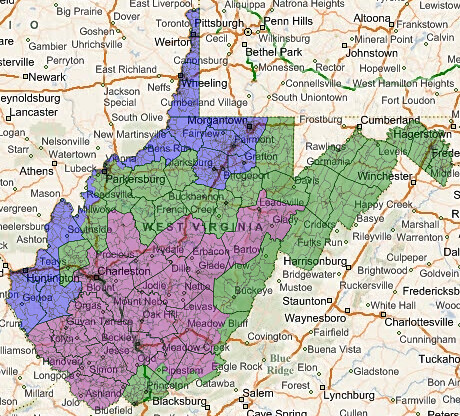
Since it is one of the states the Dems completely control, I decided to look some at what could be done in West Virginia. Two objectives came to mind:

– Shore up Rahall

– Make life difficult for McKinley

Here is my first map:

The second district (in green) is designed to soak up as many Republican areas as possible and is around 61% McCain.  The first district (in blue) is now up about 45% Obama, while the third district clocks in at just over 46% Obama.  This is compared with 42% that Obama got in both districts in their current form.

Capito Moore lives in Charleston, so she might run for statewide office rather than in the new second, but should she decide to stay in congress her non-residency should be a non-issue, given her popularity.

This got me thinking: Is 46% Obama really the best we can do in West Virginia?  Only 7 counties went for Obama and they’re scattered throughout the state.  

This lead to my second map:

The 11 counties entirely contained in the 2nd (green) district went for Obama by just over 2000 votes.  Once you include the connective strips, it probably flips to McCain, but not by very much. With precinct data I’m sure it would be possible to create something similar that actually went Dem in 2008.

I wouldn’t actually recommend such a map.  Not only does it strengthen McKinley, it puts Capito Moore in the intended D second district and Rahall and his Beckley base in the now more Republican third. Nevertheless, I thought it an interesting experiment.

Redistricting outlook: Alabama-Arkansas

Now that it’s 2011, the redistricting games will soon begin in earnest, with more detailed Census data expected in February or March and some states holding spring legislative sessions to deal with drawing new maps. Long ago I planned to do state-by-state rundowns of the redistricting process as soon as 2010 election results and Census reapportionment were clear. Now that time has arrived, and I’ll go alphabetically, starting with Alabama, Arizona, and Arkansas.

The rest below the fold…

Alabama

Photobucket

Districts: 7

Who’s in charge? Republicans

Is that important? No

Don’t expect too much drama in Alabama, as Republicans seek an incumbent protection map that ensures no Democrat getting elected in the 2nd (represented by Martha Roby) or 3rd (Mike Rogers). The 7th remains a VRA-protected black-majority district, and the only Democratic stronghold in the state.

Arizona

Photobucket

Districts: 9, up from 8 in 2002

Who’s in charge? Nonpartisan commission

Is that important? Oh, yes

Whenever a nonpartisan commission is involved, most (but not all) bets are off. Both Hispanic-majority VRA districts — the 4th, represented by Ed Pastor, and Raul Grijalva’s 7th — will have to be kept majority-minority, and the weird lines in northern Arizona separating the Hopi (in Trent Franks’ 2nd) from the Navajo (in Paul Gosar’s 1st) will remain. But the commission is under no obligation to protect incumbents, and that goes for Gosar, Grijalva, Giffords, Quayle, Schweikert, and anyone else who may face trouble in the next decade. In any case, most observers predict a new GOP seat in the Phoenix area, since Democratic areas are sufficiently concentrated in the 4th and much of the state’s population growth has occurred in conservative suburban Maricopa County.

My prediction: Republicans +1, all things being equal. Multiple incumbent defeats are, however, very possible depending on the new lines.

Arkansas

Photobucket

Districts: 4

Who’s in charge? Democrats

Is that important? Probably not

While Democrats have the redistricting trifecta in Arkansas as they did not in 2002, I cannot imagine them exploiting it particularly well. The trends in this state are as plain as the nose on your face, and Democrats know from rising GOP fortunes both within the Natural State and within all its neighboring states that their days in power are numbered. If anything, they may attempt to strengthen Mike Ross’ 4th District, the only blue seat, but I don’t see them working to dislodge Tim Griffin or Rick Crawford, both of whom represent districts that just ten years ago were considered reliably and ancestrally Democratic. It’s not easy being a Democrat in the South, particularly not the slow-growing Old South consisting of Arkansas, Louisiana, Mississippi, Alabama, et al.

In the next edition: California, Colorado, and Connecticut.

House Seats to Target for a Democratic Majority

If Democrats are to regain the majority in the House in 2012, these are the seats they must target:

Republican-held seats:

AK-AL: Don Young

AZ-1: Paul Gosar

AZ-3: Ben Quayle

AZ-5: David Schwiekert

AR-1: Rick Crawford

AR-2: Tim Griffin

CA-3: Dan Lungren

CA-4: Tom McClintock

CA-44: Ken Calvert

CA-45: Mary Bono Mack

CA-48: John Campbell

CA-50: Brian Bilbray

CO-4: Cory Gardner

FL-12: Dennis Ross

FL-13: Vern Buchanan

FL-22: Allen West

FL-24: Sandy Adams

FL-25: David Rivera

IL-8: Joe Walsh

IL-10: Bob Dold

IL-11: Adam Kinzinger

IL-13: Judy Biggert

IL-14: Randy Hultgren

IL-17: Bobby Schilling

IN-8: Larry Bucshon

IA-4: Tom Latham

MI-7: Tim Walberg

MN-8: Chip Craavack

NE-2: Lee Terry

NV-2: Dean Heller

NV-3: Joe Heck

NH-1: Frank Guinta

NH-2: Charlie Bass

NJ-2: Frank LoBiondo

NJ-3: Jon Runyan

NJ-4: Chris Smith

NJ-5: Scott Garrett

NJ-7: Leonard Lance

NM-2: Steve Pearce

NY-3: Peter King

NY-13: Mike Grimm

NY-19: Nan Hayworth

NY-25: Ann Marie Buerkle

NY-29: Thomas Reed

NC-2: Renee Ellmers

OH-1: Steve Chabot

OH-2: Jean Schmidt

OH-3: Mike Turner

OH-6: Bill Johnson

OH-12: Pat Tiberi

OH-14: Steve LaTourette

OH-15: Steve Stivers

PA-7: Pat Meehan

PA-8: Mike Fitzpatrick

PA-11: Lou Barletta

PA-15: Charlie Dent

TX-23: Francisco Canceso

TX-27: R. Blake Farenthold

WI-7: Sean Duffy

WI-8: Reid Ribble

By what margin will Bob Shamansky win?

View Results

Loading ... Loading ...

WV-Gov: Ireland Will Run

One of the few high-profile names in West Virginia GOP circles is throwing her hat in the ring for the governor’s race — whenever that may happen:

Former Secretary of State Betty Ireland announced Thursday that she will file Pre-Candidacy papers to run for the office, which will allow her to raise money for her campaign.

Ireland says she will file two forms: one for a 2011 special election year, and another for the 2012 regularly scheduled governor’s race. This will allow her to begin raising monies for a special governor’s race in 2011 if there is one, or for a 2012 race. Ireland is a Republican.

Ireland joins state Sen. Clarke Barnes, the only other Republican who has committed to this race so far. It remains to be seen if the biggest fish in the GOP wading pool — Rep. Shelley Moore Capito — will take the plunge, as well.

2010 Politicos of the Year

So, everyone else does lists at the end of the year. Why shouldn’t we? Here following, my picks for the 2010 Politicos of the year (in reverse chronological order).  

10. Suzana Martinez – NM-Gov

Martinez was a unknown district attorney when she took on Lt. Governor Dina Denish in a state that had not only overwhelmingly voted for Obama in 2008 but elected an all Democratic slate to Congress. She succesfully tied Denish into scandal-ridden outgoing governor Bill Richardson and won. The fact she did so in such a Democratic state makes her acheivement marginally more impressive than the Republicans other woman-minority governor-elect, Nikki Haley.

9. Lisa Murkowski – AK-SEN

Ran won of the worst primary campaigns in history, followed by the first successful write in campaign in 50 years. The kudos she deserves for the later far outweigh the mocking she deserves for the former.

8. Jerry Brown – CA-Gov

The former and future governor of California survived the most expensive attack campaign in American history. Almost without breaking a sweat.

7. Kamala Harris – CA-AG

A rising star, and the first woman to win this traditionally conservative law and order position. It’s no accident she’s being compared to Obama.

6. Rick Snyder – MI-Gov

“One tough nerd” managed to beat out three better known candidates in the Republican primary and crush his Democratic opponent in a state that gave Obama a landside win. Good luck with governing it.

5. Rick Scott – FL-Gov

Just as Time Magazine once picked the Ayatollah Khoemeni as “Man of the Year” we have to put Scott up there as a politician of the year. He beat out Florida’s AG for the nomination, and went on to defeat the much respected CFO of the state, despite being acclaimed as the “Madoff of Medicare,” among other titles.

4. Pete Sessions – R-Texas

It’s hard to single out one candidate in the Republican sweep of the House races this year, although some (Bob Dold? Chip Cravaack? Bill Flores) stand out. So, I’m putting Pete Sessions as a placeholder for everyone, because despite criticism about the NRCC’s tepid fundraising he managed to do better than either the RGA or the NRSC, partially through being very agressive about targeting races. Of course, we’ll see how he does in 2012, when the landscape may not be as promising.

3. Marco Rubio – FL-SEN

Almost everyone (except Kos) was declaring Rubio dead in the water when Charlie Crist released his first fundraising totals after announcing for Senate in 2009. Now, it’s Charlie Crist who is dead in the water, and Marco Rubio who is the potential Republican presidential candidate.

2. Harry Reid – NV-SEN

Here’s how much respect I have for Harry Reid as a politician: I think he would have beaten any of his opponents for Senate in 2010. He’s that good – his commercials were some of the best of the cycle.

1. Scott Brown – MA-SEN

It’s hard to believe that at the beginning of the year, it was assumed Martha Coakley, as Steve Singiser put it, “is likely to be the first woman elected to that chamber from the State of Massachusetts.” Even after all that’s happened since Brown’s victory, it’s hard to come up with a more shocking political result in a long time (the only one I can come up with is Harris Wofford’s win over Richard Thornburgh way back in 1991). What’s more, at this writing, Brown seems to be holding on to his popularity. Because Brown became the early face of the Republican wave that would sweep most strongly in the House elections, but also in the Senate, Governor and all the way down to the state legislatures, I think he should be 2010’s Politico of the Year.

WORST POLITICOS – 2010

1. Christine O’Donnell

Oh I hope she goes to jail. I really do. Even then, she probably won’t shut up. But I do have to say: thank you Erik Erickson and all the Tea Party organizations who gave us Dems a freebie in Delaware this year.

2. Joe Miller

Would have probably one a place as one of the best had he maintained his momentum after the primary. Instead, he lost to a write-in. Ultamite choke.

Del Ali

The head of polling organization Research 2000 is not a politician, but he was involved enough in politics that he makes my worst list for this year. Hope Kos wins his lawsuit.

Alan Grayson

Republicans should send a big thanks to Grayson for taking so much cash from well meaning progressives to fund an 18 point loss – one of the worst of any incumbent this cycle.

Blanche Lincoln, Paul Hodes (tie)

I guess you can give Lincoln credit for beating Bill Halter in the primary, but considering she was chairman of a major committee (Agriculture) in the Senate, shouldn’t she have been able to keep this race closer than a 22 point spread? As for Hodes, remember back in 2008 when Kos told us Hodes would finish off Judd Gregg (or whoever took Gregg’s place) in 2010? Yeah, well Hodes lost by almost 24 points. That was worse than Lee Fisher, or almost anyone else in a supposedly competitive race.