Regional Differences in the United Kingdom’s 2010 General Election

By: Inoljt, http://mypolitikal.com/

On May 7th of 2010, the United Kingdom held a general election to determine its new prime minister. While the Conservative Party gained a number of seats, this was not enough to ensure a majority. Fears of a hung Parliament subsided, however, when the Conservatives joined with the Liberal Democrats to form a governing coalition.

Here is a map of the general election:

Photobucket

This map indicates the number of seats won by each party in the general election. Red – the traditional color for socialism – is the color of the leftist Labour Party; blue the color of the conservative Tories; yellow the color of the Liberal Democrats.

More below.

Like other countries, the United Kingdom does not vote homogeneously. Certain regions are more loyal to one party; other regions to another.

Take, for instance, three distinct parts of Great Britain: Scotland, Wales, and Southeast England. The voting patterns of all three reveal some fascinating things about the country:

Photobucket

As the map above indicates, Labour dominated Scotland, winning a total of 41 seats to the Conservative Party’s paltry single seat.

Several factors lie behind Scotland’s strong pro-Labour vote. There used to be a time when the Tories could rely upon a substantial bloc of Scottish voters, mostly in the rural North. Under Prime Minister Margaret Thatcher’s term, however, pro-market reforms led to the disintegration of Scottish industry – and to this day Scotland remains hostile to the Conservative Party.

Former Prime Minister Gordon Brown’s Scottish heritage also helped him in the region. Indeed, in Scotland Labour did even better than the previous general election, winning 2.5% more of the vote.

A comparison of Labour’s performance in Wales provides evidence of this. Like Scotland, Wales constitutes a Labour stronghold; in 2005 Prime Minister Tony Blair led his party to win 30 seats out of 40 total (the Tories won 3). In 2010, however, the Conservative Party gained five seats in this Labour base. In Scotland support for favorite son Mr. Brown may have boosted Labour fortunes; this was not the case in Wales.

Mr. Brown’s Scottish heritage did not help him everywhere. In the South East England region the Labour Party received a pummeling from the Tories; they lost 13 seats, leaving Labour with a grand total of 4 seats. The Conservatives took 75 seats. Clearly, Mr. Brown’s appeal was limited here; it is possible that his being Scottish had something to do with this.

An examination of Southern England reveals yet more regional differences:

Photobucket

This map illustrates the division between Southern and Northern Great Britain. Southern England has always constituted the Tory base; Northern England the Labour stronghold.

A number of fascinating socioeconomic reasons lie behind this. Historically, Southern England was – and still is – the richest, most “snobbish” part of the United Kingdom. Indeed, the South East region constitutes the richest part of the country, apart from London. It is from this region that the Conservative Party draws its main strength.

Northern England, Scotland, and Wales are different. The forces of the Industrial Revolution have influenced their history quite profoundly; for decades their economies relied – too much, in hindsight – upon the factories, steel mills, and coal mines unleashed by industrialization. The death of Anglo-Saxon manufacturing, however, hit this region hard and left it poorer than the South.

The Industrial Revolution also catalyzed conditions ripe for socialism and left-wing politics. It created an urban proletariat – and, indeed, the Labour Party was formed to represent this class. Today these places still vote heavily for the Labour Party.

Indeed, to this day Labour constitutes the party for the working class – despite Mr. Blair’s rebranding of New Labour. This is a role the Democratic Party no longer truly holds, its grasp of the white working class torn apart by racial politics. Great Britain is still homogeneous enough to avoid this. Class still matters in the United Kingdom, far more than it does in the United States.

(Note: All images derived from BBC News.)

2010 SSP Election Prediction Contest: RESULTS!

We were going to wait for all results to be fully official before announcing our contest results (and awarding babka), but Joe “Norm Coleman” Miller seems to refuse to give it up (not even at the urging of Norm “Norm Coleman” Coleman).

Results were calculated as follows:

  • For the two-way races, we asked you for a winner and a margin. We take the difference of your predicted margin and the real margin (including third party candidates), and add that to your “regular” score.

  • For the three-way races, we asked you for the percentage each candidate was going to get. Again, we take the difference of your prediction and the actual percentage earned by the candidate, and add that to your “three-way” score.

  • Your total score is the sum of the “regular” and “three way” scores, with a lower score being better.

  • If you didn’t enter a margin/vote percentage (or we couldn’t understand what you entered), you got a “penalty” equal to the maximum score from a given race.

So a few summary statistics, by race:

  • CT-Gov: 69% of you correctly guessed that Dan Malloy would win. Average margin was Malloy by 1.52%.

  • OH-Gov: 57% of you correctly guessed that John Kasich would win. Average margin was Kasich by 1.53%.

  • OR-Gov: 90% of you correctly guessed that John Kitzhaber would win, on average by 3.39%.

  • CO-Sen: 57% of you correctly guessed that Michael Bennet would win. However, the average margin was Ken Buck by 0.40%

  • NV-Sen: 66% of you correctly guessed that Harry Reid would win, on average by 0.30%.

  • WI-Sen: 91% of you correctly guessed that Ron Johnson would win, on average by 5.17%.

  • FL-25: Only 47% of you guessed that David Rivera would win, but the average predicted margin was Rivera by 0.45%.

  • PA-07: 75% of you correctly guessed that Pat Meehan would win, by 2.96% on average.

  • VA-11: 79% of you guessed that Gerry Connolly would win, and correctly so; the average predicted margin was 2.81%.

In the three-way races:

  • MN-Gov: Average prediction was Dayton 44.45; Emmer 39.68; Horner 14.75.

  • AK-Sen: Average prediction was McAdams 31.88; Miller 33.36; Murkowski 33.62.

This could almost be a testament to the wisdom of crowds (…or alternatively, the central limit theorem) – as a collective whole, only one race would have been called incorrectly. If averages were an entry, it would have placed 21st.

So, of course, having done our best Census Bureau impression (at least we haven’t congratulated ourselves excessively!) – who won?

itskevin, abgin, and UpstateNYer come on down! (And by “come on down”, I mean “email DavidNYC with contact information” …) Sidenote: remember, you had to have submitted your entries before 5pm EDT on Election Day – and had (and still have) a valid account at the time of announcement of contest.

Full results are available here. Thanks to everyone who participated!

If you didn’t win, don’t worry, there may or may not be a prediction contest for the Chicago mayoral race, too. I see David’s babka and raise him one deep dish. That, or some dead fish wrapped in a copy of the Trib, depending on how we feel.  

Just Whistling Dixie: Unlikely Pro-Democratic Maps for Four Southern States (AL, KY, LA, VA)

After the jump, I present a survey of maps that are demographically possible if political improbable. They are presented mostly for holiday slow-time discussion fodder. The states covered are Alabama, Kentucky, Louisiana, and Virginia. Republicans will control the process in Alabama; the Democrats control a single house of the legislature in the other three states. So the Democrats are unlikely to get maps as good as these. My redistricting instincts tend towards “good government” aesthetics, so these maps are about what’s possible with relatively compact districts.

Alabama

Top-line results: 5 R – 2 D. (Neutral year, open seat, quality candidates, my impression)

This map creates two majority-black districts in Alabama, while pushing the Huntsville-based 5th in slightly more Democratic direction.

The estimates in Dave’s App put Alabama at 4.66M people. The actual Census figure is 4.78M.

The 1st and 2nd engage in extensive territory swapping with the 2nd. The 1st gains gains the southeastern corner of the state; the 2nd gains much of Mobile proper. This roughly doubles the black percentage of the 2nd, taking it to 53% black, 43% white. Martha Roby should be in trouble. The 7th is very slightly diluted, dropping from 61% to 59% black. Making the 2nd majority black also let me shore up Mike Roger’s 3rd, which lost about 8 points off its black percentage.

In the north, the 5th needed to shrink. Glancing over the last decades worth of county-level results, the eastern side of the district seemed slightly more Democratic than the western side, so I lopped off Jackson County. Mo Brooks would probably still be fine here, but I’d rate this as the district most likely to flip to the Democrats outside of the majority-black ones.

I’m not entirely sure what the Republican will do with their control. The current 4th and 6th are R+26 and R+29 respectively, so a well-executed unpacking of those districts should end shoring up the other four GOP-held districts.

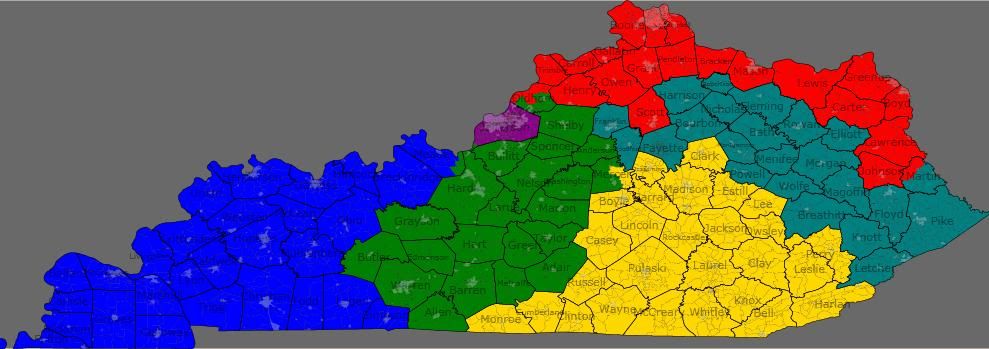
Kentucky

Top-line results: 3 R – 2 D – 1 S (Neutral year, open seat, quality candidates, my impression)

This map shores up Ben Chandler’s 6th district, while pushing the Paducah-based 1st into a potentially swingy seat. (I might be over-estimating Democratic chances there.)

The estimates in Dave’s App put Kentucky at 4.04M people. The actual Census figure is 4.34M.

Looking at recent governor and US senator races, I noticed that the geographically largest areas of Democratic support in Kentucky is in the central portion of western eastern half of the state. That support is currently cracked into parts of three districts. I consolidated that support into Chandler’s 6th (teal), which should go from swingy to solidly Democratic.

In doing so, I forced the 5th (yellow) to the west, eating up areas that are contributing to Republican margins in the 1st (blue). (The new 5th is very Republican — it’s the only district without a single county that went Democratic in either of the last two US Senate races.) This new 1st should be winnable for a Democrat under the right circumstances — for example, by eyeballing it, I estimate that Mongiardo probably won in the 2004 Senate race.

I actually think that my 6th might have a decent shot of being created if the state House Democrats can force incumbent-protection. It’s just that the first will need to be solidified for the Republicans by some territory swaps with the 2nd and 5th.

Louisiana

Top-line results: 3 R – 2 D – 1 S. (Neutral year, open seat, quality candidates, my impression)

This map creates two majority-black districts in Louisiana, while trying to make the Shreveport-based 4th as Democratic as possible.

The estimates in Dave’s App put Louisiana at 4.41M people. The actual Census figure is 4.53M.

The 2nd (green) and 6th (teal) are the intended majority black districts. The actual figures are more like 49.6% in each. The 4th (red) is 54% white, 41% black. I hope that’s enough to make the 4th competitive for the Democrats.

Most speculation I’ve seen indicated the Republicans will be trying to make a single Baton Rouge-to-New Orleans majority-black district. Given the recent rate of party switching in the Louisiana state legislature, I imagine they’ll probably succeed.

Virginia

Top-line results: 5 D – 4 R – 2 S (Neutral year, open seat, quality candidates, my impression)

I originally presented this map in a comment in diary by drobertson. It fits the theme though, so I’m reposting it for consideration. This map is probably the most “good government” of these maps – each district basically corresponds to an existing political/cultural region of Virginia.

Its most notable feature is that presents two plurality black districts in the southeastern part of the state.

The estimates in Dave’s App put Virginia at 7.77M people. The actual Census figure is 8.00M.

1st (blue) – Peninsulas – Obama 46, McCain 54

2nd (green) – Suburban Hampton Roads – Obama 49, McCain 51

3rd (purple) – Urban Hampton Roads – Obama 69, McCain 31 — VRA: 49% black, 42% white

4th (red) – Richmond, Petersburg, and South Virginia – Obama 61, McCain 39 — VRA: 50% black, 44% white

5th (yellow) – Piedmont – Obama 47, McCain 53

6th (teal) – Shenandoah – Obama 43, McCain 57

7th (grey) – Richmond suburbs – Obama 42, McCain 58

8th (slate blue) – Arlington, Alexandria, north Fairfax- safe D

9th (cyan) – southwest Virginia – Obama 40, McCain 60

10th (magenta) – Prince William and Loudoun – Obama 56, McCain 44

11th (lime) — south Fairfax and Manassas – ???

The presidential percentages are back-of-the-envelope style. I used the 2008 figures to the nearest hundred and counted split cities/counties as if they were wholly within the district they were most in. I didn’t feel like delving into Fairfax precincts for the 8th/11th. The 8th should be just as safe as it is now, and I think, though I’m not 100% certain, that this version of the 11th is more Democratic than the current one. (Drobertson questioned this assertion at the time I made it, but agreed that this new district ought to be better for Gerry Connolly if not Generic D.)

The 2nd is more Republican than listed, but I don’t know how much more. I counted Isle of Wight and Suffolk as if they are wholly in it, but they are both donating their most heavily black precincts to the neighboring 4th and 3rd, respectively.

There’s a similar dynamic for the 4th and 7th, which are probably even more firmly in their respective parties’ control than it appears. I counted all of Richmond and Henrico in the 4th, but the majority white parts of each are actually in the 7th.

Notes on incumbents: Wittman, Scott, Cantor, Goodlatte, Moran, and Connolley are all fine. Rigell and Forbes would share the 2nd. Hurt lives in the new 4th. Griffith lives in the new 6th. Wolf lives in the new 8th. I assume all three of them would continue to run in the same districts anyway — all of them are in counties adjacent to their districts.

In the real world, the Virginia state senate Democrats should be able to force incumbent-protection, but seperating Richmond from Hampton Roads for two black opportunity districts won’t be happening.

MN-Sen: Why Bachmann Will Run

http://polibeast.blogspot.com/…

I admit, I’m a pretty nostalgic guy. I’m the type who, despite my limitless political junkiness, would much prefer falling asleep at night to TV Land or Nick at Nite, as opposed to the chatter on MSNBC or FOX. My all-time favorite show is “The Wonder Years,” and, when I’m rich and have a hot wife, I plan to collect comic books and pinball machines, in due part because they remind me so strongly of past times. (Yeah, I’m THAT cool.)

There is a political sort of nostalgia I hold, too. For instance, I wish I were around for the 1984 election, where I would have so passionately championed the Mondale/Ferraro ticket. Here are two figures I hold the highest regard for, and who I only wish I were able to have voted for. I look back on the glory days of Scoop Jackson, John F. Kennedy, and other Democratic juggernauts with the same wide-eyed look as I do old sitcoms and Phil Spector records. There’s something about old Americana that I can’t help but love.

I hate to admit this, but, as of late, I’ve found myself nostalgic for, of all people, Katherine Harris. Yes, liberal readers, the former Florida Secretary of State and U.S. Congresswoman. You know, the one who was so obviously non-partisan, fair, and unbiased in the 2000 presidential race? Yeah, that one.

See, the thing is, I see this new crowd of Katherine Harrises, the Sarah Palin/Michele Bachmann/Christine O’Donnell coalition of right-wing women, are merely amateurs in comparison to the original Tea Party Queen (well, in all fairness, that title probably belongs of Phyllis Schalfly, but, c’mon, she was no fun). Harris was as loony, crazy, and uber-conservative as they come, and the U.S. House is less entertaining as a result of her absence. She was really something else.

The reason I find myself lately pondering Katherine Harris is that one of those aforementioned Tea Party gals, Michele Bachmann, appears poised to stage a very Katherine Harris-y move.

I get the sense that Bachmann, who’s really one of our most clueless and deranged U.S. House members, sees herself much in the same vein as Harris – that, like Harris thought of herself, she is something bigger and better than just an ordinary U.S. Congresswoman. Her political ambitions are too bombastic for her to remain in the U.S. House, and I firmly believe that, because of these ambitions, Bachmann will make a surprising power play in ’12.

I believe that Bachmann will run for the U.S. Senate against Minnesota Democratic incumbent Amy Klobuchar in ’12. Why?

Well, much like Harris in 2006, Bachmann rightfully realizes that the state’s conservative base would catapult her to a comfortable primary victory. This is true. She wouldn’t even have to worry about it. In ’06, Harris knew all along that she probably couldn’t beat incumbent Sen. Bill Nelson. What she realized, though, is that she could cruise through a primary, and, that if Nelson staged a blundering gaffe during the general election, she might at least have a small chance of winning. (That gaffe never happened, and she lost by 18 points.)

For Bachmann, it’s the same thing. Like Nelson in ’06, Klobuchar is a relatively popular incumbent, and, like Harris in ’06, Bachmann is far too conservative for her state’s electorate. What Bachmann hopes is that Klobuchar doesn’t run as sterling a campaign as Nelson in ’06 – that, somehow, Klobuchar screws up so royally that a Tea Party candidate can win statewide in one of the most blue states in the union.

Even if Bachmann loses, however, it’s a winning situation. She’s no longer just one of hundreds of U.S. House members. She took her shot at the big leagues, won her party’s nomination statewide, garnered tons of national press attention, and further established herself as a hero to the right. In the end, U.S. Senate victory or not, she’ll probably feel awfully good at the end of the day.

As for Harris, I’m sure she enjoyed the attention and thrill of the ’06 race. Sure, she’s no longer relevant, but, hey, does relevancy necessarily matter when you’re at home sitting on the gigantic pile of cash you built-up when you were relevant? Probably not a whole lot.

For Bachmann, I suspect a U.S. Senate run is a risk she’s more than willing to take. (Not that she has a snowball’s shot in hell of winning.)

http://polibeast.blogspot.com/…

Illinois Redistricting 12-4-2

Illinois looks to be one of the few bright spots for Democrats in redistricting.  An unexpected hold of the Governor’s seat gives Illinois Democrats the vaunted trifecta.  This map assumes blank things:

1) There will be 3 black VRA districts and a single Hispanic district.  In the next redistricting there will likely finally be 2 Hispanic seats.  For now the Hispanic community is too spread out to effectively draw a district.

2) Comebacks aren’t the most effective way to go.  Some of those had no right to be blue (see IL-14, IL-8), drawing a map based on those districts isn’t the wisest path for a Democratic gerrymander.

3) The Democrats won’t shy away from drawing districts that require a fight.  There’s an impulse toward the safest path in the Democratic party.  A map with about 10 surefire Democratic seats may be possible, but this year it’s worth it to push for the extra seats.

It’s been done to death, but it’s where I live and work so, without further ado:

Image Hosted by ImageShack.us

Image Hosted by ImageShack.us

Image Hosted by ImageShack.us

Image Hosted by ImageShack.us

CD 1 (Blue)- Bobby Rush (D)

W: 39% B: 54%

Major Cities: Orland Park, Tinley Park, Orland Park, Blue Island, Homer Glen, Chicago

Safe Democratic

Bobby Rush’s southwest side district remains mostly the same.  It is significantly less black than it was before, but it is still a majority.  The district reaches out and grabs a significant chunk of the current 13th district.  It will remain a safe Democratic district, if not so overwhelmingly.

Image Hosted by ImageShack.us

CD 2(Dark Green)-Jesse Jackson Jr. (D)

W: 32% B: 54% H: 11%

Major Cities: Chicago Heights, Calumet City, Peotone, Chicago

Safe Democratic

Similar to the 1st district the 2nd grabs some Republican leaning areas and becomes significantly less black.  Like the 1st it’s still a solid Democratic district and Rep. Jackson’s as long as he wants it.

Image Hosted by ImageShack.us

CD 3 (Purple)-Dan Lipinski (D) or Judy Biggert (R)

W: 64% H: 27%

Major Cities: Hinsdale, Burbank, Oak Lawn, Berwyn, Cicero, Chicago

Safe Democratic

Judy Biggert’s home is technically in the 3rd, but running here would be an uphill fight for her.  More likely she’ll decide that at 75 her decades of public service are enough.  The core of the Lipinski family’s 3rd district is still there.  It picks up more Hispanic areas in the east to offset the areas of DuPage it grabs.

Image Hosted by ImageShack.us

CD 4(Red)-Luis Gutierrez (D)

W: 19% H: 70%

Major Cities: Chicago

Safe Democratic

It’s still super-Hispanic.  The northern enclave is somewhat larger and the southern one somewhat smaller.  The connection between the sections is less painfully gerrymandered.

Image Hosted by ImageShack.us

CD 5(Yellow)-Mike Quigley (D)

W: 64% H: 23%

Major Cities: Addison, Bensenville, Elmwood Park, Chiago

Lean Democratic

The 5th district grabs a large chunk of downtown Chicago and a large chunk of DuPage County.  I’m most worried about this district’s safety, back of the envelope numbers and a couple of guesses say the district should be safe, but actual results would make me feel better about the seat.  Quigley does hold onto most of his base and the majority of the district is in Chicago.  Admittedly I’m being over cautious.

Image Hosted by ImageShack.us

CD 6(Teal)-Peter Roskam (R), Randy Hultgren (R), or Judy Biggert (R)

W: 75% A: 9% H: 10%

Major Cities: Wheaton, Naperville, Downers Grove, St. Charles, Barrington Hills

Safe Republican

Bench: Fred Crespo-HD 44

The 6th district becomes a suburban Republican vote sink.  Roskam’s district keeps its Wheaton base, grabs Republican strongholds in Naperville, St. Charles, and Barrington Hills.  All of the west and northwest suburban precincts that are unpleasant for Democrats get stuffed in here.  If Democrats insist on running a candidate who is more than a placeholder, state rep Fred Crespo held his seat in November and could run.  It’s a bad idea, but if the party insists.  On the Republican side both Roskam and Hultgren live in the district.  Both represented the 48th district in the state Senate and a primary fight between the two would be something to see.  A big part of Biggert’s base is in the district.  She could decide to run here, but is as likely to retire.  Which is disappointing because I’d pay to see a three-way brawl between sitting Republican Congressmen.

Image Hosted by ImageShack.us

CD 7(Silver)-Danny Davis (D)

W: 25% B: 53% H: 16%

Major Cities: Villa Park, Elmhurst, Bellwood, Oak Park, Chicago

Safe Democratic

Davis’ district picks up some new territory in DuPage.  It’s still a majority black district (though less than before).  And it’s still a Democratic district, though less than its current D+35.

Image Hosted by ImageShack.us

CD 8(Purple)-Joe Walsh (R) or Vacant

W: 67% H: 19%

Major Cities: Waukegan, Lake Forest, Highland Park, Vernon Hills, Grayslake, Gurnee

Lean Democrat

Bench-Rep. Melissa Bean, Sen. Susan Garrett LD-29, Sen. Terry Link-LD 30

The 8th pulls almost entirely out of Cook County and takes the whole of Lake County plus a sliver of Barrington.  It’s a swing district.  Bean may have been able to hold it this year, especially against Walsh.  This district leans ever so slightly Democrat.  Bean could run again here, she’s not a retread for most of the district.  She kept the score close throughout Lake County in 2010, and won it in 2008.  Even Dan Seals won the parts of Lake in the 10th in 2010 and 2008.  If Bean doesn’t make an attempt to reclaim her seat State Senators Susan Garrett and Terry Link are positioned to make a run for Congress.

Image Hosted by ImageShack.us

CD 9(Blue)-Jan Schakowsky (D)

W: 64% A: 11% H: 14%

Major Cities: Evanson, Park Ridge, Des Plaines, Evanston, Chicago

Safe Democrat

Schakowsky’s seat doesn’t change much.  She loses much of Skokie and Niles and picks up more of Chicago and Republicans areas around Northfield, Wheeling and Rosemont.  If anything her seat comes out stronger.

Image Hosted by ImageShack.us

CD 10(Pink)-Bob Dold (R)

W: 70% A: 14% H: 12%

Major Cities: Schaumberg, Rolling Meadows, Arlington Heights, Skokie, Northbrook

Lean Democrat

Bench: Rep. Elaine Nekritz HD-59, Sen. Jeff Schoenberg LD-9, Julie Hamos, Dan Seals

This seat should have been a Democratic seat ages ago.  Any gerrymander should be sure to put the 10th over the top.  The 10th now stays mostly within Cook County, ducking into DuPage for just a few thousand votes.  If Democratic strongholds in Schaumburg, Niles, Skokie, Northbrook and Winnetka combined with Democratic trending Hoffman, Elk Grove and Palatine can’t produce a Democrat in this district then there truly is a curse.  Popular state Senator Jeff Schoenberg could make a successful run for the seat, though the real boon would be state rep Elaine Nekritz.  Nekritz is an archetypical suburban Democrat: socially progressive and fiscally moderate.  She would run the table in a district like this.  Some area Democrats are hoping for a Julie Hamos comeback.  I dislike the idea personally because of the first rule of suburban Chicago politics: if you can’t beat Dan Seals you don’t get a second chance.  Which leads us to Dan Seals, who could take a fourth crack at the seat.  By no means should he, but by no means should he have run this year, so we’ll have to see.

Image Hosted by ImageShack.us

CD 11(Blue)-Adam Kinzinger (R) or Tim Johnson (R)

W: 79% B: 11%

Major Cities: Champaign-Urbana, Bloomington-Normal, Decatur, Danville, Kankakee

Tossup

Bench: Sen. Mike Frerichs-LD 52

The 11th grabs every Democratic leaning city in eastern Illinois.  The college towns Champaign-Urbana (People’s Republic of) and Bloomington-Normal as well as the union towns of Decatur and Danville make up half to two-thirds of the district.  The rest of the district is decidedly anti-Democrat.  Putting this district in the D-column comes down to a turnout fight.  Sen. Mike Frerichs is a Democrat who can win right-leaning voters.  He’ll be able to stop a Republican from running up the score in between the cities.  Tim Johnson lives in Urbana and represents the 15th district currently.  He could run here and have a chance to win, but up-and-comer Adam Kinzinger also live in the district.  Johnson has seniority, but Kinzinger has the potential to be a rising star of the party.  Here’s hoping for a cage match.

Image Hosted by ImageShack.us

CD 12(Blue)-Jerry Costello (D)

W: 79% B: 16%

Major Cities: East St. Louis, Edwardsville, Carbondale, Alton, Cairo

Safe Democrat

The 12th is relatively unchanged.  It picks up some new territory in Calhoun County and around Edwardsville, drops some of Williamson and Jefferson Counties, and remains a safe district for incumbent Costello.

Image Hosted by ImageShack.us

CD 13(Pink)-Randy Hultgren (R) or Vacant

W: 61% B: 11% H: 24%

Major Cities: Joliet, Aurora, Lockport, Romeoville, Batavia

Lean Democratic

Bench: Rep. Bill Foster, Rep. Linda Chapa LaVia-HD 83, Sen. Linda Holmes-LD 42, Sen. Arthur Wilhelmi-LD 43.

The 13th district picks up Aurora and Joliet for its loses in DuPage.  This district is distinctly more Democratic.  It’s not a district to take for granted, but in a fair fight expect a Democratic win.  Bill Foster could run for this district from Batavia, or any member of the deep bench in the area could rally a coalition of minority and working class voters in the area.  Sen. Wilhelmi would, I believe be the strongest candidate on the Democratic side.  Hultgren could run here if the party moved to protect Roskam.  It would ultimately be a fools errand; in 2010 Foster pounded Hultgren 61-37 in Aurora.

Image Hosted by ImageShack.us

CD 14(Brown)-Joe Walsh (R) or Vacant

W: 71% H: 19%

Major Cities: Elgin, Rockford, McHenry, Crystal Lake, Batavia

Tossup

Bench: Rep. Jack Franks-HD 63, Rep. Keith Farnham-HD 43, Sen. Mike Noland-LD 22

Joe Walsh could run here.  He’s claiming his home is in McHenry now.  McHenry County was good to Walsh in 2010 and he may want to stay with his base.  The district is not as Republican as it looks at first glance.  Democratic Rockford and Elgin make up about half of the district while McHenry county not is the wasteland it was five or ten years ago.  Democrat Jack Franks has kept his northwest McHenry county seat Democratic for more than a decade now.  If Franks runs it’s a narrow advantage for the Democrats, if he doesn’t it’s a complete tossup.

Image Hosted by ImageShack.us

CD 15(Orange)-Tim Johnson (R) or John Shimkus (R)

W: 93%

Major Cities: Charleston, Effingham, Colinsville, Metropolis, Centralia

Safe Republican

Bench: Rep. Jay Hoffman-HD 112, Rep. Brandon Phelps-HD 118, Sen. Gary Forby-LD 59

The Republicans have to go somewhere.  This is one of them.  Any democrat running here is a ConservaDem placeholder.  The interesting thing to watch could be two powerful Republicans wailing on each other.  If Johnson is pushed out of the 11th to make way for Kinzinger then it’s likely that he’ll hop the border and try to run in the 15th.  About a third of Johnson’s old 15th remains in the new 15th.  If neither Johnson nor Shimkus feel like retiring things could get fun down here, grab the popcorn.

Image Hosted by ImageShack.us

CD 16(Light Green)-Don Manzullo (R)

W: 87%

Major Cities: Freeport, Galena, Rochelle, DeKalb, Morris, Lasalle

Lean Republican

Bench: Rep. Careen Gordon-HD 75, Rep. Frank Mautino-HD 76

Manzullo’s old district, less Rockford, Boone County and McHenry County plus north-central Illinois.  This 16th will generally be a Republican hold, but is not as monolithic as the other downstate Republican seats.  Bureau, LaSalle, Jo Daviess, Carroll, and Stephenson are willing to vote Democratic if they’re given a good enough reason.  Combined with liberal Putnam county and left trending exurban counties (DeKalb, Kane, Kendall) this seat could turn blue for a short while in a Democratic wave year.

Image Hosted by ImageShack.us

CD 17(Purple)-Bobby Schilling (R) or Aaron Schock (R)

W: 82% B: 10%

Major Cities: Peoria, Quad Cities, Springfield, Galesburg, Sterling, Macomb

Lean Democratic

Bench: Rep. Mike Boland-HD 71, Sen. Mike Jacobs-LD 36, Sen. David Koehler-LD 46, Rep. Phil Hare.

This was a Democratic seat for some 30-years.  It still is; it fell prey to a weak candidate and a terrible year in an area that has passed recession and is economically depressed.  There is no problem with keeping a western Illinois Democratic district.  This map strengthens the 17th, cutting Republican Adams and Hancock Counties and picking up Peoria, Mason County, and the rest of Springfield while holding the Democratic core of Knox, Henderson, Mercer and Rock Island Counties.  A number of Democrats have expressed interest in taking back what will be one of DCCC’s top targets in 2012.  Any of them should have a good chance to beat the Republican.  Bobby Schilling currently represents the 17th, but Aaron Schock now lives in the district.  He’ll likely keep running in the 18th though.

Image Hosted by ImageShack.us

CD 18(Yellow)-Aaron Schock (R)

W: 95%

Major Cities: Quincy, Jacksonville, Pekin, East Peoria

Safe Republican

Bench: Sen. John Sullivan-LD 47, Sen. Deanna Demuzio-LD 49

Schock’s district gets stronger.  He picks up Macoupin County and its Democratic machine, but more than cancels it out with Adams, Hancock and Tazewell Counties.

Madigan may balk at this map.  It somewhat weakens Lipinski while strengthening Schakwsky (Madigan likes Lipinski and dislikes Schakowsky) and it likely takes Jack Franks out of the House, a seat that will probably flip without Franks.  Also, rather than going for a more sure 13-5 split the map tries to run up the score to 14-4.

This map isn’t necessarily a prediction of what we’ll see.  But it is, I believe, the most aggressive map Democrats can draw.  And as a Democrat its the map I hope to see.

Arkansas: 1D-1S-2R or 0D-2S-2R?

The redistricting process give the chance of have some improvement in Arkansas. Here the democrats keep still the trifecta and will draw the map what they want. Then this is a very interesting state for redistricting.

I think the democrats from Arkansas should take this chance for redistricting like the last time having the trifecta.

Looking to the results of the last election I think they are two possible combinations:

1D-1S-2R

0D-2S-2R

Arkansas 1D-1S-2R

The 1D-1S-2R can be the safest in the short term. And it would be better still if the democratic district can have the protection of the VRA.

I would like the democrats here find the VRA protection for one of the districts, because I think the republicans can draw a 4-0 map for them when they can, if they are not one district protected by the VRA.

The first map what I draw find the most black areas in the state for see if they are enough black in Arkansas for do a VRA district in the state. It is a map what shows the most black areas in the south and the east of the state with the size of a US House district. They are no-conected areas with the size of a district and over 50% black:

Photobucket

This areas would give the chance of create a minority-majority district with the blacks as first group if we try to connect the most black precints.

But it seems the current laws in the state leaves not divide the counties in different districts. If we take the most black option for a district in Arkansas we would have a district 38.32% Black like this:

Photobucket

It is not enough for have the protection of the VRA law. I would like the democrats from Arkansas think if it would be good to change the laws for make a VRA district or not.

But the next maps finding a good redistricting (since the democratic point) try to respect the current laws.

A little less black (38.25%) would be the most democratic district what the democrats from Arkansas can do. It is the AR-02 in the next map. This is the most democratic combination what I find, the best for unseat T Griffin.

This district would be 56.69% Obama, a 17.83% better than the average of the state (38.86% Obama). And being Arkansas R+9 still, that mean this district can be approximately D+8.

Photobucket

Taking this district as the new AR-02, and finding the most democratic combination possible between all the other counties for keep the seat of M Ross, we would have a map like this:

Photobucket

This new version for the AR-04 would be 42.59% Obama what is 3.73% better than the average of the state (38.86% Obama). That would give approximately a R+5 district. It is not easy to leave enough connected population for the AR-01 and AR-03 districts. The rating of both districts would be R+20 or little plus.

Arkansas 0D-2S-2R

Other different option would be to find a 0D-2S-2R combination with two swing district with rating close to EVEN. Just I need to find the most democratic option for come to this goal and this leaving decent deviations. It is not difficult to draw a D+ district including Pulaski county, but is so difficult to draw a EVEN district without this county. But well, this would be the district:

Photobucket

This version of the AR-04 (because includes Nevada county) is only 47.23% Obama, 8.37% better than the average of the state (38.86% Obama), and being Arkansas R+9, this district would be aproximately EVEN or R+1. This district would be 36% black.

The rest of the map with the best combination possible for AR-02 leaving enough space for AR-01 and AR-03 would be:

Photobucket

This version of AR-02 would be 47.22% Obama, 8.36% over the average of all the state (38.86%) and would be aproximately EVEN or R+1.

In this map again AR-01 and AR-03 would be R+15+.

I think the 1D-1S-2R option is better if:

– If we can have a VRA district in Arkansas (doing the necessary changes in the current law).

– While M Ross continues in the US House.

The 0D-2S-2R can be better if M Ross leaves the US House for run for Governor (as example).

By what margin will Bob Shamansky win?

View Results

Loading ... Loading ...

All I Want for Christmas is a Nevada Redistricting

Merry Christmas to everyone who celebrates it, whether on 25 December or otherwise. While waiting for the ham to be done, I drew up a map of Nevada with four shiny new districts, just what the U.S. Census Bureau ordered.

The way I drew it, we’re basically looking at a 2-2 map, with three if not all of those districts being somewhat “soft” (potentially competitive in the right cycle) due to the quirks of Nevada geography, politics, and geopolitics. Some people on other threads (the Missouri one, for example) have suggested that Gov.-elect Sandoval and the Republicans will probably be satisfied to shore up Rep.-elect Heck somewhat in exchange for letting the Democrats have their way, to an extent, with the new NV-04. I’m inclined to agree. Also, drawing a safe 1-3 map for a rapidly blueing state like Nevada is not terribly easy.

I don’t usually go out of order, but we should probably start at the top here (geographically rather than numerically) because Nevada is an oddly shaped state.

NV-02 (green, safe lean Republican)

Rep. Dean Heller, a Republican, is thought to be prepping a Senate bid against Sen. John Ensign, the scandal-tarnished Republican incumbent whose unreliability and moral flexibility has been a thorn in the side of Republican leadership in Nevada and in Washington for several years now. If he decides to forgo a bid for statewide office in favor of running for reelection, I doubt he’ll have a problem here. Washoe County may be swingy, but Heller is popular, and any Republican can run up crushing margins in the cow counties. If Heller runs for Senate in 2012, though, Republicans and Democrats alike will want to put a lot of effort into recruiting top-tier candidates here.

NV-01 (blue, safe Democratic)

Vegas, baby! This is Rep. Shelley Berkley’s district, and she’s considered the likeliest Democrat to run for Ensign’s seat in 2012. I figure she’ll vacate, and it’s just as well, because although Nevada isn’t a VRA preclearance state, the Department of Justice may lean on the incoming Sandoval administration to ensure a minority-majority seat. Latinos are actually about a quarter of Nevada’s population, they’re the fastest-growing demographic, and it’s pretty easy to draw a compact Latino-plurality district. This district is actually 28% white, 14% black, 6% Asian, and 49% Latino, going off 2008 population estimates, and I’ll bet dollars to doughnuts it’s outright Latino-majority in the new census data. Sandoval himself may do okay here, but it’s a safe Democratic district.

NV-03 (purple, likely Republican)

Rep.-elect Joe Heck edged Rep. Dina Titus, flipping the present “fair fight” incarnation of this district from blue to red, last month. One of Sandoval’s top priorities will be shoring him up. Adding a bunch of cow counties and consolidating the district’s hold on white-collar Clark County precincts is a decent way of accomplishing that. While Sharron Angle might lose this district, and Titus could conceivably take it back, it now tips pretty firmly in Heck’s favor.

NV-04 (red, likely Democratic)

One of the big reasons why the current NV-03 is a swing district is that it includes both Democratic and Republican areas along with some subdivisions that go both ways (no, not like that, most of those are pretty heavily Democratic). I gave most of those Republican areas to my NV-03, or at least I tried to, while NV-04 takes over most of the Democratic areas, centering around Spring Valley. It’s a mostly suburban district, though it includes just a bit of rural Clark County up Highway 95. Titus or another strong Democrat with a suburban base should be pretty solid here except in particularly gruesome cycles, although a socially moderate or libertarian Republican could potentially win it.

As a Christmas bonus, I’m also going to repost my revised and updated map for Missouri, which shrinks to eight districts in 2012’s redistricting, without much commentary:

This isn’t necessarily the most favorable map Democrats can possibly get, but it’s probably the most favorable map they’re likely to get in 2012. (There’s a whole discussion about this on the other diary.) It’s probably a 3-5 map, with Democratic Rep. Russ Carnahan’s MO-03 (purple) likely playing host to a deathmatch between Carnahan and Republican Rep. Jo Ann Emerson of Cape Girardeau in 2012.

A few quick notes: Democratic Rep. Lacy Clay’s MO-01 (blue) is 48% white, 47% black, remaining VRA-compliant. I was of the school of thought saying it couldn’t be done without throwing Carnahan overboard, but there you have it. Carnahan’s share of St. Louis County consists almost entirely of precincts that voted for then-Sen. Barack Obama in the 2008 presidential election, so I think Mr. Local Boy has a good base there. And Republican Rep. Todd Akin’s home in rich white Town and Country remains in his district of MO-02 (green).

Not much to add here. Democratic Rep. Emanuel Cleaver in MO-08 (slate blue), renumbered from the current MO-05, still doesn’t get a VRA district, but he’s a good politician who is popular with both white and black Democrats in Kansas City. I resisted the urge to dismember Republican Rep.-elect Vicki Hartzler’s MO-05 (yellow), renumbered from the current MO-04, because I didn’t think the Republicans in the Missouri state legislature would let such a plan get to Democratic Gov. Jay Nixon’s desk.

Hope everyone is dividing their time as they see fit between family, friends, and politics. Thoughts on either map are welcome and appreciated.

Upstate NY redistricting

Another try at New York.

I am emphasizing upstate NY-from Westchester County upwards.  I am assuming that the Dems lose a seat in NYC, so the Rs will now have to take a hit upstate.

General map

Photobucket

Old CDs overlaid on New map

In several instances, the ideal percentage for a party was reduced in an effort to keep some coherence in township boundaries.

for ease of reference, I am keeping the old CD numbers and general locations where possible.

Photobucket

Old CD17       New CD17

O72% M28%      O67% M32%

Rockland, Westchester, NYC

safe for Engle. An alternative would be to push CD17 completely into NYC, making CD18 a Westchester/Rockland District.  Either way, both CD17 and CD18 would be safe D.

OldCD18         NewCD18 Lowey

O62 M38         O70% M30%

Westchester County, NYC

Old CD19       New CD19  Hayworth

O51% M48%      O50% M49%

Could have hiked  the McCain % some if she didnt live in Westchester.

Loses Dutchess County, gains R portions of Rockland.

Old CD20       New CD20  Gibson

O51% M48%      O50% M49%

Similar configuration to the old.  Loses some of the more D portions of Dutchess, gains Fulton County.

Old CD21       New CD21 Tonko

O58% M40%      O58% M40%

Gains Otsego county, but similar configuration

Old CD22  New CD22 Hinchey

O59 M39   O58% M40%

Similar configuration to old district. Gains all of Tompkins County, parts of western Dutchess County. I could easily bring back up to 59% by breaking up townships in Dutchess.

Old CD23  New CD23 Owens

O52 M47   O58% M40%

Major surgey to bring in Syracuse City, but over half the district [the good half] is from Owens old CD23.  A brutal primary with a Syracuse politician could be fatal, but this seems the only way to bring in the necessary D voters. 200,000 of the district is now Syracuse.

CD24  disappeared into new CD24, CD29, CD25

Old CD25       New CD25 Buerkle and Hanna both R

O56% M43%      O50% M48%

Looks like a fight between Onondaga County Buerkle][sans Syracuse] and Oneida county [Hanna]

Old CD26       New CD26 Lee

O46% M52%      O45% M54%

Loses Monroe county, gains in Erie county, and gains Chautauqua county, but retains the general configuration of his old district.  I deliberately kept all of his old district in his new, outside of the above, since Lee probably has the clout vs Reed to do so.

Old CD27       New CD27 Higgins

O54% M44%      O63 M35

City of Buffalo

Old CD28       New CDRochester

O69% M30%      O58% M40%

I did read somewhere that Slaughter was not happy with the dumbell.  Well, now her district is confined to Monroe County.

Old CD29     New CD24 Reed

O48 M51      O46 M52

Mostly the old CD29, sans Monroe County. Gains 4 counties on the eastern edge from CD24 and CD25.

Map of Old CDs on new

Photobucket

Maps of Colorado Elections

To follow up the series of posts on Colorado, I’ve posted a few recent presidential elections in the state (courtesy of the New York Times). Each map comes with some brief analysis.

Photobucket

Boosted by a Democratic National Convention held in Denver, Senator Barack Obama wins a thorough victory in the ultimate swing state of 2008. The Democratic candidate does especially well in the Republican-leaning suburbs of Denver – winning several outright and dampening margins in Douglas County and Colorado Springs.

More below.

Photobucket

Written off early as a sure Republican victory, Colorado surprises pundits in 2004 with a surprisingly strong Democratic performance. It is one of the few states where Democrats do better than in 2000 as they pick up the 2000 Ralph Nader vote.

______________________________________________________

Photobucket

Governor George W. Bush performs well throughout the Rocky Mountains in 2000, and Colorado is no exception. With Green Party candidate Ralph Nader pulling off a substantial bloc of liberal voters, Mr. Bush even cracks the Democratic “C” that composes the Democratic base of Colorado.

______________________________________________________

Photobucket

Conservative Colorado returns to form in 1996; President Bill Clinton loses the state by the barest of margins as conservative Ross Perot voters go Republican. Republican Bob Dole wins based off Republican strength in Colorado Springs and rural Colorado.

______________________________________________________

Photobucket

Surprise! – reliably Republican Colorado votes Democratic for the first time in a generation, and for the first time in a competitive race since the days of Harry Truman. To be fair, this map somewhat overstates Democratic strength: Republican margins are dampened by Ross Perot’s strength amongst conservatives.

–Inoljt, http://mypolitikal.com/