HI-01: CQ Says DCCC May Back Case

Wow, this would be explosive:

House Democrats are considering backing former Rep. Ed Case in Hawaii’s competitive winner-take-all special election next month, a move that would run counter to the endorsements of the Aloha State’s two Senators.

Several sources with knowledge of the situation said that the Democratic Congressional Campaign Committee is inclined to support Case over state Senate President Colleen Hanabusa, who has the support of Hawaii Democratic Sens. Daniel K. Inouye and Daniel K. Akaka, organized labor and EMILY’s List.

CQ doesn’t really get into the “why,” except to say:

But according to sources familiar with the committee’s considerations, national Democrats see several weaknesses in Hanabusa’s candidacy stemming mostly from her tenure in the state Legislature.

Hanabusa’s second campaign spot of the cycle, for example, boasted she “cut legislative salaries,” but she was maligned in the press last week for taking a pay raise while she made the cut.

That’s it? Really? Don’t get me wrong – the ad flub is pretty ugly. And many people don’t have especially warm feeling towards state legislatures these days. But not only does Hanabusa have the support of pretty much the entire political establishment in Hawaii, she’s also a much stronger fundraiser than Case. Indeed, she’s expected to report $400K raised in Q1, while Case hasn’t offered an estimate and very likely raised less. Then of course there’s also the fact that supporting the conservative Case in a district this blue would be a monster fuck-you to progressives. (Yes, favorite son Barack Obama inflated the vote totals in his home state, but this was a D+7 district just based on the Gore & Kerry results.)

Now, I appreciate that the unusual nature of this all-party jungle election might force the DCCC to make some unusual choices here. And perhaps they have polling showing some tough negatives for Hanabusa. But backing Case would nonetheless be a very divisive move which could very well backfire, seeing as it could sour the race between the two Democrats even further. (Just think about all the bad blood there’s been in GOP races where the Republican establishment picks a favorite.) I have a sinking feeling in my stomach about how this one will play out.

SSP currently rates this race as Lean Dem, but that rating could definitely change.

CA-Gov, CA-Sen: County Baselines

Here is my attempt at estimating the county baselines to see the absolute minimum we can pull in the counties to be able to break 50% statewide in California. Based on trends that I’ve pointed out many times over, close races in California are likely to get rarer and rarer, so I decided that now would be my best chance at showing what a close race in California could look like. Third parties usually pull between 3 and 5% of the vote, so I gave 4% to the third parties.

County 2008 # voters % of 2008 vote 2008% Pres. Needed to reach 50%
State
13,743,177
100.0%
61/37
50/46
Los Angeles
3,368,057
24.5%
69/29
58/38
San Diego
1,245,947
9.1%
54/44
43/53
Orange
1,167,657
8.5%
50/48
57/39
Santa Clara
678,033
4.9%
69/29
58/38
Riverside
657,005
4.8%
50/48
39/57
Alameda
628,545
4.6%
79/19
68/28
San Bernardino
616,320
4.5%
52/46
41/55
Sacramento
546,660
4.0%
58/39
47/48
Contra Costa
456,876
3.3%
68/30
57/39
San Francisco
388,112
2.8%
84/14
73/23
Ventura
343,690
2.5%
55/43
44/52
San Mateo
307,350
2.2%
73/25
62/34
Fresno
275,554
2.0%
50/48
39/57
Kern
235,854
1.7%
40/58
29/67
Sonoma
231,817
1.7%
74/24
63/33
San Joaquin
212,214
1.5%
54/44
43/53
Santa Barbara
176,562
1.3%
60/37
49/46
Placer
175,215
1.3%
43/54
32/63
Stanislaus
162,941
1.2%
50/48
39/57
Solano
162,638
1.2%
63/35
52/44
Marin
141,321
1.0%
78/20
67/29
Monterey
131,381
1.0%
68/30
57/39
Santa Cruz
128,555
0.9%
77/20
66/29
Tulare
106,551
0.8%
41/57
30/66
Butte
99,392
0.7%
50/47
39/56
El Dorado
93,890
0.7%
44/54
33/63
Shasta
81,378
0.6%
36/62
25/71
Yolo
80,674
0.6%
67/31
56/40
San Luis Obispo
68,424
0.5%
51/46
40/55
Merced
64,688
0.5%
53/45
42/54
Humboldt
64,358
0.5%
62/34
51/43
Napa
60,366
0.4%
65/33
54/42
Nevada
56,177
0.4%
51/46
40/55
Madera
43,032
0.3%
42/56
31/65
Mendocino
40,580
0.3%
69/27
58/36
Imperial
39,823
0.3%
62/36
51/45
Kings
35,775
0.3%
42/56
31/65
Sutter
33,337
0.2%
41/57
30/66
Tuolumne
27,499
0.2%
42/55
31/64
Lake
25,863
0.2%
58/39
47/48
Tehama
24,803
0.2%
36/60
25/69
Calaveras
23,588
0.2%
42/55
31/64
Siskiyou
21,723
0.2%
43/53
32/62
Yuba
21,681
0.2%
41/56
30/65
San Benito
19,982
0.1%
60/38
49/47
Amador
19,006
0.1%
41/56
30/65
Lassen
11,510
0.1%
31/65
20/74
Plumas
11,169
0.1%
43/55
32/64
Glenn
10,053
0.1%
38/60
27/69
Mariposa
9,756
0.1%
42/55
31/64
Del Norte
9,684
0.1%
45/52
34/61
Inyo
8,625
0.1%
44/53
33/62
Colusa
6,532
0.0%
40/58
29/67
Trinity
6,482
0.0%
50/46
39/55
Mono
5,621
0.0%
56/42
45/51
Modoc
4,505
0.0%
30/67
19/76
Sierra
2,012
0.0%
37/58
26/67
Alpine
697
0.0%
61/36
50/45

Here’s a visual aid, comparing the expected results in a close race in California with the 2008 results:

Hypothetical close race

Image and video hosting by TinyPic

2008

Image and video hosting by TinyPic

Maryland Non-Biased Redistricting: Sadly, my last one until Dave adds more partisan data

I do have some other cool things coming up for you soon, however.  

Photobucket

This is by far the simplest state to redistrict.  There are relatively few counties, and the shape of the state makes it easy to redistrict as well.  Right now, the partisan composition is 7-1 D, but in a few months, it will most likely be 6-2 D.  The 2012 Redistricting will be based on that.

1st: Blue District

57-41 McCain, from 58-40 McCain

Little change here, but the district is much more contiguous.  Kratovil will be gone by the time the 2012 election rolls around, but since St. Sen. Andy Harris, the man most likely to succeed him, doesn’t live in this new district, Kratovil could conceivably run again, as could Caroline Co. Commisioner Jefferson Ghrist, who is running in the primary against Harris this year.  79% White, 15% Black, and Republican unless Obama wins by a landslide in 2012.  The E. Shore and Harford and Cecil Counties make up this district.

2nd: Green District: Dutch Ruppersberger-D and John Sarbanes-D

56-42 Obama, from 60-38 Obama (R) or 59-39 Obama (S)

I guess technically it’s now a swing district, not a Democratic district, but it’s pretty safe for any reasonably popular Democratic incumbent. I believe Ruppersberger would retire and Sarbanes would retain the seat. Nearly all of Suburban Baltimore County is here.  65% White, 26% Black. + 0.5 R.

3rd: Red District: Elijah Cummings-D

83-15 Obama, from 79-20 Obama

58% Black, 35% White, and very Democratic.  Cummings is safe here, with all of Baltimore and small arms of inner suburbs.

4th: Purple District

53-45 Obama

A nearly perfect swing district, consisting of Annapolis, Baltimore Suburbs, Ellicott city, etc.

71% White, 17% Black.  I’d assume this area is very wealthy. Now at +1 R.

5th: Yellow District: Roscoe Bartlett

58-40 McCain (no change)

Bartlett’s district is very similar and safe, with the panhandle, Frederick, and some Baltimore Exurbs. 85% White.

6th: Periwinkle District: Steny Hoyer

77-22 Obama.  From 65-33 Obama

This would be a very interesting primary if it happened, as Donna Edwards, lives here, too, but she’ll probably run in the 8th.  If she does run here, the district is 55% Black, 37% White, but Hoyer is a member of the leadership and highly entrenched.  Either way, it’s safe Dem.  Hoyer could always retire as well.  It combines high-minority Prince George’s County with Southern Maryland.

7th: Blue-ish District: Chris Van Hollen

68-30 Obama, from 74-25 Obama.

Van Hollen is happy he has no contested primary.  His district’s safe; it’s all DC Suburbs.  60% White, 14% Hispanic, 14% Asian, 11% Black.

8th: Gray District: Donna Edwards

82-17 Obama.  From 85-14 Obama.

If Edwards runs here, which is more likely, she’s safe.  It’s more DC Suburbs, including the U. of Maryland.  42% Black, 29% White, 19% Hispanic.

All in all, this district converts two blue seats to purple seats, which could lead to anything from a 6-2 Dem to a 4-4 split, depending on the year and the candidates.  I believe 5-3 would more accurately reflect Maryland’s Democratic lean, but this is how it turned out.


TX-Redistricting: Deal or no deal? Examining the proposed Texas compromise

In today's daily digest, it was posted that Team Blue and the GOP are trying to hammer out a compromise that would effectively split Texas' four new congressional districts: two for Democrats and two for Republicans. (The article can be found here.)

For a little while, I've been working on a diary examining whether the VRA helps or hurts Team Blue, specifically in the South. My first diary was going to be about Texas, specifically the Metroplex and the near-the-border districts. So, while that diary might still happen, I think it would be interesting to use Dave's Redistricting App to examine how this proposed compromise would affect the Texas Congressional delegation. 

DISCLAIMER: All districts are drawn as a Republican gerrymander, keeping with VRA restrictions. Also, incumbent homes are largely ignored.

As many of you know, Texas is supposed to gain four congressional seats from the upcoming Census. If they only gain three, then this is all moot, but let's assume that they'll gain four.

Over the past four years, the Dallas-Ft. Worth Metroplex has experienced rapid population growth, specifically Hispanic population growth. In fact, the MSA grew by almost exactly 25% since the 2000 census–a little more than one million people. Therefore, the area should gain a district an a half.

As it stands right now, there are eight districts that occupy part of Tarrant County (Ft. Worth, Arlington) or Dallas County: seven are GOP seats and one is occupied by Eddie Bernice Johnson, who represents a minority-majority district that sucks up a whole lot of Democratic votes.

After the DeLaymander, DavidNYC posted a good explanation of the VRA that would affect any redistricting process: 

But #3 is, perversely, what gets us. The Voting Rights Act is a very complex piece of legislation, and the litigation interpreting it is very, very hard to get a handle on. But at its core, the VRA says that redistricters must try to maximize the number of "majority-minority" districts – ie, districts where cohesive minorities constitute a sufficiently large bloc such that this group's will is likely to prevail at election time. 

This means that Texas redistrict-ers must maximize the majority-minority districts in the Metroplex. After the 2010 census, if the GOP has control over of the Senate, the House, and the governor’s mansion (which is probable, but not a foregone conclusion), they must create two majority-minority districts, something like this:

Photobucket

The turquoise and the yellow snake-like districts in Ft. Worth and Dallas are the minority-majority districts.

Yellow District:

Obama: 80%

McCain: 20%

White: 27%

Black: 51%

Hispanic: 18%

Turquoise District:

Obama: 62%

McCain: 37%

White: 27%

Black: 9%

Hispanic: 61%

The rest of the districts all had 45% or less for Obama.

A black majority and a Hispanic majority district should come out of this process. The current 30th (seen below) has the 2000 Census demographics:

White: 36.6%

Black: 41.8%

Hispanic: 34.8%
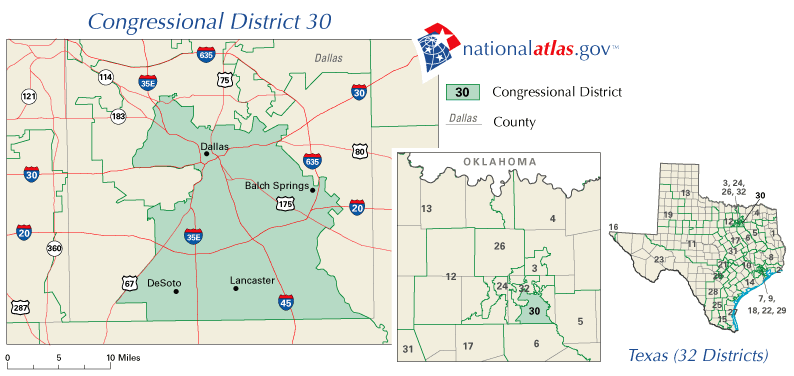
There’s no way that could pass VRA muster right now. So, from the two new VRA districts in the Metroplex, Democrats automatically gain a safe seat without any deal.

Now, we explore Houston, where Hispanic growth has occurred over the past ten years. To accommodate the VRA, a new Hispanic district must be drawn. Further, both black plurality districts must remain. It should look something like this:

Photobucket

I used MattTX2’s bipartisan compromise as inspiration for the boundaries. However, my pink Hispanic district is much less Democratic. Here are the results:

Pink District:

Obama: 52%

McCain 47%

White: 35%

Black: 8%

Hispanic: 51%

Blue District:

Obama: 59%

McCain: 41%

White: 27%

Black: 12%

Hispanic: 58%

Beige District:

Obama: 79%

McCain: 21%

White: 17%

Black: 47%

Hispanic: 24%

Army Green District (Northern District)

Obama: 65%

McCain: 35%

White: 34%

Black: 38%

Hispanic: 22%

Now, the pink district is barely a Hispanic majority district, so it could be argued that there are not enough voting age Hispanics to make it a VRA-protected districts (I’ll get to that later). So, the district might need to change shapes and might need to add more Hispanic precincts (making it more Democratic). I would think that this would be a safe Democratic seat, so a Hispanic Dem would win here. Without the deal, we just picked up two seats.

Here’s where it gets complicated:

Photobucket

Southern Texas. Let’s ignore the El Paso seat because it’s a safe Dem seat anyway. Let’s also ignore the yellow suburban San Antonio seat because it’s safely Republican and not completely drawn (and Lamar Smith’s). Here, we have six VRA-protected Hispanic seats. They cannot be packed along the border (no McAllen-only district) because that would put too many Hispanics in one district, which was ruled unconstitutional after the DeLaymander.

Let’s go left to right.

PURPLE DISTRICT

Obama: 47%

McCain: 52%

White: 37%

Black: 3%

Hispanic: 58%

When Bonilla was the congressman for this district, it was R+14. After the DeLaymander, the district was ruled unconstitutional because it didn’t have enough Hispanics of voting age. Well, this district is 58% Hispanic now, compared to Ciro Rodriguez’s current district, which has 55%. So I think this would pass muster. This is where the GOP can screw everything up (and open a whole big can of worms). They can draw this district to elect a Hispanic Republican, but they will be open to lawsuits as it takes in heavily conservative white suburban parts–but, hey, it’s a gerrymander! We can still hold this seat, but it gets harder.

Red District

Obama: 54%

McCain: 45%

White: 33%

Black: 7%

Hispanic: 57%

This would be frustrating for Dems, as Cuellar now has to enter San Antonio. Still, this is a safe Dem district.

Green District

Obama: 50%

McCain: 50%

White: 27%

Black: 3%

Hispanic: 69%

A newly-created district, we would be competitive, but I think it would be hard. However, with changing demographics, I think this is winnable very soon.

The District With Brooks County (sorry, I don’t know what color that is)

Obama: 61%

McCain: 38%

White: 18%

Black: 1%

Hispanic: 80%

Corpus Christi District

Obama: 52%

McCain: 47%

White: 28%

Black: 3%

Hispanic: 67%

San Antonio Blue District

Obama: 66%

McCain: 33%

White: 19%

Black: 5%

Hispanic: 74%

Here are some more close ups:

Photobucket

Photobucket

What this means is that the Purple and Green districts would become ultra competitive (and lean Republican). Still, the demographics changes could eventually lead to a Dem flip.

Conclusion:

Even without such a deal, we will likely gain two seats due to the VRA anyway. In addition, one of the other added seats is a Hispanic majority seat in Southern Texas that would be a tossup.

Since the Dems have a little leverage (a possible gubernatorial win or a possible takeover of the House), they could push to take the two of the newly-drawn districts Dallas and Houston districts (which they’ll get anyway), protect Edwards, and draw all of the Southern districts. I think that would probably be the best.

And, lastly, this took forever!!! So please comment and tell me what you think.

Weekly Open Thread: What Races Are You Interested In?

We’re very proud to announce that we recently welcomed our 8 millionth visitor to the Swing State Project. To help us celebrate, we’re looking to hit another couple of important milestones on Twitter and Facebook: we need five more followers on Twitter to hit 1500 and 32 more fans on Facebook to hit 400. Who will put us over the top?

UPDATE: Thanks everybody! We blew right through our Twitter goal, but we’re still 18 13 11 5 swingnuts short of an even 400 on Facebook. I know we can do this!

LATER UPDATE: We did it: 401 fans on Facebook! Thanks for your support, everyone!

AL-03: Josh Segall Drops Out

Via e-mail:

After much thought and careful consideration, I have decided not to pursue the office of US Representative for Alabama’s Third District. So many of you have been incredibly supportive of my run, and I want to thank you from the bottom of my heart for your advice, encouragement, and efforts.  I am immeasurably proud and appreciative of what we have accomplished together.

Segall had a very respectable run in 2008, holding Republican incumbent Mike Rogers to a 54-46 margin despite being outspent by 2-to-1. However, Segall’s fundraising never seemed to really get off the ground this year, resulting in his ultimate decision to keep his powder dry.

Unfortunately, the filing deadline for this race passes at 5pm tonight, leaving Alabama Democrats with barely any time to find a warm body to run in his place.

RaceTracker Wiki: AL-03

IA-Gov: Branstad launching statewide tv ads

Former Governor Terry Branstad’s campaign announced today that two television commercials will begin airing statewide on Monday, April 5. That’s two days before the first debate between the three Republican candidates for governor and about nine weeks before the June 8 primary.

The Branstad campaign will run this 60-second ad called “Ready”, which first aired during the University of Northern Iowa’s NCAA basketball game last week, and this 30-second ad called “I Know Iowa.” The “Ready” ad intersperses Branstad’s campaign promises with testimonials about his character and talents. I can’t embed the 30-second ad here, but it features footage of Branstad with lots of different Iowans, as well as his campaign bus driving toward the state capitol building. The candidate himself does the voice-over for the shorter ad, and here’s my rough transcript:

Iowans are genuinely fearful and concerned, but also, people are hopeful. They know that we have the ability to come back. They’ve seen it done before. We can create 200,000 jobs. We can increase family incomes by 25 percent. We can reduce the size and cost of government, and we can make our education system the best in America. I love this state, and I love the people of this state, because I know given the opportunity, Iowans will always exceed expectations.

Both commercials convey the central theme of the Branstad campaign: he can lead Iowa out of tough times and back to greatness. I don’t see substance backing up Branstad’s campaign promises, but for the most part Iowa journalists are giving him a free pass. I question whether his Republican opponents will be able to make an effective case against him. Branstad probably will be the only candidate advertising on television for several weeks. It’s not clear that Bob Vander Plaats and Rod Roberts have the resources to run even two weeks of commercials statewide. Vander Plaats has a stronger potential grassroots network given his experience with Mike Huckabee’s campaign and the support of the Iowa Family Policy Center, but Roberts seems to be competing for the same conservative voters Vander Plaats is targeting.

SSP Daily Digest: 4/2

  • AR-Sen: Blanche Lincoln says she’s raised over $1 million in Q1 and has over $4 mil on hand. Primary opponent Bill Halter, as we noted yesterday, raked in over $2 mil.
  • AZ-Sen: J.D. Hayworth says he’s raised… some amount in the vicinity of $1 million dollars. Originally he said he had narrowly missed that goal, but then later his campaign claimed they beat the seven-figure mark. Obviously a pretty meaningless distinction. (John McCain, as we noted yesterday, raised over $2 mil.)
  • NH-Sen: Some fundraising numbers for GOP senate hopefuls: $100K for Jim Bender (+$400K self-loan), and $400K for Bill Binnie.
  • NV-Sen: There aren’t many good days anymore for John Ensign. New revelations show that he tried to intervene to save the very same energy company he asked to hire his mistress’s husband. Ensign had been denying that he tried to help this company, P2SA Equity, just days ago.
  • NY-Sen-B: They’ve scraped the bottom of the barrel so hard that they’ve clawed a hole in the damn thing. The NY GOP is now supposedly reduced to seeing if Bill Weld, the failed retread ex-Gov. of Massachusetts, wants to run against Kirsten Gillibrand. Weld, you might recall, was passed over for the privilege of getting steamrolled by Eliot Spitzer in 2006. The Daily News also claims that that state chair Ed Cox has reached out to ex-Rep. Jim Walsh, now a lobbyist. A Cox spokesman denies all of this, so, go figure.
  • AK-AL: Andrew Halcro, who sounded very lukewarm about continuing his challenge to Rep. Don Young in the GOP primary a month ago, has officially bailed. Young still has a Republican challenger, though: businessman Sheldon Fisher.
  • AR-02: Mike Huckabee isn’t joining the Tim Griffin bandwagon. In fact, he just endorsed rival Republican Scott Wallace, a Little Rock restaurateur who is a decided underdog in the GOP primary. In a now-classic trope, Wallace is attacking Griffin for a fundraiser he held the other day headlined by Eric Cantor, portraying the race as yet another DC establishment vs. local dude race. Huckabee seemed to echo those themes a bit in his statement endorsing Wallace.
  • AZ-01: Republican state House Majority Whip Andy Tobin said he was considering entering the race against frosh Dem Ann Kirkpatrick, but then very quickly backtracked. That leaves Rusty “Trombone” Bowers as the GOP’s chief organ-grinder here.
  • AZ-03: Paradise Valley Mayor Vernon Parker, running for fellow Republican John Shadegg’s open seat, says he’s raised $230,000. No word yet from the other GOPers in this race (and there are a lot of them) or Dem John Hulburd.
  • FL-12: Former state Rep. Dennis Ross said he raised $160K in the first quarter in his bid to succeed outgoing fellow Republican Adam Putnam. Dem Lori Edwards hasn’t announced any numbers yet, but her fundraising fell of a cliff in the second half of last year.
  • IN-02: Complaining that GOP bigs have (gasp) taken sides in the Republican primary – and not in his favor – Some Dude Martin Nolan is dropping out of the race. He’s endorsing former pharma exec Jack Jordan over state Rep. “Whacky” Jackie Walorski.
  • NY-29: Assemblyman David Koon is pulling his name out of consideration for the Dem nod to replace ex-Rep. Eric Massa. Since it looks like there won’t be a special election, am I right in assuming that Dems will select a nominee via a primary, rather than by committee?
  • OH-16: GOPer Jim Renacci is airing his first TV ad. It’s just a cable buy (mostly FOX News), so it can’t be costing very much.
  • OK-05: A second Democrat has announced a run for GOP Rep. Mary Fallin’s open seat: attorney and Marine veteran Billy Coyle. He joins legal studies prof Tom Guild in the race on the Dem side in this R+13 district.
  • PA-07: Bryan Lentz wants the feds to investigate the petition signatures of his Republican opponent, Pat Meehan. The case was referred by the local D.A. to the state attorney general, but Meehan’s donated money AG Tom Corbett, his fellow GOPer who is running for governor. Lentz wants this conflict of interest cleared up by having the DOJ handle the case instead.
  • PA-12: Dem Mark Critz, running in the Murtha special election, is up on the air with a positive intro ad. (As is typical for these kinds of announcements – sigh – no word on the size of the buy.) His opponent, GOPer Tim Burns, also just went up.
  • PA-17: The PA AFL-CIO is withholding its endorsement from Rep. Tim Holden in the Democratic primary, due to his vote against healthcare reform. The AFL has usually back Holden with vigor, but this time they are staying neutral in his race against attorney Sheila Dow Ford. Ford hasn’t filed any FEC reports yet, while Holden has about $675K on hand, so this may not amount to much. Moreover, the AFL says they may “reconsider” their position for the general election.
  • VA-11: At long last: The national Spray Polyurethane Foam Alliance might finally get a voice in Congress. That’s because Kurt P. Riesenberg, the president and executive director of the national Spray Polyurethane Foam Alliance, is joining the GOP primary to take on Rep. Gerry Connolly. He joins businessman Keith Fimian and Fairfax County Supervisor Pat Herrity. Long live the national Spray Polyurethane Foam Alliance!
  • DGA/RGA: The Democratic Governors Association said it raised $8m in the first three months of 2010, a quarterly record, and has $22 mil on hand. Their Republican counterpart, the RGA, raised $9 mil and has $31.2 mil on hand.
  • Polling: SSP diarist Spiderdem has done some very good – and very necessary – digging on brand-new pollster “We Ask America.” It looks like they are a subsidiary of a subsidiary of the Illinois Manufacturer’s Association, an anti-labor, anti-tax organization that’s a member of the notorious National Association of Manufacturers. I have no problem with partisan pollsters, but pollsters who aren’t up-front about their affiliations deserve our scorn. (And given that Bill Foster’s camp is charging that WAA’s robopolling made it difficult or impossible to record an answer in favor of healthcare reform, they may deserve more than scorn.)
  • Redistricting: Democrats and Republicans are talking over a plan to split Texas’s expected four-seat gain right down the middle – two seats for them, two for us. On the one hand, it seems like a good bargain for Team Blue, especially if we wind up controlling none of the levers of the redistricting process. On the flipside, since most of the state’s growth has been among the Hispanic population, the Voting Rights Act may very well spot us two seats to begin with, so this may not really be much of a deal for us.
  • Site News: Some time last month, the Swing State Project welcomed its 8 millionth visitor to the land of Some Dudes, ganja breaks, and Panic! at Tedisco. (We crossed the 7 million mark in October of last year.) Help us celebrate: We want to reach 1,500 followers on Twitter and 400 fans on Facebook.
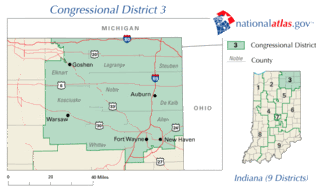
  • IN-03: Why I Think Tom Hayhurst Has a Chance

    In a series of comments here at SSP, I’ve argued that the IN-03 congressional race is the sleeper race of the 2010 cycle.  In this diary, I’ll expand on these comments and explain in detail why I think Democratic candidate Dr. Tom Hayhurst has a real shot at pulling the upset of 2010 here in Indiana.

    Some caveats: no, I don’t expect Hayhurst to win; I’m arguing only that he has a legitimate shot and could win given the right (not entirely unrealistic) set of circumstances.  Also, this diary isn’t intended as a critique of the SSP front-page team, which recently made the decision not to list IN-03 as a potential pickup on the Big Board.  They have excellent reasons for their choice, and their fantastic writing and analysis is what keeps me coming back to SSP more than any other political site on the Net.  Finally, though I live in another district in Indiana (IN-09), I’ve never been to IN-03, nor do I know Hayhurst, Souder, any of the other candidates, or anyone who lives in the district.  Thus, my comments in this diary are based solely on my own analysis and on information I’ve gleaned from the Web.

    Background

    IN-03 is a mostly rural district in the northeastern corner of the state.  Its largest city is Fort Wayne.  The district has a Cook PVI of R+14; McCain won it 56-43, but Bush won it in 2004 by a vastly larger 68-31.  According to Cook, this is the 64th most Republican district in the country; among Democrats, only Chet Edwards, Walt Minnick, Bobby Bright, and Jim Matheson hold districts more Republican-leaning.

    Nevertheless, the district has had a reasonably good electoral history for Democrats recently.  In 2006, Hayhurst held Souder to a 54-46 margin.  In 2008, 28-year-old attorney Michael Montagano performed less successfully against Souder, losing 55-40 (and getting outperformed by Obama in the district).

    Obviously, it will take a perfect storm of events for Hayhurst to win this seat.  A victory in a seat like this would require a combination of an impressive Democratic candidate who’s a perfect fit for the district, a very weak Republican candidate, a Democratic fundraising advantage in the race, a divisive Republican primary, and a favorable electoral climate.  As I’ll argue, though, all but the last of these qualities exist in this race.  If the political climate remains as GOP-friendly as is it now, Souder should eke out a win.  If Democrats become more popular as a result of the health care bill and additional legislation, Hayhurst could pull the upset.

    A Strong Democratic Candidate

    Tom Hayhurst is a 67-year-old retired medical doctor and Democratic activist.  He’s a good fit for the district: an avuncular medical professional who seems like he walked out of a 1950’s movie about small-town America.  (He’s a better fit than, for instance, a young lawyer like Montagano, which is one of the reasons Montagano lost in 2008.)  He’s an avowed centrist whose position on health care has evolved from opposing the House bill to arguing that he can make it more cost-effective in Congress.  Additionally, Hayhurst is talking jobs and advocating strongly for the expansion of passenger rail in Indiana.  He has wide name recognition throughout the district as a result of his previous congressional run.

    A description of Hayhurst as a candidate can’t help but include his impressive showing in 2006: 46% of the vote, outperforming the district by six points without a shred of help from the DCCC or elsewhere.  (Granted, DCCC spending didn’t seem to help Montagano in 2008.)  All told, Hayhurst is about the best candidate Dems could field in this district.

    A Weak Republican Incumbent

    Coupled with Hayhurst’s strength is the weakness of Mark Souder, about the limpest noodle around in Indiana’s congressional delegation (which is saying something, since he’s got competition from Steve Buyer and Dan Burton).  Souder’s known as a weak campaigner and fundraiser, isn’t well-liked by Republicans in his district, and is an all-around weak incumbent.  Some typical criticisms of Souder: he cares more about fantasy sports than he does about his job; he broke a term limits pledge back in 2006; his campaigning skills are so weak that even Rothenberg thinks the NRCC should have cut him loose back in 2008.  Clearly, this is not a guy who’s well-loved or particularly adept at keeping his seat.  In 2008, with NRCC help, he was able to win convincingly against Montagano; but two years earlier, he couldn’t be bothered to campaign seriously against Hayhurst and almost lost the seat as a result.

    A Democratic Fundraising Advantage

    Wouldn’t it be nice if after just one fundraising quarter (the one that ended three months ago) Hayhurst had more cash-on-hand than Souder did?  Incredibly enough, that’s exactly what happened.  Thanks to anemic fundraising and an incredibly high burn rate, Souder ended up at the end of December with less cash-on-hand than Hayhurst.

    Furthermore, this isn’t the first time Hayhurst has outraised Souder; he did the same thing for the entire 2006 campaign, padding the total with $200,000 of his own money (Souder’s numbers here).  The evidence indicates that not only can Hayhurst keep pace with Souder, he can do so for the long haul.

    A Bruising Republican Primary

    Of course, this would be one thing if Souder could save all his cash for the general election.  However, for the first time in eight years, Souder is facing a bruising three-way primary.  His opponents are rich carpetbagging auto dealer Bob Thomas and former Dan Coats press secretary Phil Troyer, who’s the teabagger favorite.  Troyer’s fundraising has been anemic so far, so the real battle at the moment is between Souder and and the deep-pocketed Thomas.  Both candidates have ads up, and they’re bashing one another just as hard as they can.  Here’s a sample:

    A current radio ad for Souder’s re-election campaign even includes name-calling, referring to Thomas as ‘Big Bucks Bob Thomas’ and accuses him of spending “‘half-a-million (dollars) shopping for a seat in congress.” …

    “When he says I’m trying to buy this seat, well the fact is, he’s already sold it… to special interests groups in Washington D.C.,” said Thomas.

    As they say, ouch.  Souder should be able to prevail against the split field, just as he did in 2002 against a primary challenge from the left.  But Thomas is forcing him to drain his already anemic coffers, while Hayhurst continues to rack up more money.  Additionally, Souder will limp into the general election considerably bloodied by the attacks of his competitors.

    An Uncertain National Climate

    This brings us to the final criterion required for a Hayhurst upset: a favorable national climate.  Certainly this one isn’t looking likely at the moment.  But the election’s still seven months away, and a lot of things can change in seven months.

    The key takeaway: because of the national climate, Souder looks likely for reelection.  However, if the climate shifts so that Democrats lose, say, fifteen seats rather than thirty, Hayhurst has a shot at pulling off the biggest upset of the cycle.  This is definitely one race worth keeping an eye on.

    In Which I Reopen Wounds, or, Examining Boston through the Coakley-Brown Race

    David and the rest of the SSP crew have been kind enough to give me a soapbox here, and I think I’ll be starting a series on breaking down large jurisdictions through the lens of some election.

    Having gotten my hands on precinct data for the city for both 2008 and the 2010 Special, I thought I’d continue to examine the disparities between Obama’s and Coakley’s respective performances.

    As you can see on the map, the geographic central core of the city, Roxbury and Mattapan, remained strong with little dropoff from Coakley to the Obama. Jamaica Plain, Allston/Brighton, and Back Bay – all strong Obama areas as well – showed slightly greater drop-offs. Even greater drop-offs were noticeable in the already swingy areas of the city, such as West Roxbury, Dorchester, Charlestown, and Southie. McCain won only 3 precincts throughout the entire city’s 254; Brown increased that to 33.

    Putting this statewide perspective, we get this:

    Again looking at the map, South Boston was pretty darn brutal for Coakley, with Brown scoring 60%+ in several precincts. Many people (including one Stephen Lynch) indicated particular hostility for Coakley in the neighborhood. She did get destroyed here, but was it any worse than how badly she got destroyed across the rest of the state?

    I think not. Sidenote: I’m defining “South Boston” the same way the Boston City Council does, that is, all nine precincts in Ward 6 and precincts 1-7 in Ward 7.

    In 2008, in the 16 precincts constituting “South Boston” (or Southie), Obama beat McCain by a margin of 3,100 votes, or roughly 59-39. In 2010, Coakley lost by a margin of 1,500 votes, or roughly 43-56. Overall, this was a 16.0% swing; this is somewhat worse than that 15.31% swing experienced by Coakley across the state.

    But, despite my election-night model assuming so, Coakley didn’t experience a uniform dropoff. Instead, dropoffs are quite correlated with how well Obama performed in the area was to begin with. (This makes sense – Democratic strongholds are likely to remain so, while swingy areas in which Obama did well might have been particularly receptive to Republicans in a close election.)

    Throwing this up on a graph (with Coakley’s dropoff on the vertical axis and Obama’s margin on the horizontal), we get:

    You’ll see a few outliers here: the point at the origin you can throw out – that’s Boston Precinct 01-15, which last had a voter in 2004. The correlation on that is 0.83 0.816, suggesting quite a strong relationship.

    Taking the geekery to the next level, I busted out the extraordinarily helpful Stata (how academic of you, my SPSS-using friends tell me…):

    For those who are less of statistics nerds than I am, the regression tells us two main things:

    • For every point increase in Obama’s margin in a voting unit (precincts within Boston, towns elsewhere), we can expect Coakley’s performance relative to Obama’s to improve by 0.14%.
    • For a hypothetical voting unit that was exactly tied between Obama and McCain, we should expect a 17% swing away from Coakley.

    Applying this to South Boston, we see that there isn’t really a pattern: some precincts had drop-offs more than to be expected, others had less.

    There really isn’t much a discernible pattern here, again, supporting the conclusion that while Southie didn’t like Martha, they didn’t indicate their dislike for her through their votes more than the rest of the state did.

    This can all be represented visually as well:

    The last benefit of getting the Boston data was I could finish results of the Senate Race by CD. As we’d already known, they weren’t pretty, but here’s the results table just as a freebie: