Washington State: A Nonpartisan 10 District Map

In the wake of the news that Washington State is slated to recieve a new seat in Congress, I decided to try and draw a 10 district map for the state. Since they redistrict by a non partisan board, I tried to make the districts as sensible as they could be and avoid splitting counties wherever possible. I also ignored incumbents’ homes and aimed to create districts based upon shared interests where possible without splitting counties. For example, the new 10th is centered on the high tech industry as a creative class district, while the new 8th is a blue collar industrial district, and the 6th has a secondary military focus.

The resulting map probably will make at least three incumbent Democrats less than pleased. Norm Dicks and Jay Inslee now live in the new 2nd, Rick Larsen is now in the new 1st, the 6th and 10th are unoccupied. Dems should win the 1st, 2nd, 6th, 7th, 9th, and the new 10th without much problem. The 8th is drawn to favor a blue collar union Dem, though Reichert could win there, and the 3rd is still the most balanced in the state.

The GOP is probably content with this one; while not a gerrymander, the 4th and 5th are secure, the 3rd is still a tossup, and Reichert sheds the problematic parts of the old 8th (though his new one is far from secure).

Statewide

Pierce County (Tacoma)

King County (Seattle)

Details for Each District


Washington’s 1st Congressional District


Community of Interest: Snohomish County

Politically: Likely Democrat

Ethnic Makeup: 77% White, 2% Black, 1% Native Americam, 9% Asian, 7% Latino, 3% Other

One of my core beliefs is that if any county has roughly the correct amount of population to form a single congressional district, it should remain intact as a single unit. Thus, the 1st takes up all but about 30,000 residents of Snohomish County, which supported Obama by a 58-40 margin. That said, Jay Inslee doesn’t live in this version of the district, but current 2nd CD congressman Rick Larsen does. Correspondingly, Inslee now finds himself in Larsen’s 2nd. It would be an interesting situation to be sure.

Washington’s 2nd Congressional District

Community of Interest: Pacific Coast Communities

Politically: Likely Democrat

Ethnic Makeup: 83% White, 2% Black, 2% Native American, 4% Asian, 7% Latino, 3% Other

This is the district that I am by far the least happy with in the whole map. It’s a direct result of keeping Snohomish largely together in the 1st, and is an awkward combination of Bremerton’s Kitsap County, the various islands, and the two farthest north coastal counties. All of these are fairly Democratic areas, and it should elect a Democrat. The new 2nd has two Democratic incumbents: Jay Inslee (already discussed) and Norm Dicks, who lives in Bremerton. I’d guess that Dicks runs in my 6th, where most of his old district is and Inslee or Larsen would run here.

Washington’s 3rd Congressional District

Community of Interest: Southern Washington

Politically: Tossup, Slight Dem Lean

Ethnic Makeup: 76% White, 1% Black, 2% Native American, 3% Asian, 15% Latino, 2% Other

This, along with my new 8th District are the two most competitive within the new map. The bulk of the district’s population lives in Clark County, and Obama carried every county in the district with the exception of the Yakima County portion of the district. Now, about that Yakima County portion of the district…it’s 60% Latino, so it’s not nearly as bad as you might think upon first glance. That said, I don’t doubt that the right GOPer could win here given the swingy nature of several of the counties.


Washington’s 4th Congressional District


Community of Interest: Central Washington

Politically: Safe Republican

Ethnic Makeup: 68% White, 1% Black, 1% Native American, 2% Asian, 27% Latino, 1% Other

The most GOP district in all of Washington. It contains several smaller cities: Pasco, Kennewick, Walla Walla, and the vast bulk of the city of Yakima. This should be a sinecure for whichever GOPer holds it.


Washington’s 5th Congressional District


Community of Interest: Eastern Washington

Politically: Likely Republican

Ethnic Makeup: 86% White, 1% Black, 2% Native American, 2% Asian, 5% Latino, 2% Other

This is the less Republican of the two Eastern Washington seats, and most of the population here is concentrated in Spokane County, which McCain barely won. It also contains Washington State University in Pullman; Whitman County is the only one in the district that voted for John McCain. This should be a relatively safe place for Cathy McMorris-Rodgers, but it’s not a mortal lock like the 4th.


Washington’s 6th Congressional District


Community of Interest: Olympic Peninsula/US Military

Politically: Likely Democratic

Ethnic Makeup: 83% White, 2% Black, 2% Native American, 3% Asian, 6% Latino, 3% Other

This version of the 6th has been largely reconfigured; it sheds Bremerton to the 2nd, and Tacoma into the 9th. In its place, the new 6th gains heavily Democratic Thurston County (Olympia)which voted 60-38 for Obama. It also picks up moderately Democratic Pacific and Wahkitum Counties as well as Republican Lewis County. It also includes Fort Lewis, McChord Air Force Base and the Gig Harbor portions of Pierce.

My guess is that with Fort Lewis and McChord, Dicks would run here instead of the 2nd, which despite Kitsap and Bremerton, is still mostly of a Whatcom/Skagit/San Juan/Island District. The only familiar part of the 2nd for Dicks would be Bremerton, whereas here he has represented the four northernmost counties plus the Pierce component of the district. It’s likely not quite as Democratic as the old 6th, but it should elect some flavor of Democrat.

The only regret I had here was not getting the missile sub base in Bangor into this district as well. If you’re willing to split Snohomish and King even more, you can do that. With that said, two out of three ain’t bad, and Dicks will look after Bangor anyways.

Washington’s 7th Congressional District

Community of Interest: City of Seattle

Politically: Strong Democratic

Ethnic Makeup: 63% White, 9% Black, 1% Native American, 17% Asian, 8% Latino, 3% Other

This is basically the city of Seattle with just a sliver of suburbs to the south. Slam dunk Dem with a very high Dem + PVI number.

Washington’s 8th Congressional District

Community of Interest: South King County

Politically: Tossup

Ethnic Makeup: 69% White, 6% Black, 1% Native American, 11% Asian, 9% Latino, 3% Other

Now we move on to that Democratic perennial target, the 8th District. That district, in its old form has been vaporized into three. The new 8th has been designed as a largely South King County seat; think of this as the Boeing/Weyerhauser district. It includes Kent, Renton, Covington, and Auburn from the old 8th, as well as Federal Way, Des Moines, and SeaTac from the old 9th. In addition, there is a small slice of Pierce County (mostly Bonney Lake) included.

Dave Reichert would probably run here; the new 10th is drawn as a Microsoft/High Tech District that has most of Darcy Burner’s best areas included. That said, most of the Pierce County portions that have saved him in the past ended up in the new 9th District.

For the Democrats, my guess is that State Rep Chris Hurst runs here, setting up a cop vs. cop showdown. Hurst always would have difficulty in a Dem primary in the old 8th, as he was a poor fit for the Bellvue/Mercer Island parts. This much more working class version should fit him like a glove.

Washington’s 9th Congressional District

Community of Interest: City of Tacoma/Pierce County

Politically: Likely Democratic

Ethnic Makeup: 72% White, 7% Black, 1% Native American, 7% Asian, 8% Latino, 4% Other

The 9th has been redrawn to be all about Tacoma and Pierce County. With the exception of Gig Harbor, Bonney Lake, and Fort Pierce, all of Pierce County is in the district. Adam Smith, a Tacoma resident, should be just fine here.

Washington’s 10th Congressional District

Community of Interest: King County’s High Tech Community

Politically: Likely Democrat

Ethnic Makeup: 77% White, 2% Black, 1% Native American, 12% Asian, 6% Latino, 2% Other

If the new 8th is all about Boeing and Weyerhauser, then this is the Microsoft District. It includes Bellvue, Redmond, Mercer Island, Shoreline, Issiquah, and part of Bothell. There is also a small portion of Snohomish County with about 30,000 voters.

It is likely the wealthiest district in the state and the best educated. It is appropriately the newest district, as this portion of King County has been the fastest growing in the state. It includes the areas where Darcy Burner did best in the old 8th and will almost certainly elect a Democrat. The primary here would be something to watch….Ross Hunter would likely have the inside track here.

NC State Senate – Dem Leadership Turnover

The North Carolina State Senate will see considerable turnover in the Democratic Leadership by the end of 2010. Democrats currently hold a 30-20 majority, and have controlled the Senate Chamber since the 1870s. All members face re-election every 2 years.

3 Democrats have announced they will not run in 2010, and Majority Leader Tony Rand resigned today to accept a new position in state government. The retirements include 3 (now 4) of the 5 most senior Democrats in the Senate.

1/17 Update – Another retirement announced – Sen Charlie Albertson will not run in 2010.

Majority Leader Tony Rand has resigned after 27 years to accept Governor Bev Perdue’s appointment as Chair of the State Parole Commission. Gov Perdue will appoint Rand’s replacement.

http://www.fayobserver.com/Art…

Sen David Hoyle, co-chair of the Senate Finance Committee, has announced he will not run for re-election in 2010 after serving for 18 years in the State Senate.

http://jackbetts.blogspot.com/…

Sen Julia Boseman has announced she won’t seek a 4th term in 2010. Boseman is NC’s only openly gay or lesbian legislator.

http://www.starnewsonline.com/…

Sen RC Soles, Chairman of the Commerce Committee and NC’s longest serving State Senator, has announced he will not run for re-election in 2010. Soles was first elected to the Legislature in 1968, serving 40 years. Soles shot and wounded an intruder in his home earlier this year, and may face charges.

http://www.wral.com/news/state…

The seats held by Hoyle, Boseman, and Soles were all considered competitive in 2008.

http://www.wral.com/news/local…

1/17 update: Sen Charlie Albertson announced Friday he will not run for re-election in 2010. His district #10 is a D +3 district. Albertson has served in the legislature for 20 years. He is the 3rd most senior Democrat in the Senate.

http://www.wral.com/news/local…

SSP Daily Digest: 12/30

Dave’s Redistricting App: If you use Dave’s App, please don’t close your browser window/tab when you take a break. Whenever you load a new instance of the app, it causes a big bandwidth hit, especially when you open up New York state. So to help Dave conserve bandwidth, leave your browser open once you’ve loaded whatever you’re working on until you’re finished with that project. Thanks! (D)

AZ-Sen: Ex-Rep. J.D. Hayworth says that he may be ready to start “testing the waters” for a primary challenge to John McCain. Hayworth was recently seen in D.C., holding a joint fundraiser with Maricopa County Sheriff Joe Arpaio that raked in $100,000. Hayworth’s share of the proceeds went directly to help alleviate his outstanding legal bills.

CT-Sen: Well, this is awkward. Before Chris Dodd led the attacks on AIG for its executive compensation fiasco, Dodd was in AIG’s offices, collecting checks from their employees.

MA-Sen: Republican Scott Brown has launched the first ad of his campaign, making a totally cheeseball comparison between himself and JFK.

NY-Gov: Basil Paterson, David’s dad and former SoS, raises the ugly specter of the 2002 gubernatorial primary between Carl McCall and Andrew Cuomo as some kind of “warning” to Cuomo. (D)

AL-05: As we expected, PSC Commissioner Susan Parker has turned down the opportunity to challenge Parker Griffith in 2010. This leaves Democrats without a top shelf candidate, but there are other options worth considering. One potential candidate, state Rep. Randy Hinshaw, talks with Left in Alabama about the campaign that he’d like to see the Democratic nominee run. Doc’s Political Parlor hears that Deborah Bell Paseur is unlikely to run, and that Hinshaw is “as likely as anyone” to go for it. Madison County Commissioner Bob Harrison is also thinking about it.

CA-19: The Defenders of Wildlife are gearing up to do whatever it takes to prevent Richard Pombo from re-entering Congress (as he is considering), even if it means supporting another conservative Republican for the seat of retiring GOP Rep. George Radanovich. Meanwhile, Taniel notes that ex-Fresno mayor Jim Patterson is a Club For Growth protege — so this could be a pretty lively primary.

LA-03: State Rep. Nickie Monica has become the first Republican to file for the seat of Dem Rep. Charlie Melancon.

TX-10: Foreign policy consultant Dan Grant, who lost a 2008 Democratic primary to local celebrity judge Larry Joe Doherty, has taken his name out of consideration as a last-minute replacement for businessman Jack McDonald, who withdrew his candidacy for the seat of GOP Rep. Mike McCaul last week.

NC-10: Here’s something interesting we missed a while back: Iredell County Commissioner Scott Keadle is challenging Rep. Patrick McHenry in the GOP primary, and he’s backed his play with $250K of his own money. It’s not really clear what exactly Keadle’s beef with McHenry is – he seems to be running a 1994-esque campaign, accusing McHenry (who’s only held office since 2005) of turning into a “career politician,” and pledging to serve no more than three terms himself. (Hat-tip: Reader IR) (D)

VA State Sen: Hotline on Call takes a look at a crucial special election between ex-Fairfax Co. School Board member Steve Hunt (R) and Del. Dave Marsden (D). Marsden and Hunt are running to replace Republican AG-elect Ken Cuccinelli. If Democrats somehow win the seat, they’d be able to pad their razor-thin majority in the Senate to 22-18.

NYC-Mayor: The Swing State Project has gotten its hands on the precinct-by-precinct results for the 2009 New York City mayor’s race. You can also check out our entire storehouse of obscure election returns and otherwise-unpublished polling memos at the SSP Document Collection. For some tasty eye candy and analysis, SSP Research Bureau Chief jeffmd has put together some beautiful maps comparing Thompson’s performance to Obama’s. (D)

Polltopia: Pick PPP’s next state polling target: Alabama, Connecticut, Illinois, Florida or Massachusetts.  

No Sleep till Brooklyn: Why Bill Thompson isn’t Mayor(-elect)

A few threads back, there was a lively discussion about voting patterns in Brooklyn, and how that impacted the 2009 mayoral race.

Thanks to David who worked his lawyerly Freedom-of-Information magic, we got some precinct results to look at.

I compared Thompson’s performance to Obama’s performance, and the results are pretty stark as to where the areas of relative strength are for each candidate.

So the baselines first:

Obama beat McCain by 59.27%; he earned 79.34% to McCain’s 20.07%. 2,613,944 total votes were cast.

Thompson lost to Bloomberg by 4.38%; he earned 46.33% to Bloombo’s 50.71%. 1,154,505 votes were cast, meaning turnout was 44% of 2008 turnout.

Maps (what else do I post here?) and more over the flip.

So here are Obama and Thompson’s absolute performances in the city.


Obama’s performance we already knew about, but a few striking aspects of Thompson’s performance:

  • Upper East Siders lurve them some Bloombo.

  • Whites in the Bronx voted for Bloomberg.

  • Hispanics voted mostly for Thompson (though not to the levels they voted for Freddy Ferrer, I would posit).

  • Blacks stayed strongly loyal to Thompson, with slight drop-offs visible in Brooklyn and East Queens.

  • Staten Island stayed Staten Island.

More interestingly, here is a comparison of Obama and Thompson’s absolute performances. A more intense blue indicates a stronger Obama performance; a deeper red indicates a stronger Thompson performance.

Obviously, most of the map is some shade of blue, since Obama’s margin was 63.65% greater than Thompson’s. Even given this, there are still two visible clusters of red in Brooklyn: Williamsburg and Borough Park. Thompson still lost these precincts by a decent margin, but he improved over Obama despite the tide moving 64% in the other direction. I took this as evidence of the Hasidic Jewish community’s growing dislike of Bloomberg, which had been mentioned a few times before the election.

On the flipside, as you would expect, Manhattan and Brooklyn Heights are home to the Obama-Bloomberg voters, especially on the Upper East and West Sides, in Midtown, and down in the Financial District.

The lighter shades of blue are in East Queens and Central Brooklyn – mostly majority-black precincts that went strongly for both.

Another interesting cluster of these, though, is on the South Shore of Staten Island; Thompson’s performance didn’t fall all that much off from Obama’s (admittedly already weak) performance there. It seems there, though, that the voters are more reflexively Republican than those in Southern Brooklyn, where Obama seemed to be a particularly bad fit. (backup evidence: Stephen Cymbrowitz and Carl Kruger are elected from those areas in Brooklyn. Southern Staten Island elects two Republicans to the Assembly/Senate, Lou Tobacco and Andrew Lanza).

Alternatively, this can be shown in graph form. Obama’s margin on the x-axis; Thompson’s on the y-axis.


Now any monkey could have told you generally a stronger Obama performance is correlated with a stronger Thompson performance, but the exceptions to that general rule are evident here as well. The large cluster of green on the bottom right are those previously mentioned Manhattan precincts, while the dispersed red dots towards the middle and lower left are the Brooklyn precincts in which Thompson actually improved. (Incidentally, yellow represents Staten Island, orange for the Bronx, and blue for Queens). The bright green line is the even-performance line.

Now two more maps of interest, each candidate’s performance relative to their citywide cumulative total (Obama first, then Thompson).


Obama did well throughout the city, a strong Obama performance was the norm. You don’t see many places darker than light blue, simply because you can’t get more than 100% of the vote! Where Obama underperformed, he really underperformed. You see this in Suburban Queens and also Middle Village/Maspeth, and of course Southern Brooklyn and Staten Island.

Thompson’s performance really varied much more. He overperformed in many places, and underperformed in many places as well; these deviations are of much more equal magnitude. Again, as we’ve realized, Thompson’s weakest area was the Upper East Side.

So all this poses the question, what happened?

Well, in three words, Thompson’s turnout problem.

Conventional wisdom dictates that minorities (who are actually a majority in NYC) turn out less in general. While this may or may not be true, I normalized and considered 2009 turnout as a percentage of 2008 turnout.

The results, first at the precinct level. The same color codes apply as before for borough. Turnout as a percentage of 2008 turnout is expressed on the x-axis; the Thompson-Bloomberg margin on the y-axis. (Turnout dropped most in the Bronx, in case you’re wondering.)


You see a general effect of center left to lower right, suggesting stronger Bloomberg performances being correlated with greater turnout. This effect is even more pronounced when we consolidate to an assembly district level:


It’s not pretty. For you stats geeks out there, the correlation on that bad boy is -0.77. Ouch.

Incidentally, that one AD with the lowest drop-off? None other than Dov Hikind’s 48th AD. Turnout there was lower there in 2008, but those that voted in 2008 were most likely to have voted again in 2009.

As a parting thought, take solace (or anguish) in this: if turnout had dropped to the 44% figure I mentioned at the start equally across the city, Thompson would have won, 49.16% to 48.00%.

Having arrived at Brooklyn, I’m going to sleep. I realize I owe you a proposed set of New York Senate districts. I just need to write the diary. I’ll get around to it…eventually.

AL-05, AL-Gov: Sparks Seeks to Revise Recent History

From the Huntsville Times:

State Agriculture Commissioner Ron Sparks pledged to continue his bid for governor on Tuesday, saying there was “never a point” where he considered running for the North Alabama congressional seat held by Parker Griffith, who last week switched from the Democratic Party to the Republican Party. […]

Sparks’ announcement comes after speculation that he was considering a run for Griffith’s seat.

Sparks criticized his Democratic opponent, Birmingham Rep. Artur Davis, of making it appear Sparks was running for Congress, and at one point, lieutenant governor.

Alright, I’ll say it: Who the hell does Ron Sparks think he’s fooling? Because he’s certainly not pulling a fast one on anyone who’s been paying attention to the political circus going on in northern Alabama over the past week. Let’s review the evidence.

On December 23rd, we noted that Sparks posted a status update on his Facebook page saying that he had been called by the DCCC and was giving thought to the campaign. In what seems to be a misguided effort to cover up its tracks, the Sparks campaign has removed that post from their Facebook profile. I didn’t have the foresight to save the text from that status update, but fortunately, the esteemed Reid Wilson did:

“As you may know, I received a call from the DCCC yesterday regarding the 5th congressional seat abandoned by Parker Griffith. We will be considering all of our options in the days and weeks ahead,” Sparks wrote in a status update.

Kind of pokes a fat freakin’ hole in Sparks’ statement that he never considered running for Congress, huh?

For days, this was how the situation was characterized by the local media:

Agriculture Commissioner Ron Sparks also said he has not ruled out a run for the 5th Congressional District. He said he’s still planning to run for governor, but will talk to several people over the coming days before making a final decision.

If Sparks was so firmly committed to the gubernatorial race, why didn’t he shoot down such talk immediately? The answer, to you and I and everyone else who has been paying the slightest bit of attention, was that Sparks was actually giving the race some thought. As if you needed any further evidence, Sparks was quoted just last week as saying that he was mulling over the race with his advisers:

Sparks said Wednesday he is sticking with his campaign for governor for now. But Sparks said he will talk with advisers during the holidays and didn’t rule out a change.

“I need a lot of advice from people who understand politics a lot better than I do,” said Sparks.

Not only that, his campaign, as recently as Sunday spent a lot of time talking up his ability to win a 5th District race:

Justin Saia, Sparks’s campaign manager, would only say that the commissioner is “open to entertaining other options” – but then made the case for why his candidate would be formidable in the congressional campaign.

“He has won every county in the 5th twice,” Saia said, noting Sparks’s roots in north Alabama. […]

Saia said that Sparks “understands the complexities and dynamics of north Alabama,” a traditionally Democratic and populist-oriented part of the state, and pointed out that he has already won support from many local officials there in his gubernatorial bid.

Saia said the commissioner hasn’t yet made a decision about leaving the gubernatorial contest. He indicated that Sparks is interested in what sort of commitment the DCCC would be willing to make on a seat that has been in Democratic hands for over a century but could be hotly contested next year.

It was bad enough that Sparks flirted so openly with this race, only to turn around and decline the opportunity. It’s so much worse to spin yarns about how he never considered leaving the gubernatorial race at all.

I don’t know what Ron Sparks thinks he’s accomplishing here, but he’s succeeded in making himself look like a damned fool.

Contest Entry: New York Redistricting for 28 Democrats

This is my entry for Round 1 of the Great SSP Redistricting Contest. Let me apologize to the early commenters who couldn’t see the whole diary.  I was saving it as I typed it just in case my computer decided to shut down on me in the middle of this long write up.  Without further ado…

In addition to the contest rules, I added two personal goals for my map: 1) Create 28 districts that gave a majority of their votes to President Obama. 2) Add some cushion to potentially vulnerable members of the Congressional Progressive Caucus. CPC members are Clarke, Hall, Hinchey, Maloney, Massa, Nadler, Rangel, Serrano, Slaughter and Velazquez.

Here's the big picture:  Photobucket

Long Island

Photobucket NY-1 Tim Bishop

Population:  700,503

New 1st:  Obama – 53, McCain – 47

Old 1st:  Obama – 52, McCain – 48

Race:  White – 84, Black – 4, Asian – 2, Hispanic – 8, Other – 1.

This district isn’t much different from it’s old counterpart.  Smithtown is no longer in this district while parts of Islip have been added.  Bishop’s district is slightly more Democratic, with +2 percentage points.

NY-2 Steve Israel

Population:  701,080

New 2nd:  Obama – 53, McCain – 47

Old 2nd:  Obama – 56, McCain – 43

Race:  White – 74, Black – 8, Asian – 3, Hispanic – 13, Other – 2.

This district isn’t as strong as Israel’s old one (you’ll find out why below), but is still majority-Obama.  Smithtown from the 1st and parts of Babylon from the 3rd have been added. been added.  Parts of Islip, Oyster Bay, and Babylon have been subtracted.  With these changes, Obama is -7 from the old 2nd, but still takes 53% of the vote.

NY-3 Carolyn McCarthy

Population:  700,222

New 3rd:  Obama – 54, McCain – 45

Old 3rd:  Obama – 47, McCain – 52

Old 4th:  Obama – 58, McCain – 41

Race:  White – 71, Black – 12, Asian – 4, Hispanic – 12, Other – 2.

Since we get bonus points for screwing Peter King, I decided to eliminate his district.  Oyster Bay is now split into McCarthy’s and Ackerman’s districts.  I don’t know which part King’s house is in, but unless he moves, he’ll have to run against one of them.  I tried to keep the new 2nd, 3rd, and 4th districts as evenly Democratic as possible, so they were all diluted to get their fair share of King’s pro-McCain district.  In McCarthy’s case, her home in Mineola, Hempstead, and parts of Oyster Bay make a change of -8 from her old district.

NY-4 Gary Ackerman

Population:  700,925

New 4th:  Obama – 54, McCain – 45

Old 5th:  Obama – 63, McCain – 36

Race:  White – 78, Black – 6, Asian – 7, Hispanic – 8, Other – 1.

This district is ugly.  Ackerman was hit the hardest of the 3, but in order to screw King, he’ll have to take one for the team.  His district is still Obama +9.  His home of Roslyn Heights, plus parts of Oyster Bay, Hempstead, Babylon, and Queens make up the new 4th.  Change is a whopping -18.

The Boroughs

Photobucket

NY-5 Gregory Meeks

Population:  700,739

New 5th:  Obama – 82, McCain – 18

Old 6th:  Obama – 89, McCain – 11

Race:  White – 21, Black – 52, Asian – 7, Hispanic – 14, Other – 6.

This is a VRA district, 52% black.  Not much has really changed here from the old 6th.  Some of the western areas have been placed in the new 8th.

NY-6 Joseph Crowley

Population:  701,328

New 6th:  Obama – 74, McCain – 25

Old 7th:  Obama – 79, McCain – 20

Race:  White – 25, Black – 6, Asian – 27, Hispanic – 38, Other – 4.

Crowley loses the Bronx, but gains more of Queens.

NY-7 Jerry Nadler

Population:  700,683

New 7th:  Obama – 56, McCain – 43

Old 8th:  Obama – 74, McCain – 26

Race:  White – 65, Black – 4, Asian – 15, Hispanic – 12, Other – 3.

This district took a big hit in order to help McMahon.  Includes much of South Brooklyn and snakes up into the Northern parts.

NY-8 Anthony Weiner

Population:  701,185

New 8th:  Obama – 61, McCain – 38

Old 9th:  Obama – 55, McCain – 44

Race:  White – 55, Black – 6, Asian – 17, Hispanic – 16, Other – 6.

Weiner’s distric is simililar to his old one, but loses some Brooklyn areas, holds onto Forest Hills, and adds more of Queens.  Obama gains +12.

NY-9 Ed Towns

Population:  700,786

New 9th:  Obama – 92, McCain – 7

Old 10th:  Obama – 91, McCain – 9

Race:  White – 17, Black – 60, Asian – 7, Hispanic – 12, Other – 3.

Another VRA district, this one 60% black.  This Brooklyn based district now extends into Manhattan.

NY-10 Yvette Clarke

Population:  700,960

New 10th:  Obama – 84, McCain – 16

Old 11th:  Obama – 91, McCain – 9

Race:  White – 25, Black – 52, Asian – 5, Hispanic – 13, Other – 4.

VRA district, 52% black.  Clarke’s new district now snakes into Queens.

NY-11 Nydia Velazquez

Population:  700,306

New 8th:  Obama – 87, McCain – 12

Old 9th:  Obama – 86, McCain – 13

Race:  White – 22, Black – 16, Asian – 8, Hispanic – 50, Other – 4.

VRA district that is 50% hispanic.  Still gets Brooklyn and Manhattan but also gets much more of Queens.

NY-12 Mike McMahon

Population:  701,421

New 12th:  Obama – 54, McCain – 45

Old 13th:  Obama – 49, McCain – 51

Race:  White – 61, Black – 8, Asian – 8, Hispanic – 20, Other – 3.

This district should be much easier for McMahon, going from majority McCain to majority Obama.  Still has all of Staten Island, but Brooklyn areas are more Democratic than the old 13th.

NY-13 Carolyn Maloney

Population:  699,898

New 13th:  Obama – 81, McCain – 18

Old 14th:  Obama – 78, McCain – 21

Race:  White – 72, Black – 5, Asian – 11, Hispanic – 10, Other – 2.

Maloney’s Upper East Side base, plus Southern Manhattan.  No longer in Queens.

NY-14 Charlie Rangel

Population:  700,649

New 14th:  Obama – 91, McCain – 8

Old 15th:  Obama – 93, McCain – 6

Race:  White – 29, Black – 26, Asian – 3, Hispanic – 40, Other – 2.

VRA district that is 71% minority.  Rangel gets some new areas south of his old district but cedes some of his old district to the new 11th and new 15th.

NY-15 Jose Serrano

Population:  701,218

New 15th:  Obama – 95, McCain – 5

Old 16th:  Obama – 95, McCain – 5

Race:  White – 3, Black – 30, Asian – 2, Hispanic – 63, Other – 2.

VRA district that is 63% hispanic.  Other than taking a little bit of Manhattan and a little bit of Queens, this district does not change much.

NY-16 Eliot Engel

Population:  699,973

New 16th:  Obama – 80, McCain – 20

Old 17th:  Obama – 72, McCain – 28

Race:  White – 33, Black – 22, Asian – 6, Hispanic – 36, Other – 3.

Instead of going from Engel’s home of Woodside and heading upstate, this district takes most of the Bronx areas from the old 7th and even gets into north Queens a little bit.

Upstate

Photobucket

NY-17 Nita Lowey

Population:  701,251

New 17th:  Obama – 70, McCain – 30

Old 18th:  Obama – 62, McCain – 38

Race:  White – 50, Black – 25, Asian – 4, Hispanic – 18, Other – 3.

Loses parts of Rockland Co. and the parts of Westchester Co. down to the Northern parts of White Plains.  Extends south into Mount Vernon and the Bronx.

Photobucket

Photobucket

NY-18 John Hall

Population:  700,819

New 18th:  Obama – 57, McCain – 42

Old 19th:  Obama – 51, McCain – 48

Race:  White – 77, Black – 8, Asian – 3, Hispanic – 9, Other – 2.

Of all the districts, this one was my favorite to rearrange.  Hall was elected in a 54% Bush district that only improved to 51% Obama in the 2008 election.  Can’t let that stand, now can we?  Hall now has Westchester Co. north of White Plains, all of Putnam Co., and Dutchess Co. up to his home in Dover.  Obama gets +12.  That should give this CPC member plenty of breathing room.  Dance with me.

NY-19 Scott Murphy

Population:  700,169

New 19th:  Obama – 54, McCain – 45

Old 20th:  Obama – 51, McCain – 48

Race:  White – 92, Black – 3, Asian – 1, Hispanic – 2, Other – 1.

Murphy keeps his home in Glens Falls but loses the rest of Warren Co.  He also loses Ostego, Delaware, and Greene.  In exchange, he gains some Albany burbs.

NY-20 Paul Tonko

Population:  701,411

New 20th:  Obama – 56, McCain – 43

Old 21st:  Obama – 58, McCain – 40

Race:  White – 83, Black – 8, Asian – 2, Hispanic – 6, Other – 2.

Tonko gets Albany, most of Albany Co., Schenectady, Schoharie, Greene, and Mongomery Cos.  He also gets parts of Delaware, Sullivan, Orange, Fulton, and Herkimer Cos.

NY-21 Maurice Hinchey

Population:  700,399

New 21st:  Obama – 55, McCain – 44

Old 20th:  Obama – 59, McCain – 39

Race:  White – 77, Black – 8, Asian – 3, Hispanic – 10, Other – 2.

Hinchey gets Ulster and Rockland Cos., plus eastern parts of Orange.

Photobucket

NY-22 Bill Owens

Population:  701,006

New 22nd:  Obama – 52, McCain – 47

Old 23rd:  Obama – 52, McCain – 47

Race:  White – 94, Black – 2, Asian – 1, Hispanic – 2, Other – 1.

Owens basically gets the northern part of the state.  Presidential vote percentage stays the same.

Photobucket

Photobucket

Photobucket

Photobucket

NY-23 Mike Arcuri

Population:  698,936

New 23rd:  Obama – 53, McCain – 46

Old 24th:  Obama – 51, McCain – 48

Race:  White – 89, Black – 6, Asian – 1, Hispanic – 3, Other – 1.

I tried to help Arcuri, considering how close his reelection was in 2008.  I tried to help him there by taking away some Republican areas such as Herkimer, Broome, and Tioga and giving him the bottom half of Syracuse and all of Madison Co.  Obama gets +4.

NY-24 Dan Maffei

Population:  700,343

New 24th:  Obama – 53, McCain – 45

Old 25th:  Obama – 56, McCain – 43

Race:  White – 92, Black – 3, Asian – 2, Hispanic – 2, Other – 1.

Maffei’s district gets -5 for Obama voters, but he should still be safe.  District stretches from Syracuse to Rochester and picks up Republican Ontario Co. and parts of Steuben and Livingston.

NY-25 Chris Lee

Population:  701,362

New 25th:  Obama – 52, McCain – 47

Old 26th:  Obama – 46, McCain – 52

Race:  White – 85, Black – 9, Asian – 2, Hispanic – 3, Other – 1.

Like King, Lee now finds himself in a majority Obama district.  Working Families Party’s 2008 nominee Jon Powers lives in Clarence with Lee and would probably be able to win this district (heck I think he could have won it in 2008 had it not been for that messed up Democratic Primary).  It stretches from Rochester to Buffalo and includes all of Genesee and Orleans Cos. and most of Niagara Co.

NY-26 Brian Higgins

Population:  695,323

New 26th:  Obama – 54, McCain – 45

Old 27th:  Obama – 54, McCain – 44

Race:  White – 89, Black – 5, Native – 1, Asian – 1, Hispanic – 4, Other – 1.

Not much changes partisanship wise for Higgins.  He now has Niagara Falls, West Buffalo, West Erie Co, all of Chautauqua, West and South Cattaraugus, and South Allegany.

NY-27 Louise Slaughter

Population:  694,213

New 27th:  Obama – 58, McCain – 41

Old 28th:  Obama – 69, McCain – 30

Race:  White – 77, Black – 15, Asian – 2, Hispanic – 4, Other – 1.

This one goes from Rochester to Buffalo and then snakes over to Steuben, Yates, and Schuyler Cos.  Kinda ugly, but honestly, I think my districts are much better looking than whoever drew the current New York map.  I’m guessing it was Pataki and the Republicans in the legislature wanting to protect several districts that now belong to Democrats.  Ha ha.  In any event, Slaughter loses a lot of Obama voters, but still has a good district.

NY-28 Eric Massa

Population:  701,496

New 28th:  Obama – 54, McCain – 44

Old 29th:  Obama – 48, McCain – 51

Race:  White – 88, Black – 6, Asian – 2, Hispanic – 2, Other – 1.

Like McMahon, Massa goes from a McCain district to an Obama district.  Like Hall, Massa is now a CPC member with a district not as hostile.  Buffalo, down to his home in Corning, up into Thompkins Co. and east to Delaware, Sullivan, and Orange.  Possibly the ugliest district on my map.  But it’s an ugly district that gave Obama +10 over McCain.

There you have it, 28 districts that gave Barack Obama a majority in 2008.  Can all of these districts elect Democrats?  Yes.  Will they?  That depends on our candidates.

Let me know what you think.

By what margin will Bob Shamansky win?

View Results

Loading ... Loading ...

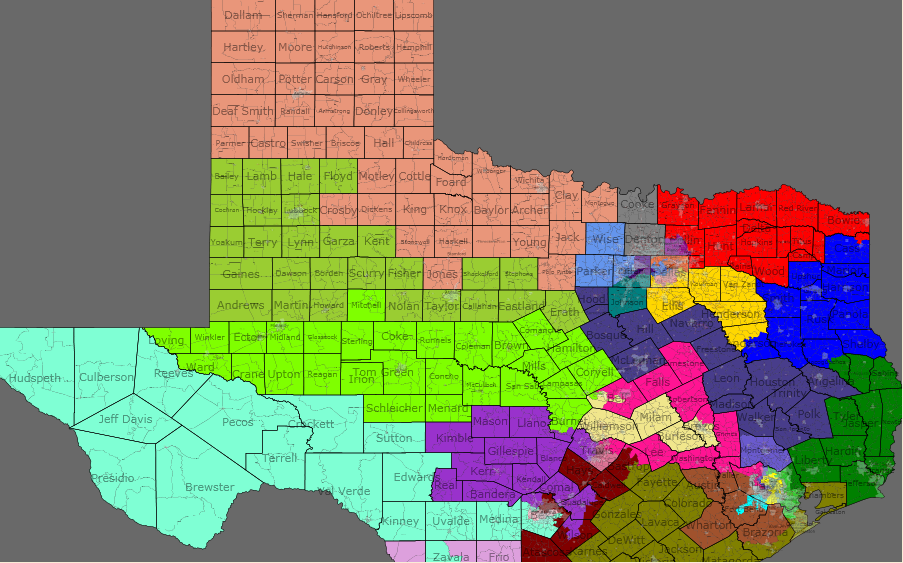
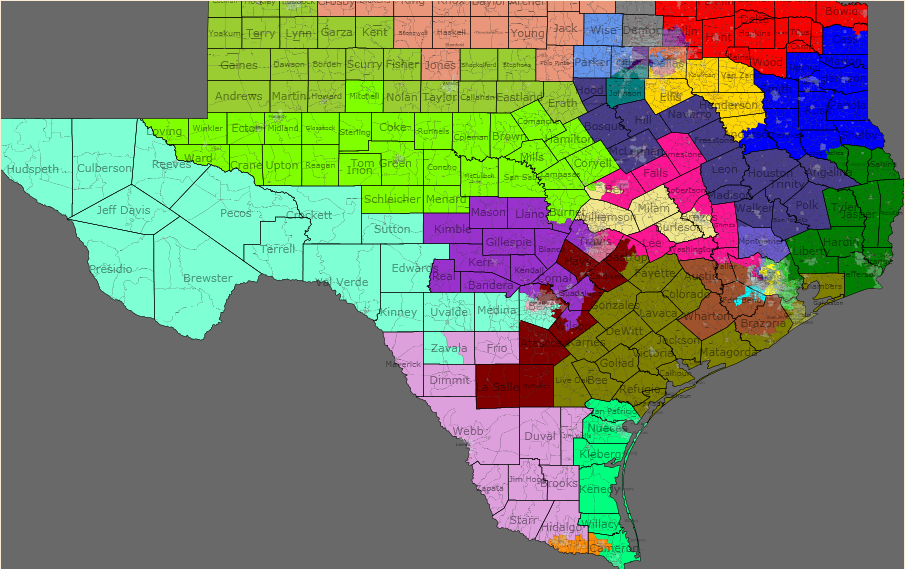
TX Redistricting, 35 Seats, GOP Gerrymander

Nathaniel90’s diary motivated me to make my own Republican gerrymander of Texas. By the time I was done, I was kinda shocked at how “ugly” some of my districts looked, notably TX-7, TX-8, and TX-10 all reaching into downtown Houston to dilute a new minority district, and how TX-21, TX-17, TX-10, and a new Republican TX-35 were snaked across central Texas so as to keep all these seats in Republican control for 10 years and likely dislodge Edwards. My inspiration here was a comment by TXMichael to separate Bell, Williamson, and McLennan into three different districts. Originally I was going to allow Edwards to be “safe” and create a district for him out of these three counties and Travis, but I think the TX Republican party is more likely to try something like this.

TX-7 is the most “at risk” GOP district in the state at 56% White. Most GOP districts are close to 60% white. All Democratic seats, except the Travis county based TX-25 are over 75% minority.

Full State, Top HalfFull State, Top Half

Full State, Bottom Half

Full State, Bottom Half

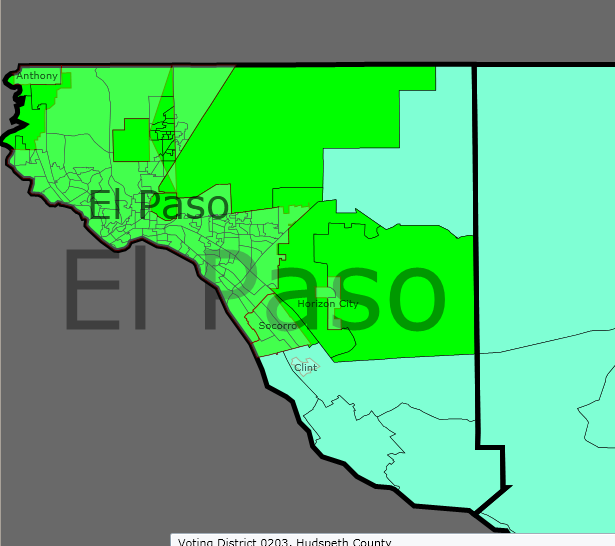
El Paso

El Paso

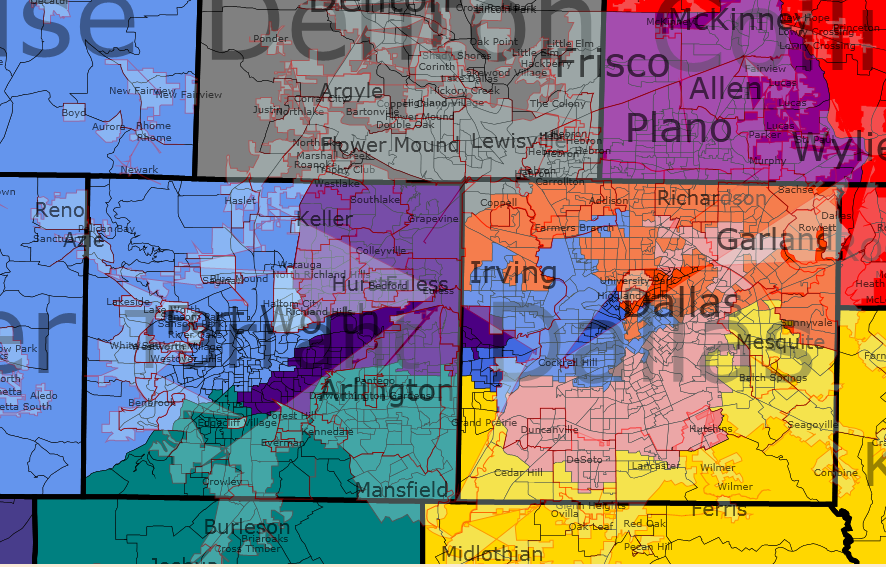
Dallas/Fort Worth This is what I am the most proud of. Sessions and Marchant are safe, and a new Democratic seat is made on Dallas’ west side.

FW

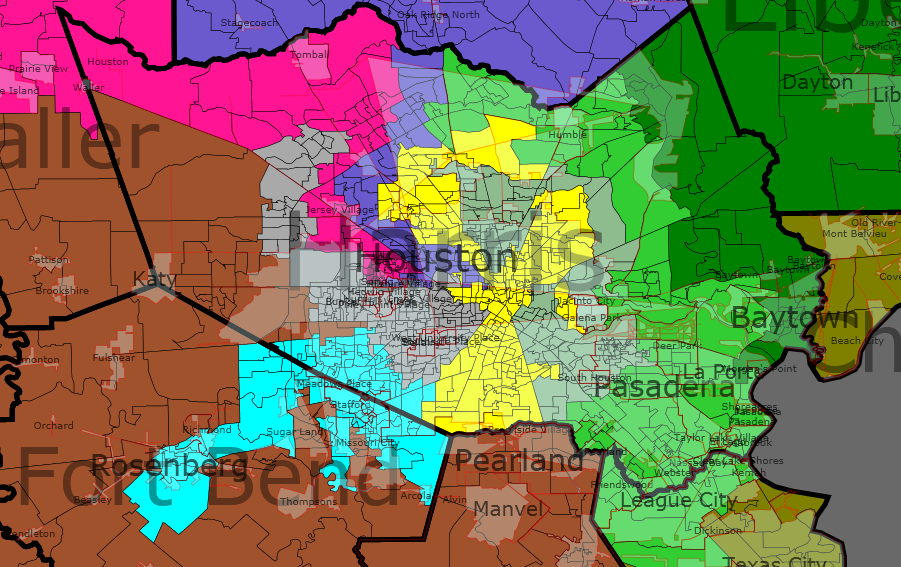
Harris CountyA new Republican seat is made. I’m shocked at how I had to have TX-7, TX-8 and TX-10 reach into downtown to grab leftover minority precincts. If a 36th seat comes around, I think this is where it’s going to go providing an extra buffer for TX-7 and TX-34 (TX-2, TX-29, and TX-34 are all green and border each other, sorry)

Harris County

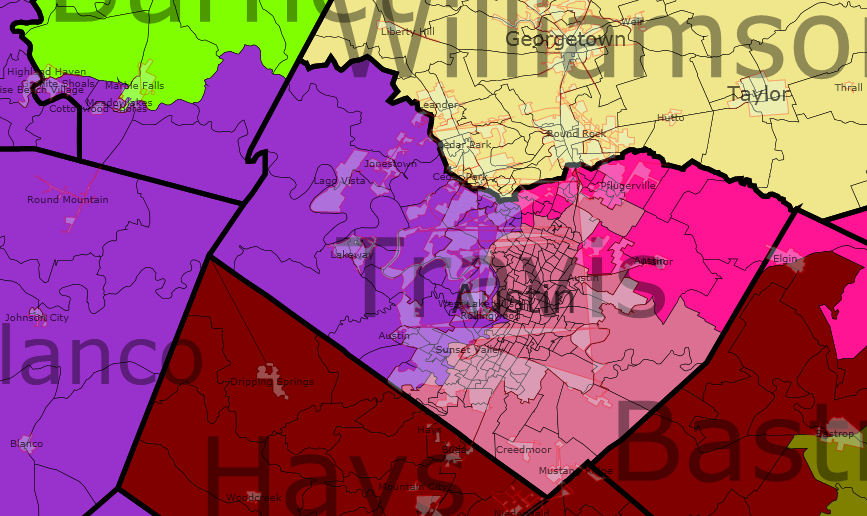
Travis County

Travis County

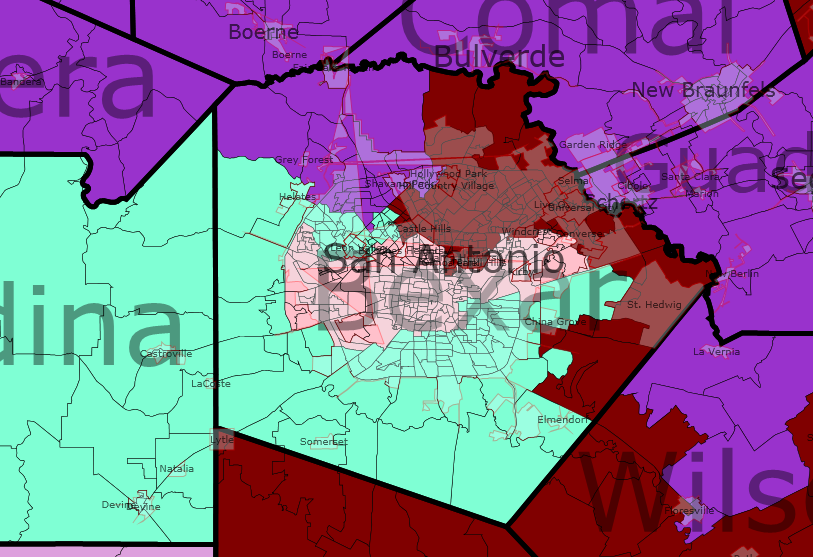
Bexar County

Bexar County

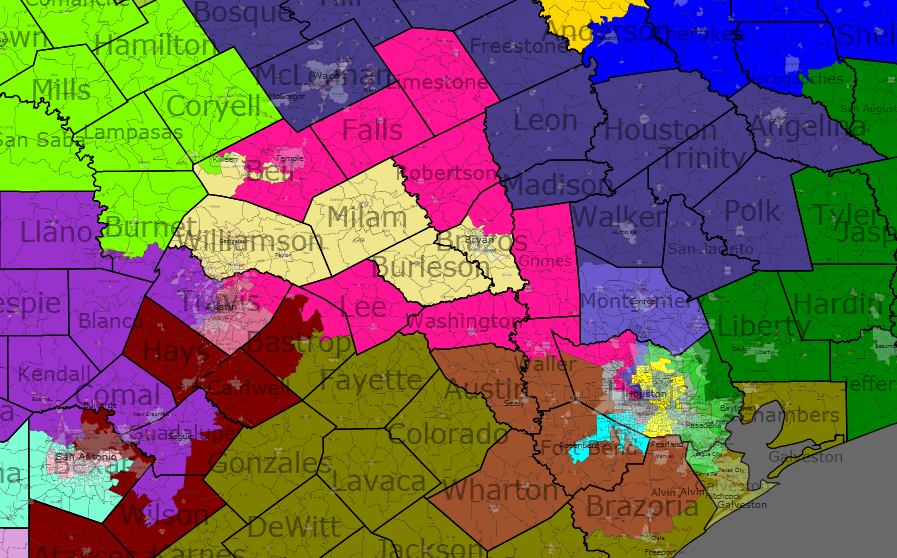
Central Texas OMG! What did I do to TX-10, TX-17, TX-21, TX-31, and TX-35? I eliminated Chet Edwards with a can not win district and made a new rural Republican seat. Sucks to be Chet, I guess the Republicans can make things worse.

Central Texas

Districts in Review:

TX-1 (Blue): Louie Gohmert (R)  Smith County, Nacadoches, and northern East Texas. 67% White

Contracts in size, loses a few counties, but still the same East Texas district full of people JSmith does not tolerate 😛

TX-2 (Dark Green): Ted Poe (R) Far East Harris County, Beaumont, and Jasper. 65% White

Loses some Harris County precincts and expands to become mostly based out of East Texas grabbing all of Jefferson county and several other rural East Texas counties.

TX-3 (Purple): Sam Johnson (R) Collin County, Plano. 65% White

Contract, contract, contract. Loses all Dallas precincts and grabs a handful of new Collin county precincts in exchange.

TX-4 (Red): Ralph Hall (R) Rural Colin County, Rockwall County, Paris. 75% White

Almost no changes. Only changes were the addition of Wood County and Loss of all of Cass County.

TX-5 (Yellow): Jeb Hensarling (R) Mesquite, Grand Prairie, Ellis County, Athens County. 60% White.

Hensarling’s district rotates clockwise in Dallas county, losing some of the stuff on his north end and reaches around to the southwest corner. Additionally, the addition of Ellis county gives TX-5 a rural county with a large population.

TX-6 (Sea Green): Joe Barton (R) Arlington, Johnson County. 59% White

In Tarrant, TX-6 grabs a little more of downtown. The rest of the district is entirely different. Gone is the I-45 stretch to Centervile, instead the Heavy straight-ticket GOP county of Johnson is added.

TX-7 (Grey): John Culberson (R) West Houston. 56% White

The most “vulnerable” GOP district in the state. relatively the same, bleeds some precincts out of Jersey Village and few more out of Spring Village. Grabs some new precincts out of West University Place and Bellaire.

TX-8 (Deep Purple): Kevin Brady (R) The Woodlands, West Downtown Houston. 64% White

The first “special” district. TX-8 gives up all of the rural East Texas districts (no more Jim Turner to dislodge) and now reaches it’s tentacle from Montgomery county into downtown Houston grabbing as many leftover minority districts as it can find.

TX-9 (Light Blue): Al Green (D) Southwest Houston, Rosenburg. 32% Black, 29% Hispanic, 24% White

TX-9 begins a run towards Fort Bend County. Despite the Delay reputation left with Sugarland and Fort Bend, Obama got 49% in this County. TX-9 reaches to Rosenburg to grab all the minority precincts to make a safe TX-22.

TX-10 (Bright Pink): Mike McCaul (R) Northeast Travis, North Harris, Downtown Houston, Temple. 59% White

The next special district. A lot of this would be easier is McCaul did not live in Travis County. Some Travis counties were shed, as was Burleson, Austin, and some of Waller county. The district gains by grabbing those other minoirty precincts in Harris that TX-8 could not get and reach around College Station to Bell County and grabs as much as it can from this shifting democratic county.

TX-11 (Lime Green): Mike Conaway (R) San Angelo, Midland, Odessa. 57% White

Not many changes.Grabs Coryell and Hamilton County, burns Kimble, Mason, Llano, and Gillespie.

TX-12 (Blue): Kay Granger (R) North West Tarrant County. 59% White.

Not much change. Loses some land to TX-6 and takes some downtown precincts from TX-24.

TX-13 (Peach): Mac Thornberry (R) Panhandle. 67% White.

Loses no land, grabs a handful of new counties, including Deaf Smith, Archer, Young, and Castro, and Parmer.

TX-14 (Safari Green): Ron Paul (R) Galveston, Aransas, La Grange. 55% White

Om nom nom, land. TX-14 grows and grows a lot. Goodbye Wharton county, hello I-10 corridor and lands north of Corpus Christie. Don’t let the low numbers of Whites fool you, this is libertarian land that loves Ron Paul crazies.

TX-15 (Orange): Ruben Hinojosa (D) McAllen, Harlengen. 87% Hispanic.

If TX-14 was scarfing food, TX-15 is bulimic. It contracts to just these two cities.

TX-16 (Nuclear Green) Sylvester Reyes (D) El Paso. 81% Hispanic

I think it bleed 3 precincts total. No change.

TX-17 (Dark Purple) Chet Edwards (D) Waco, Hood County, Corsicana, Huntsville, San Jacinto County. 67% White.

Okay, Chet Edwards should have been eliminated in 2004, but he wasn’t and he’s a BAMF. The addition of College Station should have finished him off, except the legislature forgot Aggies are idiots (if you live in Texas, you know the jokes and you are laughing) and will vote for someone only if they wear their A&M class ring. First thing to do, get rid of A&M. He now has Sam Houston University in Huntsville and the entire backwoods region north of Houston. My only regret with this district? Getting rid of Johnson county, maybe I should have kept Johnson and eliminated Hood instead. Oh well . . . Either ways, behold the end of Rep. Edwards.

TX-18 (Yellow) Sheila Jackson-Lee (D) Downtown Houston. 51% Black, 34% Hispanic

Grabs a lot of area on the South side of Houston and burns stuff near Jersey Village. I’m surprised I got a 51% black district.

TX-19 (Puke Green) Randy Neugenbauer (R) Rural West Texas, Lubbock. 61% White.

Grabs Erath and Andrews County, not many other changes

TX-20 (Light Pink) Charlie Gonzales (D) Downtown San Antonio. 72% Hispanic.

Contraction. Sam shape, just loses a few precincts on each side.

TX-21 (Burnt Red) Lamar Smith (R) North Bexar County, Hayes County, McMullen County. 57% White.

WHAT IS THIS THING?!?!?! The most altered district in Texas is what it is. North San Antonio is the only part that is the same. It adds barely democratic Hayes county, and lost of other rural counties on the east side of Austin/San Antonio . My surprise was how far south it had to reach to get enough voters.

TX-22 (Dirt Brown) Pete Olson (R) Fort Bend County, North Brazoria County, Wharton, Austin, Waller Counties and Far West Harris County (including Katy). 58% White.

TX-22 gives up on Galveston county and lots of the urban parts of Fort Bend. In exchange it reaches out of Houston and goes for rural lands. The Addition of Katy in Houston is the most straight ticket republicans you can find, anywhere.

TX-23 (Sea Blue) Ciro Rodriguez (D) South Bexar County, Rural lands to El Paso, Del Rio. 67% Hispanic.

Goodbye white northern precincts in Bexar county, hello safe Dem seat for Ciro.

TX-24 (Purple) Kenny Marchant (R). North East Tarrant County.

Goodbye Dallas, Goodbye Denton. Yes, I know Kenny lives in Denton, but he’s gonna have to move, his district moved fast, and he’s going to have to as well. Southlake, Grapevine, etc will cancel out the addition of downtown Fort Worth precincts.

TX-25 (Pink) Lloyd Doggett (D). Austin 43% White, 41% Hispanic.

So much for the 2002 plans to split up Austin, Rep. Doggett comes home and represents the White liberals in his new condensed district.

TX-26 (Grey) Michael Burgess (R) Denton and Cooke Counties. 68% White.

Burgess is going to be real safe for a real long time with this district. All of Denton and Cooke, Burns all of Tarrant.

TX-27 (Gak Green) Solomon Ortiz (D) Corpus Christie to Brownsville. 71% Hispanic.

Grabs all of San Patricio county, besides that, pretty much the same.

TX-28 (Lavender) Henry Cuellar (D) Laredo, Maverick County, Jim Wells County, and North Hidalgo County. 92% Hispanic.

TX-28 grabs a lot of the rural land that was previously held by TX-15. It’s rural growth, but it is still a safe valley seat.

TX-29 (Grey Green) Gene Green (D) East Downtown Houston. 76% Hispanic.

I don’t know if Gene Green can be dislodged via a primary, but this is a safe Democratic district that will elect a Hispanic should he retire in the next decade. Eliminated Baytown.

TX-30 (Peachy) E.B. Johnson (D) South Dallas, Bits around Garland. 42% Black, 35% Hispanic

TX-30 is still an african American district thanks to Duncanville, but it won’t be by 2020. It trades a lot of land around Garland with TX-32 to still be a safe Dem seat.

TX-31 (Goldenrod) John Carter (R) Williamson County, Killeen, College Station. 63% White.

Williamson is moving blue, but the College Station parts should offset it through the decade. Carter is not be vulnerable to a democrat, but he may be vulnerable to an Aggie challenge (see TX-17 rant)

TX-32 (Orange) Pete Sessions (R) Richardson, Garland, Rowlett 62% White.

I don’t know how I did it, but I made a safe Republican TX-32. All the suburbs, all the mansions, none of the risk. Loses West Dallas, gains from TX-5 on the East Side.

TX-33 (Blue) NEW (D) Corckett Hill, West Dallas, Irving. 66% Hispanic.

Safe new Dem seat. Get ready to say “Rep. Rafael Anchia,” if he is not mayor of Dallas by then.

TX-34 (Glowing Green) NEW (R) Clear Lake, North Galveston County, Humble. 58% White.

If Katy is the most Republican part of Harris County, this is the second most. North Galveston is getting whiter and more Republican and Clear Lake continues to hold NASA and the white collar engineers and mansions. It may get closer near the end of the decade due to growth on the north side, but this one will be R and stay that way due to straight ticket voters. Likely new Rep: State Rep. Larry Taylor of Friendswood.

TX-35 (Bright Purple) NEW (R) West Travis County, Northwest Bexar county, Comal County, Llano, Kerrville. 72% White.

Very Republican, very rural with growing exurbs. Don’t let the Travis county parts fool you, that is the swing part of the county. New Rep will be . . .a Republican, who knows.

Conclusion:

20R-12R is going to become 23R-12D. However, even if the republicans controlled the process in 2020, I don’t think they can make more R seats. Hispanics are moving in, and they are taking over. Who knows, by 2020, they might actually start voting.

Let me know what you all think!

IA-Gov: Branstad robocalling Democrats

An alert Bleeding Heartland reader got a recorded phone call around dinnertime Monday, featuring former Republican Governor Terry Branstad.

Apparently there were a couple of questions about how Governor Chet Culver is doing and his handling of spending and the budget. Branstad’s recorded voice touted his own record on economic policy.

The call also asked if the listener would support a constitutional amendment limiting marriage to between one man and one woman, and if the listener would vote for Branstad in the upcoming Republican primary.

According to my e-mail tipster, the call said it was paid for by the Branstad for Governor comittee, and gave a phone number as well as the address for Branstad’s campaign website.

This particular household has two registered Democrats and no registered Republicans, and the homeowner has had the same phone number for more than 15 years. So I figured either the calling firm was using a bad list, or Branstad’s campaign is reaching out to find Democrats who aren’t happy with Culver.

Since I posted about this robocall at Bleeding Heartland, a bunch of other Iowa Democrats in households with no Republicans have reported receiving the same call, including State Representative Tyler Olson of Cedar Rapids. It seems clear that the target universe for this call was active Democratic voters.

If Branstad’s campaign is trying to identify Democrats willing to cross over to vote for him in the Republican primary, it makes me wonder what his internal polling says about the GOP race. I’ve been assuming that Bob Vander Plaats has virtually no chance of overcoming Branstad’s financial and institutional advantages during the primary, but if Marco Rubio can catch up to Charlie Crist in Florida, maybe Vander Plaats can win by running to Branstad’s right.

Several polls have shown Branstad leading Culver by a substantial margin, although the latest Iowa poll for the Des Moines Register undercut Branstad’s electability argument somewhat by showing Vander Plaats leading Culver as well. Perhaps Republican voters will come to believe they can beat Culver with the man favored by social conservative activists as opposed to Branstad, who was drafted by elite Republican donors.

SSP Daily Digest: 12/29

NC-Sen: It looks like Elaine Marshall is fishing for campaign help outside of DSCC-approved circles. She recently hired A.J. Carrillo to “oversee day-to-day activities and coordinate strategy.” Carrillo, as you may recall, managed Greg Fisher’s ill-fated primary campaign against Bruce Lunsford in the 2008 Kentucky Senate race. Two years earlier, Carrillo had better luck, helping guide Jerry McNerney to an upset victory over the DCCC-backed Steve Filson in the CA-11 primary, and to another surprise win over GOP Rep. Richard Pombo in the general election. Meanwhile, Republican Sen. Richard Burr seems to be wistfully nostalgic for the days of Bush, going so far as to tap Karl Rove to headline a fundraiser for him.

NE-Sen: Rasmussen’s Magical Mystery Tour touches down in Nebraska today, and finds some frightening numbers for Democratic Sen. Ben Nelson. In a hypothetical race against current Gov. Dave Heineman, Nelson trails by 61-30. Nelson is not up for re-election until 2012.

UT-Sen (?): I wonder if this failed amendment to prohibit full body scanning as a “primary” screening device by none other than noted civil libertarian Jason Chaffetz could be used as fodder against him if he ever decides to run for Senate. Glenn Thrush, meanwhile, thinks the vote might have broader repercussions. For his part, Chaffetz is taking a surprisingly principled stand on his proposed ban.

MD-Gov: Democratic Gov. Martin O’Malley has picked up a primary challenger in George W. Owings III, a former state delegate who served in the Ehrlich administration as his secretary of veterans affairs. Owings plans to run to O’Malley’s right in the primary. Good luck with that one.

MI-Gov: GOP douche extraordinaire Pete Hoekstra is actually taking heat in the Republican primary from venture capitalist Rick Snyder for his recent fundraising email that invited contributions to stop “the Obama/Pelosi efforts to weaken our security” in the wake of the most recent attempted terrorist attack.

MN-Gov: Josh Goodman has a good piece on Mark Dayton going public (but not fully) about his struggles with depression and alcoholism.

WY-Gov: Will Democratic Gov. Dave Freudenthal try for a third term? He’s seriously weighing the possibility, and has hired Global Strategy Group as his pollster to gauge his popularity in the state — and very likely to see if voters would mind if he challenged the state’s gubernatorial term-limits law in the courts.

AL-05: The Alabama Democratic Party doesn’t believe that Parker Griffith and his consulting firm will delete the data that they downloaded from the party’s database just hours before Griffith defected to the GOP. While the ALDP is threatening Griffith and Main Street Strategies with legal action over the data, the Alabama GOP is salivating over the prospect of getting its hands on it.

FL-17: Hotline on Call takes a look at the bubbling-under Democratic primary to replace Kendrick Meek.

PA-07: Democratic state Rep. Bryan Lentz, who’s running to replace Joe Sestak in the House, is seeking to stake out a position as the reform candidate in his race against his likely Republican opponent, former US Attorney Pat Meehan. Lentz has called for the removal of ethically-questionable state House Majority Leader Todd Eachus as the head of the Democratic caucus.

WA-03: Reid Wilson takes a closer look at the field to replace retiring Democratic Rep. Brian Baird. All signs are pointing to a likely run by ex-state Rep. Denny Heck.

KY-State House: Gov. Steve Beshear has set a February 2nd special election date to fill the central Kentucky House seat of newly-elected Republican state Senator Jimmy Higdon.

Texas: SSP’s thunder from down under, benawu, reminds us that the filing deadline for Texas closes in a week, and Democrats still have a lot of congressional races left unfilled, including the sadly-vacant TX-10.

Strategy: Steve Rosenthal, a respected name in Dem consulting circles, has a very good piece on the five-step recovery process he suggests that Democrats follow in order to mitigate electoral damage in 2010.

AL-05, AL-Gov: Sparks Stays Out, Gube Primary Gets Tense

As we anticipated last night, Ron Sparks is staying out of the 5th CD race after publicly flirting with a run against Parker Griffith a few days ago. The truth of it is, Sparks would have been well-advised to shut the door immediately on a bid in public while making his deliberations in private. His opponent in the Democratic gubernatorial primary, Artur Davis, seized upon the opportunity to launch a blistering broadside against Sparks:

“In the last couple of years, I’ve seen Ron Sparks go from a U.S. Senate race to a lieutenant governor’s race to the governor’s race to a congressional race and now back to the race for governor,” Davis said. “The problem for Ron Sparks is that he always needs permission from a small group of insiders in Montgomery and they want a governor who will do their bidding, not a congressman in North Alabama.”

For his part, Sparks is firing back in a populist manner:

“I am seeking the Democratic nomination for Governor against another man who has abandoned the values that put him in Congress.

“My opponent, voted against vital health care reform measures. He voted to protect the rights of credit card companies rather than the rights of Alabama families. He thumbs his nose at the democratic leaders of our state and panders to right wing power brokers and big business contributors. He draws more of his support from Manhattan than he does from main street Alabama.

“[…] My opponent is a man who breaks his word and betrays his supporters.”

It’s difficult not to agree that Artur Davis is useless, but I don’t see why Sparks saw any upside in staying in such a fratricidal primary where he’ll be severely outgunned financially. I think this move shaved a few years off of his political longevity.

RaceTracker Wiki: AL-05