CA-19: Radanovich Retires

Politico:

Rep. George Radanovich (R-Calif.) will be announcing this afternoon today that he won’t be seeking re-election, according to a senior GOP source.

His chief of staff, Ted Maness, told POLITICO the congressman would be releasing a statement at 2:00 EST, but declined to confirm that he’ll be retiring. […]

Republicans comprise 44 percent of registered voters, while Democrats make up 37 percent, and 14 percent decline to affiliate themselves with a party.

Fresno Mayor Jim Patterson, a political ally of Radanovich, is expected to run for the Republican nomination in the district.

This is the first Republican retirement of the 2010 cycle — which is kind of amazing after the mass exodus of Republicans from Congress to the retirement manors of Florida over the past two cycles. I suppose we took care of most of the low-hanging fruit.

Radanovich’s seat isn’t prime territory for a pick-up. However, although its PVI is R+9, Barack Obama dramatically improved upon the old Democratic baseline in the district, losing the CD by only 52-46 to John McCain. Compare that to John Kerry’s flattening here by a 61-38 margin four years earlier. A good deal of that shift can be attributed to the demographic changes occurring within the district, which has seen a marked increase in its minority population since 2000. Those demographic gains haven’t reached the tipping point here yet, but this district could be susceptible to a bit of nipping and tucking in the next round of redistricting in order to hasten that process.

UPDATE: Check out who Reid Wilson flags as a potential GOP contender here:

One source said Radanovich will back state Sen. Jeff Denham (R) as his replacement. CA Senate districts are actually larger than congressional districts, though Denham’s is more closely related to Rep. Dennis Cardoza’s (D) neighboring 18th district. Top GOPers had tried to convince Denham to run against Cardoza, though Radanovich’s district has a stronger GOP lean.

But Denham is unlikely to get a clean shot at the seat. Fresno Mayor Jim Patterson (R) is also likely to run, and one source suggested to ex-Rep. Richard Pombo (R), who lost his neighboring 11th district to Rep. Jerry McNerney (D) in ’06, may be a potential contender as well.

Needless to say, a comebacker for “Dirty Dick” Pombo would be very fun to watch.

RaceTracker Wiki: CA-19

Texas candidate filing closes soon

Candidate filing closes in just over a week, on January 4th.

How are the parties going vis a vis recruiting candidates to run in all 32 House Districts?

Below the fold for all the details and hey go check out the 2010 Race Tracker Wiki over at Open Congress for all your House, Senate and Gubernatorial needs.

(Cross posted at Daily Kos, MyDD and Open Left)

The Texas Congressional House delegation is currently split 20/12 in favor of the GOP.

I think we can safely assume that both parties will file candidates (almost invariably the current incumbents) in the Districts that they currently hold.

So onto candidate filings.

First the bad news and there is no way to sugarcoat this – The GOP have a full slate, many with multiple candidates. Yep all 12 Dem held Districts have GOP candidates:

TX-09 (Green) – D+22,

TX-15 (Hinojosa) – D+3,

TX-16 (Reyes) – D+10,

TX-17 (Edwards) – R+20,

TX-18 (Jackson Lee) – D+24,

TX-20 (Gonzalez) – D+8,

TX-23 (Rodriguez) – R+4,

TX-25 (Doggett) – D+6,

TX-27 (Ortiz) – R+2,

TX-28 (Cuellar) – R+0,

TX-29 (Green) – D+8,

TX-30 (Johnson) – D+27,

And for us Democrats the news does not get any better.

We have confirmed candidates in only 8 of 20 GOP held Districts:

TX-05 (Hensarling) – R+17,

TX-06 (Barton) – R+15,

TX-11 (Conaway) – R+28,

TX-19 (Neugebaeur) – R+26,

TX-21 (Smith) – R+14,

TX-22 (Olsen) – R+13,

TX-26 (Burgess) – R+13,

TX-32 (Sessions) – R+8,

And in the other 12 GOP held districts there is not even a rumoured candidate:

TX-01 (Gohmert) – R+21,

TX-02 (Poe) – R+13,

TX-03 (Johnson) – R+14,

TX-04 (Hall) – R+21,

TX-07 (Culberson) – R+13,

TX-08 (Brady) – R+25,

TX-10 (McCaul) – R+10,

TX-12 (Granger) – R+16,

TX-13 (Thornberry) – R+29,

TX-14 (Paul) – R+18,

TX-24 (Marchant) – R+11,

TX-31 (Carter) – R+14,

This is a grim scenario to say the least. At this stage in 2007 we had confirmed and unconfirmed candidates in 12/19; this time 8/20.

I am not suggesting that we will not fill more of these districts but we are a long way behind. Remember that in 2008 we did not run candidates in 6 districts:

TX-01 (Gohmert) – R+21,

TX-02 (Poe) – R+13,

TX-05 (Hensarling) – R+17,

TX-11 (Conaway) – R+28,

TX-14 (Paul) – R+18,

TX-21 (Smith) – R+14,

So hop to it Texas Democrats we need more candidates filing NOW.

** Tips, rumours and what not in the comments please.***

***UPDATE***

We now have a candidate in the 14th!***

AL-05: Sparks Unlikely to Run

Well, nothing’s official, but check out this press release that found its way into my inbox:

Gubernatorial candidate Ron Sparks will hold press conferences on Tuesday, December 29 to discuss the his campaign for Governor and next year’s race for the 5th Congressional District seat in North Alabama.  The press conferences will be held at:

Huntsville: 10:00 a.m., Madison County Courthouse Steps

100 Northside Square

Birmingham: 1:30 p.m., Linn Park

Montgomery: 4:00 p.m., Sparks campaign headquarters, 4240 Carmichael Rd

If you’re announcing that you’re running for Congress, you usually don’t take your announcement tour on the road to places outside the district (Birmingham and Montgomery) that you’re supposedly interested in representing. While I suppose Chris Van Hollen still has some time on the clock to make a last minute plea, I don’t think you should hold your breath. Ron Sparks seems to think that he has a good shot at being Alabama’s next Governor. I think he’ll eventually come to regret this choice, but that’s just my take.

So what’s next? If the DCCC is smart, they’ll lean hard on Public Service Commissioner Susan Parker, who was the candidate they should have lined up behind in 2008. However, while Parker hasn’t officially ruled out the race, I’m hearing credible word that it’s more likely that she’ll run for re-election to the PSC. Democrats would then have to settle for someone further down the totem pole — one such name that I’ve heard being considered is Deborah Bell Paseur, a former district judge who narrowly lost a race for Alabama’s Supreme Court in 2008. But I’m sure we’ll hear more names in the coming days.

UPDATE: This tweet says that Sparks isn’t running.

RaceTracker Wiki: AL-05

SSP Daily Digest: 12/28

TX-Gov, TX-Lt. Gov: Former Travis County D.A. Ronnie Earle has decided to run for Lt. Governor, and not Governor or Attorney General. Republican incumbent David Dewhurst has filed to run for re-election, though many expect that he’d jump into an open seat Senate race, in the seemingly unlikely event that Kay Bailey Hutchison resigns. Earle joins Austin deli owner Marc Katz in the Democratic primary.

AL-05, AL-Gov: Democrat Ron Sparks, Alabama’s Commissioner of Agriculture and Industries, says that he will make a decision on switching from his gubernatorial campaign to a run against turncoat Rep. Parker Griffith within the next 48 hours. I don’t have any special insight here, but it sure sounds like Sparks is actually going to make this move. If Sparks takes a pass, there are a number of lesser-known potential candidates who sound interested, according to the Huntsville Times. Meanwhile, Griffith’s Tea Party-backed primary challenger, Les Phillip, is whacking Griff hard over his past donations to Harry Reid and Howard Dean. I wonder if Griffith realizes how big of a miscalculation he made.

FL-02: For all the GOP’s success in “expanding the map” of House pick-up opportunities next year, Roll Call notes that the party is more or less empty-handed in their pursuit of a challenger to ultra-Blue Dog Rep. Allen Boyd. GOP political consultants seem to be holding out hope that a self-funder may parachute into the race before the state’s March filing deadline.

NY-01: Republican businessman Randy Altschuler is already up on the air, launching broadsides at Democratic incumbent Tim Bishop for his TARP votes.

PA-06: Democrat Doug Pike had hoped that an early injection of his own personal wealth coupled with a batch of endorsements from local Democrats would keep the primary field clear in his effort to wrest control of the open seat district that Republican Jim Gerlach is leaving behind. Not so fast. Already dealing with the surging candidacy of Manan Trivedi, Pike has picked up a second primary challenger in Lower Merion Township Commissioner Brian Gordon.

PA-16: Democratic activist Lois Herr, trying for a third crack at entrenched GOP incumbent Joe Pitts, is now facing a primary from pro-life Democrat John J. McClure.

WA-03: Retiring Dem Rep. Brian Baird tells the Politico National Journal’s Reid Wilson that he thinks that Denny Heck, a well-traveled name in Washington political circles, will run for his seat. As we’ve mentioned here before, Heck was a state Rep. in the 80s, lost a Superintendent of Education race, became Gov. Booth Gardner’s chief of staff, and then founded TVW, the state’s local equivalent of C-SPAN.

NRCC/TX-32: Pete Sessions Deathwatch, Vol. 4? “I love you and believe in you. If you want my ear/voice — e-mail.” That’s the message that NRCC Chair Pete Sessions sent to banker Allen Stanford just hours after federal investigators charged him with fleecing investors to the tune of $7 billion. The muck raking crew over at TPM has the full background on this sordid story.

Party Switching: DCCC Chair Chris Van Hollen is “very confident” that there will be no more defections from the Democratic caucus this cycle. Meanwhile, the Southern Political Report has a piece analyzing the longevity of party switchers, and finds some decidedly mixed results.

Strategy: The Democratic game plan for the 2010 elections appears to hinge around the argument that the GOP will “repeal” health care reform. DSCC Chair Bob Menendez: “I would simply say to my Republican friends, what are they going to campaign on? That they’re going to repeal 30 million people who have health insurance under this package? That they’re going to repeal closing the gap on Medicare?” Note that this is exactly what Newt Gingrich is pressing the GOP to embrace.

The New York Senate Part 2: 43? Democrats

As promised a few days ago, I’d post the second part of my proposed New York Senate map. So without further ado, here it is.

I also tried to have the numbers make more sense. The goal was to make the city entirely Democratic (except Staten Island), then to get as many districts out of upstate Democratic centers as possible.

I may have been a tad too aggressive upstate, with three Buffalo Dems, two Rochester Dems, two Syracuse Dems, two Albany Dems, and one Ithaca-Binghamton Dem (in addition to Aubertine).

I also tried to stick to one man-one vote and keep the deviations down, but I couldn’t resist underpacking some Democratic districts and overpacking Republican districts..

UPDATED w/ MAPS!!! Texas GOP Gerrymander: Using Dave’s Tool

UPDATE: Thanks for mentioning Flickr as an alternative. Now the maps display correctly.

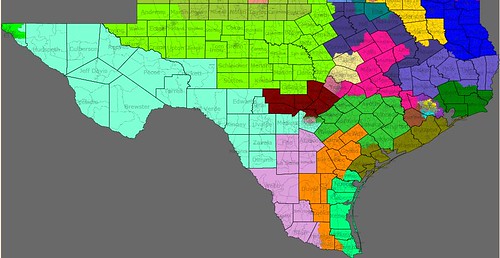
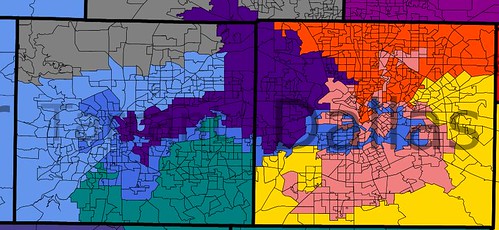
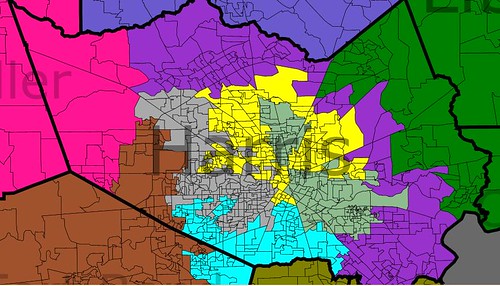
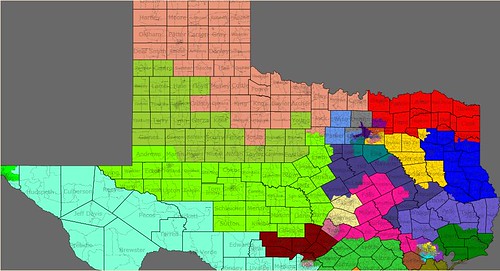
Way back in March I mapped Texas using my own low-tech method. Now, using Dave’s redistricting tool with brand new 2009 estimates, I’ve finally taken on Texas the new and improved way. Again I attempted a Republican gerrymander, but using 35 seats instead of 36 (2009 estimates show growth in Texas slowing enough that the state may gain “only” three seats rather than four).

Below the fold…

Some maps:
TexasMap1

TexasMap2

Dallas-Fort Worth:

TexasMap3

Houston:

TexasMap4

Really, the map doesn’t look that different from my original computer-painted one, except that there is no “west-central” district, and that affects the shape of several large districts in Central Texas. I will only make comments for districts that are new, substantially altered from their current forms, or statistically amusing.

OVERALL OUTCOME OF A GOP GERRYMANDER IN 2012:

22 Republicans, 13 Democrats (23-12 when Edwards retires, but may revert to 22-13 as districts like the 22nd and 24th diversify)

District 1 – Louie Gohmert (R-Tyler)

Geography: East, from Wood and Smith Counties in the northwest to Sabine County in the southeast

Politics: safe Republican

VRA stats: 68% white

District 2 – Ted Poe (R-Humble)

Geography: Southeast, from Humble and eastern Harris County in the west to the Gulf in Chambers and Jefferson Counties

Politics: safe Republican

VRA stats: 62% white

District 3 – Sam Johnson (R-Plano)

Geography: Entirely within Collin County

Politics: safe Republican

VRA stats: 65% white

Still solidly Republican and plenty white and suburban, but it’s only logical at this point that Collin County have its own district.

District 4 – Ralph Hall (R-Rockwall)

Geography: Northeast, from Grayson, Collin, and Rockwall Counties in the west to the Arkansas and Louisiana borders

Politics: safe Republican

VRA stats: 75% white

District 5 – Jeb Hensarling (R-Dallas)

Geography: Stretching east from Dallas to Wood County in the north and Cherokee County in the south

Politics: safe Republican

VRA stats: 63% white

District 6 – Joe Barton (R-Ennis)

Geography: Stretches south and east from Fort Worth to Johnson, Ellis, and Navarro Counties

Politics: safe Republican

VRA stats: 62% white

Demographically, the district doesn’t change much, but geographically it does. Gone are all those rural southern counties, mostly ceded to Chet Edwards. Barton instead picks up a lot more Fort Worth, and by the end of the 2010s, that may make the district a lot less white and a lot less Republican.

District 7 – John Culberson (R-Houston)

Geography: west Houston

Politics: fairly safe Republican

VRA stats: 59% white

By the end of the decade this may be a swing seat, despite my best efforts to keep it crimson red.

District 8 – Kevin Brady (R-The Woodlands)

Geography: Southeast, from Grimes County in the west to the Louisiana border

Politics: safe Republican

VRA stats: 73% white

Now this is as hardcore a GOP seat as one can draw east of the Hill Country.

District 9 – Al Green (D-Houston)

Geography: south Houston, Mission City, etc.

Politics: safe Democratic

VRA stats: 42% black, 38% Hispanic

District 10 – Mike McCaul (R-Austin)

Geography: McLennan and Limestone Counties in the north; in the south, stretches east from Austin to west Harris County

Politics: fairly safe Republican

VRA stats: 51% white, 31% Hispanic

The look of this district changed dramatically as I needed to accommodate a bulging Central Texas population and new seats to the south and east of McCaul’s district. Also, Edwards’ district had to be screwed with, so I gave McCaul part of McLennan County (including George W. Bush’s ranch in Crawford, long represented by a Democrat) and a few Chet-friendly counties like Falls and Robertson, leaving Edwards with tougher territory like Brazos County and a split home base. But really, how much tougher can you make the 17th for a Democrat? And meanwhile, McCaul’s district looks like it’s about to rip from being pulled in too many directions.

District 11 – Mike Conaway (R-Midland)

Geography: West, including Midland and San Angelo

Politics: safe Republican

VRA stats: 62% white

Doesn’t get much more Republican than this.

District 12 – Kay Granger (R-Fort Worth)

Geography: much of Tarrant County, plus Wise and Parker Counties

Politics: safe Republican

VRA stats: 75% white

District 13 – Mac Thornberry (R-Clarendon)

Geography: Panhandle / North, including Amarillo

Politics: safe Republican

VRA stats: 68% white

District 14 – Ron Paul (R-Surfside)

Geography: coastline, from Galveston in the northeast to Refugio County in the southwest

Politics: safe Republican

VRA stats: 58% white, 26% Hispanic

Anyone else think it’s odd that the 13th is in the northwestern-most portion of the state and the 14th just about the southeastern-most?

District 15 – Ruben Hinojosa (D-Mercedes)

Geography: South, from Karnes and DeWitt Counties to the Mexican border

Politics: safe Democratic

VRA stats: 82% Hispanic

District 16 – Silvestre Reyes (D-El Paso)

Geography: El Paso

Politics: safe Democratic

VRA stats: 81% Hispanic

District 17 – Chet Edwards (D-Waco)

Geography: Central, from Hood and Johnson Counties in the northwest to Brazos, Madison, and Houston Counties in the southeast

Politics: leans Democratic while Edwards runs, likely Republican once he retires

VRA stats: 67% white

All relevant comments listed under District 10.

District 18 – Sheila Jackson-Lee (D-Houston)

Geography: arc around central Houston

Politics: safe Democratic

VRA stats: 46% Hispanic, 35% black

Unfortunately for VRA perfectionists I could not get a black plurality here without severely upsetting the balance in other Houston-area districts. Like the “black opportunity” districts in California, Texas’ three VRA black districts are quickly becoming plurality-Hispanic, though turnout models still favor an African-American candidate in seats like this one. If I had made this district less Hispanic, it would only have made the 9th more so. There is simply no way to make both of them much more than 40% black.

District 19 – Randy Neugebauer (R-Lubbock)

Geography: West, including Lubbock and Abilene

Politics: safe Republican

VRA stats: 60% white

District 20 – Charlie Gonzalez (D-San Antonio)

Geography: central San Antonio

Politics: safe Democratic

VRA stats: 71% Hispanic

District 21 – Lamar Smith (R-San Antonio)

Geography: Stretches from Kerr and Bandera Counties in the west to Hays County in the east and down to north San Antonio

Politics: safe Republican

VRA stats: 64% white

District 22 – Pete Olson (R-Sugar Land)

Geography: Fort Bend County, southwest Houston

Politics: likely Republican (for now)

VRA stats: 45% white, 25% Hispanic

Demographically, this district is about to pop. No map can simultaneously keep the 9th VRA-protected and secure Culberson, McCaul, and Olson, unless the Republicans cede the new Houston seat (and they definitely don’t have to). If I were them I’d draw a simple district like this that will stay in GOP hands until the clock runs out on Olson (which could well be before the end of the decade).

District 23 – Ciro Rodriguez (D-San Antonio)

Geography: Southwest, from the eastern outskirts of El Paso to south San Antonio

Politics: safe Democratic

VRA stats: 71% Hispanic

Rodriguez’s current district was designed for a competitive race between him and Henry Bonilla in 2006. Now that Bonilla is out of Congress it seems probable that the Hispanic pop. here will go up significantly to preempt any trouble Lamar Smith may run into.

District 24 – Kenny Marchant (R-Coppell)

Geography: Dallas-Fort Worth, meandering through Tarrant, Dallas, and Denton Counties

Politics: likely Republican (for now)

VRA stats: 44% white, 35% Hispanic

Another ticking time bomb for the GOP? These middle-class-to-upscale suburban/urban districts are getting a lot harder for Republicans to hold. I suppose I could have made life a lot easier for Marchant by messing with the boundaries in Fort Worth and diluting the heavily white natures of the 12th and 26th, but really, Hispanic numbers are increasing rapidly in just about every urban or suburban county.

District 25 – Lloyd Doggett (D-Austin)

Geography: most of Travis County

Politics: safe Democratic

VRA stats: 60% white

District 26 – Mike Burgess (R-Flower Mound)

Geography: Denton and Tarrant Counties

Politics: safe Republican

VRA stats: 69% white

District 27 – Solomon Ortiz (D-Corpus Christi)

Geography: Southeast / coastline, from San Patricio County to the Mexican border

Politics: safe Democratic

VRA stats: 72% Hispanic

District 28 – Henry Cuellar (D-Laredo)

Geography: South, from Frio and Atascosa Counties to the Mexican border

Politics: safe Democratic

VRA stats: 89% Hispanic (most heavily Hispanic district in the nation? Probably.)

District 29 – Gene Green (D-Houston)

Geography: central and east Houston

Politics: safe Democratic

VRA stats: 76% Hispanic

Here’s the deal here: Republicans have never cared for Gene Green, and his district has always been majority-Hispanic and is getting more so. To make this an unambiguous VRA seat, remove Hispanics from nearby Republican districts, and possibly guarantee an ethnicity-based primary challenge, I imagine the GOP packing as many Houston Latinos as they can into this seat.

District 30 – Eddie Bernice Johnson (D-Dallas)

Geography: central and south/west Dallas

Politics: safe Democratic

VRA stats: 44% black, 35% Hispanic

District 31 – John Carter (R-Round Rock)

Geography: Central, around Williamson and Bell Counties

Politics: safe Republican

VRA stats: 61% white

The explosive growth in and around this district will cause it to shrink dramatically in area.

District 32 – Pete Sessions (R-Dallas)

Geography: north Dallas

Politics: likely Republican

VRA stats: 56% white, 27% Hispanic

I helped Sessions a lot here demographically, but at Marchant’s expense. One could even out the numbers to make both districts about 50% white, 30% Hispanic, but in rapidly diversifying Dallas, that’s not a lastingly secure position for a Republican anyway.

And the new seats:

District 33 – likely to elect a Latino Democrat

Geography: stretches east from Fort Worth to Dallas

Politics: safe Democratic

VRA stats: 65% Hispanic

At long last, a majority-Hispanic Metroplex district, and a second Democratic seat in the area. The Hispanic population should be robust enough to elect a Latino, but the total ethnic minority population is even more overwhelming at 85%. The Texas legislature is likely to cede a new Dallas-Fort Worth seat like this one to the Democrats, in exchange for saving increasingly vulnerable GOP seats in the suburbs and snatching the other two new seats for the Republicans.

District 34 – likely to elect a Republican

Geography: South-central, from east San Antonio to the Hill Country in the north and Victoria County in the southeast

Politics: likely Republican

VRA stats: 53% white, 36% Hispanic

This district will get more Hispanic as time gets on, but for the first decade it should be fine for a military-friendly white Republican.

District 35 – likely to elect a Republican

Geography: north and east Harris County, outskirts of Houston

Politics: safe Republican

VRA stats: 62% white, 23% Hispanic

Packing the Latinos into the 29th made a big difference here, ensuring a GOP victory in Houston’s new district. Unlike Dallas-Fort Worth, Houston still has room for another Republican seat, though the 22nd may switch columns within the next decade.

So there you have it. Texas may gain a 36th district after 2010; we’ll know once the Census numbers are released. But for now, we can be fairly sure there will be 35 at least. And surprisingly, the map isn’t that different for a 35-district Texas from a 36-district Texas.

Redistricting North Carolina (w/ data)

Well I really liked Johnny Longtorso’s map of North Carolina, so I decided to expand on that and create a similar map while figuring out the partisan data for each district. Nothing fancy, just county level voting for the 2008 election. The map is 9-4-1, either 9-5 or 10-4 depending on whether a Democrat can defeat Myrick.

Unfortunately, according to the new census report North Carolina will probably not get a 14th district. Plus it probably violates VRA, but it’s an example of how the VRA hurts Democrats in redistricting. So this map is a bit useless, but I like it.  

Congressional District 1: Butterfield (D)

County Obama Vote McCain Vote
Vance 13,166 7,606
Warren 7,086 3,063
Franklin 13,085 13,273
Nash 23,099 23,728
Wilson* 19,652 17,375
Greene 3,796 4,272
Edgecombe 17,403 8,445
Halifax 16,047 8,961
Northampton 6,903 3,671
Hertford 7,513 3,089
Gates 2,830 2,547
Bertie 6,365 3,376
Martin 6,539 5,957
Pitt 40,501 33,927
Washington*
Total 183,985 139,290
New % 56.91%
Old % 62.72%

This is now a 41% Black district (still majority minority) down from 50.6%. And probably a violation of the VRA. Butterfield Got 70.28% in the old district. Likely Democratic (Safe with Butterfield).

Congressional District 2: Etheridge (D)

County Obama Vote McCain Vote
Harnett 16,785 23,579
Johnston 26,795 43,622
Wake* 110,410 76,809
Wilson*
Total 153,990 144,010
New % 51.67%
Old % 52.33%

Leans Democratic. (Safe with Etheridge).

Congressional District 3: Jones (R)

County Obama Vote McCain Vote
Brunswick 21,331 30,753
Onslow 19,499 30,278
Craven 19,352 24,901
Carteret 11,130 23,131
Pamlico 2,838 3,823
Beaufort 9,454 13,460
Hyde 1,241 1,212
Dare 8,074 9,745
Tyrrell 933 960
Washington 3,748 2,670
Chowan 3,688 3,773
Perquimans 2,772 3,678
Camden 1,597 3,140
Pasquotank 10,272 7,778
Currituck 3,737 7,234
Pender* 9,907 13,618
New Hanover* 49,145 50,544
Total* 119,666 166,536
New % 38.14%
Old % 41.81%

District 3 basically gets all the Republican friendly coastal counties in one district. It’s also is the most visually gerrymandered district as it avoids taking Wilmington from the the 7th district. Safe Republican.

Congressional District 4: Price (D)

County Obama Vote McCain Vote
Alamance 28,918 34,859
Orange 53,806 20,266
Durham 103,456 32,353
Chatham 17,862 14,668
Lee 10,784 12,775
Total 214,826 114,921
New % 65.15%
Old % 63.32%

District consists of Durham, Chapel Hill, and Burlington. Looses parts of Wake, gains the entirety of Almanace, Chatham and Lee counties. It’s a very compact district and keeps all the counties together, but I think that there are a bit too many Democrats in this district (I’d aim for more around 60%). Safe Democratic.

Congressional District 5: Foxx (R)

County Obama Vote McCain Vote
Mitchell 2,238 5,499
Avery 2,178 5,681
Watauga 14,558 13,344
Caldwell 12,081 22,526
Alexander 5,167 11,790
Iredell 27,318 45,148
Wilkes 8,934 20,288
Ashe 4,872 7,916
Alleghany 2,021 3,124
Surry 10,475 18,730
Yadkin 4,527 12,409
Davie 6,178 13,981
Stokes 6,875 14,488
Total 107,422 194,924
New % 35.53%
Old % 39.37%

Ugh. So this one really hurt as I passionately hate Virginia Foxx. So that’s probably the best news about this map being ruined with North Carolina only getting 13 districts. Hopefully more  Republican areas can get eaten up by 10th district and Winston-Salem can be incorporated into the 5th to make at least a 45%+ area where Foxx shouldn’t be able to win. As it stands, this Northwestern congressional district is Obama’s worst district aptly home to batshit insane Foxx. Safe Republcian.

Congressional District 6: Coble(R)

County Obama Vote McCain Vote
Rowan 23,391 37,451
Davidson 22,433 45,419
Randolph 16,414 40,998
Rockingham* 17,255 23,899
Guilford* 45,000 45,000
Guilford* 142,101 97,718
Total* 124,493 192,767
New % 39.24%
Old % 36.52%

Without the 14th district, this too probably will get more Democratic as it will get Greensboro and cede some Republican area to the too Democratic 4th district. But as it stands it is Safe Republican.

Congressional District 7: McIntyre(D)

County Obama Vote McCain Vote
Columbus 11,076 12,994
Bladen 7,853 7,532
Duplin 8,958 10,834
Sampson 11,836 14,038
Lenoir 13,378 13,401
Wayne 22,671 26,952
Jones 2,378 2,817
Pender* 9,907 13,618
New Hanover* 49,145 50,544
Cumberland* 15,400 10,000
Total 152,602 162,730
New % 48.39%
Old % 47.20%

Considering that this is a McCain district, I made sure that I kept all of McIntyre’s base intact I gave most of Robeson County to the 8th to strengthen Kissell, though I attempted to snake McIntyre’s home (Lumberton) into the district.  This district is a percentage better than before. My reason for adding the rest of Sampson, all of Lenoir and Wayne is because while the counties are all either Republican or Tossup, they all seem like McIntyre can do well and build a Democratic base in.

Since from what I can see Generic Democrat did about 3% better than Obama this district is Tossup Democratic. (Safe for McIntyre).

Congressional District 8: Kissell(D)

County Obama Vote McCain Vote
Total 138,448 118,982
Anson 6,456 4,207
Montgomery 4,926 6,155
Richmond 9,713 9,424
Moore 17,624 27,314
Scotland 8,151 6,005
Hoke 9,227 6,293
Robeson 23,058 17,433
Cumberland* 59,293 42,151
Total 138,448 118,982
New % 53.78%
Old % 52.96%

I made Kissell’s district a bit more Democratic by  grabbing more of Fayetteville and Robeson and Republican Moore, but loosing all the Republican territory in Cabarrus, Stanly, and Union and Republican part of Mecklenburg (Charlotte) which he lost 34.7k to 46.4k. This is now Leans to  Likely Democratic.

Congressional District 9: Myrick (R)

County Obama Vote McCain Vote
Union 31,189 54,123
Stanly 8,878 19,329
Cabarrus 31,546 45,924
Mecklenburg* 76,958 30,848
Total 148,571 150,224
New % 49.72%
Old % 45.11%

This is a pretty spiteful gerrymander specifically to get rid of Myrick  

Analyzing Swing States: Pennsylvania, Part 4

This is the fourth part of an analysis of the swing state Pennsylvania. It focuses on the industrial southwest, a once deep-blue region rapidly trending Republican. Part five can be found here.


Pittsburgh and the Southwest

Pennsylvania’s southwest has much in common with West Virginia and Southeast Ohio, the northern end of Appalachia. Electoral change in the region is best understood by grouping these three areas together as a whole.

Socially conservative (the region is famously supportive of the NRA) but economically liberal, the industrial southwest voters typify white working-class Democrats. These voters can be found in unexpected places: Catholics in Rhode Island and Massachusetts, loggers along the Washington coast, rust-belt workers in Duluth, Minnesota and Buffalo, New York.

It was President Franklin D. Roosevelt and the New Deal that brought the working-class to the Democratic Party; before his time, the party constituted a regional force confined mainly to the South. In Pennsylvania, a Republican stronghold that had voted for President Herbert Hoover, Mr. Roosevelt laid the foundations for a lasting Democratic coalition.

For decades, voters in southwest Pennsylvania constituted this coalition’s foundation. Take, for instance, Democratic nominee Walter Mondale:

Photobucket

In 1984, the industrial southwest, badly hurting from a receding recession, cast a strong ballot for Mr. Mondale. It did so again for Governor Mike Dukakis, and twice for President Bill Clinton.

Ironically, it was during the presidency of Mr. Clinton – a man much liked by Appalachia – that the Democrats became regarded as the party of the coasts and the elite. Ever since his time, Pennsylvania’s industrial southwest has been in a bad way for Democrats.

More below.

Thus, whilst metropolitan Philadelphia has been moving steadily left, Pittsburgh and the industrial southwest have been marching in the opposite direction.

To get a sense of the movement in this region, compare these two maps:

Photobucket

In less than a generation’s span, one sees Democratic strength in northern Appalachia utterly vanish.

In a state where things have been going badly for Republicans, southwest Pennsylvania provides some consolation. Were it not for the southwest’s rightward trend, Pennsylvania would today be a fairly solid Democratic state.

Nevertheless, if I were to choose between Pittsburgh and the industrial southwest or Philadelphia and the suburban southeast, I would much prefer the latter. While Philadelphia itself is in declining, its metropolitan area as a whole has experienced rapid growth. The southwest’s population, on the other hand, remains basically stagnant, suffering the effects of economic decline.

In absolute terms, moreover, eastern Pennsylvania holds far more votes:

Photobucket

Republicans might take comfort in Allegheny County’s vote reservoir – were it not consistently blue. Indeed, Democratic strength in Pittsburgh ensures that, as a whole, the southwest will still vote Democratic for some time yet. Although – unique to practically every other major city – Republicans have been improving in Pittsburgh, its substantial black population limits their potential.

The puzzling thing, however, is why Appalachian working-class whites are moving so rapidly right. It cannot be simply race: both Vice President Al Gore and Senator John Kerry were white, after all, yet they still did progressively worse. It cannot be simply elitism, either: Governor Mike Dukakis and Governor Adlai Stevenson were intellectual technocrats, yet they won what Mr. Kerry and Mr. Gore could not.

Finally, it is not as if all the white working-class has suddenly turned Republican: voters in Michigan, northeast Ohio, upstate New York, and Silver Bow and Deer Lodge Montana, amongst other regions, still retain the Democratic habit. In Pennsylvania, working-class strongholds such as Scranton and Erie, surrounded by a sea of Republican counties, also continue to vote deep blue. They will be the topics of the next post.

–Inoljt, http://mypolitikal.com/

Coal in your Stocking: A Republican Gerrymander of Indiana

Sorry folks, I’m sick to death of New York. Here’s a Republican map of Indiana:

The plan here was to eliminate Donnelly and Hill, while conceding IN-08 to Ellsworth. Here’s the breakdown:

IN-01 (blue, Pete Visclosky – D) – Took LaPorte County form neighboring IN-02 and dropped the Republican-leaning counties in the south of the district. Easily went for Obama by about a 2-1 margin.

IN-02 (green, Joe Donnelly – D) – Shifted the district east; basically the only old parts are St. Joseph County and Elkhart. Went from 54-45 Obama to about 51-48 McCain. Donnelly might have a shot at holding this one, but it would be much tougher.

IN-03 (purple, Mark Souder – R) – Remains centered in Fort Wayne, but the rest of the district goes south now. Formerly a 56-43 McCain district; my rough estimate is about a 55-44 McCain margin now.

IN-04 (red, Steve Buyer – R) – Shifts from the Indianapolis suburbs to the north central part of the state, but I scooped out about half of Tippecanoe County to compensate for losing those Republican suburbs. Another formerly 56-43 McCain district, I’m guessing it’s about the same now, maybe a point less Republican.

IN-05 (yellow, Dan Burton – R) – Shrinks down to mostly the northern Indy suburbs, although I did add in part of the aforementioned Tippecanoe. Was 59-40 McCain, I’d say the margin’s more like 57-42 now.

IN-06 (teal, Mike Pence – R) – Stretchy! Instead of comprising the mid-eastern part of the state, it goes from Muncie, around the outskirts of the Indy area, up to the northwest end of the state. Was 53-46 McCain, actually I think it’s a little more Republican now, around 55-44 McCain.

IN-07 (grey, Andre Carson – D) – Pretty much unchanged, although slightly bigger, easily high-60s for Obama.

IN-08 (light purple, Brad Ellsworth – D) – Interestingly-shaped to remove Bloomington from IN-09, this one now includes pretty much all the Dem-friendly territory in the southwest of the state. Formerly 51-47 McCain, this flips to around 53-46 Obama.

IN-09 (light blue, Baron Hill – D) – Loses Baron’s most favorable territory and adds in some Republican parts on the west and northeast sides. Was 50-49 McCain, now a whopping 58-41 McCain.