Brian Baird retires

According to Hotline, U.S. Rep Brian Baird is retiring.  This is being confirmed by Chuck Todd

Baird represents Washington’s 3rd congressional district which according to Cook’s PVI is even.  Bush won here in 04, But Obama won with 53% so the district is clearly trending Democratic.  Chuck Todd thinks this will be a competetive race but will not be an easy pickup for the Republicans.  I personally think with the trend of the district, that if we have anyone to run on the Dem side that we should defend it rather handily.  

Baird never had problems getting re-elected and wasn’t expected to have any this year.  His closest win was 55% when he first ran for the seat.  If memory serves, Baird was a blue dog…lets hope we can find someone who can improve upon his performance.  

The Democrats seem to be having Reps in Red areas give up their seats.  I suspect this might be because of the more liberal agenda being pushed in the house is opposed by some of these blue dogs and they don’t want to take the time to oppose it and could be weary of having to deal with tons of phone calls from people who do support it, like you and me.  

Anyone know what the Dems have for a bench here?

SSP Daily Digest: 12/9

Election results: A lot happened last night, most prominently Martha Coakley’s victory in the MA-Sen Democratic primary, with 47% of the vote to Michael Capuano’s 28, Alan Khazei’s 13, and Stephen Paglicua’s 12. Coakley is poised to become the Bay State’s first female Senator; the big question for the Jan. 19 general is whether Republican state Sen. Scott Brown (who won the GOP nod 88-12 over Jack E. Robinson) can break 40%. In Kentucky, the Dems’ run of pickups in the state Senate came to a screeching halt, as Jodie Haydon lost to GOP state Rep. Jimmy Higdon 56-44 in a previously GOP-held open seat in SD-14, so the Senate’s composition stays at 20 (plus 1 GOP-leaning indie) to 17 in favor of the GOP. The GOP also picked up a previously Dem-held seat in the state House, HD-96. Republicans also retained SD-4 in Arkansas‘s dark-red northwest. In Birmingham, Alabama’s mayoral race advances to a runoff between attorney (and 2007 loser) Patrick Cooper and Jefferson County Commissioner William Bell. And in Los Angeles, Assemblyman Paul Krekorian won a vacant City Council seat despite being widely outspent by Christine Essel — which sets up an Assembly special election and temporarily leaves Dems there shy one seat.

AR-Sen: With some encouragement from labor and the netroots, it looks like Lt. Gov. Bill Halter may actually be moving forward on plans to mount a Democratic primary challenge to Blanche Lincoln from the left. He’s in Washington DC meeting with labor officials and blogosphere leaders.

FL-Sen: In more evidence of Charlie Crist’s willingness to take money from anyone, a mailer from a big fundraiser hosted for Crist by Broward County developer Ron Bergeron headlined one particular large contributor: Joseph Cobo, the Broward County Health Commissioner who’s currently under criminal investigation for corruption. Cobo was quickly removed from the host committee and Crist’s camp said the mailer was a “draft” mistakenly sent.

OH-Sen: David Plouffe, one of the architects of Barack Obama’s campaign, has weighed into the Democratic Senate primary (despite not having any obvious connections to Ohio). Plouffe endorsed Lee Fisher over Jennifer Brunner in a fundraising e-mail, perhaps suggesting subtle White House moves to consolidate things behind Fisher and start gearing up for the general.

AK-Gov: It was clear that newly-appointed Gov. Sean Parnell was going to face a primary fight with a member of the state’s political establishment, but the surprise today seems to be which one. Former state House speaker Ralph Samuels announced he’s running for Governor today. In summer, another former speaker, John Harris, had said he was going to run against Parnell, but today’s ADN article makes no mention of Harris; it does list Bill Walker and Gerald Heikes as other GOP candidates. The flashpoint in the Parnell/Samuels race appears to be oil industry taxes imposed by that known tax-and-spend liberal, Sarah Palin; Parnell supports continuation of them while Samuels wants an end.

IL-Gov, IL-Sen: In the Democratic gubernatorial primary, incumbent Pat Quinn picked up some Chicago-area endorsements, from Rep. Danny Davis and an array of aldermen; he also recently got the Sierra Club’s nod. His opponent, Comptroller Dan Hynes, however, got an endorsement from a major union, the Illinois Federation of Teachers, and a victory of sorts by getting the AFL-CIO to not endorse. The AFL-CIO did, however, just endorse Alexi Giannoulias in the Senate race.

NH-Gov: As expected, social conservative activist Karen Testerman launched her bid for Governor in New Hampshire. She brings some name recognition to the race based on her radio show and a long track record of religious right rabble-rousing, but isn’t expected to pose much of a challenge for Democratic incumbent John Lynch as he seeks a barely-precedented fourth term.

FL-02: Faced with the realization that state Sen. Al Lawson is staying in the Democratic primary race no matter what, Rep. Allen Boyd is taking advantage of his big cash edge to run a TV spot already. Despite his vote against health care reform last month, he’s running an ad that’s basically pro-HCR (although with the GOP-sounding hedges thrown in there).

IL-14: It didn’t take long for the last remaining minor player to bail out of the GOP field in the 14th, the third in a week. Jeff Danklefsen will apparently be taking his name of the ballot, and endorsing state sen. Randy Hultgren. Hultgren’s camp is also keeping an eye on Mark Vargas, who dropped out but endorsed Ethan Hastert; they want to make sure Vargas actually pulls his name off the ballot instead of remaining on there and splitting the anti-Hastert vote.

KS-02: Because even when you vote the conservative position 95% of the time, that’s just not conservative enough… freshman Republican Rep. Lynn Jenkins, already facing a credible Democratic challenge in the form of state Sen. Laura Kelly, may now face a primary challenge from state Sen. Dennis Pyle, who filed candidacy papers last week. (Former state Treasurer Jenkins was from the “moderate” wing of the party in Kansas, and beat religious right ex-Rep. Jim Ryun in the 2008 primary.)

MD-01: Something seems amiss at the Andy Harris camp, as he prepares for a rematch against Dem freshman Rep. Frank Kratovil; his campaign manager, Mike Spellings hit the road. Other insiders say it was just a personality clash.

NJ-02: I don’t know if anyone was counting on Democratic state Sen. Jeff Van Drew making his long-awaited run against Rep. Frank LoBiondo next year, but the question was asked. Van Drew says “the likelihood is not there,” but didn’t completely rule it out.

PA-07: Here’s what the GOP establishment had been hoping to avoid: the possibility of a contested primary in the open 7th, where the field was painstakingly cleared for former US Attorney Pat Meehan. Dawn Stensland, the former news anchor for the Philly Fox affiliate, says she’s considering a run for the Republican nomination. Unfortunately for her, she comes with her own built-in attention-grabbing scandal relating to her husband, another local news anchor, having an affair with yet another competing local news anchor.

PA-11: Barletta’s Back

He’s hoping the third time’s the charm:

Republican Hazleton Mayor Lou Barletta will announce today that he will mount a third run for Congress next year, two party sources familiar with his plans said.

An e-mail from his campaign said he will announce his decision at 10 a.m. through an Internet webcast on his campaign Web site, www.loubarletta.com.

The loudly anti-immigration Barletta lost by a substantial margin to Rep. Paul Kanjorski in 2002 when Barletta wasn’t widely-known. He came within 52-48 in 2008, after most polls showed Barletta winning. Obama (and local fave Joe Biden) coattails, and a truckload of DCCC dollars, helped Kanjorski get over the top.

This time, however, Barletta faces some primary opposition: attorney Chris Paige, who’s taking issue with Barletta’s stridently anti-immigrant stance (although it’s not exactly clear whether he’s doing so as a business moderate or a hardcore libertarian). Barletta also starts with one other disadvantage: he’s still saddled with $250K in campaign debt from last time, but he says that money raised now will go to his 2010 race, not paying down old debt.

There are two possibilities here: Barletta could do even better next year, as it’s a non-presidential year and his particular brand of conservatism (right-wing populism, rather than theocratic) is playing especially well right now. Or, he could stagnate at the same level of performance, as he may be showing some staleness and third tries usually don’t go so well. Actually, there are third and fourth possibilities: the 72-year-old Kanjo could say “screw this” and retire, or he could lose his own primary bid to 30-something Lackawanna County Commissioner Corey O’Brien. In either case, the fresh-legged O’Brien might actually fare better against Barletta than the rusty and baggage-toting Kanjorski, benefiting from the D+4 district’s natural Democratic lean.

RaceTracker Wiki: PA-11

Redistricting Maryland

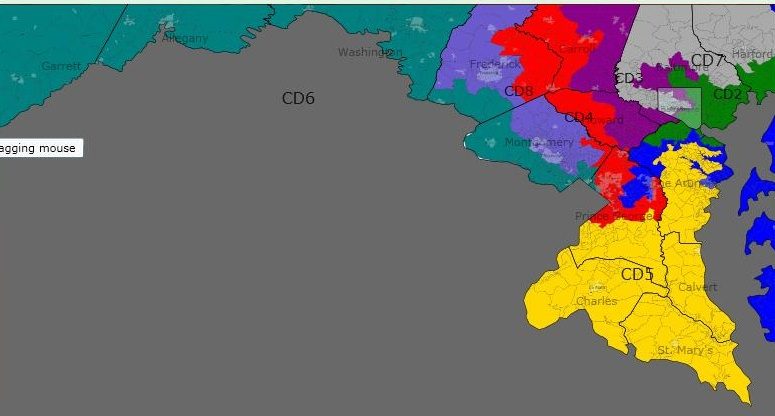
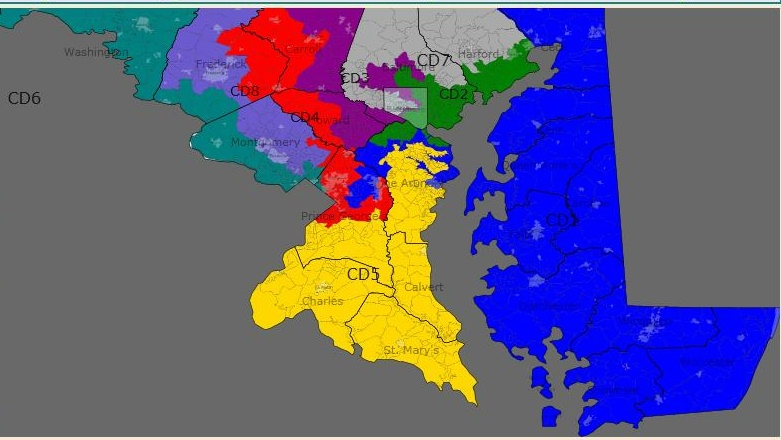
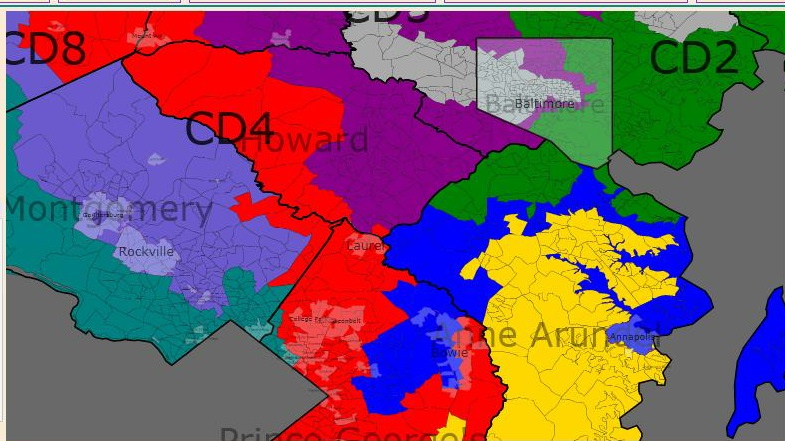
 I already did a map with Maryland redistricting in September but now that Obama/McCain election results are incorporated into maps of Maryland, I decided to create a new map this time knowing how each congressional district I made voted for Obama. I decided to do an 8-0 Democratic map without creating a convoluted gerrymander. I also wanted to make sure none of the district violated the Voting Rights Act. If you are confused with the district labeling, CD4 is for the red district while CD8 is for the light purple district. CD3 is for the purple district and CD6 represents the teal district. I think I gerrymandered a bit with the 1st and 3rd Congressional districts but on the most part, I probably avoided a large gerrymander. My main goals here were to shore up Frank Kratovli (D) who barely won in the heavily Republican 1st Congressional district last year. I also wanted to make Roscoe Bartlett’s 6th district too Democratic so he would retire. Here is a link to the current map of Maryland’s Congressional districts: http://http//www.mdp.state.md….

Here is a link for Maryland’s demographic data: http://http//quickfacts.census…

Here is yet another link, this time for 2008 election results in Maryland: http://http//uselectionatlas.o…

Here is the link for the first Maryland map

http://swingstateproject.com/d…

Here are the maps:

West Maryland

East Maryland

Central Maryland

1st District Frank Kratovli (D)

I could not split the eastern shore because the Maryland State Legislature would probably not back that kind of plan. The old district went onto the western shore taking in heavily Republican parts of Anne Arundel, Baltimore and Harford counties. For this plan, I sent the 1st into Democratic Annapolis and up north towards Prince Georges County. Along the way, I slipped in some Democratic parts of Anne Arundel County besides Annapolis and put about 130,000 people in Prince George’s County into the 1st. This raises Obama’s percentage of the vote to 54% which is about the same as my old map. Prince Georges County had high turnout in 2008 because of Obama but the turnout may drop in an off year election, causing trouble for Kratovli. He should still win because the Republican base in the 1st district is in the Eastern Shore which is Kratovli’s base. In 2008, the Republican challenger did well on the western shore. Demographics are 25% African American and 66% White. Status is Likely Democrat.

2nd district Dutch Ruppersberger (D)

By creating a more compact district, I included more Republican areas in the district. Giving the 2nd district more of Baltimore compensates a bit but I still decreased the African American population from 27% to 23%. The 2nd district represents many working class neighborhoods in Baltimore City and Baltimore County and most of those votes should support Democrats except they might lean towards former Governor Bob Ehlrich (R). Unless a candidate like Ehlrich runs, Ruppersberger should have no trouble winning. Obama won 56% of the vote here. Demographics are 23% African American and 68% White. Status is Safe/Likely Democrat.

3rd district John Sarbanes (D)

I removed all of Anne Arundel County and parts of Baltimore County. I replaced those areas with Carroll County, more of Howard County and a bit more of Baltimore City. Even though Carroll County is heavily Republican, the Democratic areas in Howard County, Baltimore City and County make the 3rd district heavily Democratic. Also, I increased the African American percentage from 16% to 23%. In my last map, the 3rd district voted 55% for Obama because I did not have enough of Howard County and too much of Carroll County. Now with these changes, Obama won a solid 60% of the vote. Demographics are 23% African American, 6% Asian and 64% White. Status is Safe Democrat.

4th district Donna Edwards (D)

Originally, this district contained heavily Democratic areas in Prince Georges and Montgomery Counties. In my old map I gave the district some Republican parts of Frederick County. Now this version of the 4th district has part of Carroll County too. The district also does not violate the Voting Rights Act because 50% of the population in my 4th district is African American. Donna Edwards should have no trouble winning here against a Republican. Obama won 75% of the vote here. Demographics are 50% African American, 9% Hispanic and 33% White. Status is Safe Democrat.

5th District Steny Hoyer (D)

Steny Hoyer is the House Majority Leader so he should get whatever kind of district he wants. By removing parts of Prince Georges County and adding Republican parts of Anne Arundel County, the district grows less Democratic. Even though he should win in this district, he may not view it as safe enough for him. Still, the 27% African American population should be enough to protect him. Obama won 57% of the vote here. Demographics are 27% African American and 64% White. Status is Safe Democrat.

6th District Vacant

This district formerly belonged to octogenarian Roscoe Bartlett (R) but since I moved his home out of the 6th, the district is currently vacant. Since I put the majority of the district in Montgomery County, the district turns from heavily Republican to heavily Democratic. I also slipped in a small piece of Prince George’s County which was in the old 8th district and basically caused Chris Van Hollen (D) to win there in 2002. The Republican areas in the west should not be enough to offset Democratic margins here. Obama won 61% of the vote in the new 6th. Demographics are 14% African American, 7% Asian, 12% Hispanic and 64% White. Status is Safe Democrat.

7th District Elijah Cummings (D)

This district also barely meets the VRA standards but it does. It also includes heavily African American and Democratic parts of Baltimore City and County (Obama won 98% of the vote in many of the precincts) but also goes to the Pennsylvania border and includes heavily Republican exurban areas in Baltimore and Harford Counties. Even though the suburban areas are extremely Republican, the district still remains heavily Democratic and Cummings should not have much trouble with reelection. Obama won 66% of the vote here. Demographics are 50% African American and 42% White. Status is Safe Democrat.

8th District Chris Van Hollen (D) v. Roscoe Bartlett (R)

Since Bartlett is very old and this district is anchored in Montgomery County, he should just retire instead of facing a hard race. Van Hollen is a strong candidate with deep pockets. Anyway, Van Hollen’s new district contains most of Frederick County which leans Republican and retains part of Montgomery County which leans Democratic. Obama won 64% of the vote here. Demographics are 14% African American, 11% Asian, 13% Hispanic and 58% White. Status is Safe Democrat

By what margin will Bob Shamansky win?

View Results

Loading ... Loading ...

GOP trying to pressure 17 House Dems to retire (updated)

The Iowa blogger John Deeth brought this piece by Hotline’s Reid Wilson to my attention.

An informal list of 17 members the NRCC believes can be convinced to step down, privately called the “Dem Retirement Assault List,” makes clear the party needs Dem incumbents to step aside if they have hopes of taking back the majority. The NRCC has taken pains to attack those lawmakers in recent weeks.

The list includes 14 members whose districts voted for Sen. John McCain (R-AZ) in ’08. McCain won districts held by Reps. Ike Skelton (D-MO) and Bart Gordon (D-TN) with more than 60% of the vote, and districts held by Reps. Rick Boucher (D-VA), Alan Mollohan (D-WV), Marion Berry (D-AR), Nick Rahall (D-WV) and Mike Ross (D-AR) with more than 55%.

McCain narrowly won seats held by Reps. John Spratt (D-SC), Allen Boyd (D-FL), Vic Snyder (D-AR), Baron Hill (D-IN), Earl Pomeroy (D-ND), Tim Holden (D-PA) and Collin Peterson (D-MN).

The NRCC has also begun targeting Reps. Sanford Bishop (D-GA), Loretta Sanchez (D-CA) and Leonard Boswell (D-IA), three members who already have credible opponents but who occupy seats Pres. Obama won in ’08.

Here in IA-03, Boswell has three declared Republican opponents. Two of them are likely to be well-funded: Brad Zaun, who has a decent chunk of the Iowa GOP establishment backing him, and former Iowa State university wrestling coach Jim Gibbons. Gibbons has already launched a couple of misleading attacks on Boswell, claiming he’s not working hard enough and that the estate tax fix will hurt farmers and small business owners.

2008 would have been a perfect time for Boswell to retire. Tons of voters in IA-03 registered as Democrats in order to participate in the Iowa caucuses, and any number of candidates could have held this seat easily.

I don’t know anyone who expects Boswell to retire next year, but if he did, this might be a tough hold. A lot would depend on the Democratic nominee, and we might have a crowded primary. One possible candidate is former First Lady Christie Vilsack, who seemed to leave the door open for a future campaign when she ruled out running against Senator Chuck Grassley.

Final note: in that Hotline piece, Wilson writes that

members frequently use the Thanksgiving and Christmas breaks as the time to decide whether to retire, filling Dec. and Jan. with announcements about their future. Already, rumors are flying that various members have decided not to run again.

I hope we don’t hear about more than a few additional retirements this winter. Who do you think are the most likely suspects?

UPDATE: Brian Baird (WA-03) wasn’t on the NRCC list, but he is retiring next year. This district’s PVI is even.

MA-Sen Results Thread

Polls are closing in the Bay State, as Martha Coakley, Michael Capuano, and friends square off. All anecdotes about turnout suggest “very low.”

MA results: Boston Globe (including fancy graphic interface!) | Mass SoS

9:05 pm (David): I wonder if the outcome would have been different had Pagliuca and Khazei not run – if Capuano might have had a better shot at consolidating the non-Coakley vote. He got a lucky freebie, though: Capuano still gets to keep his seat in the House.

8:58 pm (David): The AP has called it for Coakley.

8:55 pm: I’ll check back in in a while, but it’s looking like an easy Coakley victory; the concessions should be imminent. Btw, on the GOP side, Scott Brown beats Jack E. Robinson by a convincing 88-12.

8:50 pm: At 40% reporting, it’s still 48-27-13-12. We’re getting to the point of mathematical impossibility for Capuano.

8:45 pm: It looks like the Globe’s interface is backwards, which makes perfect sense why Coakley would be getting 71% in Capuano’s home of Somerville while Capuano would be winning all the small rural towns. So flip the town results around in your head.

8:45 pm: Now we’re up to 22%. It’s 48-27-14-12. Another bad sign for Capuano: losing in Boston, too. Coakley’s up 46-32 on Capuano in Beantown.

8:35 pm: Up to 14% reporting, and still 47-26-14-11. Here’s the really bad news for Capuano: Cambridge is starting to report — where he needs to absolutely crush if he’s going to make any ground — and at 3% reporting, Coakley is leading Capuano by a similar 47-26 margin. The main difference in Cambridge is Khazei pulling in 24%, with Pagliuca only at 4.

8:30 pm: Not much change in momentum. Now we’re at 7% reporting, and it’s 48-25-16-11.

8:15 pm: With 1% reporting, it’s Coakley at 47, Capuano at 26, Khazei at 17, and Pagliuca at 10.

KY SD-14 Results Thread (Update: Higdon Wins)

Polls close soon in Kentucky, so get your popcorn ready. Not only are we looking at the 14th Senate district (previewed above), but also the 96th House district in rural northeastern Kentucky, which was vacated by Democrat Robin Webb when she was elected to the state Senate a few months ago (in another Beshear-orchestrated Senate pickup). Democrat Barry Webb faces Republican Jill York. Democrats control the state House by a comfortable 64-35 right now, so the stakes are lower here.

Between all that and the Massachusetts Senate election, if you’re still bored, you can also check out a special in one of Arkansas’s few Republican-held state Senate seats (Dems are up 27-7), the 4th. Sharon Trusty resigned, leaving Democrat John Burnett and Republican Michael Lamoureux to fight it out in rural NW Arkansas. (H/t jameswv.) And tonight is also the Birmingham mayoral special election, to replace Larry Langford, who resigned after getting caught taking bribes. The 13-person field includes pastor Jody Trautwein (famous for his small role in Bruno) and the now-deceased Ernie Dunn. (This race is expected to go to a runoff.)

If you have any other results links that you’d like to share, please let us know in the comments.

KY results: Kentucky SoS | Lexington Herald-Leader | AR results: Arkansas SoS

8:05 pm: Haydon did win Nelson County, 3,840 to 2,982, but his 858-vote margin wasn’t enough to balance the rest. Higdon won Taylor, 2,612 to 1,396. Total result is 11,327 to 8,881 to Hidgon, a 2,446 vote margin and a 56-44 spread.

7:58 pm: Higdon has declared victory, and Haydon is conceding. This is a bit of a bummer, given the financial backing that Haydon enjoyed. As a small silver lining, perhaps Democrats will have a shot at picking up Higdon’s soon-to-be-vacant House seat.

7:45 pm: Still waiting on the last two counties in SD-14, but we’ve already lost HD-96. Republican Jill York beats Democrat Barry Webb 2,545 to 1,663, which is a 60-40 spread.

7:25 pm: Higdon also wins small Washington County by a narrow margin, 1,331 to 1,054.

7:20 pm: Now we have results from Marion County, the most Dem-friendly county but also Higdon’s home turf. Higdon wins there too by a wide margin, 2,860 to 1,405. Haydon is going to need to clean up in his own home turf (Nelson County) to pull this out.

7:15 pm: Looks like we’ve gotten some results from one county, via the Lexington newspaper (I’ve added the link). Higdon (R) takes small and conservative Mercer County, 1,542 to 1,186 votes.

7 pm: This being central Kentucky, looks like they’re taking an extended bourbon break. We’ll keep you posted.

Analyzing Swing States: Pennsylvania, Part 2.5

This is part of an analysis of the swing state Pennsylvania. Part three can be found here.

(A note: There will be a lot of maps in this post.)

Philadelphia: Precinct Results

My first post on the swing state Pennsylvania focused on the city Philadelphia, an incredibly Democratic city. At the time, I looked for detailed ward and precinct results but was unable to find any. Recently, however, I have come across a website which maps Philadelphia precinct results across a whole range of elections; it is a literal gold mine. This offers the opportunity to substantially deepen the previous analysis.

Below is a map, derived from the website, of the 2008 presidential election in Philadelphia (by precinct!)

Photobucket

An analysis of this result below.

The legend ranges from President Barack Obama’s weakest precinct (25% of the vote) to his strongest (literally every single person voted for him). In total, Mr. Obama won 83.00% of the county’s vote – an amazingly high figure. For reference, below is a map of Philadelphia’s black population.

Photobucket

There is, of course, a distinct parallel between the two demographic maps; blacks vote heavily Democratic and will continue to do so in the foreseeable future.

For decades, the city Philadelphia has trended Democratic. In percentage terms, its Democratic vote has increased for the past seven consecutive elections. In 1992, for example, former President Bill Clinton won 68.16% of the county. A comparison to Obama’s performance is revealing:

Photobucket

If there is any consolation for Republicans in all this, it is northeast (and parts of south) Philadelphia. Notice that in both maps above, Mr. Clinton and Mr. Obama perform distinctly worse here. This area of the city is populated mostly by white Catholics and Jews, although white flight has weakened their numbers. Nevertheless, northeast Philadelphia remains far whiter than the rest of the city, and as assimilated Catholics lose their traditional Democratic loyalties, Republicans have been gradually improving their percentages. John McCain actually did better than Bush in parts Northeast Philadelphia, supported by voters uncomfortable with Barack Obama’s race.

The above map hides this trend; many northeast Philadelphia voters cast their ballots for Ross Perot in 1992, so the Democratic percentage vote was artificially low that year (minority voters, on the other hand, generally did not vote for Mr. Perot). Comparing the Republican vote is more useful:

Photobucket

In general, Senator John McCain (who won 16.33% of the vote) does worse than former President George H.W. Bush (who won 20.19%). In the northeast, however, the opposite trend occurs. The shift is gradual and slow – not like West Virginia’s rapid red turn – but enough to be noticeable.

Under perfect conditions, growing Republican strength might result in something like this:

Photobucket

This is Secretary of State Hillary Clinton’s performance during the Pennsylvania primary. The senator won a respectable 34.80% of Philadelphia’s vote, fueled by support amongst white Catholics in the northeast. As evident in the map, the city contained extensive polarization; the majority of precincts gave over 70% of the vote to one candidate. In effect, Philadelphia split into two different blocs.

To be clear, Republicans will have a very difficult time achieving a result like this. It would take a momentous change for white Catholics to cast more than 70% of their ballots for Republicans. If this happened, moreover, winning Philadelphia would be the least of Democratic worries.

The other possibility would be for Republicans to improve their percentage amongst African-Americans. Statistically, 90+% support for any party seems untenable over a long period of time. Republicans, however, do not appear anywhere close to achieving this goal. The fact that they are more likely to reach 60% support amongst white Catholics than 15% support amongst blacks says a lot about the state of the Republican Party (and the state of America, too).

–Inoljt, http://mypolitikal.com/

Two Elections Today: MA-Sen and KY SD-14

It’s Election Day in two specials. Most everyone here knows it’s the primary election in the Massachusetts Senate race to replace Ted Kennedy. Well, maybe the people of the Bay State don’t know, though… turnout is projected to be low, in the wake of a sleepy campaign with little fireworks between fairly-ideologically similar candidates. (The SoS projects 300K to 500K, out of 4,000,000 registered voters.) Polls close at 8 pm Eastern.

The main question in the Bay State is whether Rep. Michael Capuano, who’s had some late momentum, can close the big gap against AG Martha Coakley, who’s led every poll. The very last poll of the race is an odd little one — a poll from Suffolk (pdf)of “bellwether” towns (only Falmouth, Fitchburg, and Lunenberg, yielding a sample size of only 367) — but it effectively splits the difference between the two camps’ internal polls that they released this weekend. It shows Coakley at 39 and Capuano at 25, with Stephen Pagliuca at 13 and Alan Khazei at 7. One good indication that most people expect Coakley to pull it out is that articles are already proliferating on the jostling to become Massachusetts’ next Attorney General.

By the way, there’s also a Republican primary. State Sen. Scott Brown is expected to win easily over perennial candidate Jack E. Robinson, and is then expected to be roadkill in the Jan. 19 general special election. Pollwatchers tonight will want to focus on Capuano’s home turf — Boston, Cambridge, and Somerville — where he’ll need to put up gigantic numbers in order to overcome Coakley’s statewide support.

However, I have a feeling that the real excitement — and where most of SSPers’ attention will lay — tonight is the special election in Kentucky’s 14th Senate district. This was opened up when Democratic Gov. Steve Beshear appointed long-time Republican Senator Dan Kelly to a judgeship, as part of his strategy to depopulate the GOP side of the Senate by giving them cushy jobs. After having picked up two state Senate seats in previous special elections this year, Democrats are now within striking distance of control of the Senate. A win tonight will move them to a 19-18 deficit (with one independent who caucuses with the GOP).

Nobody rocks a state legislative special election preview like Josh Goodman, so it’s worth visiting Governing’s blog to check out the backstory. Democrats are feeling confident going into this one, too, with former state Rep. Jodie Haydon posting a big fundraising advantage over Republican state Rep. Jimmy Higdon. That may seem surprising, but this race is turning heavily on local issues. Beshear and legislative Dems have been pushing for expanded gambling at horse racing tracks, and the horse industry in Kentucky has responded by throwing their weight behind the Dems. Higdon and the GOP have been trying to nationalize the race instead, running scary ads linking Haydon to Nancy Pelosi and the national Democratic agenda. In a district this small, though, the localizing/nationalizing thing may not matter as much as just which candidate did better at retail politicking.

This district, located in central Kentucky (centered on Bardstown, the focus of the bourbon industry), has titanic Democratic registration advantages, but also has generally voted for Republicans both in national and state races in the last decade. (See the handy charts in Josh’s article.) Keep an eye on Nelson County — the most populous county in the district, and where Haydon is from — and on Marion County, the most Democratic-friendly part of the district, but where GOPer Higdon is from. (UPDATE: By my quick calculation, this district works out to an R+14 PVI based on 04-08 presidential numbers, but that’s only about 3 points more Republican-leaning than Kentucky as a whole, and remember this is an area where people vote very differently downticket.)

The eastern half of Kentucky has a freakishly-early closing time, so we’ll be posting a results thread at 6 pm ET for these two races. In the meantime, please feel free to share your predictions in the comments!

SSP Daily Digest: 12/8

CT-Sen: Linda McMahon is in Washington DC this week to meet with Republican bigwigs about her bid for the Senate in Connecticut, meeting with Mitch McConnell, Jon Kyl, Orrin Hatch, and the knuckle-draggers at FreedomWorks. McMahon’s visit is accompanied, however, by stories in The Hill and Politico that focus on professional wrestling’s dangerous conditions, and lack of health insurance or union representation — and are replete with quotes from former wrestlers decrying McMahon and her company.

KS-Sen: The previous few rounds of polling for Rep. Todd Tiahrt in the Kansas GOP Senate primary haven’t looked so hot, but the newest offering from SurveyUSA finds him back in the thick of things. Rep. Jerry Moran now leads Tiahrt 37-34, compared with a 43-27 gap in early October. Crosstabs suggest Tiahrt has pulled back into a tie in Kansas’s northeast (the Kansas City suburbs) — with Moran dominating the rural west and Tiahrt dominating the Wichita area, the KC suburbs are the decisive region.

OR-Gov: State Republican leaders are still casting their nets about, despite former NBA player Chris Dudley bringing a lot of money to the table. With some troubled that Dudley “has not delivered any ideas at all” (and with their best-known candidate, Bill Sizemore, having gotten arraigned for tax evasion yesterday) many have now set their sights on state House minority leader Bruce Hanna, a conservative from the state’s rural southwest; Hanna says he’s “listening with interest” to their entreaties.

In the you-can’t-make-this-stuff-up department, Jerry Wilson, founder of exercise machine maker Soloflex, was originally going to run for Governor under the banner of Oregon’s Naderite Progressive Party, but somewhere along the way decided it would be better to run for one of the major party noms so he’d have a better chance, and inexplicably decided to run for a Republican. Wilson just found out that he  missed the deadline by several months to change his party registration to be able to do so (he’s a Democrat), so now he’s decided to run as a Democrat. (The pro-marijuana Wilson might want to, y’know, lay off it a little while he’s trying to put together a political campaign.) Also on the Dem side, the state’s AFL-CIO announced that it won’t be endorsing in the race until at least March, which has to be seen as a victory of sorts for ex-SoS Bill Bradbury in that they don’t view ex-Gov. John Kitzhaber as having the nomination locked down and are waiting to see how things shake out.

TX-Gov: With heavyweight Houston mayor Bill White having settled into the Democratic field in the Governor’s race, the remaining candidates are assessing their options. Kinky Friedman was expected to drop out today, but announced that he’ll take at least a few more days to meet with supporters, and with White and Farouk Shami, before pulling the plug. (Shami was a big donor to Friedman last time.) The independently wealthy Shami sounds like he’s staying in, although he’s now suffering the usual fate of celebrity business candidates: the revelation of his paltry voting record (including no vote in the 2008 general, and no votes in any Democratic primary elections, with at least one in a Republican primary instead). And on the GOP side, Lt. Gov. David Dewhurst, faced with the realization that the Senate election may not be happening any time soon, just filed for re-election to another term as LG.

FL-02: That was fast. (And not very good message discipline, either.) After confirming yesterday that he was considering a move over to Florida’s statewide CFO race, Democratic state Sen. Al Lawson backtracked today and said he’s sticking with his longshot primary challenge to Rep. Allen Boyd instead.

ID-01: An intramural fight is breaking out among Idaho Republican legislators, as state Rep. Raul Labrador seeks the Republican nomination to take on Rep. Walt Minnick next year. State Sen. Mike Jorgenson is demanding Labrador drop out, attacking him for his work as a — gasp — immigration lawyer; the two have previously clashed over immigration policy in the legislature, including Jorgenson’s proposal to bar illegal immigrants from receiving state benefits. There’s no clue given where Labrador’s opponent, Vaughn Ward, stands on immigration issues, but it’s interesting to see the same cheap-labor/close-the-borders fissures opening up here that erupted in, say, the UT-03 primary last year.

IL-14: One more dropout in the GOP field in the 14th, as young Mark Vargas, a former Defense Dept. employee in Iraq, got out of the race. Unlike other recent dropout Bill Purcell, though, Vargas endorsed Ethan Hastert on his way out the door. Jeff Danklefsen is the only minor player left on the playing field between Hastert and state Sen. Randy Hultgren.

NJ-03: The 5’9″ John Adler is certainly vulnerable to wedgies and wet willies from the 6’7″ Jon Runyan, but now he’s vulnerable to the dreaded Rear Admiral as well. Maurice “Mo” Hill, a Toms River Township Councilor, dentist, and retired Navy rear admiral, says he’ll likely run in the GOP primary against Runyan, despite local party leaders’ hopes to avoid a contested primary like the one that sank their hopes last year. Hill says he’ll move forward if he gets the backing of his local Ocean County party, regardless of how the other counties’ organizations go.

PA-06: Chester County Recorder of Deeds Ryan Costello bailed out on his run in the GOP field in the 6th, finding all the oxygen in the race gobbled up by self-funding moderate Steven Welch and well-known conservative state Rep. Curt Schroder. Schroder, meanwhile, nailed down the endorsements of two more Republican legislators in the area: Berks County state Sen. Mike Folmer and newly-elected state Montgomery County Sen. Bob Mensch.

SC-01: Another Republican is getting into the primary against vulnerable Rep. Henry Brown in the Charleston-area 1st (joining “Tumpy” Campbell): attorney, Navy vet, and former Mt. Pleasant city councilor Mark Fava. Could this have the effect of splitting the anti-Brown vote, though? On the Dem side, restauranteur Robert “Bob” Dobbs was joined several weeks ago by commercial pilot and Air Force vet Robert Burton.

TN-08: State Sen. Roy Herron isn’t getting a completely free shot in his primary to replace retiring Rep. John Tanner in rural western Tennessee: he’ll face off against 34-year-old Luther Mercer II, an educator and son of a Madison County Commissioner. Meanwhile, eager to generate more Tanners, the GOP has unveiled its target list of aging House Democrats in red districts to push to retire (mostly just via press release attacks for now — perhaps there will also be a sustained attempt to blanket their offices with brochures for oceanfront Florida condominiums as well). Recall, though, that Tanner said the prospect of a good fight was the one thing that was potentially keeping him from retiring, suggesting this has the potential to backfire in some cases.

Mayors: Lt. Governor Mitch Landrieu had said this summer that he wouldn’t seek to become the next mayor of New Orleans. When most other big-names like city council president Arnie Fielkow and state Rep. Karen Carter Peterson subsequently declined, Landrieu apparently sensed a mayoralty for the taking. Now he’s apparently changed his mind, and says he’ll launch a mayoral campaign next week. (Landrieu narrowly lost the mayor’s race to Ray Nagin in 2006.)

WATN?: 80-year-old former New York state Sen. majority leader Joe Bruno, who turned Albany into his personal fiefdom for decades, just got convicted of two felony corruption charges. And former Rep. Chip Pickering, one of the C Street House residents who bailed from a promising career after an embarrassing affair, is staying classy. He was last seen getting into a physical altercation at his young son’s soccer game — with an opposing team’s soccer coach already wearing a neck brace.