Senate Cattle Call (April 2010)

It’s time we got back in the habit of doing community cattle calls – we haven’t done one for the Senate in a year. Click that link to see how much things have changed since then.

In case you haven’t done one of these before, rank the senate seats that are up this year in order of likelihood of flipping from one party to the other. The traditional SSP way is to include seats held by both parties in a single list (separate lists make comparisons harder). Go as far down the list as you like. If you need some food for thought, check out Swing State’s senate race ratings. Have fun!

SSP Daily Digest: 4/12 (Afternoon Edition)

CO-Sen: The nomination process in Colorado has worked its way up to the county-level assemblies now, and former state House speaker Andrew Romanoff still has an edge over appointed incumbent Michael Bennet in the race for Democratic Senate primary delegates. Romanoff has a 57-42 edge over Bennet, bolstered by strong numbers in the urban Denver and El Paso Counties.

CT-Sen: This may not turn out to be much, but it’s another drip-drip hurting Linda McMahon’s credibility. It’s been revealed that in 1989, she gave advance warning to a doctor, George Zahorian, of a pending federal investigation; Zahorian was later convicted of selling steroids to WWF wrestlers. (Only Zahorian was convicted; the government’s case against the WWF fell apart.)

IN-Sen: Take this with as much salt as you’d like, as it’s a leak of an Indiana GOP Senate primary poll to a right-wing blog and the leak doesn’t even say which candidate’s camp it came from, let alone who the pollster is. Nevertheless, it shows a tight race between Dan Coats and John Hostettler: Coats leads 29-26, with Marlin Stutzman not to be counted out either at 18.

MA-Sen: Here’s more evidence that Scott Brown is intent on trying to have a long career as a moderate New England Senator, rather than flaming out in half a term of teabagging glory. He said thanks but not thanks to appearing with Sarah Palin at a teabagger rally on Boston Common on Wednesday.

OH-Sen: Another big quarter for Rob Portman, who’s started to fall behind in recent polling against his Democratic opposition but who will have a huge cash advantage over whoever his opponent is. He pulled in $2.3 million last quarter, bringing his CoH total to a ridiculous $7.6 million.

WA-Sen: Here’s what may be a tea leaf that Dino Rossi isn’t likely to run for Senate this year: state Sen. Don Benton, who’s already in the race for the GOP and is a friend of Rossi, says “I don’t believe Dino would allow me to sacrifice my family time and my business if he was going to run for the U.S. Senate,” and “If he had serious plans, I really believe he would have told me that.” Of course, this may also be a shot across Rossi’s bow, especially since Benton also points out that his fundraising ($130K last quarter) has suffered as everyone watches Rossi instead.

PA-Sen, PA-Gov (pdf): I don’t know why so many small schools in the Northeast feel the need to have their very own polling operation, but now Muhlenberg College is getting in on the act too. Their apparently first look at the Senate race uses a likely voter model, so as you might expect, it gives a bit of a lead to Pat Toomey. Toomey leads Arlen Specter 47-40 and leads Joe Sestak 33-22 (with leaners). There’s a whole lotta undecideds in the gubernatorial race, but Tom Corbett has a clear advantage among those who’ve decided: he leads Dan Onorato 42-18, Jack Wagner 44-16, and Joe Hoffel 45-11.

GA-Gov: Ethics questions are continuing to follow around ex-Rep. Nathan Deal even though he’s left the House now, in order to pursue his gubernatorial bid. Turns out he spent $20K from his state campaign account to pay for legal fees related to the House Ethics inquiry into his car inspection business. The state’s ethics board says it’s unclear whether or not it’s a violation, as it’s a situation they’ve never dealt with before.

NY-Gov: With his teabag-flavored gubernatorial campaign only a few weeks old, Carl Paladino’s campaign manager is already in damage control mode, acknowledging today that, yes, his boss send out some e-mails to political and business contacts that were “off-color” and “politically incorrect.” If, by politically incorrect, you mean including an African tribal dance photo entitled “Obama Inauguration Rehearsal,” and hardcore bestiality photos.

PA-Gov: Two House members endorsed in the Democratic governor’s primary, and given their geographical connections, neither one should be a surprise. Pittsburgh-area Rep. Mike Doyle endorsed Allegheny Co. Exec Dan Onorato, while PA-01’sBob Brady (who just happens to be chair of the Philadelphia City Democrats in his spare time) backs state Sen. Anthony Williams. Getting the Philly machine officially behind Williams, currently lagging his opponents, may help him gain a little ground on his competition.

SC-Gov: AG Henry McMaster had a strong fundraising quarter in the race to replace Mark Sanford, pulling in $464K and sitting on $1.4 million CoH. He’s almost caught up with Rep. Gresham Barrett, who was last year’s fundraising leader; Barrett raised $427K and holds $1.5 million CoH.

HI-01: Looks like it’s turning into the DCCC vs. everybody else in the 1st. The AFL-CIO and Longshoremen, undeterred by the D-Trip’s preferences, are both weighing into the race with mailers on behalf of Colleen Hanabusa, pointing out Ed Case’s anti-labor record.

MI-01: More local politicians are starting to jump into the race in the 1st, with last Friday’s sudden departure of Bart Stupak. Democratic State Rep. Joel Sheltrown said he’ll get in the race (joining Connie Saltonstall, who had been challenging Stupak in the primary). One problem for Sheltrown, though, is that he’s a “troll” (i.e. from under the bridge, instead of from the Upper Peninsula, where the district’s center of gravity is). One other sorta-big-name possible contender who doesn’t quite live in the district, ex-Rep. Jim Barcia (who’s got gerrymandered out of MI-05 in 2002, dropped down to the state Senate, which he’s now term-limited out of), confirmed he wouldn’t run. Roll Call also has the names of a few other potential Dems that we haven’t mentioned yet, including state Reps. Jeff Mayes, Judy Nerat, and Steve Lindberg, and state Agriculture Director Don Koivisto. Other possible GOPers include state Sen. Jason Allen, former state Rep. Tom Casperson (who lost by a wide margin to Stupak in 2008), and former state Rep. Scott Shackleton.

NY-24: Republican repeat challenger Richard Hanna raised $350K in the first quarter for the race against Rep. Mike Arcuri; that’s on top of the $600K he loaned himself.

PA-04: The growing scandal surrounding the Orie family (centered on state Sen. Jane Orie, who allegedly had staff in her office working on campaign work on the state’s dime) spilled over into the 4th. Mary Beth Buchanan’s campaign manager, Kurt Acker, resigned on Friday after it came out that he was one of those Orie staffers participating in the violations.

TN-08: Looks like we’ve got a good case of the dueling rich guys in the GOP primary in the 8th: physician Ron Kirkland is reporting $607K raised last quarter. Throw in the $250K he lent himself, and he’s already drawn almost even with Stephen Fincher, who’s already gotten the NRCC’s imprimatur based on his own fundraising.

VA-05: Freshman Rep. Tom Perriello also put up excellent fundraising numbers this quarter, and that seems to have more to do with getting the base excited about him (with his tough vote in favor of HCR) rather than dipping into his own wallet. Perriello raised $600K in the first quarter, leaving him with $1.4 million CoH for what’s sure to be a bruising general election campaign.

WV-01: There have been some indications that Rep. Alan Mollohan was on the outs with the West Virginia Democratic establishment (starting top-down with Gov. Bob Manchin), but here’s an interesting clue that suggests otherwise: Mollohan’s primary opponent, state Sen. Mike Oliverio, complained at a candidate forum that he’d requested registered voter files from the state committee and hadn’t received them, and he wondered if Mollohan’s influence had anything to do with that.

Polltopia: Mark Blumenthal has some added nuance on the issue of the House generic ballot, which pundits have been pointing to lately as evidence of possible huge Republican gains in the House in November. The Gallup generic ballot poll does have some predictive value… but that’s only the final Gallup poll before the election, making it a not-terribly-reliable measure at this point in time.

SSP Daily Digest: 4/12 (Morning Edition)

  • DE-Sen: Mike Castle says he raised $826K in Q1 and has $2.3 mil cash-on-hand. Dem Chris Coons did quite well, too, raising $635K in just six weeks, including contributions from over half the Dems in the Senate.
  • FL-Sen: For almost any other candidate in almost any other race, a $1.1 million quarter would be a sweet haul – but not for Charlie Crist, who got smoked by Marco Rubio’s $3.6 million take. Crist’s fundraising has dropped every quarter he’s been running, from $4.4 to $2.5 to $2.1 and now to this. Crist still has an impressive $7.5 million on hand, though, while Rubio hasn’t announced his cash figures.
  • IN-Sen: Brad Ellsworth says he raised $625K in the six weeks he’s been running for the Senate and, thanks to money he already had in his House account, now has over a million on hand.
  • AZ-08: Dem Rep. Gabby Giffords says she raised about $500K in Q1 – but so has GOP opponent Jonathan Paton, a former state senator. Giffords has about $2 mil in the bank.
  • HI-01: A poll for the DCCC supposedly shows a tie between Ed Case and Charles Djou at 32, with Colleen Hanabusa at 27. There are no other details to go on (such as who the pollster was & when the survey was in the field), but this alone doesn’t seem to support the “she’s so toxic, the D-Trip has no choice but to back Case” theory.
  • IN-06: Dem Barry Welsh, a figure known to many in the netroots, says he’s going to challenge Mike Pence a third time. Welsh, in a bout of dour realism about this R+10 district, states: “I don’t have any delusions of winning.”
  • LA-02: Looks like Joe Cao put in an appearance at the Southern Republican Leadership Conference this past weekend. Admittedly, it took place in his home district, but still, attending a wingnut festival where you have the likes of Haley Barbour defending Bob McDonnell’s love of the Confederacy doesn’t seem like a wise political move. Fortunately, the wingers hate Cao, too – click the link to see more.
  • MD-01: Jack Wilson, “a semi-retired owner of an electrical contracting business, Navy veteran and former union steam fitter” – and teabagger – will run as an independent.
  • MI-01: A few names are surfacing on the Dem side to replace retiring Rep. Bart Stupak: State Reps. Mike Lahti and Gary McDowell, and state Sen. Mike Prusi. On the GOP side, state House Min. Leader Kevin Elsenheimer said he’s taking a “serious look” at the race and will make a decision soon.
  • PA-07: After a setback in court, Bryan Lentz has withdrawn his challenge to Pat Meehan’s ballot petitions. However, the state Attorney General’s office is still investigating what look like serious irregularities in the filings.
  • PA-12: There’s a third guy on the ballot in the PA-12 special election: Libertarian Demo Agoris. He’s practically the dictionary definition of a perennial candidate, running five times for the same state House seat, with a different political party each time, including once as a member of the Green Party. Unfortunately, it doesn’t look like he has “Whig” under his belt – yet.
  • VA-02: Another one (see MD-01 item): Kenny Golden, a former chair of the Virginia Beach GOP, says he’s dropping out of the Republican primary to instead run as an independent.
  • Minnesota: The aptly-named MinnesotaMike fills us in on what went down at five different CD-level conventions in his state this weekend. Two Dem and three GOP House nominees were chosen.
  • Census: Another reason to hate on hipsters: The lowest census form return rate in NYC so far is in Williamsburg, Brooklyn – aka hipster central, whose denizens apparently can’t take time out from cooing over their fixies to fill out a simple piece of paperwork.
  • Polltopia: The boys over at Public Policy Polling want your suggestions on where to poll next. Tell them!
  • Passings: Former GOP Rep. Bob Franks, who lost the 2000 senate race to Jon Corzine and was touted for a possible return to his old seat in the 7th CD as recently as 2008, passed away last week at the age of 58.
  • The Seven States of New York (Maximizing Democrats)

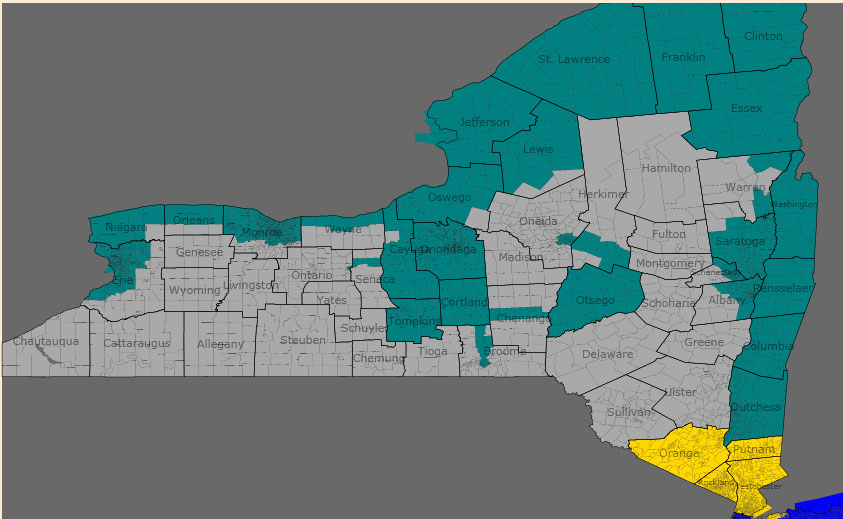
    Previously, I did a hypothetical exercise in which I turned California into a Democratic gerrymander of five states (four of them were basically guaranteed to be Democratic under nearly all circumstances and one Democratic leaning, but not completely safe, state. The state that I really wanted to do though was New York, especially New York City (in fact, my original idea was to simply make states out of the city and the rest of New York could just be its own state, but I decided that with some creativity, it's possible to play around with the rest of the state and still give the Democrats an edge over the Republicans. Some accomodations are necessary in order to create some of these states, and that'll be apparant when they're viewed, but rather than try to explain here, I'll just let the maps do the talking:
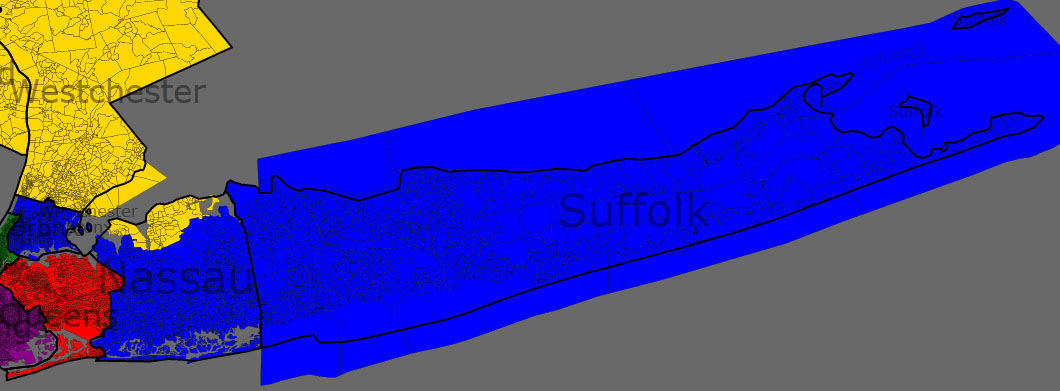
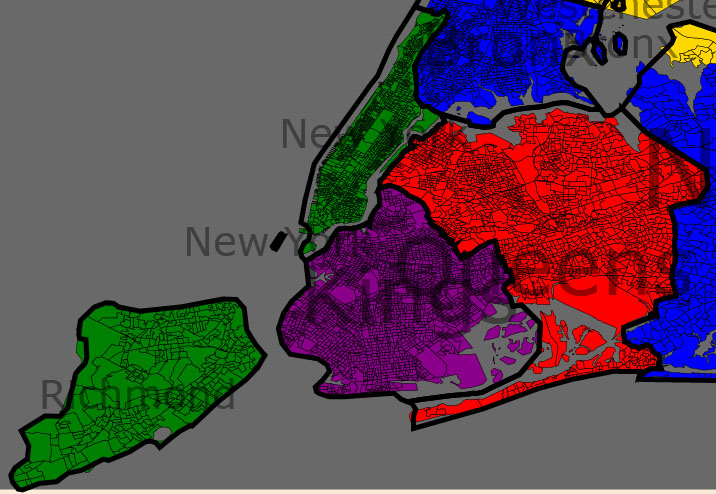


    Ok, with the maps out of the way, here come the explanations:


    State 1 (New Island) (Blue)

    Population: 4,191,074
    Demographics: White 56%, Black 16%, Hispanic 23%, Asian 3%
    Partisanship: Obama 62%, McCain 38%
    Areas: Bronx, Nassau, Suffolk

    Notes: Originally, my plan was to combine the Bronx with Staten Island, which would make for some poetic justice for the Bastard Child of New York City (my grandpa was born in Staten Island, so I'm allowed have a little fun at SI's expense :P). Unfortunately, a friend of mine reminded me that the Bronx has both serious corruption issues, and that the voters there are less progressive than their substantial Democratic lean would suggest (see Pedro Espada and Ruben Diaz for more on the problems with the Bronx). His suggest was that I combine the Bronx with Manhattan or with Weschester County, but I ultimately decided that would be a huge waste of Democratic votes, so I made my choice to combine the Bronx with the Long Island counties of Nassau and Suffolk. This change turns the swingy Long Island into a reliably Democratic state without giving the Bronx too much statewide influence.


    State 2 (New New York) (Green)

    Population: 2,151,335
    Demographics: White 52%, Black 14%, Hispanic 24%, Asian 8%
    Partisanship: Obama 78% McCain 21%
    Areas: Staten Island, Manhattan

    Notes:  Alright, as I said earlier, my original plan was to combine Staten Island with the Bronx, but it didn't work out, so I had to decide what to do with it, and the solution was to throw it in with Manhattan. Staten Island's population base is largely ethnic Italians, which also makes it relatively conservative and Republican, so naturally the best thing to do with them is to throw them in with among the most (if not the most) liberal counties in the country. This isn't horribly bad though, as the two boroughs combined are only a little bit little bit less populous than neighboring Queens. By the way, yes, the name is a shout-out to Futurama.


    State 3 (New Brooklyn) (Purple)

    Population: 2,589,378
    Demographics: White 35%, Black 34%, Hispanic 20%, Asian 8%
    Partisanship: Obama 80%, McCain 20%
    Areas: Brooklyn

    Notes: All I did was make Kings County into its own state. Its wikipedia page should suffice to explain my father's new birth state.


    State 4 (New Queens) (Red)

    Population: 2,319,060
    Demographics: White 33%, Black 19%, Hispanic 25%, Asian 18%
    Partisanship: Obama 75%, McCain 24%
    Areas: Queens

    Notes: This state is the entirety of Queens and nothing more, so I'll just give the wikipedia page for more information


    State 5 (New Amsterdam) (Yellow)

    Population: 1,828,601
    Demographics: White 70%, Black 11%, Hispanic 13%, Asian 4%
    Partisanship: Obama 58%, McCain 41%
    Areas: Westchester

    Notes: This is the first state that is completely outside of the borders of New York City, and the first one that did not go at least 20 points for Obama, the county is half Westchester, and half from the more Republican lower upstate counties (which is what bring down Obama's numbers, while helping to prop up his numbers at a couple of other places. Now, this does means that in a really really bad year, this state could be prone to some close calls for the Democrats, but still it's Democratic enough that I'm not horribly worried about it.


    State 6 (New Albany) (Blue-Green)

    Population: 4,514,692
    Demographics: White 85%, Black 8%, Hispanic 3%, Asian 2%
    Partisanship: Obama 57%, McCain 41%
    Areas: Albany, Rochester, Buffalo

    Notes: I'm sure I don't need to say just how atrocious this district is, but you know something, I'm ok with that, especially given some of the most egregious historical state gerrymanders (I'm looking at you North and South Dakota…) This state basically absorbs all of the major cities in the upstate area while taking pains to keep out the more heavily Republican parts of the state. This is the most populous of the new states, which it must be to keep it as Democratic as it is (without having to send tentacles into the city). I was originally planning to divide upstate into east and west, with one state (east) having a slight (but not very pronounced) Democratic lean, while the other half (the west) would be a pure toss-up state, but it would subject the new states to crazy swings based on the environment (even moderately bad cycles could be enough to give the Republicans 3 of 4 of the two states' senate seats), so I just decided to create a more strongly Democratic state at the cost of conceding a state to the Republicans, which leads us to…


    State 7 (New Farmland) (Grey)

    Population: 2,011,300
    Demographics: White 95%, Black 3%, Hispanic 3%, Asian 1%
    Partisanship: Obama 47% McCain 51%
    Areas: Rural upstate New York

    Notes: Once you take the cities of Albany, Rochester and Buffalo (not to mention places like Utica) away, upstate New York becomes quite Republican by northeast standards (although certainly more moderate). The Republicans should be able to hold this area for the short-term, though if the Republicans don't moderate themselves, they'll probably find this state will turn on them.

    By what margin will Bob Shamansky win?

    View Results

    Loading ... Loading ...

    Analyzing Swing States: Virginia, Part 5

    This is the fifth part of a series of posts analyzing the swing state Virginia. It focuses on the traditional Democratic base and its decline. The last part can be found here.

    In the days of the Solid South, Democrats worried more about primary elections than Republican challengers. The party, under the sway of the Byrd machine, dominated almost every part of the state – as it did throughout the South.

    Civil rights and suburban growth broke the back of this coalition. In 1952 Virginia voted for Republican candidate Dwight Eisenhower. By the 1970s Virginia had elected its first Republican governor, senator, and attorney general in nearly a century.

    Democrats were left with strength in two reliable regions – the southeast and the western panhandle. These places constituted the traditional Democratic base, which Democrats relied on for a number of decades.

    The 1996 presidential election provides an excellent illustration of this base:

    Analyzing Swing States: Virginia,Part 5

    More below.

    With his rare ability to command support among both poor Appalachian whites and poor Southern blacks, Mr. Clinton performed powerfully with the traditional Democratic coalition. As the map indicates, the incumbent president dominated the southeast, while winning a number of counties in the panhandle. It is an illustration of the traditional base at a strong point.

    Clinton also lost Virginia by two percentage points. This indicates something else: it is actually very difficult to win the state with the traditional Democratic base. There are just not enough Appalachian whites and blacks (20% of the population) in Virginia. Take mostly black, heavily Democratic  Richmond. In 2008 a little more than 90,000 votes were cast in the city. A respectable number – but barely more than half the 162,088 votes cast in  neighboring, suburban Chesterfield County.

    Richmond also constitutes an important part of the Virginia’s Democratic-voting southeast – the first prong of the classical Democratic coalition. Democratic strength in this region can be explained through demographics; the region is home to much of the state’s black population:

    Analyzing Swing States: Virginia,Part 5

    Black voters, grateful for its passage of Civil Rights, remain a vital constituency of the Democratic coalition. They constitute a  stable block of voters  for a Democratic candidate to build upon.

    Geographically, Democrats usually win a few rural, majority-black counties in the southeast. In addition, black votes give Democrats sizable margins coming out of Richmond and four Hampton Roads cities – Norfolk (the largest), Portsmouth, Hampton, and Newport News. In 2008 Senator Barack Obama’s vote ranged from 64% (Newport News) to 79% (Richmond) in each of these cities.

    Unfortunately for Democrats, the second prong of their traditional base – the Appalachian panhandle – is quickly moving away from them. This area is fairly rural and somewhat poor; as the map above indicates, its population is fairly homogeneously white. Until recently, Democrats could rely on panhandle votes even in the event of a double-digit loss. Its residents voted Democratic based off a combination of economic interests and tradition.

    As the party becomes more metropolitan-based and liberal, however, the panhandle has been drifting away. The election of President Barack Obama, an ill-fit with Appalachian America, has accelerated the rightward movement. In 2009, Democratic candidate Creigh Deeds lost the panhandle by a landslide.

    Analyzing Swing States: Virginia,Part 5

    Even in the days in which the panhandle voted loyally Democratic, the base – as has been noted before – was insufficient for statewide victory. Democrats needed to add another prong to their coalition. Mr. Clinton attempted to do so by reviving support amongst the rural whites who’d long ago abandoned the Democratic Party; he mostly failed in his endeavor. In 1976, President Jimmy Carter did much better with rural whites but much worse with their suburban counterparts; Mr. Carter also barely lost Virginia.

    Statewide Democratic candidates, on the other hand, have been able to win the state through a combination of the traditional base and a respectable suburban showing. Indeed, no Democratic presidential, senatorial, or gubernatorial candidate has won Virginia, for at least two decades, while losing suburban Fairfax County.

    In recent years Democrats have traded the Appalachian panhandle for these NoVa suburbs. This switch has, in the aggregate, been to their benefit. The old Democratic base was rarely enough to win Virginia. With the addition of NoVa, Democrats have won three out of four past statewide elections. Virginia has moved from a red state to a purple one.

    –Inoljt, http://mypolitikal.com/

    PA-12: NRCC Drops $200K

    Despite the fact that Democrats are perceived to have something of a turnout advantage in the special election to replace the late Jack Murtha (remember: the only truly competitive big-event statewide primaries in Pennsylvania are on the Democratic ticket, and those primaries happen to fall on the same day as the PA-12 special), the NRCC must be smelling an opportunity here. They just dropped some serious dollars on the race:

      1. Opposes Candidate: MARK CRITZ (H0PA12132)

           Office Sought: House of Representatives, Pennsylvania District 12

           Payee: MCCARTHY MARCUS HENNINGS LTD

           Date Expended = 04/09/2010      Amount Expended = $10500.00

           Purpose: MEDIA

      2. Opposes Candidate: MARK CRITZ (H0PA12132)

           Office Sought: House of Representatives, Pennsylvania District 12

           Payee: NATIONAL MEDIA RESEARCH PLANNING & PLAC

           Date Expended = 04/09/2010      Amount Expended = $168290.65

           Purpose: MEDIA

      3. Opposes Candidate: MARK CRITZ (H0PA12132)

           Office Sought: House of Representatives, Pennsylvania District 12

           Payee: THE TARRANCE GROUP

           Date Expended = 04/09/2010      Amount Expended = $15000.00

           Purpose: SURVEY/RESEARCH

    FL-25: Joe Garcia Will Return; SSP Moves Race to Lean R

    Some good news from CQ:

    Former Miami-Dade County Democratic Party Chairman Joe Garcia, who came 6 points shy of knocking off Rep. Mario Diaz-Balart (R) in 2008, is throwing his hat back into the ring for another try this cycle.

    Sources say Garcia will announce his candidacy for the now-open 25th district seat mid-next week. Garcia is known to be gathering his campaign team. […]

    Garcia had a meeting with Democratic Congressional Campaign Committee Chairman Chris Van Hollen (Md.) in late February after the Diaz-Balart’s announced their electoral plans and he was also encouraged by officials within the administration to take another look at the race. He may have finally been convinced to run by the results of a poll that the DCCC conducted on the race in late March.

    “A Joe Garcia candidacy would instantly make this seat an excellent pick up opportunity,” DCCC spokesman Shripal Shah said on Friday.

    This is a seat that’s been trending Democratic in recent years. As CQ notes in their full piece, Democrats have turned a 21,000-strong voter registration deficit in 2006 to a voter registration advantage of about 600 at the beginning of 2010. That shift has played out at the Presidential level, too: Obama lost this CD by only 1% in 2008, a big gain from John Kerry’s 12% loss in 2004.

    Garcia proved himself to be a capable fundraiser and campaigner in 2008, raising $1.8 million and holding GOP Rep. Mario Diaz-Balart to a six-point win. Garcia will need to bring his A-game this time, too, as his likely Republican opponent, state Rep. David Rivera, has announced that he’s hauled in over $700K in his first six weeks of campaigning.

    UPDATE: With Garcia’s decision to enter the race, SSP is changing our rating of this contest from Likely R to Lean R.

    SSP Daily Digest: 4/9 (Afternoon Edition)

    KY-Sen: AG Jack Conway has a new ad up in the Democratic primary, hitting Lt. Gov. Dan Mongiardo for $57K in luxury travel on the taxpayer dime. That might get some attention, but a potentially more interesting story is about decidedly non-luxurious accommodations: Mongiardo has been staying with his in-laws while he’s on the job in Frankfort. The problem with that? He’s still taking his $30K/yr. housing stipend despite not needing to spend it.

    AZ-Gov: Maricopa Sheriff Joe Arpaio is getting kind of like the boy who cried wolf, in terms of his constant expressions of interest in running for Governor that never pan out (the 77-year-old Arpaio been doing so for more than a decade). He’s back in the news today saying he’s looking into the costs of a petition drive, just in case he decides he wants to run this year.

    IL-Gov: If your fellow Republican is publicly criticizing you for being too extreme, you’re probably doing it wrong. Moderate ex-Gov. Jim Edgar (the last Illinois governor to finish his term without the law hot on his heels, and a Kirk Dillard backer in this year’s primary) smacked down state Sen. Bill Brady, saying instead that raising taxes (as Pat Quinn plans to do) is the only way out of the state’s budget mess.

    MN-Gov: State House speaker Margaret Anderson Kelliher got a key union endorsement today, from hotel union UNITE HERE. She’s lining up the institutional pieces for the DFL endorsement, which will happen later this month.

    PA-Gov: Ex-Rep. Joe Hoeffel got the endorsement of Planned Parenthood in the Democratic primary in Pennsylvania. (With Hoeffel and state Sen. Anthony Williams the only pro-choice candidates in the field, it probably wasn’t a very tough decision.)

    HI-01: The DCCC has been hitting Charles Djou for signing the Grover Norquist/Americans for Tax Reform no-tax pledge, although they’re doing so in a roundabout way: they’re saying Djou signed a pledge “that protects tax breaks for companies that send jobs overseas” (as the pledge requires opposing the end of any deductions or credits). If the message gets some traction in this testing ground, expect to see more of it in November.

    MN-06: Aubrey Immelman is back. The college professor who ran against Michele Bachmann in the GOP primary in 2008 will try again in 2010, saying “I am a single-issue candidate. That is to defeat Michele Bachmann.” He hasn’t said whether he’ll run in the GOP primary again, though, or as an indie in the general (where he’d bump up against IP candidate Bob Anderson).

    ND-AL: In the wake of strong numbers from Republican opponent state Rep. Rick Berg, Earl Pomeroy released his own numbers today, and they’re good too. Pomeroy raised $407K (to Berg’s $483K), but Pomeroy’s big advantage is in cash on hand; he’s sitting on $1.6 million.

    NY-20: Scott Murphy also posted good fundraising numbers today, as he gears up to face Republican Chris Gibson, who’s only beginning his campaign. Murphy raised $475K last quarter, and has $1.1 million CoH.

    OR-05: Here’s a race where I didn’t even know cat fud was a-flyin’. But if his own poll is to believed, it looks like teabagger Fred Thompson (no, not the former presidential candidate) could steal the nomination from prized NRCC recruit state Rep. Scott Bruun (who’s from the moderate suburban wing of the GOP that used to actually be able to win elections in Oregon). Thompson has a poll from GOP pollster John Feliz showing him leading Bruun by 2% (although specific numbers don’t seem forthcoming). Either one would have an uphill fight against Rep. Kurt Schrader in the general.

    VA-09: One other fundraising highlight from today sees Rep. Rick Boucher girding for a likely battle against GOP state House majority leader Morgan Griffith. Boucher raised $317K for the quarter, not phenomenal although fine for a cheap media district and better than Griffith’s $104K (though Griffith’s fundraising was condensed into the last few weeks of the cycle, after his announcement). After years of facing nobodies or outright nobody, though, Boucher has built up a huge surplus, and is now sitting on just shy of $2 million CoH.

    Vermont: The Green Mountain State is moving up its primary date, in order to comply with national laws intended to make sure that military personnel have time to return their ballots. Gov. Jim Douglas says he won’t veto the new law, passed by the legislature, moving the primary from mid-September to August 24.

    Teabaggers: A Univ. of Washington study of teabaggers in battleground states has some interesting demographic information, and also some data about underlying attitudes that confirm what some of us have been suspecting: it’s largely about racial resentment. People who believe the government “has done too much to support blacks” are 36% more likely to back the teabaggers than those who don’t. And of those who approve of the Tea Party movement, only a minority said that they believe blacks to be “hardworking” (35%), “intelligent” (45%), or “trustworthy” (41%). Here’s the money quote from the study’s author:

    “While it’s clear that the tea party in one sense is about limited government, it’s also clear from the data that people who want limited government don’t want certain services for certain kinds of people. Those services include health care,”Parker said.

    Polltopia: While some people (like Markos) have been feeling more optimistic as the enthusiasm gap between the parties narrows, PPP’s Tom Jensen sees the problem persisting even if it’s improving. PPP finds that if the electorate were composed the same as in 2008, they’d have found the Dems in the lead in their recent polls of OH-Sen, PA-Sen, IL-Sen, and WI-Gov. Instead, though, the LV samples pull in a disproportionate number of McCain voters than Obama voters.

    Regional Realignment, Part 7: the Western Great Lakes

    156 years ago, the Republican Party was created in this region.  Many would be surprised at the strength the Republicans had in this region (Wisconsin, Minnesota, and Illinois), although a lot of this advantage had already evaporated by 1960.  Today, we consider this area to be mostly controlled by the Democrats, but that hasn’t always been the case.  

    US House Representation Realignment

    After the 1960 general election, the Democrats had approximately 60% of all house seats (and 64 of the 100 senate seats).  I have inserted below the results of certain general elections.

    1960  21(D), 23(R)

    1964  22(D), 20(R)

    1966  18(D), 24(R)

    1972  19(D), 22(R)

    1974  25(D), 16(R)

    1980  18(D), 23(R)

    1982  22(D), 17(R)

    1990  25(D), 14(R)

    1992  22(D), 15(R)

    1994  19(D), 18(R)

    2000  20(D), 17(R)

    2002  17(D), 18(R)

    2004  18(D), 17(R)

    2006  20(D), 15(R)

    2008  22(D), 13(R)

    50 years ago, the Democrats and Republicans had basically a split in House representation.  The Democrats gained control after the Watergate scandal, only to lose control with the emergence of the Reagan Revolution.  In 1982, with the economy stagnant, Democrats picked up some momentum that carried the party thru 1992.  The Republicans made some modest gains during the Contract With America rampage, eventually peaking with a slight edge of seats by 2002.  With the failures of the Bush Administration, the Democrats picked up a sizable advantage.

    US Senate Representation Realignment

    1960  4(D), 2(R)

    1964  5(D), 1(R)

    1966  4(D), 2(R)

    1972  5(D), 2(R)

    1974  5(D), 1(R)

    1980  2(D), 4(R)

    1982  2(D), 4(R)

    1990  4(D), 2(R)

    1992  5(D), 1(R)

    1994  5(D), 1(R)

    2000  5(D), 1(R)

    2002  4(D), 2(R)

    2004  5(D), 1(R)

    2006  5(D), 1(R)

    2008  6(D), 0(R)

    Exept for the several years in the early 80’s, the Democrats have enjoyed the majority of this region’s senate seats.  With the advent of the Reagan Revolution, the Republicans won several Senate seats to gain this advantage, only to lose control again a few years later.  Today, all 6 Senate seats are in the hands of the Democrats.

    Conclusions

    While we have no room to grow in the Senate, we have several vulnerable senate seats that may cause us to play some defense, most notably Burris’ seat (up in 2010) and Franken’s seat (up in 2014).  While the IL seat is currently a tossup, I imagine Franken’s voting record won’t attract the ire of the voters.  The House is a different story:  although we have a 22-13 advantage, we still have room to grow.  Minnesota and Wisconsin could provide Team Blue with a couple more house seats in the next 10 years.  Illinois probably has 4 seats (IL-10, IL-6, IL-13, and IL-16) that could come to play with a combination of the right Democratic candidate and the right national tide.  Unfortunately for the Western Great Lakes, the population growth is stagnant, and we will probably see Illinois and Minnesota lose 2 seats after the 2010 Census.  I don’t believe a 23-10 post-2010 is out of the question.