Senate 2010 outlook

A whopping eight months since my last Senate roundup, I figured it was high time to survey the landscape again. Overall, things have gotten significantly better for the Republicans in the last year, though not nearly as overwhelmingly so as the drama-prone national media might have you believe.

A continued Democratic majority in the Senate is all but assured after November (and is still quite likely in the House as well). The probable range, IMO, is a Democratic caucus in the 112th Senate of between 54 seats at the low end and 58 seats at the high end.

Read a race-by-race analysis (with pretty maps) below the fold…

Photobucket

This is the playing field in 2010: Democratic open seats in North Dakota, Connecticut, and Delaware; Republican open seats in Florida, Ohio, Missouri, Kentucky, New Hampshire, and Kansas. And here is my (early) results projection:

Photobucket

I am fairly certain of Republican pickups in North Dakota, Arkansas, and Nevada at this time, while the true tossup races for now are in Colorado, Missouri, Ohio, Delaware, and New Hampshire. The Democrats remain very slight favorites to hold Illinois and Pennsylvania, and the Republicans retain edges in Florida, Kentucky, and North Carolina.

As always, seats are ranked by likelihood of flipping:

1. North Dakota (open) – Byron Dorgan (D) retiring after 3 terms

Outlook: Very Likely Republican pickup

Dorgan’s retirement is indeed a huge blow to the Democrats, though perhaps canceled out by Dodd’s bowing out in Connecticut. Gov. John Hoeven (R) is in and will almost certainly be the junior Senator from North Dakota.

2. Arkansas – Blanche Lincoln (D) seeking third term

Outlook: Likely Republican pickup

Lincoln’s numbers are getting uglier against all opponents (the best she does is an eight-point deficit) and show no signs of recovering. Barring an eleventh-hour miracle, her Senate career is over, it seems.

3. Nevada – Harry Reid (D) seeking fifth term

Outlook: Leans Republican pickup

Reid has such a fundraising advantage and some time left to up his approval ratings, but few longtime incumbents recover from these dismal numbers. Many Democrats are probably quietly hoping that Reid “pulls a Dodd” in the next few months.

4. Colorado – Michael Bennet (D) seeking full term

Outlook: Tossup

Bennet faces a tough challenge in the Democratic primary from former state House Speaker Andrew Romanoff, and neither candidate seems secure against ex-Lt. Gov. Jane Norton or any of the other Republican prospects. The Democrats definitely have a good chance to hold this seat, with neither candidate carrying much prior baggage, but I sense that this race will go however the national climate goes, and at this moment, that means it will go to the GOP.

5. Delaware (open) – Ted Kaufman (D) retiring after partial term

Outlook: Tossup

I know that most polls have shown longtime Rep. Mike Castle (R) leading state Attorney General Beau Biden (D), but I for one am fairly convinced this race will tighten and the trends go Biden’s way once he declares and the state’s Democrats start “coming home.” Interestingly, Castle will be 71 years old on election day, to Biden’s 41, so there will likely be a noticeable contrast in tone and style between these two highly familiar candidates.

6. Missouri (open) – Kit Bond (R) retiring after four terms

Outlook: Tossup

Polls here have been close but consistent, with Secretary of State Robin Carnahan (D) barely ahead of Rep. Roy Blunt (R), always within the margin of error. Still, considering the GOP-friendly trends elsewhere during the last several months, this seems a promising sign for the Show Me State Democrats. For now, this is the Dems’ best opportunity for a pickup.

6. Ohio (open) – George Voinovich (R) retiring after two terms

Outlook: Tossup / Leans Republican hold

Even with nationwide Republican advances of late, former Rep. Rob Portman (R) has never built a convincing lead against either Lt. Gov. Lee Fisher (D) or Secretary of State Jennifer Brunner (D). Fisher is favored to win the primary, and at the point I expect the race to become a tossup. If the election were today, Portman would win.

7. New Hampshire (open) – Judd Gregg (R) retiring after three terms

Outlook: Tossup / Leans Republican hold

Former state Attorney General Kelly Ayotte (R) has a slight lead over Rep. Paul Hodes (D) — grain-of-salt-worthy pollster ARG has her ahead 43-36, hardly a game-ending advantage. Like Ohio, Hodes should close the gap over the spring and summer, and if he doesn’t, we should be worried.

8. Pennsylvania – Arlen Specter (D) seeking sixth term

Outlook: Leans Democratic hold

Specter is in for a close fight (if he makes it to the general election) against former Rep. Pat Toomey (R), the hardline conservative who nearly unseated him in the GOP primary back in 2004. In the meantime, Rep. Joe Sestak is giving Specter reason to watch his left flank. But Specter has been careful to compile a fairly progressive record since switching parties last spring, and my own prediction is that this gives him a clear edge for the nomination. At that point, disaffected Democrats and moderate-minded Independents will gradually line up behind the incumbent in big enough numbers to carry him to victory over Toomey, especially if the winds shift back to the Dems over the summer.

9. Illinois (open) – Roland Burris (D) retiring after partial term

Outlook: Leans Democratic hold

The polls have been unclear about who has the advantage in a race between Republican Rep. Mark Kirk and Democratic state Treasurer Alexi Giannoulias, while (due to name recognition) Kirk polls well ahead of lesser-known Dems David Hoffman and Cheryle Jackson. Considering the state’s recent history, it’s hard to imagine Kirk winning on any but an exceptionally fortunate night for the GOP.

10. Florida (open) – George LeMieux (R) retiring after partial term

Outlook: Leans Republican hold

Gov. Charlie Crist has long been the favorite for this seat in a general election, as his cross-partisan popularity remains high, but his biggest problem will be winning the GOP primary against conservative former state House Speaker Marco Rubio. If Rubio beats Crist, as many now expect (though his momentum could always stall), expect a competitive and expensive race between Rubio and Rep. Kendrick Meek (D).

11. North Carolina – Richard Burr (R) seeking second term

Outlook: Leans Republican hold

I’ve been surprised by the sporadic polling in this race. Burr faces a reputable challenger in Secretary of State Elaine Marshall (D), even if this is a Southern state in a GOP-leaning election cycle. Burr is far from universally popular or even universally recognized, but for now the DSCC clearly has to prioritize defense.

12. Kentucky (open) – Jim Bunning (R) retiring after 2 terms

Outlook: Leans Republican hold

The Democratic primary between Lt. Gov. Dan Mongiardo and state Attorney General Jack Conway has been nasty, while “small government conservative” Rand Paul has by several accounts taken the upper hand in the GOP primary against Secretary of State Trey Grayson, the establishment choice. Considering Kentucky’s traditional balance of social conservatism with economic liberalism, Paul would seem an unorthodox general election choice, but polls show he would do well against the Democrats. Definitely a primary to watch, even if either Republican is clearly favored in November.

Just below competitive:

– California for the Democrats (Boxer clearly ahead of Carly Fiorina, but not quite out of the woods)

– Gillibrand (New York B) for the Democrats (against anyone but Rep. Peter King, who might keep the race competitive, Gillibrand should win easily, assuming she wins the primary)

– Louisiana for the Republicans (Vitter leads Rep. Charlie Melancon, but his personal issues make it hard for me to rate him as “safe”)

The Democrats should be fine in Connecticut (Blumenthal trouncing Simmons/McMahon/Schiff), as should the Republicans in Kansas (either Tiahrt or Moran). Meanwhile, Republican incumbents seem solid (in the general election, at least) in Alabama, Alaska, Arizona, Georgia, Idaho, Iowa, Oklahoma, South Carolina, South Dakota, and Utah. Democratic incumbents should win without trouble in Hawaii, Indiana, Maryland, New York (Schumer), Oregon, Vermont, Washington, and Wisconsin.

PA-Gov: Gerlach Gets Out

Since there’s a spate of dropouts going on, it looks like a prominent Republican decided to get in on the action too. Rep. Jim Gerlach has cut short his bid in the Republican gubernatorial primary, where he’s been lagging AG Tom Corbett by gigantic margins. He cites money woes as the driving concern, though:

[Expenses] left me with two choices: either spend all of my time raising money with little time left for meeting with voters; or withdrawing my candidacy and working even harder to serve the public. I am choosing to serve the public – many of whom have graciously rewarded me with their support for nearly two decades.

The big question mark for Dems is whether Gerlach plans to move back into the PA-06 race, which would probably serve to drop this ever-so-slightly-Dem-leaning tossup back to a GOP-leaning hold. Gerlach may be kicking himself for giving up his seat at all, although in the wake of barely escaping Bob Roggio in 2008, it was probably hard to imagine that he might actually have an easier time of it against better opposition in 2010 thanks to changes in the prevailing winds. However, Gerlach’s spokesperson says he hasn’t ruled anything “in or out” about running in the 6th. For starters, it’s not clear which of the myriad GOPers already running to replace Gerlach would stand down if Gerlach got back in the race.

UPDATE: While it’s not exactly concrete, GOP state Rep. Curt Schroder is indicating that he’s going to stay in the PA-06 race even if Gerlach goes for another term.

RaceTracker Wiki: PA-Gov

Contest Entry: 28 D+1 or more districts

The idea behind this plan is to create 28 districts that Democrats can expect to win, while pushing back against conservative charges of gerrymandering by creating districts that are relatively compact.  In my mind, a district was likely to elect a Democrat if it gave Barack Obama 54% of the vote or more – i.e. at least one point more than the national average.  There is a risk that in a heavily Republican year a number of Democrats could get splattered, but once things shifted back they should be able to pick most of these seats back up.  

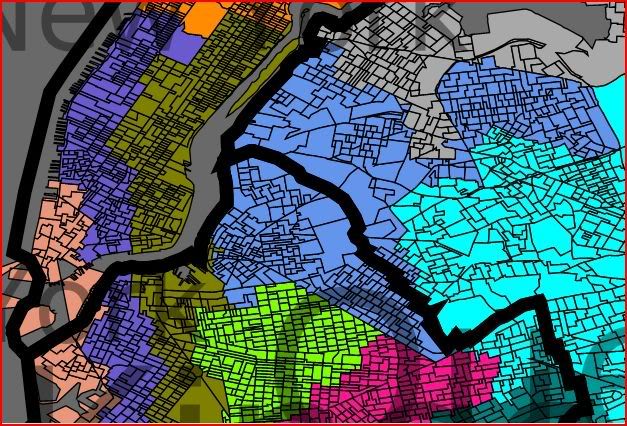
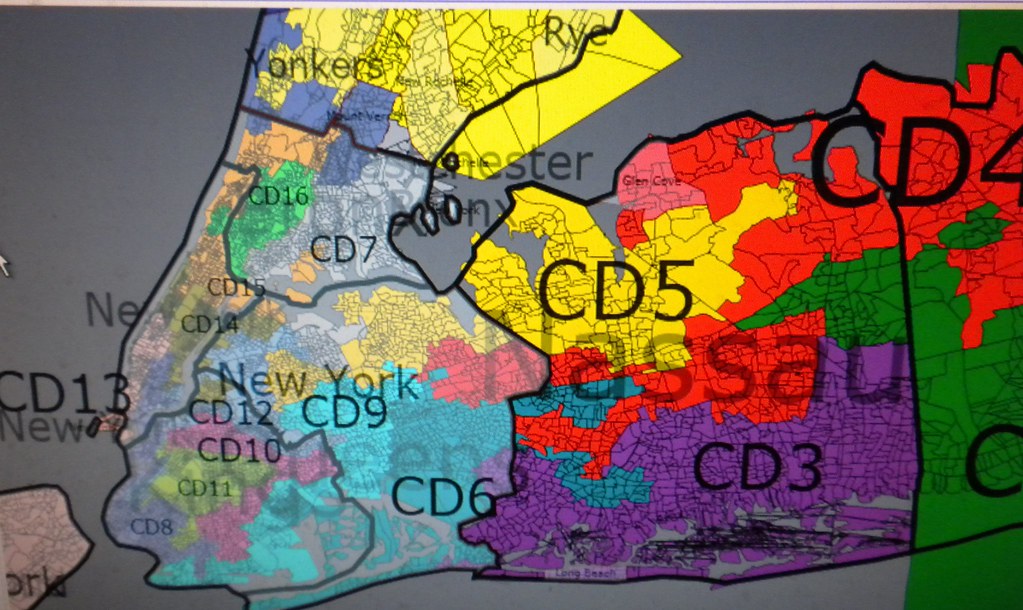
In addition, I wanted to create districts that split as few counties as possible.  Obviously, you can’t avoid county-splitting without violating one-person-one-vote, but I’ve managed to keep this to a minimum.  In the NYC area, all bets are off, though districts are more compact than they’ve probably been since the 1980s.

Because many of these districts are only marginally Democratic, I also tried to keep as much of an incumbent’s “home turf” as possible.  You’ll recognize most of these districts, but the changes are substantial.  

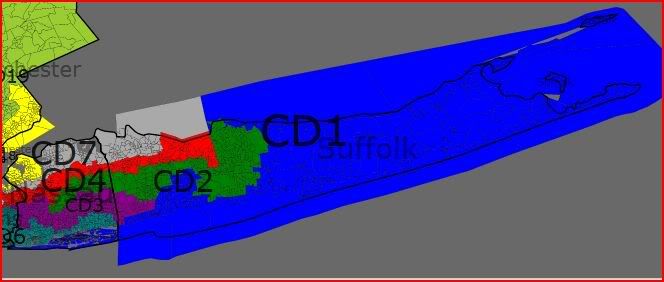
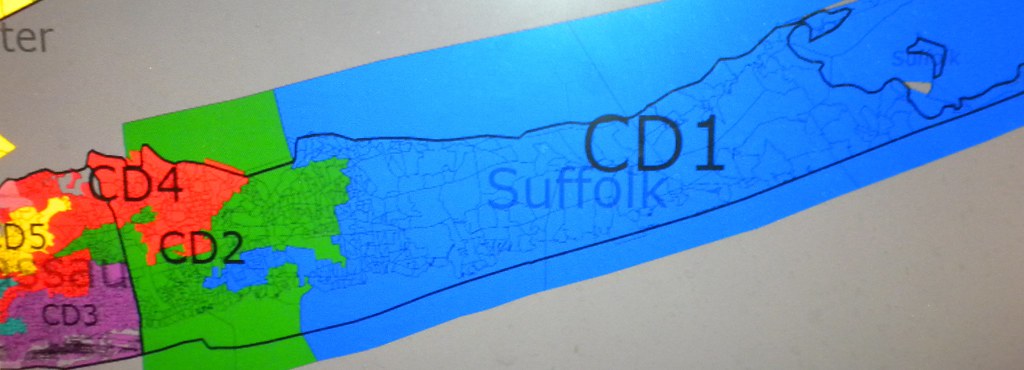
In sum, I split up Lee’s district between Massa, Slaughter, Arcuri and Higgins.  Peter King loses most of his present district, and gains Southwestern Nassau County.  In a 55% Obama district with a substantial African American population, I think he’ll find it quite difficult to survive.  Suffolk is split up three ways.  Other than that, I think you’ll recognize the map pretty easily.

As a side note, this non-New Yorker (who avoids the City as much as possible) was pretty shocked to learn how much of South Brooklyn votes like Texas (I do know that the demographics are NOTHING like Texas, but I didn’t realize just how heavily Republican they voted).  The 91% McCain precincts made the map-drawing there much more difficult than I expected.

(BTW, no idea why the images screwed up like they did.  If anyone has a clue let me know and I’ll re-try).

Photobucket

Photobucket

Photobucket

Photobucket

Photobucket

Photobucket

Photobucket

Photobucket

Photobucket

Photobucket

District 1:  Tim Bishop

Current District:  Obama 52%, McCain 48%

Proposed District: Obama 54%, McCain 46%

Population: 700,592

Demographics: 78% white, 7% bl, 2% asn, 12% hisp., 2% other.

The idea here is to split the fairly Democratic Hamptons, which enables Bishop to pick up some more heavily Democratic voters in Islip and Babylon.  Bishop also gets some Democratic precincts around Plainview.

District 2:  Steve Israel

Current District:  Obama 56%, McCain 43%

Proposed District:  Obama 54%, McCain 46%

Population:  701,787

Demographics:  78% white, 7% bl, 3% asn, 10% hisp., 1% other.

This is most of northern Suffolk County.  Israel picks up some Republican towns on the North Shore, but gains part of the Hamptons to offset a bit.

District 3:  RIP, Peter King

Current District:  Obama 47%, McCain 52%

Proposed District:  Obama 55%, McCain 44%

Population:  701,964

Demographics:  72% white, 13% bl, 3% asn, 10% hisp., 2% other.

King loses almost all of his district, which is now roughly the bottom third of Nassau County, and gains the most heavily Democratic portions of McCarthy’s old district.  Overall, this is a huge drop in Republican performance, and a big gain in Democratic performance.  Moreover, about 2/3 of his constituents are new to him, and a lot of them aren’t particularly friendly.  He can’t move to the 4th or 5th because of what we’re doing there.  To the extent Republicans complain, three horizontal districts is exactly how Nassau County was configured in the 1960s, when it was advantageous to evenly distribute the Republican vote.

District 4:  Carolyn McCarthy.

Current District:  Obama 58%, McCain 41%

Proposed District:  Obama 58%, McCain 41%

Population: 703,628

Demographics: 82% wh, 12% bl, 1% asn, 3% hisp, 1% other

McCarthy has quite a few new constituents, but most of them are Democrats.  To the east, she picks up Jericho and surrounding counties, and then gets a bunch of racially mixed counties in Queens out of the Old Ninth.  The population base is still Nassau, so I don’t see much risk of a primary challenge here.

District 5:  Gary Ackerman

Current District: Obama 63%, McCain 36%

Proposed District: Obama 55%, McCain 44%

Population: 702, 300

Demographics: 65% wh, 3% bl, 19% asn, 11% hisp, 2% other

Ackerman might not like the district, which is much more Republican and which now stretches across Northern Long Island into Suffolk County. On the other hand, this is a lot of territory that he had in the 1992 iteration of the district, and he has to pick up new areas due to population loss anyway.  He could be vulnerable to a primary challenge, but ultimately low voter participation among recent Hispanic and Asian immigrants probably maintains a pretty white primary electorate here.

District 6:  Gregory Meeks

Current District: Obama 89% McCain 11%

Proposed District:  81% McCain 19%

Population: 699,514

Demographics: 26% wh, 50% bl, 5% asn, 13% hisp, 6% other

It is becoming very, very difficult to maintain three black majority districts in New York City due to population loss and losing district.  We’ll see this in Pennsylvania, Illinois and Michigan this time around as well, where black majority districts created in the 1970s and 1980s are just stretched too thin to continue to exist.  Anyway, Meeks’ district grows west into Brooklyn and maintains its black majority – barely – by picking up some heavily black precincts near Sea Gate and Coney Island.

District 7:  Joe Crowley

Current District: 79% Obama, 20% McCain

Proposed District:  83% Obama, 16% McCain

Population: 701,950

Demographics: 27% wh, 27% bl, 5% asn, 37% hisp, 4% oth

Crowley’s district loses a lot of Queens, and becomes much more of a Bronx-based district, connected by the Bronx-Whitestone bridge.  It’s actually probably a better district for Crowley than his present one, due to low turnout among new minorities.  I doubt he’ll miss Jackson Heights.

District 8:  Jerrold Nadler

Current District:  74% Obama, 26% McCain

Proposed District:  82% Obama, 20% McCain

Population: 702,525

Demographics: 56% wh, 5% bl, 17% asn, 19% hisp

Because I push Velazquez’s district back into Queens, Nadler picks up Hispanic precincts in Southern Manhattan, as well as some old Maloney districts.  Other than that, this should look pretty familiar; it now crosses over the Brooklyn Bridge, and again, I don’t think he’ll miss Bensonhurst.

District 9:  Anthony Weiner

Current District:  55% Obama, 45% McCain

Proposed District: 63% Obama, 37% McCain

Population: 700, 751

Demographics: 57% wh, 10% bl, 14% asn, 16% hisp, 4% other

Weiner loses some of Central Queens to the Fourth, and loses his connection to Brooklyn due to the new Sixth extending all the way across Jamaica Bay.  So I did one of the few really grotesque things with this map.  I put a “tunnel” through East New York to get to a lot of Weiner’s old Brooklyn constituents, and to help break up “Little Texas” in South Brooklyn.  If I just did water contiguity, I could probably “pretty” this up quite a bit.

District 10: Ed Towns

Current District:  91% Obama, 9% McCain

Proposed District:  80% Obama, 20% McCain

Population:  704,800

Demographics: 27% wh, 50% bl, 5% asn, 15% hisp, 3% oth

This district maintains its black majority (barely) and is much more compact than the present district.  It is still based around East New York.  The problem is that with stagnant population growth and the need of every district in the state to take on a fair number of new constituents due to the eliminated district, there just aren’t a whole lot of African American voters to split between three black-majority districts.  So I took some additional voters from Little Texas and added them on.  They won’t be voting in a Democratic primary anytime soon anyway.

District 11:  Yvette Clarke

Current District:  91% Obama, 9% McCain

Proposed District:  85% Obama, 15%

Population:  693,425

Demographics:  27% wh, 50% bl, 5% asn, 15% hisp, 3% other

Clarke has to pick up a substantial number of new constituents as well, from  her Bed-Stuy district, so I use her to break up South Brooklyn.  This is one of the bigger deviations from the equal population standard, but it’s hard to bring her numbers up while maintaining the black majority.

District 12:  Nydia Velazquez

Current District:  86% Obama, 13% McCain

Proposed District: 82% Obama, 17% McCain

Population:  700,933

Demographics: 19% wh, 12% bl, 14% asn, 52% hisp, 3% other

This is more like Velazquez’s 1990s district, which took in the Hispanic vote in Northern Queens, rather than NYC.  There’s an ugly tunnel across Brooklyn to connect to Velazquez’s home in Carroll Gardens, but this is still an improvement in terms of compactness from the present one.

District 13:  Michael McMahon

Current District:  49% Obama, 51% McCain

Proposed District:  54% Obama, 46% McCain

Population:  695, 331

Demographics: 65% wh, 7% bl, 10% asn, 15% hisp, 2% other

I was bound and determined not to split Staten Island and not to use the Staten Island ferry to connect the district to the City.  It just didn’t work – I could get up to 53% Obama but not 54%.  I suppose if I knew the City better I could do it, but I didn’t feel like testing out every precinct in Brooklyn.  Besides, for most of the district’s existence it was joined with Manhattan via the ferry anyways, not into Brooklyn, so I can live with this.

District 14:  Carolyn Maloney

Current District:  78% Obama, 21% McCain

Proposed District:  80% Obama, 19% McCain

Population: 697, 918

Demographics: 54% wh, 12% bl, 8% asian, 22% hisp, 4% other

Maloney loses a good chunk of the Lower East Side, but picks up Clinton Hill, Williamsburg, and Greenpoint.  Connection to the island is still through the Queens Midtown Tunnel.

District 15:  Charlie Rangel

Current District: 93% Obama, 6% McCain

Proposed District:  93% Obama, 6% McCain

Population:  706, 188

Demographics:  20% wh, 29% bl, 3% asn, 46% hisp, 2% other.

Not a whole lot of changes for Rangel, who goes a little further into the Upper East Side and loses Queens.  Rangel could be vulnerable to a primary challenge from the burgeoning Hispanic community, which isn’t necessarily a bad thing.

District 16: Jose Serrano

Current District: 95% Obama, 5% McCain

Proposed District: 93% Obama, 7% McCain

Population: 703,044

Demographics: 6% wh, 29% bl, 2% asn, 61% hisp, 2% other

Not many changes here to this Southwest Bronx district.  This remains among the top 5 most heavily Democratic districts in the country.

District 17:  Eliot Engel

Current District: 72% Obama, 28% McCain

Proposed District: 55% Obama, 45% McCain

Population:  698, 694

Demographics:  73% wh, 10% bl, 4% asn, 12% hisp, 2% other

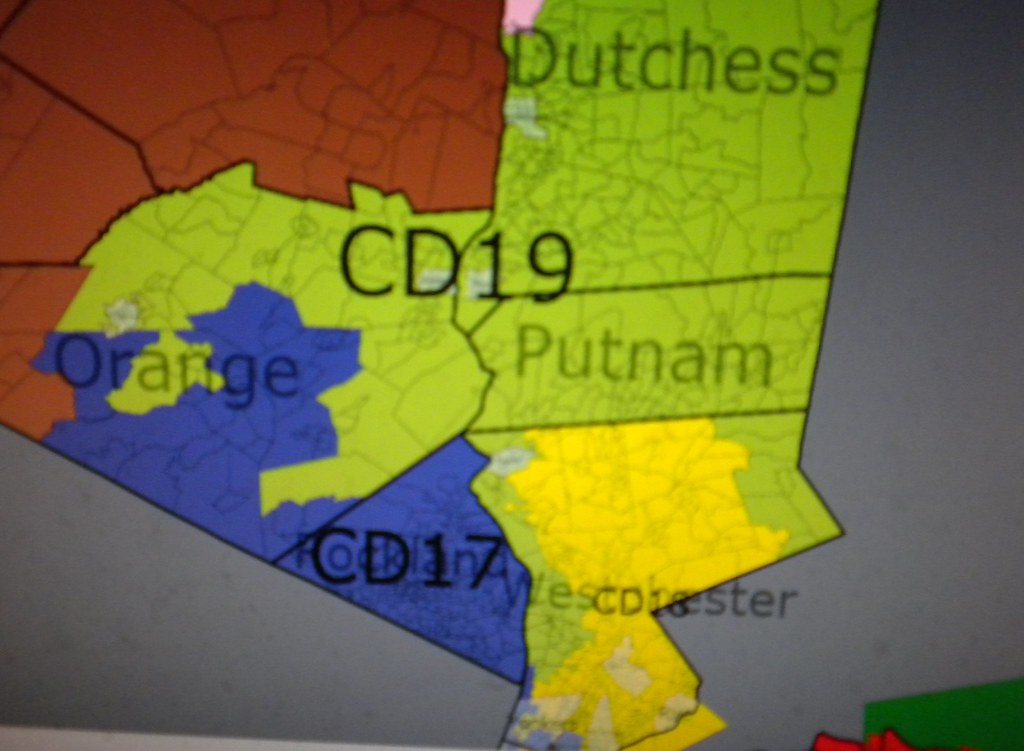
Oh, Engel’s not going to like this.  He loses a chunk of the Bronx and gains all of Sullivan and half of Orange County.  He could presumably lose a primary, but while Engel is a solid liberal, he’s not really a rock star of the party.  If you aren’t obsessed with keeping counties together, you could give Nita Lowey parts of Rockland in exchange for parts of Yonkers and shore Engel up.  But at the end of the day, this is how you make upstate districts more Democratic.

District 18:  Nita Lowey

Current District: 62% Obama, 38% McCain

Proposed District: 67% Obama, 33% McCain

Population: 707, 243

Demographics: 56% wh, 20% bl, 4% asn, 17% hisp, 3% other

Lowey gets more of Westchester and a more Democratic district.  She’ll still like this a lot more than her 1992 district, which actually went down in the Bronx and Queens.  

District 19:  John Hall

Current District:  51% Obama, 48% McCain

Proposed District:  54% Obama, 46% McCain

Population: 700,714

Demographics:  79% wh, 7%bl, 3% asn, 10% hisp, 1% other

Hall is still the one to represent FDR’s old stomping grounds.  He gives up a chunk of Orange and Rockland Counties and gets a lot of Westchester, while keeping his Dutchess and Putnam County bases.  That’s a good trade for him; he’ll still be the one here.

District 20:  Scott Murphy

Current District:  51% Obama, 48% McCain

Proposed District:  54% Obama, 45% McCain

Population:  704,604

Demographics:  91% wh, 4% bl, 1% asn, 2% hisp, 1% other

This district becomes much more compact.  It loses its spike into Essex County and its extension into Delaware County, but it gains heavily Democratic parts of Rensselear and an Albany precinct for 1p1v purposes.  Much better territory for Murphy.  

District 21:  Paul Tonko

Current District:  58% Obama, 40% McCain

Proposed District:  55% Obama, 43% McCain

Population:  697,033

Demographics:  89% wh, 5% bl, 1% asn, 3% hisp, 1% other

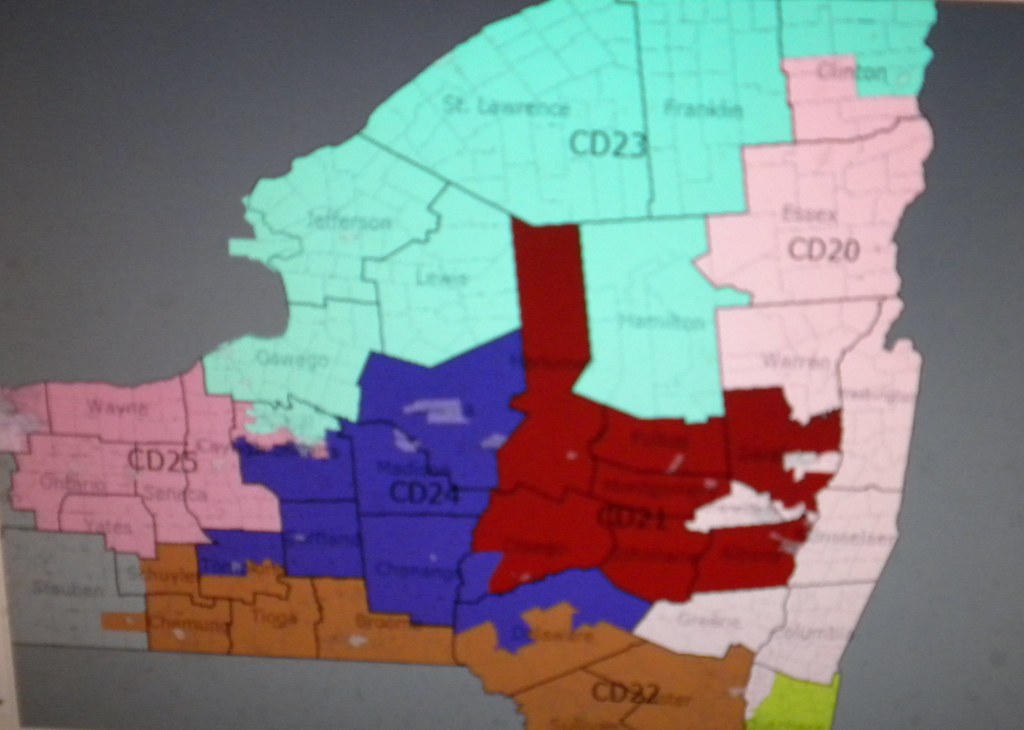
The heart of this district actually remains very much the same:  Albany, Schoharie and Montgomery counties.  Tonko loses the city of Schenectady to shore up the 23rd, and picks up lightly populated, but fairly Republican Cortland, Chenango, Otsego, Greene and Herkimer Counties.  Tonko should have little trouble keeping this seat, even with the reduced Democratic percentages.

District 22:  Maurice Hinchey

Current District:  59% Obama, 39% McCain

Proposed District: 56% Obama, 42% McCain

Population: 704,793

Demographics: 89% wh, 3% bl, 2% asn, 3% hisp, 2% other

Hinchey loses the Sullivan and parts of Rockland Counties.  Because of population loss, he picks up entire versions of Delaware, Broome, Tioga, and Tompkins Counties, and then takes Chemung, Schuyler and Yates out of the 29th and 26th.  The tendril over to Ithaca is actually less obvious because of this, and it’s a nicer looking district.  He keeps all of his Ulster base.

District 23:  Bill Owens

Current District:  52% Obama, 46% McCain

Proposed District:  54% Obama, 44% McCain

Population:  702, 958

Demographics:  91% wh, 3% bl, 1% asn, 2% hisp, 1% other

This district is fundamentally unchanged.  Owens loses the more conservative portions of Oneida County and Madison County, while picking up the heavily Democratic Schenectady precincts.  The three North Country are still kept together.

District 24:  Mike Arcuri

Current District:  51% Obama, 48% McCain

Proposed District:  54% Obama, 45% McCain

Population:  696, 248

Demographics:  88% wh, 6% bl, 1% nat, 1% asn, 2% hisp, 1% other

Gone is the crescent-shaped old 24th.  Instead, Arcuri keeps his Oneida County base, and picks up a chunk of Syracuse, with Madison in between.  It’s a good tradeoff for the rural counties he gives up, though he may be more vulnerable to a primary challenge.

District 25:  Dan Maffei

Current District:  56% Obama, 43% McCain

Proposed District:  54% Obama, 45% McCain

Population:  696,671

Demographics:  88% wh, 6% bl, 2% asn, 2% hisp, 1% other

Pretty simple concept going on here.  Maffei keeps most of central Syracuse, and Wayne County, picks up some suburbs of the ‘Cuse, a couple of small rural districts, and a lot more of Rochester.  Population loss in this area just requires everyone to get a lot of new constituents regardless, but his district is pretty safe.

District 26:  Brian Higgins

Current District:  54% Obama, 44% McCain

Proposed District:  54% Obama, 44% McCain

Population:  694,363

Demographics: 83% wh, 10%bl, 1% nat, 1%asn, 4% hisp, 8% other

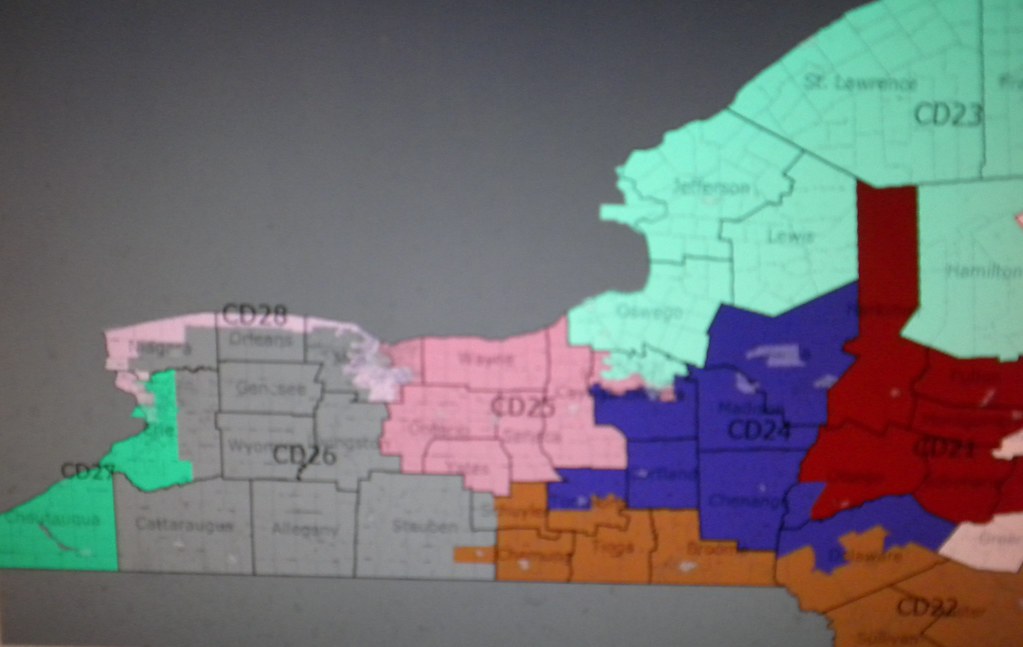
Higgins picks up Cattaraugus, Allegany, and part of Wyoming Counties, but makes up for it with more of central Buffalo.  It’s a wash for him.  As a side note, I’m genuinely interested what the 8% “other” is.

District 27:  Louise Slaughter

Current District:  69% Obama, 30% McCain

Proposed District:  54% Obama, 44% McCain

Population:  693,836

Demographics:  85%wh, 8% bl, 2% asn, 4% hisp, 1% other

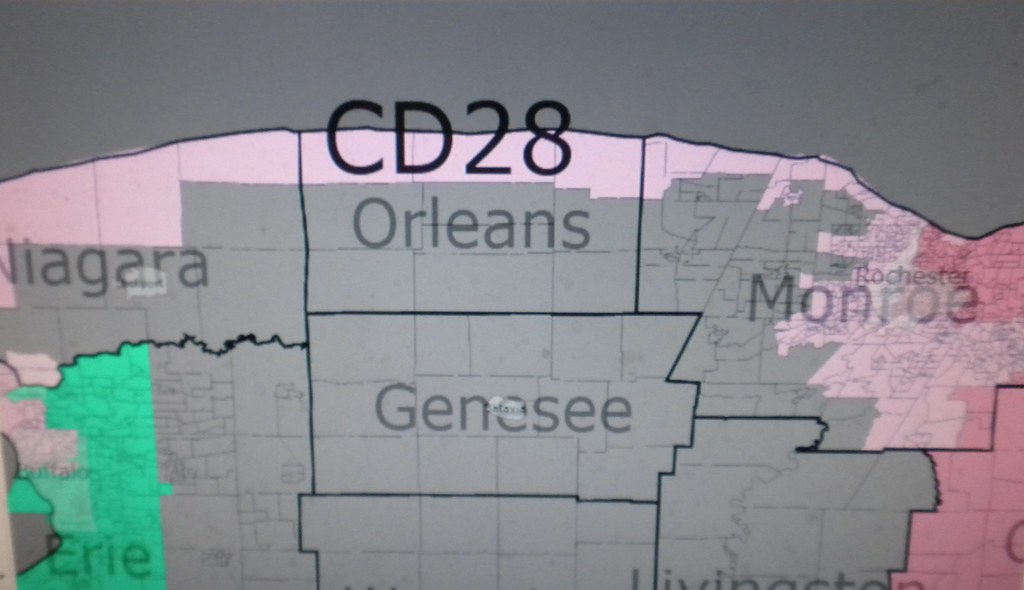
Okay, first a gripe.  If Slaughter would move to the west side of Rochester, we could do a lot better here.  Since she’s 80, I was half tempted to just do it anyway, but I guess I don’t get to make the contest rules.  ðŸ™‚ Anyway, by expanding into Orleans County she gets a more compact-looking district.  Her failure to hoard Democrats in Buffalo and Rochester is why this whole thing works.  This could result in the election of a blue dog-type Democrat, but trading Slaughter for a blue dog as a price for getting rid of Chris Lee strikes me as a good deal.

District 28:  Chris Lee and Eric Massa

Current District:  51% McCain, 48% Obama (Massa)

Current District:  52% McCain, 46% Obama (Lee)

Proposed District:  54% Obama, 45% McCain  

Population: 695, 120

Demographics: 82% wh, 12% bl, 1% asn, 3% hisp, 1% other

This is really Lee’s old district at heart, with Massa’s home base tacked on.  The big difference is that Lee loses half of Wyoming County to Higgins while picking up some nasty precincts around Buffalo and Rochester.  Assuming Massa doesn’t lose a primary challenge, he should be able to win in a much bluer district.

Q.E.D.

SSP Daily Digest: 1/7

• AR-Sen: The news that the guy who held Blanche Lincoln to within about 10 points last time (in 2004) is getting back in the race this year seems like it should be a bigger news story than it is, but there’s an already filled-to-capacity GOP field and the establishment seems to have already picked favorites. At any rate, former state Sen. Jim Holt, closely linked with the state’s religious right, officially launched his bid today.

• AZ-Sen: It’s look more and more like ex-Rep. J.D. Hayworth is serious about pursuing a Republican primary challenge to John McCain and not just looking to fundraise his way out of some lingering legal debts. He’s been contacting consultants and pollsters about strategy, and he’s also made some high-profile appearances recently, including headlining a fundraiser for controversial Maricopa County Sheriff Joe Arpaio. In response to the possible challenge, John McCain is launching two different radio ads full of right-wing language pretty transparently aimed at the teabagging crowd, saying Barack Obama is “leading an extreme left-wing crusade” and calling himself “Arizona’s last line of defense.”

• CT-Sen: Let’s not get too far ahead of ourselves, but it’s looking likelier that starting in 2013, Richard Blumenthal will be Connecticut’s senior senator. PPP finds that Joe Lieberman’s numbers, not good before his HCR sabotage, have gotten even worse. His approval is a mind-blowing 14/81 among Democrats (probably ending any plans by him to seek the Democratic nomination in 2012). He fares least worst among Republicans, who give him a 39/48 approval; it’s good for a 25/67 approval over all, along with a 19/68 approval of his actions on health care (which pissed off Democrats while still leaving Republicans unhappy when he voted for final passage). While the Hill’s piece on Rep. Chris Murphy seems to be based mostly on a vague sentence by Murphy, it does point to a suddenly congealing CW that Murphy (with Blumenthal already engaged) will be the person to tackle Lieberman in 2012.

• FL-Sen, FL-Gov: You know you’re in trouble when you’re spending valuable time fighting rumors spread on Facebook by thoroughly discredited ex-Rep. Mark Foley. Charlie Crist today said there’s no truth to the rumors that he’s about to drop his faltering Senate primary bid and try for re-election as Governor instead.

• IL-Sen: Patrick Hughes, who’s been seeding his right-wing insurgent bid with some of his own money, is seeking to break out of the single digits in the GOP primary polls against Rep. Mark Kirk by upping his name recognition. He’s out with a TV spot today.

• MA-Sen: Martha Coakley is shifting her sleepy general election campaign into overdrive today with the special election several weeks away, launching her first general election TV ad. She’s also receiving the endorsements today of most of the key figures in the Kennedy clan, including Ted’s widow Vicky and ex-Rep. Joe (along with honorary Kennedy and temporary Senator Paul Kirk).

• ND-Sen: As we parse the comments from various potential Democratic candidates in the newly-open Senate race in North Dakota, it sounds like former AG Heidi Heitkamp is “very interested” and “very much looking into” the race, while talk show host Ed Schultz is “at this point… not even considering.”

• NY-Sen-B: Here’s an interesting possibility surfacing, as the GOP seeks anyone who’s willing to take on Kirsten Gillibrand in the Senate race: ex-Rep. Susan Molinari, who was considered a rising star back when she represented NY-13. She’s started floating her name out there (or more accurately, her dad, Staten Island GOP leader Guy Molinari), but one key point from the article is that Molinari — currently employed at the firm of Bracewell & Giuliani (yes, that Giuliani) — “left Congress in 1997 and currently lives in Virginia.” Meanwhile, as the potential Harold Ford Jr. candidacy is still the “wtf?” heard ’round the blogosphere, The Albany Project takes a deeper look at the mysterious forces pushing the idea front and center.

• IL-Gov: Desperately needing to make up some ground on incumbent Gov. Pat Quinn in the last month before the Democratic primary, Comptroller Dan Hynes is going hard negative against Quinn from the apparent right in a new TV spot, painting him as a soft-on-crime tax-raiser. Meanwhile, Quinn got the endorsement from the Chicago Sun-Times.

• MA-Gov: State Treasurer Tim Cahill’s independent candidacy for Governor hasn’t really seemed to have its desired effect for Cahill, as it mostly has allowed Democratic Gov. Deval Patrick to move ahead in the polls as Cahill splits the anti-Patrick votes. Cahill looks to be trying to lure some more GOP voters into his camp to become the definitive anti-Patrick candidate, though, with his running mate pick, GOP former state Rep. Paul Loscocco. It doesn’t sound like Cahill or Loscocco are very enthuasiastic about taking each other to the prom, though; Cahill already got turned down by four previous people he’d asked to be his running mate (including current Senate candidate Scott Brown), and Loscocco had previously been lobbying to be GOP candidate Charlie Baker’s running mate but missed the cut on that one.

• MD-Gov: Incumbent Gov. Martin O’Malley seems to have a fairly clear path to re-election, but for the time being he has higher-profile opposition in his own primary than from the Republicans. He’s facing a challenge from the right from George Owings, who officially launched today. Owings was a conservative Democratic state Delegate for many years and then picked by GOP Governor Bob Ehrlich as the state’s veteran affairs secretary (who was then sacked by O’Malley once he took office); Owings is attacking O’Malley’s tax raising and opposition to the death penalty.

• NE-Gov: Democrats are back to square one in the Nebraska gubernatorial race against GOP incumbent Dave Heineman, after Douglas Co. Commissioner (and former Omaha mayor) Mike Boyle — who’d sounded likely to run last month — decided against a bid. Democratic state Sen. Steve Lathrop has also ruled the race out.

• CO-03: Martin Beeson, the Republican DA for an agglomeration of small mountain counties, has pulled out of his bid for the GOP nod in the 3rd to challenge Rep. John Salazar. Beeson’s hopes dimmed when state Rep. (and 2006 loser) Scott Tipton got into the GOP field a few months ago.

• IL-10: Moderate Republican state Rep. Beth Coulson got a big (if unsurprising) endorsement, from fellow GOP moderate ex-Rep. John Porter. Porter held the seat for 20 years, until he made way for his former chief of staff (current Rep. Mark Kirk) in 2000.

• MN-01: Apparently John Wade, the president of Rochester’s Chamber of Commerce, had been interested in a run in the 1st against Democratic sophomore Rep. Tim Walz. He just decided against it, although a lone business conservative seems like he might have a shot at winning the crowded GOP primary, split between a number of loudmouthed social conservatives (most notably ex-state Rep. Allen Quist).

• MS-01: Good fundraising has propelled Republican state Sen. Alan Nunnelee up a tier in the NRCC’s framework for challengers. Nunnelee, who’ll likely face off against Rep. Travis Childers and his mighty ‘stache, is now a “Contender.”

• TN-06: Democrats are having trouble recruiting to fill the slot left behind by Rep. Bart Gordon’s retirement. State Rep. Henry Fincher just said no; he follows fellow state Rep. Mike McDonald in declining. It can’t be that appetizing, given the district’s reddening hue, several strong GOPers waiting in the wings, and the likelihood of GOP gerrymandering making the district even less hospitable in 2012.

• UT-03, UT-Sen: I’d be surprised if anyone were on pins and needles about this, but if you missed yesterday’s announcement, yes, Rep. Jason Chaffetz will be returning for another term in the House rather than getting into the primary against impermissibily sane GOP Sen. Bob Bennett.

• EMILY’s List: Stephanie Shriock, chief of staff to Sen. Jon Tester, will take over as head of EMILY’s List from Ellen Malcolm. It marks the first change in leadership at the top for the prolific PAC.

• RNC: After a revolt by what remains of its moderate wing, the RNC has backed down on its purity test (which would require 8 of 10 agreements on right-wing positions, and probably would have cut loose Mike Castle, Mark Kirk, Rob Simmons, and Charlie Crist loose from RNC funding). Now they’re simply requiring that nobody endorse any Democratic candidates in 2010. Meanwhile, Michael Steele continues to overshadow the rest of the RNC’s operations with his gift of saying odd things, with today’s installment a riposte to intraparty critics intent on withholding RNC donations because of Steele’s leadership: “get a life” or “fire me.”

• Gay marriage: It’s been flying under the radar with everything else going on this week, but New Jersey’s state Senate is currently debating gay marriage, with a vote possibly later today. Only 13 Senators have definitely committed to it so far though, short of the 21 needed for passage. (Dems are already short 1 vote with the absence of Dana Redd, who resigned after becoming mayor of Camden.)

• Census: Here’s an interesting conundrum for the Census Bureau — how to deal with the issue of the nation’s legions of sunbirds: retirees who live in the south for winter and the north for summer. It’s especially an issue for Minnesota as it seeks to stave off elimination of one of its Congressional districts, and it’s making special efforts to make sure long-term travelers list themselves according to their Minnesota addresses.

CT-Sen: Blumenthal Still Crushing Opposition

Rasmussen (1/6, likely voters):

Richard Blumenthal (D): 56

Rob Simmons (R): 33

Some other: 4

Not sure: 7

Richard Blumenthal (D): 58

Linda McMahon (R): 34

Some other: 3

Not sure: 5

Richard Blumenthal (D): 60

Peter Schiff (R): 24

Some other: 6

Not sure: 10

(MoE: ±4.5%)

Rasmussen piles on with a quickly-executed poll of the Connecticut Senate race, in the wake of Chris Dodd’s bombshell retirement announcement and AG Richard Blumenthal’s prompt entry. Although Rasmussen finds a narrower margin than PPP did yesterday (PPP found Blumenthal over Simmons 59-28, a 31-point margin for Blumenthal instead of today’s 23), there’s no way for them to polish this turd for the GOP. Considering that Rasmussen’s last CT-Sen outing had Simmons beating Dodd by 13 — and that Simmons is suddenly reduced to putting out memos that amount to “Hey, I can still win!” — Dodd’s withdrawal looks to have saved the Democrats at least one big headache come November.

RaceTracker Wiki: CT-Sen

CO-Gov: Salazar Won’t Run, Will Back Hickenlooper

If you can bear to look at Chris Cillizza‘s Twitter background wallpaper, he has a rather important message up:

Ken Salazar will not run for gov of Colorado…will back Denver Mayor Hickenlooper…

We’ll update as more information becomes available. (UPDATE: Here’s Salazar‘s statement regarding Hickenlooper:)

“Colorado needs a strong, experienced leader with optimism and new ideas for carrying our state forward. That is why I am endorsing John Hickenlooper for governor of Colorado,” Salazar said in a statement. “John Hickenlooper is a uniter. He transcends political and geographic divides to bring people together to develop solutions. If he decides to run, he will make an excellent governor for the state of Colorado.”

RaceTracker: CO-Gov

CO-Gov: McInnis Leads Other Possible Dems

Rasmussen (1/6, likely voters):

John Hickenlooper (D): 42

Scott McInnis (R): 45

Some other: 5

Don’t know: 8

John (or Ken?) Salazar (D): 41

Scott McInnis (R): 47

Some other: 2

Don’t know: 9

Andrew Romanoff (D): 37

Scott McInnis (R): 47

Some other: 6

Don’t know: 11

(MoE: ±4%)

Rasmussen strikes quickly to check out potential matchups between Republican ex-Rep. Scott McInnis and possible Democratic candidates, now that Gov. Bill Ritter has decided not to run for re-election. They find that Denver mayor John Hickenlooper fares the best of the three options, while former House speaker (and current Senate primary candidate, where he’s making no headway against the eminently beatable Michael Bennet) Andrew Romanoff does the worst.

You may notice the very strange configuration of John (or Ken?) Salazar above. That’s because, depending on where you look, Rasmussen is listing both names. Their article says Ken (the Interior Sec. and former Senator), which would make more sense, as his interest in the race has been loud and public, but the toplines page and the Pollster.com writeup say John (the CO-03 Rep.), which would make much less sense, as he not only hasn’t expressed interest in the race but has been speaking on his brother’s behalf. Rasmussen Reports? You decide.

RaceTracker: CO-Gov

Contest Entry: A Mostly Compact 27-1 Redistricting of New York

I aimed for a 27-1 district so I could shore up all the Democrats. I thought about going for a 28-0 district but I believe the main priority should be protecting the Democrats in Upstate New York because many of them hold marginal districts. Chris Lee is the only Republican in the Upstate New York Congressional delegation. I strengthened him while I gave Peter King (R) who represents the 3rd Congressional district a very tough time in Long Island. He lives in Seaford which is in eastern Nassau County along the coast. It is possible he could win but it is very unlikely. I also aimed to retain the African American majority of the 6th, 10th and 11th districts and increase the African American population of the 15th district. I also kept the 16th district’s heavy Hispanic majority, and made the 12th and 7th Hispanic majority districts. I also made sure no district (except the 26th which Chris Lee represents) fell below 53% for Obama (only the 2nd district was 53% for Obama.) The 1st, 20th, 22nd, 23rd and 24th were all 54% for Obama, though. The district I eliminated was Freshman Eric Massa’s (D) 29th district which contained some rural areas and part of Monroe County (Rochester.) Massa lived in Corning which is far away from Rochester, McCain won the district and I had to eliminate someone so I chose him. Just for your info, the home of each representative is next to his or her name. Also, current percentages show how well each presidential candidate performed in the current lines of a congressional district. The change shows how better or worse Obama’s performance is in the district I drew compared to the old one. “Important areas” refers to important areas inside the district I drew. Also, I tried to not draw convoluted districts except I did not succeed with the 4th. I did not want to make big changes because in my opinion, realistically, the map if the Democrats control the State Senate should not be too different from the current map but it should still strengthen Democrats. Here are some helpful links:

For maps and information on current Congressional districts: http://en.wikipedia.org/wiki/N…

For election results by county: http://www.uselectionatlas.org…

For demographic data by county: http://quickfacts.census.gov/q…

where you can find locations of certain towns and neighborhoods: http://maps.google.com/

Long Island

Long Island

1st District Tim Bishop (D) Southampton

Vote totals: Obama 162,072 54%, McCain 135,928 45%

Demographics: 6% African American, 11% Hispanic and 79% White    

Current percentages: Obama 52% McCain 48% Change: Obama +5

Population: 701,151

Important areas: Suffolk County, Riverhead, Port Jefferson and Islip. I removed Smithtown from the district which is politically marginal. I added in heavily Democratic neighborhoods in Islip to help strengthen Bishop. These changes are not foolproof protections but he is much safer than he currently is so I expect him to be fine. Status is Safe/Likely Democratic

2nd district Steve Israel (D) Huntington Village

Vote totals: Obama 157,988 53%, McCain 139,528 47%

Demographics: 7% African American, 10% Hispanic and 77% White

Current percentages: Obama 56% McCain 43%

Change: Obama -7

Population:700,773              

Important areas: Suffolk County, Nassau County, Brentwood, part of Huntington, part of Oyster Bay, part of Islip, Smithtown, and Babylon. I weakened Israel a bit by removing Democratic parts of Islip and adding in more of the Republican South Coast, including part of Peter King’s current district. I retained Jewish neighborhoods in Oyster Bay and a few Hispanic neighborhoods in Islip. Peter King does not live in this district and since only a bit of his current district is in the 2nd, I do not see him running here. He may try but since he is running in mostly unfamiliar territory, he should not have the best shot. Israel’s district has the lowest Obama performance (except for the 26th.) Still, he has faced token opposition in recent years winning 67% of the vote in 2008. His strong stance on Israel should keep him strong among Jewish voters. Unless a very strong challenger such as Peter King challenges Israel, he should be fine. Status is Likely Democratic, Lean Democratic if Peter King runs.

3rd District Peter King (R)

Vote totals: Obama 184,548 58%, McCain 134,192 41%

Demographics: 18% African American, 11% Hispanic and 66% White

Current percentages: McCain 52% Obama 47%

Change: Obama +22

Population: 700,433

Important areas: Nassau County, a tiny slice of Queens County, Hempstead, South Oyster Bay and Long Beach. Peter King has no good options with the new map. This district contains large parts of his old district so if I were him, I would probably chose to run here. There are just a few problems for him: his district is now 68% White instead of 86% White, the district has heavily Democratic neighborhoods in Hempstead, Valley Stream and a few precincts in Queens where Obama won 98% of the vote (no, I am not kidding.) McCain won 52% under the current lines and even though King has most of his base here, about half of the district is new territory and the new territory is heavily Democratic. King may put up a strong fight but he is unlikely to make inroads in the district’s new territory so he should lose by a few points. If Andrew Cuomo (D) runs for Governor, he should boost up the Democratic ticket and King will certainly lose. Status is Lean Democratic if Peter King runs, Likely Democratic if he does not.

4th District Carolyn McCarthy (D) Mineola

Vote totals: Obama 170,373 56%, McCain 134,300 43%

Demographics: 8% African American, 10% Hispanic, 11% Asian and 68% White Current percentages: Obama 58% McCain 41% Change: Obama -4

Population:700,400

Important areas: Nassau County, Queens County, Suffolk County, Huntington, Glen Cove, Oyster Bay, Oakland Gardens and Mineola. McCarthy should not be overjoyed with her district but she should be safe. It is a bit convoluted because I had it take marginal parts of Huntington and then I sent the district into Queens to get some Democratic neighborhoods. Most of those neighborhoods were in the 60’s for Obama. McCarthy would have to get used to her new territory but it is Democratic enough to keep her safe. Status is Safe/Likely Democratic

5th District Gary Ackerman (D) Rosalyn Heights vs. Joseph Crowley (D) Elmhurst

Vote totals: Obama 127,658 59%, McCain 85,585 40%

Demographics: 18% Hispanic, 26% Asian and 50% White

Current percentages: Obama 63% McCain 36% Change: Obama -8

Population: 701,084  

Important areas: Queens County, Nassau County, Great Neck, Little Neck, Beechcrest and Rosalyn Heights. The Queens portion of the district used to be very white and working class but now it is one of the most diverse areas in the country. Still, the district is not minority majority yet but in a few years, it will be. Ackerman gains some Republican parts of Nassau County while losing some heavily Hispanic areas in Queens to the 12th district. Still, he is very safe and he has a smaller chance of a minority candidate giving him a strong primary challenge. The only part of Crowley’s district that the 5th has is Crowley’s home Elmhurst so I expect him to run in the current 7th district which has most of his old district. He would probably lose to Ackerman in a primary if he ran here. Status is Safe Democratic.

New York City

New York City and close in suburbs

6th District Gregory Meeks (D) Far Rockaway

Vote totals: Obama 195,708 78%, McCain 52,681 21%

Demographics: 50% African American, 13% Hispanic, 6% Asian and 25% White.

Current percentages: Obama 89% McCain 11%

Change:Obama-21

Population:701,133

Important areas: Queens County, Nassau County, Rockaway, Jamaica, Queens Village and Locust Manor. The old 6th district has many Democrats to spare so I gave the 6th district Republican parts of the Rockaway Peninsula and Nassau County. The district’s numbers are pretty polarized because although Obama crushes McCain at a first glance, there are some precincts on Breezy Point (Rockaway Peninsula) that are 70% for McCain or more that I added here. To be able to take Republican parts of Nassau County while keeping the population African American majority, I had to extend the district across Jamaica Bay to include African American areas in Canarsie. Meeks has his home in this district; he should have absolutely no problem here. Status is Safe Democratic

7th District Vacant

Vote totals: Obama 155,777 84%, McCain 26,639 15%

Demographics: 21% African American, 52% Hispanic, 5% Asian and 19% White

Current percentages: Obama 79% McCain 20% Change: Obama +10

Population:701,275

Important areas: Queens County, Bronx County, Westchester County, Jackson Heights, Westchester Village and Eastchester Bay. Due to New York City’s growing Hispanic population, I realized it needed another Hispanic majority district. I removed College Park and Elmhurst while adding Longwood and other Hispanic neighborhoods in the Bronx. This increased the Hispanic population from 40% to 52%. If Crowley wanted to run, he would probably head here since this contains most of his old district. Since the district has a Hispanic majority, a Hispanic candidate should have a good shot even though Hispanics tend to have lower turnout than other groups of voters so they probably will not make up the majority of the district’s votes. I am expecting a three way race with an African American candidate, Joseph Crowley and a Hispanic candidate. I am not sure if Ruben Espinosa, a conservative Democrat who represents New York’s 32nd Senate district will run here but he may be too conservative for voters who are unfamiliar with him. Then again, there may not be a brawl if the establishment gets behind a candidate. The establishment should not be pleased with Espinosa because he was an advocate for preventing same sex couples from obtaining equal marriage rights. Anyway, no Republican should win here. Status is Safe Democratic.

8th District Vacant

Vote totals: Obama 135,904 66%, McCain 69,115 33%

Demographics: 9% Hispanic, 19%Asian and 65% White

Current percentages: Obama 74% McCain 26%

Change: Obama -15

Population: 700,805

Important areas: Brooklyn, Manhattan, Borough Park, Bay Ridge and Flatiron. Other changes I made included adding Bay Ridge and part of Chinatown while removing Coney Island, Chelsea and the Upper West Side. Besides water contiguity, the Brooklyn Bridge also connects the district. I removed Nadler’s home from the district but since the 8th still contains most of the old district, he will probably run here and win. Something interesting is how polarized certain parts of the district are. Borough Park has voting district BK48 022 where Obama only won 2% of the vote. This is probably because there is an Orthodox Jewish community there and they sometimes vote almost simultaneously for certain candidates. Anyway, the district is too Democratic for the Borough Park precincts to have an effect. Status is Safe Democratic.

9th District Anthony Weiner (D) Forest Hills

Vote totals: Obama 125,869 64%, McCain 69,328 35%

Demographics: 11% African American, 18% Hispanic, 13% Asian and 52% White

Current percentages: Obama 55% McCain 44% Change: Obama +18              

Population: 701,194

Important areas: Queens, Brooklyn, Forest Hills, Brighton Beach and Ozone Park. I increased Obama’s percentage here from 55% to 64% by removing the Rockaway Peninsula and other not heavily Democratic neighborhoods. I also added African American neighborhoods in Flatlands, increasing the African American percentage here from 4% to 11%. Anyway, I do not see a Republican winning with these new changes. Status is Safe Democratic.

10th District Edolphus Towns (D) East New York

Vote totals: Obama 189,570 84%, McCain 34,120 15%

Demographics: 53% African American, 16% Hispanic and 24% White                            

Current percentages: Obama 91% McCain 9% Change: Obama -14

Population: 700,447

Important areas: Brooklyn, East New York, Brownsville and Bedford-Stuyvesant. This district undergoes a few changes by taking some primarily white neighborhoods and losing parts of Canarsie. I exchanged the neighborhoods with the 9th district to make the 9th safer for Weiner. The 10th still is heavily Democratic and complies with the VRA. Status is Safe Democratic.

11th District Yvette Clarke (D) Flatbush

Vote totals: Obama 190,135 88%, McCain 24,313 11%

Demographics: 52% African American, 14% Hispanic, 7% Asian and 24% White.

Current percentages: Obama 91% McCain 9%

Change: Obama -5

Population: 700,427

Important areas: Brooklyn, Flatbush and Crown Heights. The 11th district does not change much either, remaining heavily African American and Democratic even though there a few precincts that voted 90% for McCain here. Status is Safe Democratic.

12th District Nydia Velazquez (D) Williamsburg

Vote totals: Obama 153,958 85%, McCain 26,105 14%

Demographics: 9% African American, 52% Hispanic, 12% Asian and 22% White.

Current percentages: Obama 86% McCain 13%

Change: Obama -2                

Population: 700,906

Important areas: Queens, Brooklyn, Manhattan, Williamsburg, Fresh Pond Junction, and Lower East Side. The district is contiguous with Manhattan not just throughout water but also through a bridge. I shifted the district north to include some Hispanic neighborhoods east of Astoria and while removing some neighborhoods in Brooklyn for population purposes. These changes give this district a Hispanic majority even though they probably do not make up the majority of the voters yet. I assumed this because Hispanics usually have lower turnout levels than other voters’ turnout levels. I barely kept Velazquez’s home in this district by keeping it one voting district away from the 14th but at least she will not have to move. Overall, Velazquez should have no trouble in an election or a primary. Status is Safe Democratic.

13th District Michael McMahon (D) Staten Island

Vote totals: Obama 165,015 62%, McCain 100,172 37%

Demographics: 8% African American, 13% Hispanic, 7% Asian and 70% White

Current percentages: Obama 49% McCain 51% Change: Obama +27

Population:700,828

Important areas: all of Richmond County (Staten Island,) Manhattan, Chelsea, Hell’s Kitchen and the Financial District. In 2008, McMahon was elected into the current 13th district which McCain narrowly won. I made sure McMahon has no trouble here by connecting the district to Manhattan by the Hudson River and the Staten Island Ferry route. Even though about 1/3 of the district is in Manhattan, that portion voted more than 80% for Obama so it makes the district Democratic overall. Staten Island barely voted for McCain. McMahon should win easily. Status is Safe Democratic.

14th District Caroline Maloney (D) Upper East Side vs. Jerrold Nadler (D) Upper West Side

Vote totals: Obama 234,406 80%, McCain 56,462 19%

Demographics: 12% Hispanic, 8% Asian and 73% White

Current percentages: Obama 78% McCain 21% Change: Obama +5  

Population: 700,489

Important areas: Queens, Manhattan, Upper West Side, Upper East Side and Astoria. This district loses some minority majority areas in Queens but is kept contiguous with the Queens portion by the Queensboro Bridge and the East River. I gave the district the Upper West Side with Nadler’s home but since most of his current district is in the 8th, I expect him to move there and run in it. Maloney should be safe from any challenge. Status is Safe Democratic.

15th District Charlie Rangel (D) Harlem

Vote totals: Obama 220,118 92%, McCain 18,510 7%

Demographics: 36% African American, 42% Hispanic and 17% White.

Current percentages: Obama 93% McCain 6% Change: Obama -2                          

Population: 700,237

Important areas: Manhattan, Bronx, Hamilton Heights, Harlem and Woodlawn Heights. I made the district more African American by adding in Woodlawn Heights and removing heavily Hispanic Washington Heights. The Triborough Bridge connects the small slice of Queens. Rangel should retire soon and I wanted to make it easier for an African American to replace him. Hispanics should soon cast more votes in the Democratic primary here but right now, African Americans probably make up the majority. Status is Safe Democratic.

16th District Jose Serrano (D) South Bronx

Vote totals: Obama 157,529 94%, McCain 10,205 5% Demographics: 26% African American, 63% Hispanic and 6% White.

Current percentages: Obama 95% McCain 5%Change: Obama -1

Population: 700,237

Important areas: Bronx, South Bronx, University Heights, Mt. Hope and Yankee Stadium! Serrano’s district shifts west a bit to pick up Washington Heights and a few other primarily Hispanic neighborhoods from the 15th. Besides these adjustments, the district remains mostly the same, heavily Hispanic and Democratic. Status is Safe Democratic.

Westchester

Westchester County and Vicinity

17th District Eliot Engel (D) Riverdale

Vote totals: Obama 169,832 61%, McCain 104,965 38%

Demographics: 24% African American, 12% Hispanic and 58% White.

Current percentages: Obama 73% McCain 26% Change: Obama -24

Population: 700,317

Important areas: Bronx, Westchester County, Rockland County, Orange County, Wakefield, Mt. Vernon, and Yonkers. Engel’s district adds all of Rockland County where Obama won 53% of the vote and it adds parts of Orange County that lean Republican (Orange County in 2008 was not colored orange, Obama won it by a few points.) I had to take out parts of the Bronx for population purposes. Overall, I reduced Obama’s percentage from 73% to 61%. This is still a safe enough district for Engel so he should have no trouble with reelection. Status is Safe Democratic.

18th District Nita Lowey (D) Harrison

Vote totals: Obama 187,681 61%, McCain 116,591 38%

Demographics: 10% African American, 16% Hispanic, 5% Asian and 68% White

Current percentages: Obama 62% McCain 38%

Change: Obama -1

Population: 698,674

Important areas: Westchester County, Yonkers, New Rochelle and White Plains. I removed all of Rockland County, pushed the district to the Putnam County border and removed some Democratic precincts along the river. Lowey’s district is a few points less Democratic but she should have no problem winning reelection. Status is Safe Democratic.

19th District John Hall (D) Dover

Vote totals: Obama 164,634 55%, McCain 134,119 44%

Demographics: 8% African American, 10% Hispanic and 77% White

Current percentages: Obama 51% McCain 48% Change: Obama +8

Population: 700,453

Important areas: Westchester County, Putnam County, Orange County, Dutchess County, Newburgh, Poughkeepsie and Middletown. Hall keeps his home in the district but it shifts north a bit. It loses southern Orange County while picking up Democratic Newburgh and Poughkeepsie. I also extended a finger into southern Westchester County to pick up Democratic areas there. These changes shift the district a few points to the left. Hall could have a tough race with a strong challenge but for now, he looks very safe. Status is Safe/Likely Democratic.

Upstate

East Upstate

East Upstate

Western Upstate

Western Upstate

20th District Scott Murphy (D) Glen Falls

Vote totals: Obama 176,409 54%, McCain 146,305 45%

Demographics: 91% White

Current percentages: Obama 51% McCain 48% Change: Obama +6

Population: 700,742

Important areas: Dutchess County, Columbia County, Renneslar County, Schenectady County, Saratoga County, Washington County, Warren County, Essex County, Clinton County, Schenectady, Troy and Saratoga Springs. Jim Tedisco (R) ran against Scott Murphy for this seat and lost by a few hundred votes. Since Tedisco is from Saratoga County, I removed all the Republicans parts of it. Due to population growth, I needed to move the district north into Clinton County for population purposes but since Clinton County is Democratic, this helps strengthen the district. Adding Schenectady while removing Republican parts of Delaware County helped make this district safer. Murphy is a freshman in Congress so a strong challenge can still unseat him but he is safer now. Status is Likely Democratic.

21st District Paul Tonko (D) Amsterdam

Vote totals: Obama 180,169 55%, McCain 144,547 44%

Demographics: 5% African American, 90% White

Current percentages: Obama 58% McCain 40% Change: Obama -6

Population: 700,462

Important areas: Albany County, Schohane County, Otsego County, Herkimer County, Fulton County, Montgomery County, Saratoga County, Albany. The 21st district grows more Republican by losing Schenectady and Troy. I added Otsego and Herkimer Counties. Otsego is marginal but Herkimer is heavily Republican. These changes drop Obama’s percentage from the high 50’s to 54%. Tonko is also new but since he has heavily Democratic Albany in his district, it should protect him unless he faces a very strong challenge. Status is Safe/Likely Democratic.

22nd District Maurice Hinchey (D) Hurley vs. Eric Massa (D) Corning

Vote totals: Obama 172,318 54%, McCain 142,676 45%

Demographics: 89% White

Current percentages: Obama 59% McCain 39% Change: Obama -11

Population: 698,990

Important areas: Ulster County, Orange County, Sullivan County, Delaware County, Broome County, Tioga County, Tompkins County, Chemung County, Steuban County, Kingston and Binghamton. I weakened Hinchey to protect other Democrats. I removed heavily Democratic Ithaca in Tompkins County while adding some rural territory nearby that leans Republican. Hinchey retains his home and it should be hard for a Republican challenger to unseat him since he is entrenched here. I slipped in Eric Massa’s home in Corning but since I placed almost no other territory here currently in Massa’s district, Hinchey should win a primary against Massa who was elected in 2008. Status is Safe Democratic.

23rd District Bill Owens (D) Plattsburgh

Vote totals: Obama 154,639 54%, McCain 124,322 44%

Demographics: 92% White

Current percentages: Obama 52% McCain 47% Change: Obama +5

Population: 698,458

Important areas: Clinton County, Franklin County, St. Lawrence County, Hamilton County, Jefferson County, Lewis County, Oswego County, Onondaga County, Syracuse and Watertown. Owens is the newest Democrat in Congress due to his upset victory here over Conservative Doug Hoffman in a special election last November. To protect Owens, I removed all of Oneida County which leans Republican while adding about 1/3 of heavily Democratic Syracuse. These changes bolster Obama’s performance by five points and although they do not completely protect Owens, he should be safe enough. Status is Safe/Likely Democratic

24th District Michael Arcuri (D) Utica

Vote totals: Obama 166,172 54%, McCain 134,215 44%

Demographics: 6% African American, 88% White

Current percentages: Obama 51% McCain 48% Change: Obama +7

Population: 698,920

Important areas: Onondaga County, Oneida County, Madison County, Chenango County, Otsego County, Delaware County, Cortland County, Tompkins County, Ithaca, Syracuse and Rome (not in Italy.) Arcuri won only 51%-49% when I thought he would have no trouble winning reelection. He was elected only in 2006 so he needs time to get entrenched. I helped protect Arcuri by removing some rural counties that Obama or McCain barely won. The district used to be primarily rural. I added in Cornell University in heavily Democratic Ithaca and I added in heavily Democratic parts of Syracuse too. These changes make Obama’s margin seven points larger than the current district. If the district did not include Oneida County, Obama’s performance would be higher. Since Arcuri lives in Oneida County, he is pretty popular there so he needed to worry about candidates pilling up margins in the rural counties. Not anymore, Arcuri looks safe here. Status is Safe Democratic.

25th District Dan Maffei (D) Dewitt

Vote totals: Obama 186,077 57%, McCain 136,799 42%

Demographics: 11% African American, 5% Hispanic, and 82% White

Current percentages: Obama 56% McCain 43% Change: Obama +2

Population: 697,859

Important areas: Onondaga County, Cayuga County, Seneca County, Ontario County, Yates County, Wayne County, Monroe County, Rochester and Syracuse. Maffei won this district easily in 2008 so his district did not much strengthening. I removed most of Syracuse to protect the 23rd and 24th districts but I had to extend the 25th through Syracuse to connect to Dewitt, Maffei’s home. I added in the rural counties such as Cayuga, Seneca, Ontario and Yates so other districts would not hold them. Those counties are marginal. Maffei should have no trouble winning under the new lines because I added in most of heavily Democratic Rochester. Maffei should have no complaints. Status is Safe Democratic

Buffalo/Rochester area

Buffalo/Rochester Area

26th District Chris Lee (R) Clarence

Vote totals: Obama 136,910 42%, McCain 183,059 56%

Demographics: 94% White

Current percentages: Obama 46% McCain 52% Change: Obama -8

Population: 698,474

Important areas: Erie County, Cattaraugus County, Niagara County, Genesee County, Wyoming County, Livingston County, Monroe County, Allegany County, Steuban County, Schuyler County, Batavia and Hornell. I wanted to make Lee very safe so he could take away areas that could weaken Democratic incumbents. I removed some Democratic Buffalo suburbs in Erie County while adding in Republican suburbs in Erie County. I removed a few voting districts in Monroe County too. The new territory I added was rural counties along the Pennsylvania border that are currently in the 29th district. These changes make Lee safer and hopefully the only Republican in the New York Congressional delegation. Status is Safe Republican.

27th District Brian Higgins (D) South Buffalo District

Vote totals: Obama 187,563 55%, McCain 145,799 43%

Demographics: 7% African American, 87% White

Current percentages: Obama 54% McCain 44% Change: Obama +2

Population: 698,914

Important areas: Chautauqua County, Erie County, Buffalo and Tonawanda. Higgins seems safe in his district but to strengthen him, I removed Republican precincts in eastern Erie County to put them in the 26th district. I added suburban territory that leans Democratic around Tonawanda. These changes increase Obama’s performance just a bit and protect Higgins who appears to be popular in this district. Status is Safe Democratic.

28th District Louise Slaughter (D) Fairport

Vote totals: Obama 193,491 61%, McCain 119,737 38%

Demographics: 15% African American and 76% White

Current percentages: Obama 69% McCain 30% Change: Obama -16

Population: 698.682

Important areas: Erie County, Niagara County, Orleans County, Monroe County, Buffalo, Niagara Falls and Rochester. To strengthen the 25th and 27th districts, I made the 28th much more Republican. I removed most of Rochester while adding marginal suburban areas currently in the 26th and the 29th districts. Even though Obama’s performance drops by 16 points, this is still the most Democratic district in Upstate New York. Status is Safe Democratic

By what margin will Bob Shamansky win?

View Results

Loading ... Loading ...

Texas write in Candidates needed

Texas candidate filing has now closed.

As you may already be aware there are a number of uncontested Republican Congresscritters.

And that sucks – big time.

Below the fold to see exactly what you (if you live in Texas) can do about it.

(Cross posted here, there and everywhere)

As is the case every election cycle there are a number of Republican Congressmen unopposed as at the end of candidate filings.

This year there are 7, more than any other in recent times!

They are as follows:

TX-01 (Gohmert) – R+21,

TX-02 (Poe) – R+13,

TX-07 (Culberson) – R+13,

TX-08 (Brady) – R+25,

TX-13 (Thornberry) – R+29,

TX-24 (Marchant) – R+11,

TX-31 (Carter) – R+14,

This is unfortunate to say the least.

However given the ludicrously easy ballot laws in Texas being a write in candidate is as easy as submitting 500 signatures of registered voters in your congressional district of choice and voila – away you go. Seems too easy? Well it is that easy!  

So come on who has the cojones to take on a Republican on their home turf, thus inhibiting their ability to lend an assist to Repubs in close races?

Your thoughts?

Contest Entry: Answer Guy’s NY Redistricting Contest Entry

Here’s my contest entry, creating a 27-1 redistricted map for the State of New York.

I had several goals in mind, most lining up with the contest rules anyway.

Here were some of my guiding principles:

* Keep incumbents’ homes in their current districts where possible.  

* Pay special attention to good Democrats in bad or mediocre districts.

* Don’t get greedy and gamble too much; don’t repeat the mistakes the GOP made in Pennsylvania and Ohio 10 years ago and turn safe districts into vulnerable ones.

* Comply with all VRA mandates, but don’t overpack minority-majority districts.

I didn’t, in most cases, pay a lot of attention to keeping counties together. I kept most cities, other than NYC obviously, in one district most of the time. (I think whoever posted that comment in someone else’s contest entry that Staten Islanders would be angry at whoever approved a plan to split Staten Island was dead on.)

I tried to stay away from ridiculous gerrymanders for the most part, but had to succumb in a few instances. With the exception of placing Rikers Island (accessible by bridge from Queens but not the Bronx, even though it is considered part of Bronx County) in the Bronx-based NY-16 I did not create any district whose parts whose only contiguity was open non-bridged/tunneled water.

Upstate

Upstate New York Map
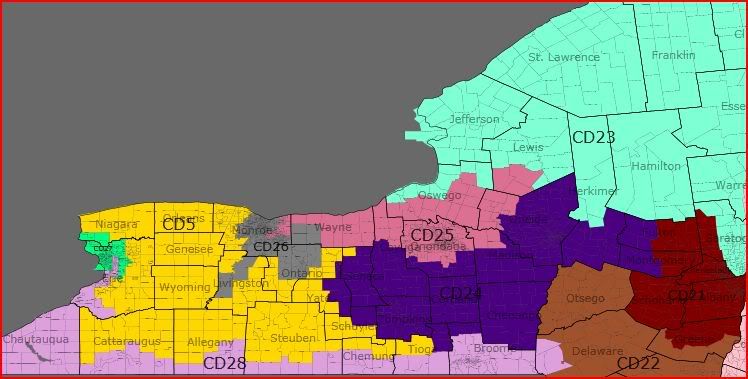
Upstate

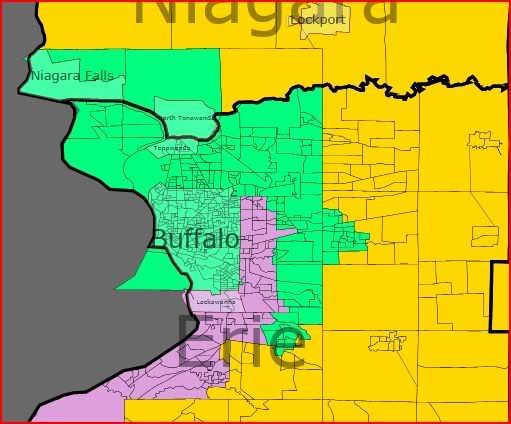
Buffalo Area Map

Buffalo Area

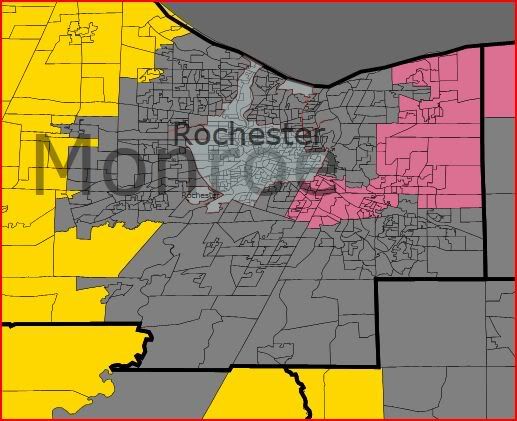
Rochester Area Map

Rochester Area

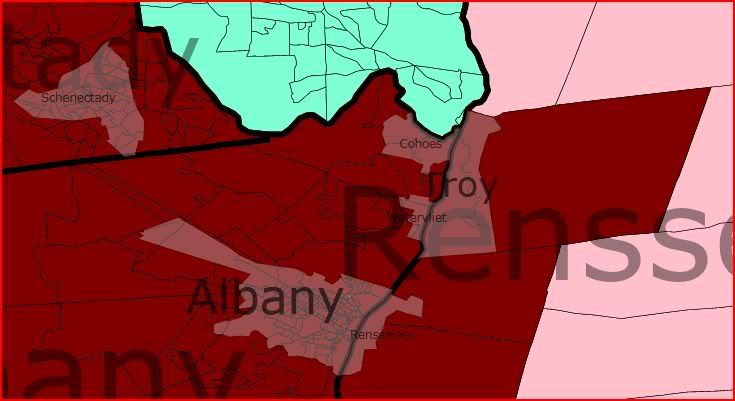
Albany Area Map

Albany Area

NY-28 (Pale Pink)

Presidential Data –

Old NY-29: McCain 51-48

New NY-28: Obama 51-47 (+4D)

Demographic Data –

Old NY-29: 93% White, 3% Black, 2% Asian, 1% Hispanic

New NY-28: 92% White, 3% Black, 2% Hispanic, 1% Asian

Incumbent: Eric Massa (D-Corning)

Description: Running along a narrow strip the Southern Tier along the Pennsylvania border from Delaware to Cattaraugus County, then including all of Chautauqua and parts of Erie County. Essentially replaces the current NY-29.

Comments: Yeah, this one is a bit unwiedly. Most of the smaller towns of the Southern Tier are so intensely Republican that this district had to run a long way to become a Democratic district. Most of that strength comes from the opposite ends of the district’s length – one end that includes most of the Binghamton metro area and another end covering certain southern and western suburbs of Buffalo, particularly strongly Democratic portions of Lackawanna, West Seneca, and Cheektowaga. In between the pickings are slim; there’s the whole of Chautaqua County, notably less hostile to Democrats as a whole than the counties between there and Binghamton. NY-28 seeks out the more Democratic cities and towns in an otherwise Republican area, including Alfred, Wellsville, Elmira, and, conveniently enough, Eric Massa’s home of Corning. The big change is the new NY-28, unlike the old NY-29, goes nowhere near Rochester. Nearly 25% of the district’s population is in Erie County.

Bottom Line: Still a marginal district, but a little better given that any Republican challenger is going to have to make himself known in both the Binghamton and Buffalo markets. Of course, so is Massa.  He’s been a terrific Congressman, so hopefully he can hold on.

NY-27 (Seafoam Green)

Presidential Data –

Old NY-27: Obama 54-44

New NY-27: Obama 62-37 (+8D)

Demographic Data:

Old NY-27: 91% White, 5% Hispanic, 4% Black, 2% Asian

New NY-27: 76% White, 16% Black, 4% Hispanic, 2% Asian

Incumbent: Brian Higgins (D-Buffalo)

Description: Contains portions of Erie and Niagra counties, including the entire cities of Buffalo, North Tonawanda, and Niagra Falls.

Comments: This district shifts northward, taking in all of Buffalo and most of the inner suburbs, such as Amherst and Tonawanda, that are not in NY-28. The old district went south of Buffalo instead and included a fair amount of hostile territory, because it was created for Republican Jack Quinn. The Democratic numbers here improve dramatically due to the inclusion of the whole of Buffalo rather than losing the most Democratic parts to the notorious “earmuffs” of the current NY-28.

Bottom Line: Given Democrats’ trouble in parts of the decaying industrial Rust Belt, the old district could have been vulnerable, but this new district seems pretty safe for Higgins and his successors.

NY-5 (Golden Yellow)

Presidential Data –

Old NY-26: 52-46 McCain

New NY-5: 57-41 McCain (+5 R)

Demographic Data:

Old NY-26: 93% White, 3% Black, 2% Hispanic, 1% Asian

New NY-5: 95% White, 2% Black, 1% Hispanic

Descriptions: Containing all of three counties, and portions of eleven more, this sprawling (and yet reasonable-looking) piece of territory covers the most Republican portions of the Buffalo and Rochester suburbs, the largely Republican turf between them, and most of the strongly GOP rural Southern Tier…you get the idea. [Note: I labelled this district as “NY-5” because, well, it seemed the best color contrast with the other districts in the area; in my first draft of this map, the 5th and 18th districts had a long border, which was annoying since they were similar shades of yellow.]

Incumbent: Chris Lee (R-Clarence)

Comments: All the Republicans in western New York (with a few from Central New York thrown in for good measure) had to go somewhere, and this is where I stuffed as many of them as I could. For the price of keeping other Democrats safe, I wrote this one off. It didn’t make any sense to me to have as many 50-50 Buffalo and Rochester suburbs in there as the current 26th does.

Bottom Line: Safe Republican. You can’t win ’em all.

NY-26 (Dark Gray)

Presidential Data –

Old NY-28: Obama 69-30

New NY-26: Obama 59-40 (-10D)

Demographic Data:

Old NY-28:  64% White, 30% Black, 5% Hispanic, 2% Asian

New NY-26: 78% White, 13% Black, 5% Hispanic, 2% Asian

Incumbent: Louise Slaughter (D-Perinton)

Description: No more earmuffs; this district is now firmly in the Rochester orbit as the portions in and around Buffalo are gone. It includes all of the city of Rochester and the majority of its suburbs, excluding the most Republican areas to the west and a few eastern suburbs that are in NY-25. It’s mostly in Monroe County, with some portions of Wayne, Ontario, and Livingston in there as well. Basically replaces the existing NY-28.

Comments: This is a signifcantly weaker district for Democrats without Buffalo, but I’m not too worried. The two appendages to the south are one into Livingston County to grab college town Geneseo and the other into Ontario County to get the city of Candindiagua.

Bottom Line: Slaughter trades a less Democratic district for not having to cover Buffalo anymore. She and her Democratic successors should still be fine. There are a lot less wasted votes here now.

NY-25 (Salmon Pink)

Presidential Data –

Old NY-25: Obama 56-43

New NY-25: Obama 56-43 (unch.)

Demographic Data:

Old NY-25: 88% White, 7% Black, 2% Hispanic, 2% Asian

New NY-25: 88% White, 6% Black, 2% Hispanic, 2% Asian

Incumbent: Dan Maffei (D-DeWitt)

Description: The current NY-25 is very close to the existing district. Anchored now as before by Syracuse, it includes most of Onondaga County, including all of Syracuse; to the east it includes portions of Oswego, Madison, Oneida, and Lewis Counties, while to the west it includes northern Cayuga County, most of Wayne County and a few Rochester suburbs in Monroe County.

Comments: Few changes. All districts had to expand a little bit, so the new NY-25 takes in a few rural areas in Lewis and Madison as well as a few Republican communities in the Rome-Oneida area so as to help NY-24. It includes fewer and different Rochester burbs from the old district.

Bottom Line: Pretty much the same. Maffei should be fine here absent a strong challenger.

NY-24 (Dark Purple)

Presidential Data –

Old NY-24: Obama 51-47

New NY-24: Obama 52-46 (+1D)

Demographic Data:

Old NY-24: 93% White, 3% Black, 2% Hispanic, 1% Asian

New NY-24: 91% White, 3% Black, 2% Hispanic, 2% Asian

Incumbent: Michael Arcuri (D-Utica)

Description: Containing all or part of 14 counties, it’s based around the cities of Utica, Rome, and Oneida. It includes most of Oneida and Madison Counties and the whole of Tompkins, Cortland and Chenango Counties. It also includes most of Seneca and Cayuga, small parts of northern Tioga and Broome and southern Onondaga, the southern (more populated) half of Herkimer County and the western (less populated) halves of Fulton and Montgomery Countes, the area around Geneva in Ontario County and the Town of Hector in Schuyler County.

Comments: Formerly Republican turf, it’s now a swing district. Adding all of Tompkins County, including Ithaca (NY-22 no longer needs it, as I’ll explain below) helps Democrats, and the small towns in the Finger Lakes region are less hostile to Democrats than similar towns to the north and west. NY-24 was a frustrating one to draw for me for a variety of reasons. Rome-Utica is a weak basis for a Democratic district to begin with, adding Ithaca only helps so much, and because, again, all the upstate districts had to get bigger (this one even more than some) there was really nothing available to add to it apart from Republican rural areas. So the best I could do without endangering better Democrats than Arcuri has been is to improve it by one point and hope that and incumbency are enough.

Bottom Line: A little better. Still a tough district for Democrats, even a conservative one like Arcuri. Should a Republican prevail here in 2010, it’d be a good candidate to carve up.

NY-23 (Pale Blue)

Presidential Data –

Old NY-23: 52-47 Obama

New NY-23: 53-46 Obama (+1D)

Demographic Data:

Old NY-23: 94% White, 3% Black, 2% Hispanic, 1% Native American, 1% Asian

New NY-23: 93% White, 2% Black, 2% Hispanic, 1% Native American, 1% Asian

Incumbent: Bill Owens (D-Plattsburgh)

Description: Contains most of what is known as the North Country. The big changes are that it stays further away from Syracuse and Rome but that it now includes most of the Saratoga Springs area as well as all of Essex County and most of the land area of Warren County. (Glens Falls is still out so that it can still be in Scott Murphy’s NY-20.)

Comments: Looks mostly the same as before except that as NY-24 and NY-25 have expanded a bit to the north and east, NY-23 has had to dip down into the Capital Region. This change has the nice side effect of making it slightly more Democrat-friendly.

Bottom Line: Bill Owens is still going to have a challenging district, but some fairly hostile turf has been replaced by some decent territory around Saratoga Springs. Nonetheless, should a Republican win here in 2010, it’d be a good candidate for carving up.

NY-21 (Dark Brown)

Presidential Data –

Old NY-21: Obama 58-40

New NY-21: Obama 57-41 (-1D)

Demographic Data:

Old NY-21: 87% White, 8% Black, 3% Hispanic, 2% Asian

New NY-21: 86% White, 7% Black, 3% Hispanic, 2% Asian

Incumbent: Paul Tonko (D-Amsterdam)

Description: Includes most of the Albany-Troy metro area, including all of Albany, Schenectady, and Schoharie Counties and portions of Rensselaer, Saratoga, Greene, Fulton, and Montgomery.

Comments: Essentially it’s the same district. It’s a little weaker than the current district because it had to expand and only had hostile Republican turf (new portions of Greene, Fulton, and Saratoga on the periphery) available to add.

Bottom Line: Should still be a reasonably safe district for Tonko and his Democratic successors.

Hudson Valley Region

Hudson Valley Area Map
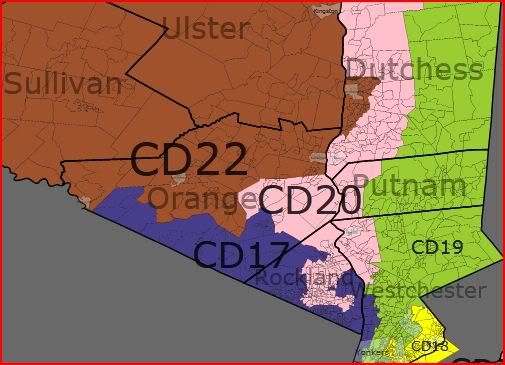
Hudson Valley

Westchester-Rockland Map

Westchester-Rockland Area

NY-22 (Light Brown)

Presidential Data –

Old NY-22: Obama 59-39

New NY-22: Obama 57-41 (-2D)

Demographic Data:

Old NY-22: 83% White, 8% Black, 8% Hispanic, 2% Asian

New NY-22: 80% White, 9% Hispanic, 8% Black, 1% Asian, 2% Other

Description: Now mostly a Hudson Valley district, at least population-wise, it includes the cities of Newburgh, Poughkeepsie, and Kingston, the latter of which is incumbent Hinchey’s home base. Including all of Ulster, Sullivan, and Otsego, it also includes portions of Orange, Dutchess, and Greene, as well as most of Delaware County.

Comments: I reclassified both this district and NY-20 out of the “Upstate” category for a reason. The arm of the existing district that runs out to Binghamton and Ithaca was originally the product of a compromise whereby Hinchey got a safer district (that didn’t include much of then-mostly Republican Delaware County) while the various upstate Republicans didn’t have to worry about representing either of those Democratic cities. However,  all those aforementioned Republicans are gone now and replaced by Democrats, and Democrats’ fortunes in Ulster, Sullivan, and even Delaware County have improved to the point where the district doesn’t need to be shorn up in that fashion. As a consolation prize, NY-22 adds the very Democratic city of Poughkeepsie and while Delaware County and the new portions of Orange and Greene Counties are Republican, the new turf in Otsego County (with Cooperstown and college town Oneonta) is surprisingly Democrat-friendly.

Bottom Line: If current trends continue in the Hudson Valley, with the diversification of the periphery of the NYC metro area, this should say a safe Democratic seat even without Binghamton and Ithaca.

NY-20 (Rose Pink)

Presidential Data –

Old NY-20: Obama 51-48

New NY-20: Obama 55-43 (+4D)

Demographic Data:

Old NY-20: 95% White, 2% Black, 2% Hispanic, 1% Asian

New NY-20: 81% White, 8% Black, 7% Hispanic, 3% Asian

Incumbent: Scott Murphy (D-Glens Falls)

Description: A long thin strand that mostly follows the Hudson River from Lake Champlain down almost to the Tappan Zee. It avoids most of the bigger cities upstream which are in either NY-21 or NY-22. Contains parts of 10 counties, just as the current NY-20 does, but cuts out the Catskills region and instead runs further downstream into Orange, Putnam, Westchester, and Rockland Counties. (The Rockland/Orange section is connected to the rest of the district via the Bear Mountain Bridge.)

Comment: This might be the district I changed more than any other and it’s even more different than it looks on a map. It still contains most of the northern Taconic region as well as incumbent Murphy’s home town of Glens Falls. However, the current district doesn’t go below Poughkeepsie on the Hudson River whereas the majority of the new district lives in its new southern portion in Westchester, Rockland, Orange, and southern Dutchess Counties, and the racial diversity has increased dramatically. The Rockland and Westchester sections of the district are strongly Democratic, which pulls the district from a true swing district into one that leans significantly towards the Democrats. This is another district that looks kind of unwieldy. I certainly did not set out to design something that both borders Vermont and comes within a couple miles of bordering New Jersey.

Bottom Line: The good news for Scott Murphy, assuming he survives 2010, would be a district that’s significantly more Democratic than the one he has now, making a Republican challenge much harder. The bad news is that he may well have to worry more about a Democratic primary challenge from a resident of the lower portion of this district, not to mention needing to worry about the expensive NYC media market.  

NY-19 (Yellow-Green)

Presidential Data –

Old NY-19: Obama 51-48

New NY-19: Obama 58-41 (+7D)

Demographic Data:

Old NY-19: 88% White, 8% Hispanic, 5% Black, 2% Asian

New NY-19: 72% White, 12% Hispanic, 10% Black, 4% Asian, 2% Other

Incumbent: John Hall (D-Dover)

Description: A north-south piece of territory that covers the eastern half of Dutchess County, the eastern-two thirds of Putnam County, and the majority of Westchester County.

Comments: A “musical chairs” situation where no upstate districts are eliminated creates a downstate pull on everything else, and that’s very much manifested here. NY-19 now stays entirely east of the Hudson, more or less following Metro North’s Harlem Line and the Taconic Parkway from the northernmost reaches of Dutchess County down to the borders of the Bronx. As one might expect, subtracting mostly Republican turf in Orange County and a mixed bag of stuff in Rockland County while adding all of White Plains and portions of New Rochelle and Mount Vernon is a huge boost to Democratic numbers. These changes would likely remove NY-19 from the list of swing districts entirely and into “Likely Democratic” if not “Safe Democratic” territory.

Bottom Line: This map should make John Hall a very happy man.

NY-18 (Bright Yellow)

Presidential Data –

Old NY-18: Obama 62-38

New NY-: Obama 68-30 (+6D)

Demographic Data:

Old NY-18: 67% White, 16% Hispanic, 10% Black, 5% Asian, 1% Other

New NY-18: 50% White, 22% Hispanic, 21% Black, 4% Asian, 2% Other

Incumbent: Nita Lowey (D-Harrison)

Description: Sort of a “Long Island Sound” district, it covers a stretch of lower Westchester along the Sound and the Connecticut border (Pelham, Eastchester, part of New Rochelle, Rye City and Town, Mamaroneck, and Harrison), eastern and central portions of the Bronx (a mixture of white, black, and Hispanic neighborhoods), then over the Throgs Neck Bridge to Queens. NY-18 contains portions of the Bayside and Flushing areas and moves into the Great Neck section of Nassau County.

Comments: A lot has changed here as Rockland County is out entirely and Lowey’s home town of Harrison is in the far northern edge of the new district as instead NY-18 gets pushed downstate, into the Bronx and Queens and even onto Long Island. Note that in the 1990s, Lowey’s district actually included portions of Queens and the Bronx so this isn’t entirely new to her.  The upside for an incumbent Democrat is obvious – even though I tried to include as many Republican areas as I could (the Queens and Nassau portion together is about even between Obama and McCain) the district still moved 6 points towards Team Blue, thanks mostly to the Bronx. Note also than non-Hispanic whites are now just barely a majority of the new district.

NY-17 (Grey-Blue)

Presidential Data –

Old NY-17: Obama 72-28

New NY-17: Obama 67-32 (-5D)

Demographic Data:

Old NY-17: 49% White, 32% Black, 20% Hispanic, 5% Asian, 1% Other

New NY-17: 46% White, 28% Hispanic, 19% Black, 4% Asian, 3% Other

Incumbent: Elliot Engel (D-Riverdale,Bronx)

Description: This district contains mostly northern parts of the Bronx (Wakefield, Woodlawn, Riverdale) with some portions down near Fordham University, takes in parts of the cities of Mount Vernon and Yonkers in Westchester County, and then crosses the Tappan Zee Bridge to include portions of Rockland and Orange Counties, mostly along I-287 and, appropriately enough, NY Route 17.

Comment: The biggest change here is that this new district stretches out into Orange, cutting out the more Democratic precincts in Rockland County formerly in the district and leaving in mostly the ones which voted for McCain.  Furthermore, by the 2008 Presidential vote NY-17 is now 5 points less Democratic, but that’s likely somewhat misleading as a large number of those ostensible Republican votes were in precincts that consisted largely or wholly of Hasidic or other Orthodox Jews, who strongly preferred McCain to Obama but have voted for plenty of state and local Democrats and who should have little trouble supporting Engel, one of the more prominent Friends of Israel in Congress. The remainder of Rockland is now in NY-20, where it helps boost Democratic vote totals. The new Orange County portion of NY-17 also leans toward the GOP…but the Bronx and Westchester portions are so heavily Democratic that it hardly matters.  The demographics change a little bit as NY-17 gains more Hispanic residents by cutting deeper into the Central Bronx while losing African-American residents to the downward movement of NY-18 and NY-19.It remains a minority-majority district, albeit one with no clear majority.

Bottom Line: Still safe for Democrats, especially for Engel.

New York City

New York City Map
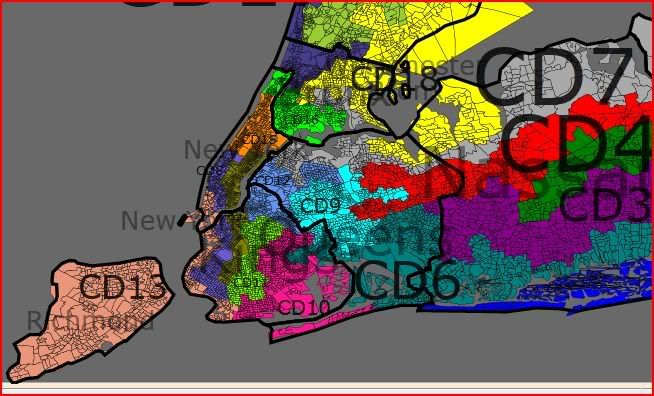
New York City

Bronx/Manhattan

Bronx & Upper Manhattan Map
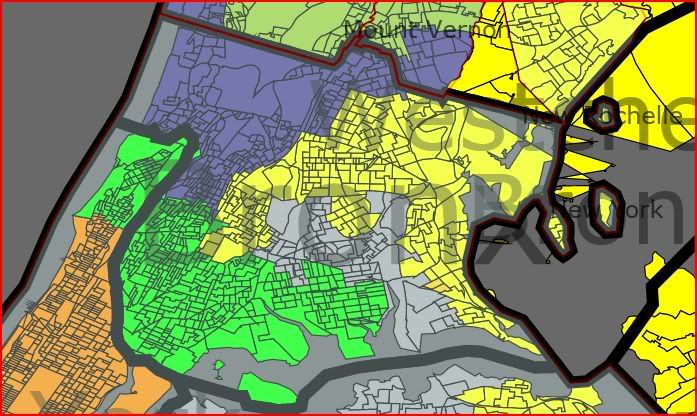
The Bronx

Lower Manhattan Map

Central NYC

NY-16 (Lime Green)

Presidential Data –

Old NY-16: Obama 95-5

New NY-16: Obama 94-6 (-1D)

Demographic Data:

Old NY-16: 63% Hispanic, 36% Black, 20% White, 2% Asian, 6% Other

New NY-16: 63% Hispanic, 28% Black, 5% White, 1% Asian, 2% Other

Incumbent: Jose Serrano (D-South Bronx)

Description: Most of the southern and central Bronx, plus the far northern portion (Inwood, Washington Heights) of Manhattan. Also includes Rikers Island.

Comment: Despite being a Voting Rights Act mandate, NY-16 was a pretty easy district to draw; it’s not like one needs to look too hard for Hispanic precincts in the Bronx.  Because NY-18 got pushed into the Bronx and NY-17 got pushed further into the Bronx, my choices were either to push NY-7 out of the Bronx entirely or send NY-16 into Manhattan. Because I wanted NY-7 to absorb some Republican parts of Long Island (I’ll get there eventually, I promise), I chose the latter option. Far northern Manhattan is mostly Hispanic as well. Rikers Island is in here because while there are residents there, there are no votes (it’s a jail) and NY-7, where the island would otherwise have been, needed actual votes more.

Bottom Line: Somehow one point less Democratic, not that Serrano or anyone else will notice much, given that this remains the most Democratic district in New York and in the nation as a whole.

NY-15 (Orange)

Presidential Data –

Old NY-15: Obama 93-6

New NY-15: Obama 91-8 (-2D)

Demographic Data:

Old NY-15: 48% Hispanic, 35% Black, 28% White, 3% Asian, 5% Other

New NY-15: 36% Hispanic, 29% Black, 29% White, 4% Asian, 2% Other

Incumbent: Charles Rangel (D-Harlem, Manhattan)

Description: Uptown Manhattan, including Harlem and East Harlem, as well as portions of the Upper East and Upper West Sides, plus Ward’s/Randall’s Islands.

Comment: The smallest Congressional District in America in area, now even smaller. It’s been pushed downtown some by the incursion of NY-16 into Manhattan. It’s now almost evenly split among white, black, and Hispanic voters.

Bottom Line: Less Hispanic than before, NY-16 contains a few more affluent whites than the old district did. Not sure whether this will make a primary challenge to Rangel amidst his ethical lapses more or less likely.

NY-14 (Olive)

Presidential Data –

Old NY-14: Obama 78-21

New NY-14: Obama 78-22 (unch)

Demographic Data:

Old NY-14: 73% White, 14% Hispanic, 11% Asian, 5% Black

New NY-14: 65% White, 14% Hispanic, 11% Asian, 7% Black, 3% Other

Incumbent: Carolyn Maloney (D-East Side,Manhattan)

Description: Most of the East Side of Manhattan, from the 90s down to the Williamsburg Bridge, plus most of Midtown as well as Roosevelt Island. In Brooklyn it includes portions of Williamsburg, Downtown, Fort Greene, Prospect Heights, Park Slope, and Borough Park.

Comment: Since NY-12 now stays out of Manhattan completely, the Lower East Side is in here. The Brookyn parts are entirely new to this district, as Maloney’s current district instead crosses the East River into Queens. There’s none of Queens in here but there’s not much to complain about as these are, other than heavily Orthodox Borough Park, the most Manhattan-like parts of Brooklyn in terms of demographics and voting patterns; they’re here because most of these precincts (i.e. mostly white and liberal) are poor fits for VRA compliant districts.  

Bottom Line: No real changes.

NY-08  (Lavender Blue)

Presidential Data –

Old NY-08: 74-26

New NY-08: Obama 80-20 (+6D)

Demographic Data:

Old NY-08: 75% White, 12% Hispanic, 11% Asian, 6% Black, 2% Other

New NY-08: 56% White, 19% Asian, 17% Hispanic, 4% Black, 3% Other

Incumbent: Jerrold Nadler (D-West Side, Manhattan)

Description:  In Manhattan, this district starts on the Upper West Side and then runs downtown to cover much of Lower Manhattan including most of Chinatown, though it gives up some of Lower Manhattan up to shore up NY-13. It crosses the Brooklyn Bridge and then runs all the way down to Bath Beach , taking in all or part of Brooklyn Heights, Carroll Gardens, Sunset Park, Bay Ridge, Dyker Heights, and Bensonhurst in between.

Comment: This is one of many districts used to cover Republican-leaning parts of South Brookyn, overwhelming the GOP voters of Borough Park, Bay Ridge, and Bensonhurst with Manhattan liberals. It probably shows up as being more Democratic due to my effort to give the district more of northwest Brooklyn (which is heavily Democratic) to make the district look less gerrymandered than before. Interestingly enough, since this district now includes most of Chinatown as well as someparts of Brooklyn with large Asian-American communities, NY-8 would become the district in the state, and probably the nation outside of the West, with the highest percentage of Asian-Americans.

Bottom Line: No real changes.

Brooklyn/Staten Island

Brooklyn Map
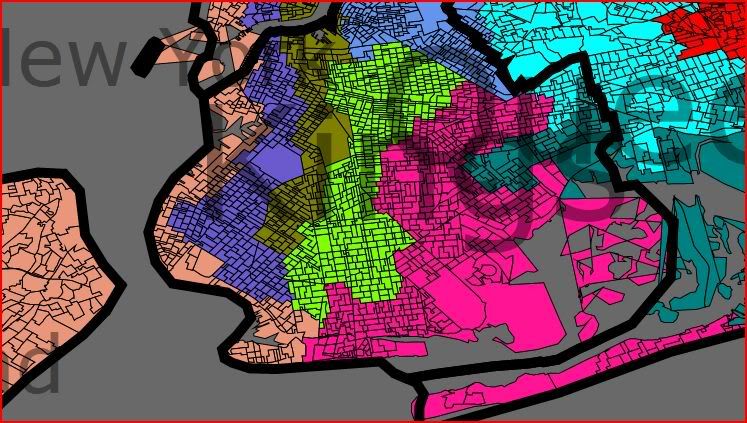
Brooklyn

NY-13 (Peach Tan)

Presidential Data –

Old NY-13: McCain 51-49

New NY-13: Obama 55-45 (+6D)

Demographic Data:

Old NY-13: 77% White, 11% Hispanic, 9% Asian, 7% Black

New NY-13: 64% White, 16% Hispanic, 10% Black, 7% Asian, 2% Other

Incumbent: Mike McMahon (D-Staten Island)

Description: This district includes the whole of Staten Island, then crosses the Verrazano Bridge into Brooklyn, where it becomes a thin forked line. One brach runs down along the water to Coney Island while the other branch stretches narrowly through Bay Ridge and Sunset Park up into Gowanus and Red Hook, then crosses the Brooklyn-Battery Tunnel into the southernmost part of Manhattan, including the Finanical District, Tribeca and SoHo.  

Comment: What a huge difference those 30,000 Manhattanites (mostly white, mostly highly educated, many of them gay/lesbian) make!  Specifically, they by themselves move this district 3 points toward the Democrats. Staten Island of course leans Republican and the Brooklyn portions of the old district weren’t much better, so most of Bay Ridge and Bensonhurst have been excised in favor of more favorable parts of Brooklyn, namely Coney Island at one end and Red Hook at the other. That pushes the district over the 50-50 line but the Manhattan portions make for a more solidly Democratic district.

Bottom Line: Mike McMahon should breathe a little easier.

NY-11 (Bright Green)

Presidential Data –

Old NY-11: Obama 91-9

New NY-11: Obama 81-19 (-10D)

Demographic Data:

Old NY-11: 61% Black, 25% White, 12% Hispanic, 4% Asian

New NY-11: 50.05% Black, 29% White, 11% Hispanic, 6% Asian, 3% Other

Incumbent: Yvette Clark (D-Prospect Gardens, Brooklyn)

Description: Entirely in Brooklyn, mostly in the central part of the borough.

Comment: The northern portions are heavily African-American (e.g Bedford-Stuyvesant) and/or Afro-Caribbean (e.g. Crown Heights) in nature. Much of the predominantly white southern portion, including parts of Borough Park, Midwood, and Homecrest, have strong Republican leanings. It’s 10 points weaker than the old NY-11, mostly because the black vote is less concentrated and because heavily Democratic non-black precincts in Red Hook and Park Slope were replaced with Republican-voting ones further south. Due to some moving around of other districts, Brownsville and East Flatbush were mostly removed from NY-11 while Bed-Stuy and portions of the Clinton Hill/Fort Greene area were added in their place.

Bottom Line: Hardly much of a cause for concern.

NY-10 (Magenta)

Presidential Data –

Old NY-10: 63% Black, 21% White, 17% Hispanic, 3% Asian, 2% Other

New NY-10: 51% Black, 32% White, 11% Hispanic, 4% Asian, 3% Other

Demographic Data:

Old NY-10: 91-9

New NY-10: Obama 78-21 (-13D)

Incumbent: Edolphus Towns (D-East New York, Brooklyn)

Description: Mostly in Brooklyn, with a portion in Queens on the westernmost parts of the Rockaway Peninsula. Includes all or part of Flatbush, East Flatbush, East New York, Brownsville, Canarsie, Marine Park, Sheepshead Bay, Manhattan Beach, Brighton Beach, and Gravesend.

Comment: Same idea as NY-11 above. In this case, the north and east sections are heavily black (Brownsville, East New York) and constitute a majority while the mostly white sections to the south or west (Gravesend, Manhattan Beach, Brighton Beach, Rockaway Park) vote Republican. The Democratic performance dropped dramatically, but that’s good news in a case such as this because it just means fewer wasted votes.

Bottom Line: Should be no real change.

Queens

Queens Map
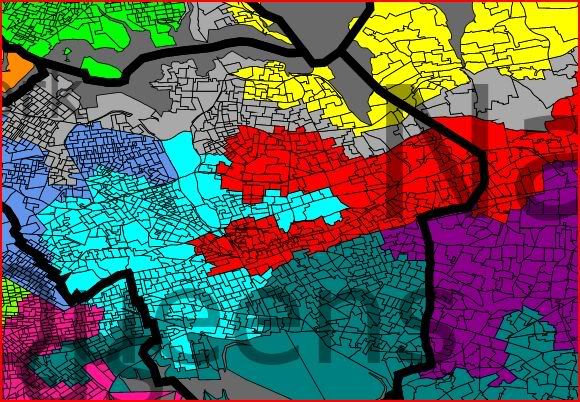
Queens

NY-12 (Robin’s Egg Blue)

Presidential Data –

Old NY-12: Obama 86-13

New NY-12: Obama 82-17 (-4D)

Demographic Data:

Old NY-12: 48% Hispanic, 39% White, 16% Asian, 11% Black,

New NY-12: 51% Hispanic, 24% White, 12% Asian, 9% Black, 4% Other

Incumbent: Nydia Velasquez (D-Williamsburg, Brooklyn)

Description: Split between Queens and Brooklyn.

Comment: It’s a miscellaneous collection consisting primarily of predominantly Hispanic neighborhoods in Queens and Brooklyn but including most of Valasquez’ home neighborhood of Williamsburg. It’s changed a bit though as it’s much more compact than before; it no longer includes any of Manhattan and leaves the bayfront portions of Brooklyn such as Red Hook and Sunset Park behind. Instead NY-12 moves east and north and takes in parts of Queens such as Long Island City and portions of Jackson Heights, Elmhurst, and Corona as well as the Brooklyn neighborhoods of Greenpoint and Bushwick. These changes were made mostly because sending three districts via bridge from lower Manhattan to Brooklyn required getting NY-12 out of their way. (It looked better before I discovered that Joe Crowley’s home in Woodside was right in it’s path. )

Bottom Line: Obviously still a safe Democratic district for Velasquez or any other nominated Democratic candidate. There is now a Hispanic majority here.

NY-07 (Light Gray)

Presidential Data –

Old NY-07: 45% White, 36% Hispanic, 19% Black, 13% Asian, 2% Other

New NY-07: 48% White, 24% Hispanic, 16% Asian, 9% Black, 4% Other

Demographic Data:

Old NY-07: Obama 79-20

New NY-07: Obama 66-33 (-13D)

Incumbent: Joseph Crowley (D-Woodside, Queens)

Description: Geographically, mostly a long thin strand running from Astoria and Woodside in Queens out Northern Boulevard and then the North Shore out to portions of Huntington, including portions of northern Nassau and Suffolk Counties, with another branch going into southeastern and central sections of the Bronx via the Whitestone Bridge.

Comment: NY-07, being a rare district in this part of the state not presently subject to VRA constraints, figures prominently in removal of Peter King and his district from the delegation.  With the exception of a few more diverse areas, the North Shore area leans Republican from one end to the other, one reason that much of it is in the current NY-03. One key to keeping this district from falling into swing territory is that the relatively small section of the Bronx actually represents about 20% of the district’s population, and that the predominantly white precincts in that borough that would be of limited help to a Democrat (many of which actually are in the current NY-07) were placed elsewhere, leaving overwhelmingly black or Hispanic precincts who collectively gave Obama 86% of their votes. The Queens portion of the new district also leaves out some of the whiter and less Democratic parts of that borough that had been in NY-07 before. 66% leaves plenty of Democratic margin, even if the 2008 turnout numbers represent something of a ceiling – in part because Long Island figures to continue to diversify.

Bottom Line: Crowley might be the most ticked off Democrat in the delegation as he gets a mostly new set of constituents and one less friendly than he is used to. But someone has to take those Republican votes on Long Island and every other candidate for that task is limited either by already being something of a swing district or by VRA compliance requirements.

NY-06 (Teal Blue)

Presidential Data –

Old NY-06: Obama 89-11

New NY-06: Obama 72-27 (-17D)

Demographic Data:

Old NY-06: 54% Black, 19% White, 17% Hispanic, 9% Asian, 4% Other

New NY-06: 50.01% Black, 36% White, 9% Hispanic, 2% Asian, 3% Other

Incumbents: Gregory Meeks (D- St. Albans, Queens); Peter King (R-Seaford)

Description: Built around a primarily black section of Eastern Queens, it has one branch that runs west to pick up parts of Brownsville and East New York in Brooklyn, taking in Broad Channel and portions of Howard Beach along the way and another that runs to the east along the south shore of Long Island’s Nassau County, including most of the Five Towns area but growing narrower until reaching the Nassau County border near Massapequa.

Comment: I’m pretty sure King’s not actually going to run here. When I was drawing this map, I didn’t know where exactly his home was; I’d have actually guessed it was in the NY-03 I drew with Carolyn McCarthy around, which is probably the district he’d choose to run in anyway. Someone else’s contest entry pointed out the precinct, I looked it up, and what do you know, his precinct’s in the (barely) black-majority NY-06.  

Even more than the two Brooklyn districts NY-10 and NY-11, this is NY-06 a classic “blacks and Republicans” district, avoiding any significant areas predominantly white precincts where Obama did well, since those voters don’t help this district comply with the VRA and are more needed elsewhere. The Nassau portion of the district is mostly strongly Republican; diverse areas in southern Nassau County, such as Freeport, where Obama performed well were put into NY-3. I’m a little scared of “blacks and Republicans” districts in some contexts (for fear that the racial turnout gap could become large enough to produce some unpleasant Election Day surprises)  but this one is a bit different in that most of the predominantly black neighborhoods in this area are middle-class and well-educated (and thus less likely to suffer from extremely low turnout) and that incumbent Meeks seems like the kind of African-American politician perfectly capable of winning over some white votes (and even Obama’s worst precincts in here were in the 30s rather than the single digits) if he needs them.  

Bottom Line:  Probably another unhappy incumbent, even if he’s still safe.

NY-09 (Sky Blue)

Presidential Data –

Old NY-09: Obama 55-44

New NY-09: Obama 68-31 (+13D)

Demographic Data:

Old NY-09: 71% White, 15% Asian, 14% Hispanic, 4% Black, 2% Other

New NY-09: 40% White, 26% Hispanic, 17% Asian, 9% Black, 7% Other

Incumbent: Anthony Weiner (D-Forest Hills, Queens)

Description: Now almost entirely in Queens, it’s based, just like the current NY-09 in a group of mostly white Queens neighborhoods such as Maspeth, Middle Village, Woodhaven, Ozone Park, most of Howard Beach,  and incumbent Weiner’s own home turf in Forest Hills. It’s become a no-majority district now because it’s border areas in the east and south, particularly the small portion in Brooklyn, have many largely black and Hispanic precincts, and because the Asian-American population has been increased slightly.

Comment: Because other districts are used to cover Republican parts of southern Brooklyn, the Democratic share of the vote in this new district shoots way up. There wasn’t quite enough room to get this district out onto Long Island, so I ended up just trying to make sure the more GOP-friendly parts of Queens were in here rather than in NY-04 or NY-07 to the extent possible.

Bottom Line: Anthony Weiner wasn’t and isn’t in any real danger here. The danger is that he has known higher office aspirations, just like his predecessor Chuck Schumer, so I expect this to be an open seat sooner rather than later. A 55-44 open seat is a cause for concern, but an open seat in the new district would not be.

NY-04 (Red)

Presidential Data –

Old NY-05: Obama 63-36

New NY-04: Obama 60-39 (-3D)

Demographic Data:

Old NY-05: 56% White, 25% Asian, 24% Hispanic, 6% Black

New NY-04: 54% White, 18% Asian, 14% Hispanic, 9% Black, 5% Other

Incumbent: Gary Ackerman (D-Roslyn Heights)

Description: The new NY-04 most closely resembles the existing NY-05, split between Queens and Long Island.

Comment:

This district had the highest Asian population of any district outside of Hawaii and California, but they’ve been spread out some more in this map; those areas in Queens are less Democrat-voting than the neighborhoods that have replaced them in this NY-04; note that the black population, mostly in the Queens portion of the district, increased from 6% to 9%. The Long Island portion of the district, about 41% of it’s residents, narrowly voted for McCain, but 72% of the Queens section (a diverse set of neighborhoods such as East Flushing, Oakland Gardens, and parts of Jamaica Estates, collectively 59% of the district’s population) voted for Obama. In North Hempstead in Nassau, Ackerman has a lot of the same constituents he’s used to, including those in his Roslyn home as well as all or parts of Albertson and Westbury, though Great Neck, Port Washington, and most of Manhasset are moved as NY-07 and NY-18 now move into Nassau County. The Oyster Bay and Suffolk County portions would be entirely new to Ackerman and neither, with a few exceptions (Greenlawn and Huntington Station) are particularly friendly towards Democrats. The Oyster Bay portions are mostly in Peter King’s current NY-03. Essentially, this district’s Democratic base in Queens is used to cover some heavily Republican parts of Long Island, including parts of Garden City, and a large chunk of the town of Smithtown.  

Bottom Line: Ackerman has more territory to cover and a bunch of new constitutents, which probably won’t make him happy. But he isn’t seriously endangered by any of the changes and his successor here should be a fellow Democrat as well, especially given the long-term trends on Long Island.

Long Island

Nassau County Map
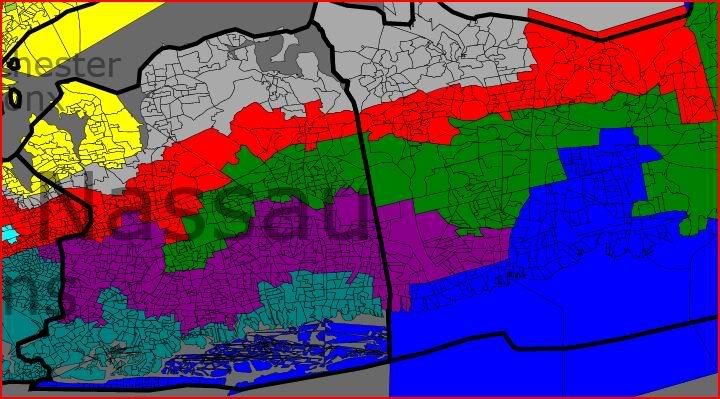
Long Island

Suffolk County Map

Outer Long Island

NY-03 (Medium Purple)

Presidential Data –

Old NY-04: Obama 58-41

Old NY-03: McCain 52-47

New NY-03: Obama 56-44

Demographic Data:

Old NY-04: 69% White, 19% Black, 14% Hispanic, 5% Asian

Old NY-03 94% White, 2% Black, 2% Hispanic, 1% Asian

New NY-03: 68% White, 16% Black, 10% Hispanic, 4% Asian

Incumbent: Carolyn McCarthy (D-Mineola); Peter King (R-Seaford)

Description: A roughly eliptical swath across Long Island, covering parts of the Town of Babylon in Suffolk County, interior portions of Nassau County, with a handful of precincts in the far eastern part of Queens. It’s mostly a fusion of the current NY-03 with the current NY-04.

Comment: Here’s where things really get interesting.   The eastern half of this district is as of now mostly represented by Republican Peter King while the western half is mostly represented by Democrat Carolyn McCarthy. And then there are two entirely new pieces, one in the east in the Town of Babylon and one in the west in Queens. As one might expect from me at this point, 75% of the 23,000 Queens residents of this district are African-American, as are a substantial minority of the eastern portion which includes the African-American majority village of North Amityville. The western half, full of diverse communities like Valley Stream, Uniondale, Freeport, and McCarthy’s own Mineola, predominates, as the demographic numbers clearly indicate; this looks a whole lot more like McCarthy’s district than King’s. In a race between the two, I’d expect McCarthy to be the clear favorite.

Bottom Line: For Peter King, it’s a matter of picking his poison. The current NY-03 has been placed in six different districts, only two of which are halfway plausible places for him to run; NY-07 contains only a few of his old constituents and runs all the way into the Bronx, NY-04 is mostly (population-wise) in Queens and only contains a few of his old constituents, NY-06 contains his house but is mostly in Queens and is majority African-American, and while NY-01 may be the least Democrat-leaning of all his options, that’s almost entirely unfamiliar territory further out in Suffolk County and his obnoxious screeds on TV don’t play well in the Hamptons anyway. That leaves Steve Israel’s NY-02 and Carolyn McCarthy’s NY-03. Of those NY-03 seems the plausible choice as it contains a little more of King’s current turf than NY-02 does and includes most of King’s base in Massapequa, Farmingdale, and Bethpage.  Even here he’s a clear underdog against McCarthy.

NY-02 (Dark Green)

Presidential Data –

Old NY-02: Obama 56-43

New NY-02 Obama 56-44 (unch)

Demographic Data –

Old NY-02: 78% White, 14% Hispanic, 10% Black, 3% Asian

New NY-02: 74% White, 10% Hispanic, 10% Black, 4% Asian

Incumbent: Steve Israel (D-Dix Hills)

Description: Shaped a bit like a big-headed lizard with a long tail section. Predominantly in Suffolk County, it covers most of the Town of Brookhaven and southern portions of Smithtown, with a tail through interior portions of western Suffolk (small portions towns of Babylon and Islip and southern portions of Huntington and stretching into a strand running through the middle of eastern portions of Nassau County, as far west as Hempstead Village.

Comments: This district remains about exactly as Democratic-leaning as it was before, but has changed considerably. It loses its North Shore territory but picks up a different part of the North Shore, around Port Jefferson. Only its central portion, around Israel’s own Dix Hills, and Republican-leaning southeast portion in the Town of Islip remain largely intact. The Nassau County portion, expanded considerably from the old NY-02, picks up some of Peter King’s old base around Levittown and Hicksville but also includes heavily Democratic Hempstead Village, which makes up for not having such Democratic strongholds as Brentwood and Central Islip anymore. It probably has more of Peter King’s old constituents than any district save NY-03. This district had to be altered considerably to help take out Peter King and help lock down what would otherwise be a shaky NY-01.

Bottom Line: Israel’s probably not a happy camper as the power of incumbency goes down dramaticallly with brand new constituents, even if the generic Democratic advantage remains the same as it does here. It’s still hard to imagine Peter King winning here as he hasn’t represented many of these people and would have to move inland considerably to belong to this district.  

NY-01 (Medium Blue)

Presidential Data –

Old NY-01: Obama 52-44

New NY-01: Obama 55-43 (+3D)

Demographic Data –

Old NY-01: 89% White, 8% Hispanic, 4% Black, 2% Asian

New NY-01: 76% White, 14% Hispanic, 7% Black, 2% Asian, 2% Other

Incumbent: Tim Bishop (D-Southhampton)

Description: Based in eastern Suffolk County, including both the North and South forks and all the Hamptons, and then runs along the South Shore to Bay Shore then over Robert Moses Causeway to Fire Island and along Ocean Parkway through beach barrier islands to Point Lookout, Long Beach, and Atlantic Beach in Nassau County.  The tail becomes wider at one point to include Brentwood and Central Islip.

Comments: A marginal Democratic district shorn up somewhat by the shedding of mostly (apart from Port Jefferson) unfriendly portions of the Towns of Brookhaven and Smithtown and their replacement with the barrier islands in Nassau County and heavily Democratic Central Islip and Brentwood (mostly responsible for the significant jump in the Hispanic population) which more than make up for the Republican-leaning South Shore area (some of which is now represented by Peter King)that  this new map includes. It’s admittedly bit of a gerrymander as this new NY-01 borders (by water) Queens despite also including Shelter Island.  

Bottom Line: This should help keep this seat in Democratic hands.  

By what margin will Bob Shamansky win?

View Results

Loading ... Loading ...