Regional Realignment, part 2: the Mid-Atlantic states

For purposes of this diary, the Mid-Atlantic states are defined as New Jersey, Pennsylvania, Delaware, and Maryland.  Since 1992, all four of these states have awarded their electoral votes to the Democratic candidate.  That hasn’t always been the case:  as recent as 1984 and 1988, all four of these states were won by Ronald Reagan and George H. W. Bush, respectively.  Over the last 50 years, we have seen considerable gains in certain elections by both the Democrats and Republicans.  I imagine that this trend will continue in years to come.

House Representation Realignment

As mentioned in part 1 of this topic, in 1960 the Democrats controlled approximately 60% of the house seats.  I have inserted below the final results of certain general elections.

After each US House election, Mid-Atlantic

1960:  27(D), 25(R)

1964:  33(D), 18(R)

1966:  28(D), 23(R)

1972:  25(D), 24(R)

1976:  33(D), 16(R)

1980:  28(D), 21(R)

1982:  30(D), 16(R)

1990:  25(D), 21(R)

1992:  22(D), 21(R)

1994:  20(D), 23(R)

2004:  20(D), 21(R)

2006:  24(D), 17(R)

2008:  27(D), 14(R)

Beginning in 1960, the Democrats barely held a majority of seats in this region, although nationally they controlled 60% of the house seats.  By 1964, the JFK/LBJ administration had earned considerable trust within this region, resulting in nearly a 2/3 majority of Democratic seats.  The 1966 elections hurt (probably a strong “dead cat” bounce, plus growing uncertainty about the LBJ war policy).  By 1972, Nixon’s policies have converted many of this electorate to his side, only to lose their gains in full by 1976 (the Watergate years).  The Reagan revolution started to bloom by 1980, and the Republicans had significant strength in this area (sans the 1982 election, where Reagan’s approval ratings were hit by a bad economy).  By 1994, the Republicans gained a majority of this region’s seats, not relinquishing control until 2006.  During the 2006 and 2008 elections, the Democrats gained 7 additional seats, coming close to holding 2/3 of this region’s house seats.

Senate Representation Realignment

After each US Senate election, Mid-Atlantic

1960:  2(D), 6(R)

1964:  4(D), 4(R)

1966:  4(D), 4(R)

1972:  2(D), 6(R)

1976:  3(D), 5(R)

1980:  4(D), 4(R)

1982:  4(D), 4(R)

1990:  5(D), 3(R)

1992:  6(D), 2(R)

1994:  5(D), 3(R)

2004:  6(D), 2(R)

2006:  7(D), 1(R)

2008:  7(D), 1(R)

With Arlen Specter switching parties in April 2009, the Democrats currenlty hold all 8 Senate seats in this region.  At one time the Republicans held their own in occupying the Senate seats in this region, but that’s mostly because the Republicans candidates were considered more in line with the Rockefeller Republican image.  However, the Rockefeller Republicans lost their powers by the time of the Reagan revolution, and as a result they became a dying breed.  

Conclusion:

The Mid-Atlantic region should be considered a “blue region”.  For the most part, this region identifies more with the Democratic brand than the Republican brand.  Since the Republicans have shown little desire to moderate their image, I personally imagine that the Dems will control this region for many more years.  Unfortunately, the Dems have little areas to grow.  We might be able to gain 1 more seat in PA and NJ, but we will have to play more on defense.  There are probably 5-7 house seats currently in the hands of Democrats that will be competitive in the next few election cycles.  We will have to play a lot of Defense in the next few election cycles.  Both of the NJ Senators are not overly popular, keeping Specter’s seat will be a tough proposition, and we have a Republican running for the Delaware Senate seat that has a moderate image.  I don’t believe that Tommey will defeat Specter, but PA has once before elected a Santorum that is in the same mold as Tommey.  

Overall, this is a good region for Democrats, but we can’t take anything for granted.  We are almost tapped out in areas to grow, but we must defend our seats or the Republicans might gain a foothold in this region.

The State of the State Legislatures, Part Two: Chambers Held by Republicans

In part one, I looked at the state legislatures currently held by Democrats. This time around, I’m taking a look at state houses held by the Republicans. Unfortunately for Democrats, it’s not very fertile ground for pickups. Most of the state legislatures that the Democrats had a chance at in 2006 and 2008 are out of reach now, given the worse climate and number of struggling governors and open gubernatorial seats.

Same notes as last time; Louisiana, Mississippi, New Jersey and Virginia will have their elections in 2011, while the Kansas and New Mexico Senates are both elected in Presidential years, and the Nebraska unicameral is nonpartisan. For the current composition, Democrats are listed first, Republicans second, and independents/others listed third. Vacancies are not noted, and the numbers were pulled from Wikipedia, so they’re not perfect. Also, I am using the generic term “House” for the lower house of each legislature. I know some are called Assembly, it’s just simpler to do it this way.

Tossup

Montana Senate (Currently 23/27) – One of the chambers that flipped to the Republicans in 2008, the Montana Senate is like the House, closely divided. With no major statewide election on the ballot (just Denny Rehberg, who won’t have a serious challenger), it’ll be down to legislative candidates to get voters out.

Lean Republican

Alaska Senate (Currently 10/10) and House (Currently 18/22) – Even as the McCain/Palin ticket dominated the statewide vote, the Democrats actually managed to pick up a seat in each of the houses of the legislature. Everpresent ethics problems have been dogging the VECO-lovin’ Republicans, and the Senate Republicans are so divided that a coalition of all ten Democrats and six of the ten Republicans governs the chamber, leaving the other four Senators out in the cold. It’s looking less and less likely that the gubernatorial race will be competitive, thanks to Sean Parnell’s ability to not be Sarah Palin, but the narrow margins in the legislature should be watched.

Michigan Senate (Currently 16/22) – Thanks to term limits kicking in, a ridiculous number of seats will be open in 2010 — 29 of the 38 seats, 17 Republicans and 12 Democrats. This pretty much makes the chamber up for grabs, although Republicans have the advantage due to currently having the majority, plus winning Mark Schauer’s open Senate seat last year.

Likely Republican

Kentucky Senate (Currently 17/20/1) – Steve Beshear has been playing Godfather with Senate Republicans, giving them offers they couldn’t refuse (judgeships with great pension plans) in exchange for the shot at picking up their seats. His magic seems to have worn off, however, with the last special being a Republican hold. Of the seats up in 2010, Democrats are contesting eight out of 11, while Republicans are going after six of the seven Democrat-held seats. The Independent is up too, and it looks to be a three-way affair. While it will only take two seats for the Democrats to tie, and three to take over, I’m not sure where they can find them.

Safe Republican

Arizona Senate (Currently 12/18) and House (Currently 24/36)

Florida Senate (Currently 14/26) and House (Currently 44/75)

Georgia Senate (Currently 22/34) and House (Currently 74/105/1)

Idaho Senate (Currently 7/28) and House (Currently 18/52)

Indiana Senate (Currently 17/33)

Kansas House (Currently 49/76)

Missouri Senate (Currently 11/23) and House (Currently 74/89)

North Dakota Senate (Currently 21/26) and House (Currently 35/58)

Ohio Senate (Currently 12/21)

Oklahoma Senate (Currently 22/26) and House (Currently 39/62)

Pennsylvania Senate (Currently 20/30)

South Carolina Senate (Currently 19/27) and House (Currently 52/72)

South Dakota Senate (Currently 14/21) and House (Currently 24/46)

Tennessee Senate (Currently 14/19) and House (Currently 48/50/1)

Texas Senate (Currently 12/19) and House (Currently 73/77)

Utah Senate (Currently 8/20) and House (Currently 22/53)

Wyoming Senate (Currently 7/23) and House (Currently 19/41)

Not much to say here. If the Democrats couldn’t win these bodies in 2006 and 2008, it’s not happening in 2010. The Tennesee and Texas Houses are close, but 2010 is looking likely to be a bad year for Democrats in Tennessee, and in Texas, Democrats failed to challenge 55 of the 77 Republicans in the House, while Republicans are contesting about half of the 73 seats held by Democrats.

SSP Daily Digest: 3/11 (Morning Edition)

  • FL-Sen: Insider Advantage, polling on behalf of the Florida Times Union, confirms what PPP sees in the GOP primary. They have Marco Rubio eviscerating Charlie Crist, 60-26. Charlie Crist better figure out his exit strategy in a hurry, or else he’ll have a lot more time to spend on back waxes come September.
  • KY-Sen: Some Dude Bill Johnson said he’s bailing on the GOP primary to succeed Jim Bunning, saying his internal polling looked cruddy. He’d spent a few hundred grand of his own money, but yeah, I never heard of him either. He does have a perfect Some Dude name – according to the SSP tags, there’s another Bill Johnson running in Ohio this cycle, and still another running in Alabama!
  • NV-Sen: How is this man still in office? The New York Times reports:”Previously undisclosed e-mail messages turned over to the F.B.I. and Senate ethics investigators provide new evidence about Senator John Ensign’s efforts to steer lobbying work to the embittered husband of his former mistress….”
  • CO-Gov: In an apparent bid to out-nut his party-mate Jane Norton when it comes to outlandishly conservative proposals on the “restructuring” of basic governance, Scott McInnis was caught on tape at a recent Tea Party candidate forum suggesting that the state Department of Education be looked at as a possible target for elimination. (JL)
  • GA-Gov: Georgia Dems are pressing the House Ethics Committee to wrap up its investigation of Rep. Nathan Deal, who is slated to resign from the House at the end of the month. If they don’t finish by then, there’s a good chance they’ll just drop the investigation – something, in fact, they just did with regard to Eric Massa.
  • HI-Gov: This is interesting. We noted the International Longshore and Warehouse Union’s endorsement of Honolulu Mayor Mufi Hanneman in the Dem primary yesterday, but we didn’t look at their rationale. One of their reasons ought to appeal to progressives: Hanneman, like the ILWU and Sens. Dan Akaka and Dan Inouye, has backed Colleen Hanabusa over Ed Case for the HI-01 May special election. Rival Neil Abercrombie has stayed neutral, which looks like a big mistake, given how powerful the ILWU is in Hawaii.
  • NY-Gov: Trying to forestall attempts to find a better candidate (or shove him from the race), Rick Lazio rolled out a bunch of endorsements from a bunch of Republicans who are all retired these days: former Gov. George Pataki and former Reps. Amo Houghton, Sherwood Boehlert, and George Wortley. I had to look up Wortley – he hasn’t served since 1989.
  • MI-07: Look out, John Kasich! Tim Walberg says “I was Tea Party before there was a Tea party.” He also says he lost in 2008 “because McCain was not a true conservative and people were tired of moderates.”
  • NY-14: With Democratic majorities at risk and progressive power in Congress at a troubling ebb, too many powerful New Yorkers seem only too happy to back an unabashed pro-bankster neophyte challenging a liberal female incumbent. I’m talking about Reshma Saujani, who’s running on a platform of kissing Wall Street’s ass (“If you go to Texas, you’ll never hear a Congressional member speak poorly of the oil industry”) against Rep. Carolyn Maloney. Oh, but don’t worry – Saujani’s got all the important things covered. At a recent women’s fundraiser, one of her supporters assured the crowd, “But it gets better, look how fashionable she is. She’ll definitely be the best dressed person in Congress.”
  • NY-29: Former Rep. Randy Kuhl has decided he won’t try to win his old seat back. Instead, he’s endorsing ex-Corning Mayor Tom Reed. Incidentally, Kuhl must have had the worst oppo team ever when he was actually running for office, no?
  • SC-02: Ugh – Dem Rob Miller, who raked in a couple mil he never otherwise would have seen after Rep. Joe Wilson’s “You lie!” outburst, is making some unforced errors. He kicked a TV reporter and camera crew out of a speech to a local Democratic club, and then tried to later claim he had done no such thing. Unfortunately, contemporaneous emails contradicted Miller’s claims. I really hope that Miller’s elevation to Red to Blue status means he’s going to get some professional campaign assistance, and that he’s not just being fleeced for his Brewster’s millions.
  • Redistricting: I love this diary – possumtracker takes us on a magical mystery tour of some of the most extreme possible majority-minority districts, in places you probably never thought such districts could exist. Let’s hope actual map-drawers (or the DoJ) don’t take too many cues, though, since these kinds of districts would likely kill many neighboring Democratic seats.
  • Robocalls: The Republican Attorney General of Indiana, Greg Zoeller, chastised the NRCC yesterday for its use of robocalls introduced by a live operator. Zoeller says that, while legal, the NRCC’s tactics violate the spirit of a tri-partisan treaty signed between the state’s Democratic, Republican and Libertarian parties banning the use of robocalls in the state. Zoeller asked the NRCC to suspend its use of robocalling in the state. Typical for the NRCC, they told Zoeller to go twist. (JL)
  • 9-5 Non-VRA map of Georgia

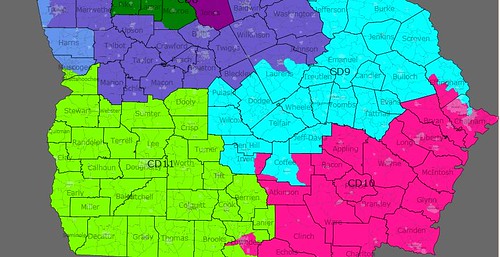
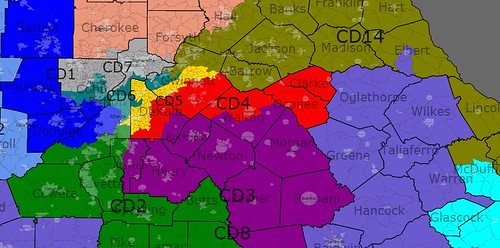
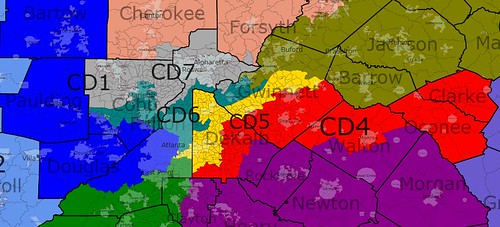
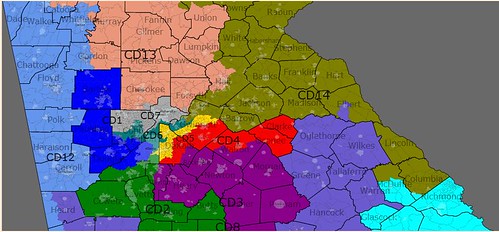
    An 9-5 Democratic map probably. I will quickly give a rundown of the districts followed by a few maps of the districts.

    District 1 (blue): 46% black and 45% white, probably John Lewis territory more than anyone else but man would the folks in Paulding and Bartow counties be pissed to be in a district with the west side of ATL. Probably the most ridiculous district.

    District 2 (green): 45 percent white and 44 percent black, amazing considering how all the black population is concentrated in a chunk of Fulton and a sliver of Clayton. David Scott would probably run here.

    District 3 (purple): 48% white and 42% black, Clayton and east Dekalb make this a Democratic district probably. I have no idea what Democrat would run though.

    District 4 (red): 49 percent white, 39 percent black. Probably my favorite district. White percentage doesn’t necessarily represent GOP percentage because of Clarke county which is 60% white yet 60% Democratic. I think Hank Johnson would want this one or…

    District 5 (yellow): Very diverse district, 40 percent white, 34 percent black, 17 percent Hispanic, 8 percent Asian. Similar to the 4th, white percentage includes liberal whites in east Fulton/ west central Dekalb. Another possibility for Hank Johnson?

    District 6 (teal): 49% white, 25 percent black, 19% Hispanic, 6% Asian. Getting desperate here but this would no doubt be a Democratic district due to once again liberal whites in ATL plus the majority-minority status of the district. Have no idea who would represent this but definitely not Tom Price.

    District 7 (gray): Finally a GOP seat in Metro ATL (6-1 delegation for Dems so far)! Tom Price and Phil Gingrey battle it out here for a 76 percent white, safe GOP district.

    District 8 (periwinkle): I’m pretty sure I helped Jim Marshall out with this one stretching across Middle GA. 56% white, 39% black probably pretty close to 50-50 for Obama/McCain (7-1 Dems).

    District 9 (light blue): Screwed up a little here but Barrow should be safe. 54% white, 40% black so less black than now. I was attempting to get a Democratic south east GA district by diluting Barrow’s district but you’ll see that’s not happening… (but we have a 8-1 Dem advantage).

    District 10 (neon pink): 65% white and 28% black. Not quite good enough to elect a Democrat considering the hostility of SE GA whites towards Democrats (8-2 Democrats).

    District 11 (yellow-green): pretty much the same as Sanford Bishop’s pre 2006 district. 52 percent white and 41 percent black I think a Democrat would be fine here (9-2 Democrats).

    Districts 12-14: well the Republicans had to go somewhere… All these districts are between 75 to 82% white. I think the 12th would be Westmoreland’s, the 13th is similar to the open 9th and the 14th get’s rid of Paul Broun so hurray for that!

    With the three additional GOP seats that brings me to a 9-5 Democratic advantage. Pretty unrealistic but entirely possible if not for the VRA guidelines. Honestly though I think this might expand black representation because of the additional metro ATL seats but I worry in a bad cycle the 11th and the 9th could be in danger for Democrats. Still even if those fell we’d be tied 7-7, gaining a seat.

    North GA:

    NGA

    South GA:

    SGA

    Middle GA:

    CentralGA

    Metro ATL:

    MetroATLzoom

    January Party Committee Fundraising Roundup

    Everybody needs money. That’s why they call it money. Here are the January fundraising numbers for the six major party committees (December numbers are here):


    Committee January Receipts January Spent Cash-on-Hand CoH Change Debt
    DCCC $4,689,595 $3,049,268 $18,321,761 $1,640,328 $1,333,333
    NRCC $4,501,859 $3,043,209 $4,132,927 $1,458,650 $0
    DSCC $5,104,289 $4,791,193 $12,950,254 $450,254 $833,167
    NRSC $5,013,023 $2,689,836 $10,631,311 $2,331,311 $0
    DNC $9,189,882 $7,629,473 $10,204,457 $1,521,120 $4,681,829
    RNC $10,530,291 $9,469,361 $9,482,877 $1,060,929 $0
    Total Dem $18,983,766 $15,469,934 $41,476,471 $3,611,701 $6,848,330
    Total GOP $20,045,173 $15,202,407 $24,247,115 $4,850,890 $0

    Like last month, the GOP once again outraises the Dems and narrows the cash-on-hand gap.

    Rasmussen Reports, You Decide, Vol. 9

    Like a surly prison cafeteria worker serving up a pot of gruel, Scotty Ras is dishing out another ladle-full of unappetizing polls.

    IL-Sen (3/8, likely voters, 2/3 in parens):

    Alexi Giannoulias (D): 44 (40)

    Mark Kirk (R): 41 (46)

    Other: 5 (4)

    Undecided: 10 (10)

    (MoE: ±4.5%)

    MA-Gov (3/8, likely voters, 11/23 in parens):

    Deval Patrick (D): 34 (32)

    Christy Mihos (R): 19 (26)

    Tim Cahill (I): 30 (28)

    Undecided: 16 (14)

    Deval Patrick (D): 35 (33)

    Charlie Baker (R): 32 (28)

    Tim Cahill (I): 19 (25)

    Undecided: 14 (14)

    (MoE: ±4.5%)

    NH-Sen (3/8, likely voters, 2/10 in parens):

    Paul Hodes (D): 37 (39)

    Kelly Ayotte (R): 47 (46)

    Other: 4 (3)

    Not Sure: 12 (13)

    Paul Hodes (D): 42 (44)

    Ovide Lamontagne (R): 38 (38)

    Other: 5 (4)

    Not Sure: 15 (13)

    Paul Hodes (D): 36 (41)

    Bill Binnie (R): 46 (42)

    Other: 4 (3)

    Not Sure: 14 (13)

    (MoE: ±4.5%)

    WA-Sen (3/9, likely voters, 2/11 in parens):

    Patty Murray (D-inc): 46 (46)

    Dino Rossi (R): 49 (48)

    Some other: 3 (1)

    Not sure: 2 (5)

    Patty Murray (D-inc): 48 (50)

    Don Benton (R): 37 (38)

    Some other: 3 (3)

    Not sure: 12 (9)

    Patty Murray (D-inc): 49 (49)

    Clint Didier (R): 30 (34)

    Some other: 6 (4)

    Not sure: 15 (13)

    Patty Murray (D-inc): 47 (48)

    Chris Widener (R): 32 (33)

    Some other: 5 (5)

    Not sure: 16 (14)

    (MoE: ±4.5%)

    Theoretical, improbable majority-minority districts

    I thought it would be interesting to use Dave’s Redistricting App to show that it was possible to create minority-majority districts in places that people might not necessarily expect, yet are indeed possible. I know that most of these districts will probably never be created, but it was an interesting chance to see what districts could be created. Technically, the definition of a majority-minority district according to the Supreme Court is any district that is less than 50% white (a coalition district), not necessarily a majority for one specific group. So some of these districts are +50% for one group, such as black or Hispanic, others have a plurality for another group, while others are just less than 50% white. So here are some of the districts I looked at:

    California

    Photobucket

    Racial stats: 51% Asian, 29% white, 12% Hispanic, 4% other, 3% black

    This is an Asian majority district in the Bay Area. While several current districts have an Asian plurality with current Census data, none of them have an Asian majority. This district would probably elect an Asian representative, most likely Rep. Mike Honda, who already represents many Asian areas in San Jose. I think this might be the first Asian majority district to ever exist outside of Hawaii.

    Colorado

    Photobucket

    Racial stats: 51% Hispanic, 37% white, 7% black, 3% Asian, 1% Native American, 1% other

    It was actually possible to create a district in the Denver area that is majority-Hispanic. I linked Hispanic areas in the cities of Lakewood, Denver, Commerce City, Longmont, Brighton, and Greeley. Most of the voters come from Diana DeGette’s 1st district and Ed Perlmutter’s 7th district, although Jared Polis’s 2nd district and Betty Markey’s 4th district also lose some voters. I assume this district would elect a Democrat, possibly Diana DeGette, or possibly someone else.

    Connecticut

    Photobucket

    Racial stats: 43% white, 27% black, 24% Hispanic, 3% Asian, 3% other

    By linking minority areas in the cities of Bridgeport, New Haven, Waterbury, New Britain, and Hartford, it was possible to create a district that is majority-minority in Connecticut. The district has the homes of John Larson and Rosa DeLauro, and takes in all of the major urban centers in the four eastern and central districts, so it would probably help Republicans in some of the other districts. While the district is less than 50% white, it is almost evenly split between the district’s Hispanic and black populations, so it would be interesting to see what would happen in an election here.

    Indiana

    Photobucket

    Racial stats: 45% black, 43% white, 9% Hispanic, 2% other, 1% Asian

    By connecting heavily black areas in Indianapolis and Gary, it is possible to create a district that is plurality (yet not majority) black. I assume that Andre Carson would run here and win, although he would probably be challenged in the primary by Pete Visclosky. However, this district is more Indianapolis, so I think Carson would defeat Visclosky. This district would be incredibly Democratic either way, I’m sure Obama broke 75% here, maybe even 80%.

    New Jersey

    Photobucket

    Racial stats: 39% white, 34% black, 21% Hispanic, 4% Asian, 2% other

    This district connects minority areas in Atlantic City, Camden, and Trenton, and could probably be made even less white than this version is. Battle Royale between John Adler and Robert Andrews that would allow a minority candidate to slip through the primary? Thanks to andgarden for this idea.

    New Mexico

    Photobucket

    1st district (blue): 53% Hispanic, 37% white, 5% Native American, 2% other, 2% black, 1% Asian

    2nd district (green): 51% Hispanic, 42% white, 4% Native American, 1% black, 1% other, 1% Asian

    3rd district (purple): 55% white, 22% Hispanic, 17% Native American, 2% other, 2% black, 1% Asian

    As it stands now, all three New Mexico districts are majority-minority, although Dave’s Redistricting App shows a Hispanic majority in only one district, the current NM-02, with updated 2008 numbers. So I wanted to see if it was possible to create not just one, but two Hispanic majority districts. I accomplished this task without too much difficulty, although I admit that it looks a bit strange. The 2nd district remains almost unchanged, although it picks up Torrance County and Hispanic-majority San Miguel County and loses the cities of Carlsbad and Hobbs. Meanwhile, the city of Albuquerque is split in half, along with the northern and eastern edges of the state. The Hispanic western half of Albuquerque as well as other Hispanic areas to the north and east of the 2nd district, as well as Santa Fe go into the 1st district. Meanwhile, the mostly white eastern half of Albuquerque is put into the sprawling 3rd district, which goes from Gallup and Farmington in the northwest all the way down to Hobbs in the southeast.

    This would set up an interesting chain of events assuming the three Democratic congressmen currently in office (Heinrich, Teague, and Lujan) were still in office. No one would probably want to run in the new 3rd district, which is the white-majority district and the most Republican of the three. Teague would most likely run in the 2nd district, which is similar to his current district, although he would have to move as his home in Hobbs is now in the 3rd district. Meanwhile, Lujan and Heinrich would probably face off in the 3rd district, although I imagine Lujan would be the favorite since he represents much of this district already and there is now a Hispanic majority in the district. Meanwhile, a Republican would likely win the 3rd district seat, although perhaps I am wrong since New Mexico is a pretty Democratic state on the whole and this district still has significant Hispanic (22%) and Native American (17%) populations. This map would never occur with a Democratic legislature/governor, although perhaps the Republicans would attempt this if they controlled the state government, which is highly unlikely for now.

    Ohio

    Photobucket

    Racial stats: 53% black, 42% white, 2% other, 1% Asian, 1% Hispanic

    This district actually inspired the rest of the diary after I thought of it over the summer. This new majority-black district links African-American areas in the cities of Cincinnati, Dayton, and Columbus, and manages to look cleaner than even the current NC-12 (Mel Watt’s district). It would almost certainly elect a black Democrat, and at the same time would take pressure off of other Republicans such as Pat Tiberi and Mike Turner. If Steve Chabot was elected in 2010, he would probably have to run against Boehner or Schmidt in the primary as this district would take up much of the current OH-01’s turf in Cincinnati. If Steve Driehaus hung on in 2010, I think he would probably lose the primary to an African-American, although who knows what would happen.

    Also, several people have said that they have been unable to keep OH-10 as a majority-black district in Cleveland without going into Akron.

    It is indeed possible, here is a map:

    Photobucket

    Racial stats: 50% black, 41% white, 5% Hispanic, 2% Asian, 1% other

    The main way I did this was by taking a lot of the population from Dennis Kucinich’s district, which puts his district 270,000 people in the red, which makes it almost a given his district will be combined with Sutton’s district in my opinion.

    Texas

    Photobucket

    Racial stats: 44% white, 33% black, 19% Hispanic, 1% Asian, 1% other

    I know that there are a lot of pockets of black and Hispanic voters in East Texas, so I wanted to see if it would be possible to make a minority-majority district in East Texas without going into Houston or Dallas at all. So I was able to make a meandering district that picks up minority voters in Galveston, Beaumont, Port Arthur, Orange, Huntsville, Lufkin, Longview, Tyler, Texarkana, and Paris. It looks a bit like Cleo Fields’ old district in neighboring Louisiana, although this district emerges at just 33% black. Still, that might be enough to put a black Democrat through the primary and into office, as the entire district is just 44% white overall and many of those white voters are Republicans and wouldn’t vote in the Democratic primary anyway. I made this district before Dave put in the partisan data, so I haven’t calculated the presidential numbers yet, although I imagine that it was probably in the low 50s for McCain, nowhere near as Republican as the current East Texas districts.

    So I know that many of these districts are highly theoretical, but I still thought it was an interesting exercise in seeing what is possible and what may even be required by law someday as voting rights law evolves. Let me know what you think of these districts and this subject!

    By what margin will Bob Shamansky win?

    View Results

    Loading ... Loading ...

    Analysis of Illinois Congressional Races

    Democrats currently hold 12 of Illinois’s 19 congressional districts.  In 2010, 8 Democratic seats (IL-01 – Rush; IL-02 – Jackson; IL-03 – Lipinski; IL-04 – Gutierrez; IL-05 – Quigley; IL-07 – Davis, IL-09 – Schakowsky, and IL-12 – Costello) and 5 Republican seats (IL-06 – Roskam; IL-15 – Johnson; IL-16 – Manzullo; IL-18 – Schock; and IL-19 – Shimkus) appear to be safe.  Of the 6 potentially competitive races, I predict the Democrats take one seat (IL-10 – OPEN (Kirk)).

    DISTRICT 08 – MELISSA BEAN – DEMOCRAT

    PVI: R+1

    RATING: VERY LIKELY DEMOCRATIC HOLD

    The eighth district covers the wealthy Northern Chicago suburbs of Cook, Lake, and McHenry counties.  

    Democrat Melissa Bean is the sitting Congresswoman.  She was a successful sales executive with Fortune 500 companies as clients.  She hit the political map in 2002, when she lost to incumbent Phil Crane by only 15% in spite of a lack of party support.  She did not have that problem in 2004, when she beat Crane by 4%.  She defended the seat by 7% against David McSweeney in 2006, and by 20% against Steve Greenberg in 2008.

    Republican Joe Walsh is a businessman and conservative activist.  His is a former teacher and social worker.  He won a crowded primary by nearly 10%.  He is considered the first “Tea Party” candidate to win a contested primary for a major office.  It was recently reported that Walsh’s home is being foreclosed.  

    As of January 13, 2010, Bean had $785,000 on hand, and Walsh had $7,000.

    I hesitate to diminish Walsh.  He obviously received traction in the primary, and raised over $100,000.  However, Bean is pretty flush, and has done a good job of establishing herself in this blueing district.  I would be surprised if Bean wins by less than 10%.

    DISTRICT 10 – OPEN (MARK KIRK) – REPUBLICAN

    PVI: D+6

    RATING: TOSS-UP/TILT DEMOCRATIC PICKUP

    The tenth district takes in the wealthy Northern Suburbs of Chicago.  It is historically Republican.  A Democrat has represented it for only four of the last 100+ years (Abner Mikva 1975-1979).

    Democrat Dan Seals is a marketing executive.  He is African-American.  He ran two strong races against Mark Kirk in 2006 and 2008, losing by 6% both times.  Kirk had easily won his 2002 and 2004 contests.  Seals defeated State Representative Julie Hamos by less than one percent in the primary.

    Republican Bob Dold(!) is a pest control company owner.  He served as an investigative counsel for the House Government Reform and Oversight Committee, and worked for former Vice President Dan Quayle.  Dold won his primary by 7% over State Representative Beth Coulson.

    As of January 13, 2010, Seals had $146,000 on hand, while Dold had $198,000.

    Both candidates will do well with fundraising.  Seals seems like a much better ideological fit for this rapidly blueing district.  I see Seals’s 2006 and 2008 races against Kirk as a sign of his strength in the district, as Kirk had trounced his prior opponents.  Others seem to disagree.  If the climate is right, Dold could keep this one in GOP hands, but I give Seals the edge.

    DISTRICT 11 – DEBBIE HALVORSON – DEMOCRAT

    PVI: R+1

    RATING: LIKELY DEMOCRATIC HOLD

    The eleventh takes in a strip from the Southern Chicago suburbs nearly all the way across the state, and dips into Bloomington.  Democrats had represented the district from 1959 to 1995, when Jerry Weller swept in during the 1994 wave and stayed for 15 years before retiring in 2009.

    Democrat Debbie Halvorson is the sitting Congresswoman.  Her base is in the Southern exurbs of Chicago.  She began as a Mary Kay cosmetics saleswoman.  Starting in 1997, she served 12 years in the Illinois Senate, including the last four as majority leader.  She defeated Marty Ozinga by 24% to win this seat in 2008.

    Republican Adam Kinzinger was a member of the McLean County Board from 1998 to 2003.  McLean County includes Bloomington, and is in the Southern part of the district.  Kinzinger is a former National Guard pilot who served in Afghanistan and Iraq.  He was named Wisconsin Red Cross “Hero of the Year” for an incident wherein he wrestled a knife-wielding assailant to the ground who had just cut a woman’s throat in downtown Milwaukee.  He easily won his primary.

    As of January 13, 2010, Halvorson had $952,000 on hand, while Kinzinger had $196,000.

    Kinzinger seems like a compelling candidate, but Halvorson will be extremely difficult to beat, particularly with nearly a million dollars in the bank.  Halvorson has a reputation as an energetic campaigner – the anti-Martha Coakley.  Her demolition of Marty Ozinga speaks volumes.  When Halvorson defeated incumbent Aldo DeAngelis for the State Senate seat she held for 12 years, DeAngelis’s campaign manager quipped: “Aldo knew all the bank presidents, but Debbie knew all the tellers.”  I would say Halvorson holds on by low double digits, maybe high single digits.

    DISTRICT 13 – JUDY BIGGERT – REPUBLICAN

    PVI: R+1

    RATING: VERY LIKELY REPUBLICAN HOLD

    The thirteenth district covers the Southwestern suburbs of Chicago, extending into DuPage and Will counties.  It is the wealthiest district in Illinois.  It has been represented by a Republican for over 100 years.

    Republican Judy Biggert is the sitting Congresswoman.  An attorney by trade, she served in the Illinois House from 1993-1999.  She was elected in 1998, and was easily re-elected until 2008, when her current opponent Scott Harper held her to a 10% victory.

    Democrat Scott Harper is the founder of a successful media, design, and marketing company.

    As of January 13, 2010, Biggert had $638,000 on hand, while Harper had $99,000.

    Harper is a serious candidate, but there is no reason to believe that he will improve on his 10% loss in 2008 in what will probably be a Republican year.

    DISTRICT 14 – BILL FOSTER – DEMOCRAT

    PVI: R+1

    RATING: LEAN DEMOCRATIC HOLD

    The fourteenth district extends from the Western Chicago suburbs nearly all the way across the state.  Prior to 2008, it had been represented by Republicans for nearly 70 years.

    Democrat Bill Foster is the sitting Congressman.  His base is in the Western Chicago exurbs.  He is an award-winning research physicist and co-founder of a successful theater lighting company.  He won a 2008 special election for the seat over Jim Oberweis by 6%, and then won the general election over Oberweis by 16%.

    Republican Randy Hultgren is a State Senator representing the Western Chicago exurbs.  An attorney by trade, he was elected to the State Senate in 2006.  He defeated Ethan Hastert, the son of former House Speaker Dennis Hasters, in the primary by 10%.

    As of January 13, 2010, Foster had $1 million on hand, while Hultgren had $10,000.

    Hultgren should be taken seriously as a candidate.  He has a base in the less conservative Eastern part of the district, and his defeat of Hastert was no small feat.  However, he spent nearly all of his money on the primary and is far behind in fundraising.  I expect Foster to win by high single digits here.

    DISTRICT 17 – PHIL HARE – DEMOCRAT

    PVI: D+3

    RATING: VERY LIKELY DEMOCRATIC HOLD

    The seventeenth district is a gerrymandered district concentrated along the Mississippi River in West Central Illinois, but jutting out into Springfield and Decatur.  It is heavily white and heavily blue collar.  Democrat Lane Evans held the seat from 1983 to 2007.  Prior to that, it had been represented by Republicans since 1918, with the exception of a single, one-term Democrat.

    Democrat Phil Hare is the sitting Congressman.  He is from Rock Island in the Northern part of the district.  He was a union leader before becoming an aide to Representative Evans.  Evans retired prior to the 2006 election, and Hare defeated Andrea Zinger by 14% to take the seat.  He was unopposed in 2008.

    Republican Bobby Schilling owns a restaurant in East Moline, in the Northern part of the district.  He touts his background as a union Treasurer at Prudential Insurance.  He is a movement conservative supported by the Tea Party.  

    As of January 13, 2010, Hare had $716,000 on hand, while Schilling had $45,000.

    In a November 22, 2009 local media poll had Hare’s re-elect at 40% re-elect, 47% against.

    This race has a chance to be competitive.  This is the type of hardscrabble, blue collar district where Democrats may struggle in 2010.  That said, Hare has a 16 to 1 cash on hand advantage, and Schilling appears to be very conservative.  I expect Hare to win by about 15%.
    SSP Daily Digest: 3/10 (Afternoon Edition)

    DE-Sen: Good news on the cat fud front, as according to the press release: “O’Donnell announcement adds Delaware to growing list of states hosting conservative insurgencies against liberal Republican incumbents.” Activist and occasional Fox News commentator Christine O’Donnell is making official today that she’s running in the Republican Senate primary against Rep. Mike Castle (although she’s been “unofficially” running for months), who, of course, is neither liberal nor incumbent. O’Donnell lost the 2006 Republican Senate primary and opposed Joe Biden in 2008, losing 65-35.

    NV-Sen: Danny Tarkanian is charging Harry Reid with shenanigans, accusing him of putting Tea Party candidate Jon Ashjian up to running in the race. Tarkanian’s proof? “No one in the Tea Party knows who he is. He didn’t know the principles of the Tea Party.” He’s also accusing Reid’s camp of picking Ashjian in particular because, like Tarkanian, he’s Armenian, and that’ll split the Armenian vote.

    OR-Sen (pdf):  A few people (perhaps those who’ve never heard of Rasmussen before) seemed caught off guard when Rasmussen found that Ron Wyden wasn’t breaking 50% against law professor Jim Huffman. Wyden just released an internal poll via Grove Insight showing him in better position against Huffman: 53-23 (with 5% for the Libertarian candidate). He also polls almost the same against the state’s top Republicans, who at any rate (with filing day having passed) won’t be running against him: state Sen. Jason Atkinson (53-22) and Rep. Greg Walden (52-24).

    WA-Sen: The Hill has a little more… well, I’d hesitate to say detail, as that implies there’s some substance there… on the prospect of a Dino Rossi run for Senate, with various anonymous GOP sources saying that Rossi’s “thanks but no thanks” attitude has “changed in recent weeks,” and that if there’s a 1-10 scale of being likely to run for office, Rossi’s at a 3.

    AL-Gov: Bradley Byrne, the Republican former state community colleges chancellor, got an endorsement from Jeb Bush, which may help shore up some more conservative votes in a primary that includes right-wing judge Roy Moore. Bush has been active on the endorsements front lately, giving his imprimatur to Wisconsin’s Scott Walker and to John McCain as well.

    CA-Gov: This is kind of a strange media strategy: kicking out reporters for daring to do their jobs and ask questions of you at a scheduled appearance. It all seems to be part of the plan for Meg Whitman, though: silence from the candidate, and let the ads do the talking.

    HI-Gov: Recently-resigned Rep. Neil Abercrombie has a real race on his hands to get out of the Democratic gubernatorial primary: his main rival, Honolulu mayor Mufi Hannemann, just got the endorsement of the state’s largest union, the ILWU (the Longshoremen). Abercrombie can still boast a new union endorsement of his own from the IBEW.

    MA-Gov: There seems to be a lot of smoke coming out from under the hood of Christy Mihos’s campaign for the Republican gubernatorial nomination, as seen not only in dwindling poll numbers but now the departure of campaign manager Joe Manzoli. Manzoli claims to be owed $40K in back pay but says that wasn’t the reason for his departure, while Mihos bounced a check from himself to his campaign fund in January.

    ME-Gov: Here’s a jolt of life in the sleepy Maine governor’s race, one of the least-noticed and least clear-cut races in the country. Bill Clinton weighed in, offering an endorsement to state Senate president Libby Mitchell in the Democratic primary.

    NY-Gov: One more snap poll on David Paterson’s perilous political predicament today. It seems like there’s been nothing but noise in these polls, with very wide-ranging responses on whether Paterson should resign or stay, but if you follow the trendlines from today’s Quinnipiac poll back to the previous one, it looks like his position is stabilizing. 50% say he should stay, and 39% say he should resign (compared with 46-42 last seek), although is approval is still awful at 21/61.

    CT-04: One more Republican entrant in the crowded field to take on freshman Rep. Jim Himes in the 4th, with the entry of Easton First Selectman Tom Herrmann. First Selectman is analogous to mayor in Connecticut municipalities that are organized as towns, not cities, but in his spare time he’s a managing director at a private equity firm (so presumably he has some money to burn). The GOP field in the 4th is dominated by state Sen. Dan Debicella and former state Sen. Rob Russo.

    GA-07: We won’t have Ralph Reed to kick around – this cycle, at least. As expected, he won’t run in the GOP primary to fill outgoing Rep. John Linder’s seat. (D)

    NC-08: One other Republican campaign manager hit the trail, getting out of the seeming trainwreck that is the campaign of Tim d’Annunzio in the 8th. Apparently the leading candidate there by virtue of his self-funding ability, d’Annunzio made waves last month for wading into the comments section of the local newspaper – and now his former manager, Jack Hawke, seems to have had enough with d’Annunzio’s lack of message discipline, with d’Annunzio storming off the stage during a recent candidate forum and also with his postings to the end-times-focused “Christ’s War” blog.

    VA-11: Here’s a warning flare from a race that’s not really on too many people’s radars: Rep. Gerry Connolly’s first re-election in the 11th. His rematch opponent, home inspection firm owner Keith Fimian, is boasting of an internal poll (from McLaughlin) showing him beating Connolly 40-35. Considering that Connolly already beat Fimian by 12 points in 2008, while Barack Obama was carrying the 11th by 15, that’s pushing the edges of credulity, but certainly indicates this race needs monitoring. (And of course, Fimian may not even survive his primary, where he matches up against Fairfax Co. Supervisor Pat Herrity.)

    IL-Lt. Gov.: In an attempt to clear the smoke out of the back room, IL Dems have opened up their process for selecting a replacement lieutenant governor candidate. (You may recall that primary winner Scott Lee Cohen dropped out last month.) You can apply via email – and over 200 people have so far. (D)

    Filings: There’s a little more on the Arkansas filings fail by the GOP: they left uncontested 8 of the 17 state Senate seats up for grabs, making it mathematically impossible for them to retake the Senate, and also left 44 of the 100 House seats and the Attorney General’s race uncontested. Filing deadlines passed yesterday in Pennsylvania and Oregon, without any major surprises. In Pennsylvania, there weren’t any last-minute entries in the Senate or Governor’s races; the big story may be the LG race, with 12 different candidates, including a last-minute entry by Republican state Rep. Daryl Metcalfe. The Republican field in the 6th seems to have vaporized at the last moment, leaving Rep. Jim Gerlach opposed only by teabagger Patrick Sellers; Manan Trivedi and Doug Pike are the only Dems there.

    In Oregon, there was a brief hubbub that Steve Novick might run for Multnomah County Chair, just vacated by newly appointed state Treasurer Ted Wheeler, but alas, it wasn’t to be; he threw his support to County Commissioner Jeff Cogen for the job. Blue Oregon also looks at the state Senate and House landscapes; Republicans fared better here, leaving only 1 Senate race and 1 House race unfilled (Dems left 3 House races empty). Of the 16 Senate seats up this year, Dems are defending 12 of them, but a lot of them are dark-blue; the main one to watch is SD-26, an exurban/rural open seat being vacated by Rick Metsger (running in the Treasurer special election) where Dem state Rep. Brent Barton faces GOP Hood River Co. Commissioner Chuck Thomsen. (Dems control the Senate 18-12.)

    Fundraising: While we at SSP are often rather blunt about Congressional Dems’ need to give to their campaign committees, at least they’re doing a better job of it than their GOP counterparts. Reid Wilson crunches the numbers and finds out that Dem House members have given $15.7 million to the DCCC while GOPers have given the NRCC only $4.7 million. The disparity is greater on the Senate side, where Senate Dems have given the DSCC $2.6 million but the NRSC has gotten only $450K.

    Passages: We’re saddened to report the death of Doris “Granny D” Haddock, the 2004 candidate for Senate in New Hampshire. Haddock was 100; she was 94 when she challenged Judd Gregg in his most recent re-election. She’s probably best known for walking across the country to support campaign finance reform at the age of 89.

    Social media: Like Swing State Project, but does your head start to hurt after you get past 140 characters? Sign up to get SSP wisdom in its most condensed form, via our Twitter feed or on Facebook.

    FL-Sen: Nowhere to Run for Charlie Crist?

    Public Policy Polling (3/5-8, registered voters, no trend lines):

    Kendrick Meek (D): 33

    Charlie Crist (R): 46

    Undecided: 22

    Kendrick Meek (D): 39

    Marco Rubio (R): 44

    Undecided: 18

    Kendrick Meek (D): 25

    Marco Rubio (R): 34

    Charlie Crist (I): 27

    Undecided: 14

    Charlie Crist (D): 34

    Marco Rubio (R): 43

    Undecided: 22

    (MoE: ±3.4%)

    It’s clear that the situation is pretty dire for Charlie Crist. Already facing a primary challenge that has proven so overwhelming that Crist has resorted in recent days to ridiculous allegations of back waxing against his opponent, it’s looking like the path to victory for Crist in a general election as an indie or a Democrat don’t look particularly promising, either.

    While he once seemed invincible, Crist has plummeted back down to earth much like his fellow governors around the nation. His approval rating is at a quite bad 35-51, and almost half the electorate — 47%! — say they want him “out of elected office” next year. Ouch.

    We’ve seen similar permutations of this race polled before. Back in November, Research 2000 had Crist doing quite a bit better as an independent or as a Democrat, but that same poll also gave him a 59-32 favorable rating. Even if PPP is not quite on the mark with this poll, I’d bet serious money that Crist’s favorables have taken a big hit since November.